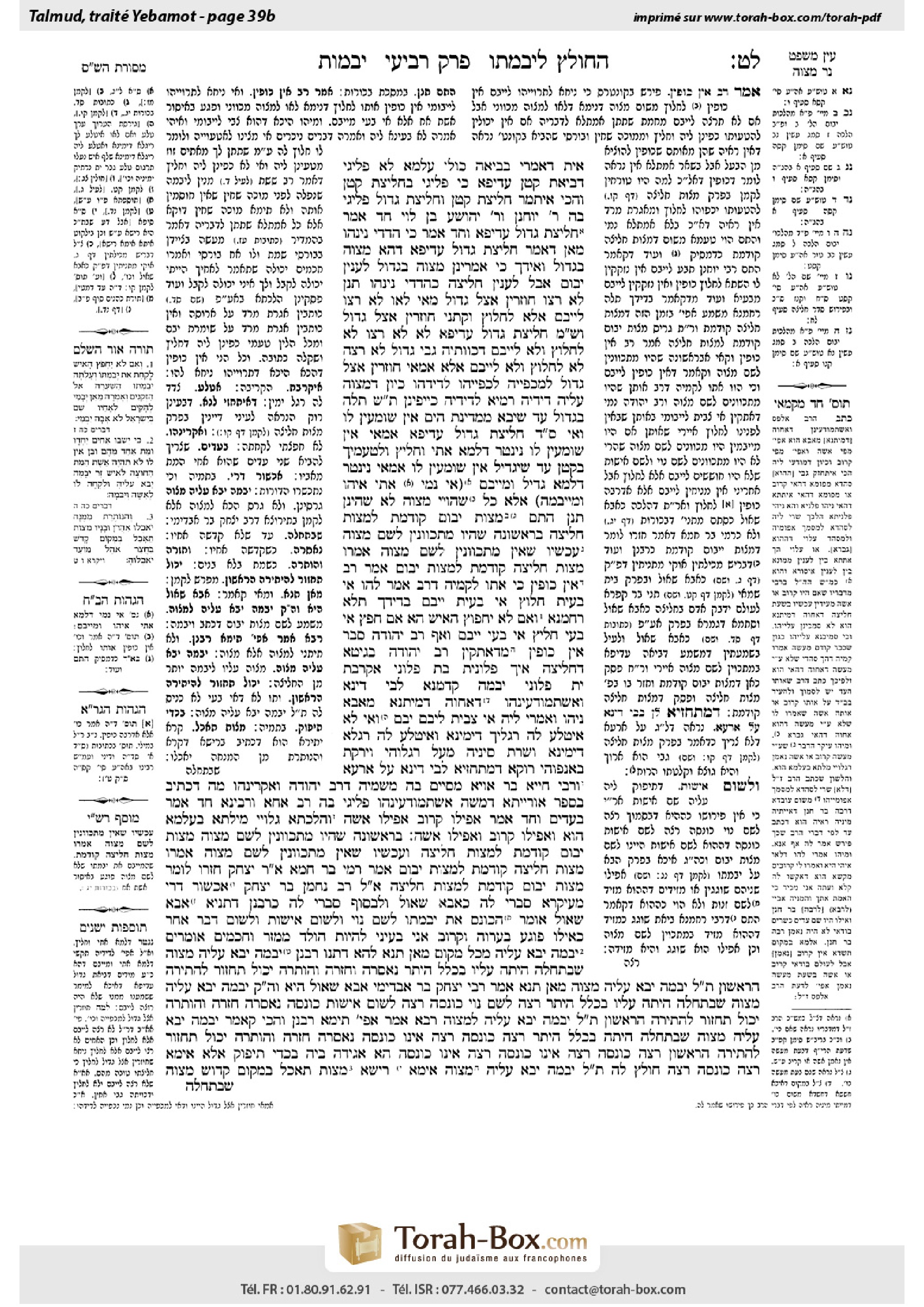
Yevamot 39b: Talmud study for Daf Yomi
Daf Yomi is the daily study of one Talmud folio. Explore 37 tractates with scans, Hebrew text, Sefaria English and AI-generated French translations where annotated.
Passage selection and English or AI-generated French translation are available where the scan has annotations. Daf Study is independent of Torah-Box and Sefaria.
Browse Yevamot · יבמות · All tractatesYevamot 39b text and translations
This page of Yevamot includes the Aramaic text, an English translation and an AI-generated French translation, alongside the scan above.
יבמות ל״ט ב · Aramaic and Hebrew text
אִית דְּאָמְרִי: בְּבִיאָה, כּוּלֵּי עָלְמָא לָא פְּלִיגִי דְּבִיאַת קָטָן עֲדִיפָא. כִּי פְּלִיגִי בַּחֲלִיצַת קָטָן.
וְהָכִי אִיתְּמַר: חֲלִיצַת קָטָן וַחֲלִיצַת גָּדוֹל, פְּלִיגִי בַּהּ רַבִּי יוֹחָנָן וְרַבִּי יְהוֹשֻׁעַ בֶּן לֵוִי. חַד אָמַר: חֲלִיצַת גָּדוֹל עֲדִיפָא, וְחַד אָמַר: כִּי הֲדָדֵי נִינְהוּ.
מַאן דְּאָמַר חֲלִיצַת גָּדוֹל עֲדִיפָא — דְּהָא מִצְוָה בַּגָּדוֹל. וְאִידַּךְ — כִּי אָמְרִינַן מִצְוָה בַּגָּדוֹל לְעִנְיַן יִבּוּם, אֲבָל לְעִנְיַן חֲלִיצָה — כַּהֲדָדֵי נִינְהוּ.
תְּנַן: לֹא רָצוּ — חוֹזְרִין אֵצֶל גָּדוֹל. מַאי לָאו: לֹא רָצוּ לְיַיבֵּם, אֶלָּא לַחְלוֹץ. וְקָתָנֵי: חוֹזְרִין אֵצֶל גָּדוֹל, וּשְׁמַע מִינַּהּ חֲלִיצַת גָּדוֹל עֲדִיפָא!
לָא, לֹא רָצוּ לֹא לַחְלוֹץ וְלָא לְיַיבֵּם, דִּכְווֹתֵיהּ גַּבֵּי גָּדוֹל: לֹא רָצָה לֹא לַחְלוֹץ וְלֹא לְיַיבֵּם. אֶלָּא אַמַּאי חוֹזְרִין אֵצֶל גָּדוֹל? לְמִכְפְּיֵיהּ (לִכְפְּיֻיהוּ) [נִכְפִּינְהוּ] לְדִידְהוּ! כֵּיוָן דְּמִצְוָה עֲלֵיהּ דִּידֵיהּ רַמְיָא — לְדִידֵיהּ כָּיְיפִינַן.
תָּא שְׁמַע: תָּלָה בַּגָּדוֹל עַד שֶׁיָּבֹא מִמְּדִינַת הַיָּם — אֵין שׁוֹמְעִין לוֹ. וְאִי סָלְקָא דַּעְתָּךְ חֲלִיצַת גָּדוֹל עֲדִיפָא, אַמַּאי אֵין שׁוֹמְעִין לוֹ? נִינְטַר דִּלְמָא אָתֵי וְחָלֵיץ!
וּלְטַעְמָיךְ, בְּקָטָן עַד שֶׁיַּגְדִּיל, אֵין שׁוֹמְעִין לוֹ — אַמַּאי? נִינְטַר דִּלְמָא גָּדֵיל וּמְיַיבֵּם. (אִי נָמֵי אָתֵי אִיהוּ וּמְיַיבְּמַהּ.) אֶלָּא: כֹּל שַׁהוֹיֵי מִצְוָה לָא מְשַׁהֵינַן.
תְּנַן הָתָם: מִצְוַת יִבּוּם קוֹדֶמֶת לְמִצְוַת חֲלִיצָה. בָּרִאשׁוֹנָה, שֶׁהָיוּ מִתְכַּוְּונִין לְשֵׁם מִצְוָה. עַכְשָׁו שֶׁאֵין מִתְכַּוְּונִין לְשֵׁם מִצְוָה, אָמְרוּ: מִצְוַת חֲלִיצָה קוֹדֶמֶת לְמִצְוַת יִבּוּם.
אָמַר רַב: אֵין כּוֹפִין. כִּי אֲתוֹ לְקַמֵּיהּ דְּרַב, אֲמַר לְהוּ: אִי בָּעֵית — חֲלוֹץ, אִי בָּעֵית — יַיבֵּם. בְּדִידָךְ תְּלָא רַחֲמָנָא: ״וְאִם לֹא יַחְפּוֹץ הָאִישׁ״, הָא אִם חָפֵץ, אִי בָּעֵי — חָלֵיץ, אִי בָּעֵי — יְיַבֵּם.
וְאַף רַב יְהוּדָה סָבַר אֵין כּוֹפִין. מִדְּאַתְקֵין רַב יְהוּדָה בְּגִיטָּא דַחֲלִיצָה: אֵיךְ פְּלוֹנִית בַּת פְּלוֹנִי אַקְרִבַת יָת פְּלוֹנִי יְבָמַהּ קֳדָמַנָא לְבֵי דִינָא, וְאִשְׁתְּמוֹדְעִינְהוּ דַּאֲחוּהּ דְמִיתָנָא מֵאַבָּא נִיהוּ, וְאָמְרִי לֵיהּ: אִי צָבֵית לְיַבֵּם — יַבֵּם, וְאִי לָא — אַיטְלַע לַהּ רִגְלָיךְ דְּיַמִּינָא.
וְאַיטְלַע לַהּ רִגְלָא דְיַמִּינָא, וּשְׁרָת סֵינֵיהּ מַעַל רַגְלוֹהִי, וִירַקַת בְּאַנְפּוֹהִי רוּקָּא דְּמִתְחַזְיָא לְבֵי דִינָא עַל אַרְעָא.
וְרַבִּי חִיָּיא בַּר אַוְיָא מְסַיֵּים בַּהּ מִשְּׁמֵיהּ דְּרַב יְהוּדָה: וְאַקְרִינְהוּ מָה דִּכְתִיב בִּסְפַר אוֹרָיְיתָא דְמֹשֶׁה.
אִשְׁתְּמוֹדְעִינְהוּ, פְּלִיגִי בַּהּ רַב אַחָא וְרָבִינָא, חַד אָמַר: בְּעֵדִים, וְחַד אָמַר: אֲפִילּוּ קָרוֹב, אֲפִילּוּ אִשָּׁה. וְהִלְכְתָא: גַּלּוֹיֵי מִילְּתָא בְעָלְמָא הוּא, וַאֲפִילּוּ קָרוֹב וַאֲפִילּוּ אִשָּׁה.
בָּרִאשׁוֹנָה, שֶׁהָיוּ מִתְכַּוְּונִין לְשֵׁם מִצְוָה — מִצְוַת יִבּוּם קוֹדֶמֶת לְמִצְוַת חֲלִיצָה. וְעַכְשָׁיו שֶׁאֵין מִתְכַּוְּונִין לְשֵׁם מִצְוָה, אָמְרוּ: מִצְוַת חֲלִיצָה קוֹדֶמֶת לְמִצְוַת יִבּוּם.
אָמַר רָמֵי בַּר חָמָא אָמַר רַבִּי יִצְחָק: חָזְרוּ לוֹמַר מִצְוַת יִבּוּם קוֹדֶמֶת לְמִצְוַת חֲלִיצָה. אֲמַר לֵיהּ רַב נַחְמָן בַּר יִצְחָק: אִכַּשּׁוּר דָּרֵי?
מֵעִיקָּרָא סָבְרִי לַהּ כְּאַבָּא שָׁאוּל, וּלְבַסּוֹף סָבְרִי לַהּ כְּרַבָּנַן.
דְּתַנְיָא, אַבָּא שָׁאוּל אוֹמֵר: הַכּוֹנֵס אֶת יְבִמְתּוֹ לְשֵׁם נוֹי, וּלְשׁוּם אִישׁוּת, וּלְשׁוּם דָּבָר אַחֵר — כְּאִילּוּ פּוֹגֵעַ בְּעֶרְוָה. וְקָרוֹב אֲנִי בְּעֵינַי לִהְיוֹת הַוָּלָד מַמְזֵר. וַחֲכָמִים אוֹמְרִים: ״יְבָמָהּ יָבֹא עָלֶיהָ״, מִכׇּל מָקוֹם.
מַאן תְּנָא לְהָא דְּתָנוּ רַבָּנַן: ״יְבָמָהּ יָבֹא עָלֶיהָ״ — מִצְוָה! שֶׁבַּתְּחִלָּה הָיְתָה עָלָיו בִּכְלַל הֶיתֵּר. נֶאֶסְרָה, וְחָזְרָה וְהוּתְּרָה, יָכוֹל תַּחְזוֹר לְהֶתֵּירָהּ הָרִאשׁוֹן — תַּלְמוּד לוֹמַר: ״יְבָמָהּ יָבֹא עָלֶיהָ״, מִצְוָה.
מַאן תַּנָּא? אָמַר רַבִּי יִצְחָק בַּר אַבְדִּימִי: אַבָּא שָׁאוּל הִיא. וְהָכִי קָאָמַר: ״יְבָמָהּ יָבֹא עָלֶיהָ״, מִצְוָה. שֶׁבַּתְּחִלָּה הָיְתָה עָלָיו בִּכְלַל הֶיתֵּר. רָצָה לְשֵׁם נוֹי — כּוֹנְסָהּ, רָצָה לְשׁוּם אִישׁוּת — כּוֹנְסָהּ.
נֶאֶסְרָה, חָזְרָה וְהוּתְּרָה. יָכוֹל תַּחְזוֹר לְהֶתֵּירָהּ הָרִאשׁוֹן — תַּלְמוּד לוֹמַר: ״יְבָמָהּ יָבֹא עָלֶיהָ״, לְמִצְוָה.
רָבָא אָמַר: אֲפִילּוּ תֵּימָא רַבָּנַן, וְהָכִי קָאָמַר: ״יְבָמָהּ יָבֹא עָלֶיהָ״, מִצְוָה. שֶׁבַּתְּחִלָּה הָיְתָה בִּכְלַל הֶיתֵּר. רָצָה כּוֹנְסָהּ, רָצָה אֵינוֹ כּוֹנְסָהּ.
נֶאֶסְרָה, חָזְרָה וְהוּתְּרָה. יָכוֹל תַּחְזוֹר לְהֶתֵּירָהּ הָרִאשׁוֹן, רָצָה — כּוֹנְסָהּ, רָצָה — אֵינוֹ כּוֹנְסָהּ. רָצָה אֵינוֹ כּוֹנְסָהּ?
הָא אֲגִידָה בֵּיהּ, בִּכְדִי תִּיפּוֹק? אֶלָּא אֵימָא: רָצָה — כּוֹנְסָהּ, רָצָה — חוֹלֵץ לָהּ, תַּלְמוּד לוֹמַר: ״יְבָמָהּ יָבֹא עָלֶיהָ״, מִצְוָה.
אֵימָא רֵישָׁא: ״מַצּוֹת תֵּאָכֵל בְּמָקוֹם קָדוֹשׁ״ — מִצְוָה.
Yevamot 39b · English translation
There are those who say that the dispute is more limited: When there is the possibility of consummating the levirate marriage, everyone agrees that the consummation of the levirate marriage by a younger brother is preferable to the ḥalitza of the eldest brother. When they disagree it is with regard to the significance of the ḥalitza of a younger brother.
And this is how the dispute was stated: Rabbi Yoḥanan and Rabbi Yehoshua ben Levi disagree with regard to a case in which there is choice between the ḥalitza of a younger brother or the ḥalitza of the eldest brother. One said: The ḥalitza of the eldest brother is preferable. And the other one said: The two options are equivalent.
The Gemara explains: With regard to the one who said that the ḥalitza of the eldest brother is preferable, this is due to the fact that the mitzva of levirate marriage and ḥalitza is incumbent upon the eldest brother. And the other Sage would respond to this claim by saying that when we say that the mitzva is incumbent upon the eldest brother, that is only with regard to the consummation of the levirate marriage; however, with regard to performing ḥalitza, all the brothers are equivalent.
The Gemara suggests a proof for the first opinion: We learned in the mishna: If the younger brothers do not want to consummate the levirate marriage, the court returns to the eldest brother and demands that he at least perform ḥalitza. The Gemara suggests: What, is it not that the other brothers did not want to consummate the levirate marriage but are willing to perform ḥalitza? And yet the mishna teaches: The court returns to the eldest brother so that he can perform ḥalitza. If so, conclude from here that the ḥalitza of the eldest brother is preferable.
The Gemara rejects the proof: No, the mishna might concern a case where the other brothers did not want either to perform ḥalitza or to consummate the levirate marriage, and it is only because they are unwilling to do either that the court returns to the eldest brother. The Gemara asks: If this is so, then in the corresponding situation in which the mishna states: The eldest brother does not want to do so, the case must be that he does not want either to perform ḥalitza or to consummate the levirate marriage. But if so, when the younger brothers also refuse, why should the court invest the extra effort to return to the eldest brother to force him to fulfill his duty? Let the court force them, i.e., the younger brothers, to fulfill their duty. The Gemara responds: Since the mitzva is incumbent upon the eldest brother ab initio, it is he who is forced.
Come and hear another proof from the mishna: If a younger brother makes his decision dependent upon the eldest brother, who is currently unavailable, suggesting that the yevama wait until he comes from overseas, the court does not listen to him. And if it enters your mind to suggest that the ḥalitza of the eldest brother is preferable, why doesn’t the court listen to him? Let the court wait, as perhaps he will come and perform ḥalitza. Rather, it would appear that the mishna assumes that with regard to performing ḥalitza, all the brothers are equivalent.
The Gemara challenges this: But even according to your reasoning, you certainly agree that the possibility of consummating the levirate marriage is always preferable. If so, what about the previous case in the mishna, where the eldest brother asks to wait until his brother who is a minor will mature? In that case as well the mishna rules: The court does not listen to him; but why shouldn’t the court listen to him? Let the court wait, as perhaps he will come and consummate the levirate marriage. Alternatively, in the case where the eldest brother is overseas, let the court wait, as perhaps he will come and consummate the levirate marriage with her. Rather, it is clear that the reason for the mishna’s ruling is that we do not delay the performance of a mitzva. Therefore, if one of the brothers is currently unable to perform the mitzva, he is not considered at all. Consequently, no proof can be derived from the mishna.
§ We learned in a mishna there (Bekhorot 13a): The mitzva of consummating the levirate marriage takes precedence over the mitzva of performing ḥalitza; this applied initially, when yevamin would have intent for the sake of fulfilling the mitzva. Now, that they do not have intent for the sake of fulfilling the mitzva, the Sages say: The mitzva of performing ḥalitza takes precedence over the mitzva of consummating the levirate marriage.
Rav said: Nevertheless, the court does not force a yavam to perform ḥalitza, and if he wishes it is still permitted to consummate the levirate marriage. The Gemara relates: When a yavam and a yevama would come before Rav, he would say to them: If you want, perform ḥalitza, and if you want, consummate the levirate marriage, as the Merciful One makes the matter dependent upon your will, as it is stated: “And if the man does not wish to take his yevama” (Deuteronomy 25:7) then he should perform ḥalitza. This implies that the Torah requires him to perform ḥalitza only if he does not wish to consummate the levirate marriage, but if he wishes to do so, then the matter is dependent upon him, and if he wants, he performs ḥalitza, or if he wants, he consummates the levirate marriage.
The Gemara notes: And even Rav Yehuda holds that the court does not force a yavam to perform ḥalitza if he wishes to consummate the levirate marriage. This is apparent from the fact that Rav Yehuda enacted in his court that the following formulation should be used in the bill of ḥalitza: That so-and-so, daughter of so-and-so, brought so-and-so, her yavam, before the court; and we identified him, that he was indeed the paternal brother of the deceased, and we said to him: If you desire to consummate the levirate marriage, then consummate the levirate marriage, and if not, extend your right foot toward your yevama so that she may perform ḥalitza by removing your shoe.
The bill of ḥalitza would continue with the account of what transpired: And he extended [itla] his right foot toward her and she removed his shoe from upon his foot and she spat toward his face spittle, which was visible to the court, and which landed upon the ground.
And Rabbi Ḥiyya bar Avya in the name of Rav Yehuda would conclude the formulation of the bill of ḥalitza with an additional sentence: And we dictated to the yavam that which is written in the book of the Torah of Moses, i.e., those declarations that the yavam and the yevama are required to make.
The Gemara clarifies the intention of the phrase: And we identified him as the brother of the deceased. Rav Aḥa and Ravina disagree concerning this phrase: One said that this identification must be made through legally valid witnesses, and the other one said that even the testimony of a relative and even the testimony a woman is accepted in this case. The Gemara concludes: And the halakha is that the identification of the brother is considered to be merely revealing the facts of the matter, and therefore, even a relative and even a woman may tender this information.
The Gemara paraphrases the mishna from tractate Bekhorot: Initially, when yevamin would have intent for the sake of fulfilling the mitzva of consummating the levirate marriage, the mitzva of consummating the levirate marriage took precedence over the mitzva of performing ḥalitza. And now that they do not have intent for the sake of fulfilling the mitzva, the Sages say: The mitzva of performing ḥalitza takes precedence over the mitzva of consummating the levirate marriage.
Rami bar Ḥama said that Rabbi Yitzḥak said: In later generations they went back to once again saying that the mitzva of consummating the levirate marriage takes precedence over the mitzva of performing ḥalitza. Rav Naḥman bar Yitzḥak said to him in wonderment: Could it be that the later generations improved their spiritual level and now intend to consummate the levirate marriage solely for sake of fulfilling the mitzva?
The Gemara explains that this does not mean that the later generations improved themselves; rather, initially they held in accordance with the opinion of Abba Shaul, and so the mitzva of performing ḥalitza took precedence, and in the end they held in accordance with the opinion of the Rabbis, and so the mitzva of consummating the levirate marriage took precedence.
As it is taught in a baraita: Abba Shaul says that one who consummates a levirate marriage with his yevama for the sake of her beauty, or for the sake of marital relations, or for the sake of another matter, e.g., he wishes to inherit her husband’s estate, it is considered as though he encountered a forbidden relation, and I am inclined to view the offspring born from such a union as a mamzer. Since the prohibition against engaging in relations with one’s brother’s wife is overridden only for the sake of fulfilling the mitzva of consummating the levirate marriage, when one does not have the intention to fulfill that mitzva, the baseline prohibition applies, and so any offspring from the union will be mamzerim. The Rabbis say: The Torah states: “Her brother-in-law will have intercourse with her” (Deuteronomy 25:5), which indicates that he should do so in any case, even if his intentions are not solely for the sake of fulfilling the mitzva.
The Gemara asks: Who is the tanna who taught the following baraita that the Sages taught: The Torah states: “Her brother-in-law will have intercourse with her” (Deuteronomy 25:5); this is to be considered a mitzva, as initially, before she was married to his brother, she was among all other women who are permitted to him, and then when she married his brother she became forbidden to him, and when his brother died without offspring she reverted from her forbidden status and became permitted to him. One might have thought that she would revert to her original permitted status; therefore, the verse states: “Her brother-in-law will have intercourse with her” to teach that it is in fact a mitzva to do so.
Who is the tanna who taught this baraita? Rav Yitzḥak bar Avdimi said: It is Abba Shaul, and this is what the baraita is saying: “Her brother-in-law will have intercourse with her” teaches that it is permitted to engage in intercourse with her only when his intention is to fulfill a mitzva, as initially, before she was married to his brother, she was among all other women who are permitted to him, and so, if he wished, then even for the sake of her beauty he was permitted to marry her, or similarly, if he wished, then even for the sake of marital relations he was permitted to marry her.
When she married his brother she became forbidden to him, and when his brother died without offspring she reverted from her forbidden status and became permitted to him. One might have thought that she would fully revert to her original permitted status; therefore, the verse states: “Her brother-in-law will have intercourse with her” to teach that he is permitted to marry her only when his intention is for the mitzva.
Rava said: You can even say that the baraita is in accordance with the Rabbis, and this is what the baraita is saying: “Her brother-in-law will have intercourse with her” indicates that it is a mitzva to consummate the levirate marriage, as initially, before she was married to his brother, she was among all other women who are permitted to him, and so if he wished, he was permitted to marry her, or if he wished, he was permitted to choose not to marry her.
When she married his brother she became forbidden to him, and when his brother died without offspring she reverted from her forbidden status and became permitted to him. One might have thought that she would fully revert to her original permitted status, so that if he wishes, he may marry her, or if he wishes, he may choose not to marry her.
The Gemara interjects that the logic of this last statement seems implausible: Does he really have the option to do as he wishes? Isn’t she bound to him with a levirate bond? Could it be that she will be released from that bond without doing anything? Rather, emend the previous argument and instead say: One might think that if he wishes, he may marry her, or if he wishes not to do so, he performs ḥalitza with her. Therefore, the verse states: “Her brother-in-law will have intercourse with her,” to teach that it is now a mitzva to consummate the marriage, and doing so is preferable to performing ḥalitza.
The baraita under discussion also presents another case that follows a similar model of initially being permitted, then prohibited, and then once again permitted. The Gemara analyzes the explanations of Rav Yitzḥak and Rava based on that clause of the baraita: Say the first clause and try to explain it in a way consistent with the various explanations of the latter clause: The Torah states concerning the meal-offerings eaten by the priests: “It shall be eaten unleavened in a sacred place” (Leviticus 6:9); this indicates that doing so is a mitzva,
Yevamot 39b · Traduction française (IA)
Certains disent que le désaccord est plus limité : lorsqu’il est possible de contracter le mariage léviratique, tous reconnaissent que sa consommation par un frère cadet est préférable à la ḥalitsa accomplie par le frère aîné. Le désaccord porte sur la valeur de la ḥalitsa accomplie par un frère cadet.
Et voici comment le désaccord a été formulé : Rabbi Yoḥanan et Rabbi Yehoshua ben Levi sont en désaccord dans le cas où l’on a le choix entre la ḥalitsa accomplie par un frère cadet et celle accomplie par le frère aîné. L’un dit : la ḥalitsa du frère aîné est préférable. L’autre dit : les deux possibilités se valent.
La Guemara explique : celui qui affirme que la ḥalitsa du frère aîné est préférable le dit parce que la mitsva du mariage léviratique et de la ḥalitsa incombe au frère aîné. L’autre Sage lui répondrait que lorsque nous disons que la mitsva incombe au frère aîné, cela ne concerne que la consommation du mariage léviratique ; en revanche, pour ce qui est d’accomplir la ḥalitsa, tous les frères se valent.
La Guemara propose une preuve en faveur du premier avis : nous avons appris dans la Michna que si les frères cadets ne veulent pas contracter le mariage léviratique, le tribunal revient au frère aîné et exige de lui qu’il accomplisse au moins la ḥalitsa. La Guemara suggère : n’est-ce pas que les autres frères ne veulent pas contracter le mariage léviratique, mais sont prêts à accomplir la ḥalitsa ? Pourtant, la Michna enseigne que le tribunal revient au frère aîné pour qu’il accomplisse la ḥalitsa. Il faut donc en conclure que la ḥalitsa du frère aîné est préférable.
La Guemara rejette cette preuve : non, la Michna pourrait concerner un cas où les autres frères ne veulent ni accomplir la ḥalitsa ni contracter le mariage léviratique ; c’est uniquement parce qu’ils refusent les deux que le tribunal revient au frère aîné. La Guemara demande : si tel est le cas, alors, dans la situation correspondante où la Michna dit que le frère aîné ne veut pas le faire, il doit s’agir d’un cas où il ne veut ni accomplir la ḥalitsa ni contracter le mariage léviratique. Mais si tel est le cas, lorsque les frères cadets refusent eux aussi, pourquoi le tribunal ferait-il l’effort supplémentaire de revenir au frère aîné pour le contraindre à s’acquitter de son devoir ? Que le tribunal contraigne plutôt les frères cadets à s’acquitter de leur devoir. La Guemara répond : puisque la mitsva incombe d’emblée au frère aîné, c’est lui qui est contraint.
Viens et entends une autre preuve tirée de la Michna : si un frère cadet subordonne sa décision à celle de son frère aîné, actuellement indisponible, et suggère que la yevama attende son retour de l’étranger, le tribunal ne l’écoute pas. Or, si tu envisages que la ḥalitsa du frère aîné est préférable, pourquoi le tribunal ne l’écouterait-il pas ? Que le tribunal attende, car il se peut que le frère aîné revienne et accomplisse la ḥalitsa. Il semble plutôt que, pour ce qui est d’accomplir la ḥalitsa, la Michna considère que tous les frères se valent.
La Guemara objecte : mais même selon ton raisonnement, tu reconnais certainement que la possibilité de contracter le mariage léviratique est toujours préférable. Dans ce cas, que dire du cas précédent de la Michna, où le frère aîné demande d’attendre que son frère mineur atteigne l’âge adulte ? Là aussi, la Michna tranche que le tribunal ne l’écoute pas ; mais pourquoi ne l’écouterait-il pas ? Que le tribunal attende, car il se peut que le frère cadet atteigne l’âge adulte et contracte le mariage léviratique. De même, dans le cas où le frère aîné est à l’étranger, que le tribunal attende, car il se peut qu’il revienne et contracte avec elle le mariage léviratique. Il est donc clair que la raison de la décision de la Michna est que l’on ne retarde pas l’accomplissement d’une mitsva. Par conséquent, si l’un des frères est actuellement incapable d’accomplir la mitsva, il n’est pas pris en considération. On ne peut donc tirer aucune preuve de la Michna.
§ Nous avons appris dans une Michna du traité Bekhorot (13a) : la mitsva de contracter le mariage léviratique a priorité sur celle d’accomplir la ḥalitsa ; c’était le cas à l’origine, lorsque les yevamim avaient l’intention d’accomplir la mitsva. À présent, puisqu’ils n’ont pas l’intention d’accomplir la mitsva, les Sages disent : la mitsva d’accomplir la ḥalitsa a priorité sur celle de contracter le mariage léviratique.
Rav dit : néanmoins, le tribunal ne contraint pas un yavam à accomplir la ḥalitsa ; s’il le souhaite, il lui est toujours permis de contracter le mariage léviratique. La Guemara rapporte : lorsqu’un yavam et une yevama se présentaient devant Rav, il leur disait : « Si vous le voulez, accomplissez la ḥalitsa ; si vous le voulez, contractez le mariage léviratique, car le Miséricordieux a rendu la chose dépendante de votre volonté », comme il est dit : « Et si l’homme ne veut pas prendre sa yevama » (Deutéronome 25,7), alors il doit accomplir la ḥalitsa. Cela implique que la Torah lui impose d’accomplir la ḥalitsa seulement s’il ne veut pas contracter le mariage léviratique ; mais s’il le veut, la décision dépend de lui : s’il le veut, il accomplit la ḥalitsa et, s’il le veut, il contracte le mariage léviratique.
La Guemara note : Rav Yehuda aussi estime que le tribunal ne contraint pas un yavam à accomplir la ḥalitsa s’il souhaite contracter le mariage léviratique. Cela ressort du fait que Rav Yehuda avait établi dans son tribunal la formulation suivante pour l’acte de ḥalitsa : « Untel, fille d’Untel, a amené Untel, son yavam, devant le tribunal ; nous avons vérifié qu’il était bien le frère paternel du défunt, et nous lui avons dit : “Si tu désires contracter le mariage léviratique, fais-le ; sinon, tends ton pied droit vers ta yevama afin qu’elle puisse accomplir la ḥalitsa en retirant ta chaussure.” »
L’acte de ḥalitsa poursuivait le récit de ce qui s’était passé : « Et il tendit [itla] son pied droit vers elle, elle lui retira la chaussure du pied, puis cracha en direction de son visage une salive visible par le tribunal, qui tomba à terre. »
Et Rabbi Ḥiyya bar Avya concluait la formulation de l’acte de ḥalitsa, au nom de Rav Yehuda, par une phrase supplémentaire : « Et nous avons dicté au yavam ce qui est écrit dans le livre de la Torah de Moïse », c’est-à-dire les déclarations que le yavam et la yevama doivent prononcer.
La Guemara précise le sens de l’expression : « Nous avons vérifié qu’il était le frère du défunt. » Rav Aḥa et Ravina sont en désaccord à ce sujet : l’un dit que cette vérification doit être faite au moyen de témoins juridiquement recevables ; l’autre dit que, dans ce cas, le témoignage d’un parent et même celui d’une femme sont acceptés. La Guemara conclut que l’identification du frère est considérée comme une simple révélation des faits ; par conséquent, un parent et même une femme peuvent fournir cette information.
La Guemara reformule la Michna du traité Bekhorot : à l’origine, lorsque les yevamim avaient l’intention d’accomplir la mitsva en contractant le mariage léviratique, cette mitsva avait priorité sur celle d’accomplir la ḥalitsa. À présent, puisqu’ils n’ont pas l’intention d’accomplir la mitsva, les Sages disent : la mitsva d’accomplir la ḥalitsa a priorité sur celle de contracter le mariage léviratique.
Rami bar Ḥama a dit au nom de Rabbi Yitzḥak : dans les générations ultérieures, on est revenu à l’avis selon lequel la mitsva de contracter le mariage léviratique a priorité sur celle d’accomplir la ḥalitsa. Rav Naḥman bar Yitzḥak lui dit avec étonnement : se pourrait-il que les générations ultérieures aient amélioré leur niveau spirituel et aient désormais l’intention de contracter le mariage léviratique uniquement pour accomplir la mitsva ?
La Guemara explique que cela ne signifie pas que les générations ultérieures se soient améliorées ; c’est plutôt qu’à l’origine, elles suivaient l’avis d’Abba Shaul, si bien que la mitsva d’accomplir la ḥalitsa avait priorité, et qu’à la fin, elles ont suivi l’avis des Rabbins, si bien que la mitsva de contracter le mariage léviratique avait priorité.
Comme il est enseigné dans une baraïta : Abba Shaul dit que celui qui contracte un mariage léviratique avec sa yevama pour sa beauté, pour avoir des relations conjugales ou pour quelque autre raison — par exemple, parce qu’il souhaite hériter des biens de son mari —, c’est comme s’il avait eu des relations avec une femme interdite, et je suis porté à considérer que l’enfant issu d’une telle union est un mamzer. Puisque l’interdiction d’avoir des relations avec la femme de son frère n’est levée que pour accomplir la mitsva de contracter le mariage léviratique, si l’on n’a pas l’intention d’accomplir cette mitsva, l’interdiction fondamentale s’applique, et tout enfant issu de cette union sera donc mamzer. Les Rabbins disent : la Torah dit : « Son beau-frère aura des relations avec elle » (Deutéronome 25,5), ce qui indique qu’il doit le faire dans tous les cas, même si ses intentions ne sont pas uniquement d’accomplir la mitsva.
La Guemara demande : quel est le tanna qui a enseigné la baraïta suivante des Sages ? La Torah dit : « Son beau-frère aura des relations avec elle » (Deutéronome 25,5) ; cela doit être considéré comme une mitsva. En effet, à l’origine, avant qu’elle n’épouse son frère, elle faisait partie de toutes les autres femmes qui lui étaient permises. Puis, lorsqu’elle a épousé son frère, elle lui est devenue interdite ; et lorsque son frère est mort sans descendance, elle est sortie de son statut de femme interdite et lui est redevenue permise. On aurait pu penser qu’elle retrouverait son statut initial de femme permise ; c’est pourquoi le verset dit : « Son beau-frère aura des relations avec elle », afin d’enseigner qu’il s’agit effectivement d’une mitsva.
Quel est le tanna qui a enseigné cette baraïta ? Rav Yitzḥak bar Avdimi a dit : c’est Abba Shaul, et voici le sens de la baraïta : « Son beau-frère aura des relations avec elle » enseigne qu’il n’est permis d’avoir des relations avec elle que si son intention est d’accomplir une mitsva. En effet, à l’origine, avant qu’elle n’épouse son frère, elle faisait partie de toutes les autres femmes qui lui étaient permises ; s’il le souhaitait, il pouvait donc l’épouser même pour sa beauté et, de même, s’il le souhaitait, il pouvait l’épouser même pour avoir des relations conjugales.
Lorsqu’elle a épousé son frère, elle lui est devenue interdite ; et lorsque son frère est mort sans descendance, elle est sortie de son statut de femme interdite et lui est redevenue permise. On aurait pu penser qu’elle retrouverait entièrement son statut initial de femme permise ; c’est pourquoi le verset dit : « Son beau-frère aura des relations avec elle », afin d’enseigner qu’il ne lui est permis de l’épouser que si son intention est d’accomplir la mitsva.
Rava a dit : on peut même dire que la baraïta suit l’avis des Rabbins, et voici son sens : « Son beau-frère aura des relations avec elle » indique que contracter le mariage léviratique est une mitsva, car, à l’origine, avant qu’elle n’épouse son frère, elle faisait partie de toutes les autres femmes qui lui étaient permises ; s’il le souhaitait, il pouvait donc l’épouser, et, s’il le souhaitait, il pouvait choisir de ne pas l’épouser.
Lorsqu’elle a épousé son frère, elle lui est devenue interdite ; et lorsque son frère est mort sans descendance, elle est sortie de son statut de femme interdite et lui est redevenue permise. On aurait pu penser qu’elle retrouverait entièrement son statut initial de femme permise, de sorte que, s’il le souhaite, il peut l’épouser et que, s’il le souhaite, il peut choisir de ne pas l’épouser.
La Guemara intervient : le raisonnement de cette dernière affirmation semble invraisemblable. A-t-il vraiment le choix de faire ce qu’il veut ? N’est-elle pas liée à lui par le lien léviratique ? Se pourrait-il qu’elle soit libérée de ce lien sans qu’aucune démarche ne soit entreprise ? Il faut plutôt corriger l’argument précédent et dire : on aurait pu penser que, s’il le souhaite, il peut l’épouser et que, s’il ne le souhaite pas, il accomplit la ḥalitsa avec elle. C’est pourquoi le verset dit : « Son beau-frère aura des relations avec elle », afin d’enseigner qu’à présent, contracter le mariage léviratique est une mitsva et préférable à l’accomplissement de la ḥalitsa.
La baraïta en question présente aussi un autre cas qui suit le même modèle : d’abord permis, puis interdit, puis de nouveau permis. La Guemara analyse les explications de Rav Yitzḥak et de Rava à partir de cette clause de la baraïta : énonçons la première clause et tentons de l’expliquer de façon cohérente avec les différentes explications de la dernière clause : la Torah dit, au sujet des offrandes végétales consommées par les prêtres : « On la mangera sans levain, dans un lieu saint » (Lévitique 6,9) ; cela indique qu’agir ainsi est une mitsva.
Traduction française générée par IA à partir de l’édition anglaise de Sefaria. Vérifie toujours un passage avec le texte source.
Text from Sefaria: William Davidson Edition - Vocalized Aramaic (CC BY NC); William Davidson Edition - English (CC BY NC).