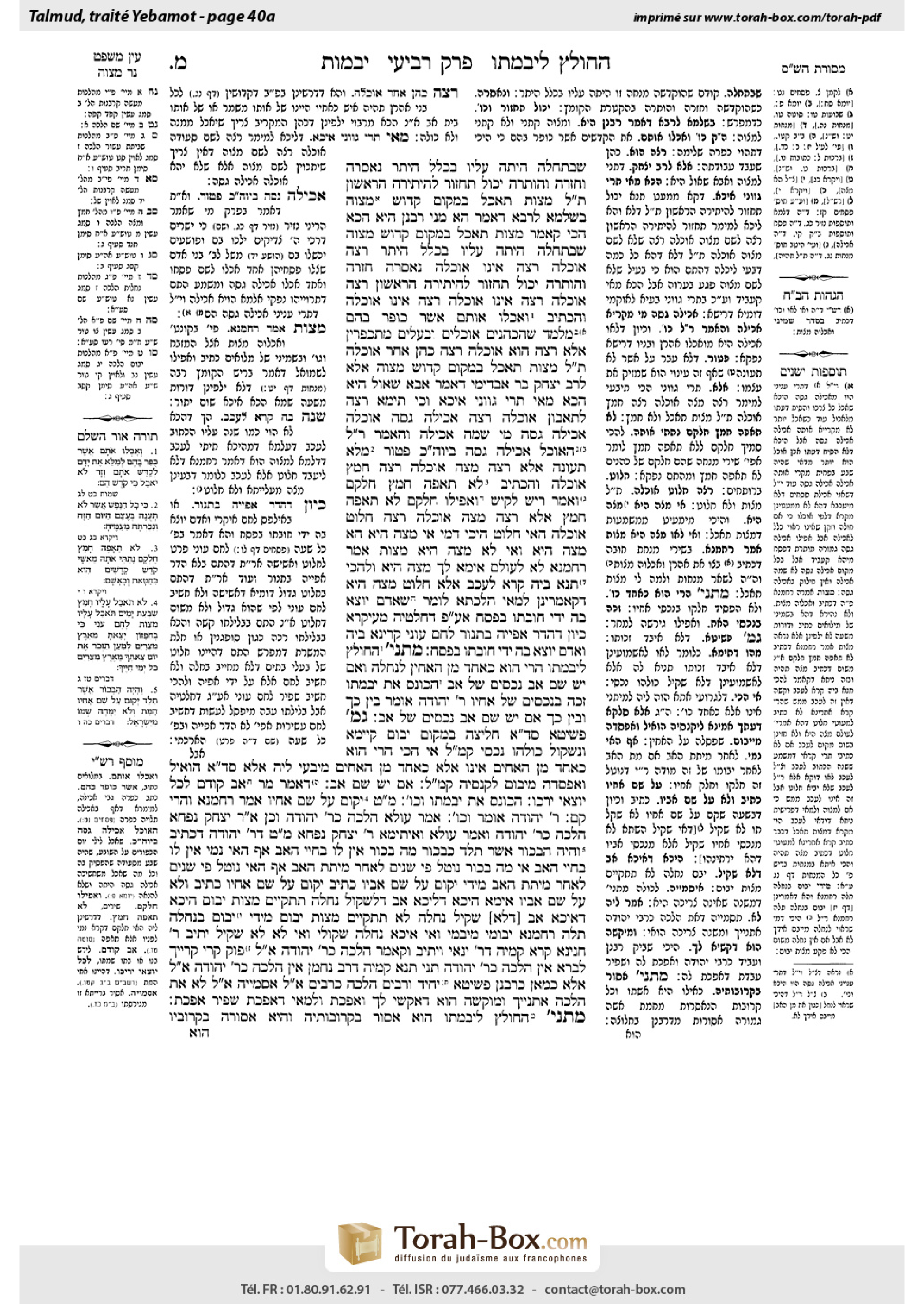
Yevamot 40a: Talmud study for Daf Yomi
Daf Yomi is the daily study of one Talmud folio. Explore 37 tractates with scans, Hebrew text, Sefaria English and AI-generated French translations where annotated.
Passage selection and English or AI-generated French translation are available where the scan has annotations. Daf Study is independent of Torah-Box and Sefaria.
Browse Yevamot · יבמות · All tractatesYevamot 40a text and translations
This page of Yevamot includes the Aramaic text, an English translation and an AI-generated French translation, alongside the scan above.
יבמות מ׳ א · Aramaic and Hebrew text
שֶׁבַּתְּחִלָּה הָיְתָה עָלָיו בִּכְלַל הֶיתֵּר. נֶאֶסְרָה, וְחָזְרָה וְהוּתְּרָה, יָכוֹל תַּחְזוֹר לְהֶיתֵּירָהּ הָרִאשׁוֹן — תַּלְמוּד לוֹמַר: ״מַצּוֹת תֵּאָכֵל בְּמָקוֹם קָדוֹשׁ״ — מִצְוָה.
בִּשְׁלָמָא לְרָבָא דְּאָמַר הָא מַנִּי רַבָּנַן הִיא — הָכָא, הָכִי קָאָמַר: ״מַצּוֹת תֵּאָכֵל בְּמָקוֹם קָדוֹשׁ״ — מִצְוָה. שֶׁבַּתְּחִלָּה הָיְתָה עָלָיו בִּכְלַל הֶיתֵּר, רָצָה — אוֹכְלָהּ, רָצָה — אֵינוֹ אוֹכְלָהּ (נֶאֶסְרָה, חָזְרָה וְהוּתְּרָה, יָכוֹל תַּחְזוֹר לְהֶיתֵּירָהּ הָרִאשׁוֹן), רָצָה — אוֹכְלָהּ, רָצָה — אֵינוֹ אוֹכְלָהּ.
רָצָה אֵינוֹ אוֹכְלָהּ?! וְהָכְתִיב: ״וְאָכְלוּ אֹתָם אֲשֶׁר כֻּפַּר בָּהֶם״, מְלַמֵּד שֶׁהַכֹּהֲנִים אוֹכְלִים וּבְעָלִים מִתְכַּפְּרִין!
אֶלָּא: רָצָה — הוּא אוֹכְלָהּ, רָצָה — כֹּהֵן אַחֵר אוֹכְלָהּ, תַּלְמוּד לוֹמַר: ״מַצּוֹת תֵּאָכֵל בְּמָקוֹם קָדוֹשׁ״ — מִצְוָה.
אֶלָּא לְרַב יִצְחָק בַּר אַבְדִּימִי, דְּאָמַר אַבָּא שָׁאוּל הִיא, הָכָא מַאי תְּרֵי גַוְונֵי אִיכָּא?
וְכִי תֵּימָא: רָצָה — לְתֵאָבוֹן אוֹכְלָהּ, רָצָה — אֲכִילָה גַּסָּה אוֹכְלָהּ, אֲכִילָה גַּסָּה מִי שְׁמָהּ אֲכִילָה? וְהָאָמַר רֵישׁ לָקִישׁ: הָאוֹכֵל אֲכִילָה גַּסָּה בְּיוֹם הַכִּפּוּרִים פָּטוּר מִ״לֹּא תְעֻנֶּה״!
אֶלָּא: רָצָה — מַצָּה אוֹכְלָהּ, רָצָה — חָמֵץ אוֹכְלָהּ.
וְהָכְתִיב: ״לֹא תֵאָפֶה חָמֵץ חֶלְקָם״, וְאָמַר רֵישׁ לָקִישׁ: וַאֲפִילּוּ חֶלְקָם לֹא תֵאָפֶה חָמֵץ! אֶלָּא: רָצָה — מַצָּה אוֹכְלָהּ, רָצָה — חָלוּט אוֹכְלָהּ.
הַאי חָלוּט הֵיכִי דָּמֵי? אִי מַצָּה הִיא — הָא מַצָּה הִיא, וְאִי לָא מַצָּה הִיא — ״מַצּוֹת״ אָמַר רַחֲמָנָא!
לָא, לְעוֹלָם אֵימָא לָךְ מַצָּה הִיא, וּלְהָכִי תְּנָא בֵּיהּ קְרָא — לְעַכֵּב.
אֶלָּא חָלוּט מַצָּה הִיא דְּקָאָמְרִינַן, לְמַאי הִלְכְתָא? לוֹמַר שֶׁאָדָם יוֹצֵא בָּהּ יְדֵי חוֹבָתוֹ בְּפֶסַח, אַף עַל פִּי דְּחַלְטֵיהּ מֵעִיקָּרָא, כֵּיוָן דַּהֲדַר אַפְיֵיהּ בְּתַנּוּר — ״לֶחֶם עוֹנִי״ קָרֵינָא בֵּיהּ, וְאָדָם יוֹצֵא בָּהּ יְדֵי חוֹבָתוֹ בַּפֶּסַח.
מַתְנִי׳ הַחוֹלֵץ לִיבִמְתּוֹ — הֲרֵי הוּא כְּאֶחָד מִן הָאַחִין לַנַּחֲלָה. וְאִם יֵשׁ שָׁם אָב — נְכָסִים שֶׁל אָב. הַכּוֹנֵס אֶת יְבִמְתּוֹ — זָכָה בִּנְכָסִים שֶׁל אָחִיו. רַבִּי יְהוּדָה אוֹמֵר: בֵּין כָּךְ וּבֵין כָּךְ, אִם יֵשׁ שָׁם אָב — נְכָסִים שֶׁל אָב.
גְּמָ׳ פְּשִׁיטָא! סָלְקָא דַּעְתָּךְ אָמֵינָא חֲלִיצָה בִּמְקוֹם יִבּוּם קָיְימָא, וְנִשְׁקוֹל כּוּלְּהוּ נִכְסֵי, קָא מַשְׁמַע לַן.
אִי הָכִי, הֲרֵי הוּא כְּאֶחָד מִן הָאַחִים — אֵינוֹ אֶלָּא כְּאֶחָד מִן הָאַחִים מִיבְּעֵי לֵיהּ!
אֶלָּא, סָלְקָא דַּעְתָּךְ אָמֵינָא: הוֹאִיל וְאַפְסְדַהּ מִיִּבּוּם, לִקְנְסֵיהּ, קָא מַשְׁמַע לַן.
אִם יֵשׁ שָׁם אָב. דְּאָמַר מָר: אָב קוֹדֵם לְכׇל יוֹצְאֵי יְרֵכוֹ.
הַכּוֹנֵס אֶת יְבִמְתּוֹ וְכוּ׳. מַאי טַעְמָא — ״יָקוּם עַל שֵׁם אָחִיו״ אָמַר רַחֲמָנָא, וַהֲרֵי קָם.
רַבִּי יְהוּדָה אוֹמֵר וְכוּ׳. אָמַר עוּלָּא: הֲלָכָה כְּרַבִּי יְהוּדָה. וְכֵן אָמַר רַבִּי יִצְחָק נַפָּחָא: הֲלָכָה כְּרַבִּי יְהוּדָה.
וְאָמַר עוּלָּא, וְאִיתֵּימָא רַבִּי יִצְחָק נַפָּחָא: מַאי טַעְמָא דְּרַבִּי יְהוּדָה, דִּכְתִיב: ״וְהָיָה הַבְּכוֹר אֲשֶׁר תֵּלֵד״ — כִּבְכוֹר, מָה בְּכוֹר אֵין לוֹ בְּחַיֵּי הָאָב — אַף הַאי נָמֵי אֵין לוֹ בְּחַיֵּי הָאָב.
אִי: מָה בְּכוֹר נוֹטֵל פִּי שְׁנַיִם לְאַחַר מִיתַת הָאָב, אַף הַאי נוֹטֵל פִּי שְׁנַיִם לְאַחַר מִיתַת הָאָב!
מִידֵּי ״יָקוּם עַל שֵׁם אָבִיו״ כְּתִיב? ״יָקוּם עַל שֵׁם אָחִיו״ כְּתִיב, וְלֹא ״עַל שֵׁם אָבִיו״.
אֵימָא: הֵיכָא דְּלֵיכָּא אָב דְּלִשְׁקוֹל נַחֲלָה — תִּתְקַיֵּים מִצְוַת יִבּוּם, הֵיכָא דְּאִיכָּא אָב [דְּלָא] שָׁקֵיל נַחֲלָה — לֹא תִּתְקַיֵּים מִצְוַת יִבּוּם.
מִידֵּי יִבּוּם בְּנַחֲלָה תְּלָה רַחֲמָנָא? יַבּוֹמֵי מְיַבְּמִי, וְאִי אִיכָּא נַחֲלָה — שָׁקֵיל, וְאִי לָא — לָא שָׁקֵיל.
יְתֵיב רַבִּי חֲנִינָא קָרָא קַמֵּיהּ דְּרַבִּי יַנַּאי, וְיָתֵיב וְקָאָמַר: הֲלָכָה כְּרַבִּי יְהוּדָה. אֲמַר לֵיהּ: פּוֹק קְרִי קְרָיָיךְ לְבָרָא, אֵין הֲלָכָה כְּרַבִּי יְהוּדָה.
תָּנֵי תַּנָּא, קַמֵּיהּ דְּרַב נַחְמָן: אֵין הֲלָכָה כְּרַבִּי יְהוּדָה. אֲמַר לֵיהּ: אֶלָּא כְּמַאן, כְּרַבָּנַן? פְּשִׁיטָא, יָחִיד וְרַבִּים הֲלָכָה כְּרַבִּים!
אֲמַר לֵיהּ: אֶסְמְיַיהּ?! אֲמַר לֵיהּ: לָא. אַתְּ — הֲלָכָה אַתְנְיֻיךְ, וּמִקְשָׁא הוּא דְּאִקְּשִׁי לָךְ, וַאֲפַכְתְּ. וּלְמַאי דַּאֲפַכְתְּ, שַׁפִּיר אֲפַכְתְּ.
מַתְנִי׳ הַחוֹלֵץ לִיבִמְתּוֹ — הוּא אָסוּר בִּקְרוֹבוֹתֶיהָ, וְהִיא אֲסוּרָה בִּקְרוֹבָיו.
Yevamot 40a · English translation
as initially, before the flour was consecrated, it was among all other foods that are permitted to him, and then when the flour was consecrated as a meal-offering, it became forbidden to him, and then once a handful of the offering was brought on the altar, it reverted from its forbidden status and became permitted to him. One might have thought that it would revert to its original permitted status; therefore, the verse states: “It shall be eaten unleavened in a sacred place” (Leviticus 6:9), which indicates that it is a mitzva to eat it.
The Gemara asks: Granted, according to Rava, who said: In accordance with whose opinion is this baraita? It is in accordance with the opinion of the Rabbis; according to him, here, in the first clause, this is what the baraita is saying: “It shall be eaten unleavened in a sacred place” indicates that it is a mitzva for the priest who prepares the offering to eat it himself. As, initially, before the flour was consecrated, it was among all other foods that are permitted to him: If he wishes, he may eat it, and if he wishes, he may choose not to eat it. When the flour was consecrated, it became forbidden to him, and then once a handful was brought on the altar, it reverted from its forbidden status and became permitted to him. One might have thought that it would revert to its original permitted status, so that if he wishes, he may eat it, and if he wishes, he may choose not to eat it.
The Gemara interjects that the logic of this last statement seems implausible: Could it be that if he wishes, he may choose not to eat it? But isn’t it written: “And they shall eat those things through which atonement is attained” (Exodus 29:33), which teaches that the priests eat portions of the offering and by their doing so the owners who brought the offering attain atonement? Clearly, then, the eating of the offerings is not volitional.
Rather, the baraita should be understood as saying: One might have thought that if he wishes, he may eat it, and if he wishes, another priest may eat it; therefore, the verse states: “It shall be eaten unleavened in a sacred place” (Leviticus 6:9), to teach that it is a mitzva for the priest who prepares the offering to eat it himself. This explanation of the first clause of the baraita is entirely consistent with Rava’s explanation of the latter clause concerning the mitzvot of levirate marriage. In his opinion, both clauses demonstrate that there is a mitzva to perform an action in a case where one might have thought there was none.
However, according to Rav Yitzḥak bar Avdimi, who said that the baraita is in accordance with the opinion of Abba Shaul and explained the baraita accordingly as teaching the correct manner in which the mitzva is to be performed, here, in the first clause concerning the meal-offering, what two manners of eating are there of which one would be prohibited?
And if you would say that the baraita might refer to two types of eating and is saying: One might have thought that if he wishes he may eat it with an appetite, and if he wishes he may eat it though an act of excessive eating, forcing himself to eat despite already being fully satiated; perforce this is not correct, as does excessive eating have the legal status of an act of eating? Didn’t Reish Lakish say: One who eats through an act of excessive eating on Yom Kippur is exempt from the punishment of karet indicated in the verse: “For whatever soul it be that shall not be afflicted in that same day shall be cut off from his people” (Leviticus 23:29)? From this it is apparent that excessive eating does not have the legal status of an act of eating.
The Gemara therefore suggests a different interpretation of the baraita that is consistent with Rav Yitzḥak’s opinion: Rather, say the baraita is referring to two different manners in which the meal-offering was prepared: If he wishes he may eat it unleavened, and if he wishes he may eat it leavened.
The Gemara interjects that the logic of this last statement seems implausible: Could it be that if he wishes, the offering could be leavened? But isn’t it written: “Their portion shall not be baked leavened” (Leviticus 6:10), and Reish Lakish said that both the handful brought on the altar and even the priest’s portion shall not be baked leavened? Rather, the baraita should be understood as saying: One might have thought that if he wishes he may eat it unleavened, and if he wishes he may eat it even if it was prepared by being boiled. Therefore, the verse taught that one must eat it unleavened. Understood in this way, this clause of the baraita is also consistent with Rav Yitzḥak’s opinion.
The Gemara asks: With regard to this possibility of eating the meal-offering boiled, what are the circumstances, i.e., how is it classified? If it is considered to be unleavened because it is presumed that the flour never managed to rise before it was cooked, then it is unleavened and there is no reason to prohibit its use; and if it is not considered to be unleavened because it is presumed that the flour managed to rise before it was cooked, then it is certainly disqualified from use because the Merciful One states that the offering must be “unleavened” (Leviticus 10:12). How, then, could one ever have questioned whether it is permitted to eat the meal-offering if it was boiled?
The Gemara explains: No; actually, I could say to you that the boiled meal-offering is considered to be unleavened, and nevertheless it is disqualified because it is for this very reason that the verse repeated the requirement that it be unleavened, in order to invalidate a meal-offering that was boiled.
The Gemara asks: But if boiled flour is invalid as a meal offering, then with regard to this statement that we said that boiled flour is unleavened, for what halakha is it relevant? The Gemara answers: It is to say that a person fulfills his obligation with it on Passover. This is because even though he initially boiled it, since he subsequently baked it in an oven, it is called “bread of affliction” (Deuteronomy 16:3), and therefore a person fulfills his obligation with it on Passover.
MISHNA: One who performs ḥalitza with his yevama is like any one of the other brothers with respect to the inheritance of the deceased brother’s estate, i.e., each of the brothers takes an equal share of the inheritance. And if there is a father of the deceased, who is still alive, the property of the deceased belongs to the father. One who consummates levirate marriage with his yevama thereby acquires his deceased brother’s property solely for himself. Rabbi Yehuda says: In either case, whether he consummated the levirate marriage or performed ḥalitza, if there is a father who is still alive, the property belongs to the father.
GEMARA: The Gemara asks with regard to the opening clause of the mishna: The fact that one who performs ḥalitza does not gain any special rights to the inheritance of the deceased brother is obvious; why did the mishna teach it? The Gemara answers: It could enter your mind to say that the ḥalitza takes the place of the levirate marriage and therefore the brother who performs ḥalitza should take all the property in the same way as one who consummates the levirate marriage. Therefore, the mishna teaches us that this is not the case.
The Gemara asks: If so, that the mishna’s point is to teach that by performing ḥalitza one is not afforded any additional rights to the inheritance, why is the mishna formulated as: He is like any one of the other brothers, placing the emphasis on what he gains? It should have instead taught: He is still only like one of the other brothers, which would emphasize the mishna’s point that by performing ḥalitza he does not gain any additional rights.
Rather, the mishna needs to teach the opening clause in this manner because it could enter your mind to say that since by performing ḥalitza with his yevama he caused her to forfeit the possibility of consummating the levirate marriage, he should be penalized and should forfeit any entitlement to his brother’s property. Therefore the mishna teaches us that this is not so.
§ The mishna states: If there is a father of the deceased, who is still alive, the property of the deceased belongs to the father. The Gemara explains: As the Master said with regard to the laws of inheritance (Bava Batra 115a): A father of the deceased takes precedence over all the father’s descendants. Therefore, since the father is still alive, the brothers do not inherit at all.
The mishna states: One who consummates levirate marriage with his yevama thereby acquires his deceased brother’s property. The Gemara asks: What is the reason for this? The Merciful One states in the Torah: “He shall succeed in the name of his dead brother” (Deuteronomy 25:6), and he has succeeded him by marrying his wife; consequently, he succeeds him by acquiring his property as well.
§ The mishna continues by citing an opposing opinion. Rabbi Yehuda says: In either case, whether he consummated levirate marriage or performed ḥalitza, if there is a father who is still alive, the property belongs to the father. The Gemara cites a ruling on this dispute: Ulla said: The halakha is in accordance with the opinion of Rabbi Yehuda. And similarly, Rabbi Yitzḥak Nappaḥa said: The halakha is in accordance with the opinion of Rabbi Yehuda.
And Ulla said, and some say that it was Rabbi Yitzḥak Nappaḥa who said: What is the reason for the opinion of Rabbi Yehuda? As it is written: “And it shall be that the firstborn that she bears shall succeed in the name of his dead brother” (Deuteronomy 25:6). The term “firstborn” is understood to be a reference to the yavam. By referring to him in this way the Torah indicates that his rights to his brother’s estate are like those of a firstborn child’s rights to his father’s estate: Just as a firstborn has no rights to any of his father’s estate during the lifetime of the father, and he may take his double portion only upon the father’s death, so too, this yavam as well has no rights to any of his brother’s estate during the lifetime of the father.
The Gemara asks: If there is truly a comparison between the yavam who consummated the levirate marriage and a firstborn, then one should also say that just as the firstborn takes a double portion of his father’s estate after the death of the father, so too, this yavam should become entitled to take a double portion of the father’s estate after the father’s death, i.e., the portion due to him as a son, and that portion that would have been awarded to his brother. However, this is not the case; if the yavam is not actually the father’s firstborn then he receives only an equal portion of the inheritance together with the other brothers.
The Gemara explains: Is it written in the Torah: He shall succeed in the name of his father? No, it is written: “He shall succeed in the name of his dead brother,” which indicates that he succeeds his brother but not in the name of his father, i.e., the Torah never granted him any special entitlement to his father’s estate, and so he should not receive a double portion of it.
The Gemara asks: Since Rabbi Yehuda holds that the halakha that the yavam inherits from his brother, which is stated in the verses describing levirate marriage, applies only when the father is no longer alive, perhaps the other halakhot in those verses also apply only when the father is no longer alive, and accordingly one should say: When there is no father who is still alive, which means that the yavam takes the inheritance, only then should the mitzva of levirate marriage apply, but when there is a father who is still alive, which means that the yavam does not take the inheritance, in that case the mitzva of levirate marriage should not apply.
The Gemara rejects the possibility of saying this: Does the Merciful One make the mitzva of levirate marriage dependent upon inheritance? Certainly not; rather, in all cases the yavam should consummate the levirate marriage, and then if there is an inheritance to which he is entitled, he takes it, and if not, he does not take it.
Rabbi Ḥanina Kara, the Bible expert, was sitting before Rabbi Yannai, and he was sitting and saying: The halakha is in accordance with the opinion of Rabbi Yehuda. Rabbi Yannai said to him: Leave the study hall and recite your verses outside, as you are incorrect in your ruling; in fact, the halakha is not in accordance with the opinion of Rabbi Yehuda.
In another incident, a tanna who would recite baraitot in the study hall taught a baraita before Rav Naḥman: The halakha is not in accordance with the opinion of Rabbi Yehuda. Rav Naḥman said to him: But then it follows that in accordance with whose opinion is the halakha? It is the opinion of the Rabbis. The Gemara asks: But this fact is obvious, as in a dispute between one individual Sage and many other Sages, the halakha is always decided in accordance with the opinion of the many.
The tanna said to him: Are you saying that this statement in the baraita is unnecessary and so I should remove that ruling from the baraita when I recite it in the future? Rav Naḥman said to him: No, do not remove it, as although the statement is unnecessary, it is correct. Rav Naḥman explained further: It must be that originally the baraita that you were taught stated: The halakha is in accordance with the opinion of Rabbi Yehuda, and that ruling was difficult for you because you knew that the halakha is always decided in accordance with many, and so you reversed the statement of the baraita to say, as you presently recited it, that the halakha is not in accordance with the opinion of Rabbi Yehuda. And with regard to the manner in which you reversed it, you reversed it well, and therefore you should leave it in its current form.
MISHNA: In the case of one who performs ḥalitza with his yevama, by rabbinic decree it is as though she had been married to him and then he divorced her. Consequently, he is forbidden to engage in relations with her relatives and she is forbidden to engage in relations with his relatives.
Yevamot 40a · Traduction française (IA)
Au départ, avant que la farine ne soit consacrée, elle faisait partie de tous les autres aliments qui lui étaient permis. Puis, lorsque la farine fut consacrée comme offrande de farine, elle lui devint interdite. Ensuite, une fois qu’une poignée de l’offrande eut été déposée sur l’autel, elle cessa d’être interdite et lui redevint permise. On aurait pu penser qu’elle retrouvait son statut initial d’aliment permis ; c’est pourquoi le verset dit : « Elle sera mangée sans levain dans un lieu saint » (Lévitique 6, 9), ce qui indique que la manger est une mitsva.
La Guemara demande : Certes, selon Rava, qui a dit : « De l’avis de qui est cette baraïta ? De l’avis des Rabbins », voici ce que dit la baraïta dans sa première partie : « Elle sera mangée sans levain dans un lieu saint » indique que c’est une mitsva pour le prêtre qui prépare l’offrande de la manger lui-même. En effet, au départ, avant que la farine ne soit consacrée, elle faisait partie de tous les autres aliments qui lui étaient permis : s’il le souhaite, il peut la manger, et s’il le souhaite, il peut choisir de ne pas la manger. Lorsque la farine fut consacrée, elle lui devint interdite, puis, une fois qu’une poignée eut été déposée sur l’autel, elle cessa d’être interdite et lui redevint permise. On aurait pu penser qu’elle retrouvait son statut initial d’aliment permis, de sorte que, s’il le souhaite, il peut la manger, et s’il le souhaite, il peut choisir de ne pas la manger.
La Guemara objecte que la logique de cette dernière affirmation semble invraisemblable : se pourrait-il que, s’il le souhaite, il puisse choisir de ne pas la manger ? Pourtant, n’est-il pas écrit : « Ils mangeront ces choses par lesquelles l’expiation est obtenue » (Exode 29, 33), ce qui enseigne que les prêtres mangent des parts de l’offrande et que, ce faisant, les propriétaires qui ont apporté l’offrande obtiennent l’expiation ? Il est donc clair que manger les offrandes n’est pas laissé au choix.
Il faut plutôt comprendre la baraïta ainsi : on aurait pu penser que, s’il le souhaite, il peut la manger, et s’il le souhaite, un autre prêtre peut la manger. C’est pourquoi le verset dit : « Elle sera mangée sans levain dans un lieu saint » (Lévitique 6, 9), pour enseigner que c’est une mitsva pour le prêtre qui prépare l’offrande de la manger lui-même. Cette explication de la première partie de la baraïta concorde tout à fait avec l’explication de Rava concernant la dernière partie, relative aux mitsvot du lévirat. Selon lui, les deux parties montrent qu’il y a une mitsva d’accomplir un acte dans un cas où l’on aurait pu penser qu’il n’y en avait pas.
Cependant, selon Rav Yitzḥak bar Avdimi, qui a dit que la baraïta est conforme à l’avis d’Abba Shaul et l’a expliquée en conséquence comme enseignant la manière correcte d’accomplir la mitsva, quelles sont, dans la première partie concernant l’offrande de farine, les deux manières de la manger, dont l’une serait interdite ?
Et si tu dis que la baraïta pourrait parler de deux types de consommation et dire : « On aurait pu penser que, s’il le souhaite, il peut la manger avec appétit, et s’il le souhaite, il peut la manger en excès », c’est-à-dire en se forçant à manger alors qu’il est déjà entièrement rassasié, cela ne peut pas être juste : le fait de manger en excès a-t-il le statut juridique d’un acte de consommation ? Reish Lakish n’a-t-il pas dit que celui qui mange en excès à Yom Kippour est exempt de la peine de karet mentionnée dans le verset : « Toute personne qui ne s’affligera pas en ce jour-là sera retranchée de son peuple » (Lévitique 23, 29) ? Il apparaît donc que manger en excès n’a pas le statut juridique d’un acte de consommation.
La Guemara propose donc une autre interprétation de la baraïta, compatible avec l’avis de Rav Yitzḥak : il faut plutôt dire que la baraïta parle de deux manières différentes de préparer l’offrande de farine : s’il le souhaite, il peut la manger sans levain, et s’il le souhaite, il peut la manger avec du levain.
La Guemara objecte que la logique de cette dernière affirmation semble invraisemblable : se pourrait-il que, s’il le souhaite, l’offrande puisse être préparée avec du levain ? Pourtant, n’est-il pas écrit : « Leur part ne sera pas cuite avec du levain » (Lévitique 6, 10), et Reish Lakish n’a-t-il pas dit que ni la poignée déposée sur l’autel ni même la part du prêtre ne doivent être cuites avec du levain ? Il faut plutôt comprendre la baraïta ainsi : on aurait pu penser que, s’il le souhaite, il peut la manger sans levain, et s’il le souhaite, il peut la manger même si elle a été préparée par ébullition. Le verset enseigne donc qu’il faut la manger sans levain. Ainsi comprise, cette partie de la baraïta concorde elle aussi avec l’avis de Rav Yitzḥak.
La Guemara demande : concernant cette possibilité de manger l’offrande de farine bouillie, quelles en sont les circonstances, c’est-à-dire comment faut-il la classer ? Si elle est considérée comme sans levain, au motif que l’on présume que la farine n’a pas eu le temps de lever avant la cuisson, alors elle est sans levain et il n’y a aucune raison d’en interdire l’usage. Mais si elle n’est pas considérée comme sans levain, au motif que l’on présume que la farine a eu le temps de lever avant la cuisson, alors elle est certainement impropre à l’usage, car le Miséricordieux dit que l’offrande doit être « sans levain » (Lévitique 10, 12). Comment aurait-on donc pu se demander s’il est permis de manger l’offrande de farine lorsqu’elle a été bouillie ?
La Guemara explique : Non ; en réalité, je pourrais te dire que l’offrande de farine bouillie est considérée comme sans levain et qu’elle est néanmoins impropre, car c’est précisément pour cette raison que le verset a répété l’exigence qu’elle soit sans levain, afin d’invalider une offrande de farine qui aurait été bouillie.
La Guemara demande : Mais si la farine bouillie est impropre comme offrande de farine, à quelle halakha se rapporte l’affirmation selon laquelle la farine bouillie est sans levain ? La Guemara répond : cela signifie qu’une personne s’acquitte de son obligation avec cette farine à Pessa’h. En effet, bien qu’elle ait d’abord été bouillie, puisqu’elle a ensuite été cuite au four, elle est appelée « pain de misère » (Deutéronome 16, 3) ; une personne s’acquitte donc de son obligation avec elle à Pessa’h.
Michna : Celui qui accomplit la ḥalitsa avec sa yevama est, en ce qui concerne l’héritage des biens du frère défunt, comme chacun des autres frères : chacun des frères reçoit une part égale de l’héritage. Si le père du défunt est encore vivant, les biens du défunt lui appartiennent. Celui qui contracte le mariage léviratique avec sa yevama acquiert ainsi à lui seul les biens de son frère défunt. Rabbi Yehuda dit : dans les deux cas, qu’il ait contracté le mariage léviratique ou accompli la ḥalitsa, si le père est encore vivant, les biens lui appartiennent.
Guemara : À propos de la première partie de la Michna, la Guemara demande : il est évident que celui qui accomplit la ḥalitsa n’obtient aucun droit particulier sur l’héritage du frère défunt ; pourquoi la Michna l’enseigne-t-elle ? La Guemara répond : on aurait pu penser que la ḥalitsa tient lieu de mariage léviratique et que, par conséquent, le frère qui l’accomplit devrait prendre tous les biens, comme celui qui contracte le mariage léviratique. La Michna nous enseigne donc que ce n’est pas le cas.
La Guemara demande : si c’est le cas, si le propos de la Michna est d’enseigner que celui qui accomplit la ḥalitsa ne reçoit aucun droit supplémentaire sur l’héritage, pourquoi la Michna est-elle formulée ainsi : « Il est comme chacun des autres frères », en mettant l’accent sur ce qu’il reçoit ? Elle aurait plutôt dû enseigner : « Il reste seulement comme l’un des autres frères », ce qui aurait mis l’accent sur le point de la Michna, à savoir que l’accomplissement de la ḥalitsa ne lui confère aucun droit supplémentaire.
La Michna doit plutôt enseigner sa première partie sous cette forme, car on aurait pu penser que, puisqu’en accomplissant la ḥalitsa avec sa yevama, il lui a fait perdre la possibilité de contracter le mariage léviratique, il devrait être sanctionné et perdre tout droit aux biens de son frère. La Michna nous enseigne donc que ce n’est pas le cas.
§ La Michna enseigne que, si le père du défunt est encore vivant, les biens du défunt lui appartiennent. La Guemara explique : comme l’a dit le Maître au sujet des lois de l’héritage (Bava Batra 115a), le père du défunt a priorité sur tous ses descendants. Par conséquent, puisque le père est encore vivant, les frères n’héritent de rien.
La Michna enseigne que celui qui contracte le mariage léviratique avec sa yevama acquiert ainsi les biens de son frère défunt. La Guemara demande : quelle en est la raison ? Le Miséricordieux dit dans la Torah : « Il succédera au nom de son frère défunt » (Deutéronome 25, 6), et il lui a succédé en épousant sa femme ; par conséquent, il lui succède également en acquérant ses biens.
§ La Michna poursuit en citant un avis opposé. Rabbi Yehuda dit : dans les deux cas, qu’il ait contracté le mariage léviratique ou accompli la ḥalitsa, si le père est encore vivant, les biens lui appartiennent. La Guemara rapporte une décision sur ce désaccord : Ulla a dit que la halakha est conforme à l’avis de Rabbi Yehuda. De même, Rabbi Yitzḥak Nappaḥa a dit que la halakha est conforme à l’avis de Rabbi Yehuda.
Ulla a dit — et certains disent que c’est Rabbi Yitzḥak Nappaḥa qui l’a dit : quelle est la raison de l’avis de Rabbi Yehuda ? Il est écrit : « Le premier-né qu’elle mettra au monde succédera au nom de son frère défunt » (Deutéronome 25, 6). Le terme « premier-né » est compris comme une référence au yavam. En le désignant ainsi, la Torah indique que ses droits sur la succession de son frère sont semblables à ceux d’un premier-né sur la succession de son père : de même qu’un premier-né n’a aucun droit sur les biens de son père du vivant de celui-ci, et qu’il ne peut recevoir sa double part qu’à la mort de son père, de même ce yavam n’a aucun droit sur les biens de son frère tant que le père est vivant.
La Guemara demande : s’il existe véritablement une comparaison entre le yavam qui a contracté le mariage léviratique et un premier-né, ne devrait-on pas aussi dire que, de même que le premier-né reçoit une double part des biens de son père après la mort de celui-ci, ce yavam devrait lui aussi avoir droit, après la mort du père, à une double part des biens de celui-ci, c’est-à-dire à la part qui lui revient en tant que fils ainsi qu’à celle qui serait revenue à son frère ? Or, ce n’est pas le cas : si le yavam n’est pas lui-même le premier-né du père, il ne reçoit qu’une part égale de l’héritage avec les autres frères.
La Guemara explique : est-il écrit dans la Torah : « Il succédera au nom de son père » ? Non, il est écrit : « Il succédera au nom de son frère défunt », ce qui indique qu’il succède à son frère, mais non au nom de son père. Autrement dit, la Torah ne lui a jamais accordé de droit particulier sur les biens de son père ; il ne doit donc pas en recevoir une double part.
La Guemara demande : puisque Rabbi Yehuda considère que la halakha selon laquelle le yavam hérite de son frère, énoncée dans les versets décrivant le mariage léviratique, ne s’applique que lorsque le père n’est plus en vie, peut-être les autres halakhot de ces versets ne s’appliquent-elles elles aussi que lorsque le père n’est plus en vie. Il faudrait alors dire que la mitsva du mariage léviratique ne s’applique que lorsqu’il n’y a pas de père encore vivant, c’est-à-dire lorsque le yavam hérite, mais que, lorsqu’un père est encore vivant et que le yavam n’hérite donc pas, la mitsva du mariage léviratique ne s’applique pas.
La Guemara rejette cette possibilité : le Miséricordieux subordonne-t-il la mitsva du mariage léviratique à l’héritage ? Certainement pas. Il faut plutôt que, dans tous les cas, le yavam contracte le mariage léviratique ; ensuite, s’il y a un héritage auquel il a droit, il le reçoit, et sinon, il ne le reçoit pas.
Rabbi Ḥanina Kara, l’expert de la Bible, était assis devant Rabbi Yannai et disait : « La halakha est conforme à l’avis de Rabbi Yehuda. » Rabbi Yannai lui dit : « Sors de la maison d’étude et récite tes versets dehors, car ta décision est erronée ; en réalité, la halakha n’est pas conforme à l’avis de Rabbi Yehuda. »
Lors d’un autre incident, un tanna qui récitait des baraïtot dans la maison d’étude enseigna une baraïta devant Rav Naḥman : « La halakha n’est pas conforme à l’avis de Rabbi Yehuda. » Rav Naḥman lui dit : « Mais alors, de l’avis de qui est la halakha ? De l’avis des Rabbins. » La Guemara demande : mais cela est évident, car, dans un désaccord entre un Sage isolé et plusieurs autres Sages, la halakha est toujours tranchée conformément à l’avis de la majorité.
Le tanna lui dit : « Veux-tu dire que cette affirmation de la baraïta est superflue et que je dois donc la supprimer de la baraïta lorsque je la réciterai à l’avenir ? » Rav Naḥman lui dit : « Non, ne la supprime pas ; même si cette affirmation est superflue, elle est juste. » Rav Naḥman poursuivit : « Il faut que, dans la version initiale de la baraïta qu’on t’a enseignée, il était écrit : “La halakha est conforme à l’avis de Rabbi Yehuda.” Cette décision te posait problème, car tu savais que la halakha est toujours tranchée conformément à l’avis de la majorité ; tu as donc inversé l’affirmation de la baraïta pour dire, comme tu viens de la réciter, que la halakha n’est pas conforme à l’avis de Rabbi Yehuda. Tu l’as bien inversée de cette manière ; tu dois donc la laisser sous sa forme actuelle. »
Michna : Dans le cas de celui qui accomplit la ḥalitsa avec sa yevama, un décret rabbinique considère que c’est comme si elle avait été mariée avec lui, puis qu’il avait divorcé d’elle. Par conséquent, il lui est interdit d’avoir des relations avec ses parentes, et elle, d’avoir des relations avec ses parents.
Traduction française générée par IA à partir de l’édition anglaise de Sefaria. Vérifie toujours un passage avec le texte source.
Text from Sefaria: William Davidson Edition - Vocalized Aramaic (CC BY NC); William Davidson Edition - English (CC BY NC).