Yevamot 41a: Talmud study for Daf Yomi
Daf Yomi is the daily study of one Talmud folio. Explore 37 tractates with scans, Hebrew text, Sefaria English and AI-generated French translations where annotated.
Passage selection and English or AI-generated French translation are available where the scan has annotations. Daf Study is independent of Torah-Box and Sefaria.
Browse Yevamot · יבמות · All tractatesYevamot 41a text and translations
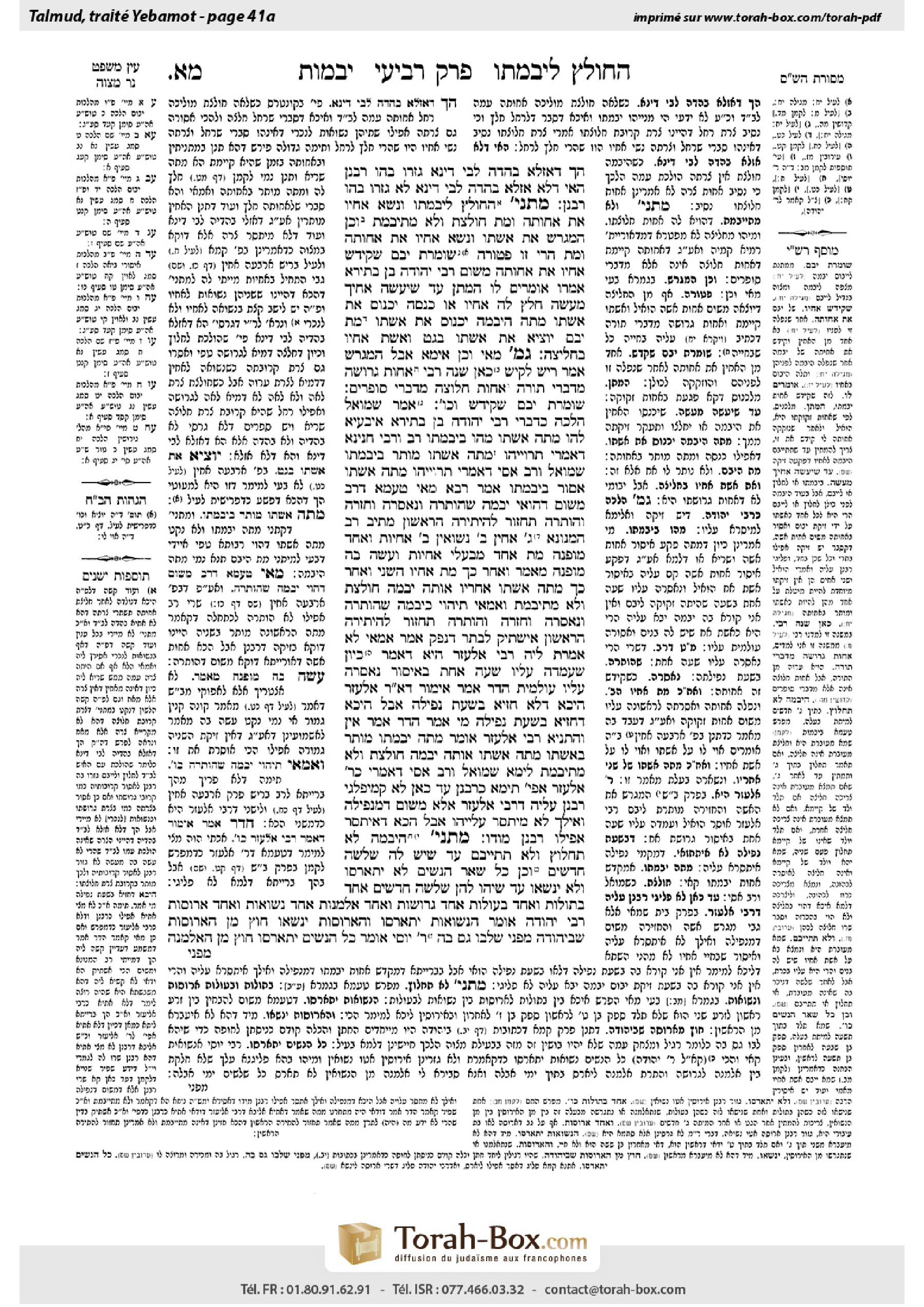
This page of Yevamot includes the Aramaic text, an English translation and an AI-generated French translation, alongside the scan above.
יבמות מ״א א · Aramaic and Hebrew text
הָךְ דְּאָזְלָא בַּהֲדַהּ לְבֵי דִינָא, גְּזַרוּ בְּהוּ רַבָּנַן. הַאי דְּלָא אָזְלָא בַּהֲדַהּ לְבֵי דִּינָא, לָא גְּזַרוּ בְּהוּ רַבָּנַן.
מַתְנִי׳ הַחוֹלֵץ לִיבִמְתּוֹ, וְנָשָׂא אָחִיו אֶת אֲחוֹתָהּ, וָמֵת — חוֹלֶצֶת וְלֹא מִתְיַבֶּמֶת. וְכֵן הַמְגָרֵשׁ אֶת אִשְׁתּוֹ, וְנָשָׂא אָחִיו אֶת אֲחוֹתָהּ, וָמֵת — הֲרֵי זוֹ פְּטוּרָה.
שׁוֹמֶרֶת יָבָם שֶׁקִּידֵּשׁ אָחִיו אֶת אֲחוֹתָהּ — מִשּׁוּם רַבִּי יְהוּדָה בֶּן בְּתִירָא אָמְרוּ, אוֹמְרִים לוֹ: הַמְתֵּן עַד שֶׁיַּעֲשֶׂה אָחִיךָ מַעֲשֶׂה.
חָלַץ לָהּ אָחִיו אוֹ כְּנָסָהּ — יִכְנוֹס אֶת אִשְׁתּוֹ. מֵתָה הַיְּבָמָה — יִכְנוֹס אֶת אִשְׁתּוֹ. מֵת יָבָם — יוֹצִיא אֶת אִשְׁתּוֹ בְּגֵט, וְאֵשֶׁת אָחִיו בַּחֲלִיצָה.
גְּמָ׳ מַאי ״וְכֵן״? אֵימָא: ״אֲבָל הַמְגָרֵשׁ״.
אָמַר רֵישׁ לָקִישׁ, כָּאן שָׁנָה רַבִּי: אֲחוֹת גְּרוּשָׁה מִדִּבְרֵי תוֹרָה, אֲחוֹת חֲלוּצָה מִדִּבְרֵי סוֹפְרִים.
שׁוֹמֶרֶת יָבָם שֶׁקִּידֵּשׁ וְכוּ׳. אָמַר שְׁמוּאֵל: הֲלָכָה כְּדִבְרֵי רַבִּי יְהוּדָה בֶּן בְּתֵירָא.
אִיבַּעְיָא לְהוּ: מֵתָה אִשְׁתּוֹ, מַהוּ בִּיבִמְתּוֹ? רַב וְרַבִּי חֲנִינָא דְּאָמְרִי תַּרְוַיְיהוּ: מֵתָה אִשְׁתּוֹ — מוּתָּר בִּיבִמְתּוֹ. שְׁמוּאֵל וְרַב אַסִּי דְאָמְרִי תַּרְוַיְיהוּ: מֵתָה אִשְׁתּוֹ — אָסוּר בִּיבִמְתּוֹ.
אָמַר רָבָא: מַאי טַעְמָא דְּרַב — מִשּׁוּם דַּהֲוַאי יְבָמָה שֶׁהוּתְּרָה וְנֶאֶסְרָה, וְחָזְרָה וְהוּתְּרָה, תַּחְזוֹר לְהֶיתֵּירָהּ הָרִאשׁוֹן.
מֵתִיב רַב הַמְנוּנָא: שְׁלֹשָׁה אַחִין, שְׁנַיִם נְשׂוּאִין שְׁתֵּי אֲחָיוֹת, וְאֶחָד מוּפְנֶה. מֵת אֶחָד מִבַּעֲלֵי אֲחָיוֹת, וְעָשָׂה בָּהּ מוּפְנֶה מַאֲמָר, וְאַחַר כָּךְ מֵת אָחִיו הַשֵּׁנִי,
וְאַחַר כָּךְ מֵתָה אִשְׁתּוֹ אַחֲרָיו — אוֹתָהּ יְבָמָה חוֹלֶצֶת וְלֹא מִתְיַבֶּמֶת.
וְאַמַּאי? תֶּיהְוֵי כִּיבָמָה שֶׁהוּתְּרָה וְנֶאֶסְרָה וְחָזְרָה וְהוּתְּרָה, תַּחְזוֹר לְהֶיתֵּירָהּ הָרִאשׁוֹן!
אִישְׁתִּיק. לְבָתַר דִּנְפַק אֲמַר: אַמַּאי לָא אֲמַרְתְּ לֵיהּ, רַבִּי אֶלְעָזָר הִיא, דְּאָמַר: כֵּיוָן שֶׁעָמְדָה עָלָיו שָׁעָה אַחַת בְּאִסּוּר — נֶאֶסְרָה עָלָיו עוֹלָמִית?
הֲדַר אֲמַר: אֵימוֹר דְּאָמַר רַבִּי אֶלְעָזָר — הֵיכָא דְּלָא חַזְיָא בִּשְׁעַת נְפִילָה, אֲבָל הֵיכָא דְּחַזְיָא בִּשְׁעַת נְפִילָה, מִי אָמַר?
הֲדַר אֲמַר: אִין, וְהָתַנְיָא, רַבִּי אֶלְעָזָר אוֹמֵר: מֵתָה יְבִמְתּוֹ — מוּתָּר בְּאִשְׁתּוֹ, מֵתָה אִשְׁתּוֹ — אוֹתָהּ יְבָמָה חוֹלֶצֶת וְלֹא מִתְיַבֶּמֶת.
לֵימָא שְׁמוּאֵל וְרַב אַסִּי דְּאָמְרִי כְּרַבִּי אֶלְעָזָר?
אֲפִילּוּ תֵּימָא כְּרַבָּנַן, עַד כָּאן לָא קָמִיפַּלְגִי רַבָּנַן עֲלֵיהּ דְּרַבִּי אֶלְעָזָר, אֶלָּא מִשּׁוּם דְּמִנְּפִילָה וְאֵילָךְ לָא מִיתְּסַר עֲלַיְיהוּ, אֲבָל הָכָא דְּאִיתְּסַר — אֲפִילּוּ רַבָּנַן מוֹדוּ.
מַתְנִי׳ הַיְּבָמָה לֹא תַּחֲלוֹץ וְלֹא תִּתְיַיבֵּם עַד שֶׁיֵּשׁ לָהּ שְׁלֹשָׁה חֳדָשִׁים. וְכֵן כׇּל שְׁאָר הַנָּשִׁים לֹא יִתְאָרְסוּ וְלֹא יִנָּשְׂאוּ עַד שֶׁיְּהוּ לָהֶן שְׁלֹשָׁה חֳדָשִׁים: אֶחָד בְּתוּלוֹת וְאֶחָד בְּעוּלוֹת, אֶחָד גְּרוּשׁוֹת וְאֶחָד אַלְמָנוֹת, אֶחָד נְשׂוּאוֹת וְאֶחָד אֲרוּסוֹת.
רַבִּי יְהוּדָה אוֹמֵר: הַנְּשׂוּאוֹת — יִתְאָרְסוּ, וְהָאֲרוּסוֹת — יִנָּשְׂאוּ. חוּץ מִן הָאֲרוּסוֹת שֶׁבִּיהוּדָה, מִפְּנֵי שֶׁלִּבּוֹ גַּס בָּהּ.
רַבִּי יוֹסֵי אוֹמֵר: כׇּל הַנָּשִׁים יִתְאָרְסוּ, חוּץ מִן הָאַלְמָנָה,
Yevamot 41a · English translation
The Gemara explains: With regard to that woman, the relative of the ḥalutza, who often goes together with the ḥalutza to court, since she is present in the court during the ḥalitza, people might mistakenly assume that it was she who actually performed ḥalitza. Were the yavam permitted to marry her rival wife, people might incorrectly conclude that it is permitted to marry the rival wife of one’s ḥalutza. To preclude this possibility, the Sages decreed with regard to her that her rival wife should be forbidden. However, with regard to this woman, the rival wife of the ḥalutza, who does not go together with the ḥalutza to court, since she is never present in the court during the ḥalitza, there is no concern that people will mistake her for the ḥalutza herself. Consequently, the Sages did not see any reason to decree with regard to her that her relatives should be forbidden.
MISHNA: In the case of a yavam who performed ḥalitza with his yevama and then his brother married her sister and died, the sister performs ḥalitza with the yavam, but she may not enter into levirate marriage with him, since as a sister of his ḥalutza she is forbidden to him. And similarly, in the case of one who divorced his wife and his brother married her sister and died, then that woman is exempt both from ḥalitza and from consummating levirate marriage, since as the sister of his former wife she is forbidden to him.
In the case of a widow waiting for her yavam to consummate levirate marriage or perform ḥalitza with her, and the brother of the yavam betrothed her sister, they said in the name of Rabbi Yehuda ben Beteira: They say to the brother: Wait and do not marry the woman you betrothed until your brother performs an act, either of ḥalitza or of consummating the levirate marriage, as until he does there remains a levirate bond between the yevama and each of the brothers, and it is prohibited to marry the sister of a woman to whom one is bound by a levirate bond.
If a brother of the one who betrothed the sister of the yevama performed ḥalitza with the yevama or consummated a levirate marriage with her, since by doing so the levirate bond between the yevama and the one who betrothed her sister is dissolved, he may then enter into marriage with his wife, who until that point was only betrothed to him, as she is no longer the sister of a woman to whom he is bound by a levirate bond. Similarly, if the yevama died, since his levirate bond to her is dissolved upon her death, he may proceed to enter into marriage with his betrothed wife. However, if the yavam died without performing an act that would have dissolved the levirate bond, he must divorce his wife with a bill of divorce, as she is forbidden to him as the sister of a woman to whom he is bound by a levirate bond, and his brother’s wife he must send out with ḥalitza, as she is forbidden to him as the sister of his divorcée.
GEMARA: The mishna considers two cases in which there is no possibility of consummating levirate marriage with a yevama. In the first case the reason is that she is the sister of one’s ḥalutza, and in the second it is that she is the sister of one’s divorcée. The mishna appears to compare the two cases by introducing the second case with: And similarly. The Gemara questions this: What is the meaning of: And similarly? The two cases are not similar; in the first case the yevama must perform ḥalitza, and in the second she is entirely exempt from the need to do anything. The Gemara answers: Emend the mishna and say: However, one who divorces.
The Gemara explains the reason for the difference between the two cases: Reish Lakish said: Here, through this mishna, Rabbi Yehuda HaNasi taught that a sister of one’s divorcée is forbidden to him by Torah law, and that is why she is entirely exempt, whereas a sister of a ḥalutza is forbidden to him only by rabbinic law, and therefore, since there is still a levirate bond between her and the yavam, she requires ḥalitza to release her from it.
§ The mishna states that in the case of a widow waiting for her yavam where the brother of the yavam betrothed her sister, Rabbi Yehuda ben Beteira said that the brother may not proceed to marry his betrothed. The Gemara cites a ruling on this matter: Shmuel said: The halakha is in accordance with the statement of Rabbi Yehuda ben Beteira.
A dilemma was raised before the Sages: If a yavam is betrothed to the sister of his yevama, then since the yevama is his betrothed wife’s sister, it is forbidden for him to consummate a levirate marriage with her. However, if his betrothed wife died, what is the halakha with regard to his yevama; is he then permitted to consummate a levirate marriage with her? It is Rav and Rabbi Ḥanina who both say: If his wife died, he is permitted to consummate a levirate marriage with his yevama. Their opinion is disputed by Shmuel and Rav Asi, who both say: If his wife died, he is forbidden to his yevama.
Rava said: What is Rav’s reasoning? She is permitted due to the fact that she is a yevama who, when her husband died, was permitted to the yavam, and then when the yavam betrothed her sister she became forbidden to him as his wife’s sister, and then when his wife died the yevama reverted to her original status and was permitted to him. As such, she should also revert to her original permitted status with regard to levirate marriage and be permitted to consummate a levirate marriage with the yavam.
Rav Hamnuna raised an objection from that which was taught in a baraita: With regard to a case of three brothers, two of whom are married to two sisters and one of whom is a bachelor, if one of the sisters’ husbands died and the bachelor performed levirate betrothal with that sister, and afterward the second brother who was married to the other sister died, and so his wife also happened before the bachelor for levirate marriage, the bachelor is then bound to each of the sisters through a levirate bond. In such a case it is prohibited for the bachelor to consummate a levirate marriage with either one, as it is prohibited to marry the sister of a woman to whom one is bound through a levirate bond.
And if afterward the wife of the second brother died after him, i.e., after her husband had already died, which restored the original situation in which the bachelor was bound by a levirate bond only to the widow of the first brother, then in such a case that yevama, the widow of the first brother, performs ḥalitza but may not enter into levirate marriage.
Rav Hamnuna explains the challenge from the baraita: But why may she not consummate the levirate marriage? She should be like a yevama who was initially permitted to her yavam, and then became forbidden to him, and then reverted to her original status and was permitted, and so in this case she should also revert to her original permitted status with regard to levirate marriage and be permitted to consummate a levirate marriage with him. The fact that the baraita rules that she is prohibited from consummating the marriage demonstrates that she does not revert to her original permitted status.
Rava was silent, as he had no immediate answer. After Rav Hamnuna left the study hall, Rava said to himself: Why did you not say to him that the baraita does not pose a challenge because it is in accordance with the opinion of Rabbi Elazar, who said in a mishna (108b) with regard to the case of a man who divorced his wife, remarried her, and then died childless, that the yevama may not consummate levirate marriage with her yavam because once a yevama has stood before her yavam in a forbidden state, even for a single moment, she remains forbidden to him forever, and in that case, during the period she was divorced from her husband she was forbidden to her yavam? The Rabbis, however, disagree with his opinion, and the halakha is ruled in accordance with their opinion.
He then said to himself: It is not certain that the baraita is in accordance with the opinion of Rabbi Elazar because one could say that Rabbi Elazar said his opinion only where she was not suitable for the yavam, i.e., she was forbidden to him, already from the time of her happening before her yavam for levirate marriage at the moment of her husband’s death. However, where she was suitable for her yavam at the time of her happening before him and became forbidden to him only at some later point, as in the case of a yavam who betrothed the sister of his yevama, did he actually say that if the reason for the prohibition is removed then she does not return to her permissible state? If the baraita does not represent the opinion of Rabbi Elazar, then it must be unanimously agreed upon, and therefore it indeed poses a challenge.
He then said: Yes, actually, Rabbi Elazar did state his opinion even in such a case, and so it is taught in a baraita: With regard to a yavam who betrothed the sister of his yevama, Rabbi Elazar says: If his yevama dies, he is permitted to his wife. If his wife dies, that yevama performs ḥalitza but may not enter into levirate marriage with him. Therefore, the challenge from the baraita can be dismissed since it represents only Rabbi Elazar’s opinion.
The Gemara suggests: Shall we say that Shmuel and Rav Asi, who say that she may not consummate the levirate marriage, hold in accordance with the opinion of Rabbi Elazar?
The Gemara rejects this: You can even say that they hold in accordance with the opinion of the Rabbis, as perhaps the Rabbis disagree with Rabbi Elazar in the case of a man who divorced and remarried his wife and then died childless only due to the fact that in that case, from the time of her happening for levirate marriage and onward she was not forbidden to them, i.e., her yevamin. The fact that the prohibition between her and her yevamin ended before she ever happened before them for levirate marriage means it has no bearing on her current eligibility for levirate marriage. However, here, in the case where the yavam betrothed the sister of his yevama, since she became forbidden after she had already happened before him for levirate marriage, even the Rabbis would agree that she remains permanently ineligible to consummate levirate marriage with him.
MISHNA: A yevama may neither perform ḥalitza nor enter into levirate marriage until she has waited three months from the time of her husband’s death. And similarly, all other women may not be betrothed and may not marry until they have waited three months since their previous marriage ended. This waiting period is necessary so that, should a woman give birth shortly after remarrying, it will be obvious who the father of the child is. This applies both to virgins and non-virgins, both to divorcées and widows, and both to women who were married to their previous husbands and women who were only betrothed. All of these women must wait three months before remarrying even though for some of them the reason for doing so does not apply.
Rabbi Yehuda says: The women who were married to their previous husbands may be betrothed, and the women who were only betrothed to their previous husbands may marry without waiting three months. This is true except for the betrothed women that are in the area of Judea, due to the fact that the groom is familiar with her. The custom in Judea was for the couple to be secluded together before the marriage so that they would become familiar with each other. This led to the possibility that they might cohabit even during their betrothal period. Rabbi Yehuda holds that one does not need to wait three months whenever the reason for doing so does not apply.
Rabbi Yosei says: All of the women may be betrothed within three months even if they were previously married, except for a widow,
Yevamot 41a · Traduction française (IA)
La Guemara explique : À propos de cette femme, la parente de la ḥaloutsa, qui accompagne souvent celle-ci au tribunal, puisqu’elle est présente au tribunal pendant la ḥalitsa, les gens pourraient croire à tort que c’est elle qui a effectivement accompli la ḥalitsa. Si le yavam était autorisé à épouser sa rivale, les gens pourraient en conclure à tort qu’il est permis d’épouser la rivale de sa propre ḥaloutsa. Pour écarter cette possibilité, les Sages ont décrété que la rivale de cette femme lui soit interdite. En revanche, à propos de cette femme, la rivale de la ḥaloutsa, qui n’accompagne pas celle-ci au tribunal, puisqu’elle n’est jamais présente au tribunal pendant la ḥalitsa, on ne craint pas que les gens la confondent avec la ḥaloutsa elle-même. Par conséquent, les Sages n’ont vu aucune raison de décréter que les parentes de cette femme lui soient interdites.
MICHNA : Dans le cas d’un yavam qui a accompli la ḥalitsa avec sa yevama, puis dont le frère a épousé la sœur de celle-ci et est mort, cette sœur accomplit la ḥalitsa avec le yavam, mais ne peut pas contracter avec lui un mariage léviratique, car, étant la sœur de sa ḥaloutsa, elle lui est interdite. De même, dans le cas d’un homme qui a divorcé de sa femme et dont le frère a épousé la sœur de celle-ci, puis est mort, cette femme est dispensée à la fois de la ḥalitsa et du mariage léviratique, car, étant la sœur de son ex-femme, elle lui est interdite.
Dans le cas d’une veuve qui attend que son yavam contracte avec elle un mariage léviratique ou accomplisse la ḥalitsa, et dont le frère du yavam a fiancé la sœur, les Sages ont dit au nom de Rabbi Yehuda ben Beteira : On dit au frère : « Attends et n’épouse pas la femme à laquelle tu es fiancé jusqu’à ce que ton frère accomplisse un acte, soit la ḥalitsa, soit le mariage léviratique », car jusque-là, un lien léviratique subsiste entre la yevama et chacun des frères, et il est interdit d’épouser la sœur d’une femme avec laquelle on est lié par un lien léviratique.
Si un frère de celui qui a fiancé la sœur de la yevama accomplit la ḥalitsa avec celle-ci ou contracte avec elle un mariage léviratique, le lien léviratique entre la yevama et celui qui a fiancé sa sœur est alors dissous. Il peut ensuite épouser sa fiancée, qui jusque-là n’était que sa promise, puisqu’elle n’est plus la sœur d’une femme avec laquelle il est lié par un lien léviratique. De même, si la yevama meurt, le lien léviratique qui l’unit à lui étant dissous par sa mort, il peut épouser sa fiancée. Toutefois, si le yavam meurt sans avoir accompli d’acte qui aurait dissous le lien léviratique, il doit divorcer de sa femme, car elle lui est interdite en tant que sœur d’une femme avec laquelle il est lié par un lien léviratique ; quant à la femme de son frère, il doit la renvoyer au moyen de la ḥalitsa, car elle lui est interdite en tant que sœur de sa divorcée.
GUEMARA : La Michna envisage deux cas où il est impossible de contracter un mariage léviratique avec une yevama. Dans le premier cas, c’est parce qu’elle est la sœur de sa ḥaloutsa ; dans le second, parce qu’elle est la sœur de sa divorcée. La Michna semble comparer les deux cas en introduisant le second par les mots : « Et de même ». La Guemara demande : Que signifie « et de même » ? Les deux cas ne sont pas semblables : dans le premier, la yevama doit accomplir la ḥalitsa, tandis que dans le second, elle est entièrement dispensée de toute démarche. La Guemara répond : Corrige la Michna et lis : « En revanche, celui qui divorce… »
La Guemara explique la différence entre les deux cas. Reish Lakish a dit : Par cette Michna, Rabbi Yehuda HaNassi enseigne que la sœur d’une divorcée est interdite à son ex-mari par la Torah ; c’est pourquoi elle est entièrement dispensée. En revanche, la sœur d’une ḥaloutsa ne lui est interdite que par décret rabbinique. Par conséquent, puisqu’un lien léviratique subsiste encore entre elle et le yavam, elle doit accomplir la ḥalitsa pour en être libérée.
§ La Michna enseigne que, dans le cas d’une veuve qui attend son yavam, lorsque le frère du yavam a fiancé sa sœur, Rabbi Yehuda ben Beteira a dit que le frère ne peut pas épouser sa fiancée. La Guemara cite une décision à ce sujet : Shmuel a dit : La halakha suit l’opinion de Rabbi Yehuda ben Beteira.
Une question fut posée aux Sages : Si un yavam se fiance avec la sœur de sa yevama, puisque celle-ci est la sœur de sa fiancée, il lui est interdit de contracter avec elle un mariage léviratique. Toutefois, si sa fiancée meurt, quelle est la halakha concernant sa yevama ? Lui est-il alors permis de contracter avec elle un mariage léviratique ? Rav et Rabbi Ḥanina disent tous deux : Si sa femme meurt, il lui est permis de contracter un mariage léviratique avec sa yevama. Shmuel et Rav Asi contestent leur opinion et disent tous deux : Si sa femme meurt, sa yevama lui reste interdite.
Rava a dit : Quel est le raisonnement de Rav ? Elle lui est permise parce qu’elle est une yevama qui, à la mort de son mari, était permise au yavam ; puis, lorsque le yavam a fiancé sa sœur, elle lui est devenue interdite en tant que sœur de sa femme ; enfin, à la mort de sa femme, la yevama a retrouvé son statut initial et lui est redevenue permise. Elle devrait donc également retrouver son statut initial et être de nouveau autorisée à contracter un mariage léviratique avec le yavam.
Rav Hamnuna a soulevé une objection à partir de ce qui a été enseigné dans une baraïta : Dans le cas de trois frères, dont deux sont mariés à deux sœurs et le troisième est célibataire, si le mari de l’une des sœurs meurt et que le célibataire contracte avec cette sœur des fiançailles léviratiques, puis que le second frère, mari de l’autre sœur, meurt et que sa femme se présente donc elle aussi devant le célibataire en vue d’un mariage léviratique, le célibataire est alors lié à chacune des sœurs par un lien léviratique. Dans ce cas, il lui est interdit de contracter un mariage léviratique avec l’une ou l’autre, car il est interdit d’épouser la sœur d’une femme avec laquelle on est lié par un lien léviratique.
Et si, par la suite, la femme du second frère meurt après lui, c’est-à-dire après la mort de son mari, la situation initiale est rétablie : le célibataire n’est alors lié par un lien léviratique qu’à la veuve du premier frère. Dans ce cas, cette yevama, la veuve du premier frère, accomplit la ḥalitsa, mais ne peut pas contracter de mariage léviratique.
Rav Hamnuna explique l’objection tirée de la baraïta : Mais pourquoi ne peut-elle pas contracter le mariage léviratique ? Elle devrait être comme une yevama qui a d’abord été permise à son yavam, puis lui est devenue interdite, avant de retrouver son statut initial et de lui redevenir permise. De même, dans ce cas, elle devrait retrouver son statut initial et être de nouveau autorisée à contracter un mariage léviratique avec lui. Le fait que la baraïta statue qu’il lui est interdit de contracter ce mariage démontre qu’elle ne retrouve pas son statut initial de femme permise.
Rava garda le silence, car il n’avait pas de réponse immédiate. Après que Rav Hamnuna eut quitté la maison d’étude, Rava se dit : Pourquoi ne lui as-tu pas répondu que la baraïta ne constitue pas une objection, car elle suit l’opinion de Rabbi Elazar, qui a dit dans une Michna (108b), à propos du cas d’un homme qui a divorcé de sa femme, l’a reprise pour épouse, puis est mort sans enfant, que la yevama ne peut pas contracter un mariage léviratique avec son yavam ? En effet, dès qu’une yevama s’est trouvée, ne serait-ce qu’un instant, dans une situation où elle était interdite à son yavam, elle lui reste interdite à jamais ; or, dans ce cas, pendant la période où elle était divorcée de son mari, elle était interdite à son yavam. Les Sages contestent cependant son opinion, et la halakha est tranchée conformément à la leur.
Il se dit ensuite : Il n’est pas certain que la baraïta suive l’opinion de Rabbi Elazar, car on pourrait dire que Rabbi Elazar n’a exprimé son opinion que lorsque la yevama ne pouvait pas être permise à son yavam, c’est-à-dire qu’elle lui était déjà interdite dès le moment où elle s’est présentée devant lui en vue d’un mariage léviratique, à la mort de son mari. Mais lorsque la yevama pouvait être permise à son yavam au moment où elle s’est présentée devant lui et ne lui est devenue interdite qu’ultérieurement, comme dans le cas d’un yavam qui a fiancé la sœur de sa yevama, Rabbi Elazar a-t-il vraiment dit que, si la cause de l’interdiction disparaît, elle ne retrouve pas son statut de femme permise ? Si la baraïta ne représente pas l’opinion de Rabbi Elazar, alors elle doit faire l’unanimité et constitue donc bel et bien une objection.
Il se dit ensuite : Oui, en réalité, Rabbi Elazar a exprimé son opinion même dans un tel cas, comme l’enseigne une baraïta : Au sujet d’un yavam qui a fiancé la sœur de sa yevama, Rabbi Elazar dit : Si sa yevama meurt, sa femme lui est permise. Si sa femme meurt, cette yevama accomplit la ḥalitsa, mais ne peut pas contracter de mariage léviratique avec lui. L’objection tirée de la baraïta peut donc être écartée, puisqu’elle ne représente que l’opinion de Rabbi Elazar.
La Guemara propose : Faut-il en conclure que Shmuel et Rav Asi, qui disent qu’elle ne peut pas contracter de mariage léviratique, suivent l’opinion de Rabbi Elazar ?
La Guemara rejette cette conclusion : On peut même dire qu’ils suivent l’opinion des Sages, car ceux-ci ne contestent peut-être l’opinion de Rabbi Elazar dans le cas d’un homme qui a divorcé de sa femme, l’a reprise pour épouse, puis est mort sans enfant, que parce que, dans ce cas, à partir du moment où elle s’est présentée en vue d’un mariage léviratique, elle n’était pas interdite à ses yevamin. Le fait que l’interdiction entre elle et ses yevamin ait pris fin avant qu’elle ne se présente devant eux en vue d’un mariage léviratique signifie qu’elle n’a aucune incidence sur son admissibilité actuelle au mariage léviratique. Mais ici, dans le cas où le yavam a fiancé la sœur de sa yevama, puisqu’elle est devenue interdite après s’être déjà présentée devant lui en vue d’un mariage léviratique, même les Sages reconnaîtraient qu’elle reste définitivement inapte à contracter avec lui un mariage léviratique.
MICHNA : Une yevama ne peut ni accomplir la ḥalitsa ni contracter un mariage léviratique avant d’avoir attendu trois mois à compter de la mort de son mari. De même, toutes les autres femmes ne peuvent ni se fiancer ni se marier avant d’avoir attendu trois mois depuis la fin de leur précédente union. Cette période d’attente est nécessaire afin que, si une femme accouche peu après s’être remariée, l’identité du père de l’enfant soit évidente. Cette règle s’applique aussi bien aux vierges qu’aux non-vierges, aux divorcées qu’aux veuves, et aux femmes qui étaient mariées à leur précédent mari qu’à celles qui étaient seulement fiancées. Toutes ces femmes doivent attendre trois mois avant de se remarier, même si, pour certaines d’entre elles, la raison de cette attente ne s’applique pas.
Rabbi Yehuda dit : Les femmes qui étaient mariées à leur précédent mari peuvent se fiancer, et celles qui étaient seulement fiancées à leur précédent mari peuvent se marier sans attendre trois mois. Cela vaut pour toutes, à l’exception des femmes fiancées en Judée, parce que le fiancé connaît sa fiancée. En Judée, le couple avait coutume de s’isoler avant le mariage afin de faire connaissance. Il était donc possible qu’ils aient des relations même pendant la période de fiançailles. Rabbi Yehuda estime qu’il n’est pas nécessaire d’attendre trois mois lorsque la raison de cette attente ne s’applique pas.
Rabbi Yosei dit : Toutes les femmes peuvent se fiancer pendant les trois mois, même si elles étaient mariées auparavant, à l’exception d’une veuve,
Traduction française générée par IA à partir de l’édition anglaise de Sefaria. Vérifie toujours un passage avec le texte source.
Text from Sefaria: William Davidson Edition - Vocalized Aramaic (CC BY NC); William Davidson Edition - English (CC BY NC).