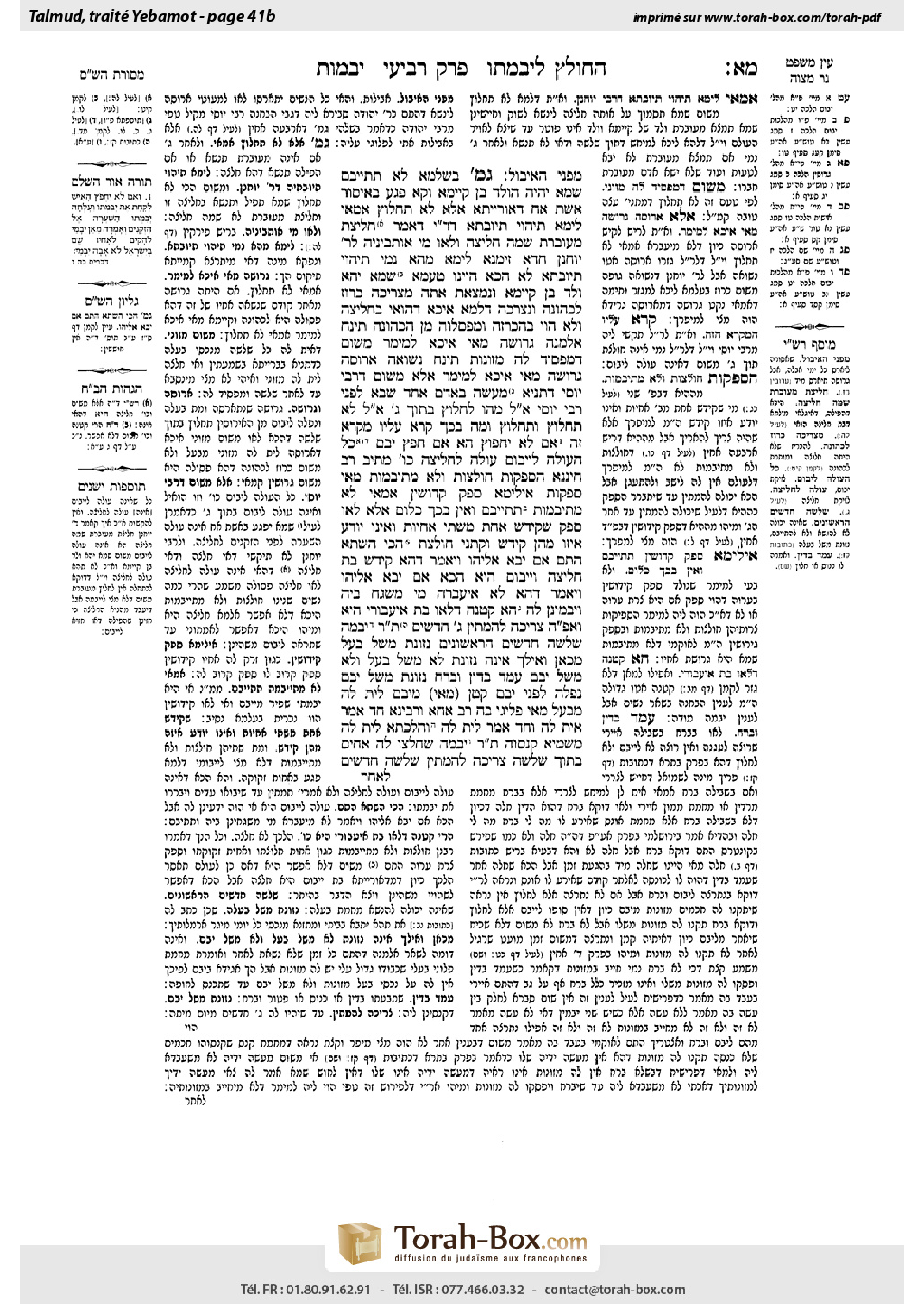
Yevamot 41b: Talmud study for Daf Yomi
Daf Yomi is the daily study of one Talmud folio. Explore 37 tractates with scans, Hebrew text, Sefaria English and AI-generated French translations where annotated.
Passage selection and English or AI-generated French translation are available where the scan has annotations. Daf Study is independent of Torah-Box and Sefaria.
Browse Yevamot · יבמות · All tractatesYevamot 41b text and translations
This page of Yevamot includes the Aramaic text, an English translation and an AI-generated French translation, alongside the scan above.
יבמות מ״א ב · Aramaic and Hebrew text
מִפְּנֵי הָאִיבּוּל.
גְּמָ׳ בִּשְׁלָמָא לֹא תִּתְיַיבֵּם: שֶׁמָּא יִהְיֶה הַוָּלָד בֶּן קַיָּימָא, וְקָא פָגַע בְּאִיסּוּר אֵשֶׁת אָח דְּאוֹרָיְיתָא. אֶלָּא לֹא תַּחְלוֹץ, אַמַּאי?
לֵימָא תֶּיהְוֵי תְּיוּבְתָּא דְּרַבִּי יוֹחָנָן, דְּאָמַר: חֲלִיצַת מְעוּבֶּרֶת שְׁמָהּ חֲלִיצָה. וְלָאו מִי אוֹתְבִינֵּיהּ לְרַבִּי יוֹחָנָן חֲדָא זִימְנָא?! לֵימָא מֵהָא נָמֵי תֶּיהְוֵי תְּיוּבְתָּא!
לָא, הָכָא הַיְינוּ טַעְמָא: שֶׁמָּא יְהֵא וָלָד בֶּן קַיָּימָא, וְנִמְצֵאתָ אַתָּה מַצְרִיכָהּ כָּרוֹז לַכְּהוּנָּה.
וְנַצְרְכַהּ! דִּלְמָא אִיכָּא דְּהָוֵאי בַּחֲלִיצָה וְלָא הָוֵי בְּהַכְרָזָה, וּמַפְסְלוּהָ מִן הַכְּהוּנָּה.
תִּינַח אַלְמָנָה. גְּרוּשָׁה — מַאי אִיכָּא לְמֵימַר? מִשּׁוּם דְּמַפְסֵיד לַהּ מְזוֹנוֹת.
תִּינַח נְשׂוּאָה. אֲרוּסָה גְּרוּשָׁה — מַאי אִיכָּא לְמֵימַר?
אֶלָּא מִשּׁוּם דְּרַבִּי יוֹסֵי, דְּתַנְיָא: מַעֲשֶׂה בְּאָדָם אֶחָד שֶׁבָּא לִפְנֵי רַבִּי יוֹסֵי. אָמַר לוֹ: מַהוּ לַחְלוֹץ בְּתוֹךְ שְׁלֹשָׁה? אָמַר לוֹ: לֹא תַּחְלוֹץ. וְתַחְלוֹץ, וּמָה בְּכָךְ?
קָרָא עָלָיו מִקְרָא זֶה: ״וְאִם לֹא יַחְפֹּץ״, הָא אִם חָפֵץ — יִבֵּם. כׇּל הָעוֹלֶה לְיִבּוּם — עוֹלֶה לַחֲלִיצָה כּוּ׳.
מֵתִיב רַב חִינָּנָא: הַסְּפֵקוֹת חוֹלְצוֹת וְלֹא מִתְיַבְּמוֹת.
מַאי סְפֵקוֹת? אִילֵּימָא סְפֵק קִדּוּשִׁין — אַמַּאי לָא מִתְיַבְּמוֹת? תִּתְיַיבֵּם, וְאֵין בְּכָךְ כְּלוּם.
אֶלָּא לָאו, סָפֵק שֶׁקִּידֵּשׁ אַחַת מִשְׁתֵּי אֲחָיוֹת, וְאֵינוֹ יוֹדֵעַ אֵיזוֹ מֵהֶן קִידֵּשׁ. וְקָתָנֵי: חוֹלֶצֶת!
הָכִי הַשְׁתָּא?! הָתָם, אִם יָבֹא אֵלִיָּהוּ וְיֹאמַר דְּהָא קִידֵּשׁ — בַּת חֲלִיצָה וְיִיבּוּם הִיא,
הָכָא, אִם יָבֹא אֵלִיָּהוּ וְיֹאמַר דְּהָא לָא אִיעַבַּרָה — מִי מַשְׁגְּחִ[ינַן] בֵּיהּ, וּ[מְ]יַבְּמִינַן לַהּ? הָא קְטַנָּה דְּלָאו בַּת אִיעַבּוֹרֵי הִיא, וַאֲפִילּוּ הָכִי צְרִיכָה לְהַמְתִּין שְׁלֹשָׁה חֳדָשִׁים.
תָּנוּ רַבָּנַן: יְבָמָה, שְׁלֹשָׁה חֳדָשִׁים הָרִאשׁוֹנִים נִזּוֹנֶת מִשֶּׁל בַּעַל. מִכָּאן וְאֵילָךְ, אֵינָהּ נִזּוֹנֶת לֹא מִשֶּׁל בַּעַל וְלֹא מִשֶּׁל יָבָם.
עָמַד בַּדִּין וּבָרַח — נִזּוֹנֶת מָשָׁל יָבָם.
נָפְלָה לִפְנֵי יָבָם קָטָן (מַאי)? מִיָּבָם לֵית לַהּ. מִבַּעַל מַאי?
פְּלִיגִי בַּהּ רַב אַחָא וְרָבִינָא, חַד אָמַר: אִית לַהּ, וְחַד אֲמַר: לֵית לַהּ, וְהִלְכְתָא: לֵית לַהּ, מִשְּׁמַיָּא קַנְסוּהּ.
תָּנוּ רַבָּנַן: יְבָמָה שֶׁחָלְצוּ לָהּ אַחִים בְּתוֹךְ שְׁלֹשָׁה — צְרִיכָה לְהַמְתִּין שְׁלֹשָׁה חֳדָשִׁים.
Yevamot 41b · English translation
due to the mourning period she must observe for her deceased husband.
GEMARA: The Gemara questions the mishna’s opening clause: Granted, she should not enter into levirate marriage, as she might already be pregnant, which would still not be noticeable during the first three months, and perhaps the baby will be viable. In that case it would emerge that she was never subject to the mitzva of levirate marriage, and therefore, if the yavam consummates a levirate marriage he will have encountered the Torah prohibition against engaging in relations with one’s brother’s wife. However, why should she not perform ḥalitza?
The Gemara suggests: Let us say that this mishna, which states that a pregnant woman should not perform ḥalitza, is a conclusive refutation of the opinion of Rabbi Yoḥanan, who said that a ḥalitza performed with a pregnant woman who later miscarries is considered a valid ḥalitza. The Gemara asks: But didn’t they already conclusively refute the opinion of Rabbi Yoḥanan one time previously from other sources? The Gemara rephrases the suggestion: Let us say that from this mishna as well there is a conclusive refutation of the opinion of Rabbi Yoḥanan.
The Gemara deflects this suggestion: No, it is possible that in the mishna here, this is the reason that she may not perform ḥalitza: Perhaps the offspring will be viable, in which case although she performed the act of ḥalitza, it is entirely meaningless since it was completely unnecessary, and she would remain permitted to marry into the priesthood. However, this could lead to a problem: People might not realize that the ḥalitza she performed was meaningless, and they would think she is a ḥalutza who is prohibited from marrying a priest. It would therefore emerge that if you permit her to perform ḥalitza even though it is possible that she is pregnant, it could be that you will ultimately require a public announcement to be made for her to attest to the fact that the ḥalitza she performed was meaningless and she is in fact still permitted to marry into the priesthood.
The Gemara wonders why this poses a problem: But why not let her perform ḥalitza even though it is possible she is pregnant, and then, if it becomes necessary, require a public announcement to be made for her? The Gemara explains why one should avoid having to rely on a public announcement: Perhaps there will be some people who are present at the ḥalitza but were not present at the public announcement, and those people will incorrectly disqualify her from marrying into the priesthood. To avoid this situation, the mishna rules that she should wait three months before performing ḥalitza.
The Gemara asks: This answer works out well with regard to a widow because as a widow she is currently still permitted to marry into the priesthood, but with regard to a divorcée, who is already prohibited from marrying into the priesthood, what is there to say; why shouldn’t she perform ḥalitza immediately? The Gemara provides an alternative reason to delay the ḥalitza: The reason is because by performing ḥalitza immediately she will forfeit the sustenance payments from her deceased husband’s estate, which she otherwise would have been entitled to for the first three months. Since she is not permitted to remarry during those three months, she will have no means of support. Therefore, she should wait until after three months have passed before performing ḥalitza.
The Gemara asks: This answer works out well with regard to a woman who was married to her previous husband and who is therefore entitled to sustenance payments, but with regard to a divorcée who was only betrothed to her previous husband, what is there to say? She is neither entitled to receive sustenance payments nor is she permitted to marry into the priesthood. Why, then, shouldn’t she perform ḥalitza immediately?
The Gemara therefore provides an alternative reason to delay the ḥalitza: Rather, it is due to that which Rabbi Yosei stated, as it is taught in a baraita: There was an incident involving a certain man who came before Rabbi Yosei. The man said to him: What is the halakha with regard to performing ḥalitza within three months of the husband’s death? He said to him: She may not perform ḥalitza. He asked him: Let her perform ḥalitza; what would be the problem with that? Even if she is pregnant, no prohibition will have been transgressed.
To explain his ruling, Rabbi Yosei recited this verse about him: “And if the man does not wish to take his yevama” (Deuteronomy 25:7) in levirate marriage, then he must perform ḥalitza. By inference, the possibility of performing ḥalitza exists only in a case in which if he wishes he may consummate the levirate marriage. This teaches the principle that one who is eligible for levirate marriage is eligible for ḥalitza, and one who is ineligible for levirate marriage is ineligible for ḥalitza. This includes even a woman who is temporarily prohibited from marrying, e.g., a woman in the first three months following a previous marriage.
Rav Ḥinnana raised an objection from the following baraita: Those women whose status as a yevama is uncertain perform ḥalitza but may not enter into levirate marriage. According to this baraita, there are in fact cases in which a woman is eligible for ḥalitza but may not enter into levirate marriage.
The Gemara clarifies the case: What is the case of women whose status as a yevama is uncertain? If we say it is referring to a woman whose betrothal to her previous husband is uncertain, then why does she not enter into levirate marriage? Let her enter into levirate marriage, and there is no problem with that, because if the betrothal was never valid, then she is permitted to the yavam as she is not his brother’s wife; and if it was valid, then she is now obligated to enter into levirate marriage with him.
Rather, is it not referring to a case of uncertainty in which a man betrothed one of two sisters and he does not know which one of them he betrothed? If that man then died childless, the yavam may not consummate the levirate marriage with either sister because it is possible that he will do so with the sister who was not betrothed to his brother, who is therefore forbidden to him as the sister of a woman who is bound to him by a levirate bond. This is in fact the case of the baraita, and the baraita teaches that she performs ḥalitza, even though she is not permitted to enter into levirate marriage.
The Gemara rejects the proof: How can these cases be compared? There, in the case of uncertainty, if Elijah were to come and say that the man betrothed this one of the sisters, then she would be eligible for ḥalitza and levirate marriage. It is clear, then, that fundamentally the sister who was betrothed is actually eligible for levirate marriage, and it is merely a lack of knowledge that prevents her from entering into it.
However, here, with regard to a woman during the first three months following her previous marriage, if Elijah were to come and say that this woman is not pregnant, would one pay heed to him and would we allow the yavam to consummate levirate marriage? Certainly not, as is evident from the fact that a minor girl, who cannot become pregnant, must also wait three months. Evidently, the requirement to wait three months applies in all situations, even those in which the reason for the requirement is irrelevant. Therefore, by virtue of that decree the yevama is considered to be fundamentally ineligible for levirate marriage and similarly is ineligible for ḥalitza.
§ The Gemara mentioned that a yevama is supported from her deceased husband’s estate. It now proceeds to cite a baraita that teaches this halakha: The Sages taught: A yevama during the first three months following her husband’s death receives sustenance payments from the husband’s estate. This is because her previous marriage to him is the cause of her current unmarried state, since it is due to that marriage that she must first wait three months before remarrying. From this point forward, she does not receive sustenance payments, neither from the husband’s estate nor from the yavam, as he has not yet consummated a levirate marriage with her.
The baraita continues: If the yavam was brought to judgment and it was decided that he was obligated to either consummate the levirate marriage with her or perform ḥalitza, and he ran away to avoid doing so, she receives sustenance payments from the estate of the yavam, which is his penalty for neglecting his duty.
The Gemara asks: If she happened before her yavam who is a minor for levirate marriage, what is the halakha? From the yavam she does not have any right to sustenance payments because, as a minor, he is unable to consummate a levirate marriage, but as to payments from her husband’s estate, what is the halakha? Since his death placed her in a situation that forces her to remain in an unmarried state, does his estate have to take the responsibility of supporting her?
Rav Aḥa and Ravina disagree with regard to this matter: One said she does have rights to sustenance payments, and the other one said she does not have any rights. And the halakha is that she does not have any rights to sustenance payments. This is because the husband is not considered to be responsible for her situation; rather, it is thought that she was penalized by Heaven.
§ The Sages taught: In the case of a yevama with whom the brothers of her deceased husband performed ḥalitza within three months of her husband’s death, she still needs to wait three months before remarrying.
Yevamot 41b · Traduction française (IA)
en raison de la période de deuil qu’elle doit observer après la mort de son mari.
GUEMARA : La Guemara s’interroge sur la première clause de la Michna : il est compréhensible qu’elle ne doive pas contracter de mariage léviratique, car elle est peut-être déjà enceinte, ce qui ne serait pas encore perceptible au cours des trois premiers mois, et l’enfant pourrait être viable. Dans ce cas, il s’avérerait qu’elle n’a jamais été soumise à la mitsva du mariage léviratique ; par conséquent, si le yavam consomme ce mariage, il transgressera l’interdiction de la Torah d’avoir des relations avec la femme de son frère. Mais pourquoi ne devrait-elle pas accomplir la ḥalitsa ?
La Guemara suggère : disons que cette Michna, qui affirme qu’une femme enceinte ne doit pas accomplir la ḥalitsa, réfute définitivement l’opinion de Rabbi Yoḥanan, qui a dit qu’une ḥalitsa accomplie avec une femme enceinte qui fait ensuite une fausse couche est considérée comme valide. La Guemara demande : mais son opinion n’a-t-elle pas déjà été réfutée définitivement auparavant, à partir d’autres sources ? La Guemara reformule la suggestion : disons que cette Michna, elle aussi, réfute définitivement l’opinion de Rabbi Yoḥanan.
La Guemara écarte cette suggestion : non, il est possible que, dans la Michna ici, la raison pour laquelle elle ne peut pas accomplir la ḥalitsa soit la suivante : l’enfant pourrait être viable. Dans ce cas, bien qu’elle ait accompli l’acte de ḥalitsa, celui-ci serait totalement dépourvu de sens puisqu’il était entièrement inutile, et elle resterait autorisée à épouser un membre de la prêtrise. Cependant, cela pourrait poser problème : les gens pourraient ne pas comprendre que la ḥalitsa qu’elle a accomplie était dépourvue de sens et penser qu’elle est une ḥaloutsa, à qui il est interdit d’épouser un prêtre. Ainsi, si tu lui permets d’accomplir la ḥalitsa alors qu’il est possible qu’elle soit enceinte, il pourrait finalement être nécessaire de faire une annonce publique attestant que la ḥalitsa qu’elle a accomplie était dépourvue de sens et qu’elle reste, en réalité, autorisée à épouser un membre de la prêtrise.
La Guemara s’étonne : mais pourquoi ne pas la laisser accomplir la ḥalitsa alors qu’il est possible qu’elle soit enceinte, puis, si nécessaire, faire une annonce publique à son sujet ? La Guemara explique pourquoi il vaut mieux éviter de devoir s’en remettre à une annonce publique : certaines personnes pourraient avoir assisté à la ḥalitsa sans avoir été présentes lors de l’annonce publique, et elles la déclareraient à tort inapte à épouser un membre de la prêtrise. Pour éviter cette situation, la Michna statue qu’elle doit attendre trois mois avant d’accomplir la ḥalitsa.
La Guemara demande : cette réponse convient dans le cas d’une veuve, car, en tant que veuve, elle est encore autorisée à épouser un membre de la prêtrise ; mais, dans le cas d’une divorcée, déjà interdite d’épouser un membre de la prêtrise, que peut-on répondre ? Pourquoi ne devrait-elle pas accomplir immédiatement la ḥalitsa ? La Guemara donne une autre raison de retarder la ḥalitsa : en l’accomplissant immédiatement, elle renoncerait aux prestations d’entretien auxquelles elle aurait autrement eu droit pendant les trois premiers mois sur la succession de son mari décédé. Comme elle n’est pas autorisée à se remarier durant ces trois mois, elle n’aurait aucun moyen de subsistance. Elle doit donc attendre que trois mois se soient écoulés avant d’accomplir la ḥalitsa.
La Guemara demande : cette réponse convient dans le cas d’une femme qui était mariée à son précédent mari et qui a donc droit à des prestations d’entretien ; mais, dans le cas d’une divorcée qui n’était que fiancée à son précédent mari, que peut-on répondre ? Elle n’a droit à aucune prestation d’entretien et n’est pas non plus autorisée à épouser un membre de la prêtrise. Pourquoi, alors, ne devrait-elle pas accomplir immédiatement la ḥalitsa ?
La Guemara donne donc une autre raison de retarder la ḥalitsa : c’est plutôt en raison de ce qu’a déclaré Rabbi Yosei, comme l’enseigne une baraïta : un homme se présenta un jour devant Rabbi Yosei. Il lui demanda : quelle est la halakha concernant l’accomplissement de la ḥalitsa dans les trois mois qui suivent la mort du mari ? Rabbi Yosei lui répondit : elle ne peut pas accomplir la ḥalitsa. L’homme lui demanda : qu’elle accomplisse la ḥalitsa ; quel problème cela poserait-il ? Même si elle est enceinte, aucune interdiction n’aura été transgressée.
Pour expliquer sa décision, Rabbi Yosei lui cita ce verset : « Et si l’homme ne veut pas prendre sa yevama » (Deutéronome 25,7) en mariage léviratique, il doit alors accomplir la ḥalitsa. On en déduit que la ḥalitsa n’est possible que dans un cas où l’homme peut, s’il le souhaite, consommer le mariage léviratique. Cela enseigne le principe suivant : celui qui est apte au mariage léviratique est apte à la ḥalitsa, et celui qui n’est pas apte au mariage léviratique ne l’est pas non plus à la ḥalitsa. Cela inclut même une femme temporairement interdite de mariage, par exemple une femme durant les trois premiers mois suivant un mariage antérieur.
Rav Ḥinnana soulève une objection à partir de la baraïta suivante : les femmes dont le statut de yevama est incertain accomplissent la ḥalitsa, mais ne peuvent pas contracter de mariage léviratique. Selon cette baraïta, il existe donc des cas où une femme est apte à la ḥalitsa, mais ne peut pas contracter de mariage léviratique.
La Guemara précise le cas : à quel cas les femmes dont le statut de yevama est incertain correspondent-elles ? Si l’on dit qu’il s’agit d’une femme dont les fiançailles avec son précédent mari sont incertaines, pourquoi ne contracterait-elle pas de mariage léviratique ? Qu’elle contracte un mariage léviratique : cela ne pose aucun problème, car, si les fiançailles n’ont jamais été valides, elle est autorisée au yavam, puisqu’elle n’est pas la femme de son frère ; et si elles étaient valides, elle est désormais tenue de contracter avec lui un mariage léviratique.
S’agit-il plutôt d’un cas où un homme a fiancé l’une de deux sœurs sans savoir laquelle des deux il avait fiancée ? Si cet homme meurt alors sans enfant, le yavam ne peut consommer le mariage léviratique avec aucune des deux sœurs, car il pourrait le faire avec la sœur qui n’a pas été fiancée à son frère et qui lui est donc interdite en tant que sœur d’une femme liée à lui par un lien léviratique. C’est bien le cas auquel se rapporte la baraïta, qui enseigne qu’elle accomplit la ḥalitsa, bien qu’elle ne soit pas autorisée à contracter un mariage léviratique.
La Guemara rejette cette preuve : comment peut-on comparer ces cas ? Dans le cas d’incertitude, si Élie venait et disait que l’homme a fiancé cette sœur-ci, celle-ci serait apte à la ḥalitsa et au mariage léviratique. Il est donc clair qu’en principe, la sœur qui a été fiancée est bien apte au mariage léviratique ; seul un manque de connaissance l’empêche de le contracter.
Mais ici, s’agissant d’une femme durant les trois premiers mois suivant son mariage précédent, si Élie venait et disait que cette femme n’est pas enceinte, l’écouterait-on et autoriserait-on le yavam à consommer le mariage léviratique ? Certainement pas, comme le montre le fait qu’une jeune fille mineure, qui ne peut pas tomber enceinte, doit elle aussi attendre trois mois. Il est donc évident que l’obligation d’attendre trois mois s’applique en toute circonstance, même lorsque la raison de cette obligation n’est pas pertinente. Par conséquent, en vertu de ce décret, la yevama est considérée comme fondamentalement inapte au mariage léviratique et, de même, à la ḥalitsa.
§ La Guemara a mentionné qu’une yevama est entretenue sur la succession de son mari décédé. Elle cite à présent une baraïta qui enseigne cette halakha : les Sages ont enseigné qu’une yevama reçoit des prestations d’entretien sur la succession de son mari durant les trois premiers mois qui suivent sa mort. C’est parce que son mariage antérieur avec lui est la cause de sa situation actuelle de femme non mariée : c’est en raison de ce mariage qu’elle doit d’abord attendre trois mois avant de se remarier. À partir de ce moment, elle ne reçoit plus de prestations d’entretien, ni de la succession de son mari ni du yavam, car celui-ci n’a pas encore consommé de mariage léviratique avec elle.
La baraïta poursuit : si le yavam a été cité en justice et que le jugement a établi qu’il était tenu soit de consommer le mariage léviratique avec elle, soit d’accomplir la ḥalitsa, mais qu’il s’est enfui pour s’y soustraire, elle reçoit des prestations d’entretien sur la succession du yavam ; c’est la pénalité qui lui est imposée pour avoir négligé son obligation.
La Guemara demande : quelle est la halakha si une yevama échoit à un yavam mineur en vue du mariage léviratique ? Elle n’a droit à aucune prestation d’entretien de la part du yavam, car, étant mineur, il est incapable de consommer un mariage léviratique ; mais qu’en est-il des prestations versées sur la succession de son mari ? Puisque la mort de celui-ci l’a placée dans une situation qui la contraint à rester sans être mariée, sa succession doit-elle prendre en charge son entretien ?
Rav Aḥa et Ravina sont en désaccord sur cette question : l’un dit qu’elle a droit à des prestations d’entretien, et l’autre dit qu’elle n’y a pas droit. La halakha est qu’elle n’a pas droit à des prestations d’entretien. En effet, on ne considère pas que le mari soit responsable de sa situation ; on estime plutôt qu’elle a été frappée d’une pénalité par le Ciel.
§ Les Sages ont enseigné : dans le cas d’une yevama dont les frères du mari décédé ont accompli la ḥalitsa dans les trois mois qui suivent sa mort, elle doit tout de même attendre trois mois avant de se remarier.
Traduction française générée par IA à partir de l’édition anglaise de Sefaria. Vérifie toujours un passage avec le texte source.
Text from Sefaria: William Davidson Edition - Vocalized Aramaic (CC BY NC); William Davidson Edition - English (CC BY NC).