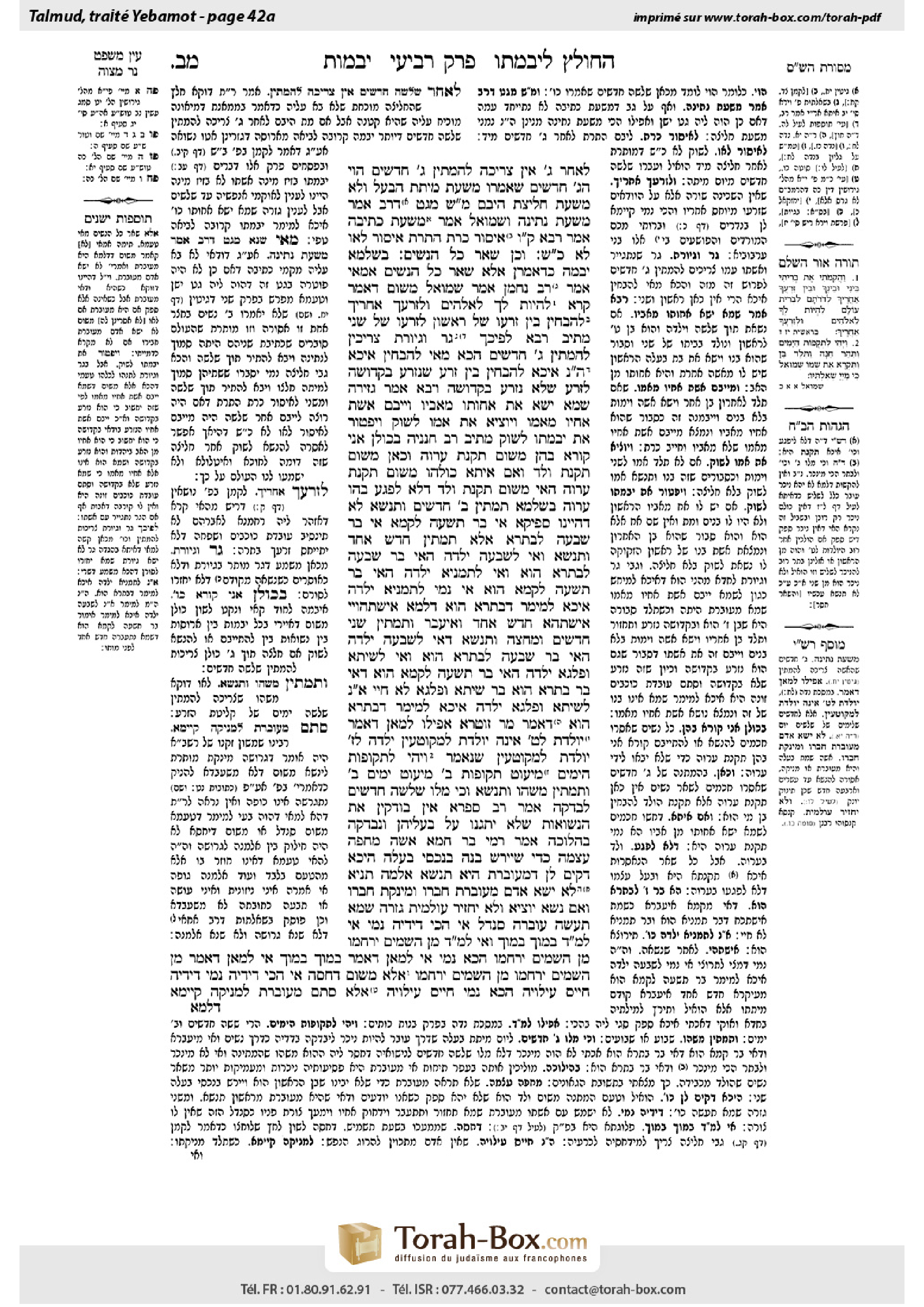
Yevamot 42a: Talmud study for Daf Yomi
Daf Yomi is the daily study of one Talmud folio. Explore 37 tractates with scans, Hebrew text, Sefaria English and AI-generated French translations where annotated.
Passage selection and English or AI-generated French translation are available where the scan has annotations. Daf Study is independent of Torah-Box and Sefaria.
Browse Yevamot · יבמות · All tractatesYevamot 42a text and translations
This page of Yevamot includes the Aramaic text, an English translation and an AI-generated French translation, alongside the scan above.
יבמות מ״ב א · Aramaic and Hebrew text
לְאַחַר שְׁלֹשָׁה — אֵין צְרִיכָה לְהַמְתִּין שְׁלֹשָׁה חֳדָשִׁים.
הֱוֵי (הַ)שְׁלֹשָׁה חֳדָשִׁים שֶׁאָמְרוּ, מִשְּׁעַת מִיתַת הַבַּעַל, וְלֹא מִשְּׁעַת חֲלִיצַת הַיָּבָם.
מַאי שְׁנָא מִגֵּט, דְּרַב אָמַר: מִשְּׁעַת נְתִינָה, וּשְׁמוּאֵל אָמַר: מִשְּׁעַת כְּתִיבָה!
אָמַר רָבָא, קַל וָחוֹמֶר: אִיסּוּר כָּרֵת הִתַּרְתָּ, אִיסּוּר לָאו — לֹא כׇּל שֶׁכֵּן.
וְכֵן שְׁאָר כׇּל הַנָּשִׁים. בִּשְׁלָמָא יְבָמָה, כְּדַאֲמַרַן. אֶלָּא שְׁאָר כׇּל הַנָּשִׁים אַמַּאי?
אָמַר רַב נַחְמָן אָמַר שְׁמוּאֵל, מִשּׁוּם דְּאָמַר קְרָא: ״לִהְיוֹת לְךָ לֵאלֹהִים וּלְזַרְעֲךָ אַחֲרֶיךָ״, לְהַבְחִין בֵּין זַרְעוֹ שֶׁל רִאשׁוֹן לְזַרְעוֹ שֶׁל שֵׁנִי.
מֵתִיב רָבָא: לְפִיכָךְ גֵּר וְגִיּוֹרֶת צְרִיכִין לְהַמְתִּין שְׁלֹשָׁה חֳדָשִׁים, הָכָא מַאי לְהַבְחִין אִיכָּא?
הָכָא נָמֵי, אִיכָּא לְהַבְחִין בֵּין זֶרַע שֶׁנִּזְרַע בִּקְדוּשָּׁה לְזֶרַע שֶׁלֹּא נִזְרַע בִּקְדוּשָּׁה.
רָבָא אָמַר: גְּזֵירָה שֶׁמָּא יִשָּׂא אֶת אֲחוֹתוֹ מֵאָבִיו, וִייַבֵּם אֵשֶׁת אָחִיו מֵאִמּוֹ.
וְיוֹצִיא אֶת אִמּוֹ לַשּׁוּק. וְיִפְטוֹר אֶת יְבִמְתּוֹ לַשּׁוּק.
מֵתִיב רַב חֲנַנְיָה: בְּכוּלָּן אֲנִי קוֹרֵא בָּהֶן מִשּׁוּם תַּקָּנַת עֶרְוָה, וְכָאן מִשּׁוּם תַּקָּנַת וָלָד. וְאִם אִיתָא, כּוּלְּהוּ מִשּׁוּם תַּקָּנַת עֶרְוָה!
הַאי מִשּׁוּם תַּקָּנַת וָלָד, דְּלָא לִפְגַע בְּהוּ עֶרְוָה.
בִּשְׁלָמָא תַּמְתִּין שְׁנֵי חֳדָשִׁים וְתִנָּשֵׂא — לָא, דְּהַיְינוּ סְפֵיקָא: אִי בַּר תִּשְׁעָה לְקַמָּא, אִי בַּר שִׁבְעָה לְבָתְרָא.
אֶלָּא תַּמְתִּין חֹדֶשׁ אֶחָד וְתִנָּשֵׂא, וְאִי לְשִׁבְעָה יָלְדָה — הַאי בַּר שִׁבְעָה לְבָתְרָא הוּא. וְאִי לִתְמָנְיָא יָלְדָה — הַאי בַּר תִּשְׁעָה לְקַמָּא הוּא!
אִי נָמֵי לִתְמָנְיָא יָלְדָה, אִיכָּא לְמֵימַר דְּבָתְרָא הוּא. דִּלְמָא אִישְׁתַּהוֹיֵי אִישְׁתַּהַי חֹדֶשׁ אֶחָד וְאִיעַבַּר.
וְתַמְתִּין שְׁנֵי חֳדָשִׁים וּמֶחֱצָה וְתִנָּשֵׂא, דְּאִי לְשִׁבְעָה יָלְדָה — הַאי בַּר שִׁבְעָה לְבָתְרָא הוּא, וְאִי לְשִׁיתָּא וּפַלְגָא יָלְדָה — הַאי בַּר תִּשְׁעָה לְקַמָּא הוּא. דְּאִי בַּר בָּתְרָא הוּא — בַּר שִׁיתָּא וּפַלְגָא לָא חָיֵי!
אִי נָמֵי לְשִׁיתָּא וּפַלְגָא יָלְדָה, אִיכָּא לְמֵימַר דְּבָתְרָא הוּא, דְּאָמַר מָר זוּטְרָא: אֲפִילּוּ לְמַאן דְּאָמַר יוֹלֶדֶת לְתִשְׁעָה אֵינָהּ יוֹלֶדֶת לִמְקוּטָּעִין, יָלְדָה לְשִׁבְעָה — יוֹלֶדֶת לִמְקוּטָּעִין.
שֶׁנֶּאֱמַר: ״וַיְהִי לִתְקֻפוֹת הַיָּמִים״, מִעוּט ״תְּקוּפוֹת״ — שְׁתַּיִם, מִעוּט ״יָמִים״ — שְׁנַיִם.
וְתַמְתִּין מַשֶּׁהוּ וְתִנָּשֵׂא, וְכִי מָלוּ שְׁלֹשָׁה חֳדָשִׁים — לִבְדְּקַהּ!
אָמַר רַב סָפְרָא: אֵין בּוֹדְקִין אֶת הַנְּשׂוּאוֹת, שֶׁלֹּא יִתְגַּנּוּ עַל בַּעֲלֵיהֶן. וְנִבְדְּקַהּ בְּהִלּוּכַהּ!
אָמַר רָמֵי בַּר חָמָא: אִשָּׁה מְחַפָּה עַצְמָהּ, כְּדֵי שֶׁיִּירַשׁ בְּנָהּ בְּנִכְסֵי בַעֲלָהּ.
הֵיכָא דְּקִים לַן דִּמְעוּבֶּרֶת הִיא, תִּנָּשֵׂא! אַלְּמָה תַּנְיָא: לֹא יִשָּׂא אָדָם מְעוּבֶּרֶת חֲבֵרוֹ וּמֵינֶקֶת חֲבֵרוֹ. וְאִם נָשָׂא — יוֹצִיא וְלֹא יַחְזִיר עוֹלָמִית!
גְּזֵרָה שֶׁמָּא תַּעֲשֶׂה עוּבָּרָהּ סַנְדָּל. אִי הָכִי, דִּידֵיהּ נָמֵי!
אִי לְמַאן דְּאָמַר בְּמוֹךְ — בְּמוֹךְ, וְאִי לְמַאן דְּאָמַר מִן הַשָּׁמַיִם יְרַחֲמוּ — מִן הַשָּׁמַיִם יְרַחֲמוּ.
הָכָא נָמֵי: אִי לְמַאן דְּאָמַר בְּמוֹךְ — בְּמוֹךְ, אִי לְמַאן דְּאָמַר מִן הַשָּׁמַיִם יְרַחֲמוּ — מִן הַשָּׁמַיִם יְרַחֲמוּ!
אֶלָּא, מִשּׁוּם דַּחְסָה. אִי הָכִי, דִּידֵיהּ נָמֵי! דִּידֵיהּ — חָיֵיס עִילָּוֵיהּ. הָכָא נָמֵי: חָיֵיס עִילָּוֵיהּ!
אֶלָּא: סְתָם מְעוּבֶּרֶת לְמֵנִיקָה קַיְימָא,
Yevamot 42a · English translation
If they performed the ḥalitza after three months, she does not need to wait three months and may marry immediately.
The Gemara infers from the latter clause of the baraita: It must be that the three months that are stated throughout the baraita are counted from the time of the husband’s death and not from the time of the ḥalitza of the yavam.
The Gemara asks: In what way is this case different from the case of a bill of divorce, where Rav said that the three months are counted from the time of the giving of the bill of divorce, and Shmuel said that the count is from the time of the writing of the bill. If a couple is secluded together after the bill of divorce is written, the bill of divorce is invalid. Therefore, there is no concern that they were secluded from that time. This is why Shmuel holds that the three months are counted from the writing. Rav apparently assumes that even so, the count always begins from the formal end of the marriage and not from the point from which there was no possibility of her becoming pregnant. Why, then, does the baraita not rule also in the case when a woman happens for levirate marriage, that the count should begin from the point of ḥalitza, since the marriage is only fully severed at that point?
Rava said: With regard to a yevama, all agree that the count begins from the time of her husband’s death. This can be derived through an a fortiori inference, as follows: If a prohibition that entails karet, i.e., the prohibition against engaging in relations with one’s brother’s wife in the event she is pregnant and not subject to levirate marriage, you have permitted after three months from the husband’s death, then in the case of a standard negative prohibition, such as the prohibition against engaging in relations with a woman within three months of the death of her previous husband, is it not all the more so clear that she should be permitted to remarry after three months from her husband’s death? Therefore, even Rav agrees that in this case, the count begins from the husband’s death.
§ The mishna states: And similarly, all other women may not be betrothed or marry until they have waited three months. The Gemara asks: Granted, a yevama has to wait, in accordance with the reason that we said, that if she is pregnant with viable offspring, consummating the levirate marriage would violate the prohibition against engaging in relations with one’s brother’s wife. But with regard to all other women, why shouldn’t they remarry immediately even if they are pregnant?
Rav Naḥman said that Shmuel said: It is due to the fact that the verse states with regard to Abraham: “To be a God to you and your seed after you” (Genesis 17:7), which indicates that the Divine Presence rests with someone only when his seed can be identified as being descended from him, i.e., there are no uncertainties with regard to their lineage. Therefore, to prevent any uncertainties concerning the lineage of her child, the woman must wait so that it will be possible to distinguish between the seed of the first husband and the seed of the second husband. After three months, if she has conceived from her previous husband, the pregnancy will already be noticeable.
Rava raised an objection from a baraita: Therefore, on account of the requirement to wait three months, a male convert and a female convert who were originally married to each other and converted need to wait three months before they may remarry following their conversion. Rava asks: Here, in this case, what reason is there to distinguish? Even if they do not wait and she is found to be pregnant, it is clear who the child’s parents are.
The Gemara explains: Here, too, there is a need to distinguish between seed that was sown in sanctity, i.e., a child conceived by a Jewish parents, and seed that was not sown in sanctity, i.e., a child conceived by gentile parents.
Rava stated a different reason for the need to wait: It is a rabbinic decree lest a child be born and be incorrectly identified as the son of his mother’s second husband when he is fact the son of her first husband. This could result in him marrying his paternal sister, unaware of the true relationship between them, or consummating a levirate marriage with the wife of his maternal brother under the misconception that his maternal brother was also his paternal brother. This would be prohibited because the prohibition to engage in relations with one’s brother’s wife is waived only in the case where there is a mitzva of levirate marriage, which applies only to paternal brothers.
Or in the event that his mother’s second husband died and he was assumed to be his only offspring, he would cause his mother to go out and be permitted to the general public because, under the misconception that he was the offspring of the deceased, he assumed that there was no mitzva of levirate marriage. Or, in the event that his maternal brother died childless and the brother’s widow became subject to levirate marriage, under the misconception that he was the paternal brother of the deceased he might perform ḥalitza and permit his supposed yevama to marry a man from the general public. To avoid these problems, the Sages decreed that a woman must wait before remarrying.
Rav Ḥananya raised an objection from a baraita: In all of those cases where the Sages prohibit a woman from marrying or consummating a levirate marriage, I identify that the prohibition is due to an ordinance instituted to prevent a violation of forbidden relations, and here, with regard to the prohibition against marrying within three months, it is due to an ordinance for the benefit of the offspring. Rav Ḥananya explains the challenge: And if it is so that Rava’s understanding of the prohibition against marrying within three months is correct, then all of the cases of forbidden marriages are due to an ordinance to prevent violation of forbidden relations. However, the baraita indicates otherwise.
The Gemara defends Rava’s opinion and explains that the baraita can be interpreted in a way that is consistent with his understanding: When the baraita says that this prohibition is due to an ordinance for the benefit of the offspring, it means that due to the prohibition the offspring will not encounter a prohibition of forbidden relations.
§ The Gemara analyzes the prohibition against marrying before three months have passed: Granted, she should not wait for only two months and then marry, as this is still a case that could give rise to an uncertainty whether the child born to her seven months after remarrying is nine months old, i.e., counting from conception, and it is the offspring of the first husband, or whether the child is only seven months old and is the offspring of the latter husband.
However, let her wait only one month and then marry, and then, since it is presumed that a baby born during its eighth month since conception is not viable but a baby born during its seventh or nine month is viable, if after seven months since remarrying she gives birth, then the child is clearly seven months old and is the offspring of the latter husband, and if after eight months since remarrying she gives birth, then this child is clearly nine months old and is the offspring of the first husband. Why, then, is there a need to wait three months?
The Gemara explains: Even if she gave birth after eight months since remarrying one could say that the child is the offspring of the latter husband, as perhaps she waited one month after remarrying and conceived only then. As such, the baby would be only seven months old, and that would explain its viability.
The Gemara asks further: But let her wait for two and a half months and then marry, as, if after seven months since remarrying she gives birth, then this child is clearly seven months old and is the offspring of the latter husband. And if after six and a half months since remarrying she gives birth, then this child is clearly nine months old and is the offspring of the first husband, because if one would suggest it is the offspring of the latter husband, in that case it would be six and a half months old, at which age it cannot survive.
The Gemara objects: Even if after six and a half months since remarrying she gave birth, one could say that the child is the offspring of the latter husband, as Mar Zutra said: Even according to the one who says that a woman who gives birth after nine months does not give birth after an incomplete number of months, i.e., she carries for a full nine months, nevertheless, a woman who gives birth after seven months can give birth after an incomplete number of months, and therefore it is possible that the baby was actually born after six and a half months.
This fact is derived from the verse concerning the birth of Samuel the prophet, as it is stated: “And it came to pass, when the seasons of the days had come, that Hannah conceived, and bore a son” (I Samuel 1:20). How much time is indicated by the phrase “the seasons of the days”? The minimal sense of the word “seasons” is two, and since each season of the year is three months, that indicates six months. The minimal sense of the word “days” is two. Accordingly, one may conclude that Samuel the prophet was born after six months and two days.
The Gemara suggests further: But let her wait any minimal amount of time, less than a month, and then marry, and then when three months after the end of her first marriage are complete, examine her body to see if she is noticeably pregnant. If she is, then perforce the baby is the offspring of her previous husband because a pregnancy is not noticeable until three months.
Rav Safra said: This solution is not possible because one does not examine the bodies of married women so as not to shame them before their husbands. The Gemara suggests: But let her be examined through the way she walks, since after three months a pregnant woman walks differently than a woman who is not pregnant.
Rami bar Ḥama said: A woman who conceived from her previous husband would mask herself by purposefully walking in a manner in which her pregnancy will not be discerned, so that her child will be identified as the son of her new husband in order that her child will ultimately inherit her new husband’s property. Therefore, it is impossible to rely upon a test of this kind. In summary, the Gemara has demonstrated that it would be ineffective to wait any less than three months.
§ The Gemara asks: In cases where we are convinced that she is pregnant, let her marry immediately, as the reason to wait three months does not apply. Why, then, is it taught in a baraita: A man may not marry a woman who is pregnant with the child of another man, nor a woman who is nursing the child of another man; and if he transgressed and married her, he is penalized for violating the prohibition, and he must divorce her and may never take her back?
The Gemara explains: This prohibition is a rabbinic decree lest she become pregnant a second time and her original fetus will be deformed into the shape of a sandal fish. The Gemara asks: If so, even if his wife is pregnant with his own child, the same concern applies.
The Gemara responds: She is permitted to engage in relations, both if one holds in accordance with the one who said that a young girl, for whom it is dangerous to become pregnant, is permitted to engage in relations using a contraceptive resorbent placed at the entrance to her womb, then also a woman pregnant with her husband’s child may engage in relations using a resorbent, and similarly if one holds in accordance with the one who said a young girl is permitted to engage in relations in her usual manner and Heaven will have mercy upon her and prevent any mishap, then in this case as well a pregnant woman should continue to engage in relations and Heaven will have mercy upon her.
The Gemara objects: But here, too, in the case of a woman who is pregnant with the child of another man, these solutions could be employed: Both if one holds in accordance with the one who says that a young girl may engage in relations using a resorbent, in this case as well she may do so using a resorbent, and similarly if one holds in accordance with the one who says that Heaven will have mercy upon her, in this case as well Heaven will have mercy upon her.
The Gemara suggests a different reason for the prohibition against marrying a woman who is pregnant with the child of another man: Rather, it is due to the damage that could be caused to the fetus by the pressure applied to it at the time of intercourse. The Gemara asks: If so, even if his wife his pregnant with his own child, the same concern applies. The Gemara explains: When it is his own child, he has mercy upon it and tries not to apply too much pressure. The Gemara asks: But here, too, when it is the child of another man, he will have mercy upon it, as certainly one is careful not to cause harm to any human life and will be careful not to press down too hard.
The Gemara suggests a different reason: Rather, the reason for the prohibition is that a typical pregnant woman is poised to nurse her child once it is born;
Yevamot 42a · Traduction française (IA)
Si la ḥalitza a été accomplie après trois mois, elle n’a pas besoin d’attendre trois mois et peut se marier immédiatement.
La Guemara déduit de la dernière clause de la baraïta que les trois mois mentionnés tout au long de la baraïta se comptent nécessairement à partir du décès du mari, et non à partir de la ḥalitza accomplie par le yavam.
La Guemara demande : En quoi ce cas diffère-t-il de celui d’un acte de divorce, au sujet duquel Rav a dit que les trois mois se comptent à partir de la remise de l’acte de divorce, tandis que Chmuel a dit que le décompte commence à partir de sa rédaction ? Si un couple se retrouve seul après la rédaction de l’acte de divorce, celui-ci est invalide. Il n’y a donc pas lieu de craindre qu’ils se soient retrouvés seuls à partir de ce moment-là. C’est pourquoi Chmuel estime que les trois mois se comptent à partir de la rédaction. Rav, semble-t-il, considère que malgré cela, le décompte commence toujours à partir de la dissolution officielle du mariage, et non à partir du moment où elle ne pouvait plus tomber enceinte. Pourquoi, alors, la baraïta ne statue-t-elle pas également, dans le cas où une femme est soumise au mariage léviratique, que le décompte doit commencer à partir de la ḥalitza, puisque le mariage n’est complètement dissous qu’à ce moment-là ?
Rava dit : En ce qui concerne une yevama, tous sont d’accord que le décompte commence au décès de son mari. On peut le déduire par raisonnement a fortiori : si vous avez permis, après trois mois à compter du décès de son mari, une relation interdite passible de karet — c’est-à-dire une relation avec la femme de son frère si elle est enceinte et n’est pas soumise au mariage léviratique —, alors, dans le cas d’une interdiction négative ordinaire, telle que l’interdiction d’avoir des relations avec une femme pendant les trois mois suivant le décès de son mari précédent, n’est-il pas d’autant plus évident qu’elle devrait être autorisée à se remarier trois mois après le décès de son mari ? Par conséquent, même Rav admet que, dans ce cas, le décompte commence au décès du mari.
§ La Michna enseigne : De même, toutes les autres femmes ne peuvent ni se fiancer ni se marier avant d’avoir attendu trois mois. La Guemara demande : Il est compréhensible qu’une yevama doive attendre, conformément à la raison que nous avons donnée : si elle est enceinte d’un enfant viable, consommer le mariage léviratique enfreindrait l’interdiction d’avoir des relations avec la femme de son frère. Mais, pour ce qui est de toutes les autres femmes, pourquoi ne pourraient-elles pas se remarier immédiatement, même si elles sont enceintes ?
Rav Naḥman rapporte au nom de Chmuel : C’est parce que le verset dit à propos d’Abraham : « Afin que je sois Dieu pour toi et pour ta descendance après toi » (Genèse 17, 7), ce qui indique que la Présence divine ne réside auprès d’une personne que lorsque l’on peut établir que sa descendance est issue de lui, c’est-à-dire lorsque sa filiation ne fait l’objet d’aucune incertitude. Aussi, afin d’éviter toute incertitude concernant la filiation de son enfant, la femme doit attendre, de sorte qu’on puisse distinguer la descendance du premier mari de celle du second. Au bout de trois mois, si elle a conçu de son mari précédent, la grossesse sera déjà visible.
Rava soulève une objection tirée d’une baraïta : C’est pourquoi, en raison de l’obligation d’attendre trois mois, un homme converti et une femme convertie qui étaient mariés l’un à l’autre avant leur conversion doivent attendre trois mois avant de pouvoir se remarier après leur conversion. Rava demande : Dans ce cas, quelle raison y a-t-il de distinguer ? Même s’ils n’attendent pas et qu’on découvre qu’elle est enceinte, il est évident que l’on sait qui sont les parents de l’enfant.
La Guemara explique : Ici aussi, il faut distinguer entre une descendance conçue dans la sainteté, c’est-à-dire un enfant conçu par des parents juifs, et une descendance qui n’a pas été conçue dans la sainteté, c’est-à-dire un enfant conçu par des parents non juifs.
Rava donne une autre raison à l’obligation d’attendre : il s’agit d’un décret rabbinique, de crainte qu’un enfant ne naisse et soit identifié à tort comme le fils du second mari de sa mère, alors qu’il est en réalité le fils de son premier mari. Il pourrait alors épouser sa sœur consanguine, ignorant leur véritable lien de parenté, ou consommer un mariage léviratique avec la femme de son frère utérin, croyant à tort que ce frère utérin était également son frère consanguin. Cela serait interdit, car l’interdiction d’avoir des relations avec la femme de son frère n’est levée que lorsqu’il y a une mitsva de mariage léviratique, qui ne s’applique qu’entre frères consanguins.
Ou bien, si le second mari de sa mère mourait et qu’on le croyait être son seul descendant, il ferait sortir sa mère de la situation d’interdiction et la rendrait permise au public, parce que, croyant qu’il était le descendant du défunt, il penserait qu’il n’y avait pas de mitsva de mariage léviratique. Ou encore, si son frère utérin mourait sans enfant et que la veuve de celui-ci était soumise au mariage léviratique, croyant à tort être le frère consanguin du défunt, il pourrait accomplir la ḥalitza et permettre à celle qu’il croit être sa yevama d’épouser un homme quelconque. Pour éviter ces problèmes, les Sages ont décrété qu’une femme doit attendre avant de se remarier.
Rav Ḥananya soulève une objection tirée d’une baraïta : Dans tous ces cas où les Sages interdisent à une femme de se marier ou de consommer un mariage léviratique, je comprends que l’interdiction découle d’une ordonnance instituée afin d’éviter une transgression des interdits sexuels ; mais ici, concernant l’interdiction de se marier avant trois mois, elle découle d’une ordonnance visant à protéger la descendance. Rav Ḥananya explique l’objection : S’il en est ainsi, et que Rava a raison dans son interprétation de l’interdiction de se marier avant trois mois, alors tous les cas de mariages interdits relèvent d’une ordonnance visant à éviter la transgression des interdits sexuels. Pourtant, la baraïta indique le contraire.
La Guemara défend l’opinion de Rava et explique que l’on peut interpréter la baraïta de manière à la concilier avec son interprétation : lorsque la baraïta dit que cette interdiction découle d’une ordonnance visant à protéger la descendance, cela signifie que, grâce à cette interdiction, la descendance ne sera pas confrontée à une relation interdite.
§ La Guemara examine l’interdiction de se marier avant que trois mois ne se soient écoulés : Il est compréhensible qu’elle ne doive pas attendre seulement deux mois avant de se marier, car il resterait alors une incertitude : l’enfant qu’elle met au monde sept mois après son remariage a-t-il neuf mois, comptés depuis la conception, et est-il le fils de son premier mari, ou n’a-t-il que sept mois et est-il le fils de son dernier mari ?
Mais qu’elle n’attende qu’un mois avant de se marier ; alors, puisqu’on présume qu’un bébé né au cours de son huitième mois depuis la conception n’est pas viable, tandis qu’un bébé né au cours de son septième ou de son neuvième mois est viable, si elle accouche sept mois après son remariage, l’enfant a clairement sept mois et est le fils de son dernier mari ; et si elle accouche huit mois après son remariage, cet enfant a clairement neuf mois et est le fils de son premier mari. Pourquoi faut-il donc attendre trois mois ?
La Guemara explique : Même si elle accouchait huit mois après son remariage, on pourrait dire que l’enfant est le fils de son dernier mari, car elle a peut-être attendu un mois après son remariage avant de concevoir. L’enfant n’aurait alors que sept mois, ce qui expliquerait qu’il soit viable.
La Guemara demande encore : Mais qu’elle attende deux mois et demi avant de se marier ; si elle accouche sept mois après son remariage, l’enfant a clairement sept mois et est le fils de son dernier mari. Et si elle accouche six mois et demi après son remariage, l’enfant a clairement neuf mois et est le fils de son premier mari, car si l’on suggérait qu’il est le fils de son dernier mari, il n’aurait alors que six mois et demi, âge auquel il ne peut survivre.
La Guemara objecte : Même si elle accouchait six mois et demi après son remariage, on pourrait dire que l’enfant est le fils de son dernier mari, car Mar Zutra a dit : Même selon celui qui dit qu’une femme qui accouche après neuf mois n’accouche pas avant que le nombre complet de mois se soit écoulé, c’est-à-dire qu’elle porte son enfant pendant neuf mois complets, une femme qui accouche après sept mois peut néanmoins accoucher avant que le nombre complet de mois se soit écoulé ; il est donc possible que le bébé soit en réalité né après six mois et demi.
Ce fait se déduit du verset relatif à la naissance du prophète Samuel, comme il est dit : « Et il arriva, lorsque le temps fut venu, qu’Anne conçut et enfanta un fils » (I Samuel 1, 20). Quelle durée l’expression « le temps fut venu » indique-t-elle ? Le sens minimal du mot « temps » est deux, et comme chaque saison de l’année dure trois mois, cela indique six mois. Le sens minimal du mot « jours » est deux. On peut donc conclure que le prophète Samuel est né après six mois et deux jours.
La Guemara propose encore : Qu’elle attende un laps de temps minimal, inférieur à un mois, puis se marie ; lorsque trois mois se seront écoulés depuis la fin de son premier mariage, on examinera son corps pour voir si sa grossesse est visible. Si c’est le cas, il s’ensuit nécessairement que le bébé est le fils de son mari précédent, car une grossesse n’est visible qu’au bout de trois mois.
Rav Safra dit : Cette solution n’est pas possible, car on n’examine pas le corps des femmes mariées, afin de ne pas les couvrir de honte devant leurs maris. La Guemara propose : Mais qu’on l’examine en observant sa démarche, car, après trois mois, une femme enceinte marche différemment d’une femme qui ne l’est pas.
Rami bar Ḥama dit : Une femme qui a conçu de son mari précédent dissimulerait sa grossesse en marchant exprès d’une manière qui ne permettrait pas de la remarquer, afin que son enfant soit identifié comme le fils de son nouveau mari et puisse, en définitive, hériter des biens de celui-ci. Il est donc impossible de se fier à un examen de ce genre. En résumé, la Guemara a démontré qu’attendre moins de trois mois serait inefficace.
§ La Guemara demande : Dans les cas où nous sommes certains qu’elle est enceinte, qu’elle se marie immédiatement, puisque la raison d’attendre trois mois ne s’applique pas. Pourquoi, alors, enseigne-t-on dans une baraïta : Un homme ne peut pas épouser une femme enceinte de l’enfant d’un autre homme, ni une femme qui allaite l’enfant d’un autre homme ; et s’il a transgressé et l’a épousée, il est sanctionné pour avoir enfreint l’interdiction et doit divorcer d’elle, sans jamais pouvoir la reprendre ?
La Guemara explique : Cette interdiction est un décret rabbinique, de crainte qu’elle ne tombe une seconde fois enceinte et que son fœtus initial ne se déforme en prenant la forme d’un poisson-sandal. La Guemara demande : Dans ce cas, la même crainte s’applique même si sa femme est enceinte de son propre enfant.
La Guemara répond : Elle est autorisée à avoir des relations, que l’on adopte l’opinion de celui qui dit qu’une jeune fille, pour qui une grossesse serait dangereuse, est autorisée à avoir des relations en utilisant une éponge contraceptive placée à l’entrée de son utérus — auquel cas une femme enceinte de l’enfant de son mari peut, elle aussi, avoir des relations en utilisant une éponge —, ou que l’on adopte l’opinion de celui qui dit qu’une jeune fille est autorisée à avoir des relations de la manière habituelle, et que le Ciel aura pitié d’elle et empêchera tout malheur ; dans ce cas également, une femme enceinte doit continuer à avoir des relations, et le Ciel aura pitié d’elle.
La Guemara objecte : Mais ici aussi, dans le cas d’une femme enceinte de l’enfant d’un autre homme, on pourrait recourir à ces solutions : que l’on adopte l’opinion de celui qui dit qu’une jeune fille peut avoir des relations en utilisant une éponge, auquel cas elle peut faire de même ici ; ou que l’on adopte l’opinion de celui qui dit que le Ciel aura pitié d’elle, auquel cas le Ciel aura également pitié d’elle ici.
La Guemara propose une autre raison à l’interdiction d’épouser une femme enceinte de l’enfant d’un autre homme : elle découle plutôt du dommage que la pression exercée au moment des relations pourrait causer au fœtus. La Guemara demande : Dans ce cas, la même crainte s’applique même si sa femme est enceinte de son propre enfant. La Guemara explique : Lorsqu’il s’agit de son propre enfant, il en a pitié et s’efforce de ne pas exercer une pression excessive. La Guemara demande : Mais ici aussi, lorsqu’il s’agit de l’enfant d’un autre homme, il en aura pitié, car chacun prend certainement garde à ne pas nuire à une vie humaine et veille à ne pas exercer une pression trop forte.
La Guemara propose une autre raison : l’interdiction s’explique plutôt par le fait qu’une femme enceinte ordinaire est censée allaiter son enfant après sa naissance ;
Traduction française générée par IA à partir de l’édition anglaise de Sefaria. Vérifie toujours un passage avec le texte source.
Text from Sefaria: William Davidson Edition - Vocalized Aramaic (CC BY NC); William Davidson Edition - English (CC BY NC).