Yevamot 42b: Talmud study for Daf Yomi
Daf Yomi is the daily study of one Talmud folio. Explore 37 tractates with scans, Hebrew text, Sefaria English and AI-generated French translations where annotated.
Passage selection and English or AI-generated French translation are available where the scan has annotations. Daf Study is independent of Torah-Box and Sefaria.
Browse Yevamot · יבמות · All tractatesYevamot 42b text and translations
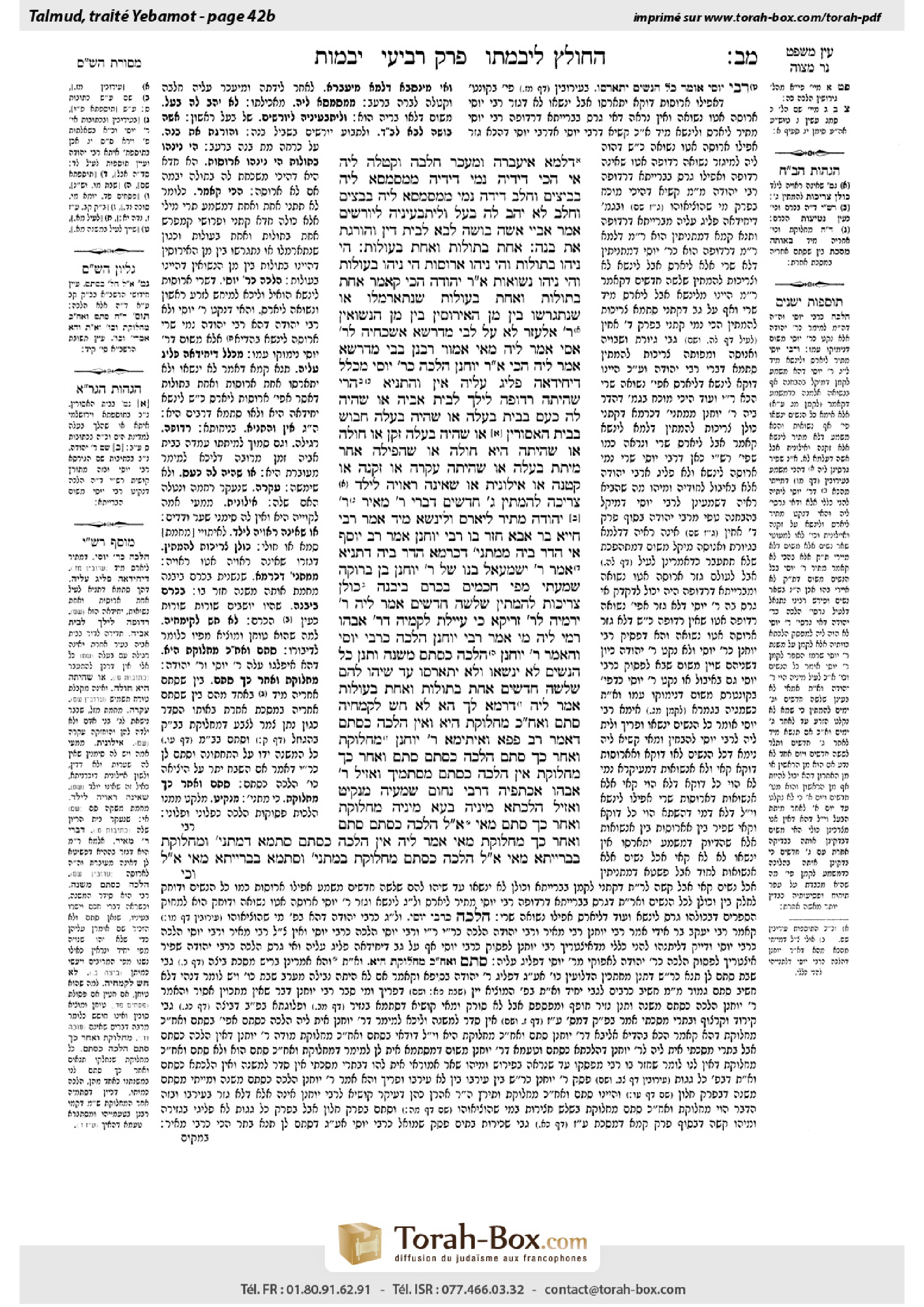
This page of Yevamot includes the Aramaic text, an English translation and an AI-generated French translation, alongside the scan above.
יבמות מ״ב ב · Aramaic and Hebrew text
דִּלְמָא אִיעַבַּרָה וּמִעֲכַר חַלְבַהּ, וְקָטְלָה לֵיהּ. אִי הָכִי, דִּידֵיהּ נָמֵי! דִּידֵיהּ — מְמַסְמְסָא לֵיהּ בְּבֵיצִים. וְחָלָב דִּידַהּ נָמֵי, מְמַסְמְסָא לֵיהּ בְּבֵצִים וְחָלָב! לָא יָהֵב לַהּ בַּעַל. (וְלִיתְבְּעִינֵיהּ) [וְתִתְבְּעִינְהוּ] לְיוֹרְשִׁים! אָמַר אַבָּיֵי: אִשָּׁה בּוֹשָׁה לָבֹא לְבֵית דִּין, וְהוֹרֶגֶת אֶת בְּנָהּ.
אַחַת בְּתוּלוֹת וְאַחַת בְּעוּלוֹת. הֵי נִיהוּ בְּתוּלוֹת וְהֵי נִיהוּ אֲרוּסוֹת? הֵי נִיהוּ בְּעוּלוֹת וְהֵי נִיהוּ נְשׂוּאוֹת?
אָמַר רַבִּי יְהוּדָה, הָכִי קָאָמַר: אַחַת בְּתוּלוֹת וְאַחַת בְּעוּלוֹת שֶׁנִּתְאַרְמְלוּ אוֹ שֶׁנִּתְגָּרְשׁוּ, בֵּין מִן הָאֵרוּסִין בֵּין מִן הַנִּשּׂוּאִין.
רַבִּי אֶלְעָזָר לָא עָל לְבֵי מִדְרְשָׁא. אַשְׁכְּחֵיהּ לְרַבִּי אַסִּי, אֲמַר לֵיהּ: מַאי אֲמוּר רַבָּנַן בְּבֵי מִדְרְשָׁא? אֲמַר לֵיהּ, הָכִי אָמַר רַבִּי יוֹחָנָן: הֲלָכָה כְּרַבִּי יוֹסֵי.
מִכְּלָל דִּיחִידָאָה פְּלִיג עֲלֵיהּ? אִין, וְהָתַנְיָא: הֲרֵי שֶׁהָיְתָה רְדוּפָה לֵילֵךְ לְבֵית אָבִיהָ, אוֹ שֶׁהָיָה לָהּ כַּעַס בְּבֵית בַּעְלָהּ, אוֹ שֶׁהָיָה בַּעְלָהּ חָבוּשׁ בְּבֵית הָאֲסוּרִין, אוֹ שֶׁהָיָה בַּעְלָהּ זָקֵן אוֹ חוֹלֶה, אוֹ שֶׁהָיְתָה הִיא חוֹלָה,
אוֹ שֶׁהִפִּילָה אַחַר מִיתַת בַּעְלָהּ, אוֹ שֶׁהָיְתָה עֲקָרָה, אוֹ זְקֵנָה, אוֹ קְטַנָּה, אוֹ אַיְלוֹנִית, אוֹ שֶׁאֵינָהּ רְאוּיָה לֵילֵד — צְרִיכָה לְהַמְתִּין שְׁלֹשָׁה חֳדָשִׁים, דִּבְרֵי רַבִּי מֵאִיר. רַבִּי יְהוּדָה מַתִּיר לֵיאָרֵס וְלִינָּשֵׂא מִיָּד.
אָמַר רַבִּי חִיָּיא בַּר אַבָּא: חָזַר בּוֹ רַבִּי יוֹחָנָן. אָמַר רַב יוֹסֵף: אִי הֲדַר בֵּיהּ — מִמַּתְנִיתִין דְּכַרְמָא הֲדַר בֵּיהּ. דְּתַנְיָא: אָמַר רַבִּי יִשְׁמָעֵאל בְּנוֹ שֶׁל רַבִּי יוֹחָנָן בֶּן בְּרוֹקָה, שָׁמַעְתִּי מִפִּי חֲכָמִים בַּכֶּרֶם בְּיַבְנֶה: כּוּלָּן צְרִיכוֹת לְהַמְתִּין שְׁלֹשָׁה חֳדָשִׁים.
אֲמַר לֵיהּ רַבִּי יִרְמְיָה לְרַבִּי זְרִיקָא: כִּי עָיְילַתְּ לְקַמֵּיהּ דְּרַבִּי אֲבָהוּ, רְמִי לֵיהּ: מִי אָמַר רַבִּי יוֹחָנָן הֲלָכָה כְּרַבִּי יוֹסֵי? וְהָאָמַר רַבִּי יוֹחָנָן: הֲלָכָה כִּסְתַם מִשְׁנָה. וּתְנַן: כׇּל הַנָּשִׁים לֹא יִנָּשְׂאוּ וְלֹא יִתְאָרְסוּ עַד שֶׁיְּהוּ לָהֶם שְׁלֹשָׁה חֳדָשִׁים, אַחַת בְּתוּלוֹת וְאַחַת בְּעוּלוֹת!
אֲמַר לֵיהּ: דִּרְמָא לָךְ הָא — לָא חַשׁ לְקִמְחֵיהּ. סְתָם וְאַחַר כָּךְ מַחְלוֹקֶת הִיא, וְאֵין הֲלָכָה כִּסְתָם. דְּאָמַר רַב פָּפָּא, וְאִיתֵּימָא רַבִּי יוֹחָנָן: מַחְלוֹקֶת וְאַחַר כָּךְ סְתָם — הֲלָכָה כִּסְתָם. סְתָם וְאַחַר כָּךְ מַחְלוֹקֶת — אֵין הֲלָכָה כִּסְתָם.
מִסְתְּמִיךְ וְאָזֵיל רַבִּי אֲבָהוּ אַכַּתְפֵּיהּ דְּרַבִּי נַחוּם שַׁמָּעֵיהּ, מְנַקֵּיט וְאָזֵיל הִלְכָתָא מִינֵּיהּ. בְּעָא מִינֵּיהּ: מַחְלוֹקֶת וְאַחַר כָּךְ סְתָם מַאי? אֲמַר לֵיהּ: הֲלָכָה כִּסְתָם. סְתָם וְאַחַר כָּךְ מַחְלוֹקֶת מַאי? אֲמַר לֵיהּ: אֵין הֲלָכָה כִּסְתָם.
סְתָמָא דְּמַתְנִיתִין וּמַחְלוֹקֶת בְּבָרַיְיתָא, מַאי? אֲמַר לֵיהּ: הֲלָכָה כִּסְתָם. מַחְלוֹקֶת בְּמַתְנִיתִין וּסְתָמָא בְּבָרַיְיתָא, מַאי? אֲמַר לֵיהּ:
Yevamot 42b · English translation
therefore, one should be concerned that perhaps she will become pregnant and her milk will dry up during pregnancy, and the lack of milk will kill her newborn child. The Gemara asks: If so, even if his wife is pregnant with his own child, the same concern applies. The Gemara explains: For his own child, she will feed [memasmesa] him with eggs and milk as a substitute for the mother’s milk. The Gemara asks: Even if the child is not his, it is still the mother’s child, and for her child she will also feed him with eggs and milk. The Gemara answers: The husband will not give her money to procure food for a child that is not his. The Gemara asks: But she could sue her first husband’s heirs to provide subsistence for the child. Abaye said: A woman is embarrassed to come to court, and therefore she will not obtain enough sustenance for him. Consequently, she effectively kills her son as a result.
§ The mishna states: The requirement to wait three months before remarrying applies both to virgins and non-virgins, both to divorcées and to widows, and both to women who were married to their previous husbands and to women who were only betrothed. The Gemara asks: Which women are referred to as virgins and which are referred to as those who were betrothed? Although the two terms appear to be synonymous, since a virgin will be subject to levirate marriage only if she was betrothed, they must certainly refer to two different categories of women. Similarly, which women are referred to as non-virgins and which are referred to as married, as a married woman is always considered to be a non-virgin?
Rabbi Yehuda said this is what the mishna is saying: The requirement to wait applies to both virgins and non-virgins who were widowed or divorced, whether from betrothal or from marriage, i.e., the mishna does not list different categories of women but instead establishes a general principle.
The Gemara relates: Rabbi Elazar did not enter the study hall one day. He found Rabbi Asi and said to him: What was said by the Sages in the study hall today? He said to him: This is what Rabbi Yoḥanan said: The halakha is in accordance with the opinion of Rabbi Yosei that a woman is permitted to be betrothed even before three months have passed, since the reason for waiting does not apply in that case.
Rabbi Elazar said: From the fact that Rabbi Yoḥanan needed to state this, it would seem that there is an individual opinion that disagrees with him, even though no such opinion is mentioned in the mishna. Rabbi Asi answered: Yes, that is correct, and so it is taught in a baraita in the Tosefta (Yevamot 6:6): With regard to a woman who is certainly not pregnant, for example, a woman who, at the time of her husband’s death, had not lived with her husband for some time because she always eagerly hurried, like one pursued, to go to her father’s house, or because she had been subject to anger in her husband’s house, or because her husband had been incarcerated in prison, or because her husband was elderly or infirm, or because she was infirm.
Or a woman who could not be pregnant because she miscarried after her husband’s death, or because she was barren, or elderly, or a minor, or a sexually underdeveloped woman [aylonit], or if for some other reason she was unsuited to give birth; even though the reason for the decree to wait three months does not apply to such a woman, nevertheless, she must wait three months. This is the statement of Rabbi Meir. Rabbi Yehuda permits such women to be betrothed or to marry immediately. It is apparent from the baraita that the question of whether a woman is required to wait the three months when the reason to do so does not apply is subject to a dispute.
Rabbi Ḥiyya bar Abba said: Rabbi Yoḥanan retracted his statement that the halakha is in accordance with the opinion of Rabbi Yosei. Rav Yosef said: Even if he wanted to retract his statement, would he retract from the baraita that records the opinions of the Sages of the vineyard of Yavne? As it is taught in a baraita: Rabbi Yishmael, son of Rabbi Yoḥanan ben Beroka, said: I heard from the mouth of the Sages in the vineyard of Yavne that all those women enumerated in the baraita above need to wait three months. If the great Sages of Yavne held in accordance with the opinion Rabbi Yosei, then the halakha is certainly in accordance with his opinion.
Rabbi Yirmeya said to Rabbi Zerika: When you come before Rabbi Abbahu, raise the following contradiction: Did Rabbi Yoḥanan actually say that the halakha is in accordance with the opinion of Rabbi Yosei? Didn’t Rabbi Yoḥanan say that the halakha is always established in accordance with the ruling of an unattributed mishna? And we learned in the mishna an unattributed ruling: All women may not marry and may not be betrothed until they have waited three months since their previous marriage ended; this applies to both virgins and non-virgins.
When Rabbi Zerika went and asked, Rabbi Abbahu said to him: The one who raised this contradiction to you is clearly not concerned for his flour; this is a case of an unattributed ruling followed by a dispute on that ruling, and in such cases the halakha is not necessarily in accordance with the unattributed opinion. As Rav Pappa said, and some say it was Rabbi Yoḥanan who said the following principle: When the Mishna first records a dispute, and afterward it records only one side of that dispute as an unattributed opinion, then the halakha is in accordance with the unattributed opinion. However, when the Mishna first records an unattributed opinion and afterward records that the ruling is subject to a dispute, the halakha is not necessarily in accordance with the unattributed opinion. In each case, the later reference is considered to be a summary of the matter.
§ The Gemara relates: Rabbi Abbahu would walk while leaning upon the shoulder of Rabbi Naḥum, his attendant, and along the way Rabbi Naḥum would walk and gather halakhic rulings from him. Once, Rabbi Naḥum asked him: When the Mishna first records a dispute, and afterward it records only one side of that dispute as an unattributed opinion, what is the halakha? Rabbi Abbahu said to him: The halakha is in accordance with the unattributed opinion. Rabbi Naḥum then asked: When the Mishna first records an unattributed opinion and afterward records that the ruling is subject to a dispute, what is the halakha? Rabbi Abbahu said to him: The halakha is not necessarily in accordance with the unattributed opinion.
Rabbi Naḥum asked: When a ruling is recorded in the Mishna as unattributed and it is subject to a dispute in a baraita, what is the halakha? Rabbi Abbahu said to him: The halakha is in accordance with the unattributed opinion in the Mishna. Rabbi Naḥum then asked: When the Mishna records that a matter is subject to a dispute, and only one side is recorded as an unattributed opinion in a baraita, what is the halakha? Rabbi Abbahu said to him:
Yevamot 42b · Traduction française (IA)
Il faut donc craindre qu’elle tombe enceinte et que son lait se tarisse pendant la grossesse, et que le manque de lait ne tue son nouveau-né. La Guemara demande : si tel est le cas, même lorsque sa femme est enceinte de son propre enfant, la même crainte s’applique. La Guemara explique : pour son propre enfant, elle le nourrira [memasmesa] avec des œufs et du lait en remplacement du lait maternel. La Guemara demande : même si l’enfant n’est pas le sien, il reste l’enfant de sa mère, et elle le nourrira également avec des œufs et du lait. La Guemara répond : le mari ne lui donnera pas d’argent pour se procurer de la nourriture pour un enfant qui n’est pas le sien. La Guemara demande : mais elle pourrait poursuivre en justice les héritiers de son premier mari afin qu’ils assurent la subsistance de l’enfant. Abaye dit : une femme a honte de se présenter au tribunal ; elle n’obtiendra donc pas suffisamment de quoi le nourrir. Par conséquent, elle cause effectivement la mort de son fils de cette manière.
§ La Michna enseigne que l’obligation d’attendre trois mois avant de se remarier s’applique aussi bien aux vierges qu’aux non-vierges, aux divorcées comme aux veuves, et aux femmes qui étaient mariées à leur précédent mari comme à celles qui étaient seulement fiancées. La Guemara demande : quelles femmes désigne-t-on comme vierges, et lesquelles désigne-t-on comme ayant été fiancées ? Bien que ces deux termes semblent synonymes, puisqu’une vierge ne sera soumise au mariage léviratique que si elle était fiancée, ils doivent nécessairement désigner deux catégories différentes de femmes. De même, quelles femmes désigne-t-on comme non-vierges, et lesquelles comme ayant été mariées, puisqu’une femme mariée est toujours considérée comme non-vierge ?
Rabbi Yehuda dit que voici ce que la Michna enseigne : l’obligation d’attendre s’applique aussi bien aux vierges qu’aux non-vierges devenues veuves ou divorcées, qu’elles aient été fiancées ou mariées. Autrement dit, la Michna n’énumère pas différentes catégories de femmes, mais établit plutôt un principe général.
La Guemara rapporte : un jour, Rabbi Elazar ne se rendit pas à la maison d’étude. Il rencontra Rabbi Asi et lui demanda : qu’ont dit les Sages aujourd’hui à la maison d’étude ? Celui-ci lui répondit : voici ce qu’a dit Rabbi Yoḥanan : la halakha est conforme à l’opinion de Rabbi Yosei, selon laquelle une femme est autorisée à se fiancer avant même que trois mois se soient écoulés, puisque la raison de l’attente ne s’applique pas dans ce cas.
Rabbi Elazar dit : du fait que Rabbi Yoḥanan ait eu besoin de préciser cela, il semblerait qu’une opinion individuelle soit en désaccord avec lui, bien qu’aucune opinion de ce genre ne soit mentionnée dans la Michna. Rabbi Asi répondit : oui, c’est bien le cas, comme l’enseigne une baraïta dans la Tossefta (Yevamot 6:6) : avec une femme dont il est certain qu’elle n’est pas enceinte, par exemple une femme qui, au moment de la mort de son mari, n’avait pas vécu avec lui depuis quelque temps parce qu’elle avait toujours coutume de se hâter avec empressement, comme si elle était poursuivie, pour se rendre chez son père, ou parce qu’elle était en butte à la colère dans la maison de son mari, ou parce que son mari avait été emprisonné, ou parce que son mari était âgé ou infirme, ou parce qu’elle-même était infirme.
Ou une femme qui ne pouvait pas être enceinte parce qu’elle avait fait une fausse couche après la mort de son mari, ou parce qu’elle était stérile, âgée, mineure, sexuellement sous-développée [aylonit], ou pour toute autre raison qui la rendait inapte à enfanter ; bien que la raison du décret imposant d’attendre trois mois ne s’applique pas à une telle femme, elle doit néanmoins attendre trois mois. Telle est l’opinion de Rabbi Meir. Rabbi Yehuda autorise ces femmes à se fiancer ou à se marier immédiatement. Il ressort de la baraïta que la question de savoir si une femme doit attendre trois mois lorsque la raison de cette attente ne s’applique pas fait l’objet d’un désaccord.
Rabbi Ḥiyya bar Abba dit : Rabbi Yoḥanan est revenu sur sa déclaration selon laquelle la halakha est conforme à l’opinion de Rabbi Yosei. Rav Yosef dit : même s’il avait voulu revenir sur sa déclaration, l’aurait-il fait contre la baraïta qui rapporte les opinions des Sages du vignoble de Yavne ? En effet, une baraïta enseigne : Rabbi Yishmael, fils de Rabbi Yoḥanan ben Beroka, dit : j’ai entendu de la bouche des Sages du vignoble de Yavne que toutes les femmes énumérées dans la baraïta ci-dessus doivent attendre trois mois. Si les grands Sages de Yavne estimaient que la halakha était conforme à l’opinion de Rabbi Yosei, alors la halakha est certainement conforme à son opinion.
Rabbi Yirmeya dit à Rabbi Zerika : lorsque tu te présenteras devant Rabbi Abbahu, soulève la contradiction suivante : Rabbi Yoḥanan a-t-il vraiment dit que la halakha est conforme à l’opinion de Rabbi Yosei ? Rabbi Yoḥanan n’a-t-il pas dit que la halakha est toujours établie conformément à une décision anonyme de la Michna ? Or, nous avons appris dans la Michna une décision anonyme : aucune femme ne peut se marier ni se fiancer avant d’avoir attendu trois mois depuis la fin de son précédent mariage ; cela s’applique aussi bien aux vierges qu’aux non-vierges.
Lorsque Rabbi Zerika alla lui poser la question, Rabbi Abbahu lui dit : celui qui t’a soulevé cette contradiction ne se soucie manifestement pas de son pain ; il s’agit d’une décision anonyme suivie d’un désaccord portant sur cette décision, et dans de tels cas la halakha n’est pas nécessairement conforme à l’opinion anonyme. En effet, Rav Pappa a dit — et certains disent que c’est Rabbi Yoḥanan qui a énoncé le principe suivant : lorsque la Michna rapporte d’abord un désaccord, puis ne rapporte qu’un seul côté de ce désaccord sous forme d’opinion anonyme, la halakha est conforme à l’opinion anonyme. En revanche, lorsque la Michna rapporte d’abord une opinion anonyme, puis indique que la décision fait l’objet d’un désaccord, la halakha n’est pas nécessairement conforme à l’opinion anonyme. Dans chaque cas, la référence ultérieure est considérée comme un résumé de la question.
§ La Guemara rapporte : Rabbi Abbahu marchait en s’appuyant sur l’épaule de Rabbi Naḥum, son assistant, et, en chemin, Rabbi Naḥum recueillait auprès de lui des décisions halakhiques. Un jour, Rabbi Naḥum lui demanda : lorsque la Michna rapporte d’abord un désaccord, puis ne rapporte qu’un seul côté de ce désaccord sous forme d’opinion anonyme, quelle est la halakha ? Rabbi Abbahu lui répondit : la halakha est conforme à l’opinion anonyme. Rabbi Naḥum demanda ensuite : lorsque la Michna rapporte d’abord une opinion anonyme, puis indique que la décision fait l’objet d’un désaccord, quelle est la halakha ? Rabbi Abbahu lui répondit : la halakha n’est pas nécessairement conforme à l’opinion anonyme.
Rabbi Naḥum demanda : lorsqu’une décision est rapportée anonymement dans la Michna et fait l’objet d’un désaccord dans une baraïta, quelle est la halakha ? Rabbi Abbahu lui répondit : la halakha est conforme à l’opinion anonyme de la Michna. Rabbi Naḥum demanda ensuite : lorsque la Michna indique qu’une question fait l’objet d’un désaccord et qu’un seul côté est rapporté anonymement dans une baraïta, quelle est la halakha ? Rabbi Abbahu lui répondit :
Traduction française générée par IA à partir de l’édition anglaise de Sefaria. Vérifie toujours un passage avec le texte source.
Text from Sefaria: William Davidson Edition - Vocalized Aramaic (CC BY NC); William Davidson Edition - English (CC BY NC).