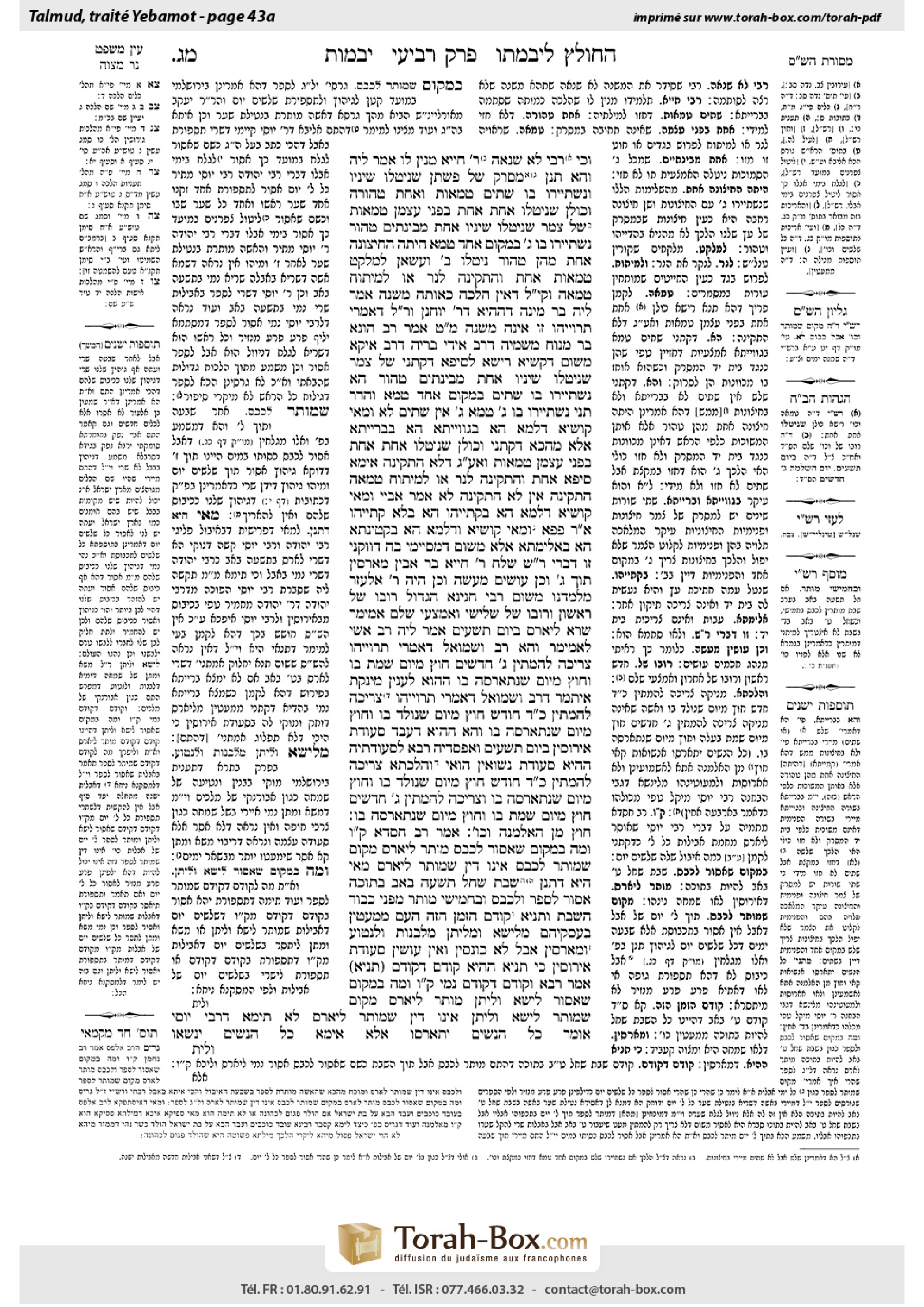
Yevamot 43a: Talmud study for Daf Yomi
Daf Yomi is the daily study of one Talmud folio. Explore 37 tractates with scans, Hebrew text, Sefaria English and AI-generated French translations where annotated.
Passage selection and English or AI-generated French translation are available where the scan has annotations. Daf Study is independent of Torah-Box and Sefaria.
Browse Yevamot · יבמות · All tractatesYevamot 43a text and translations
This page of Yevamot includes the Aramaic text, an English translation and an AI-generated French translation, alongside the scan above.
יבמות מ״ג א · Aramaic and Hebrew text
וְכִי רַבִּי לֹא שְׁנָאָהּ, רַבִּי חִיָּיא מִנַּיִן לוֹ?
אֲמַר לֵיהּ, וְהָא תְּנַן: מַסְרֵק שֶׁל פִּשְׁתָּן שֶׁנִּיטְּלוּ שִׁינָּיו, וְנִשְׁתַּיְּירוּ בּוֹ שְׁתַּיִם — טְמֵאוֹת, וְאַחַת — טְהוֹרָה. וְכוּלָּן שֶׁנִּיטְּלוּ אַחַת אַחַת בִּפְנֵי עַצְמָן — טְמֵאוֹת.
שֶׁל צֶמֶר שֶׁנִּיטְּלוּ שִׁינָּיו אַחַת מִבֵּינְתַיִם — טָהוֹר. נִשְׁתַּיְּירוּ בּוֹ שְׁלֹשׁ בְּמָקוֹם אֶחָד — טָמֵא. הָיְתָה הַחִיצוֹנָה אַחַת מֵהֶן — טָהוֹר. נִיטְּלוּ שְׁנַיִם וַעֲשָׂאָן לְמַלְקֵט — טְמֵאוֹת. אַחַת וְהִתְקִינָהּ לְנֵר אוֹ לְמִיתּוּחַ — טְמֵאָה.
וְקַיְימָא לַן דְּאֵין הֲלָכָה כְּאוֹתָהּ מִשְׁנָה! אֲמַר לֵיהּ: בַּר מִינַּהּ דְּהַהִיא, דְּרַבִּי יוֹחָנָן וְרֵישׁ לָקִישׁ דְּאָמְרִי תַּרְוַיְיהוּ: זוֹ אֵינָהּ מִשְׁנָה.
מַאי טַעְמָא? אָמַר רַב הוּנָא בַּר מָנוֹחַ מִשְּׁמֵיהּ דְּרַב אִידִי בְּרֵיהּ דְּרַב אִיקָא: מִשּׁוּם דְּקַשְׁיָא רֵישָׁא לְסֵיפָא. דְּקָתָנֵי: שֶׁל צֶמֶר שֶׁנִּיטְּלוּ שִׁינָּיו אַחַת מִבֵּינְתַיִם — טָהוֹר. הָא נִשְׁתַּיְּירוּ בּוֹ שְׁתַּיִם בְּמָקוֹם אֶחָד — טָמֵא, וַהֲדַר תָּנֵי נִשְׁתַּיְּירוּ בּוֹ שְׁלֹשׁ — טָמֵא. שָׁלֹשׁ — אִין, שְׁתַּיִם — לָא!
וּמַאי קוּשְׁיָא? דִּלְמָא הָא בְּגַוּוֹיָיתָא, הָא בְּבָרָיְיתָא.
אֶלָּא מֵהָכָא, דְּקָתָנֵי: וְכוּלָּן שֶׁנִּיטְּלוּ אַחַת אַחַת בִּפְנֵי עַצְמָן — טְמֵאוֹת, וְאַף עַל גַּב דְּלֹא הִתְקִינָהּ. אֵימָא סֵיפָא: אַחַת וְהִתְקִינָהּ לְנֵר אוֹ לְמִיתּוּחַ — טְמֵאָה. הִתְקִינָהּ — אִין, לֹא הִתְקִינָהּ — לָא!
אָמַר אַבָּיֵי: וּמַאי קוּשְׁיָא? דִּלְמָא הָא בְּקַתַּיְיהוּ, הָא בְּלָא קַתַּיְיהוּ.
אָמַר רַב פָּפָּא: וּמַאי קוּשְׁיָא? וְדִלְמָא הָא בְּקַטִּינָתָא, הָא בְּאַלִּימָתָא.
אֶלָּא מִשּׁוּם דִּמְסַיְּימִי בָּהּ דַּוְוקָנֵי: זוֹ רַבִּי שִׁמְעוֹן.
שָׁלַח רַבִּי חִיָּיא בַּר אָבִין: מְאָרְסִין תּוֹךְ שְׁלֹשָׁה, וְכֵן עוֹשִׂים מַעֲשֶׂה.
וְכֵן הָיָה רַבִּי אֶלְעָזָר מְלַמְּדֵנוּ מִשּׁוּם רַבִּי חֲנִינָא הַגָּדוֹל: רוּבּוֹ שֶׁל רִאשׁוֹן, וְרוּבּוֹ שֶׁל שְׁלִישִׁי, וְאֶמְצָעִי שָׁלֵם.
אַמֵּימָר שְׁרָא לֵיאָרֵס בְּיוֹם תִּשְׁעִים. אֲמַר לֵיהּ רַב אָשֵׁי לְאַמֵּימָר: וְהָא רַב וּשְׁמוּאֵל דְּאָמְרִי תַּרְוַיְיהוּ: צְרִיכָה לְהַמְתִּין שְׁלֹשָׁה חֳדָשִׁים, חוּץ מִיּוֹם שֶׁמֵּת בּוֹ וְחוּץ מִיּוֹם שֶׁנִּתְאָרְסָה בּוֹ! הַהוּא — לְעִנְיַן מֵינֶקֶת אִיתְּמַר, דְּרַב וּשְׁמוּאֵל דְּאָמְרִי תַּרְוַיְיהוּ: צְרִיכָה לְהַמְתִּין עֶשְׂרִים וְאַרְבָּעָה חֹדֶשׁ, חוּץ מִיּוֹם שֶׁנּוֹלַד בּוֹ, וְחוּץ מִיּוֹם שֶׁנִּתְאָרְסָה בּוֹ.
וְהָא הָהוּא דַּעֲבַד סְעוּדַת אֵירוּסִין בְּיוֹם תִּשְׁעִים, וְאַפְסְדֵיהּ רָבָא לִסְעוֹדְתֵּיהּ! הָהִיא, סְעוּדַת נִשּׂוּאִין הֲוַאי.
וְהִלְכְתָא: צְרִיכָה לְהַמְתִּין עֶשְׂרִים וְאַרְבָּעָה חוֹדֶשׁ — חוּץ מִיּוֹם שֶׁנּוֹלַד בּוֹ, וְחוּץ מִיּוֹם שֶׁנִּתְאָרְסָה בּוֹ. וּצְרִיכָה לְהַמְתִּין שְׁלֹשָׁה חֳדָשִׁים — חוּץ מִיּוֹם שֶׁמֵּת בּוֹ, וְחוּץ מִיּוֹם שֶׁנִּתְאָרְסָה בּוֹ.
חוּץ מִן הָאַלְמָנָה וְכוּ׳. אָמַר רַב חִסְדָּא קַל וָחוֹמֶר: וּמָה בִּמְקוֹם שֶׁאָסוּר לְכַבֵּס, מוּתָּר לֵיאָרֵס. מְקוֹם שֶׁמּוּתָּר לְכַבֵּס — אֵינוֹ דִּין שֶׁמּוּתָּר לֵיאָרֵס?!
מַאי הִיא, דִּתְנַן: שַׁבָּת שֶׁחָל תִּשְׁעָה בְּאָב בְּתוֹכָהּ — אָסוּר לְסַפֵּר וּלְכַבֵּס, וּבַחֲמִישִׁי — מוּתָּר, מִפְּנֵי כְּבוֹד הַשַּׁבָּת. וְתַנְיָא: קוֹדֶם הַזְּמַן הַזֶּה — הָעָם מְמַעֲטִין בְּעִסְקֵיהֶם, מִלִּישָּׂא וּמִלִּיתֵּן, מִלִּבְנוֹת וְלִנְטוֹעַ. וּמְאָרְסִין אֲבָל לֹא כּוֹנְסִין, וְאֵין עוֹשִׂין סְעוּדַת אֵירוּסִין.
כִּי תַּנְיָא הָהִיא, קוֹדֶם דְּקוֹדֶם (תַּנְיָא).
אָמַר רָבָא: וְקוֹדֶם דְּקוֹדֶם נָמֵי קַל וָחוֹמֶר: וּמָה בִּמְקוֹם שֶׁאָסוּר לִישָּׂא וְלִיתֵּן — מוּתָּר לֵיאָרֵס, מְקוֹם שֶׁמּוּתָּר לִישָּׂא וְלִיתֵּן — אֵינוֹ דִּין שֶׁמּוּתָּר לֵיאָרֵס?!
לָא תֵּימָא: דְּרַבִּי יוֹסֵי אוֹמֵר כׇּל הַנָּשִׁים יִתְאָרְסוּ, אֶלָּא אֵימָא: כָּל הַנָּשִׁים יִנָּשְׂאוּ.
Yevamot 43a · English translation
If Rabbi Yehuda HaNasi had not taught that ruling in the Mishna, from where would Rabbi Ḥiyya, his disciple and redactor of the baraitot, have known it? Since the source of the unattributed ruling in the baraita is certainly the dispute recorded in the mishna, its lack of attribution in the baraita only reflects the fact that Rabbi Ḥiyya ruled in accordance with that opinion, but that cannot be used to indicate that it is the accepted halakha.
Rabbi Naḥum questioned the principle that the halakha is always in accordance with an unattributed ruling in a mishna and said to Rabbi Ḥiyya: Didn’t we learn in a mishna (Kelim 13:8): A comb made for combing beaten flax in preparation for spinning, from which its teeth were removed and only two of its teeth remained in it, is still suitable for combing. It is therefore considered a utensil and will become ritually impure if it comes in contact with ritual impurity. However, if only one tooth remained, so that the comb was no longer suitable for combing, it is no longer considered a utensil and so will remain ritually pure even if it comes in contact with ritual impurity. And with regard to any of the teeth that were individually removed on their own, since they do serve a purpose, e.g., they may be embedded and used as hooks, they are considered utensils and can become ritually impure.
A comb made for combing wool from which every other one of its teeth were removed, so that no two consecutive teeth remained in place, is no longer suitable for combing and so will remain ritually pure. If three teeth remained in it in a single place so that it could still be used for combing, then it could become ritually impure. However, if one of those teeth was the external frame of the comb itself, then it could not function as a comb, and so it will remain ritually pure. If two of the teeth were removed and made into small pincers, then they could become ritually impure. Alternatively, if one of the teeth was removed, and it was prepared in a manner that made it suitable for use in cleaning an oil lamp or for stretching ropes, then it would be considered a utensil and could become ritually impure.
Rabbi Naḥum posed his question: But we maintain that the halakha is not in accordance with that mishna. This would seem to contradict the principle that the halakha is always in accordance with an unattributed opinion. Rabbi Ḥiyya said to Rabbi Naḥum that the principle applies to all cases apart from this mishna, as with regard to this particular mishna there are Rabbi Yoḥanan and Reish Lakish who both say: This is not an authoritative mishna, and so it cannot be relied upon for a halakhic ruling.
The Gemara asks: What is the reason to say that the mishna is not authoritative? Rav Huna bar Manoaḥ said in the name of Rav Idi, son of Rav Ika: It is because the first clause of that mishna contradicts the latter clause, as it teaches: A comb used for wool from which every other one of its teeth were removed is no longer considered a utensil, and so it will remain ritually pure. This implies that were two teeth to remain in it in one place, it could become ritually impure. And then the mishna continues and teaches: If three teeth remained in it in a single place it is still considered a utensil and so it could become ritually impure. This indicates that if there are three, yes, it could become ritually impure, but if there are two, no, it would not become ritually impure.
The Gemara asks: But what is the difficulty? Perhaps this ruling that if two teeth remain it is considered a utensil is referring to the internal teeth, found in the middle of the frame, while that ruling that it is not considered a utensil is referring to the outer teeth, which are adjacent to the frame of the comb, which makes them unsuitable for use.
Rather, the difficulty with the mishna is from here, as it teaches: And any of the teeth that were individually removed on their own, since they can serve a useful purpose they are considered utensils and can become ritually impure. And the implication is that this is true even though the tooth was not prepared for that purpose. But say the latter clause as follows: If one of the teeth was removed, and it was prepared in a manner that rendered it suitable for use in cleaning an oil lamp or for stretching ropes, then it would be considered a utensil and could become ritually impure. The implication is that if it was prepared for use, then yes, it would be considered a utensil, but if it was not prepared for use, then no, it would not be considered a utensil.
Abaye said: But what is the difficulty? Perhaps this ruling, that further preparation is not required before it is considered a utensil, is referring to a case where the teeth were removed with their base, which allows them to be used immediately for various functions, whereas that ruling, that it is considered a utensil only once it is prepared for use, is referring to a case where the teeth were removed without their base and therefore require further preparation before they can be used.
Rav Pappa stated an alternative resolution: But what is the difficulty? Perhaps this ruling that further preparation is not required is referring to a case where the teeth were narrow, whereas that ruling that it is considered a utensil only once it is prepared for use is referring to a case where the teeth were thick.
Rather, the reason that the mishna is not accepted as authoritative is not due to some difficulty in the formulation of the mishna, but because those who are exact in their rendition of the tradition conclude this mishna with: This is the statement of Rabbi Shimon. In other words, this mishna is not unattributed but presents the minority opinion of a single Sage, and it is for this reason that it is not accepted as authoritative.
§ Rabbi Ḥiyya bar Avin sent a message from Eretz Yisrael with regard to the halakha cited in the mishna: One may betroth a woman, but not marry her, within three months of her previous marriage; and so one acts in practice.
And so Rabbi Elazar would teach us in the name of Rabbi Ḥanina the Great that the three months are counted as follows: One counts the majority of the days of the first month, and the majority of the third month, and the entire middle month.
Ameimar permitted one to betroth a woman on the ninetieth day itself. Rav Ashi said to Ameimar: Didn’t Rav and Shmuel both say that she needs to wait three full months, excluding the day on which the husband died and excluding the day on which she is betrothed? It is apparent that it is still prohibited to betroth a woman on the ninetieth day itself. Ameimar said to him: That which you heard, that the days of the husband’s death and of the betrothal are not included, was stated only with regard to a nursing woman, as it was Rav and Shmuel who both said: A nursing woman needs to wait twenty-four months before being betrothed, excluding the day on which the baby was born and excluding the day on which she is betrothed.
The Gemara asks: Wasn’t there an incident concerning a certain person who prepared a betrothal feast on the ninetieth day following the death of the woman’s first husband, and Rava caused him to forfeit his feast by prohibiting the betrothal on that day? The Gemara answers: That feast was actually a marriage feast, but had it been a betrothal feast it would have been permitted.
The Gemara summarizes: The halakha is that a nursing mother needs to wait twenty-four months, excluding the day on which the baby was born and excluding the day on which she is betrothed. And if she was widowed but was not nursing, then she needs to wait only three months, excluding the day on which her previous husband died and excluding the day on which she is betrothed.
§ The mishna states that Rabbi Yosei says: All women may be betrothed within three months except for a widow, due to the mourning period she must observe for her deceased husband. Rav Ḥisda questioned the mishna’s ruling and said: Based on an a fortiori inference, it should be permitted for a woman to be betrothed during the thirty-day mourning period for her husband: If during another period of mourning, which the Gemara will specify, when it is prohibited to launder clothes, it is permitted to be betrothed, then during the thirty-day mourning period for a husband, when it is permitted to launder clothes, isn’t it logical that it should also be permitted to be betrothed?
The Gemara explains the cases involved: What is the period of mourning to which Rav Ḥisda is referring? As we learned in a mishna (Ta’anit 26b): During the week in which the Ninth of Av occurs, it is prohibited to cut hair and to launder clothes, but on Thursday it is permitted in deference to Shabbat. And it is taught in a baraita: Prior to this time the public reduce their activities, refraining from business transactions, from building and planting, and they may betroth women but may not marry them, and they may not make a betrothal feast. The Gemara assumes that the baraita is referring to the days immediately preceding the Ninth of Av. Accordingly, during the days prior to the Ninth of Av it is prohibited to launder clothes, but it is permitted to be betrothed. It was upon this period of time that Rav Ḥisda based his a fortiori inference.
To defend Rav Yosei’s ruling in the mishna, the Gemara explains: When that baraita is taught, it is taught with regard to the period prior to the period that is prior to the Ninth of Av, i.e., the days prior to the week in which the Ninth of Av occurs. It is only then that it is permitted to be betrothed, but during the week in which the Ninth of Av occurs it is prohibited. Therefore, the basis of Rav Ḥisda’s a fortiori inference is undermined.
Rava said: From the period prior to the period that is prior to the Ninth of Av, a challenge to Rabbi Yosei’s ruling can also be advanced based on an a fortiori inference, as follows: If in a period of mourning when it is prohibited to conduct business transactions, it is permitted to be betrothed, then during the thirty-day mourning period for a husband, when it is permitted to conduct business transactions, isn’t it logical that it should also be permitted to be betrothed?
The Gemara accepts the conclusion of this a fortiori inference and therefore concludes: Do not say that Rabbi Yosei says: All women may be betrothed within three months; rather, emend his statement to say: All women may be married within three months except for a widow. However, even Rabbi Yosei agrees that it is permitted for a widow to be betrothed during this period.
Yevamot 43a · Traduction française (IA)
Si Rabbi Yehuda HaNasi n’avait pas enseigné cette règle dans la Michna, d’où Rabbi Ḥiyya, son disciple et rédacteur des baraïtot, l’aurait-il connue ? Puisque la source de la règle anonyme de la baraïta est certainement le désaccord consigné dans la Michna, l’absence d’attribution dans la baraïta signifie seulement que Rabbi Ḥiyya a tranché conformément à cette opinion ; cela ne permet toutefois pas d’en déduire qu’il s’agit de la halakha admise.
Rabbi Naḥum mit en question le principe selon lequel la halakha suit toujours une règle anonyme de la Michna et dit à Rabbi Ḥiyya : N’avons-nous pas appris dans une Michna (Kelim 13:8) : Un peigne destiné à peigner le lin battu avant le filage, dont les dents ont été retirées et auquel il n’en reste que deux, peut encore servir à peigner. Il est donc considéré comme un ustensile et devient rituellement impur s’il entre en contact avec une source d’impureté rituelle. En revanche, s’il ne lui reste qu’une dent, de sorte qu’il ne peut plus servir à peigner, il n’est plus considéré comme un ustensile et demeure donc rituellement pur, même s’il entre en contact avec une source d’impureté rituelle. Quant aux dents retirées une à une, puisqu’elles peuvent servir à quelque chose — par exemple, on peut les enfoncer pour les utiliser comme crochets —, elles sont considérées comme des ustensiles et peuvent devenir rituellement impures.
Un peigne destiné à peigner la laine, dont une dent sur deux a été retirée, de sorte qu’il ne reste aucune paire de dents consécutives, ne peut plus servir à peigner et demeure donc rituellement pur. S’il lui reste trois dents au même endroit, de sorte qu’il peut encore servir à peigner, il peut alors devenir rituellement impur. Toutefois, si l’une de ces dents est le cadre extérieur du peigne lui-même, celui-ci ne peut pas servir de peigne et demeure donc rituellement pur. Si deux dents ont été retirées et transformées en petites pinces, elles peuvent devenir rituellement impures. De même, si une dent a été retirée et préparée de manière à pouvoir servir à nettoyer une lampe à huile ou à tendre des cordes, elle est considérée comme un ustensile et peut devenir rituellement impure.
Rabbi Naḥum posa sa question : Mais nous soutenons que la halakha ne suit pas cette Michna. Cela semble contredire le principe selon lequel la halakha suit toujours une opinion anonyme. Rabbi Ḥiyya lui répondit que ce principe s’applique à tous les cas, sauf à cette Michna, car Rabbi Yoḥanan et Reish Lakish disent tous deux à son sujet : Ce n’est pas une Michna faisant autorité ; on ne peut donc pas s’y fier pour trancher la halakha.
La Guemara demande : Pourquoi dire que cette Michna ne fait pas autorité ? Rav Huna bar Manoaḥ a dit au nom de Rav Idi, fils de Rav Ika : C’est parce que le début de cette Michna contredit sa fin. Elle enseigne en effet : Un peigne à laine dont une dent sur deux a été retirée n’est plus considéré comme un ustensile et demeure donc rituellement pur. Cela implique que, s’il lui restait deux dents au même endroit, il pourrait devenir rituellement impur. Puis la Michna poursuit : S’il lui reste trois dents au même endroit, il est encore considéré comme un ustensile et peut donc devenir rituellement impur. Cela indique que s’il en reste trois, oui, il peut devenir rituellement impur, mais que s’il en reste deux, non, il ne le peut pas.
La Guemara demande : Mais où est la difficulté ? Peut-être que la règle selon laquelle deux dents restantes en font un ustensile concerne les dents intérieures, situées au milieu du cadre, tandis que la règle selon laquelle le peigne n’est pas considéré comme un ustensile concerne les dents extérieures, adjacentes au cadre du peigne, ce qui les rend impropres à l’usage.
La difficulté concernant la Michna vient plutôt de ce passage, qui enseigne : Chacune des dents retirées individuellement, puisqu’elle peut servir à quelque chose, est considérée comme un ustensile et peut devenir rituellement impure. Cela implique que c’est vrai même si la dent n’a pas été préparée à cette fin. Mais formulons plutôt la dernière clause ainsi : Si une dent a été retirée et préparée de manière à pouvoir servir à nettoyer une lampe à huile ou à tendre des cordes, elle est considérée comme un ustensile et peut devenir rituellement impure. Cela implique que si elle a été préparée pour cet usage, oui, elle est considérée comme un ustensile, mais que si elle n’a pas été préparée pour cet usage, non, elle ne l’est pas.
Abaye dit : Mais où est la difficulté ? Peut-être que la règle selon laquelle aucune préparation supplémentaire n’est nécessaire pour que les dents soient considérées comme des ustensiles concerne un cas où elles ont été retirées avec leur base, ce qui permet de les employer immédiatement à diverses fins ; tandis que l’autre règle, selon laquelle elles ne sont considérées comme des ustensiles qu’une fois préparées à l’usage, concerne un cas où elles ont été retirées sans leur base et nécessitent donc une préparation supplémentaire avant de pouvoir être utilisées.
Rav Pappa proposa une autre résolution : Mais où est la difficulté ? Peut-être que la règle selon laquelle aucune préparation supplémentaire n’est nécessaire concerne un cas où les dents étaient étroites, tandis que l’autre règle, selon laquelle elles ne sont considérées comme des ustensiles qu’une fois préparées à l’usage, concerne un cas où les dents étaient épaisses.
La Michna n’est donc pas considérée comme faisant autorité non pas en raison d’une difficulté dans sa formulation, mais parce que ceux qui sont rigoureux dans la transmission de la tradition concluent cette Michna par ces mots : « Telle est la déclaration de Rabbi Shimon. » Autrement dit, cette Michna n’est pas anonyme : elle présente l’opinion minoritaire d’un seul Sage. C’est pour cette raison qu’elle n’est pas considérée comme faisant autorité.
§ Rabbi Ḥiyya bar Avin envoya un message depuis Eretz Israël au sujet de la halakha citée dans la Michna : Une femme peut être fiancée, mais non épouser son nouveau mari, dans les trois mois qui suivent son précédent mariage ; et c’est ainsi que l’on pratique.
Rabbi Elazar nous enseignait également, au nom de Rabbi Ḥanina le Grand, comment compter ces trois mois : on compte la majeure partie des jours du premier mois, la majeure partie des jours du troisième mois et la totalité du mois intermédiaire.
Ameimar autorisa les fiançailles d’une femme le quatre-vingt-dixième jour même. Rav Ashi lui dit : Rav et Shmuel n’ont-ils pas tous deux dit qu’elle doit attendre trois mois complets, sans compter le jour où son mari est mort ni celui de ses fiançailles ? Il semble donc qu’il soit encore interdit de la fiancer le quatre-vingt-dixième jour même. Ameimar lui répondit : Ce que tu as entendu, à savoir que les jours du décès du mari et des fiançailles ne sont pas comptés, ne concernait que la femme qui allaite. En effet, Rav et Shmuel ont tous deux dit qu’une femme qui allaite doit attendre vingt-quatre mois avant de se fiancer, sans compter le jour de la naissance du bébé ni celui de ses fiançailles.
La Guemara demande : N’y a-t-il pas eu le cas d’un homme qui avait préparé un festin de fiançailles le quatre-vingt-dixième jour après la mort du premier mari de la femme, et à qui Rava fit perdre son festin en interdisant les fiançailles ce jour-là ? La Guemara répond : Il s’agissait en réalité d’un festin de mariage ; s’il s’était agi d’un festin de fiançailles, celui-ci aurait été permis.
La Guemara résume : La halakha est qu’une mère qui allaite doit attendre vingt-quatre mois, sans compter le jour de la naissance du bébé ni celui de ses fiançailles. Si elle est devenue veuve mais n’allaite pas, elle ne doit attendre que trois mois, sans compter le jour où son précédent mari est mort ni celui de ses fiançailles.
§ La Michna rapporte que Rabbi Yosei dit : Toutes les femmes peuvent se fiancer dans les trois mois, à l’exception d’une veuve, en raison de la période de deuil qu’elle doit observer pour son mari défunt. Rav Ḥisda contesta la règle de la Michna et dit : À plus forte raison, une femme devrait être autorisée à se fiancer pendant les trente jours de deuil pour son mari. En effet, si, pendant une autre période de deuil que la Guemara précisera, il est interdit de laver les vêtements mais permis de se fiancer, alors, pendant les trente jours de deuil pour un mari, période où il est permis de laver les vêtements, n’est-il pas logique qu’il soit également permis de se fiancer ?
La Guemara précise les cas concernés : À quelle période de deuil Rav Ḥisda fait-il référence ? Comme nous l’avons appris dans une Michna (Ta’anit 26b) : Durant la semaine où tombe le Neuf Av, il est interdit de se couper les cheveux et de laver les vêtements, mais le jeudi, ces actes sont permis par égard pour le Chabbat. Et il est enseigné dans une baraïta : Avant cette période, le public réduit ses activités : il s’abstient de transactions commerciales, de construire et de planter ; on peut fiancer des femmes, mais non les épouser, et on ne peut pas organiser de festin de fiançailles. La Guemara suppose que la baraïta se rapporte aux jours qui précèdent immédiatement le Neuf Av. Ainsi, durant les jours précédant le Neuf Av, il est interdit de laver les vêtements, mais il est permis de se fiancer. C’est cette période que Rav Ḥisda invoquait pour son raisonnement a fortiori.
Pour défendre la règle de Rabbi Yosei dans la Michna, la Guemara explique : Lorsque cette baraïta est enseignée, elle concerne la période précédant celle qui précède le Neuf Av, c’est-à-dire les jours précédant la semaine où tombe le Neuf Av. Ce n’est que pendant cette période qu’il est permis de se fiancer ; durant la semaine où tombe le Neuf Av, cela est interdit. Le fondement du raisonnement a fortiori de Rav Ḥisda est donc écarté.
Rava dit : On peut également contester la règle de Rabbi Yosei par un raisonnement a fortiori fondé sur la période précédant celle qui précède le Neuf Av, comme suit : Si, pendant une période de deuil où il est interdit de faire des transactions commerciales, il est permis de se fiancer, alors, pendant les trente jours de deuil pour un mari, période où il est permis de faire des transactions commerciales, n’est-il pas logique qu’il soit également permis de se fiancer ?
La Guemara accepte la conclusion de ce raisonnement a fortiori et conclut donc : Ne dis pas que Rabbi Yosei dit : « Toutes les femmes peuvent se fiancer dans les trois mois » ; corrige plutôt sa déclaration ainsi : « Toutes les femmes peuvent se marier dans les trois mois, à l’exception d’une veuve. » Toutefois, même Rabbi Yosei reconnaît qu’il est permis à une veuve de se fiancer durant cette période.
Traduction française générée par IA à partir de l’édition anglaise de Sefaria. Vérifie toujours un passage avec le texte source.
Text from Sefaria: William Davidson Edition - Vocalized Aramaic (CC BY NC); William Davidson Edition - English (CC BY NC).