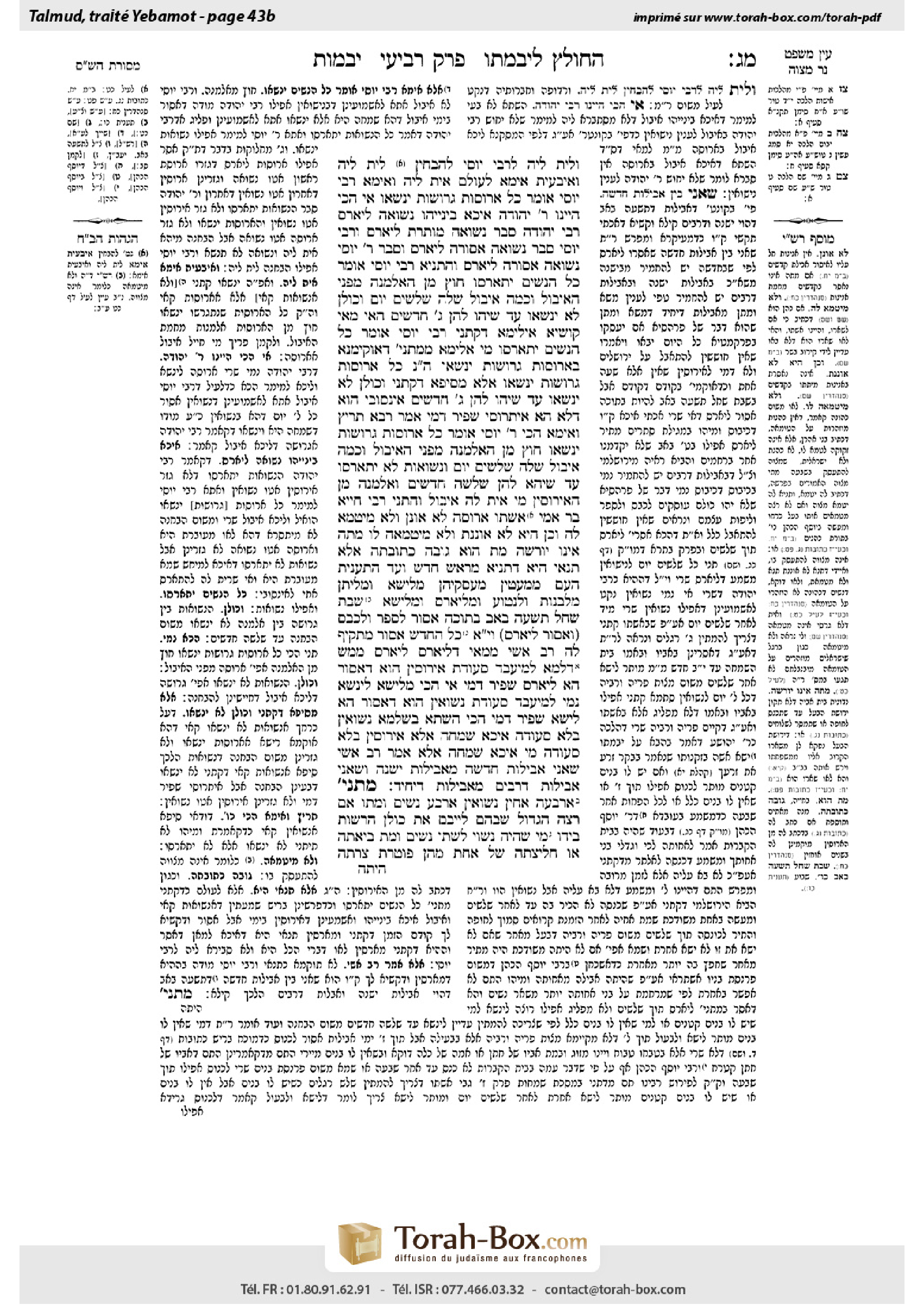
Yevamot 43b: Talmud study for Daf Yomi
Daf Yomi is the daily study of one Talmud folio. Explore 37 tractates with scans, Hebrew text, Sefaria English and AI-generated French translations where annotated.
Passage selection and English or AI-generated French translation are available where the scan has annotations. Daf Study is independent of Torah-Box and Sefaria.
Browse Yevamot · יבמות · All tractatesYevamot 43b text and translations
This page of Yevamot includes the Aramaic text, an English translation and an AI-generated French translation, alongside the scan above.
יבמות מ״ג ב · Aramaic and Hebrew text
וְלֵית לֵיהּ לְרַבִּי יוֹסֵי לְהַבְחִין?
לֵית לֵיהּ. וְאִיבָּעֵית אֵימָא: לְעוֹלָם אִית לֵיהּ, וְאֵימָא, רַבִּי יוֹסֵי אוֹמֵר: כׇּל אֲרוּסוֹת גְּרוּשׁוֹת יִנָּשְׂאוּ.
אִי הָכִי, הַיְינוּ רַבִּי יְהוּדָה? אִיכָּא בֵּינַיְיהוּ נְשׂוּאָה לֵיאָרֵס. רַבִּי יְהוּדָה סָבַר: נְשׂוּאָה מוּתֶּרֶת לֵיאָרֵס. וְרַבִּי יוֹסֵי סָבַר: נְשׂוּאָה אֲסוּרָה לֵיאָרֵס.
וְסָבַר רַבִּי יוֹסֵי נְשׂוּאָה אֲסוּרָה לֵיאָרֵס? וְהָתַנְיָא, רַבִּי יוֹסֵי אוֹמֵר: כׇּל הַנָּשִׁים יִתְאָרְסוּ, חוּץ מִן הָאַלְמָנָה מִפְּנֵי הָאִיבּוּל, וְכַמָּה אִיבּוּל שֶׁלָּהּ — שְׁלֹשִׁים יוֹם. וְכוּלָּן לֹא יִנָּשְׂאוּ עַד שֶׁיְּהוּ לָהֶן שְׁלֹשָׁה חֳדָשִׁים.
הַאי, מַאי קוּשְׁיָא? אִילֵּימָא דְּקָתָנֵי, רַבִּי יוֹסֵי אוֹמֵר: כׇּל הַנָּשִׁים יִתְאָרְסוּ — מִי אַלִּימָא מִמַּתְנִיתִין, דְּאוֹקֵימְנָא בַּאֲרוּסוֹת גְּרוּשׁוֹת יִנָּשְׂאוּ, הָכָא נָמֵי: כׇּל אֲרוּסוֹת גְּרוּשׁוֹת יִנָּשְׂאוּ.
אֶלָּא מִסֵּיפָא, דְּקָתָנֵי: וְכוּלָּן לֹא יִנָּשְׂאוּ עַד שֶׁיְּהוּ לָהֶן שְׁלֹשָׁה חֳדָשִׁים. אִינְּסוֹבֵי הוּא דְּלָא, הָא אִיתְּרוֹסֵי — שַׁפִּיר דָּמֵי!
אָמַר רָבָא: תָּרֵיץ וְאֵימָא הָכִי, רַבִּי יוֹסֵי אוֹמֵר: כׇּל אֲרוּסוֹת גְּרוּשׁוֹת יִנָּשְׂאוּ, חוּץ מִן הָאַלְמָנָה, מִפְּנֵי הָאִיבּוּל. וְכַמָּה אִיבּוּל שֶׁלָּהּ — שְׁלֹשִׁים יוֹם. וּנְשׂוּאוֹת לֹא יִתְאָרְסוּ עַד שֶׁיְּהֵא לָהֶן שְׁלֹשָׁה חֳדָשִׁים.
וְאַלְמָנָה מִן הָאֵירוּסִין מִי אִית לַהּ אִיבּוּל? וְהָתָנֵי, רַבִּי חִיָּיא בַּר אַמֵּי: אִשְׁתּוֹ אֲרוּסָה — לֹא אוֹנֵן וְלֹא מִיטַּמֵּא לָהּ. וְכֵן הִיא — לֹא אוֹנֶנֶת וְלֹא מִיטַּמְּאָה לוֹ. מֵתָה — אֵינוֹ יוֹרְשָׁהּ. מֵת הוּא — גּוֹבָה כְּתוּבָּתָהּ!
אֶלָּא, תַּנָּאֵי הִיא. דְּתַנְיָא: מֵרֹאשׁ חֹדֶשׁ וְעַד הַתַּעֲנִית הָעָם מְמַעֲטִין מֵעִסְקֵיהֶן, מִלִּישָּׂא וּמִלִּיתֵּן, מִלִּבְנוֹת וְלִנְטוֹעַ, וּמִלֵּיאָרֵס וּמִלִּישָּׂא. שַׁבָּת שֶׁחָל תִּשְׁעָה בְּאָב בְּתוֹכָהּ — אָסוּר לְסַפֵּר וּלְכַבֵּס (וְאָסוּר לֵיאָרֵס). וְיֵשׁ אוֹמְרִים: כׇּל הַחֹדֶשׁ אָסוּר.
מַתְקֵיף לַהּ רַב אָשֵׁי: מִמַּאי דְּלֵיאָרֵס, לֵיאָרֵס מַמָּשׁ? דִּלְמָא לְמִיעְבַּד סְעוּדַת אֵירוּסִין הוּא דְּאָסוּר, הָא לֵיאָרֵס — שַׁפִּיר דָּמֵי.
אִי הָכִי, מִלִּישָּׂא (לִינָּשֵׂא) נָמֵי, לְמֶיעְבַּד סְעוּדַת נִשּׂוּאִין הוּא דְּאָסוּר, הָא לִישָּׂא שַׁפִּיר דָּמֵי? הָכִי הַשְׁתָּא?! בִּשְׁלָמָא נִשּׂוּאִין בְּלֹא סְעוּדָה — אִיכָּא שִׂמְחָה, אֶלָּא אֵירוּסִין בְּלֹא סְעוּדָה — מִי אִיכָּא שִׂמְחָה?
אֶלָּא אָמַר רַב אָשֵׁי: שָׁאנֵי אֲבֵילוּת חֲדָשָׁה מֵאֲבֵילוּת יְשָׁנָה, וְשָׁאנֵי אֲבֵילוּת דְּרַבִּים מֵאֲבֵילוּת דְּיָחִיד.
מַתְנִי׳ אַרְבָּעָה אַחִין נְשׂוּאִין אַרְבַּע נָשִׁים וָמֵתוּ, אִם רָצָה הַגָּדוֹל שֶׁבָּהֶם לְיַיבֵּם אֶת כּוּלָּן — הָרְשׁוּת בְּיָדוֹ.
מִי שֶׁהָיָה נָשׂוּי לִשְׁתֵּי נָשִׁים וּמֵת — בִּיאָתָהּ אוֹ חֲלִיצָתָהּ שֶׁל אַחַת מֵהֶן פּוֹטֶרֶת צָרָתָהּ.
Yevamot 43b · English translation
The Gemara asks: But does Rabbi Yosei not accept that there is a decree to wait three months in order to distinguish between the seed of the first and second husbands? According to the Gemara’s emendation of his statement, it would appear there is no case in which Rabbi Yosei applies the decree.
The Gemara answers: Indeed, he does not accept the decree. And if you wish, say that actually, he does accept the decree and applies it in the case of a married woman who was divorced. And with regard to the challenge to his opinion from the a fortiori inference, emend the mishna and say: Rabbi Yosei says that all women who were only betrothed to their previous husbands and then divorced may be married within three months, since the reason to wait does not apply in this case.
The Gemara asks: If so, then this opinion of Rabbi Yosei is identical to the opinion of Rabbi Yehuda. What difference is there between them? The Gemara answers: There is a practical difference between them in the case of a woman who was married to her previous husband and seeks to be betrothed. Rabbi Yehuda holds that it is permitted to betroth a woman who was married to her previous husband without first waiting three months. And Rabbi Yosei holds that it is prohibited to betroth a woman who was married to her previous husband without first waiting three months.
The Gemara asks: But does Rabbi Yosei really hold that it is prohibited to betroth a woman who was married to her previous husband without first waiting three months? Isn’t it taught in a baraita: Rabbi Yosei says that all women may be betrothed without waiting except for a widow, due to the mourning period she must observe for her deceased husband; and how long is her mourning period? It is thirty days. And none of them may be married until they have waited three months.
The Gemara clarifies the question: What difficulty does this baraita pose? If we say that the baraita teaches: Rabbi Yosei says that all women may be betrothed without waiting, is the baraita stronger than the mishna that was established as teaching that women who were only betrothed to their previous husbands and then divorced may be married within three months? Here, too, the baraita could be established as teaching that all women who were only betrothed to their previous husbands and then divorced may be married within three months.
Rather, the difficulty arises from the latter clause that teaches: And none of them may marry until they have waited three months. This implies that Rabbi Yosei holds that it is specifically marrying that is not permitted, but betrothing seems well and is permitted. This challenges the Gemara’s original claim that Rabbi Yosei disagrees with Rabbi Yehuda on this point.
Rava said: Resolve the difficulty and emend Rabbi Yosei’s statement to say this: Rabbi Yosei says that all women who were only betrothed to their previous husbands and then divorced may marry within three months except for a widow, due to the mourning period she must observe for her deceased husband. And how long is her mourning period? It is thirty days. And women who were married to their previous husbands may not be betrothed until they have waited three months.
The Gemara asks: But does a woman who became a widow from betrothal have to observe a mourning period for her husband? Didn’t Rabbi Ḥiyya bar Ami teach in a baraita: If one’s wife to whom he was betrothed died, he does not observe a period of acute mourning for her, and if he is a priest he is not permitted to become ritually impure for her. And similarly, if he dies, she does not observe a period of acute mourning for him and she does not become ritually impure for him. If she dies, he does not inherit from her. If he dies, she collects payment of her marriage contract. The baraita demonstrates that a widow is required to mourn her husband only if she was married to him and not merely betrothed. If so, clearly Rabbi Yosei’s ruling in the mishna is referring to married women. Accordingly, all of the Gemara’s emendations of Rabbi Yosei’s statement, in order to defend his statement from Rav Ḥisda’s a fortiori inference, are refuted.
Rather, it must be that the question of whether it is permitted to betroth a woman during the period prior to the week of the Ninth of Av is subject to a dispute between tanna’im. As it is taught in a baraita: From the New Moon of Av and until the fast on the ninth, the public reduces its activities, refraining from business transactions, from building and planting, and from betrothing and marrying. During the week in which the Ninth of Av occurs, it is prohibited to cut hair and to launder clothes, and it is prohibited to be betrothed. And some say: It is prohibited for the entire month. The Gemara’s challenge to Rabbi Yosei’s opinion that it is prohibited for a widow to be betrothed during her mourning period was based on an a fortiori inference that assumes that it is permitted to be betrothed during the mourning period preceding the week of the Ninth of Av. However, since this ruling is subject to a dispute, Rabbi Yosei could reject the a fortiori inference by stating that he holds in accordance with the opinion that it is in fact prohibited to be betrothed during that period.
Rav Ashi strongly objects to this: From where is it known that when the baraita prohibits one to be betrothed, it is referring to actually betrothing? Perhaps it is only to make a betrothal feast that is prohibited, but merely to be betrothed seems well and is permitted.
The Gemara questions Rav Ashi’s objection: If so, then with regard to the prohibition against marrying as well one could make the same claim: With regard to the prohibition to marry, too, it is only to make a marriage feast that is prohibited, but merely to marry seems well and is permitted. The Gemara rejects its question: How can these cases be compared? Granted, from a marriage, even without a feast, there is joy, but from a betrothal without a feast, is there any joy? It is merely a legal ceremony.
Rather, Rav Ashi stated a different resolution of Rav Yosei’s opinion: New mourning, i.e., the mourning for a relative who has just passed away, is different from old mourning, i.e., the mourning over historic events such as the destruction of the Temple, and it is appropriate to be more lenient in the latter. And the mourning of the public is different from the private mourning of the individual, and it is appropriate to be more stringent in the latter. As such, it is not possible to form an a fortiori inference from the halakhot of mourning for the Temple to those of a wife mourning for her husband.
MISHNA: In a case of four brothers married to four women and some of the brothers died childless, their wives thereby become yevamot. If the eldest of the brothers who survived wished to consummate the levirate marriage with all of his yevamot, he has permission to do so.
In the case of one who was married to two women and died childless, the intercourse or ḥalitza of either one of the wives with the yavam releases her rival wife from the levirate bond, and the rival wife need not enter into levirate marriage or perform ḥalitza.
Yevamot 43b · Traduction française (IA)
La Guemara demande : Mais Rabbi Yosei n’admet-il pas qu’il faut attendre trois mois afin de distinguer la descendance du premier mari de celle du second ? Selon la correction apportée par la Guemara à ses propos, il semblerait qu’il n’y ait aucun cas où Rabbi Yosei applique cette règle.
La Guemara répond : En effet, il n’admet pas cette règle. Ou bien, si tu le souhaites, dis qu’en réalité, il l’admet et l’applique au cas d’une femme mariée qui a été divorcée. Quant à l’objection à son opinion fondée sur le raisonnement a fortiori, corrigeons la Michna ainsi : Rabbi Yosei dit que toutes les femmes qui n’avaient été que fiancées à leur précédent mari, puis ont été divorcées, peuvent se marier dans les trois mois, puisque la raison d’attendre ne s’applique pas dans ce cas.
La Guemara demande : Dans ce cas, cette opinion de Rabbi Yosei est identique à celle de Rabbi Yehuda. Quelle différence y a-t-il entre elles ? La Guemara répond : Il y a une différence pratique entre elles dans le cas d’une femme qui était mariée à son précédent mari et souhaite se fiancer. Rabbi Yehuda estime qu’il est permis à une femme qui était mariée à son précédent mari de se fiancer sans attendre d’abord trois mois. Rabbi Yosei estime qu’il lui est interdit de se fiancer sans attendre d’abord trois mois.
La Guemara demande : Mais Rabbi Yosei estime-t-il vraiment qu’il est interdit à une femme qui était mariée à son précédent mari de se fiancer sans attendre d’abord trois mois ? N’est-il pas enseigné dans une baraïta : Rabbi Yosei dit que toutes les femmes peuvent se fiancer sans attendre, à l’exception d’une veuve, en raison de la période de deuil qu’elle doit observer pour son mari défunt. Et quelle est la durée de sa période de deuil ? Trente jours. Et aucune d’entre elles ne peut se marier avant d’avoir attendu trois mois.
La Guemara précise la question : Quelle difficulté cette baraïta soulève-t-elle ? Si nous disons que la baraïta enseigne : « Rabbi Yosei dit que toutes les femmes peuvent se fiancer sans attendre », la baraïta fait-elle davantage autorité que la Michna, dont il a été établi qu’elle enseigne que les femmes qui n’avaient été que fiancées à leur précédent mari, puis ont été divorcées, peuvent se marier dans les trois mois ? Ici aussi, on pourrait établir que la baraïta enseigne que toutes les femmes qui n’avaient été que fiancées à leur précédent mari, puis ont été divorcées, peuvent se marier dans les trois mois.
La difficulté vient plutôt de la dernière clause, qui enseigne : « Et aucune d’entre elles ne peut se marier avant d’avoir attendu trois mois. » Cela implique, selon Rabbi Yosei, que seul le mariage est interdit, tandis que les fiançailles semblent permises. Cela contredit l’affirmation initiale de la Guemara selon laquelle Rabbi Yosei est en désaccord avec Rabbi Yehuda sur ce point.
Rava dit : Résous la difficulté en corrigeant ainsi les propos de Rabbi Yosei : Rabbi Yosei dit que toutes les femmes qui n’avaient été que fiancées à leur précédent mari, puis ont été divorcées, peuvent se marier dans les trois mois, à l’exception d’une veuve, en raison de la période de deuil qu’elle doit observer pour son mari défunt. Et quelle est la durée de sa période de deuil ? Trente jours. Et les femmes qui étaient mariées à leur précédent mari ne peuvent se fiancer avant d’avoir attendu trois mois.
La Guemara demande : Mais une femme devenue veuve alors qu’elle n’était que fiancée doit-elle observer une période de deuil pour son mari ? Rabbi Ḥiyya bar Ami n’a-t-il pas enseigné dans une baraïta : Si la femme à laquelle un homme était fiancé meurt, il n’observe pas pour elle de période de deuil aigu, et, s’il est prêtre, il n’est pas autorisé à se rendre rituellement impur pour elle. De même, s’il meurt, elle n’observe pas pour lui de période de deuil aigu et ne se rend pas rituellement impure pour lui. Si elle meurt, il n’hérite pas d’elle. S’il meurt, elle perçoit le paiement de sa kétouba. La baraïta montre qu’une veuve doit faire le deuil de son mari seulement si elle était mariée avec lui, et non simplement fiancée. Dans ce cas, il est clair que la décision de Rabbi Yosei dans la Michna se rapporte aux femmes mariées. Par conséquent, toutes les corrections que la Guemara a apportées aux propos de Rabbi Yosei afin de les défendre contre le raisonnement a fortiori de Rav Ḥisda sont réfutées.
Il faut donc plutôt conclure que la question de savoir s’il est permis de se fiancer durant la période précédant la semaine du Neuf Av fait l’objet d’un désaccord entre les tannaïm. Car il est enseigné dans une baraïta : À partir de Roch Ḥodech Av et jusqu’au jeûne du neuf, le public réduit ses activités et s’abstient des transactions commerciales, des travaux de construction et de plantation, ainsi que des fiançailles et des mariages. Durant la semaine où tombe le Neuf Av, il est interdit de se couper les cheveux et de laver ses vêtements, et il est interdit de se fiancer. Certains disent : cela est interdit pendant tout le mois. L’objection de la Guemara à l’opinion de Rabbi Yosei, selon laquelle il est interdit à une veuve de se fiancer durant sa période de deuil, reposait sur un raisonnement a fortiori qui suppose qu’il est permis de se fiancer durant la période de deuil précédant la semaine du Neuf Av. Toutefois, puisque cette règle fait l’objet d’un désaccord, Rabbi Yosei pourrait rejeter le raisonnement a fortiori en affirmant qu’il suit l’opinion selon laquelle il est effectivement interdit de se fiancer durant cette période.
Rav Ashi s’y oppose vivement : D’où sait-on que lorsque la baraïta interdit de se fiancer, elle parle des fiançailles proprement dites ? Peut-être est-il seulement interdit d’organiser un festin de fiançailles, tandis que se fiancer simplement semble permis.
La Guemara met en question l’objection de Rav Ashi : Dans ce cas, on pourrait avancer la même affirmation au sujet de l’interdiction de se marier : seul le festin de mariage serait interdit, tandis que se marier simplement semblerait permis. La Guemara rejette cette question : Comment peut-on comparer ces cas ? Certes, le mariage, même sans festin, procure de la joie ; mais les fiançailles sans festin procurent-elles la moindre joie ? Ce n’est qu’une cérémonie juridique.
Rav Ashi proposa plutôt une autre résolution de l’opinion de Rav Yosei : Le deuil récent, c’est-à-dire le deuil d’un proche qui vient de mourir, diffère du deuil ancien, c’est-à-dire le deuil lié à des événements historiques tels que la destruction du Temple ; il convient d’être plus indulgent dans ce dernier cas. Le deuil du public diffère du deuil privé d’un particulier, et il convient d’être plus strict dans ce dernier cas. Il n’est donc pas possible de tirer un raisonnement a fortiori des lois du deuil pour le Temple vers celles d’une épouse qui fait le deuil de son mari.
MICHNA : Dans le cas de quatre frères mariés à quatre femmes, dont certains sont morts sans enfant, leurs épouses deviennent ainsi des yevamot. Si l’aîné des frères survivants souhaite contracter le mariage léviratique avec toutes ses yevamot, il en a le droit.
Dans le cas d’un homme marié à deux femmes qui meurt sans enfant, la consommation du mariage léviratique ou la ḥalitsa de l’une des épouses avec le yavam libère sa coépouse du lien léviratique ; cette dernière n’a donc besoin ni de contracter un mariage léviratique ni d’accomplir la ḥalitsa.
Traduction française générée par IA à partir de l’édition anglaise de Sefaria. Vérifie toujours un passage avec le texte source.
Text from Sefaria: William Davidson Edition - Vocalized Aramaic (CC BY NC); William Davidson Edition - English (CC BY NC).