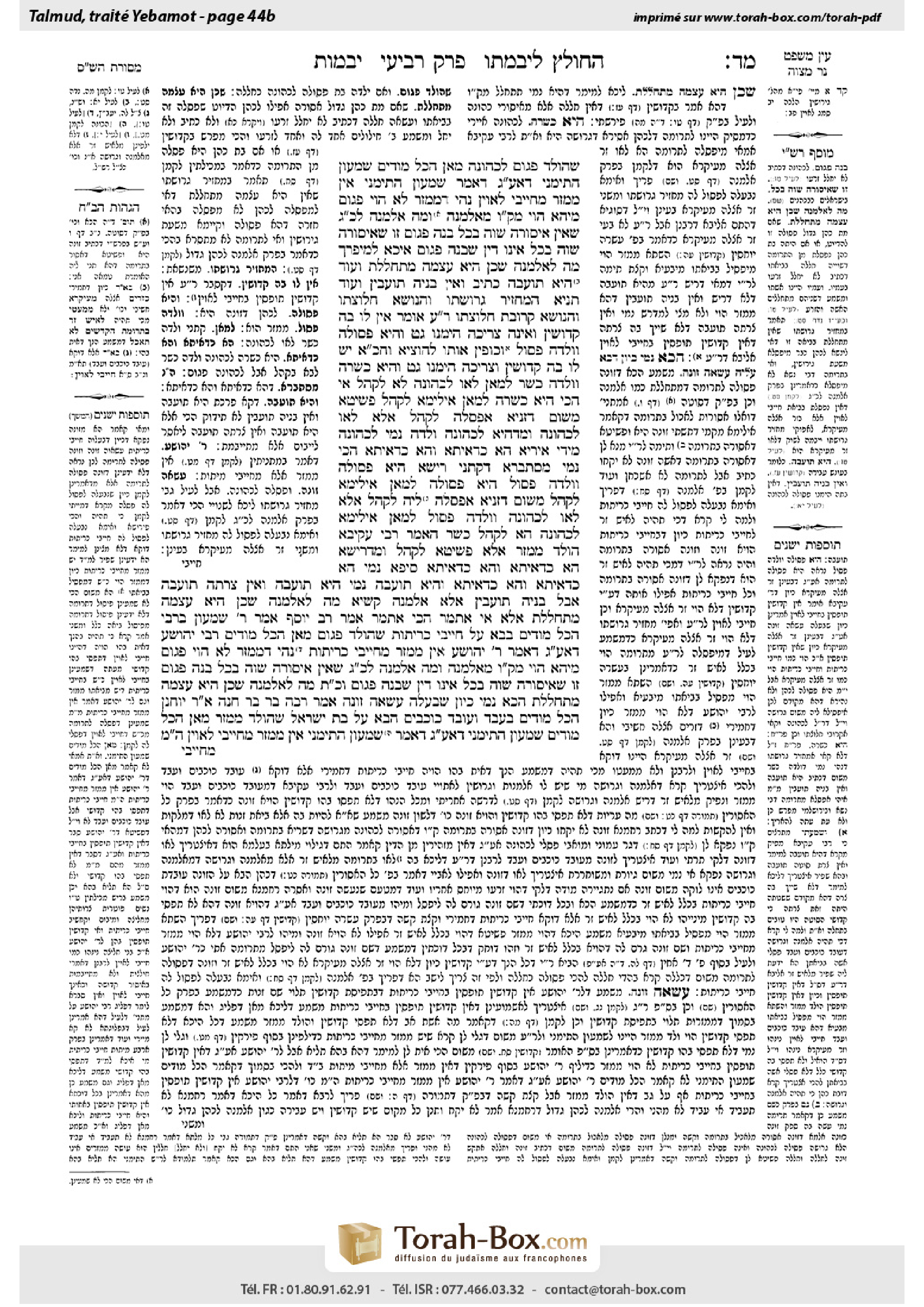
Yevamot 44b: Talmud study for Daf Yomi
Daf Yomi is the daily study of one Talmud folio. Explore 37 tractates with scans, Hebrew text, Sefaria English and AI-generated French translations where annotated.
Passage selection and English or AI-generated French translation are available where the scan has annotations. Daf Study is independent of Torah-Box and Sefaria.
Browse Yevamot · יבמות · All tractatesYevamot 44b text and translations
This page of Yevamot includes the Aramaic text, an English translation and an AI-generated French translation, alongside the scan above.
יבמות מ״ד ב · Aramaic and Hebrew text
שֶׁהַוָּלָד פָּגוּם לַכְּהוּנָּה. מַאן הַכֹּל מוֹדִים — שִׁמְעוֹן הַתִּימְנִי, דְּאַף עַל גַּב דְּאָמַר שִׁמְעוֹן הַתִּימְנִי: אֵין מַמְזֵר מֵחַיָּיבֵי לָאוִין, נְהִי דְּמַמְזֵר לָא הָוֵי, פָּגוּם מִיהָא הָוֵי,
מִקַּל וָחוֹמֶר מֵאַלְמָנָה. וּמָה אַלְמָנָה לְכֹהֵן גָּדוֹל, שֶׁאֵין אִיסּוּרָהּ שָׁוֶה בַּכֹּל — בְּנָהּ פָּגוּם, זוֹ, שֶׁאִיסּוּרָהּ שָׁוֶה בַּכֹּל — אֵינוֹ דִּין שֶׁבְּנָהּ פָּגוּם?
אִיכָּא לְמִיפְרַךְ: מָה לְאַלְמָנָה שֶׁכֵּן הִיא עַצְמָהּ מִתְחַלֶּלֶת.
וְעוֹד: ״הִיא תּוֹעֵבָה״ כְּתִיב, וְאֵין בָּנֶיהָ תּוֹעֲבִין.
וְעוֹד, תַּנְיָא: הַמַּחֲזִיר גְּרוּשָׁתוֹ וְהַנּוֹשֵׂא חֲלוּצָתוֹ וְהַנּוֹשֵׂא קְרוֹבַת חֲלוּצָתוֹ, רַבִּי עֲקִיבָא אוֹמֵר: אֵין לוֹ בָּהּ קִדּוּשִׁין, וְאֵינָהּ צְרִיכָה הֵימֶנּוּ גֵּט, וְהִיא פְּסוּלָה, וּוְלָדָהּ פָּסוּל, וְכוֹפִין אוֹתוֹ לְהוֹצִיא. וַחֲכָמִים אוֹמְרִים: יֵשׁ לוֹ בָּהּ קִדּוּשִׁין, וּצְרִיכָה הֵימֶנּוּ גֵּט, וְהִיא כְּשֵׁרָה וּוְלָדָהּ כָּשֵׁר.
לְמַאן, לָאו לִכְהוּנָּה? לָא, לַקָּהָל. אִי הָכִי, הִיא כְּשֵׁרָה, לְמַאן? אִילֵימָא לַקָּהָל — פְּשִׁיטָא, מִשּׁוּם דְּזַנְּיָא אִפַּסְלָה לַקָּהָל?! אֶלָּא לָאו לִכְהוּנָּה,
וּמִדְּהִיא לִכְהוּנָּה, וְלָדָהּ נָמֵי לִכְהוּנָּה! מִידֵּי אִירְיָא? הָא כִּדְאִיתָא וְהָא כִּדְאִיתָא.
הָכִי נָמֵי מִסְתַּבְּרָא, דְּקָתָנֵי רֵישָׁא: הִיא פְּסוּלָה וּוְלָדָהּ פָּסוּל. הִיא פְּסוּלָה לְמַאן? אִילֵימָא לַקָּהָל, מִשּׁוּם דְּזַנְּיָא אִפַּסְלָה לֵיהּ לַקָּהָל?! אֶלָּא לָאו לִכְהוּנָּה.
וּוְלָדָהּ פָּסוּל, לְמַאן? אִילֵימָא לִכְהוּנָּה: הָא לַקָּהָל כָּשֵׁר? הָאָמַר רַבִּי עֲקִיבָא: הַוָּלָד מַמְזֵר! אֶלָּא פְּשִׁיטָא לַקָּהָל.
וּמִדְּרֵישָׁא הָא כִּדְאִיתָא וְהָא כִּדְאִיתָא, סֵיפָא נָמֵי הָא כִּדְאִיתָא וְהָא כִּדְאִיתָא.
וְ״הִיא תּוֹעֵבָה״ נָמֵי — הִיא תּוֹעֵבָה וְאֵין צָרָתָהּ תּוֹעֵבָה, אֲבָל בָּנֶיהָ תּוֹעֲבִין.
אֶלָּא אַלְמָנָה קַשְׁיָא: מָה לְאַלְמָנָה שֶׁכֵּן הִיא עַצְמָהּ מִתְחַלֶּלֶת!
אֶלָּא, אִי אִתְּמַר הָכִי אִתְּמַר: אָמַר רַב יוֹסֵף אָמַר רַבִּי שִׁמְעוֹן בְּרַבִּי: הַכֹּל מוֹדִים בְּבָא עַל חַיָּיבֵי כָּרֵיתוֹת שֶׁהַוָּלָד פָּגוּם. מַאן הַכֹּל מוֹדִים, רַבִּי יְהוֹשֻׁעַ. דְּאַף עַל גַּב דְּאָמַר רַבִּי יְהוֹשֻׁעַ: אֵין מַמְזֵר מֵחַיָּיבֵי כָּרֵיתוֹת, נְהִי דְּמַמְזֵר לָא הָוֵי — פָּגוּם מִיהָא הָוֵי,
מִקַּל וָחוֹמֶר מֵאַלְמָנָה: וּמָה אַלְמָנָה לְכֹהֵן גָּדוֹל, שֶׁאֵין אִיסּוּרָהּ שָׁוֶה — בַּכֹּל בְּנָהּ פָּגוּם, זוֹ שֶׁאִיסּוּרָהּ שָׁוֶה בַּכֹּל — אֵינוֹ דִּין שֶׁבְּנָהּ פָּגוּם.
וְכִי תֵּימָא: מָה לְאַלְמָנָה, שֶׁכֵּן הִיא עַצְמָהּ מִתְחַלֶּלֶת — הָכָא נָמֵי, כֵּיוָן שֶׁבְּעָלָהּ, עֲשָׂאָהּ זוֹנָה.
אָמַר רַבָּה בַּר בַּר חָנָה אָמַר רַבִּי יוֹחָנָן: הַכֹּל מוֹדִים בְּעֶבֶד וְגוֹי הַבָּא עַל בַּת יִשְׂרָאֵל שֶׁהַוָּלָד מַמְזֵר.
מַאן ״הַכֹּל מוֹדִים״ — שִׁמְעוֹן הַתִּימְנִי. דְּאַף עַל גַּב דְּאָמַר שִׁמְעוֹן הַתִּימְנִי אֵין מַמְזֵר מֵחַיָּיבֵי לָאוִין — הָנֵי מִילֵּי
Yevamot 44b · English translation
that the offspring, even if not a mamzer, has flawed lineage and, if the offspring is a girl, is unfit to marry into the priesthood. The Gemara clarifies: Who is included by saying: All agree? It is Shimon HaTimni, as although Shimon HaTimni said that the offspring of relations for which one is liable for violating a prohibition is not a mamzer, nevertheless, granted that Shimon HaTimni holds that he is not a mamzer; he would agree, however, that he is of flawed lineage.
This is derived through an a fortiori inference from the halakha pertaining to a widow, as follows: Just as in the case of a widow who is married to a High Priest, where the prohibition that pertains to her is not equally applicable to all, i.e., only a High Priest is prohibited from marrying a widow, and nevertheless her child from that union will have flawed lineage, then so too with regard to this divorcée, who married another man and is therefore prohibited from marrying her original husband, where the prohibition that pertains to her is equally applicable to all Jews, as the prohibition to remarry one’s divorcée after she was married to another man applies to all Jews, isn’t it logical that her child from that union will have flawed lineage?
The Gemara raises a number of objections: The logic of this a fortiori inference can be refuted: What is true with regard to a widow, where her union with a High Priest is what makes her herself disqualified from subsequently marrying any priest and, if she is the daughter of a priest, from eating teruma, is not true with regard to a remarried divorcée, where her remarriage to another man is permitted and is not the cause of any further disqualification. Therefore, one case cannot be deduced from the other.
And furthermore, “She is an abomination” (Deuteronomy 24:4) is written with regard to remarrying with one’s divorcée, and the emphasis on the word “she” teaches that only she is considered so, but her children are not abominations and they have unflawed lineage.
And furthermore, it is taught in a baraita: With regard to one who remarries his divorcée, and one who marries his ḥalutza, and one who marries a relative of his ḥalutza, Rabbi Akiva says that one’s betrothal of such women is not effective. And therefore, even if he attempts to do so, it is meaningless and she does not require a bill of divorce from him in order to separate from him. And if she has relations with him she is rendered unfit and her child is unfit, and we force him to send her away. The Rabbis say that one’s betrothal of such women is effective, and therefore if he betrothed her she requires a bill of divorce from him, and if she has relations with him she remains fit and her child is fit.
The Gemara clarifies: When the baraita states she and her child are rendered unfit, to whom are they unfit to be married? Is it not to the priesthood? No, it is to the congregation of Israel. If so, when the baraita states she is fit, to whom is she fit to be married? If we say it is to the congregation of Israel, this is obvious; could it be that because she engaged in forbidden sexual relations that she is rendered unfit from marrying into the congregation of Israel? Although by doing so she is rendered a zona, that can disqualify her only from marrying a priest. Rather, is it not that the intention is that she is fit to marry into the priesthood?
The Gemara suggests: And since in reference to her the word fit in the baraita means fit for the priesthood, it follows that for the child as well, the word fit means fit for the priesthood. The Gemara objects: Are these cases comparable? This case is as it is, and that case is as it is, and although the two cases are juxtaposed in the baraita they need not be relating to the same issue. Rather, when referring to the mother the baraita mentions fitness for the priesthood, and when referring to the child it mentions fitness for the congregation of Israel.
The Gemara notes: So, too, it is reasonable to assume that the two clauses concern different issues, as the first clause teaches in the name of Rabbi Akiva: She is unfit and her child is unfit. When that first clause states: She is unfit, to whom is she unfit to be married? If we say it is to the congregation of Israel, could it be that because she engaged in forbidden sexual relations she is rendered unfit to marry into the congregation of Israel? Rather, is it not that the intention is that she is rendered unfit to marry into the priesthood?
And then when the first clause continues and states: And her child is unfit, to whom is she unfit to be married? If we say that it is to the priesthood, that would imply that the child is fit to marry into the congregation of Israel. However, this is untenable because didn’t Rabbi Akiva himself say in the mishna here that the offspring is a mamzer and is unfit from entering the congregation of Israel? Rather, it is obvious that the intention of the baraita is that the child is unfit even to marry into the congregation of Israel.
And since in the first clause of the baraita it is apparent that, although two cases are juxtaposed, this case is as it is and that case is as it is, in the latter clause as well one should assume that this case is as it is and that case is as it is.
Having resolved the objection raised from the baraita, the Gemara returns to its preceding objection: And the objection raised from the verse: “She is an abomination,” in which the Gemara suggested that the emphasis on “she” teaches that only she is an abomination but her children are not, can also be resolved, as the emphasis on “she” could be interpreted differently to teach: “She is an abomination” but her rival wife is not an abomination, and if they both fell together for levirate marriage, the yavam may consummate the levirate marriage with her rival wife. However, it is possible that her children are in fact abominations and are unfit to marry into the priesthood.
The Gemara concludes: However, although two of the objections were resolved, the objection to the logic of the a fortiori inference from the case of a widow remains difficult, as the Gemara noted earlier: What is true with regard to a widow, where her union with a High Priest is what makes her herself disqualified from subsequently marrying any priest and, if she is the daughter of a priest, from eating teruma, is not true with regard to a remarried divorcée, where her remarriage to another man is permitted and is not the cause of any further disqualification. Therefore, there is no basis for assuming that the child of one who remarries his divorcée after she had been married to another man will have flawed lineage.
Rather, if this was stated, it was stated as follows: Rav Yosef said that Rabbi Shimon, son of Rabbi Yehuda HaNasi, said: All agree with regard to one who engages in intercourse with a forbidden relation for which one is liable to receive karet that the offspring has flawed lineage. The Gemara clarifies: Who is included by saying: All agree? It is Rabbi Yehoshua, as although Rabbi Yehoshua said in the mishna (49b) that the offspring born from a union for which one is liable to receive karet is not a mamzer, nevertheless, granted that Rabbi Yehoshua holds that he is not a mamzer; he would agree, however, that he is of flawed lineage.
This is derived through an a fortiori inference from the halakha of a widow, as follows: Just as in the case of a widow who is married to High Priest, where the prohibition that pertains to her is not equally applicable to all, i.e., only a High Priest is prohibited from marrying a widow, and nevertheless her child from that union will have flawed lineage, then so too with regard to this woman, where the prohibition that pertains to her is equally applicable to all Jews, isn’t it logical that her child from that union should have flawed lineage?
And if you would say that the logic of this a fortiori inference could be refuted in a manner similar to the suggestion above that what is true with regard to a widow, who is herself disqualified from marrying a priest, is not true with regard to a woman who is forbidden by a prohibition for which one is liable to karet, that is not correct because here, too, once he has engaged in intercourse with her he renders her a zona, and as such she is disqualified from marrying into the priesthood.
§ The Gemara considers the status of other children born from forbidden unions: Rabba bar bar Ḥana said that Rabbi Yoḥanan said: All agree with regard to a slave or a gentile who engaged in intercourse with a Jewish woman that the offspring born from such a union is a mamzer.
The Gemara clarifies: Who is included by saying: All agree? It is Shimon HaTimni, as although Shimon HaTimni said that the offspring of relations for which one is liable for violating a prohibition is not a mamzer, this applies only
Yevamot 44b · Traduction française (IA)
que l’enfant, même s’il n’est pas un mamzer, a une ascendance entachée et, s’il s’agit d’une fille, est inapte à épouser un prêtre. La Guemara précise : qui est inclus dans l’expression « Tous sont d’accord » ? Shimon HaTimni, car bien que Shimon HaTimni ait dit que l’enfant issu de relations pour lesquelles on est passible de la violation d’un interdit n’est pas un mamzer, il conviendrait néanmoins qu’il reconnaisse que son ascendance est entachée.
Cela se déduit par un raisonnement a fortiori de la halakha concernant une veuve, comme suit : de même que, dans le cas d’une veuve mariée à un grand prêtre, l’interdit qui la concerne ne s’applique pas à tous de la même manière — autrement dit, seul un grand prêtre a l’interdiction d’épouser une veuve — et que pourtant l’enfant issu de cette union a une ascendance entachée, de même, dans le cas de cette divorcée, qui a épousé un autre homme et ne peut donc épouser son premier mari, l’interdit qui la concerne s’applique à tous les Juifs — car l’interdiction de reprendre son ex-femme après qu’elle a épousé un autre homme s’applique à tous les Juifs. N’est-il donc pas logique que l’enfant issu de cette union ait une ascendance entachée ?
La Guemara soulève plusieurs objections : le raisonnement a fortiori peut être réfuté. Ce qui est vrai d’une veuve, dont l’union avec un grand prêtre la rend elle-même inapte à épouser ensuite n’importe quel prêtre et, si elle est la fille d’un prêtre, à consommer la terouma, ne vaut pas pour une divorcée remariée, car son remariage avec un autre homme est permis et n’entraîne aucune inaptitude supplémentaire. On ne peut donc pas déduire un cas de l’autre.
De plus, au sujet de celui qui reprend son ex-femme, il est écrit : « Elle est une abomination » (Deutéronome 24:4). L’accent mis sur le mot « elle » enseigne qu’elle seule est ainsi considérée, mais que ses enfants ne sont pas des abominations et ont une ascendance sans défaut.
De plus, une baraïta enseigne : au sujet de celui qui reprend son ex-femme, de celui qui épouse sa ḥaloutsa et de celui qui épouse une parente de sa ḥaloutsa, Rabbi Akiva dit que les kidouchin avec de telles femmes ne sont pas effectifs. Par conséquent, même s’il tente de les épouser, cela n’a aucune valeur et elle n’a pas besoin d’un acte de divorce de sa part pour se séparer de lui. Si elle a des relations avec lui, elle devient inapte et son enfant aussi, et on contraint l’homme à la renvoyer. Les Sages disent que les kidouchin avec de telles femmes sont effectifs ; par conséquent, s’il l’a fiancée, elle a besoin d’un acte de divorce de sa part, et si elle a des relations avec lui, elle demeure apte, tout comme son enfant.
La Guemara précise : lorsque la baraïta dit qu’elle et son enfant deviennent inaptes, à quoi sont-ils inaptes ? À épouser un membre de l’assemblée d’Israël, n’est-ce pas ? Non, ils sont inaptes à épouser un membre de la prêtrise. Dans ce cas, lorsque la baraïta dit qu’elle est apte, à quoi est-elle apte ? Si l’on dit qu’elle est apte à épouser un membre de l’assemblée d’Israël, cela va de soi. Se pourrait-il que le fait d’avoir eu des relations interdites la rende inapte à épouser un membre de l’assemblée d’Israël ? Bien que cela la rende zona, cela ne peut la rendre inapte qu’à épouser un prêtre. N’est-ce donc pas plutôt qu’elle est apte à épouser un membre de la prêtrise ?
La Guemara propose : puisque, à son sujet, le mot « apte » dans la baraïta signifie apte à épouser un membre de la prêtrise, il s’ensuit que, pour l’enfant également, le mot « apte » signifie apte à épouser un membre de la prêtrise. La Guemara objecte : ces cas sont-ils comparables ? Chaque cas doit être considéré séparément ; bien que les deux cas soient juxtaposés dans la baraïta, ils n’ont pas nécessairement trait à la même question. Ainsi, lorsque la baraïta parle de la mère, elle mentionne l’aptitude à épouser un membre de la prêtrise, et lorsqu’elle parle de l’enfant, elle mentionne l’aptitude à épouser un membre de l’assemblée d’Israël.
La Guemara note : il est également raisonnable de supposer que les deux clauses concernent des sujets différents, car la première clause enseigne au nom de Rabbi Akiva : « Elle est inapte et son enfant est inapte. » Lorsque cette première clause dit : « Elle est inapte », à quoi est-elle inapte ? Si l’on dit qu’elle est inapte à épouser un membre de l’assemblée d’Israël, se pourrait-il que le fait d’avoir eu des relations interdites la rende inapte à épouser un membre de l’assemblée d’Israël ? N’est-ce donc pas plutôt qu’elle devient inapte à épouser un membre de la prêtrise ?
Puis, lorsque la première clause poursuit en disant : « Et son enfant est inapte », à quoi est-il inapte ? Si l’on dit qu’il est inapte à épouser un membre de la prêtrise, cela impliquerait que l’enfant est apte à épouser un membre de l’assemblée d’Israël. Or cela est impossible, car Rabbi Akiva lui-même n’a-t-il pas dit dans la Michna ici que l’enfant est un mamzer et inapte à entrer dans l’assemblée d’Israël ? Il est donc évident que la baraïta entend dire que l’enfant est même inapte à épouser un membre de l’assemblée d’Israël.
Et puisqu’il ressort de la première clause de la baraïta que, bien que deux cas soient juxtaposés, chacun doit être considéré séparément, on doit également supposer, dans la dernière clause, que chaque cas doit être considéré séparément.
Après avoir résolu l’objection tirée de la baraïta, la Guemara revient à l’objection précédente : on peut également résoudre l’objection tirée du verset « Elle est une abomination », où la Guemara avait proposé que l’accent mis sur « elle » enseigne qu’elle seule est une abomination, mais pas ses enfants. En effet, l’accent mis sur « elle » peut recevoir une autre interprétation et enseigner : « Elle est une abomination », mais sa coépouse ne l’est pas ; si elles sont toutes deux soumises ensemble au mariage léviratique, le yavam peut accomplir le mariage léviratique avec sa coépouse. Il est toutefois possible que ses enfants soient bel et bien des abominations et soient inaptes à épouser un membre de la prêtrise.
La Guemara conclut : cependant, bien que deux des objections aient été résolues, l’objection au raisonnement a fortiori tiré du cas d’une veuve demeure difficile, comme la Guemara l’a indiqué précédemment : ce qui est vrai d’une veuve, dont l’union avec un grand prêtre la rend elle-même inapte à épouser ensuite n’importe quel prêtre et, si elle est la fille d’un prêtre, à consommer la terouma, ne vaut pas pour une divorcée remariée, car son remariage avec un autre homme est permis et n’entraîne aucune inaptitude supplémentaire. Il n’y a donc aucun fondement pour supposer que l’enfant de celui qui reprend son ex-femme après qu’elle a été mariée à un autre homme aura une ascendance entachée.
Il faut plutôt dire que, si cette déclaration a été faite, elle l’a été sous la forme suivante : Rav Yossef a dit que Rabbi Shimon, fils de Rabbi Yehouda HaNassi, a dit : tous sont d’accord pour dire que, lorsqu’un homme a des relations avec une parente interdite pour lesquelles il est passible de karet, l’enfant a une ascendance entachée. La Guemara précise : qui est inclus dans l’expression « Tous sont d’accord » ? Rabbi Yehoshua, car bien que Rabbi Yehoshua ait dit dans la Michna (49b) que l’enfant né d’une union pour laquelle on est passible de karet n’est pas un mamzer, il conviendrait néanmoins qu’il reconnaisse que son ascendance est entachée.
Cela se déduit par un raisonnement a fortiori de la halakha concernant une veuve, comme suit : de même que, dans le cas d’une veuve mariée à un grand prêtre, l’interdit qui la concerne ne s’applique pas à tous de la même manière — autrement dit, seul un grand prêtre a l’interdiction d’épouser une veuve — et que pourtant l’enfant issu de cette union a une ascendance entachée, de même, dans le cas de cette femme, l’interdit qui la concerne s’applique à tous les Juifs. N’est-il donc pas logique que l’enfant issu de cette union ait une ascendance entachée ?
Et si l’on disait que le raisonnement a fortiori peut être réfuté par une objection analogue à celle formulée plus haut — selon laquelle ce qui est vrai d’une veuve, elle-même inapte à épouser un prêtre, ne vaut pas pour une femme frappée d’un interdit pour lequel on est passible de karet —, ce ne serait pas exact, car ici aussi, dès qu’il a des relations avec elle, il la rend zona et, à ce titre, elle devient inapte à épouser un membre de la prêtrise.
§ La Guemara examine le statut d’autres enfants nés d’unions interdites : Rabba bar bar Ḥana a dit au nom de Rabbi Yoḥanan : tous sont d’accord pour dire qu’un esclave ou un non-Juif qui a des relations avec une femme juive engendre un mamzer.
La Guemara précise : qui est inclus dans l’expression « Tous sont d’accord » ? Shimon HaTimni, car bien que Shimon HaTimni ait dit que l’enfant issu de relations pour lesquelles on est passible de la violation d’un interdit n’est pas un mamzer, cela ne s’applique qu’à
Traduction française générée par IA à partir de l’édition anglaise de Sefaria. Vérifie toujours un passage avec le texte source.
Text from Sefaria: William Davidson Edition - Vocalized Aramaic (CC BY NC); William Davidson Edition - English (CC BY NC).