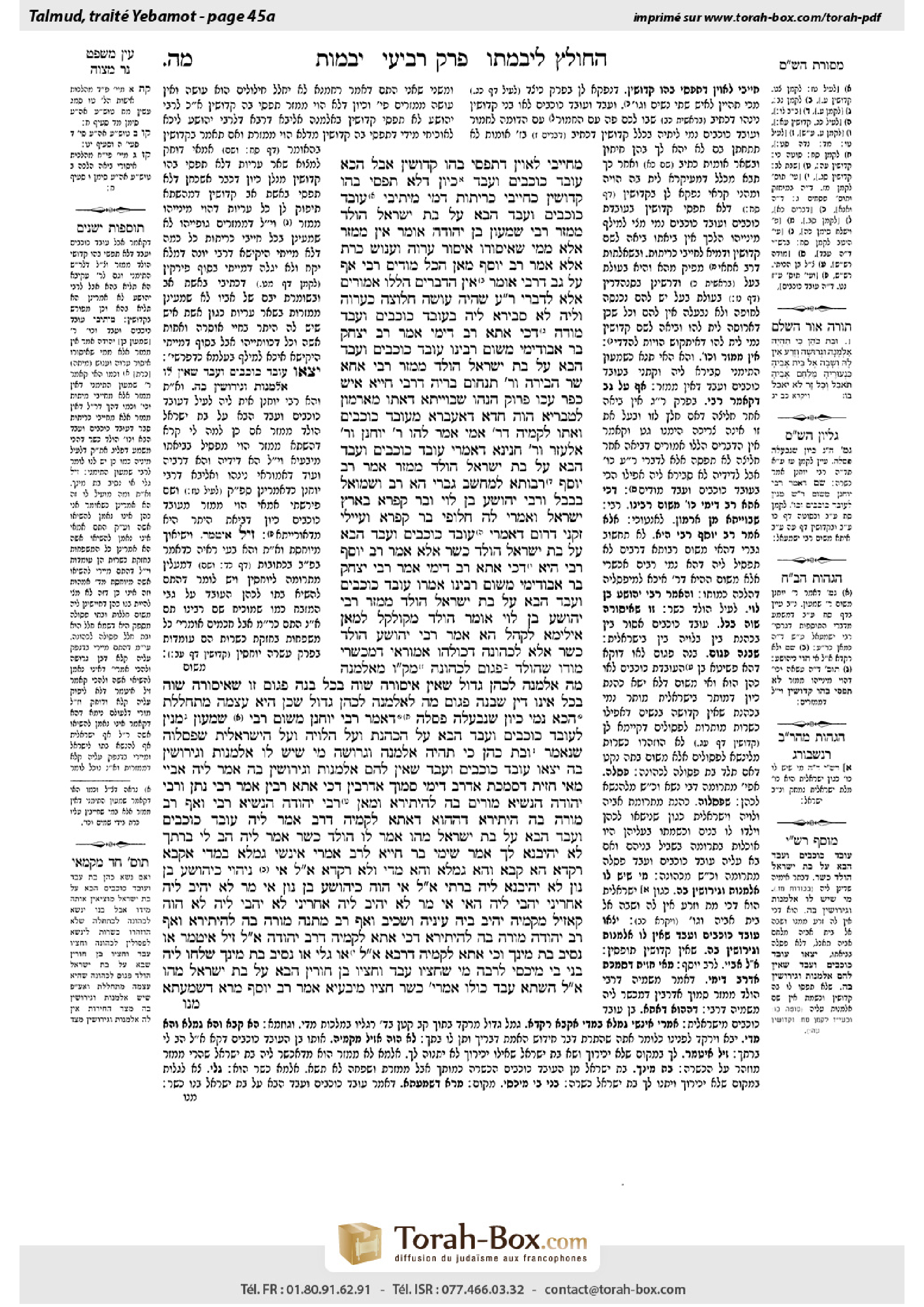
Yevamot 45a: Talmud study for Daf Yomi
Daf Yomi is the daily study of one Talmud folio. Explore 37 tractates with scans, Hebrew text, Sefaria English and AI-generated French translations where annotated.
Passage selection and English or AI-generated French translation are available where the scan has annotations. Daf Study is independent of Torah-Box and Sefaria.
Browse Yevamot · יבמות · All tractatesYevamot 45a text and translations
This page of Yevamot includes the Aramaic text, an English translation and an AI-generated French translation, alongside the scan above.
יבמות מ״ה א · Aramaic and Hebrew text
מֵחַיָּיבֵי לָאוִין דְּתָפְסִי בְּהוּ קִדּוּשִׁין, אֲבָל הָכָא, גּוֹי וְעֶבֶד, כֵּיוָן דְּלָא תָּפְסִי בְּהוּ קִדּוּשִׁין — כְּחַיָּיבֵי כָּרֵיתוֹת דְּמֵי.
מֵיתִיבִי: גּוֹי וְעֶבֶד הַבָּא עַל בַּת יִשְׂרָאֵל — הַוָּלָד מַמְזֵר. רַבִּי שִׁמְעוֹן בֶּן יְהוּדָה אוֹמֵר: אֵין מַמְזֵר אֶלָּא מִמִּי שֶׁאִיסּוּרוֹ אִיסּוּר עֶרְוָה וְעָנוּשׁ כָּרֵת.
אֶלָּא אָמַר רַב יוֹסֵף: מַאן ״הַכֹּל מוֹדִים״ — רַבִּי, אַף עַל גַּב דְּרַבִּי אוֹמֵר: אֵין הַדְּבָרִים הַלָּלוּ אֲמוּרִים אֶלָּא לְדִבְרֵי רַבִּי עֲקִיבָא, שֶׁהָיָה עוֹשֶׂה חֲלוּצָה כְּעֶרְוָה, וְלֵיהּ לָא סְבִירָא לֵיהּ, בְּגוֹי וְעֶבֶד מוֹדֶה. דְּכִי אֲתָא רַב דִּימִי, אָמַר רַב יִצְחָק בַּר אֲבוּדִימִי מִשּׁוּם רַבֵּינוּ: גּוֹי וְעֶבֶד הַבָּא עַל בַּת יִשְׂרָאֵל — הַוָּלָד מַמְזֵר.
רַבִּי אַחָא שַׂר הַבִּירָה וְרַבִּי תַּנְחוּם בְּרֵיהּ דְּרַבִּי חִיָּיא אִישׁ כְּפַר עַכּוֹ פְּרוּק הָנְהוּ שְׁבוּיָיתָא דַּאֲתוֹ מֵאַרְמוֹן לִטְבֶרְיָא. הֲוָה חֲדָא דְּאִעַבַּרָא מִגּוֹי, וַאֲתוֹ לְקַמֵּיהּ דְּרַבִּי אַמֵּי, אֲמַר לְהוּ: רַבִּי יוֹחָנָן וְרַבִּי אֶלְעָזָר וְרַבִּי חֲנִינָא דְּאָמְרִי: גּוֹי וְעֶבֶד הַבָּא עַל בַּת יִשְׂרָאֵל — הַוָּלָד מַמְזֵר.
אָמַר רַב יוֹסֵף: רְבוּתָא לְמִחְשַׁב גַּבְרֵי?! הָא רַב וּשְׁמוּאֵל בְּבָבֶל, וְרַבִּי יְהוֹשֻׁעַ בֶּן לֵוִי וּבַר קַפָּרָא בְּאֶרֶץ יִשְׂרָאֵל, וְאָמְרִי לַהּ חַלּוֹפֵי בַּר קַפָּרָא וְעַיֹּילֵי זִקְנֵי דָרוֹם, דְּאָמְרִי: גּוֹי וְעֶבֶד הַבָּא עַל בַּת יִשְׂרָאֵל הַוָּלָד כָּשֵׁר!
אֶלָּא אָמַר רַב יוֹסֵף: רַבִּי הִיא. דְּכִי אֲתָא רַב דִּימִי אָמַר רַבִּי יִצְחָק בַּר אֲבוּדִימִי: מִשּׁוּם רַבֵּינוּ אָמְרוּ: גּוֹי וְעֶבֶד הַבָּא עַל בַּת יִשְׂרָאֵל — הַוָּלָד מַמְזֵר.
רַבִּי יְהוֹשֻׁעַ בֶּן לֵוִי אוֹמֵר: הַוָּלָד מְקוּלְקָל. לְמַאן? אִילֵימָא לַקָּהָל — הָא אָמַר רַבִּי יְהוֹשֻׁעַ: הַוָּלָד כָּשֵׁר! אֶלָּא לִכְהוּנָּה, דְּכוּלְּהוּ אָמוֹרָאֵי דְּמַכְשְׁרִי — מוֹדוּ שֶׁהַוָּלָד פָּגוּם לִכְהוּנָּה.
מִקַּל וְחוֹמֶר מֵאַלְמָנָה: מָה אַלְמָנָה לְכֹהֵן גָּדוֹל, שֶׁאֵין אִיסּוּרָהּ שָׁוֶה בַּכֹּל — בְּנָהּ פָּגוּם, זוֹ שֶׁאִיסּוּרָהּ שָׁוֶה בַּכֹּל — אֵינוֹ דִּין שֶׁבְּנָהּ פָּגוּם.
מָה לְאַלְמָנָה לְכֹהֵן גָּדוֹל שֶׁכֵּן הִיא עַצְמָהּ מִתְחַלֶּלֶת! הָכָא נָמֵי, כֵּיוָן שֶׁנִּבְעֲלָה — פְּסָלָהּ.
דְּאָמַר רַבִּי יוֹחָנָן מִשּׁוּם רַבִּי שִׁמְעוֹן: מִנַּיִן לְגוֹי וְעֶבֶד הַבָּא עַל הַכֹּהֶנֶת וְעַל הַלְּוִיָּה וְעַל הַיִּשְׂרְאֵלִית שֶׁפְּסָלוּהָ — שֶׁנֶּאֱמַר: ״וּבַת כֹּהֵן כִּי תִהְיֶה אַלְמָנָה וּגְרוּשָׁה״, מִי שֶׁיֵּשׁ לוֹ אַלְמְנוּת וְגֵירוּשִׁין בָּהּ, יָצְאוּ גּוֹי וְעֶבֶד שֶׁאֵין לָהֶם אַלְמְנוּת וְגֵירוּשִׁין בָּהּ.
אֲמַר לֵיהּ אַבָּיֵי: מַאי חָזֵית דְּסָמְכַתְּ אַדְּרַב דִּימִי — סְמוֹךְ אַדְּרָבִין! דְּכִי אֲתָא רָבִין, אָמַר: רַבִּי נָתָן וְרַבִּי יְהוּדָה הַנָּשִׂיא מוֹרוּ בַּהּ לְהֶיתֵּירָא. וּמַאן רַבִּי יְהוּדָה הַנָּשִׂיא — רַבִּי.
וְאַף רַב מוֹרֵה בַּהּ [לְ]הֶיתֵּירָא. דְּהָהוּא דַּאֲתָא לְקַמֵּיהּ דְּרַב, אֲמַר לֵיהּ: גּוֹי וְעֶבֶד הַבָּא עַל בַּת יִשְׂרָאֵל, מַהוּ?
אָמַר לֵיהּ: הַוָּלָד כָּשֵׁר. אֲמַר לֵיהּ: הַב לִי בְּרַתָּךְ. לָא יָהֵיבְנָא לָךְ.
אָמַר שִׁימִי בַּר חִיָּיא לְרַב, אָמְרִי אִינָשֵׁי: גַּמְלָא בְּמָדַי אַקַּבָּא רָקְדָא. הָא קַבָּא, וְהָא גַּמְלָא, וְהָא מָדַי — וְלָא רָקְדָא!
אֲמַר לֵיהּ: אִי נִיהְוֵי כִּיהוֹשֻׁעַ בִּן נוּן — לָא יָהֵיבְנָא לֵיהּ בְּרַתִּי. אָמַר לֵיהּ: אִי הֲוָה כִּיהוֹשֻׁעַ בִּן נוּן, אִי מָר לָא יָהֵיב לֵיהּ — אַחֲרִינֵי יָהֲבִי לֵיהּ, הַאי אִי מָר לָא יָהֵיב לֵיהּ — אַחֲרִינֵי לָא יָהֲבִי לֵיהּ.
לָא הֲוָה קָאָזֵיל מִקַּמֵּיהּ. יְהֵיב בֵּיהּ עֵינֵיהּ וּשְׁכֵיב.
וְאַף רַב מַתְנָה מוֹרֵה בַּהּ לְהֶיתֵּירָא, וְאַף רַב יְהוּדָה מוֹרֵה בַּהּ לְהֶיתֵּירָא. דְּכִי אֲתָא לְקַמֵּיהּ דְּרַב יְהוּדָה, אֲמַר לֵיהּ: זִיל אִיטַּמַּר, אוֹ נְסֵיב בַּת מִינָּךְ. וְכִי אֲתָא לְקַמֵּיהּ דְּרָבָא, אֲמַר לֵיהּ: אוֹ גְּלִי, אוֹ נְסֵיב בַּת מִינָּךְ.
שְׁלַחוּ לֵיהּ בְּנֵי בֵּי מִיכְסֵי לְרַבָּה: מִי שֶׁחֶצְיוֹ עֶבֶד וְחֶצְיוֹ בֶּן חוֹרִין הַבָּא עַל בַּת יִשְׂרָאֵל, מַהוּ? אֲמַר לְהוּ: הַשְׁתָּא עֶבֶד כּוּלּוֹ, אָמְרִינַן כָּשֵׁר — חֶצְיוֹ מִיבַּעְיָא?
אָמַר רַב יוֹסֵף: מָרָא דִשְׁמַעְתָּא
Yevamot 45a · English translation
to forbidden relations for which one is liable for violation of a prohibition concerning which a betrothal between the couple would take effect. However, here, with regard to a gentile and a slave, since their betrothal of a Jewish woman would not take effect, a union with them is comparable to forbidden relations for which one is liable to receive karet, and therefore the offspring of such a union will be a mamzer.
The Gemara raises an objection from a baraita: In the case of a gentile or a slave who engaged in intercourse with a Jewish woman, the offspring born from such a union is a mamzer. Rabbi Shimon ben Yehuda says: The offspring is a mamzer only if born from relations with one who is forbidden by a prohibition of forbidden relations that are punishable by karet. It is apparent from the baraita that one who holds, as does Shimon HaTimni, that only the offspring from forbidden relations for which one is liable to receive karet is a mamzer, nevertheless holds that the offspring of a slave or gentile and a Jewish woman is not a mamzer.
Rather, Rav Yosef said: Who is included by saying: All agree? It is Rabbi Yehuda HaNasi, as although Rabbi Yehuda HaNasi says in a baraita (52b) concerning the mishna (50a–51b) that states that a levirate betrothal between a yavam and a yevama with whom he had already performed ḥalitza is ineffective: This statement was said only according to the statement of Rabbi Akiva, as he would consider a ḥalutza like a forbidden relative such that if the yavam betrothed her it would not take effect. And although Rabbi Yehuda HaNasi himself does not hold accordingly with regard to that issue, with regard to the offspring of a union with a gentile or a slave he concedes that the offspring is a mamzer. As, when Rav Dimi came from Eretz Yisrael, he said that Rav Yitzḥak bar Avudimi said in the name of our Master, i.e., Rabbi Yehuda HaNasi: With regard to a gentile or a slave who engaged in intercourse with a Jewish woman, the offspring is a mamzer.
The Gemara cites a related incident: Rabbi Aḥa, lord of the capital, and Rabbi Tanḥum, son of Rabbi Ḥiyya, the man of Akko village, redeemed those captives who came from Armon to Tiberias. One of them had been impregnated by a gentile, and they came before Rabbi Ami to ask what the offspring’s status would be when born. He said to them that Rabbi Yoḥanan and Rabbi Elazar and Rabbi Ḥanina all say: With regard to a gentile or a slave who engaged in intercourse with a Jewish woman, the offspring is a mamzer.
Upon hearing this, Rav Yosef said: Is it so great to enumerate men? The fact that several great Sages held this opinion does not prove that their opinion is the accepted halakha. But there are Rav and Shmuel in Babylonia, and Rabbi Yehoshua ben Levi and bar Kappara in Eretz Yisrael, and some say to remove bar Kappara from this list and insert instead the Elders of the South, who all say: With regard to a gentile or a slave who engaged in intercourse with a Jewish woman, the lineage of the offspring is unflawed, and he or she may marry into the congregation of Israel.
Rather, Rav Yosef said the halakha is in fact that the offspring is a mamzer because this is Rabbi Yehuda HaNasi’s opinion, as when Rav Dimi came from Eretz Yisrael he said that Rav Yitzḥak bar Avudimi said in the name of our Master, i.e., Rabbi Yehuda HaNasi, that they say: With regard to a gentile or a slave who engaged in intercourse with a Jewish woman, the offspring is a mamzer.
Rabbi Yehoshua ben Levi says: The lineage of the offspring is sullied, and if the child is a girl she is restricted in whom she may marry. The Gemara asks: To whom is she prohibited from marrying? If we say it is to the congregation of Israel, but didn’t Rabbi Yehoshua himself say that the lineage of the offspring is unflawed and he or she may marry into the congregation of Israel? Rather, the offspring is prohibited to marry into the priesthood, as all of the amora’im who render the offspring fit to enter the congregation of Israel agree that the offspring has flawed lineage and is forbidden to marry into the priesthood.
This is derived from an a fortiori inference from the halakha of a widow, as follows: Just as in the case of a widow who is married to a High Priest, where the prohibition that pertains to her is not equally applicable to all Jews, i.e., only a High Priest is prohibited from marrying a widow, and nevertheless her child from that union will have flawed lineage, then so too with regard to this woman who engaged in relations with a gentile or slave, where the prohibition that pertains to her is equally applicable to all Jews, isn’t it logical that her child from that union will have flawed lineage?
And if one would say that the logic of this a fortiori inference could be refuted by claiming that what is true with regard to a widow who is married to a High Priest, where her union with him is what makes her herself disqualified from subsequently marrying any priest and, if she is the daughter of a priest, from eating teruma, is not true with regard to the prohibition against a Jewish woman engaging in relations with a gentile or a slave. This is not correct, because here, too, once he has engaged in intercourse with her, he thereby renders her unfit to marry into the priesthood.
As Rabbi Yoḥanan said in the name of Rabbi Shimon: From where is it derived with regard to a gentile or a slave who engaged in intercourse with a daughter of a priest or with a female Levite or with a female Israelite that they thereby render her unfit to marry into the priesthood? As it is stated: “But a priest’s daughter when she will become a widow, or a divorcée, and have no child, she returns to her father’s house as in her youth” (Leviticus 22:13). The verse indicates that she returns to her father’s house and enjoys the rights of the priesthood only in a case where she engaged in intercourse with one to whom widowhood and divorce can apply, i.e., one with whom her marriage would be valid and would be broken only through death or divorce. Excluded from this is a union with a gentile or a slave, to whom neither widowhood nor divorce can apply, as no marriage bond can be formed with them.
Abaye said to Rav Yosef: What did you see that you rely upon Rav Dimi and his tradition that Rabbi Yehuda HaNasi holds that the offspring of a gentile or a slave and a Jewish woman is a mamzer? Rely instead upon Ravin, as when Ravin came from Eretz Yisrael he said that Rabbi Natan and Rabbi Yehuda HaNasi both rule that the offspring is permitted to marry into the congregation of Israel. And who is the Rabbi Yehuda HaNasi referred to in Ravin’s report? It is the one who is simply referred to as Rabbi, the redactor of the Mishna, whose opinion is accepted as the halakha.
The Gemara notes: And even Rav rules that the offspring is permitted, as is evident from an incident involving a certain individual who came before Rav and said to him: With regard to the offspring of a gentile or a slave who engaged in intercourse with a Jewish woman, what is its halakhic status?
Rav said to him: The lineage of the offspring is unflawed. The individual who asked the question was himself such a child, and he said to Rav: If so, give me your daughter in marriage. He said to him: I will not give her to you.
Shimi bar Ḥiyya, Rav’s grandson, said to Rav: People often say that a camel in Medes can dance upon a small space that holds only a single kav of produce. However, clearly that is an exaggeration, since if one would go to Medes one could demonstrate that this is a space that holds a kav, and this is a camel, and this is Medes, and yet the camel is not dancing, i.e., the truth of a statement becomes apparent when it is put to the test. So too, it would appear that you do not truly believe in your ruling because when put to the test, you are unwilling to rely on it.
He said to him: Even if he were as great as Joshua, son of Nun, I would not give him my daughter in marriage. My refusal to give her to him in marriage is not that I do not stand by my ruling; it is for other reasons. He said to him: If he were as great as Joshua, son of Nun, then even if the Master would not give him his daughter, others would still give him their daughters. However, with regard to this man, if the Master does not give him his daughter, others will not give him their daughters either out of fear of damaging the family lineage. Nevertheless, Rav remained unwilling to give his daughter to that individual.
That individual would not go from standing before Rav and continued to plead with him. Rav placed his eyes upon him and he died.
The Gemara adds: And even Rav Mattana rules that the offspring is permitted, and even Rav Yehuda rules that the offspring is permitted, as is evident from the fact that when a child of a gentile or slave and a Jewish woman came before Rav Yehuda, he said to him: Go and conceal your paternal lineage so that people will not refrain from giving you their daughters in marriage, as it is permitted for you to marry into the congregation of Israel, or otherwise, marry a woman of your own kind, i.e., a woman of similar lineage. And similarly, when such a person came before Rava, he said to him: Either go into exile to a place where your lineage is unknown, so that others will give you their daughters in marriage, or marry a woman of your own kind.
The residents of Bei Mikhsei sent the following question to Rabba: With regard to the offspring of one who is a half-slave half-freeman, who engaged in intercourse with a Jewish woman, what is its halakhic status? He said to them: Now that with regard to the offspring of a full slave we say that his lineage is unflawed, is it necessary to ask about a half-slave?
Rav Yosef said: The Master who is responsible for dissemination of this halakha that the offspring of a slave and a Jewish woman is not a mamzer,
Yevamot 45a · Traduction française (IA)
aux unions interdites pour lesquelles on est passible de la violation d’une interdiction au titre de laquelle les fiançailles entre les deux personnes prendraient effet. Mais ici, s’agissant d’un non-Juif et d’un esclave, puisque leurs fiançailles avec une femme juive ne prendraient pas effet, leur union est comparable aux unions interdites passibles de karet ; l’enfant issu d’une telle union sera donc un mamzer.
La Guemara soulève une objection à partir d’une baraïta : dans le cas d’un non-Juif ou d’un esclave qui a eu des relations avec une femme juive, l’enfant né de cette union est un mamzer. Rabbi Shimon ben Yehuda dit : l’enfant n’est un mamzer que s’il est né d’une relation avec une personne frappée d’une interdiction relevant des unions interdites passibles de karet. Il ressort de la baraïta que celui qui soutient, comme Shimon HaTimni, que seul l’enfant issu d’une union interdite passible de karet est un mamzer, soutient néanmoins que l’enfant né d’un esclave ou d’un non-Juif et d’une femme juive n’est pas un mamzer.
Rav Yosef dit plutôt : qui est visé par l’expression « tous sont d’accord » ? Rabbi Yehuda HaNasi. En effet, bien que Rabbi Yehuda HaNasi dise dans une baraïta (52b), au sujet de la Michna (50a–51b), qui affirme que les fiançailles léviratiques entre un yavam et une yevama avec laquelle il a déjà accompli la ḥalitsa sont sans effet : « Cette affirmation n’a été formulée que selon l’opinion de Rabbi Akiva », car celui-ci considère une ḥalutza comme une parente interdite, de sorte que si le yavam la fiançait, les fiançailles ne prendraient pas effet ; et bien que Rabbi Yehuda HaNasi lui-même ne partage pas cette opinion sur cette question, il reconnaît, au sujet de l’enfant issu d’une union avec un non-Juif ou un esclave, que cet enfant est un mamzer. En effet, lorsque Rav Dimi arriva d’Eretz Israël, il dit que Rav Yitzḥak bar Avudimi avait rapporté au nom de notre Maître, c’est-à-dire Rabbi Yehuda HaNasi : « S’agissant d’un non-Juif ou d’un esclave qui a eu des relations avec une femme juive, l’enfant est un mamzer. »
La Guemara rapporte un incident lié à cette question : Rabbi Aḥa, seigneur de la capitale, et Rabbi Tanḥum, fils de Rabbi Ḥiyya, l’homme du village d’Akko, rachetèrent les captifs venus d’Armon à Tibériade. L’une d’elles avait été engrossée par un non-Juif ; ils se présentèrent devant Rabbi Ami pour lui demander quel serait le statut de l’enfant à sa naissance. Il leur répondit que Rabbi Yoḥanan, Rabbi Elazar et Rabbi Ḥanina disent tous : « S’agissant d’un non-Juif ou d’un esclave qui a eu des relations avec une femme juive, l’enfant est un mamzer. »
En entendant cela, Rav Yosef dit : « Est-il si important d’énumérer des hommes ? » Le fait que plusieurs grands Sages aient soutenu cet avis ne prouve pas que leur opinion fasse autorité comme halakha. Pourtant, Rav et Shmuel sont en Babylonie, et Rabbi Yehoshua ben Levi et bar Kappara en Eretz Israël ; certains disent qu’il faut retirer bar Kappara de cette liste et y mettre à sa place les Anciens du Sud. Tous disent : « S’agissant d’un non-Juif ou d’un esclave qui a eu des relations avec une femme juive, la lignée de l’enfant n’est pas entachée, et il ou elle peut se marier au sein de l’assemblée d’Israël. »
Rav Yosef dit plutôt que la halakha est bien que l’enfant est un mamzer, car telle est l’opinion de Rabbi Yehuda HaNasi. En effet, lorsque Rav Dimi arriva d’Eretz Israël, il dit que Rav Yitzḥak bar Avudimi avait rapporté au nom de notre Maître, c’est-à-dire Rabbi Yehuda HaNasi, qu’ils disent : « S’agissant d’un non-Juif ou d’un esclave qui a eu des relations avec une femme juive, l’enfant est un mamzer. »
Rabbi Yehoshua ben Levi dit : la lignée de l’enfant est entachée et, si l’enfant est une fille, elle est limitée dans le choix de son époux. La Guemara demande : Qui lui est-il interdit d’épouser ? Si nous disons qu’il s’agit d’un membre de l’assemblée d’Israël, Rabbi Yehoshua lui-même n’a-t-il pas dit que la lignée de l’enfant n’est pas entachée et qu’il ou elle peut se marier au sein de l’assemblée d’Israël ? Il faut plutôt dire qu’il lui est interdit d’épouser un membre de la prêtrise, car tous les amoraïm qui autorisent l’enfant à entrer dans l’assemblée d’Israël conviennent que sa lignée est entachée et qu’il lui est interdit d’épouser un membre de la prêtrise.
On le déduit par un raisonnement a fortiori à partir de la halakha relative à une veuve, comme suit : de même que, dans le cas d’une veuve mariée à un Grand Prêtre, alors que l’interdiction qui la concerne ne s’applique pas également à tous les Juifs — seul un Grand Prêtre ayant l’interdiction d’épouser une veuve —, l’enfant issu de cette union a néanmoins une lignée entachée, à plus forte raison, pour cette femme qui a eu des relations avec un non-Juif ou un esclave, alors que l’interdiction qui la concerne s’applique à tous les Juifs, n’est-il pas logique que l’enfant issu de cette union ait une lignée entachée ?
Et si l’on disait que l’on peut réfuter le raisonnement a fortiori en affirmant que ce qui est vrai au sujet d’une veuve mariée à un Grand Prêtre — à savoir que son union avec lui la rend elle-même inapte à épouser par la suite n’importe quel prêtre et, si elle est fille de prêtre, à consommer de la terouma — ne l’est pas au sujet de l’interdiction faite à une femme juive d’avoir des relations avec un non-Juif ou un esclave, ce serait inexact. Car ici aussi, dès qu’il a eu des relations avec elle, il la rend inapte à épouser un membre de la prêtrise.
Car Rabbi Yoḥanan a dit au nom de Rabbi Shimon : d’où apprend-on qu’un non-Juif ou un esclave qui a eu des relations avec une fille de prêtre, une femme lévite ou une femme israélite la rend inapte à épouser un membre de la prêtrise ? Comme il est dit : « Mais si la fille d’un prêtre devient veuve ou divorcée et n’a pas d’enfant, elle retourne à la maison de son père, comme au temps de sa jeunesse » (Lévitique 22:13). Le verset indique qu’elle retourne à la maison de son père et jouit des droits de la prêtrise uniquement si elle a eu des relations avec quelqu’un auquel peuvent s’appliquer le veuvage et le divorce, c’est-à-dire quelqu’un avec qui son mariage aurait été valide et n’aurait pu être rompu que par la mort ou le divorce. Est donc exclue une union avec un non-Juif ou un esclave, auxquels ne peuvent s’appliquer ni le veuvage ni le divorce, puisqu’aucun lien matrimonial ne peut être établi avec eux.
Abaye dit à Rav Yosef : « Qu’as-tu vu pour t’appuyer sur Rav Dimi et sa tradition selon laquelle Rabbi Yehuda HaNasi estime que l’enfant né d’un non-Juif ou d’un esclave et d’une femme juive est un mamzer ? Appuie-toi plutôt sur Ravin, car lorsque Ravin arriva d’Eretz Israël, il dit que Rabbi Natan et Rabbi Yehuda HaNasi statuent tous deux que l’enfant est autorisé à se marier au sein de l’assemblée d’Israël. Et de quel Rabbi Yehuda HaNasi parle le rapport de Ravin ? De celui qu’on désigne simplement comme Rabbi, le rédacteur de la Michna, dont l’opinion fait autorité comme halakha. »
La Guemara fait remarquer que Rav aussi statue que l’enfant est autorisé, comme le montre l’incident d’un certain homme qui se présenta devant Rav et lui demanda : « Quel est le statut halakhique de l’enfant né d’un non-Juif ou d’un esclave qui a eu des relations avec une femme juive ? »
Rav lui dit : « La lignée de l’enfant n’est pas entachée. » L’homme qui avait posé la question était lui-même un enfant né d’une telle union, et il dit à Rav : « Si c’est ainsi, donne-moi ta fille en mariage. » Rav lui répondit : « Je ne te la donnerai pas. »
Shimi bar Ḥiyya, le petit-fils de Rav, dit à Rav : « Les gens disent souvent qu’un chameau en Médie peut danser sur un petit espace qui ne contient qu’un kav de produits. C’est manifestement une exagération : si l’on allait en Médie, on pourrait montrer que cet espace contient un kav, que ce chameau est là et que c’est bien la Médie ; pourtant, le chameau ne danse pas. Autrement dit, la vérité d’une affirmation apparaît lorsqu’on la met à l’épreuve. De même, il semblerait que tu ne croies pas vraiment à ta décision, puisque, mise à l’épreuve, tu refuses de t’y fier. »
Il lui dit : « Même s’il était aussi grand que Josué, fils de Noun, je ne donnerais pas ma fille en mariage à cet homme. Si je refuse de la lui donner en mariage, ce n’est pas parce que je ne maintiens pas ma décision ; c’est pour d’autres raisons. » Il lui dit : « S’il était aussi grand que Josué, fils de Noun, même si le Maître ne lui donnait pas sa fille, d’autres lui donneraient leurs filles. Mais, pour cet homme, si le Maître ne lui donne pas sa fille, les autres ne lui donneront pas non plus les leurs, par crainte d’entacher la lignée familiale. » Néanmoins, Rav refusa de donner sa fille à cet homme.
Cet homme ne quittait pas Rav et continuait à le supplier. Rav posa les yeux sur lui, et il mourut.
La Guemara ajoute que Rav Mattana aussi statue que l’enfant est autorisé, tout comme Rav Yehuda. Cela ressort du fait que, lorsqu’un enfant né d’un non-Juif ou d’un esclave et d’une femme juive se présenta devant Rav Yehuda, celui-ci lui dit : « Va dissimuler la lignée de ton père, afin que les gens ne renoncent pas à te donner leurs filles en mariage, puisque tu es autorisé à te marier au sein de l’assemblée d’Israël ; sinon, épouse une femme de ton milieu, c’est-à-dire une femme de lignée semblable à la tienne. » De même, lorsqu’une personne de cette origine se présenta devant Rava, celui-ci lui dit : « Pars en exil dans un lieu où ta lignée est inconnue, afin que les autres te donnent leurs filles en mariage, ou épouse une femme de ton milieu. »
Les habitants de Bei Mikhsei envoyèrent à Rabba la question suivante : « Quel est le statut halakhique de l’enfant né d’un homme à moitié esclave et à moitié affranchi qui a eu des relations avec une femme juive ? » Il leur répondit : « Puisque nous disons que la lignée de l’enfant d’un esclave à part entière n’est pas entachée, est-il nécessaire de poser la question au sujet d’un homme à moitié esclave ? »
Rav Yosef dit : « Le Maître, qui est responsable de la diffusion de cette halakha selon laquelle l’enfant né d’un esclave et d’une femme juive n’est pas un mamzer… »
Traduction française générée par IA à partir de l’édition anglaise de Sefaria. Vérifie toujours un passage avec le texte source.
Text from Sefaria: William Davidson Edition - Vocalized Aramaic (CC BY NC); William Davidson Edition - English (CC BY NC).