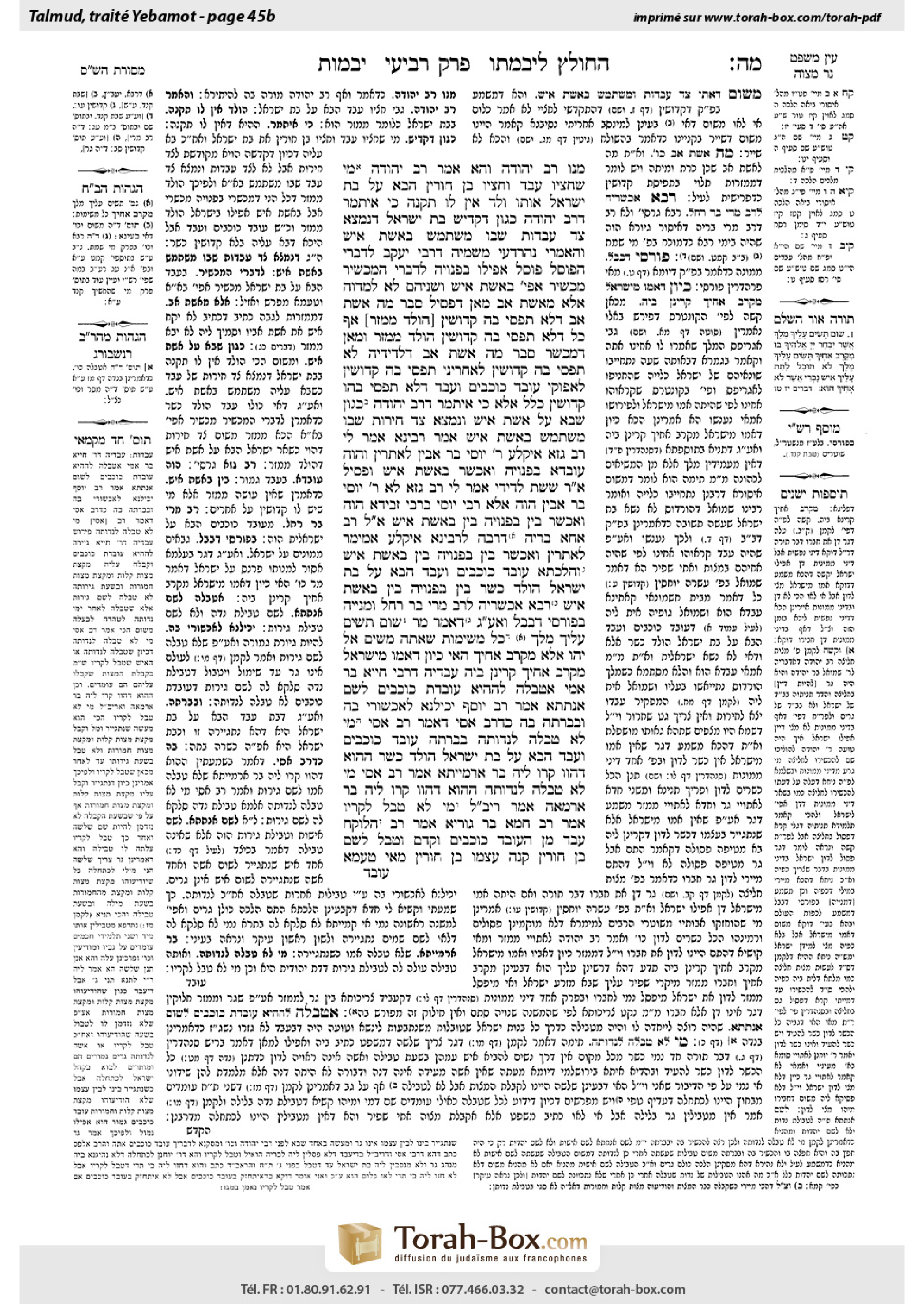
Yevamot 45b: Talmud study for Daf Yomi
Daf Yomi is the daily study of one Talmud folio. Explore 37 tractates with scans, Hebrew text, Sefaria English and AI-generated French translations where annotated.
Passage selection and English or AI-generated French translation are available where the scan has annotations. Daf Study is independent of Torah-Box and Sefaria.
Browse Yevamot · יבמות · All tractatesYevamot 45b text and translations
This page of Yevamot includes the Aramaic text, an English translation and an AI-generated French translation, alongside the scan above.
יבמות מ״ה ב · Aramaic and Hebrew text
מַנּוּ — רַב יְהוּדָה. וְהָא אָמַר רַב יְהוּדָה: מִי שֶׁחֶצְיוֹ עֶבֶד וְחֶצְיוֹ בֶּן חוֹרִין הַבָּא עַל בַּת יִשְׂרָאֵל — אוֹתוֹ וָלָד אֵין לוֹ תַּקָּנָה!
כִּי אִיתְּמַר דְּרַב יְהוּדָה, כְּגוֹן דְּקַדֵּישׁ בַּת יִשְׂרָאֵל, דְּנִמְצָא צַד עַבְדוּת שֶׁבּוֹ מִשְׁתַּמֵּשׁ בְּאֵשֶׁת אִישׁ.
וְהָאָמְרִי נְהַרְדָּעֵי מִשְּׁמֵיהּ דְּרַבִּי יַעֲקֹב: לְדִבְרֵי הַפּוֹסֵל — פּוֹסֵל אֲפִילּוּ בִּפְנוּיָה, לְדִבְרֵי הַמַּכְשִׁיר — מַכְשִׁיר אֲפִילּוּ בְּאֵשֶׁת אִישׁ.
וּשְׁנֵיהֶם לֹא לְמָדוּהָ אֶלָּא מֵאֵשֶׁת אָב. מַאן דְּפָסֵיל סָבַר: מָה אֵשֶׁת אָב דְּלָא תָּפְסִי בַּהּ קִדּוּשִׁין [הַוָּלָד מַמְזֵר], אַף כֹּל דְּלָא תָּפְסִי בַּהּ קִדּוּשִׁין — הַוָּלָד מַמְזֵר.
וּמַאן דְּמַכְשַׁר סָבַר: מָה אֵשֶׁת אָב, דִּלְדִידֵיהּ לָא תָּפְסִי בַּהּ קִדּוּשִׁין, לְאַחֲרִינֵי תָּפְסִי בַּהּ קִדּוּשִׁין, לְאַפּוֹקֵי גּוֹי וְעֶבֶד דְּלָא תָּפְסִי בְּהוּ קִדּוּשִׁין כְּלָל.
אֶלָּא: כִּי אִיתְּמַר דְּרַב יְהוּדָה, כְּגוֹן שֶׁבָּא עַל אֵשֶׁת אִישׁ, וְנִמְצָא צַד חֵירוּת שֶׁבּוֹ מִשְׁתַּמֵּשׁ בְּאֵשֶׁת אִישׁ.
אָמַר רָבִינָא, אָמַר לִי רַב גַּזָּא: אִיקְּלַע רַבִּי יוֹסֵי בַּר אָבִין לְאַתְרִין וַהֲוָה עוֹבָדָא בִּפְנוּיָה, וְאַכְשַׁר. בְּאֵשֶׁת אִישׁ, וּפְסַיל. אָמַר רַב שֵׁשֶׁת: לְדִידִי אָמַר לִי רַב גַּזָּא: לָא רַבִּי יוֹסֵי בַּר אָבִין הֲוָה אֶלָּא רַבִּי יוֹסֵי בְּרַבִּי זְבִידָא הֲוָה, וְאַכְשַׁר בֵּין בִּפְנוּיָה בֵּין בְּאֵשֶׁת אִישׁ. אֲמַר לֵיהּ רַב אַחָא בְּרֵיהּ דְּרַבָּה לְרָבִינָא: אִיקְּלַע אַמֵּימָר לְאַתְרִין וְאַכְשַׁר בֵּין בִּפְנוּיָה בֵּין בְּאֵשֶׁת אִישׁ.
וְהִלְכְתָא: גּוֹי וְעֶבֶד הַבָּא עַל בַּת יִשְׂרָאֵל — הַוָּלָד כָּשֵׁר, בֵּין בִּפְנוּיָה בֵּין בְּאֵשֶׁת אִישׁ.
רָבָא אַכְשְׁרֵיהּ לְרַב מָרִי בַּר רָחֵל וּמַנְּיֵיהּ בְּפוּרְסֵי דְּבָבֶל, וְאַף עַל גַּב דְּאָמַר מָר: ״שׂוֹם תָּשִׂים עָלֶיךָ מֶלֶךְ״ — כׇּל מְשִׂימוֹת שֶׁאַתָּה מֵשִׂים אַל יְהוּ אֶלָּא מִקֶּרֶב אַחֶיךָ, הַאי, כֵּיוָן דְּאִמּוֹ מִיִּשְׂרָאֵל — ״מִקֶּרֶב אַחֶיךָ״ קָרֵינַן בֵּיהּ.
עַבְדֵּיהּ דְּרַבִּי חִיָּיא בַּר אַמֵּי אַטְבְּלַהּ לְהָהִיא גּוֹיָה לְשֵׁם אִנְתְּתָא. אָמַר רַב יוֹסֵף: יָכֵילְנָא לְאַכְשׁוֹרֵי בַּהּ וּבִבְרַתַּהּ.
בַּהּ, כִּדְרַב אַסִּי. דְּאָמַר רַב אַסִּי, מִי לָא טְבַלָה לְנִדּוּתַהּ?
בִּבְרַתַּהּ, גּוֹי וְעֶבֶד הַבָּא עַל בַּת יִשְׂרָאֵל — הַוָּלָד כָּשֵׁר.
הַהוּא דַּהֲווֹ קָרוּ לֵיהּ ״בַּר אַרְמָיְיתָא״, אֲמַר רַב אַסִּי: מִי לָא טְבַלָה לְנִדּוּתַהּ? הָהוּא דַּהֲווֹ קָרוּ לֵיהּ ״בַּר אַרְמָאָה״. אֲמַר רַבִּי יְהוֹשֻׁעַ בֶּן לֵוִי: מִי לָא טְבַל לְקִרְיוֹ?
אָמַר רַב חָמָא בַּר גּוּרְיָא אָמַר רַב: הַלּוֹקֵחַ עֶבֶד מִן הַגּוֹי, וְקָדַם וְטָבַל לְשֵׁם בֶּן חוֹרִין, קָנָה עַצְמוֹ בֶּן חוֹרִין. מַאי טַעְמָא —
Yevamot 45b · English translation
who is he? He is Rav Yehuda, as the Gemara cited above. But didn’t Rav Yehuda himself say: With regard to one who is a half-slave half-freeman who engaged in intercourse with a Jewish woman, that offspring of that union has no recourse to be able to marry? It is apparent, then, that even one who permits the offspring of a slave to marry into the congregation of Israel does not permit the offspring of a half-slave to do so, contrary to Rava’s assertion.
The Gemara resolves the difficulty: When this ruling of Rav Yehuda was stated, it was referring to a case where the half-slave betrothed a Jewish woman. Since a slave’s betrothal does not take effect, the result of that betrothal is that the woman is married to only the free half of the half-slave half-freeman, such that it emerges that when he has relations with her, the slave side of him is engaging in relations with a married woman to whom that side of him is not married, and so the offspring of that union is a mamzer.
The Gemara raises an objection: But didn’t the Sages of Neharde’a say in the name of Rabbi Ya’akov: According to the statement of the one who renders the child of a gentile or slave and a Jewish woman unfit to marry into the congregation of Israel, he renders the child unfit even when the mother is an unmarried woman. And according to the statement of the one who renders the child fit, he renders the child fit even when the mother is a married woman.
And both of them derived their opinions only from the halakha of one’s father’s wife, as follows: The one who renders the child unfit holds that just as with regard to one’s father’s wife, one’s betrothal of her does not take effect even after she is widowed or divorced, and so the offspring of such a union is a mamzer, so too, with regard to any one for whom betrothal of her does not take effect, including a gentile or a slave, the offspring is a mamzer.
And the one who renders the child fit holds that the derivation from the halakha of one’s father’s wife is more limited, and it is derived that the offspring is a mamzer only in a case just like one’s father’s wife, in that although his betrothal of her does not take effect, with someone else his betrothal of her does take effect. This is to the exclusion of a gentile and a slave, for whom betrothal of any Jewish woman does not take effect at all, and so the offspring of such a union will not be a mamzer. It is apparent from this statement of the Sages of Neharde’a that according to the lenient opinion, the offspring of a slave is never a mamzer, irrespective of the marital status of the Jewish woman. Therefore, the Gemara’s resolution is undermined.
The Gemara offers a different resolution: Rather, when this statement of Rav Yehuda was stated, it was referring to a case where the half-slave half-freeman engaged in intercourse with a married woman who was married to someone else, and it therefore emerges that although the woman’s union with the slave side of him will not render the offspring a mamzer, the free side of him is engaging in relations with a married woman to whom he is not married, and due to that side of him the offspring is a mamzer.
Ravina said: Rav Gazza said to me that Rabbi Yosei bar Avin once happened to come to our place, and there was an incident involving an unmarried woman who had engaged in intercourse with a slave, and Rabbi Yosei bar Avin rendered her offspring fit to marry into the congregation of Israel. And there was another incident involving a married woman who had engaged in intercourse with a slave, and he rendered her offspring unfit to marry into the congregation of Israel by ruling the offspring was a mamzeret. Rav Sheshet said: Rav Gazza told me that it was not Rabbi Yosei bar Avin; rather, it was Rabbi Yosei, son of Rabbi Zevida, and he rendered the offspring fit both in the case of an unmarried woman and in the case of a married woman. Rav Aḥa, son of Rabba, said to Ravina: Ameimar once happened to come to our place and rendered the offspring fit both in the case of an unmarried woman and in the case of a married woman.
The Gemara concludes: And the halakha is that with regard to a gentile or slave who engaged in intercourse with a Jewish woman, the lineage of the offspring is unflawed, whether she was an unmarried or a married woman.
The Gemara cites a related halakha: Rava ruled that Rav Mari bar Raḥel, who was the son of a gentile father and a Jewish mother, was fit to marry into the congregation of Israel, and furthermore he appointed him as one of the officials [pursei] of Babylonia. And although the Master said that from the verse, “You shall place a king over you whom the Lord your God shall chose; from among your brethren shall you place a king over you” (Deuteronomy 17:15) it is derived that not only with regard to the kingship but also with regard to all positions of authority that you appoint, the incumbents may be selected only from among your brethren who share your Jewish lineage. Nevertheless, with regard to this one, i.e., Rav Mari bar Raḥel, since his mother is of Jewish lineage, we call him “from among your brethren,” and so he is eligible.
§ A gentile slave purchased by a Jew must be circumcised and then immersed in a ritual bath. By being immersed for the sake of slavery, he takes on the status of a full slave, which, among other things, obligates him to keep certain mitzvot. However, if the slave, or any gentile, is immersed for the sake of conversion, he then becomes a full Jew and fully obligated in mitzvot like any other Jew.
The Gemara considers the result of different intentions accompanying an immersion: Rabbi Ḥiyya bar Ami’s slave immersed a certain gentile woman for the sake of having intimate relations, i.e., to purify her from her menstrual impurity. Rav Yosef said: I am able to render both her and her daughter fit to marry into the congregation of Israel.
With regard to her, I can render her fit in accordance with the opinion of Rav Asi, as Rav Asi said concerning a woman whose status as a convert was unclear but who lived as a part of the Jewish people and acted like all other Jewish women: Didn’t she immerse for the sake of purifying herself from her menstruation? Therefore, even if the original immersion was invalid, her intention in subsequent immersions was sufficient to be considered for the sake of conversion, since ultimately she immersed as an expression of her commitment to Judaism. She is therefore fully Jewish.
And with regard to her daughter, she is the daughter of a gentile or slave who engaged in intercourse with a Jewish woman, and the halakha is that the lineage of the offspring is unflawed.
The Gemara details the circumstances of Rav Asi’s ruling: There was a certain man whom people would call: Son of the Aramean woman, as they cast aspersions on the validity of his mother’s conversion. With regard to that case, Rav Asi said: Didn’t she immerse for the sake of purifying herself from her menstruation? A similar incident is recounted: There was a certain man whom people would call: Son of an Aramean man, as they cast aspersions on the validity of his father’s conversion. Rabbi Yehoshua ben Levi said: Didn’t he immerse for the sake of purifying himself from his seminal emission? That intention is sufficient to consider the immersion an immersion for the sake of conversion.
Rav Ḥama bar Gurya said that Rav said: In the case of a Jew who purchased a slave from a gentile, and before he managed to immerse him for the sake of slavery the slave preempted him and immersed for the sake of conversion to render himself a freeman, he thereby acquired himself and becomes a freeman, i.e., his immersion effects a full conversion and he is no longer a slave. What is the reason for this halakha?
Yevamot 45b · Traduction française (IA)
De qui s’agit-il ? De Rav Yehuda, comme la Guemara l’a cité plus haut. Mais Rav Yehuda lui-même n’a-t-il pas dit, à propos d’un homme à moitié esclave et à moitié libre qui a eu des relations avec une Juive, que l’enfant issu de cette union ne peut se marier ? Il apparaît donc que même celui qui autorise l’enfant d’un esclave à se marier au sein de l’assemblée d’Israël ne l’autorise pas dans le cas de l’enfant d’un homme à moitié esclave et à moitié libre, contrairement à ce qu’affirme Rava.
La Guemara résout la difficulté : lorsque cette décision de Rav Yehuda a été énoncée, elle concernait un cas où l’homme à moitié esclave et à moitié libre avait contracté kiddouchine avec une Juive. Puisque les kiddouchine d’un esclave ne prennent pas effet, la femme n’est mariée qu’à la moitié libre de cet homme. Ainsi, lorsqu’il a des relations avec elle, sa moitié esclave a des relations avec une femme mariée à laquelle cette moitié n’est pas mariée ; l’enfant issu de cette union est donc un mamzer.
La Guemara soulève une objection : les Sages de Nehardea n’ont-ils pas dit au nom de Rabbi Ya’akov : selon celui qui déclare inapte à se marier au sein de l’assemblée d’Israël l’enfant d’un non-Juif ou d’un esclave et d’une Juive, l’enfant est inapte même lorsque la mère n’est pas mariée ? Et selon celui qui le déclare apte, l’enfant est apte même lorsque la mère est mariée.
Tous deux ont fondé leur opinion uniquement sur la halakha relative à la femme de son père, de la manière suivante : celui qui déclare l’enfant inapte soutient que, de même que les kiddouchine avec la femme de son père ne prennent pas effet, même après qu’elle est devenue veuve ou divorcée, et que l’enfant issu d’une telle union est donc un mamzer, de même, l’enfant est un mamzer pour toute femme avec laquelle les kiddouchine ne prennent pas effet, notamment une non-Juive ou une esclave.
Celui qui déclare l’enfant apte soutient que la déduction tirée de la halakha relative à la femme de son père est plus limitée : on en déduit que l’enfant est un mamzer uniquement dans un cas comparable à celui de la femme de son père, en ce sens que, bien que les kiddouchine de cet homme avec elle ne prennent pas effet, ceux d’un autre homme avec elle prennent effet. Cela exclut une non-Juive et une esclave, avec lesquelles les kiddouchine ne prennent effet pour aucun Juif ; l’enfant issu d’une telle union ne sera donc pas un mamzer. Cette déclaration des Sages de Nehardea montre que, selon l’opinion indulgente, l’enfant d’un esclave n’est jamais un mamzer, quel que soit le statut matrimonial de la Juive. La résolution de la Guemara est donc réfutée.
La Guemara propose une autre résolution : cette déclaration de Rav Yehuda concernait un cas où l’homme à moitié esclave et à moitié libre avait eu des relations avec une femme mariée à un autre homme. Il en résulte que, même si l’union de la femme avec sa moitié esclave ne rend pas l’enfant mamzer, sa moitié libre a des relations avec une femme mariée à laquelle elle n’est pas mariée ; à cause de cette moitié, l’enfant est un mamzer.
Ravina dit : Rav Gazza m’a dit que Rabbi Yosei bar Avin était un jour venu chez nous. Il y eut un cas où une femme non mariée avait eu des relations avec un esclave ; Rabbi Yosei bar Avin déclara l’enfant apte à se marier au sein de l’assemblée d’Israël. Il y eut aussi un cas où une femme mariée avait eu des relations avec un esclave ; il déclara alors l’enfant inapte à se marier au sein de l’assemblée d’Israël, statuant que l’enfant était une mamzeret. Rav Sheshet dit : Rav Gazza m’a dit que ce n’était pas Rabbi Yosei bar Avin, mais Rabbi Yosei, fils de Rabbi Zevida, et qu’il avait déclaré l’enfant apte aussi bien dans le cas d’une femme non mariée que dans celui d’une femme mariée. Rav Aḥa, fils de Rabba, dit à Ravina : Ameimar était un jour venu chez nous et avait déclaré l’enfant apte aussi bien dans le cas d’une femme non mariée que dans celui d’une femme mariée.
La Guemara conclut : la halakha est que, lorsqu’un non-Juif ou un esclave a des relations avec une Juive, la lignée de l’enfant est sans défaut, que la femme soit mariée ou non.
La Guemara cite une halakha apparentée : Rava statua que Rav Mari bar Raḥel, fils d’un père non-Juif et d’une mère juive, était apte à se marier au sein de l’assemblée d’Israël ; de plus, il le nomma à l’une des fonctions officielles [pursei] de Babylonie. Or, bien que le Maître ait dit que le verset « Tu établiras sur toi un roi que l’Éternel, ton Dieu, choisira ; c’est du milieu de tes frères que tu établiras un roi sur toi » (Deutéronome 17, 15) enseigne que non seulement le roi, mais aussi tous les titulaires des fonctions d’autorité que vous nommez, ne peuvent être choisis que parmi vos frères, ceux qui partagent votre ascendance juive, dans le cas de cet homme, Rav Mari bar Raḥel, puisque sa mère est de lignée juive, nous le considérons comme étant « du milieu de tes frères » ; il est donc admissible.
§ Un esclave non-Juif acheté par un Juif doit être circoncis, puis immergé dans un bain rituel. En étant immergé en vue de l’esclavage, il acquiert le statut d’esclave à part entière, ce qui l’oblige notamment à observer certaines mitsvot. Toutefois, si l’esclave, ou tout autre non-Juif, est immergé en vue de la conversion, il devient alors pleinement juif et est entièrement astreint aux mitsvot, comme tout autre Juif. La Guemara examine les conséquences des différentes intentions qui accompagnent une immersion : l’esclave de Rabbi Ḥiyya bar Ami immergea une certaine femme non juive en vue d’avoir des relations intimes avec elle, c’est-à-dire afin de la purifier de son impureté menstruelle. Rav Yosef dit : je peux déclarer aptes, à la fois elle et sa fille, à se marier au sein de l’assemblée d’Israël.
En ce qui la concerne, je peux la déclarer apte conformément à l’opinion de Rav Asi, car Rav Asi a dit au sujet d’une femme dont le statut de convertie était incertain, mais qui vivait au sein du peuple juif et se comportait comme les autres femmes juives : ne s’est-elle pas immergée afin de se purifier de ses règles ? Par conséquent, même si l’immersion initiale était invalide, son intention lors des immersions ultérieures suffisait pour que celles-ci soient considérées comme ayant été faites en vue de la conversion, puisqu’elle s’est finalement immergée en signe de son engagement envers le judaïsme. Elle est donc pleinement juive.
Quant à sa fille, elle est la fille d’un non-Juif ou d’un esclave qui a eu des relations avec une Juive, et la halakha est que la lignée de l’enfant est sans défaut.
La Guemara précise les circonstances de la décision de Rav Asi : il y avait un homme que les gens appelaient « le fils de l’Araméenne », mettant ainsi en doute la validité de la conversion de sa mère. À propos de ce cas, Rav Asi dit : ne s’est-elle pas immergée afin de se purifier de ses règles ? On rapporte un cas semblable : il y avait un homme que les gens appelaient « le fils de l’Araméen », mettant ainsi en doute la validité de la conversion de son père. Rabbi Yehoshua ben Levi dit : ne s’est-il pas immergé afin de se purifier de son émission séminale ? Cette intention suffit pour considérer l’immersion comme une immersion en vue de la conversion.
Rav Ḥama bar Gurya dit au nom de Rav : dans le cas d’un Juif qui a acheté un esclave à un non-Juif et qui, avant d’avoir pu l’immerger en vue de l’esclavage, voit l’esclave le devancer et s’immerger en vue de la conversion afin de devenir libre, celui-ci s’acquiert lui-même et devient libre ; autrement dit, son immersion produit une conversion complète et il n’est plus un esclave. Quelle est la raison de cette halakha ?
Traduction française générée par IA à partir de l’édition anglaise de Sefaria. Vérifie toujours un passage avec le texte source.
Text from Sefaria: William Davidson Edition - Vocalized Aramaic (CC BY NC); William Davidson Edition - English (CC BY NC).