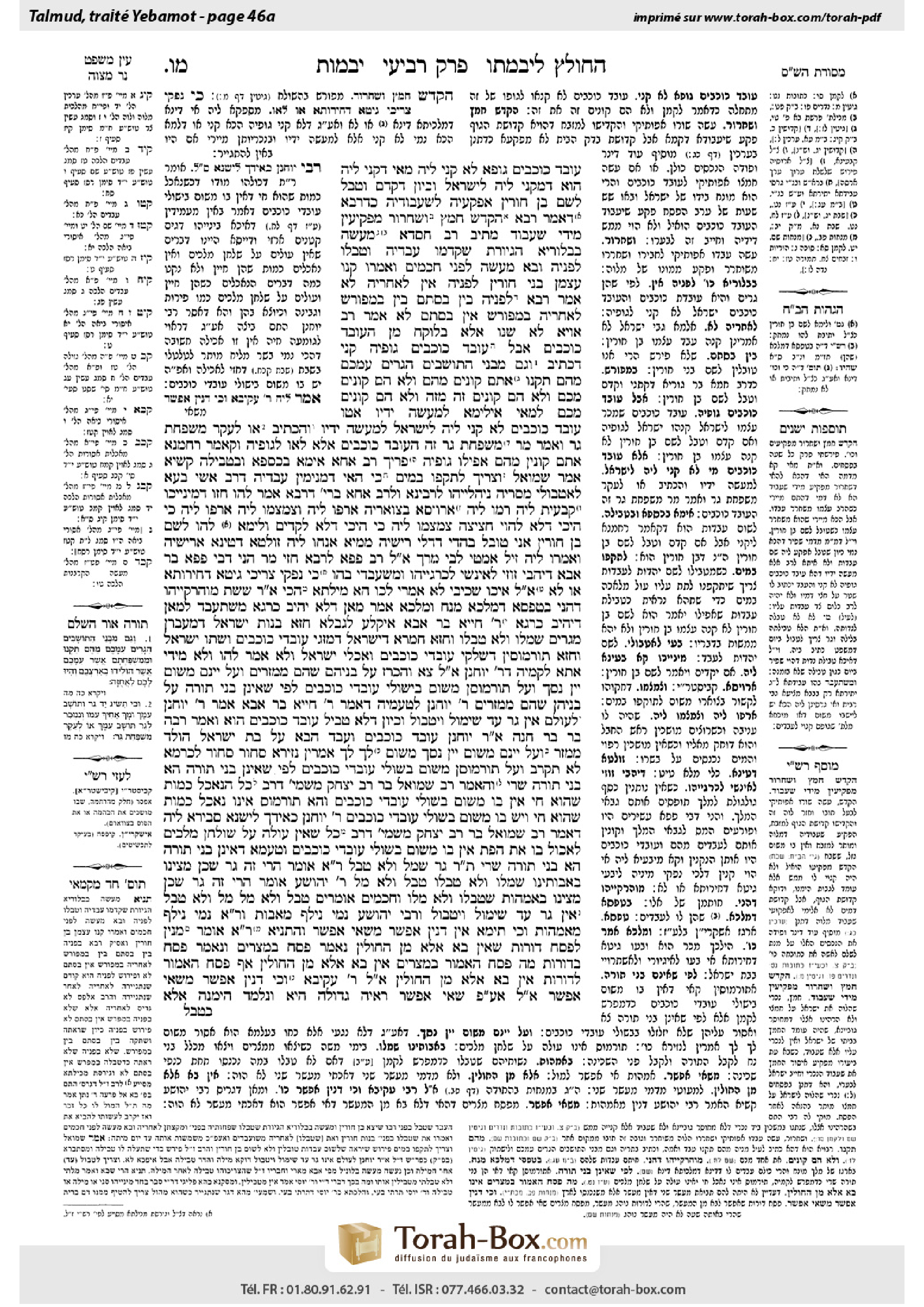
Yevamot 46a: Talmud study for Daf Yomi
Daf Yomi is the daily study of one Talmud folio. Explore 37 tractates with scans, Hebrew text, Sefaria English and AI-generated French translations where annotated.
Passage selection and English or AI-generated French translation are available where the scan has annotations. Daf Study is independent of Torah-Box and Sefaria.
Browse Yevamot · יבמות · All tractatesYevamot 46a text and translations
This page of Yevamot includes the Aramaic text, an English translation and an AI-generated French translation, alongside the scan above.
יבמות מ״ו א · Aramaic and Hebrew text
גּוֹי גּוּפָא לָא קָנֵי לֵיהּ, מַאי דְּקָנֵי לֵיהּ הוּא דְּמַקְנֵי לֵיהּ לְיִשְׂרָאֵל, וְכֵיוָן דִּקְדַם וּטְבַל לְשֵׁם בֶּן חוֹרִין — אַפְקְעֵיהּ לְשִׁעְבּוּדֵיהּ.
כִּדְרָבָא, דְּאָמַר רָבָא: הֶקְדֵּשׁ, חָמֵץ וְשִׁחְרוּר — מַפְקִיעִין מִידֵי שִׁעְבּוּד.
מֵתִיב רַב חִסְדָּא: מַעֲשֶׂה בִּבְלוֹרְיָא הַגִּיּוֹרֶת שֶׁקָּדְמוּ עֲבָדֶיהָ וְטָבְלוּ לְפָנֶיהָ, וּבָא מַעֲשֶׂה לִפְנֵי חֲכָמִים, וְאָמְרוּ: קָנוּ עַצְמָן בְּנֵי חוֹרִין. לְפָנֶיהָ — אִין, לְאַחֲרֶיהָ — לָא!
אָמַר רָבָא: לְפָנֶיהָ, בֵּין בִּסְתָם בֵּין בִּמְפוֹרֵשׁ. לְאַחֲרֶיהָ, בִּמְפוֹרֵשׁ — אִין, בִּסְתָם — לָא.
אָמַר רַב אַוְיָא: לֹא שָׁנוּ אֶלָּא בְּלוֹקֵחַ מִן הַגּוֹי, אֲבָל גּוֹי גּוּפֵיהּ — קָנֵי.
דִּכְתִיב: ״וְגַם מִבְּנֵי הַתּוֹשָׁבִים הַגָּרִים עִמָּכֶם מֵהֶם תִּקְנוּ״, אַתֶּם קוֹנִים מֵהֶם, וְלֹא הֵם קוֹנִים מִכֶּם, וְלֹא הֵם קוֹנִים זֶה מִזֶּה.
וְלֹא הֵם קוֹנִים מִכֶּם. לְמַאי? אִילֵימָא לְמַעֲשֶׂה יָדָיו — אַטּוּ גּוֹי לָא קָנֵי לֵיהּ לְיִשְׂרָאֵל לְמַעֲשֵׂה יָדָיו? וְהָכְתִיב: ״אוֹ לְעֵקֶר מִשְׁפַּחַת גֵּר״, וְאָמַר מָר: ״מִשְׁפַּחַת גֵּר״ — זֶה הַגּוֹי! אֶלָּא לָאו, לְגוּפֵיהּ. וְקָאָמַר רַחֲמָנָא: אַתֶּם קוֹנִין מֵהֶם — אֲפִילּוּ גּוּפֵיהּ.
פָּרֵיךְ רַב אַחָא: אֵימָא בְּכַסְפָּא וּבִטְבִילָה! קַשְׁיָא.
אָמַר שְׁמוּאֵל, וְצָרִיךְ לְתׇקְפּוֹ בַּמַּיִם.
כִּי הַאי דְּמִנְיָמִין עַבְדֵּיהּ דְּרַב אָשֵׁי בְּעָא (לאטבולי) [לְאַטְבּוֹלֵיהּ]. מַסְרֵיהּ נִיהֲלַיְיהוּ לְרָבִינָא וּלְרַב אַחָא בְּרֵיהּ דְּרָבָא. אָמַר לְהוּ: חֲזוֹ דְּמִינַּיְיכוּ קָבָעֵינָא לֵיהּ, רְמוֹ לֵיהּ אַרְוִיסָא בְּצַוְּארֵיהּ, אַרְפּוֹ לֵיהּ וְצַמְצִמוּ לֵיהּ.
אַרְפּוֹ לֵיהּ — כִּי הֵיכִי דְּלָא לֶהֱוֵי חֲצִיצָה. צַמְצִמוּ לֵיהּ — כִּי הֵיכִי דְּלָא לַקְדֵּים וְלֵימָא לְהוּ: לְשֵׁם בֶּן חוֹרִין אֲנִי טוֹבֵל. בַּהֲדֵי דְּדַלִּי רֵישֵׁיהּ מִמַּיָּא, אַנְּחוּ לֵיהּ זוּלְטָא דְטִינָא אַרֵישֵׁיהּ וַאֲמַרוּ לֵיהּ: זִיל אַמְטִי לְבֵי מָרָךְ.
אֲמַר לֵיהּ רַב פָּפָּא לְרָבָא: חֲזִי מָר הָנֵי דְּבֵי פָּפָּא בַּר אַבָּא, דְּיָהֲבִי זוּזִי לְאִינָשֵׁי לִכְרָגַיְיהוּ וּמְשַׁעְבְּדִי בְּהוּ. כִּי נָפְקִי, צְרִיכִי גִּיטָּא דְחֵירוּתָא, אוֹ לָא?
אֲמַר לֵיהּ: אִיכּוֹ שְׁכֵיבִי לָא אֲמַרִי לְכוּ הָא מִילְּתָא. הָכִי אָמַר רַב שֵׁשֶׁת: מוּהְרְקַיְיהוּ דְּהָנֵי, בְּטֻפְסָא דְמַלְכָּא מַנַּח, וּמַלְכָּא אָמַר: מַאן דְּלָא יָהֵיב כְּרָגָא, מִשְׁתַּעְבֵּד לְמַאן דְּיָהֵיב כְּרָגָא.
רַבִּי חִיָּיא בַּר אַבָּא אִיקְּלַע לְגַבְלָא. חֲזָא בְּנוֹת יִשְׂרָאֵל דִּמְעַבְּרָן מִגֵּרִים שֶׁמָּלוּ וְלֹא טָבְלוּ, וַחֲזָא חַמְרָא דְיִשְׂרָאֵל דְּמָזְגִי גּוֹיִם וְשָׁתוּ יִשְׂרָאֵל, וַחֲזָא תּוֹרְמוֹסִין דְּשָׁלְקִי גּוֹיִם וְאָכְלִי יִשְׂרָאֵל, וְלָא אֲמַר לְהוּ וְלָא מִידֵּי.
אֲתָא לְקַמֵּיהּ דְּרַבִּי יוֹחָנָן. אֲמַר לֵיהּ: צֵא וְהַכְרֵז עַל בְּנֵיהֶם שֶׁהֵם מַמְזֵרִים, וְעַל יֵינָם מִשּׁוּם יֵין נֶסֶךְ, וְעַל תּוֹרְמוֹסָן מִשּׁוּם בִּישּׁוּלֵי גוֹיִם, לְפִי שֶׁאֵינָן בְּנֵי תוֹרָה.
עַל בְּנֵיהֶן שֶׁהֵם מַמְזֵרִים — רַבִּי יוֹחָנָן לְטַעְמֵיהּ. דְּאָמַר רַבִּי חִיָּיא בַּר אַבָּא אָמַר רַבִּי יוֹחָנָן: לְעוֹלָם אֵין גֵּר עַד שֶׁיָּמוּל וְיִטְבּוֹל. וְכֵיוָן דְּלָא טָבֵיל, גּוֹי הוּא. וְאָמַר רַבָּה בַּר בַּר חָנָה אָמַר רַבִּי יוֹחָנָן: גּוֹי וְעֶבֶד הַבָּא עַל בַּת יִשְׂרָאֵל — הַוָּלָד מַמְזֵר.
וְעַל יֵינָם מִשּׁוּם יֵין נֶסֶךְ — מִשּׁוּם: ״לָךְ לָךְ, אָמְרִין נְזִירָא, סְחוֹר סְחוֹר, לְכַרְמָא לָא תִּקְרַב״.
וְעַל תּוֹרְמוֹסָן מִשּׁוּם בִּשּׁוּלֵי גוֹיִם — לְפִי שֶׁאֵינָן בְּנֵי תוֹרָה. הָא בְּנֵי תוֹרָה שְׁרֵי? וְהָאָמַר רַב שְׁמוּאֵל בַּר רַב יִצְחָק מִשְּׁמֵיהּ דְּרַב: כָּל הַנֶּאֱכָל כְּמוֹת שֶׁהוּא חַי — אֵין בּוֹ מִשּׁוּם בִּשּׁוּלֵי גוֹיִם. וְהָא תּוֹרְמוֹס אֵינוֹ נֶאֱכָל כְּמוֹת שֶׁהוּא חַי, וְיֵשׁ בּוֹ מִשּׁוּם בִּשּׁוּלֵי גוֹיִם!
רַבִּי יוֹחָנָן כְּאִידַּךְ לִישָּׁנָא סְבִירָא לֵיהּ, דְּאָמַר רַב שְׁמוּאֵל בַּר רַב יִצְחָק מִשְּׁמֵיהּ דְּרַב: כֹּל שֶׁאֵין עוֹלֶה עַל שׁוּלְחַן מְלָכִים לֶאֱכוֹל בּוֹ אֶת הַפַּת — אֵין בּוֹ מִשּׁוּם בִּשּׁוּלֵי גוֹיִם, וְטַעְמָא דְּאֵינָן בְּנֵי תוֹרָה, הָא בְּנֵי תוֹרָה שְׁרֵי.
תָּנוּ רַבָּנַן: גֵּר שֶׁמָּל וְלֹא טָבַל, רַבִּי אֱלִיעֶזֶר אוֹמֵר: הֲרֵי זֶה גֵּר, שֶׁכֵּן מָצִינוּ בַּאֲבוֹתֵינוּ שֶׁמָּלוּ וְלֹא טָבְלוּ. טָבַל וְלֹא מָל, רַבִּי יְהוֹשֻׁעַ אוֹמֵר: הֲרֵי זֶה גֵּר, שֶׁכֵּן מָצִינוּ בָּאִמָּהוֹת שֶׁטָּבְלוּ וְלֹא מָלוּ. וַחֲכָמִים אוֹמְרִים: טָבַל וְלֹא מָל, מָל וְלֹא טָבַל — אֵין גֵּר עַד שֶׁיָּמוּל וְיִטְבּוֹל.
וְרַבִּי יְהוֹשֻׁעַ נָמֵי נֵילַף מֵאָבוֹת, וְרַבִּי אֱלִיעֶזֶר נָמֵי נֵילַף מֵאִמָּהוֹת! וְכִי תֵימָא, אֵין דָּנִין אֶפְשָׁר מִשֶּׁאִי אֶפְשָׁר.
וְהָתַנְיָא, רַבִּי אֱלִיעֶזֶר אוֹמֵר: מִנַּיִן לְפֶסַח דּוֹרוֹת שֶׁאֵין בָּא אֶלָּא מִן הַחוּלִּין — נֶאֱמַר פֶּסַח בְּמִצְרַיִם, וְנֶאֱמַר פֶּסַח בְּדוֹרוֹת. מָה פֶּסַח הָאָמוּר בְּמִצְרַיִם — אֵין בָּא אֶלָּא מִן הַחוּלִּין, אַף פֶּסַח הָאָמוּר לְדוֹרוֹת — אֵין בָּא אֶלָּא מִן הַחוּלִּין.
אָמַר לוֹ רַבִּי עֲקִיבָא: וְכִי דָּנִין אֶפְשָׁר מִשֶּׁאִי אֶפְשָׁר? אָמַר לוֹ: אַף עַל פִּי שֶׁאִי אֶפְשָׁר — רְאָיָה גְּדוֹלָה הִיא, וְנִלְמַד הֵימֶנָּה.
אֶלָּא
Yevamot 46a · English translation
His previous gentile owner did not have ownership of the slave’s body, since a gentile is unable to have ownership of another’s body; rather, he had rights to only the slave’s labor. And only that which he owned in him was he able to sell to the Jew. Therefore, before immersion, the Jew had rights to only the slave’s labor, but not ownership of his body, and therefore, once the slave preempted his owner and immersed for the sake of conversion to make him a freeman, he abrogates his master’s lien upon him.
The Gemara notes: This explanation is in accordance with the opinion of Rava, as Rava said: Consecration of an item to the Temple, the prohibition of leavened bread taking effect upon a leavened food, and the emancipation of a slave abrogate any lien that exists upon them.
Rav Ḥisda raised an objection from a baraita: There was an incident involving Beloreya the female convert in which her slaves preempted her and immersed before her own immersion for her own conversion. And the details of the incident came before the Sages, and they said: The slaves acquired themselves and became freemen. Rav Ḥisda explains how the baraita poses a challenge: The baraita implies that only because the slaves immersed before her, while she was still a gentile, that yes, they became freemen; however, had they immersed after her, i.e., after she had already converted, then no, they would not have become freemen. The reason for this is presumably that upon her conversion she attains the rights to her slaves’ bodies, and therefore their immersion for the sake of becoming freemen would be ineffective. However, this contradicts the Gemara’s explanation above that when a Jew gains ownership of a slave from a gentile, he has a right to only the slave’s labor.
To resolve the challenge Rava said: When the baraita says that because they immersed before her they acquired themselves, that is whether they immersed without a specified intention or whether they immersed with explicit intention to convert and become freemen. However, had they immersed after her, if they did so with explicit intention to convert, then yes, the immersion would achieve that end, but if they did so without a specified intention, then no, their immersion would, by default, be considered for the sake of slavery and they would not become free.
Rav Avya said: They taught that one acquires only the rights to the slave’s labor only with regard to a Jew who purchased a slave from a gentile slave owner, but if a gentile sold his own body as a slave directly to a Jew, then the Jew acquires his body.
As it is written: “Moreover, of the children of the strangers that sojourn among you, of them you may acquire” (Leviticus 25:45). The verse states only that you, i.e., Jews, can acquire a slave from them, i.e., a gentile slave, but they cannot acquire a slave from you, i.e., a Jewish slave, and they cannot acquire a slave from one another.
When it is derived that: But they cannot acquire slaves from you, to what type of acquisition is it referring? If we say it is for his labor, is that to say that a gentile cannot acquire a Jew for his labor? Isn’t it written: “And if a stranger who is a settler with you becomes rich, and your brother becomes poor beside him, and he sells himself to the stranger who is a settler with you, or to the offshoot of a stranger’s family” (Leviticus 25:47), and the Master said in explanation of the phrase “a stranger’s family” that this is referring to a gentile. If so, the verse explicitly states that a Jew can sell himself as a slave to a gentile. Rather, is it not that the reference is to selling his body, and the Merciful One states that you, i.e., Jews, can acquire a slave from them, which means even his body. Accordingly the verse indicates that a Jew can acquire a gentile slave’s body, but a gentile is unable to acquire ownership of another’s body, even that of another gentile.
Rav Aḥa refutes Rav Avya’s explanation: Say that the verse is referring to acquiring a gentile slave by both purchasing him with money and then by immersing him for the purpose of slavery, and only in that case does it teach that a Jew acquires the gentile slave’s body. However, until he has been immersed the acquisition is not fully complete, and therefore if the slave immerses himself with the intention to become free, then his immersion would achieve that end. The Gemara concedes: This is difficult.
Shmuel said: And if one wishes to ensure that one’s slave does not declare the immersion to be for the sake of conversion, then one needs to hold him tightly in the water in a way that demonstrates the owner’s dominance over the slave at that time, thereby defining the immersion as one for the sake of slavery.
That is as demonstrated in this incident involving Minyamin, Rav Ashi’s slave: When he wished to immerse him, he passed him to Ravina and Rav Aḥa, son of Rava, to perform the immersion on his behalf, and he said to them: Be aware that I will claim compensation for him from you if you do not prevent my slave from immersing for the sake of conversion. They placed a bridle [arvisa] upon his neck, and at the moment of immersion they loosened it and then immediately tightened it again while he was still immersed.
The Gemara explains their actions: They initially loosened it in order that there should not be any interposition between the slave and the water during the immersion, which would invalidate it. They immediately tightened it again in order that the slave should not preempt them and say to them: I am immersing for the sake of becoming a freeman. When he lifted his head from the water they placed a bucket of clay upon his head and said to him: Go and bring this to the house of your master. They did this in order to demonstrate that the immersion had been successful and that he was still a slave.
Rav Pappa said to Rava: Has the Master seen those of the house of Pappa bar Abba who give money to the tax-collectors on behalf of poor people to pay for their poll tax [karga], and as a result they would enslave them. Anyone who did not pay the tax would be taken as a slave for the king. By paying for such people’s taxes, the members of the house of Pappa bar Abba essentially purchased those people, who had become the king’s slaves, for themselves. Rav Pappa asked: When those slaves go free, do they require a bill of emancipation, because the members of the house of Pappa bar Abba actually attained ownership of the slaves’ bodies, or not, as they were owned only for the sake of their labor?
He said to him: Were I dead I could not say this matter to you, so it is good that you have asked me while I am still alive, as I know that this is what Rav Sheshet said with regard to the matter: The writ of slavery [moharkayehu] of these residents of the kingdom rests in the treasury [tafsa] of the king, and in fact all the residents of the kingdom are considered to be full slaves of the king, i.e., he owns their bodies, irrespective of whether they pay their taxes. And so when the king says: One who does not give the poll tax is to be enslaved to the one who does give the poll tax on his behalf, the king’s decree is fully effective in making those residents full slaves of those who paid for them. As such, they will require a bill of emancipation when they are freed.
§ The Gemara relates: Rabbi Ḥiyya bar Abba once happened to come to Gavla. He saw Jewish women there who had become pregnant from converts who were circumcised but had still not immersed to complete their conversion process; and he saw wine of Jews that gentiles were pouring, and Jews were drinking it; and he saw lupines [turmusin] that gentiles were cooking, and Jews were eating them; but he did not say anything to them.
Later, he came before Rabbi Yoḥanan and told him what he had witnessed. Rabbi Yoḥanan said to him: Go and make a public declaration concerning their children that they are mamzerim, and concerning their wine that it is forbidden because it is like wine poured as an idolatrous libation, and concerning their lupines that they are forbidden because they are food cooked by gentiles. One should be stringent and make such a declaration because they are not well-versed in Torah, and if they are left to be lax in this regard they will eventually transgress Torah prohibitions.
The Gemara explains: With regard to the declaration concerning their children that they are mamzerim, Rabbi Yoḥanan conforms to his standard line of reasoning in two halakhot: The first is as Rabbi Ḥiyya bar Abba said that Rabbi Yoḥanan said: One is never considered to be a convert until he has been circumcised and has immersed. And since the convert in the case in Gavla had not immersed, he is still considered a gentile. And the second halakha is as Rabba bar bar Ḥana said that Rabbi Yoḥanan said: With regard to a gentile or a slave who engaged in intercourse with a Jewish woman, the offspring of that union is a mamzer.
And the reason to declare concerning their wine that it is forbidden because it is like wine poured as an idolatrous libation is that although their wine was not actually poured as an idolatrous libation, it was prohibited by rabbinic decree due to the maxim that: Go, go, we say to a nazirite, go around and go around, but do not come near to the vineyard. Although a nazirite is prohibited only from eating produce of the vine, he is warned not even to come into close proximity of a vineyard as a protective measure to ensure that he will not transgress this prohibition. So too, in many cases, the Sages decreed certain items and actions to be prohibited because they understood that if people would partake of them, they would eventually transgress Torah prohibitions.
And the final declaration concerning their lupines that they are forbidden because they are food cooked by gentiles is issued because they are not well versed in Torah. The Gemara expresses astonishment: Does this imply that were they students of the Torah their lupines would be permitted? Didn’t Rav Shmuel bar Rav Yitzḥak say in the name of Rav: Any food item that is eaten as it is, raw, is not subject to the prohibition of food cooked by gentiles, even when cooked by them? But a lupine is not eaten as it is, raw, and therefore it is subject to the prohibition of food cooked by gentiles.
The Gemara explains that Rabbi Yoḥanan holds in this matter in accordance with the opinion of the other version of what Rav Shmuel bar Rav Yitzḥak said in the name of Rav: Any food item that lacks sufficient importance such that it does not appear on the table of kings in order to eat bread with it is not subject to the prohibition of food cooked by gentiles. Lupines lack importance and are therefore permitted even if cooked by gentiles. And consequently, the only reason to make a declaration prohibiting the residents of Gavla from eating them is because they are not well versed in Torah, and if they are left to be lax in this regard they will eventually become lax in actual Torah prohibitions; by inference, to those well versed in Torah, it is permitted.
§ During their sojourn in Egypt, the children of Israel had the halakhic status of gentiles. At the revelation at Sinai they entered into a national covenant with God in which they attained their status of the Jewish people. This transformation was essentially the mass conversion of the people, and so their preparation for the revelation provides a paradigm of the process required for conversion for all generations. The tanna’im disagree as to which aspects of that original conversion are to be derived for all generations.
The Sages taught in a baraita: With regard to a convert who was circumcised but did not immerse, Rabbi Eliezer says that this is a convert, as so we found with our forefathers following the exodus from Egypt that they were circumcised but were not immersed. With regard to one who immersed but was not circumcised, Rabbi Yehoshua says that this is a convert, as so we found with our foremothers that they immersed but were not circumcised. And the Rabbis say: Whether he immersed but was not circumcised or whether he was circumcised but did not immerse, he is not a convert until he is circumcised and he immerses.
The Gemara questions the opinions in the baraita: But let Rabbi Yehoshua also derive what is required for conversion from our forefathers; why didn’t he do so? And let Rabbi Eliezer also derive the halakha from our foremothers; why didn’t he do so? And if you would say that Rabbi Eliezer did not derive the halakha from our foremothers because he holds one cannot derive the possible from the impossible, i.e., one cannot derive that men do not require circumcision from the halakha that women do not require it, because for women it is a physical impossibility, that claim may be refuted.
It would appear that Rabbi Eliezer does not accept that principle, as isn’t it taught in a baraita that Rabbi Eliezer says: From where is it derived with regard to the Paschal lamb brought throughout the generations that it may be brought only from non-sacred animals? A Paschal lamb is stated in the Torah in reference to the lamb that the Jewish people brought prior to the exodus from Egypt, and a Paschal lamb is stated in reference to the yearly obligation throughout the generations. The association between them teaches that just as the Paschal lamb stated in reference to Egypt was only brought from non-sacred animals, since prior to the giving of the Torah there was no possibility to consecrate property, so too, with regard to the Paschal lamb stated in reference to the obligation throughout the generations, it may be brought only from non-sacred animals.
Rabbi Akiva said to him: But can one derive the possible, i.e., the halakha for the Paschal lamb throughout the generations, where a possibility exists to bring it from consecrated animals, from the impossible, i.e., from the Paschal lamb in Egypt, where it was not a possibility? Rabbi Eliezer said to him: Although it was impossible to bring the Paschal lamb in Egypt from consecrated animals, nevertheless, it is still a great proof, and we may learn from it. It is apparent, then, that Rabbi Eliezer holds that one can derive the possible from the impossible. Therefore the original question stands: Why didn’t Rabbi Eliezer derive from the foremothers that circumcision is not essential for conversion?
The Gemara concedes: Rather, the baraita must be reinterpreted as follows:
Yevamot 46a · Traduction française (IA)
Son précédent maître non juif ne possédait pas le corps de l’esclave, car un non-Juif ne peut posséder le corps d’autrui ; il n’avait droit qu’au travail de l’esclave. Il ne pouvait vendre au Juif que ce qu’il possédait chez lui. Par conséquent, avant l’immersion, le Juif n’avait droit qu’au travail de l’esclave, et non à son corps. Ainsi, dès lors que l’esclave avait devancé son maître en s’immergeant en vue de sa conversion afin de devenir libre, il annulait le droit de rétention de son maître sur lui.
La Guemara fait remarquer que cette explication est conforme à l’opinion de Rava, car Rava a dit : La consécration d’un objet au Temple, l’application de l’interdiction du hamets à un aliment déjà fermenté et l’affranchissement d’un esclave annulent tout droit de rétention qui pèse sur eux.
Rav Ḥisda souleva une objection à partir d’une baraïta : Il y eut un épisode concernant Beloreya, la femme convertie, dont les esclaves la devancèrent et s’immergèrent avant sa propre immersion en vue de sa conversion. Les détails de l’épisode furent présentés aux Sages, qui dirent : « Les esclaves se sont acquis eux-mêmes et sont devenus libres. » Rav Ḥisda explique en quoi la baraïta pose une difficulté : elle implique que c’est uniquement parce que les esclaves s’étaient immergés avant elle, alors qu’elle était encore non juive, qu’ils sont devenus libres ; en revanche, s’ils s’étaient immergés après elle, c’est-à-dire après sa conversion, ils ne le seraient pas devenus. La raison en est vraisemblablement qu’en se convertissant, elle acquiert des droits sur le corps de ses esclaves, et que leur immersion en vue de devenir libres serait donc sans effet. Or, cela contredit l’explication donnée plus haut par la Guemara, selon laquelle, lorsqu’un Juif acquiert un esclave auprès d’un non-Juif, il n’a de droits que sur le travail de l’esclave.
Pour résoudre la difficulté, Rava dit : Lorsque la baraïta affirme que les esclaves se sont acquis eux-mêmes parce qu’ils s’étaient immergés avant elle, cela vaut qu’ils se soient immergés sans intention particulière ou avec l’intention explicite de se convertir et de devenir libres. En revanche, s’ils s’étaient immergés après elle, alors, s’ils l’avaient fait avec l’intention explicite de se convertir, oui, l’immersion aurait atteint son objectif ; mais s’ils l’avaient fait sans intention particulière, leur immersion aurait été considérée par défaut comme accomplie en vue de l’esclavage, et ils ne seraient pas devenus libres.
Rav Avya dit : On a enseigné que l’on n’acquiert que des droits sur le travail de l’esclave uniquement à propos d’un Juif qui a acheté un esclave auprès d’un maître non juif. Mais si un non-Juif vend directement à un Juif son propre corps comme esclave, le Juif acquiert son corps.
Car il est écrit : « De plus, parmi les enfants des étrangers qui séjournent chez vous, vous pourrez en acquérir » (Lévitique 25,45). Le verset dit seulement que vous, c’est-à-dire les Juifs, pouvez acquérir un esclave auprès d’eux, c’est-à-dire un esclave non juif ; mais eux ne peuvent pas acquérir d’esclave auprès de vous, c’est-à-dire un esclave juif, et ils ne peuvent pas non plus acquérir d’esclave les uns auprès des autres.
Lorsqu’on déduit qu’ils ne peuvent pas acquérir d’esclaves auprès de vous, de quel type d’acquisition s’agit-il ? Si nous disons qu’il s’agit de son travail, cela signifie-t-il qu’un non-Juif ne peut pas acquérir un Juif pour son travail ? N’est-il pas écrit : « Si un étranger qui séjourne chez toi s’enrichit, et que ton frère s’appauvrisse auprès de lui, et qu’il se vende à l’étranger qui séjourne chez toi, ou à un membre de la famille d’un étranger » (Lévitique 25,47) ? Et le Maître a expliqué que l’expression « un membre de la famille d’un étranger » désigne un non-Juif. Ainsi, le verset dit explicitement qu’un Juif peut se vendre comme esclave à un non-Juif. Ne s’agit-il donc pas plutôt de la vente de son corps ? Le Miséricordieux dit que vous, c’est-à-dire les Juifs, pouvez acquérir un esclave auprès d’eux, ce qui signifie que vous pouvez acquérir même son corps. En conséquence, le verset indique qu’un Juif peut acquérir le corps d’un esclave non juif, mais qu’un non-Juif ne peut posséder le corps d’autrui, même celui d’un autre non-Juif.
Rav Aḥa réfute l’explication de Rav Avya : Disons que le verset parle de l’acquisition d’un esclave non juif à la fois par son achat contre de l’argent et par son immersion en vue de l’esclavage ; c’est seulement dans ce cas qu’il enseigne que le Juif acquiert le corps de l’esclave non juif. Mais tant qu’il n’a pas été immergé, l’acquisition n’est pas entièrement achevée ; par conséquent, si l’esclave s’immerge avec l’intention de devenir libre, son immersion atteindra cet objectif. La Guemara reconnaît : La difficulté demeure.
Chmouel dit : Si quelqu’un veut s’assurer que son esclave ne déclare pas que l’immersion est accomplie en vue de la conversion, il doit le tenir fermement dans l’eau, de manière à manifester à ce moment-là la domination du maître sur l’esclave et à définir ainsi l’immersion comme accomplie en vue de l’esclavage.
Cela est illustré par l’épisode concernant Minyamin, l’esclave de Rav Ashi : lorsqu’il voulut l’immerger, il le confia à Ravina et à Rav Aḥa, fils de Rava, pour qu’ils procèdent à l’immersion en son nom, et leur dit : « Sachez que je vous réclamerai une indemnité pour lui si vous n’empêchez pas mon esclave de s’immerger en vue de la conversion. » Ils lui mirent une bride [arvisa] au cou ; au moment de l’immersion, ils la desserrèrent, puis la resserrèrent aussitôt alors qu’il était encore immergé.
La Guemara explique leur conduite : ils la desserrèrent d’abord afin qu’il n’y ait aucun obstacle entre l’esclave et l’eau pendant l’immersion, ce qui l’invaliderait. Ils la resserrèrent aussitôt afin que l’esclave ne les devance pas en leur disant : « Je m’immerge pour devenir libre. » Lorsqu’il releva la tête hors de l’eau, ils posèrent un seau d’argile sur sa tête et lui dirent : « Va porter cela chez ton maître. » Ils agirent ainsi pour montrer que l’immersion avait réussi et qu’il était encore un esclave.
Rav Pappa dit à Rava : Le Maître a-t-il vu les gens de la maison de Pappa bar Abba, qui donnent de l’argent aux collecteurs d’impôts pour le compte de pauvres afin de payer leur capitation [karga], et qui, de ce fait, les réduisent en esclavage ? Quiconque ne payait pas l’impôt était pris comme esclave pour le roi. En payant les impôts de ces personnes, les membres de la maison de Pappa bar Abba les achetaient en pratique, eux qui étaient devenus les esclaves du roi. Rav Pappa demanda : Lorsque ces esclaves sont affranchis, ont-ils besoin d’un acte d’affranchissement, parce que les membres de la maison de Pappa bar Abba ont effectivement acquis le corps des esclaves, ou non, puisqu’ils n’en avaient acquis que le travail ?
Il lui dit : « Si j’étais mort, je n’aurais pas pu te dire cette chose ; il est donc heureux que tu me l’aies demandée de mon vivant, car je sais que Rav Sheshet a dit ceci à ce sujet : L’acte d’esclavage [moharkayehu] de ces habitants du royaume se trouve dans le trésor [tafsa] du roi ; en fait, tous les habitants du royaume sont considérés comme des esclaves à part entière du roi, c’est-à-dire qu’il possède leur corps, qu’ils paient ou non leurs impôts. Ainsi, lorsque le roi décrète : “Celui qui ne paie pas la capitation sera asservi à celui qui la paie pour lui”, le décret du roi produit pleinement son effet et fait de ces habitants les esclaves à part entière de ceux qui ont payé pour eux. Par conséquent, lorsqu’ils seront libérés, ils auront besoin d’un acte d’affranchissement. »
§ La Guemara rapporte : Rabbi Ḥiyya bar Abba arriva un jour à Gavla. Il y vit des femmes juives enceintes d’hommes convertis qui avaient été circoncis, mais ne s’étaient pas encore immergés pour achever leur conversion ; il vit aussi du vin appartenant à des Juifs que des non-Juifs versaient et que des Juifs buvaient ; et il vit des lupins [turmusin] cuits par des non-Juifs et mangés par des Juifs. Mais il ne leur dit rien.
Plus tard, il se présenta devant Rabbi Yoḥanan et lui raconta ce qu’il avait vu. Rabbi Yoḥanan lui dit : « Va proclamer publiquement que leurs enfants sont des mamzerim, que leur vin est interdit parce qu’il est assimilable à du vin versé en libation idolâtre, et que leurs lupins sont interdits parce qu’il s’agit d’aliments cuits par des non-Juifs. Il faut faire preuve de rigueur et lancer une telle proclamation, car ils ne connaissent pas bien la Torah ; si on les laisse faire preuve de laxisme à cet égard, ils finiront par transgresser des interdits de la Torah. »
La Guemara explique : En ce qui concerne la proclamation selon laquelle leurs enfants sont des mamzerim, Rabbi Yoḥanan suit sa ligne habituelle sur deux halakhot. Premièrement, comme l’a dit Rabbi Ḥiyya bar Abba au nom de Rabbi Yoḥanan : « On n’est jamais considéré comme converti tant qu’on ne s’est pas circoncis et immergé. » Puisque le converti de l’épisode de Gavla ne s’était pas immergé, il est encore considéré comme un non-Juif. Deuxièmement, comme l’a dit Rabba bar bar Ḥana au nom de Rabbi Yoḥanan : « Lorsqu’un non-Juif ou un esclave a des relations avec une femme juive, l’enfant issu de cette union est un mamzer. »
La raison de proclamer que leur vin est interdit parce qu’il est assimilable à du vin versé en libation idolâtre est que, bien que leur vin n’ait pas été réellement versé en libation idolâtre, il a été interdit par décret rabbinique, conformément au principe suivant : « Va, va, dit-on au nazir, fais un détour, mais ne t’approche pas de la vigne. » Bien qu’un nazir ne soit interdit que de consommer les produits de la vigne, on lui interdit même de s’approcher d’une vigne, par mesure de précaution, afin qu’il ne transgresse pas cet interdit. De même, dans de nombreux cas, les Sages ont interdit certains objets et certaines actions, car ils estimaient que si les gens en usaient, ils finiraient par transgresser des interdits de la Torah.
Quant à la dernière proclamation, selon laquelle leurs lupins sont interdits parce qu’ils sont des aliments cuits par des non-Juifs, elle a été faite parce qu’ils ne connaissent pas bien la Torah. La Guemara s’étonne : Cela implique-t-il que, s’ils étaient versés dans la Torah, leurs lupins seraient permis ? Rav Shmuel bar Rav Yitzḥak n’a-t-il pas dit au nom de Rav : « Tout aliment qui se consomme tel quel, cru, n’est pas soumis à l’interdiction des aliments cuits par des non-Juifs, même s’ils l’ont cuit » ? Or, le lupin ne se consomme pas cru et est donc soumis à l’interdiction des aliments cuits par des non-Juifs.
La Guemara explique que, sur ce point, Rabbi Yoḥanan suit l’opinion rapportée dans l’autre version de ce que Rav Shmuel bar Rav Yitzḥak a dit au nom de Rav : « Tout aliment dont l’importance est insuffisante pour qu’il figure à la table des rois afin d’accompagner le pain n’est pas soumis à l’interdiction des aliments cuits par des non-Juifs. » Les lupins sont dépourvus d’importance et sont donc permis même s’ils ont été cuits par des non-Juifs. Par conséquent, la seule raison de proclamer qu’il est interdit aux habitants de Gavla d’en manger est qu’ils ne connaissent pas bien la Torah et que, si on les laisse faire preuve de laxisme à cet égard, ils finiront par se montrer laxistes à l’égard des véritables interdits de la Torah. On en déduit que, pour ceux qui connaissent bien la Torah, ils sont permis.
§ Pendant leur séjour en Égypte, les enfants d’Israël avaient le statut halakhique de non-Juifs. Lors de la révélation au Sinaï, ils conclurent avec Dieu une alliance nationale qui leur conféra le statut de peuple juif. Cette transformation correspondait essentiellement à la conversion collective du peuple ; leur préparation à la révélation sert donc de modèle au processus requis pour la conversion à toutes les générations. Les tannaïm sont en désaccord sur les aspects de cette conversion originelle dont il faut tirer des règles applicables à toutes les générations. Les Sages ont enseigné dans une baraïta : À propos d’un converti qui s’est circoncis mais ne s’est pas immergé, Rabbi Eliezer dit qu’il est converti, car nous trouvons que nos ancêtres, après la sortie d’Égypte, s’étaient circoncis sans s’être immergés. À propos de celui qui s’est immergé mais ne s’est pas circoncis, Rabbi Yehoshua dit qu’il est converti, car nous trouvons que nos aïeules s’étaient immergées sans se faire circoncire. Et les Sages disent : Qu’il se soit immergé sans se circoncire ou qu’il se soit circoncis sans s’immerger, il n’est pas converti tant qu’il ne s’est pas circoncis et immergé.
La Guemara met en question les opinions de la baraïta : Mais Rabbi Yehoshua devrait lui aussi déduire de nos ancêtres ce qui est requis pour la conversion ; pourquoi ne l’a-t-il pas fait ? Et Rabbi Eliezer devrait lui aussi déduire la halakha de nos aïeules ; pourquoi ne l’a-t-il pas fait ? Et si tu dis que Rabbi Eliezer n’a pas déduit la halakha de nos aïeules parce qu’il estime qu’on ne peut pas déduire le possible de l’impossible, c’est-à-dire qu’on ne peut pas déduire que les hommes n’ont pas besoin de circoncision de la halakha selon laquelle les femmes n’en ont pas besoin, puisque, pour les femmes, c’est physiquement impossible, cette affirmation peut être réfutée.
Il semble que Rabbi Eliezer n’accepte pas ce principe. N’est-il pas enseigné dans une baraïta que Rabbi Eliezer dit : « D’où déduit-on que, pour les générations à venir, le sacrifice pascal ne peut être offert qu’avec des animaux non consacrés ? » La Torah parle d’un sacrifice pascal à propos de l’agneau que le peuple juif offrit avant la sortie d’Égypte, et d’un sacrifice pascal à propos de l’obligation annuelle des générations à venir. Leur rapprochement enseigne que, de même que le sacrifice pascal mentionné à propos de l’Égypte ne fut offert qu’avec des animaux non consacrés, puisqu’avant le don de la Torah il n’était pas possible de consacrer des biens, de même le sacrifice pascal relatif à l’obligation des générations à venir ne peut être offert qu’avec des animaux non consacrés.
Rabbi Akiva lui dit : « Mais peut-on déduire le possible, c’est-à-dire la halakha relative au sacrifice pascal des générations à venir, pour lequel il est possible de l’offrir avec des animaux consacrés, de l’impossible, c’est-à-dire du sacrifice pascal d’Égypte, pour lequel ce n’était pas possible ? » Rabbi Eliezer lui répondit : « Bien qu’il fût impossible d’offrir le sacrifice pascal d’Égypte avec des animaux consacrés, cela constitue néanmoins une preuve majeure, et nous pouvons en tirer une leçon. » Il apparaît donc que Rabbi Eliezer estime qu’on peut déduire le possible de l’impossible. La question initiale demeure donc : pourquoi Rabbi Eliezer n’a-t-il pas déduit des aïeules que la circoncision n’est pas indispensable à la conversion ?
La Guemara reconnaît : Il faut plutôt réinterpréter la baraïta comme suit :
Traduction française générée par IA à partir de l’édition anglaise de Sefaria. Vérifie toujours un passage avec le texte source.
Text from Sefaria: William Davidson Edition - Vocalized Aramaic (CC BY NC); William Davidson Edition - English (CC BY NC).