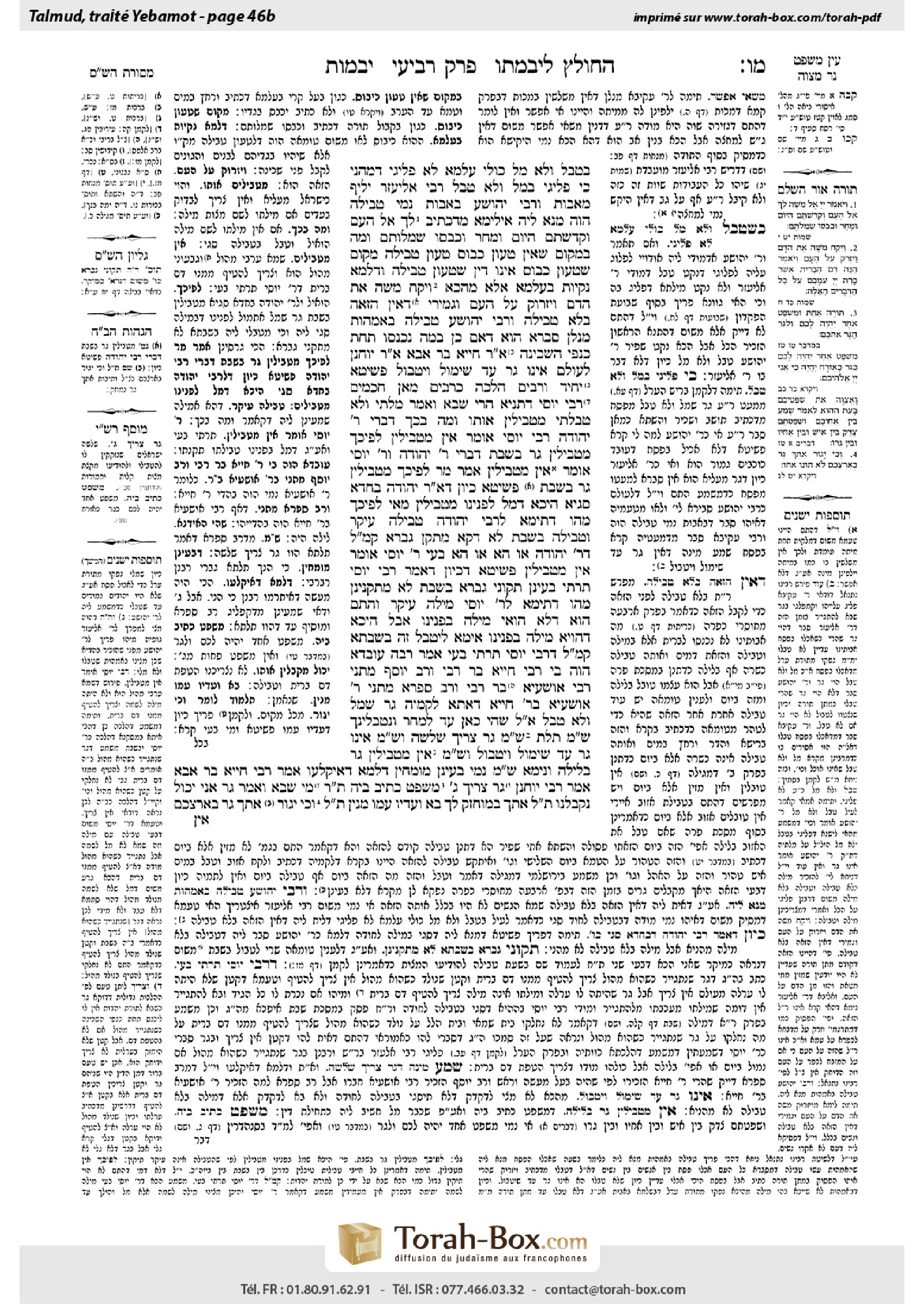
Yevamot 46b: Talmud study for Daf Yomi
Daf Yomi is the daily study of one Talmud folio. Explore 37 tractates with scans, Hebrew text, Sefaria English and AI-generated French translations where annotated.
Passage selection and English or AI-generated French translation are available where the scan has annotations. Daf Study is independent of Torah-Box and Sefaria.
Browse Yevamot · יבמות · All tractatesYevamot 46b text and translations
This page of Yevamot includes the Aramaic text, an English translation and an AI-generated French translation, alongside the scan above.
יבמות מ״ו ב · Aramaic and Hebrew text
בְּטָבַל וְלֹא מָל — כּוּלֵּי עָלְמָא לָא פְּלִיגִי דְּמַהְנֵי, כִּי פְּלִיגִי בְּמָל וְלֹא טָבַל. רַבִּי אֱלִיעֶזֶר יָלֵיף מֵאָבוֹת, וְרַבִּי יְהוֹשֻׁעַ: בְּאָבוֹת נָמֵי טְבִילָה הֲוָה.
מְנָא לֵיהּ? אִילֵּימָא מִדִּכְתִיב: ״לֵךְ אֶל הָעָם וְקִדַּשְׁתָּם הַיּוֹם וּמָחָר וְכִבְּסוּ שִׂמְלֹתָם״, וּמָה בִּמְקוֹם שֶׁאֵין טָעוּן כִּבּוּס — טָעוּן טְבִילָה, מְקוֹם שֶׁטָּעוּן כִּבּוּס — אֵינוֹ דִּין שֶׁטָּעוּן טְבִילָה.
וְדִלְמָא, נְקִיּוּת בְּעָלְמָא?!
אֶלָּא מֵהָכָא: ״וַיִּקַּח מֹשֶׁה אֶת הַדָּם וַיִּזְרֹק עַל הָעָם״, וּגְמִירִי דְּאֵין הַזָּאָה בְּלֹא טְבִילָה.
וְרַבִּי יְהוֹשֻׁעַ, טְבִילָה בָּאִמָּהוֹת מְנָלַן? סְבָרָא הוּא, דְּאִם כֵּן, בַּמֶּה נִכְנְסוּ תַּחַת כַּנְפֵי הַשְּׁכִינָה?
אָמַר רַבִּי חִיָּיא בַּר אַבָּא אָמַר רַבִּי יוֹחָנָן: לְעוֹלָם אֵינוֹ גֵּר עַד שֶׁיִמּוֹל וְיִטְבּוֹל. פְּשִׁיטָא, יָחִיד וְרַבִּים הֲלָכָה כְּרַבִּים!
מַאן חֲכָמִים — רַבִּי יוֹסֵי.
דְּתַנְיָא: הֲרֵי שֶׁבָּא וְאָמַר מַלְתִּי וְלֹא טָבַלְתִּי — מַטְבִּילִין אוֹתוֹ, וּמָה בְּכָךְ, דִּבְרֵי רַבִּי יְהוּדָה. רַבִּי יוֹסֵי אוֹמֵר: אֵין מַטְבִּילִין.
לְפִיכָךְ מַטְבִּילִין גֵּר בְּשַׁבָּת, דִּבְרֵי רַבִּי יְהוּדָה. וְרַבִּי יוֹסֵי אוֹמֵר: אֵין מַטְבִּילִין.
אָמַר מָר: לְפִיכָךְ מַטְבִּילִין גֵּר בְּשַׁבָּת. פְּשִׁיטָא, כֵּיוָן דְּאָמַר רַבִּי יְהוּדָה בַּחֲדָא סַגִּיא, הֵיכָא דְּמָל לְפָנֵינוּ — מַטְבִּילִין, מַאי ״לְפִיכָךְ״?
מַהוּ דְּתֵימָא: לְרַבִּי יְהוּדָה טְבִילָה עִיקָּר, וּטְבִילָה בְּשַׁבָּת לָא, דְּקָא מְתַקֵּן גַּבְרָא. קָא מַשְׁמַע לַן דְּרַבִּי יְהוּדָה אוֹ הָא אוֹ הָא בָּעֵי.
רַבִּי יוֹסֵי אוֹמֵר: אֵין מַטְבִּילִין. פְּשִׁיטָא, דְּכֵיוָן דְּאָמַר רַבִּי יוֹסֵי תַּרְתֵּי בָּעֵינַן — תַּקּוֹנֵי גַּבְרָא בְּשַׁבָּת לָא מְתַקְּנִינַן!
מַהוּ דְּתֵימָא: לְרַבִּי יוֹסֵי מִילָה עִיקָּר, וְהָתָם הוּא דְּלָא הֲוַאי מִילָה בְּפָנֵינוּ, אֲבָל הֵיכָא דַּהֲוַאי מִילָה בְּפָנֵינוּ — אֵימָא (לִיטְבֹּל זֶה) [לַיטְבְּלֵיהּ] בְּשַׁבְּתָא. קָא מַשְׁמַע לַן דְּרַבִּי יוֹסֵי תַּרְתֵּי בָּעֵי.
אָמַר רַבָּה: עוֹבָדָא הֲוָה בֵּי רַבִּי חִיָּיא בַּר רַבִּי, וְרַב יוֹסֵף מַתְנִי רַבִּי אוֹשַׁעְיָא בַּר רַבִּי, וְרַב סָפְרָא מַתְנֵי רַבִּי אוֹשַׁעְיָא בְּרַבִּי חִיָּיא, דַּאֲתָא לְקַמֵּיהּ גֵּר שֶׁמָּל וְלֹא טָבַל. אָמַר לֵיהּ: שְׁהִי כָּאן עַד לִמְחַר וְנַטְבְּלִינָךְ.
שְׁמַע מִינַּהּ תְּלָת. שְׁמַע מִינַּהּ: גֵּר צָרִיךְ שְׁלֹשָׁה. וּשְׁמַע מִינַּהּ: אֵינוֹ גֵּר עַד שֶׁיִמּוֹל וְיִטְבּוֹל. וּשְׁמַע מִינַּהּ: אֵין מַטְבִּילִין גֵּר בַּלַּיְלָה. וְנֵימָא: שְׁמַע מִינַּהּ נָמֵי בָּעֵינַן מוּמְחִין? דִּלְמָא דְּאִיקְּלַעוּ.
אָמַר רַבִּי חִיָּיא בַּר אַבָּא אָמַר רַבִּי יוֹחָנָן: גֵּר צָרִיךְ שְׁלֹשָׁה, ״מִשְׁפָּט״ כְּתִיב בֵּיהּ.
תָּנוּ רַבָּנַן: מִי שֶׁבָּא וְאָמַר ״גֵּר אֲנִי״, יָכוֹל נְקַבְּלֶנּוּ — תַּלְמוּד לוֹמַר: ״אִתְּךָ״, בְּמוּחְזָק לְךָ. בָּא וְעֵדָיו עִמּוֹ, מִנַּיִן — תַּלְמוּד לוֹמַר: ״וְכִי יָגוּר אִתְּךָ גֵּר בְּאַרְצְכֶם״.
Yevamot 46b · English translation
With regard to one who immersed but was not circumcised, everyone, i.e., both Rabbi Yehoshua and Rabbi Eliezer, agrees that the halakha is derived from the foremothers that immersion alone is effective. Where they disagree is with regard to one who was circumcised but had not immersed; Rabbi Eliezer derives that it is effective from the forefathers, and Rabbi Yehoshua disagrees because he maintains that in the conversion of the forefathers there was also an immersion.
The Gemara asks: From where did he derive this? If we say that he derived it from the fact that it is written that in preparation for the revelation at Sinai, God commanded Moses: “Go unto the people and sanctify them today and tomorrow, and let them wash their garments” (Exodus 19:10), as Rabbi Yehoshua understands that the washing mentioned in this verse is the ritual immersion of clothes, this leads to the following a fortiori inference: Just as in a case where one became impure through contact with some source of impurity, washing, i.e., immersion, of clothes is not required but immersion of one’s body is required, then in a case where washing of clothes is required, as in the preparation for the revelation at Sinai, isn’t it logical that immersion of one’s body should also be required?
The Gemara rejects the proof: But perhaps when the verse states that they had to wash their clothes, it was merely for cleanliness and not for the sake of ritual purity. If so, no a fortiori inference can be drawn from it to the case of immersion for ritual purity.
Rather, Rabbi Yehoshua derived it from here, where the verse states with regard to the formation of the covenant at Sinai: “And Moses took the blood and sprinkled it upon the people” (Exodus 24:8), and it is learned as a tradition that there is no ritual sprinkling without immersion. Therefore, our forefathers also must have immersed at Sinai, and consequently that is also an essential requirement for all conversions.
The Gemara asks: And with regard to the opinion of Rabbi Yehoshua, from where do we derive that also in the case of our foremothers there was immersion? The Gemara answers: It is based on logical reasoning, as, if so, that they did not immerse, then with what were they brought under the wings of the Divine Presence? Therefore, they also must have immersed.
Rabbi Ḥiyya bar Abba said that Rabbi Yoḥanan said: A man is never considered a convert until he is both circumcised and has immersed. The Gemara asks: Isn’t this obvious? In all disputes between an individual Sage and many Sages the halakha is in accordance with the opinion of the many Sages; it is therefore obvious that the halakha is in accordance with the Rabbis.
The Gemara explains: Who are the Rabbis referred to in the baraita? It is Rabbi Yosei. Since Rabbi Yosei is merely an individual Sage, it was necessarily for Rabbi Yoḥanan to state explicitly that the halakha is ruled in accordance with his opinion.
Rabbi Yosei’s opinion is as it is taught in a baraita: With regard to a convert who came and said: I was circumcised for the sake of conversion but I did not immerse, the court should immerse him, as what would be the problem with that; this is the statement of Rabbi Yehuda. Since in any case the court immerses him, Rabbi Yehuda does not require proof of the convert’s claim that he was circumcised for the sake of conversion because he holds that it is sufficient to be either circumcised or immersed for the sake of conversion. Rabbi Yosei says: The court does not immerse him. He holds that both circumcision and immersion must be performed specifically for the sake of conversion and are indispensable parts of the conversion process. Therefore, since it is impossible to verify the convert’s claim with regard to his circumcision, there is no benefit to having him immerse.
The baraita states a ramification of their dispute: Therefore, the court may immerse a convert who was already circumcised on Shabbat; this is the statement of Rabbi Yehuda. Since he holds that circumcision alone effected conversion, the immersion will not effect any further change in his status, and so it is permitted on Shabbat. And Rabbi Yosei says: The court may not immerse him. Since he holds that both circumcision and immersion are necessary to effect a conversion, the immersion will effect a change in his status by making him Jewish. Therefore it is prohibited to do so on Shabbat by rabbinic decree, because it appears similar to preparing a vessel for use.
The Gemara analyzes the latter clause: The Master said in the baraita: Therefore, the court may immerse a convert who was already circumcised on Shabbat. The Gemara asks: Isn’t this an obvious extension of his opinion; since Rabbi Yehuda said that either one of circumcision or immersion is sufficient, where a convert was circumcised in our presence the court may certainly immerse him, even on Shabbat. What, then, is the need for the baraita to include the clause that begins with: Therefore?
The Gemara explains: It is necessary to explicitly teach this ramification lest you say that according to Rabbi Yehuda the immersion is in fact the principal act that effects conversion, and when he said in the first clause that a convert who claims to have been circumcised should be immersed since there is no problem with that, his reasoning was that he holds it is only immersion that effects the conversion. And therefore performing the immersion on Shabbat would not be permitted, as it establishes the person with a new status and so would be prohibited by a rabbinic decree because it appears similar to preparing a vessel for use. The latter clause is therefore necessary to teach us that Rabbi Yehuda requires either this or that, i.e., either immersion or circumcision alone is sufficient to effect a conversion.
The Gemara analyzes the next statement in the baraita: Rabbi Yosei says: The court may not immerse him. The Gemara asks: Isn’t this an obvious extension of his opinion? As, since Rabbi Yosei requires two acts, both circumcision and immersion, to effect conversion, we may certainly not establish that person with a new status on Shabbat by completing his conversion by immersing him.
The Gemara explains: It is necessary to explicitly teach this ramification lest you say that according to Rabbi Yosei circumcision is in fact the principal act that effects conversion, and it is only there, in the first clause of the baraita, where the circumcision was not performed in our presence and so there is no way to verify whether it was done for the sake of conversion, that Rabbi Yosei states that the court should not proceed to immerse him; however, where the circumcision was performed in our presence, one might say that the conversion was already effected by the circumcision, and therefore let us immerse this convert on Shabbat. The latter clause is therefore necessary to teach us that Rabbi Yosei requires two acts, both circumcision and immersion, to effect conversion.
Rabba said: There was an incident in the house of Rabbi Ḥiyya bar Rabbi, and as Rav Yosef teaches it, Rabbi Oshaya bar Rabbi was also present, and as Rav Safra teaches it, a third Sage, Rabbi Oshaya, son of Rabbi Ḥiyya, was also present, in which a convert came before him who was circumcised but had not immersed. He said to the convert: Remain here with us until tomorrow, and then we will immerse you.
Rabba said: Learn from this incident three principles: Learn from it that a convert requires a court of three people to preside over the conversion, as Rav Safra taught that the case involved three Sages. And learn from it that one is not considered to be a convert until he has been both circumcised and immersed. And learn from it that the court may not immerse a convert at night, as they instructed him to remain there until the following day. The Gemara suggests: And let us say that one should also learn from it that we require a court of experts to preside over the conversion, as Rav Safra identified that three expert Sages were present. The Gemara rejects this: Perhaps they simply happened to be there, but in fact three laymen would suffice.
Rabbi Ḥiyya bar Abba said that Rabbi Yoḥanan said: A convert requires a court of three to preside over conversion, because “judgment,” is written with regard to him, as the verse states: “And one judgment shall be both for you and for the convert that sojourns with you” (Numbers 15:16), and legal judgments require a court of three judges.
The Sages taught in a baraita: With regard to someone who came and said: I am a convert, one might have thought that we should accept him; therefore, the verse states: “And if a convert sojourns with you in your land, you shall not oppress him” (Leviticus 19:33). The emphasis on “with you” suggests that only someone who was already presumed by you to be a valid convert should be accepted as a convert. If he came and brought witnesses to his conversion with him, from where is it derived that he is to be accepted? It is from the beginning of that verse, which states: “And if a convert sojourns with you in your land.”
Yevamot 46b · Traduction française (IA)
Concernant celui qui s’est immergé sans avoir été circoncis, tous — c’est-à-dire Rabbi Yehoshua et Rabbi Eliezer — conviennent que la halakha se déduit des matriarches : l’immersion seule est efficace. Leur désaccord porte sur celui qui a été circoncis sans s’être immergé. Rabbi Eliezer déduit des patriarches que cela est efficace, tandis que Rabbi Yehoshua s’y oppose, car il considère que les patriarches se sont également immergés lors de leur conversion.
La Guemara demande : De quoi a-t-il déduit cela ? Si l’on dit qu’il l’a déduit du fait qu’il est écrit qu’en préparation de la révélation au Sinaï, Dieu ordonna à Moïse : « Va vers le peuple, sanctifie-les aujourd’hui et demain, et qu’ils lavent leurs vêtements » (Exode 19, 10), Rabbi Yehoshua comprenant que le lavage mentionné dans ce verset désigne l’immersion rituelle des vêtements, on peut en tirer le raisonnement a fortiori suivant : de même que, lorsqu’une personne devient impure par contact avec une source d’impureté, le lavage des vêtements — c’est-à-dire leur immersion — n’est pas requis, mais l’immersion de son corps l’est, à plus forte raison, lorsqu’il est requis de laver les vêtements, comme dans le cadre de la préparation à la révélation au Sinaï, l’immersion du corps ne devrait-elle pas être requise ?
La Guemara rejette cette preuve : peut-être le verset exige-t-il le lavage des vêtements uniquement pour les nettoyer, et non à des fins de pureté rituelle. On ne peut donc en tirer aucun raisonnement a fortiori concernant l’immersion destinée à la pureté rituelle.
Rabbi Yehoshua le déduit plutôt de ce verset, qui dit au sujet de la conclusion de l’alliance au Sinaï : « Moïse prit le sang et en aspergea le peuple » (Exode 24, 8). Or, la tradition enseigne qu’il n’y a pas d’aspersion rituelle sans immersion. Nos ancêtres ont donc nécessairement dû s’immerger au Sinaï ; par conséquent, l’immersion est également une condition essentielle de toute conversion.
La Guemara demande : Et concernant l’opinion de Rabbi Yehoshua, d’où déduisons-nous que les matriarches se sont elles aussi immergées ? La Guemara répond : cela découle d’un raisonnement logique : en effet, si elles ne s’étaient pas immergées, comment auraient-elles été placées sous les ailes de la Présence divine ? Elles ont donc nécessairement dû s’immerger.
Rabbi Ḥiyya bar Abba a dit au nom de Rabbi Yoḥanan : un homme n’est jamais considéré comme converti tant qu’il n’a pas été circoncis et ne s’est pas immergé. La Guemara demande : n’est-ce pas évident ? Dans tout désaccord entre un Sage isolé et plusieurs Sages, la halakha suit l’opinion de la majorité ; il est donc évident que la halakha suit celle des Rabbins.
La Guemara explique : qui sont les Rabbins auxquels se réfère la baraïta ? Il s’agit de Rabbi Yosei. Puisque Rabbi Yosei n’est qu’un Sage isolé, Rabbi Yoḥanan devait nécessairement préciser explicitement que la halakha est tranchée selon son opinion.
L’opinion de Rabbi Yosei est celle qui est enseignée dans une baraïta : au sujet d’un converti qui se présente et dit : « J’ai été circoncis en vue de ma conversion, mais je ne me suis pas immergé », le tribunal doit le faire immerger, car quel problème y aurait-il à cela ? Telle est l’opinion de Rabbi Yehuda. Puisque le tribunal le fait de toute façon immerger, Rabbi Yehuda n’exige pas de preuve à l’appui de l’affirmation du converti selon laquelle sa circoncision a été faite en vue de sa conversion, car il estime qu’il suffit que la circoncision ou l’immersion ait été accomplie en vue de la conversion. Rabbi Yosei dit : le tribunal ne le fait pas immerger. Il estime que la circoncision et l’immersion doivent toutes deux être accomplies spécifiquement en vue de la conversion et qu’elles en sont des étapes indispensables. Par conséquent, puisqu’il est impossible de vérifier l’affirmation du converti concernant sa circoncision, il ne servirait à rien de le faire immerger.
La baraïta énonce une conséquence de leur désaccord : le tribunal peut faire immerger le Chabbat un converti qui a déjà été circoncis ; telle est l’opinion de Rabbi Yehuda. Puisqu’il estime que la circoncision suffit à accomplir la conversion, l’immersion ne modifiera pas davantage son statut et elle est donc permise le Chabbat. Rabbi Yosei, lui, dit que le tribunal ne peut pas le faire immerger. Puisqu’il estime que la circoncision et l’immersion sont toutes deux nécessaires pour accomplir une conversion, l’immersion modifiera son statut en le rendant juif. Il est donc interdit de procéder ainsi le Chabbat par décret rabbinique, car cela ressemble à la préparation d’un ustensile en vue de son usage.
La Guemara examine la dernière partie : le Maître a dit dans la baraïta : « Le tribunal peut faire immerger le Chabbat un converti qui a déjà été circoncis. » La Guemara demande : n’est-ce pas une conséquence évidente de son opinion ? Puisque Rabbi Yehuda a dit que la circoncision ou l’immersion suffit, si un converti a été circoncis en notre présence, le tribunal peut certainement le faire immerger, même le Chabbat. Pourquoi donc la baraïta inclut-elle la clause introduite par : « Par conséquent » ?
La Guemara explique : il fallait énoncer explicitement cette conséquence, de peur que tu dises que, selon Rabbi Yehuda, l’immersion est en fait l’acte principal qui accomplit la conversion et que, lorsqu’il a dit dans la première partie qu’un converti qui affirme avoir été circoncis doit être immergé, puisqu’il n’y a pas de problème à cela, son raisonnement était qu’il considère que seule l’immersion accomplit la conversion. Dans ce cas, il ne serait pas permis de procéder à l’immersion le Chabbat, car elle confère à la personne un nouveau statut et serait donc interdite par décret rabbinique, puisqu’elle ressemble à la préparation d’un ustensile en vue de son usage. La dernière partie est donc nécessaire pour nous enseigner que, selon Rabbi Yehuda, l’un ou l’autre suffit, c’est-à-dire que l’immersion seule ou la circoncision seule suffit à accomplir une conversion.
La Guemara examine la déclaration suivante de la baraïta : Rabbi Yosei dit que le tribunal ne peut pas le faire immerger. La Guemara demande : n’est-ce pas une conséquence évidente de son opinion ? Puisque Rabbi Yosei exige deux actes, la circoncision et l’immersion, pour accomplir une conversion, on ne peut certainement pas conférer à cette personne un nouveau statut le Chabbat en achevant sa conversion par son immersion.
La Guemara explique : il fallait énoncer explicitement cette conséquence, de peur que tu dises que, selon Rabbi Yosei, la circoncision est en fait l’acte principal qui accomplit la conversion et que, dans la première partie de la baraïta seulement, parce que la circoncision n’a pas été effectuée en notre présence et qu’il est donc impossible de vérifier si elle a été faite en vue de la conversion, Rabbi Yosei déclare que le tribunal ne doit pas procéder à son immersion. En revanche, lorsque la circoncision a été effectuée en notre présence, on pourrait dire que la conversion a déjà été accomplie par la circoncision et que, par conséquent, on peut faire immerger ce converti le Chabbat. La dernière partie est donc nécessaire pour nous enseigner que, selon Rabbi Yosei, deux actes, la circoncision et l’immersion, sont nécessaires pour accomplir une conversion.
Rabba a dit : il s’est produit un incident dans la maison de Rabbi Ḥiyya bar Rabbi et, selon l’enseignement de Rav Yosef, Rabbi Oshaya bar Rabbi était également présent ; selon l’enseignement de Rav Safra, un troisième Sage, Rabbi Oshaya, fils de Rabbi Ḥiyya, était aussi présent. Un converti se présenta devant lui, circoncis mais sans s’être immergé. Il lui dit : « Reste ici avec nous jusqu’à demain, puis nous te ferons immerger. »
Rabba a dit : tire de cet incident trois principes. Tire-en qu’un converti doit être présenté devant un tribunal de trois personnes pour sa conversion, puisque Rav Safra a enseigné que l’affaire impliquait trois Sages. Tire-en aussi qu’une personne n’est pas considérée comme convertie tant qu’elle n’a pas été circoncise et immergée. Tire-en enfin que le tribunal ne peut pas faire immerger un converti la nuit, puisqu’on lui a dit de rester jusqu’au lendemain. La Guemara suggère : ne devrait-on pas également en tirer qu’un tribunal de spécialistes est requis pour présider à la conversion, puisque Rav Safra a précisé que trois Sages spécialistes étaient présents ? La Guemara rejette cette suggestion : peut-être se trouvaient-ils simplement là par hasard, mais, en réalité, trois personnes ordinaires suffiraient.
Rabbi Ḥiyya bar Abba a dit au nom de Rabbi Yoḥanan : un converti doit être présenté devant un tribunal de trois personnes pour sa conversion, car le terme « jugement » est employé à son sujet, comme le dit le verset : « Il y aura un même jugement pour vous et pour le converti qui séjourne parmi vous » (Nombres 15, 16), et les jugements exigent un tribunal de trois juges.
Les Sages ont enseigné dans une baraïta : au sujet de quelqu’un qui se présente et dit : « Je suis un converti », on aurait pu penser qu’il faut l’accepter ; le verset dit donc : « Si un converti séjourne avec toi dans votre pays, vous ne l’opprimerez pas » (Lévitique 19, 33). L’expression « avec toi » suggère qu’on ne doit accepter comme converti que quelqu’un que l’on tenait déjà pour un converti valide. S’il se présente accompagné de témoins de sa conversion, d’où déduit-on qu’il doit être accepté ? Du début de ce verset, qui dit : « Si un converti séjourne avec toi dans votre pays. »
Traduction française générée par IA à partir de l’édition anglaise de Sefaria. Vérifie toujours un passage avec le texte source.
Text from Sefaria: William Davidson Edition - Vocalized Aramaic (CC BY NC); William Davidson Edition - English (CC BY NC).