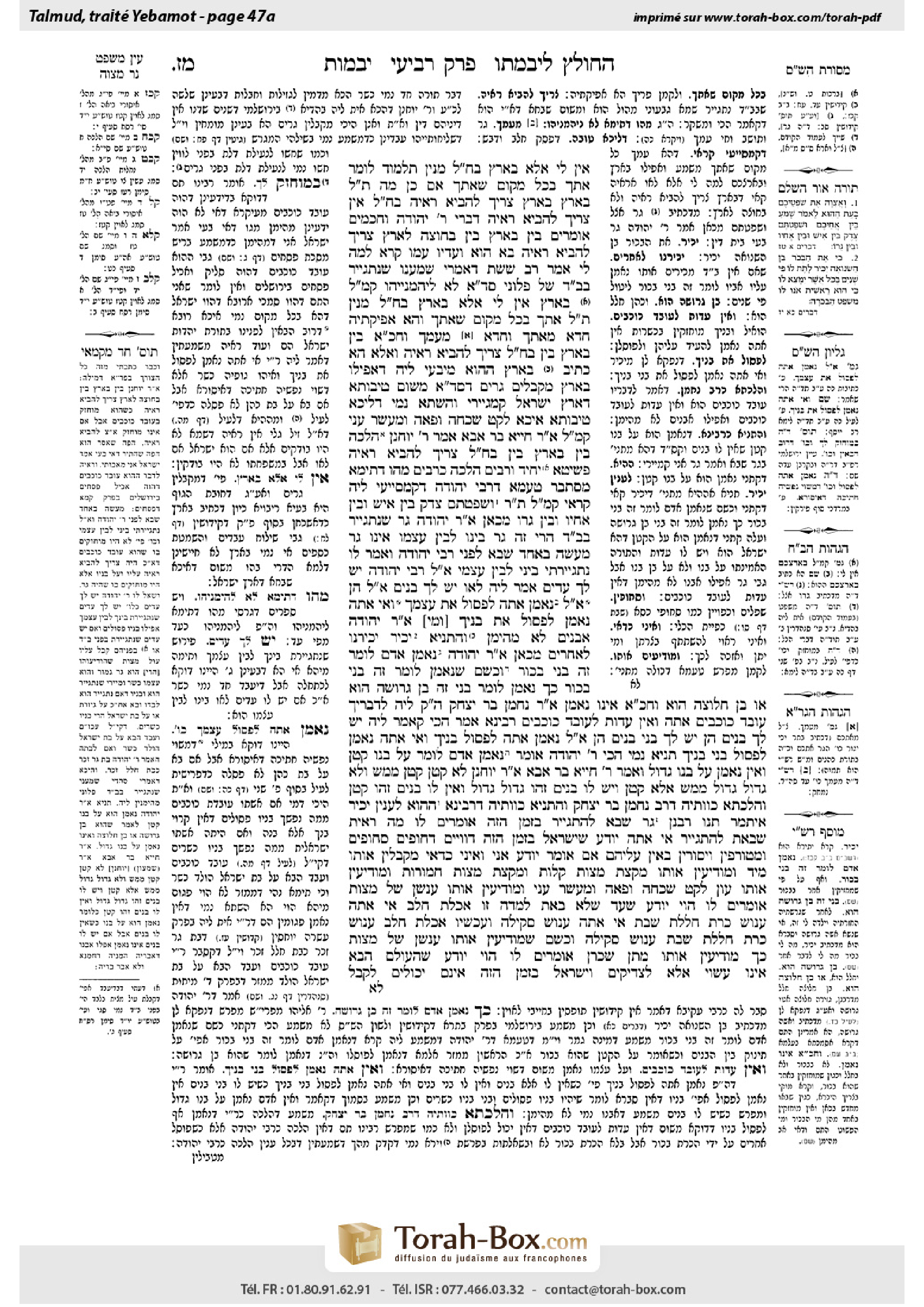
Yevamot 47a: Talmud study for Daf Yomi
Daf Yomi is the daily study of one Talmud folio. Explore 37 tractates with scans, Hebrew text, Sefaria English and AI-generated French translations where annotated.
Passage selection and English or AI-generated French translation are available where the scan has annotations. Daf Study is independent of Torah-Box and Sefaria.
Browse Yevamot · יבמות · All tractatesYevamot 47a text and translations
This page of Yevamot includes the Aramaic text, an English translation and an AI-generated French translation, alongside the scan above.
יבמות מ״ז א · Aramaic and Hebrew text
אֵין לִי אֶלָּא בָּאָרֶץ, בְּחוּץ לָאָרֶץ מִנַּיִן? תַּלְמוּד לוֹמַר: ״אִתְּךָ״ — בְּכׇל מָקוֹם שֶׁאִתְּךָ. אִם כֵּן, מָה תַּלְמוּד לוֹמַר ״בָּאָרֶץ״? בָּאָרֶץ — צָרִיךְ לְהָבִיא רְאָיָה, בְּחוּץ לָאָרֶץ — אֵין צָרִיךְ לְהָבִיא רְאָיָה, דִּבְרֵי רַבִּי יְהוּדָה. וַחֲכָמִים אוֹמְרִים: בֵּין בָּאָרֶץ בֵּין בְּחוּצָה לָאָרֶץ — צָרִיךְ לְהָבִיא רְאָיָה.
בָּא הוּא וְעֵדָיו עִמּוֹ, קְרָא לְמָה לִי? אָמַר רַב שֵׁשֶׁת: דְּאָמְרִי: שָׁמַעְנוּ שֶׁנִּתְגַּיֵּיר בְּבֵית דִּין שֶׁל פְּלוֹנִי. סָלְקָא דַּעְתָּךְ אָמֵינָא לָא לְיהֵמְנִייהוּ, קָא מַשְׁמַע לַן.
״בָּאָרֶץ״ — אֵין לִי אֶלָּא בָּאָרֶץ. בְּחוּצָה לָאָרֶץ מִנַּיִן — תַּלְמוּד לוֹמַר: ״אִתְּךָ״, בְּכׇל מָקוֹם שֶׁאִתְּךָ. וְהָא אַפֵּיקְתֵּיהּ? חֲדָא מֵ״אִתְּךָ״ וַחֲדָא מֵ״עִמָּךְ״.
וַחֲכָמִים אוֹמְרִים: בֵּין בָּאָרֶץ בֵּין בְּחוּצָה לָאָרֶץ צָרִיךְ לְהָבִיא רְאָיָה. וְאֶלָּא הָא כְּתִיב ״בָּאָרֶץ״!
הַהוּא מִיבְּעֵי לֵיהּ, דַּאֲפִילּוּ בָּאָרֶץ מְקַבְּלִים גֵּרִים. דְּסָלְקָא דַּעְתָּךְ אָמֵינָא: מִשּׁוּם טֵיבוּתָא דְּאֶרֶץ יִשְׂרָאֵל קָמִגַּיְּירִי, וְהַשְׁתָּא נָמֵי דְּלֵיכָּא טֵיבוּתָא, אִיכָּא לֶקֶט שִׁכְחָה וּפֵאָה וּמַעְשַׂר עָנִי, קָא מַשְׁמַע לַן.
אָמַר רַבִּי חִיָּיא בַּר אַבָּא אָמַר רַבִּי יוֹחָנָן: הֲלָכָה, בֵּין בָּאָרֶץ בֵּין בְּחוּץ לָאָרֶץ צָרִיךְ לְהָבִיא רְאָיָה. פְּשִׁיטָא, יָחִיד וְרַבִּים הֲלָכָה כְּרַבִּים! מַהוּ דְּתֵימָא: מִסְתַּבַּר טַעְמָא דְּרַבִּי יְהוּדָה, דְּקָמְסַיְּיעִי לֵיהּ קְרָאֵי, קָא מַשְׁמַע לַן.
תָּנוּ רַבָּנַן: ״וּשְׁפַטְתֶּם צֶדֶק בֵּין אִישׁ וּבֵין אָחִיו וּבֵין גֵּרוֹ״, מִכָּאן אָמַר רַבִּי יְהוּדָה: גֵּר שֶׁנִּתְגַּיֵּיר בְּבֵית דִּין — הֲרֵי זֶה גֵּר, בֵּינוֹ לְבֵין עַצְמוֹ — אֵינוֹ גֵּר.
מַעֲשֶׂה בְּאֶחָד שֶׁבָּא לִפְנֵי רַבִּי יְהוּדָה, וְאָמַר לוֹ: נִתְגַּיַּירְתִּי בֵּינִי לְבֵין עַצְמִי. אָמַר לוֹ רַבִּי יְהוּדָה: יֵשׁ לְךָ עֵדִים? אָמַר לוֹ: לָאו. יֵשׁ לְךָ בָּנִים? אָמַר לוֹ: הֵן. אָמַר לוֹ: נֶאֱמָן אַתָּה לִפְסוֹל אֶת עַצְמְךָ, וְאִי אַתָּה נֶאֱמָן לִפְסוֹל אֶת בָּנֶיךָ.
[וּמִי] אָמַר רַבִּי יְהוּדָה אַבָּנִים לָא מְהֵימַן? וְהָתַנְיָא: ״יַכִּיר״ — יַכִּירֶנּוּ לַאֲחֵרִים. מִכָּאן אָמַר רַבִּי יְהוּדָה: נֶאֱמָן אָדָם לוֹמַר ״זֶה בְּנִי בְּכוֹר״, וּכְשֵׁם שֶׁנֶּאֱמָן לוֹמַר ״זֶה בְּנִי בְּכוֹר״, כָּךְ נֶאֱמָן לוֹמַר: ״בְּנִי זֶה בֶּן גְּרוּשָׁה הוּא״, אוֹ ״בֶּן חֲלוּצָה הוּא״. וַחֲכָמִים אוֹמְרִים: אֵינוֹ נֶאֱמָן!
אָמַר רַב נַחְמָן בַּר יִצְחָק, הָכִי קָאָמַר לֵיהּ: לִדְבָרֶיךָ גּוֹי אַתָּה, וְאֵין עֵדוּת לְגוֹי. רָבִינָא אָמַר, הָכִי קָאָמַר לֵיהּ: יֵשׁ לְךָ בָּנִים? הֵן. יֵשׁ לְךָ בְּנֵי בָנִים? הֵן. אָמַר לוֹ: נֶאֱמָן אַתָּה לִפְסוֹל בָּנֶיךָ, וְאִי אַתָּה נֶאֱמָן לִפְסוֹל בְּנֵי בָנֶיךָ.
תַּנְיָא נָמֵי הָכִי, רַבִּי יְהוּדָה אוֹמֵר: נֶאֱמָן אָדָם לוֹמַר עַל בְּנוֹ קָטָן, וְאֵין נֶאֱמָן עַל בְּנוֹ גָּדוֹל. וְאָמַר רַבִּי חִיָּיא בַּר אַבָּא אָמַר רַבִּי יוֹחָנָן: לֹא קָטָן קָטָן מַמָּשׁ, וְלֹא גָּדוֹל גָּדוֹל מַמָּשׁ. אֶלָּא, קָטָן וְיֵשׁ לוֹ בָּנִים — זֶהוּ גָּדוֹל. גָּדוֹל וְאֵין לוֹ בָּנִים — זֶהוּ קָטָן.
וְהִלְכְתָא כְּווֹתֵיהּ דְּרַב נַחְמָן בַּר יִצְחָק. וְהָתַנְיָא כְּווֹתֵיהּ דְּרָבִינָא! הָהוּא, לְעִנְיַן ״יַכִּיר״ אִיתְּמַר.
תָּנוּ רַבָּנַן: גֵּר שֶׁבָּא לְהִתְגַּיֵּיר בִּזְמַן הַזֶּה, אוֹמְרִים לוֹ: מָה רָאִיתָ שֶׁבָּאתָ לְהִתְגַּיֵּיר? אִי אַתָּה יוֹדֵעַ שֶׁיִּשְׂרָאֵל בִּזְמַן הַזֶּה דְּווּיִים, דְּחוּפִים, סְחוּפִים וּמְטוֹרָפִין, וְיִסּוּרִין בָּאִין עֲלֵיהֶם? אִם אוֹמֵר: יוֹדֵעַ אֲנִי, וְאֵינִי כְּדַאי — מְקַבְּלִין אוֹתוֹ מִיָּד.
וּמוֹדִיעִין אוֹתוֹ מִקְצָת מִצְוֹת קַלּוֹת וּמִקְצָת מִצְוֹת חֲמוּרוֹת, וּמוֹדִיעִין אוֹתוֹ עֲוֹן לֶקֶט שִׁכְחָה וּפֵאָה וּמַעְשַׂר עָנִי. וּמוֹדִיעִין אוֹתוֹ עׇנְשָׁן שֶׁל מִצְוֹת. אוֹמְרִים לוֹ: הֱוֵי יוֹדֵעַ שֶׁעַד שֶׁלֹּא בָּאתָ לְמִדָּה זוֹ, אָכַלְתָּ חֵלֶב — אִי אַתָּה עָנוּשׁ כָּרֵת. חִלַּלְתָּ שַׁבָּת — אִי אַתָּה עָנוּשׁ סְקִילָה. וְעַכְשָׁיו, אָכַלְתָּ חֵלֶב — עָנוּשׁ כָּרֵת, חִלַּלְתָּ שַׁבָּת — עָנוּשׁ סְקִילָה.
וּכְשֵׁם שֶׁמּוֹדִיעִין אוֹתוֹ עׇנְשָׁן שֶׁל מִצְוֹת, כָּךְ מוֹדִיעִין אוֹתוֹ מַתַּן שְׂכָרָן. אוֹמְרִים לוֹ: הֱוֵי יוֹדֵעַ שֶׁהָעוֹלָם הַבָּא אֵינוֹ עָשׂוּי אֶלָּא לְצַדִּיקִים, וְיִשְׂרָאֵל בִּזְמַן הַזֶּה אֵינָם יְכוֹלִים לְקַבֵּל
Yevamot 47a · English translation
I have derived only that a convert is accepted in Eretz Yisrael; from where do I derive that also outside of Eretz Yisrael he is to be accepted? The verse states “with you,” which indicates that in any place that he is with you, you should accept him. If so, what is the meaning when the verse states: In the land? This indicates that in Eretz Yisrael he needs to bring evidence that he is a convert, but outside of Eretz Yisrael he does not need to bring evidence that he is a convert; rather, his claim is accepted. This is the statement of Rabbi Yehuda. And the Rabbis say: Whether he is in Eretz Yisrael or whether he is outside of Eretz Yisrael, he needs to bring evidence.
The Gemara analyzes the baraita: In the case when he came and brought witnesses to his conversion with him, why do I need a verse to teach that he is accepted? In all cases, the testimony of witnesses is fully relied upon. Rav Sheshet said: The case is where they say: We heard that he converted in the court of so-and-so, but they did not witness the actual conversion. And it is necessary to teach this because it could enter your mind to say that they should not be relied upon; therefore, the verse teaches us that they are relied upon.
As cited above, the latter clause of the baraita states: “With you in your land” (Leviticus 19:33). I have derived only that a convert is accepted in Eretz Yisrael; from where do I derive that also outside of Eretz Yisrael he is to be accepted? The verse states: “With you,” which indicates that in any place that he is with you, you should accept him. The Gemara asks: But didn’t you already expound that phrase in the first clause of the baraita to teach that one doesn’t accept the claims of an individual that he is a valid convert? The Gemara explains: One of these halakhot is derived from the phrase “with you” in the verse cited, and the other one is derived from the phrase “with you” in a subsequent verse (Leviticus 25:35).
The baraita states: And the Rabbis say: Whether he is in Eretz Yisrael or whether he is outside of Eretz Yisrael, he needs to bring evidence. The Gemara asks: But isn’t “in your land” written in the verse? How can the Rabbis deny any distinction between the halakha inside and outside of Eretz Yisrael?
The Gemara explains: That phrase is necessary to teach that even in Eretz Yisrael, the Jewish people should accept converts, as it could enter your mind to say that it is only for the sake of benefiting from the goodness of Eretz Yisrael, and not for the sake of Heaven, that they are converting, and therefore they should not be accepted. And it could also enter your mind to say that even nowadays, when God’s blessing has ceased and there is no longer the original goodness from which to benefit, one should still suspect their purity of motives because there are the gleanings, the forgotten sheaves, and the corners of fields, and the poor man’s tithe from which they would benefit by converting. Therefore, the verse teaches us that they are accepted even in Eretz Yisrael.
Rabbi Ḥiyya bar Abba said that Rabbi Yoḥanan said: The halakha is that whether a convert is in Eretz Yisrael or whether he is outside of Eretz Yisrael, he needs to bring evidence. The Gemara asks: Isn’t this obvious; in all disputes between an individual Sage and many Sages the halakha is in accordance with the opinion of the many Sages. The Gemara explains: It is necessary to state this lest you say that Rabbi Yehuda’s reason is more logical, being that the verse supports him when it states: “In your land.” Therefore, it is necessary for Rabbi Yoḥanan to teach us that the halakha is not in accordance with his opinion.
The Sages taught: The verse states that Moses charged the judges of a court: “And judge righteously between a man and his brother, and the convert with him” (Deuteronomy 1:16). From here, based on the mention of a convert in the context of judgment in a court, Rabbi Yehuda said: A potential convert who converts in a court is a valid convert. However, if he converts in private, he is not a convert.
The Gemara relates: There was an incident involving one who was presumed to be Jewish who came before Rabbi Yehuda and said to him: I converted in private, and therefore I am not actually Jewish. Rabbi Yehuda said to him: Do you have witnesses to support your claim? He said to him: No. Rabbi Yehuda asked: Do you have children? He said to him: Yes. Rabbi Yehuda said to him: You are deemed credible in order to render yourself unfit to marry a Jewish woman by claiming that you are a gentile, but you are not deemed credible in order to render your children unfit.
The Gemara asks: But did Rabbi Yehuda actually say that with regard to his children he is not deemed credible? But isn’t it taught in a baraita: The verse states: “He shall acknowledge [yakir] the firstborn, the son of the hated, by giving him a double portion of all that he has” (Deuteronomy 21:17). The phrase “he shall acknowledge” is apparently superfluous. It is therefore expounded to teach that the father is deemed credible so that he can identify him [yakirenu] to others. From here Rabbi Yehuda said: A man is deemed credible to say: This is my firstborn son, and just as he is deemed credible to say: This is my firstborn son, so too, a priest is deemed credible to say: This son of mine is a son of a divorced woman and myself, or to say: He is a son of a ḥalutza and myself, and therefore he is disqualified due to flawed lineage [ḥalal]. And the Rabbis say: He is not deemed credible. If Rabbi Yehuda holds that a father is deemed credible to render his children unfit, why did he rule otherwise in the case of the convert?
Rav Naḥman bar Yitzḥak said that this is what Rabbi Yehuda said to him: According to your statement you are a gentile, and there is no testimony for a gentile, as a gentile is a disqualified witness. Consequently, you cannot testify about the status of your children and render them unfit. Ravina said that this is what Rabbi Yehuda said to him: Do you have children? He said: Yes. He said to him: Do you have grandchildren? He said: Yes. He said to him: You are deemed credible in order to render your children unfit, based on the phrase “he shall acknowledge,” but you are not deemed credible in order to render your grandchildren unfit, as the verse affords a father credibility only with respect to his children.
This opinion of Ravina is also taught in a baraita: Rabbi Yehuda says: A man is deemed credible to say about his minor son that he is unfit, but he is not deemed credible to say about his adult son that he is unfit. And in explanation of the baraita, Rabbi Ḥiyya bar Abba said that Rabbi Yoḥanan said: The reference to a minor son does not mean one who is literally a minor, who has not yet reached majority, and the reference to an adult son does not mean one who is literally an adult, who has reached majority; rather, a minor who has children, this is what the baraita is referring to as an adult, and an adult who does not have children, this is what the baraita is referring to as a minor.
The Gemara concludes: And the halakha is in accordance with the opinion of Rav Naḥman bar Yitzḥak. The Gemara asks: But isn’t it taught in the baraita in accordance with the opinion of Ravina? If there is a baraita that supports his opinion, the halakha should be in accordance with his opinion. The Gemara explains: That baraita was stated concerning the matter of “he shall acknowledge,” that a father is deemed credible to render his son unfit; however, if one claims he is a gentile, he is not deemed credible to say the same about his son.
§ The Sages taught in a baraita: With regard to a potential convert who comes to a court in order to convert, at the present time, when the Jews are in exile, the judges of the court say to him: What did you see that motivated you to come to convert? Don’t you know that the Jewish people at the present time are anguished, suppressed, despised, and harassed, and hardships are frequently visited upon them? If he says: I know, and although I am unworthy of joining the Jewish people and sharing in their sorrow, I nevertheless desire to do so, then the court accepts him immediately to begin the conversion process.
And the judges of the court inform him of some of the lenient mitzvot and some of the stringent mitzvot, and they inform him of the sin of neglecting the mitzva to allow the poor to take gleanings, forgotten sheaves, and produce in the corner of one’s field, and about the poor man’s tithe. And they inform him of the punishment for transgressing the mitzvot, as follows: They say to him: Be aware that before you came to this status and converted, had you eaten forbidden fat, you would not be punished by karet, and had you profaned Shabbat, you would not be punished by stoning, since these prohibitions do not apply to gentiles. But now, once converted, if you have eaten forbidden fat you are punished by karet, and if you have profaned Shabbat, you are punished by stoning.
And just as they inform him about the punishment for transgressing the mitzvot, so too, they inform him about the reward granted for fulfilling them. They say to him: Be aware that the World-to-Come is made only for the righteous, and if you observe the mitzvot you will merit it, and be aware that the Jewish people, at the present time, are unable to receive their full reward in this world;
Yevamot 47a · Traduction française (IA)
Je n’ai déduit de là que le converti est accepté en Eretz Israël. D’où déduis-je qu’il doit également être accepté hors d’Eretz Israël ? Le verset dit : « avec toi », ce qui indique qu’en tout lieu où il se trouve avec toi, tu dois l’accepter. Si tel est le cas, que signifie l’expression « dans le pays » ? Elle indique qu’en Eretz Israël, il doit apporter la preuve qu’il est converti, tandis que hors d’Eretz Israël, il n’a pas besoin d’apporter cette preuve : sa déclaration est acceptée. Telle est l’opinion de Rabbi Yehuda. Les Sages disent : qu’il se trouve en Eretz Israël ou hors d’Eretz Israël, il doit apporter une preuve.
La Guemara analyse la baraïta : s’il est venu avec des témoins de sa conversion, pourquoi faut-il un verset pour enseigner qu’il est accepté ? Dans tous les cas, le témoignage de témoins est pleinement recevable. Rav Sheshet dit : le cas est celui où ils disent : « Nous avons entendu qu’il s’est converti devant le tribunal d’untel », mais sans avoir assisté à la conversion elle-même. Il est nécessaire de l’enseigner, car on aurait pu penser qu’on ne doit pas se fier à eux ; le verset nous enseigne donc qu’on peut s’y fier.
Comme cela a été cité plus haut, la dernière partie de la baraïta énonce : « avec toi dans ton pays » (Lévitique 19:33). Je n’ai déduit de là que le converti est accepté en Eretz Israël. D’où déduis-je qu’il doit également être accepté hors d’Eretz Israël ? Le verset dit : « avec toi », ce qui indique qu’en tout lieu où il se trouve avec toi, tu dois l’accepter. La Guemara demande : Mais n’as-tu pas déjà interprété cette expression dans la première partie de la baraïta, pour enseigner qu’on n’accepte pas la déclaration d’un seul individu affirmant être un converti valide ? La Guemara explique : l’une de ces halakhot est déduite de l’expression « avec toi » dans le verset cité, et l’autre de la même expression dans un verset ultérieur (Lévitique 25:35).
La baraïta énonce : Les Sages disent : qu’il se trouve en Eretz Israël ou hors d’Eretz Israël, il doit apporter une preuve. La Guemara demande : Mais le verset ne dit-il pas « dans ton pays » ? Comment les Sages peuvent-ils nier toute distinction entre la halakha en Eretz Israël et hors d’Eretz Israël ?
La Guemara explique : cette expression est nécessaire pour enseigner que les Juifs doivent accepter des convertis même en Eretz Israël. On aurait pu penser qu’ils se convertissent uniquement pour profiter des bienfaits d’Eretz Israël, et non par souci du Ciel, et qu’il ne fallait donc pas les accepter. On aurait aussi pu penser que, même de nos jours, alors que la bénédiction divine a cessé et qu’il n’y a plus les bienfaits dont on pouvait autrefois profiter, il faut encore mettre en doute la sincérité de leurs motivations, puisqu’ils pourraient tirer profit de leur conversion grâce aux glanures, aux gerbes oubliées, aux produits des coins des champs et à la dîme du pauvre. Le verset nous enseigne donc qu’ils sont acceptés même en Eretz Israël.
Rabbi Ḥiyya bar Abba a dit au nom de Rabbi Yoḥanan : la halakha est que, qu’un converti se trouve en Eretz Israël ou hors d’Eretz Israël, il doit apporter une preuve. La Guemara demande : N’est-ce pas évident ? Dans tout différend opposant un Sage seul à plusieurs Sages, la halakha suit l’opinion de la majorité. La Guemara explique : il était nécessaire de le préciser, de peur que tu dises que le raisonnement de Rabbi Yehuda est plus logique, puisque le verset semble lui donner raison en disant : « dans ton pays ». Rabbi Yoḥanan devait donc nous enseigner que la halakha ne suit pas son opinion.
Les Sages ont enseigné : le verset rapporte que Moïse donna aux juges d’un tribunal l’instruction suivante : « Rendez un jugement juste entre un homme et son frère, ainsi qu’avec le converti qui est avec lui » (Deutéronome 1:16). De là, en se fondant sur la mention d’un converti dans le contexte d’un jugement au tribunal, Rabbi Yehuda a dit : un candidat à la conversion qui se convertit devant un tribunal est un converti valide. Mais s’il se convertit en privé, il n’est pas converti.
La Guemara rapporte : un homme qui passait pour juif se présenta devant Rabbi Yehuda et lui dit : « Je me suis converti en privé ; par conséquent, je ne suis pas réellement juif. » Rabbi Yehuda lui dit : « As-tu des témoins à l’appui de ta déclaration ? » Il lui répondit : « Non. » Rabbi Yehuda demanda : « As-tu des enfants ? » Il répondit : « Oui. » Rabbi Yehuda lui dit : « Tu es cru lorsqu’il s’agit de te rendre inapte à épouser une femme juive en affirmant que tu es non-Juif, mais tu n’es pas cru lorsqu’il s’agit de rendre tes enfants inaptes. »
La Guemara demande : Mais Rabbi Yehuda a-t-il réellement dit qu’en ce qui concerne ses enfants, cet homme n’est pas cru ? N’est-il pas enseigné dans une baraïta : le verset dit : « Il reconnaîtra [yakir] le premier-né, le fils de la femme haïe, en lui donnant une double part de tout ce qu’il possède » (Deutéronome 21:17). L’expression « il reconnaîtra » semble superflue. On l’interprète donc ainsi : le père est cru pour le faire reconnaître [yakirenu] aux autres. De là, Rabbi Yehuda a dit : un homme est cru lorsqu’il dit : « Celui-ci est mon fils premier-né » ; et de même qu’il est cru pour dire : « Celui-ci est mon fils premier-né », un prêtre est également cru lorsqu’il dit : « Ce fils est né de moi et d’une femme divorcée », ou : « Il est né de moi et d’une femme ayant accompli la ḥalitsa » ; il est alors disqualifié en raison d’une ascendance irrégulière [ḥalal]. Les Sages disent : il n’est pas cru. Si Rabbi Yehuda considère qu’un père est cru pour rendre ses enfants inaptes, pourquoi a-t-il statué autrement dans le cas du converti ?
Rav Naḥman bar Yitzḥak dit que voici ce que Rabbi Yehuda lui a répondu : « Selon ta propre déclaration, tu es non-Juif, et le témoignage d’un non-Juif n’est pas recevable, car un non-Juif est un témoin disqualifié. Par conséquent, tu ne peux pas témoigner sur le statut de tes enfants et les rendre inaptes. » Ravina dit que voici ce que Rabbi Yehuda lui a demandé : « As-tu des enfants ? » Il répondit : « Oui. » Il lui demanda : « As-tu des petits-enfants ? » Il répondit : « Oui. » Il lui dit : « Tu es cru pour rendre tes enfants inaptes, sur la base de l’expression “il reconnaîtra”, mais tu n’es pas cru pour rendre tes petits-enfants inaptes, car le verset ne reconnaît au père ce statut qu’à l’égard de ses enfants. »
Cette opinion de Ravina est également enseignée dans une baraïta : Rabbi Yehuda dit : un homme est cru lorsqu’il déclare que son fils mineur est inapte, mais il n’est pas cru lorsqu’il déclare que son fils adulte est inapte. Pour expliquer la baraïta, Rabbi Ḥiyya bar Abba a dit au nom de Rabbi Yoḥanan : le fils mineur ne désigne pas ici un mineur au sens littéral, qui n’a pas encore atteint la majorité, et le fils adulte ne désigne pas un adulte au sens littéral, qui a atteint la majorité. Il s’agit plutôt d’un mineur qui a des enfants : c’est lui que la baraïta qualifie d’adulte ; et d’un adulte qui n’a pas d’enfants : c’est lui que la baraïta qualifie de mineur.
La Guemara conclut : la halakha suit l’opinion de Rav Naḥman bar Yitzḥak. La Guemara demande : Mais la baraïta n’est-elle pas enseignée conformément à l’opinion de Ravina ? Si une baraïta appuie son opinion, la halakha devrait la suivre. La Guemara explique : cette baraïta a été enseignée au sujet de l’expression « il reconnaîtra », selon laquelle un père est cru pour rendre son fils inapte ; toutefois, si quelqu’un affirme qu’il est non-Juif, il n’est pas cru lorsqu’il affirme la même chose à propos de son fils.
§ Les Sages ont enseigné dans une baraïta : lorsqu’un candidat à la conversion se présente devant un tribunal pour se convertir, à l’heure actuelle, alors que les Juifs sont en exil, les juges lui disent : « Qu’as-tu vu qui t’a incité à venir te convertir ? Ne sais-tu pas qu’à l’heure actuelle, le peuple juif est accablé, opprimé, méprisé et harcelé, et que les épreuves s’abattent fréquemment sur lui ? » S’il répond : « Je le sais ; bien que je ne sois pas digne de me joindre au peuple juif et de partager ses souffrances, je le désire néanmoins », le tribunal l’accepte alors immédiatement pour entamer le processus de conversion.
Les juges lui exposent certaines mitsvot faciles et certaines mitsvot rigoureuses. Ils l’informent du péché que constitue la négligence de la mitsva permettant aux pauvres de prendre les glanures, les gerbes oubliées et les produits des coins des champs, ainsi que de la dîme du pauvre. Ils l’informent aussi des peines encourues en cas de transgression des mitsvot, en lui disant : « Sache qu’avant d’accéder à ce statut et de te convertir, si tu avais consommé de la graisse interdite, tu n’aurais pas été passible de karèt, et si tu avais profané le Chabbat, tu n’aurais pas été passible de lapidation, puisque ces interdits ne s’appliquent pas aux non-Juifs. Mais maintenant, après ta conversion, si tu as consommé de la graisse interdite, tu es passible de karèt, et si tu as profané le Chabbat, tu es passible de lapidation. »
Et de même qu’ils l’informent des peines encourues en cas de transgression des mitsvot, ils l’informent également de la récompense accordée pour leur accomplissement. Ils lui disent : « Sache que le Monde à venir est réservé aux justes et que, si tu observes les mitsvot, tu y auras droit. Sache également qu’à l’heure actuelle, le peuple juif ne peut recevoir ici-bas la totalité de sa récompense ;
Traduction française générée par IA à partir de l’édition anglaise de Sefaria. Vérifie toujours un passage avec le texte source.
Text from Sefaria: William Davidson Edition - Vocalized Aramaic (CC BY NC); William Davidson Edition - English (CC BY NC).