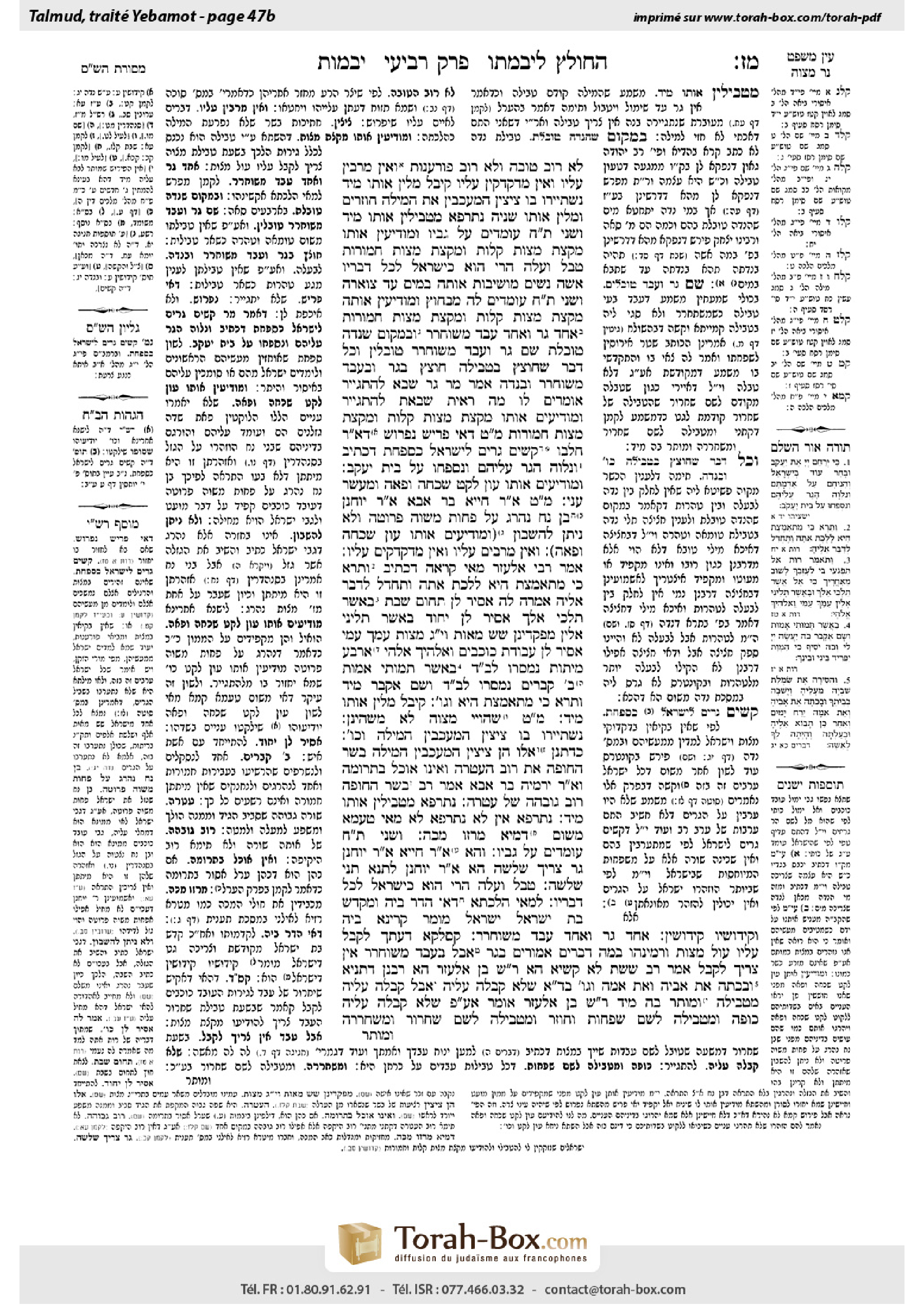
Yevamot 47b: Talmud study for Daf Yomi
Daf Yomi is the daily study of one Talmud folio. Explore 37 tractates with scans, Hebrew text, Sefaria English and AI-generated French translations where annotated.
Passage selection and English or AI-generated French translation are available where the scan has annotations. Daf Study is independent of Torah-Box and Sefaria.
Browse Yevamot · יבמות · All tractatesYevamot 47b text and translations
This page of Yevamot includes the Aramaic text, an English translation and an AI-generated French translation, alongside the scan above.
יבמות מ״ז ב · Aramaic and Hebrew text
לֹא רוֹב טוֹבָה וְלֹא רוֹב פּוּרְעָנוּת. וְאֵין מַרְבִּין עָלָיו, וְאֵין מְדַקְדְּקִין עָלָיו.
קִיבֵּל — מָלִין אוֹתוֹ מִיָּד. נִשְׁתַּיְּירוּ בּוֹ צִיצִין הַמְעַכְּבִין אֶת הַמִּילָה — חוֹזְרִים וּמָלִין אוֹתוֹ שְׁנִיָּה. נִתְרַפֵּא — מַטְבִּילִין אוֹתוֹ מִיָּד. וּשְׁנֵי תַּלְמִידֵי חֲכָמִים עוֹמְדִים עַל גַּבָּיו וּמוֹדִיעִין אוֹתוֹ מִקְצָת מִצְוֹת קַלּוֹת וּמִקְצָת מִצְוֹת חֲמוּרוֹת. טָבַל וְעָלָה — הֲרֵי הוּא כְּיִשְׂרָאֵל לְכׇל דְּבָרָיו.
אִשָּׁה — נָשִׁים מוֹשִׁיבוֹת אוֹתָהּ בְּמַיִם עַד צַוָּארָהּ, וּשְׁנֵי תַּלְמִידֵי חֲכָמִים עוֹמְדִים לָהּ מִבַּחוּץ, וּמוֹדִיעִין אוֹתָהּ מִקְצָת מִצְוֹת קַלּוֹת וּמִקְצָת מִצְוֹת חֲמוּרוֹת.
אֶחָד גֵּר, וְאֶחָד עֶבֶד מְשׁוּחְרָר. וּבִמְקוֹם שֶׁנִּדָּה טוֹבֶלֶת, שָׁם גֵּר וְעֶבֶד מְשׁוּחְרָר טוֹבְלִין. וְכׇל דָּבָר שֶׁחוֹצֵץ בִּטְבִילָה, חוֹצֵץ בְּגֵר וּבְעֶבֶד מְשׁוּחְרָר וּבְנִדָּה.
אָמַר מָר: גֵּר שֶׁבָּא לְהִתְגַּיֵּיר, אוֹמְרִים לוֹ: מָה רָאִיתָ שֶׁבָּאתָ לְהִתְגַּיֵּיר? וּמוֹדִיעִים אוֹתוֹ מִקְצָת מִצְוֹת קַלּוֹת וּמִקְצָת מִצְוֹת חֲמוּרוֹת. מַאי טַעְמָא? דְּאִי פָּרֵישׁ — נִפְרוֹשׁ. דְּאָמַר רַבִּי חֶלְבּוֹ: קָשִׁים גֵּרִים לְיִשְׂרָאֵל כְּסַפַּחַת, דִּכְתִיב: ״וְנִלְוָה הַגֵּר עֲלֵיהֶם וְנִסְפְּחוּ עַל בֵּית יַעֲקֹב״.
וּמוֹדִיעִים אוֹתוֹ עֲוֹן לֶקֶט שִׁכְחָה וּפֵאָה וּמַעְשַׂר עָנִי. מַאי טַעְמָא? אָמַר רַבִּי חִיָּיא בַּר אַבָּא אָמַר רַבִּי יוֹחָנָן: בֶּן נֹחַ נֶהֱרָג עַל פָּחוֹת מִשָּׁוֶה פְּרוּטָה — וְלֹא נִיתָּן לְהִשָּׁבוֹן.
(וּמוֹדִיעִים אוֹתוֹ עֲוֹן שִׁכְחָה וּפֵאָה) וְאֵין מַרְבִּים עָלָיו וְאֵין מְדַקְדְּקִים עָלָיו. אָמַר רַבִּי אֶלְעָזָר: מַאי קְרָאָה — דִּכְתִיב: ״וַתֵּרֶא כִּי מִתְאַמֶּצֶת הִיא לָלֶכֶת אִתָּהּ וַתֶּחְדַּל לְדַבֵּר אֵלֶיהָ״.
אֲמַרָה לַהּ: אֲסִיר לַן תְּחוּם שַׁבָּת — ״בַּאֲשֶׁר תֵּלְכִי אֵלֵךְ״. אֲסִיר לַן יִחוּד — ״בַּאֲשֶׁר תָּלִינִי אָלִין״.
מִפַּקְדִינַן שֵׁשׁ מֵאוֹת וּשְׁלֹשׁ עֶשְׂרֵה מִצְוֹת — ״עַמֵּךְ עַמִּי״. אֲסִיר לַן עֲבוֹדָה זָרָה — ״וֵאלֹהַיִךְ אֱלֹהָי״. אַרְבַּע מִיתוֹת נִמְסְרוּ לְבֵית דִּין — ״בַּאֲשֶׁר תָּמוּתִי אָמוּת״. שְׁנֵי קְבָרִים נִמְסְרוּ לְבֵית דִּין — ״וְשָׁם אֶקָּבֵר״.
מִיָּד, ״וַתֵּרֶא כִּי מִתְאַמֶּצֶת הִיא וְגוֹ׳״.
קִיבֵּל — מָלִין אוֹתוֹ מִיָּד. מַאי טַעְמָא — שַׁהוֹיֵי מִצְוָה לָא מְשַׁהֵינַן.
נִשְׁתַּיְּירוּ בּוֹ צִיצִין הַמְעַכְּבִין הַמִּילָה וְכוּ׳. כְּדִתְנַן: אֵלּוּ הֵן צִיצִין הַמְעַכְּבִין הַמִּילָה — בָּשָׂר הַחוֹפֶה אֶת רוֹב הָעֲטָרָה. וְאֵינוֹ אוֹכֵל בִּתְרוּמָה. וְאָמַר רַב יִרְמְיָה בַּר אַבָּא אָמַר רַב: בָּשָׂר הַחוֹפֶה רוֹב גּוֹבְהָהּ שֶׁל עֲטָרָה.
נִתְרַפֵּא — מַטְבִּילִין אוֹתוֹ מִיָּד. נִתְרַפֵּא — אִין, לֹא נִתְרַפֵּא — לָא. מַאי טַעְמָא? מִשּׁוּם דְּמַיָּא מַרְזוּ מַכָּה.
וּשְׁנֵי תַּלְמִידֵי חֲכָמִים עוֹמְדִים עַל גַּבָּיו. וְהָא אָמַר רַבִּי חִיָּיא אָמַר רַבִּי יוֹחָנָן: גֵּר צָרִיךְ שְׁלֹשָׁה! הָא אָמַר רַבִּי יוֹחָנָן לְתַנָּא: תְּנִי, שְׁלֹשָׁה.
טָבַל וְעָלָה הֲרֵי הוּא כְּיִשְׂרָאֵל לְכׇל דְּבָרָיו. לְמַאי הִלְכְתָא? דְּאִי הָדַר בֵּיהּ וּמְקַדֵּשׁ בַּת יִשְׂרָאֵל, יִשְׂרָאֵל מְשׁוּמָּד קָרֵינָא בֵּיהּ, וְקִידּוּשָׁיו קִידּוּשִׁין.
אֶחָד גֵּר וְאֶחָד עֶבֶד מְשׁוּחְרָר. קָסָלְקָא דַּעְתָּךְ, לְקַבֵּל עָלָיו עוֹל מִצְוֹת. וּרְמִינְהוּ: בַּמֶּה דְּבָרִים אֲמוּרִים — בְּגֵר, אֲבָל בְּעֶבֶד מְשׁוּחְרָר — אֵין צָרִיךְ לְקַבֵּל!
אָמַר רַב שֵׁשֶׁת, לָא קַשְׁיָא: הָא — רַבִּי שִׁמְעוֹן בֶּן אֶלְעָזָר, הָא — רַבָּנַן.
דְּתַנְיָא: ״וּבָכְתָה אֶת אָבִיהָ וְאֶת אִמָּהּ וְגוֹ׳״. בַּמֶּה דְּבָרִים אֲמוּרִים — שֶׁלֹּא קִבְּלָה עָלֶיהָ. אֲבָל קִבְּלָה עָלֶיהָ — מַטְבִּילָהּ, וּמוּתָּר בָּהּ מִיָּד.
רַבִּי שִׁמְעוֹן בֶּן אֶלְעָזָר אוֹמֵר: אַף עַל פִּי שֶׁלֹּא קִבְּלָה עָלֶיהָ, כּוֹפָהּ וּמַטְבִּילָהּ לְשֵׁם שִׁפְחוּת, וְחוֹזֵר וּמַטְבִּילָהּ לְשֵׁם שִׁחְרוּר, וּמְשַׁחְרְרָהּ,
Yevamot 47b · English translation
they are not able to receive either an abundance of good nor an abundance of calamities, since the primary place for reward and punishment is in the World-to-Come. And they do not overwhelm him with threats, and they are not exacting with him about the details of the mitzvot.
If he accepts upon himself all of these ramifications, then they circumcise him immediately. If there still remain on him shreds of flesh from the foreskin that invalidate the circumcision, they circumcise him again a second time to remove them. When he is healed from the circumcision, they immerse him immediately, and two Torah scholars stand over him at the time of his immersion and inform him of some of the lenient mitzvot and some of the stringent mitzvot. Once he has immersed and emerged, he is like a born Jew in every sense.
For the immersion of a woman: Women appointed by the court seat her in the water of the ritual bath up to her neck, and two Torah scholars stand outside the bath house so as not to compromise her modesty, and from there they inform her of some of the lenient mitzvot and some of the stringent mitzvot.
The procedure applies for both a convert and an emancipated slave who, upon immersion at the time of his emancipation, becomes a Jew in every sense. And in the same place that a menstruating woman immerses, i.e., in a ritual bath of forty se’a of water, there a convert and an emancipated slave also immerse. And anything that interposes between one’s body and the water of the ritual bath with regard to immersion of a ritually impure person, in a manner that would invalidate the immersion, also interposes and invalidates the immersion for a convert, and for an emancipated slave, and for a menstruating woman.
The Gemara analyzes the baraita. The Master said in the baraita: With regard to a potential convert who comes to a court in order to convert, the judges of the court say to him: What did you see that motivated you to come to convert? And they inform him of some of the lenient mitzvot and some of the stringent mitzvot. The Gemara asks: What is the reason to say this to him? It is so that if he is going to withdraw from the conversion process, let him withdraw already at this stage. He should not be convinced to continue, as Rabbi Ḥelbo said: Converts are as harmful to the Jewish people as a leprous scab [sappaḥat] on the skin, as it is written: “And the convert shall join himself with them, and they shall cleave [venispeḥu] to the house of Jacob” (Isaiah 14:1). This alludes to the fact that the cleaving of the convert to the Jewish people is like a scab.
The baraita continues: And they inform him of the sin of neglecting the mitzva to allow the poor to take gleanings, forgotten sheaves, and produce in the corner of one’s field, and about the poor man’s tithe. The Gemara asks: What is the reason to specifically mention these mitzvot? Rabbi Ḥiyya bar Abba said that Rabbi Yoḥanan said: Because a gentile is executed even on account of stealing less than the value of a peruta, since gentiles are particular about even such a small loss, and an item that a gentile steals is not subject to being returned, i.e., he is not obligated to return it to its owner. Since gentiles are unwilling to separate even from items of little value, a potential convert must be made aware that if he converts, he will be required to relinquish some of his property to others.
The baraita continues: And they inform him of the sin of neglecting the mitzva to allow the poor to take gleanings, forgotten sheaves, and produce in the corner of one’s field. And they do not overwhelm him with threats, and they are not exacting with him about the details of the mitzvot, i.e., the court should not overly dissuade the convert from converting. Rabbi Elazar said: What is the verse from which this ruling is derived? As it is written: “And when she saw that she was steadfastly minded to go with her, she left off speaking with her” (Ruth 1:18). When Naomi set out to return to Eretz Yisrael, Ruth insisted on joining her. The Gemara understands this to mean that Ruth wished to convert. Naomi attempted to dissuade her, but Ruth persisted. The verse states that once Naomi saw Ruth’s resolve to convert, she desisted from her attempts to dissuade her. The Gemara infers from here that the same approach should be taken by a court in all cases of conversion.
The Gemara reconstructs the original dialogue in which Naomi attempted to dissuade Ruth from converting: Naomi said to her: On Shabbat, it is prohibited for us to go beyond the Shabbat limit. Ruth responded: “Where you go, I shall go” (Ruth 1:16), and no further. Naomi said to her: It is forbidden for us to be alone together with a man with whom it is forbidden to engage in relations. Ruth responded: “Where you lodge, I shall lodge” (Ruth 1:16), and in the same manner.
Naomi said to her: We are commanded to observe six hundred and thirteen mitzvot. Ruth responded: “Your people are my people” (Ruth 1:16). Naomi said to her: Idolatrous worship is forbidden to us. Ruth responded: “Your God is my God” (Ruth 1:16). Naomi said to her: Four types of capital punishment were handed over to a court with which to punish those who transgress the mitzvot. Ruth responded: “Where you die, I shall die” (Ruth 1:17). Naomi said to her: Two burial grounds were handed over to the court, one for those executed for more severe crimes and another for those executed for less severe crimes. Ruth responded: “And there I shall be buried” (Ruth 1:17).
Immediately following this dialogue, the verse states: “And when she saw that she was steadfastly minded she left off speaking with her” (Ruth 1:18). Once Naomi saw Ruth’s resolve to convert, she desisted from her attempts to dissuade her.
The baraita continues: If he accepts upon himself all of these ramifications, then they circumcise him immediately. The Gemara asks: What is the reason to act immediately? It is that we do not delay the performance of a mitzva.
The baraita continues: If there still remain on him shreds of flesh from the foreskin that invalidate the circumcision, he is circumcised a second time to remove them. The Gemara explains: This is as we learned in a mishna (Shabbat 137a): These are the shreds of flesh that invalidate the circumcision if they are not cut: Any fragments of the flesh that cover the greater part of the corona. If such shreds remain, the child is considered uncircumcised, and he may not partake of teruma. And in explanation of this mishna, Rav Yirmeya bar Abba said that Rav said: This also includes the flesh that covers the greater part of the height of the corona.
The baraita continues: When he is healed from the circumcision, they immerse him immediately. The Gemara infers from the precise formulation of the baraita that when he has healed, then yes, he is immersed, but as long as he has not healed, then no, he is not. What is the reason for this? It is because water agitates a wound.
The baraita continues: And two Torah scholars stand over him at the time of his immersion. The Gemara asks: But didn’t Rabbi Ḥiyya say that Rabbi Yoḥanan said that a convert requires a court of three to be present at his conversion? The Gemara answers: In fact, Rabbi Yoḥanan said to the tanna reciting the mishna: Do not teach that there are two Torah scholars; rather, teach that there are three.
The baraita continues: Once he has immersed and emerged he is a Jew in every sense. The Gemara asks: With regard to what halakha is this said? It is that if he reverts back to behaving as a gentile, he nevertheless remains Jewish, and so if he betroths a Jewish woman, although he is considered to be an apostate Jew, his betrothal is a valid betrothal.
The baraita continues: This applies both for a convert and for an emancipated slave. The Gemara considers the meaning of this clause: If it enters your mind to interpret the baraita to mean that a convert and an emancipated slave are the same with regard to accepting upon oneself the yoke of mitzvot, then one could raise a contradiction from that which is taught in another baraita: In what case is this statement that there is a need to accept the yoke of mitzvot said? It is with respect to a convert; however, an emancipated slave does not need to accept upon himself the yoke of mitzvot when he immerses for the sake of emancipation. Rather, the immersion alone is sufficient to emancipate him and thereby render him a Jew.
Rav Sheshet said: This is not difficult, as this baraita that states that an emancipated slave is not required to accept the yoke of mitzvot is in accordance with the opinion of Rabbi Shimon ben Elazar, whereas that baraita that implies he is required to do so is in accordance with the opinion of the Rabbis, the first tanna of the following baraita.
As it is taught in a baraita: The Torah permits a Jewish soldier to take a beautiful female prisoner of war out of her captivity in order to marry her. Before he may do so, she must first undergo the process that the Torah describes: “And she shall shave her head, and do her nails; and she shall remove the raiment of her captivity from upon her, and she shall remain in your house and bewail her father and her mother a month of days” (Deuteronomy 21:12–13). She may then be immersed for the sake of conversion, even though she does not accept upon herself the yoke of mitzvot. At that point it is permitted to marry her. The baraita asks: Under what circumstance are these matters stated? It is when she did not accept upon herself the yoke of mitzvot; however, if she willingly accepted upon herself the yoke of mitzvot, he may immerse her for the sake of conversion, and he is permitted to marry her immediately without the need for her to undergo the process described in the Torah.
Rabbi Shimon ben Elazar says: Even if she did not accept upon herself the yoke of mitzvot, the need for the process can still be circumvented if he forces her and immerses her for the sake of slavery, and then he again immerses her for the sake of emancipation and thereby emancipates her, rendering her a Jewess. Rabbi Shimon ben Elazar holds that the immersion of a slave for the sake of emancipation is effective even if the slave does not accept upon himself the yoke of mitzvot.
Yevamot 47b · Traduction française (IA)
ils ne sont pas en mesure de recevoir une abondance de bienfaits ni une abondance de malheurs, car le lieu principal de la récompense et du châtiment est le monde à venir. Ils ne l’accablent pas de menaces et ne se montrent pas pointilleux avec lui sur les détails des mitsvot.
S’il accepte toutes ces conséquences, on le circoncit immédiatement. S’il reste des lambeaux de chair du prépuce qui invalident la circoncision, on le circoncit une seconde fois afin de les retirer. Lorsqu’il est guéri de la circoncision, on l’immerge immédiatement. Deux sages de la Torah se tiennent auprès de lui au moment de son immersion et lui enseignent quelques mitsvot faciles et quelques mitsvot difficiles. Une fois immergé et sorti de l’eau, il est juif à tous égards, comme s’il était né juif.
Pour l’immersion d’une femme, des femmes mandatées par le tribunal l’installent dans l’eau du bain rituel jusqu’au cou. Deux sages de la Torah se tiennent à l’extérieur du bain afin de ne pas porter atteinte à sa pudeur et, de là, lui enseignent quelques mitsvot faciles et quelques mitsvot difficiles.
Cette procédure s’applique aussi bien au converti qu’à l’esclave affranchi, qui devient juif à tous égards par son immersion au moment de son affranchissement. Le converti et l’esclave affranchi s’immergent au même endroit que la femme menstruée, c’est-à-dire dans un bain rituel contenant quarante séa d’eau. Tout ce qui fait obstacle entre le corps et l’eau du bain rituel lors de l’immersion d’une personne rituellement impure, et qui invaliderait cette immersion, fait également obstacle et invalide l’immersion d’un converti, d’un esclave affranchi et d’une femme menstruée.
La Guemara analyse la baraïta. Le Maître a enseigné dans la baraïta : Au sujet d’un candidat à la conversion qui se présente devant un tribunal afin de se convertir, les juges lui disent : « Qu’as-tu vu qui t’a incité à venir te convertir ? » Ils lui enseignent quelques mitsvot faciles et quelques mitsvot difficiles. La Guemara demande : Pourquoi lui dire cela ? Afin que, s’il est sur le point de renoncer à la conversion, il y renonce dès cette étape. Il ne faut pas chercher à le convaincre de poursuivre, car Rabbi Ḥelbo a dit : « Les convertis sont aussi nuisibles au peuple juif qu’une tache de lèpre [sappaḥat] sur la peau », comme il est écrit : « Et le converti se joindra à eux, et ils s’attacheront [venispeḥu] à la maison de Jacob » (Isaïe 14, 1). Cela fait allusion au fait que l’attachement du converti au peuple juif est comme une tache de lèpre.
La baraïta poursuit : Ils lui enseignent la faute que constitue le fait de négliger la mitsva de laisser les pauvres recueillir les glanures, les gerbes oubliées et les produits du coin de son champ, ainsi que celle de la dîme du pauvre. La Guemara demande : Pourquoi mentionner précisément ces mitsvot ? Rabbi Ḥiyya bar Abba a dit au nom de Rabbi Yoḥanan : Parce qu’un non-Juif est passible de mort même pour avoir volé une valeur inférieure à une perouta, car les non-Juifs tiennent même à une perte aussi minime ; de plus, un objet volé par un non-Juif n’est pas soumis à restitution, c’est-à-dire que celui-ci n’est pas tenu de le rendre à son propriétaire. Puisque les non-Juifs ne veulent pas se séparer même d’objets de peu de valeur, il faut faire savoir au candidat à la conversion que, s’il se convertit, il devra céder une partie de ses biens à autrui.
La baraïta poursuit : Ils lui enseignent la faute que constitue le fait de négliger la mitsva de laisser les pauvres recueillir les glanures, les gerbes oubliées et les produits du coin de son champ. Ils ne l’accablent pas de menaces et ne se montrent pas pointilleux avec lui sur les détails des mitsvot ; autrement dit, le tribunal ne doit pas chercher à dissuader excessivement le candidat de se convertir. Rabbi Elazar a dit : Quel verset fonde cette règle ? Comme il est écrit : « Lorsqu’elle vit qu’elle était fermement décidée à l’accompagner, elle cessa de lui parler » (Ruth 1, 18). Lorsque Naomi entreprit de retourner en terre d’Israël, Ruth insista pour l’accompagner. La Guemara comprend que Ruth souhaitait se convertir. Naomi tenta de l’en dissuader, mais Ruth persista. Le verset indique que, lorsque Naomi vit la détermination de Ruth à se convertir, elle renonça à ses tentatives de l’en dissuader. La Guemara en déduit que le tribunal doit adopter la même attitude dans tous les cas de conversion.
La Guemara reconstitue le dialogue initial au cours duquel Naomi tenta de dissuader Ruth de se convertir. Naomi lui dit : « Le Chabbat, il nous est interdit de dépasser la limite du Chabbat. » Ruth répondit : « Où tu iras, j’irai » (Ruth 1, 16), mais pas au-delà. Naomi lui dit : « Il nous est interdit de nous retrouver seules avec un homme avec lequel les relations nous sont interdites. » Ruth répondit : « Où tu logeras, je logerai » (Ruth 1, 16), et il en sera de même.
Naomi lui dit : « Nous sommes tenues d’observer six cent treize mitsvot. » Ruth répondit : « Ton peuple sera mon peuple » (Ruth 1, 16). Naomi lui dit : « Le culte idolâtre nous est interdit. » Ruth répondit : « Ton Dieu sera mon Dieu » (Ruth 1, 16). Naomi lui dit : « Quatre types de peines capitales ont été confiés à un tribunal pour punir ceux qui transgressent les mitsvot. » Ruth répondit : « Où tu mourras, je mourrai » (Ruth 1, 17). Naomi lui dit : « Deux lieux de sépulture ont été confiés au tribunal, l’un pour ceux qui ont été exécutés pour des crimes plus graves, l’autre pour ceux qui l’ont été pour des crimes moins graves. » Ruth répondit : « Et là, je serai enterrée » (Ruth 1, 17).
Immédiatement après ce dialogue, le verset dit : « Lorsqu’elle vit qu’elle était fermement décidée, elle cessa de lui parler » (Ruth 1, 18). Lorsque Naomi vit la détermination de Ruth à se convertir, elle renonça à ses tentatives de l’en dissuader.
La baraïta poursuit : S’il accepte toutes ces conséquences, on le circoncit immédiatement. La Guemara demande : Pourquoi agir immédiatement ? Parce qu’on ne retarde pas l’accomplissement d’une mitsva.
La baraïta poursuit : S’il reste des lambeaux de chair du prépuce qui invalident la circoncision, on le circoncit une seconde fois afin de les retirer. La Guemara explique : Cela correspond à ce que nous avons appris dans une Michna (Chabbat 137a) : « Voici les lambeaux de chair qui invalident la circoncision s’ils ne sont pas coupés : tous les fragments de chair qui couvrent la majeure partie du gland. » Si de tels lambeaux restent, l’enfant est considéré comme incirconcis et ne peut pas consommer de terouma. Pour expliquer cette Michna, Rav Yirmeya bar Abba a dit au nom de Rav : Cela inclut également la chair qui couvre la majeure partie de la hauteur du gland.
La baraïta poursuit : Lorsqu’il est guéri de la circoncision, on l’immerge immédiatement. La Guemara déduit de la formulation précise de la baraïta que, lorsqu’il est guéri, on l’immerge, mais que tant qu’il n’est pas guéri, on ne l’immerge pas. Pourquoi ? Parce que l’eau irrite une plaie.
La baraïta poursuit : Deux sages de la Torah se tiennent auprès de lui au moment de son immersion. La Guemara demande : Mais Rabbi Ḥiyya n’a-t-il pas dit au nom de Rabbi Yoḥanan qu’un converti doit être accompagné d’un tribunal de trois personnes lors de sa conversion ? La Guemara répond : En réalité, Rabbi Yoḥanan a dit au tanna qui récitait la Michna : « N’enseigne pas qu’il y a deux sages de la Torah ; enseigne plutôt qu’il y en a trois. »
La baraïta poursuit : Une fois immergé et sorti de l’eau, il est juif à tous égards. La Guemara demande : Pour quelle halakha cela est-il dit ? Cela signifie que, même s’il revient à une conduite de non-Juif, il demeure juif. Ainsi, s’il donne des kidouchin à une femme juive, ses kidouchin sont valides, bien qu’il soit considéré comme un juif apostat.
La baraïta poursuit : Cela s’applique aussi bien au converti qu’à l’esclave affranchi. La Guemara examine le sens de cette clause : Si l’on interprète la baraïta comme signifiant que le converti et l’esclave affranchi sont soumis aux mêmes règles quant à l’acceptation du joug des mitsvot, on peut soulever une contradiction à partir de ce qui est enseigné dans une autre baraïta : « Dans quel cas cette affirmation, selon laquelle il faut accepter le joug des mitsvot, s’applique-t-elle ? Au converti. En revanche, un esclave affranchi n’a pas besoin d’accepter le joug des mitsvot lorsqu’il s’immerge en vue de son affranchissement. L’immersion seule suffit à l’affranchir et, ainsi, à faire de lui un juif. »
Rav Sheshet a dit : Il n’y a pas de difficulté, car cette baraïta, qui affirme qu’un esclave affranchi n’est pas tenu d’accepter le joug des mitsvot, suit l’opinion de Rabbi Shimon ben Elazar, tandis que cette autre baraïta, qui laisse entendre qu’il y est tenu, suit l’opinion des Sages, le premier tanna de la baraïta suivante.
Comme il est enseigné dans une baraïta : La Torah autorise un soldat juif à prendre une belle prisonnière de guerre hors de sa captivité afin de l’épouser. Avant qu’il puisse le faire, elle doit d’abord suivre la procédure décrite par la Torah : « Elle se rasera la tête, se fera les ongles, ôtera les vêtements de sa captivité, restera dans ta maison et pleurera son père et sa mère pendant un mois entier » (Deutéronome 21, 12-13). Elle peut ensuite être immergée en vue de sa conversion, même si elle n’accepte pas le joug des mitsvot. Il lui est alors permis de l’épouser. La baraïta demande : Dans quelles circonstances ces règles ont-elles été énoncées ? Lorsqu’elle n’a pas accepté le joug des mitsvot. En revanche, si elle l’a accepté de son plein gré, il peut l’immerger en vue de sa conversion et l’épouser immédiatement, sans qu’elle ait à suivre la procédure décrite dans la Torah.
Rabbi Shimon ben Elazar dit : Même si elle n’a pas accepté le joug des mitsvot, il est encore possible de contourner la nécessité de cette procédure s’il la contraint, l’immerge en vue de l’esclavage, puis l’immerge de nouveau en vue de son affranchissement et l’affranchit ainsi, faisant d’elle une juive. Rabbi Shimon ben Elazar estime que l’immersion d’un esclave en vue de son affranchissement est efficace même si celui-ci n’accepte pas le joug des mitsvot.
Traduction française générée par IA à partir de l’édition anglaise de Sefaria. Vérifie toujours un passage avec le texte source.
Text from Sefaria: William Davidson Edition - Vocalized Aramaic (CC BY NC); William Davidson Edition - English (CC BY NC).