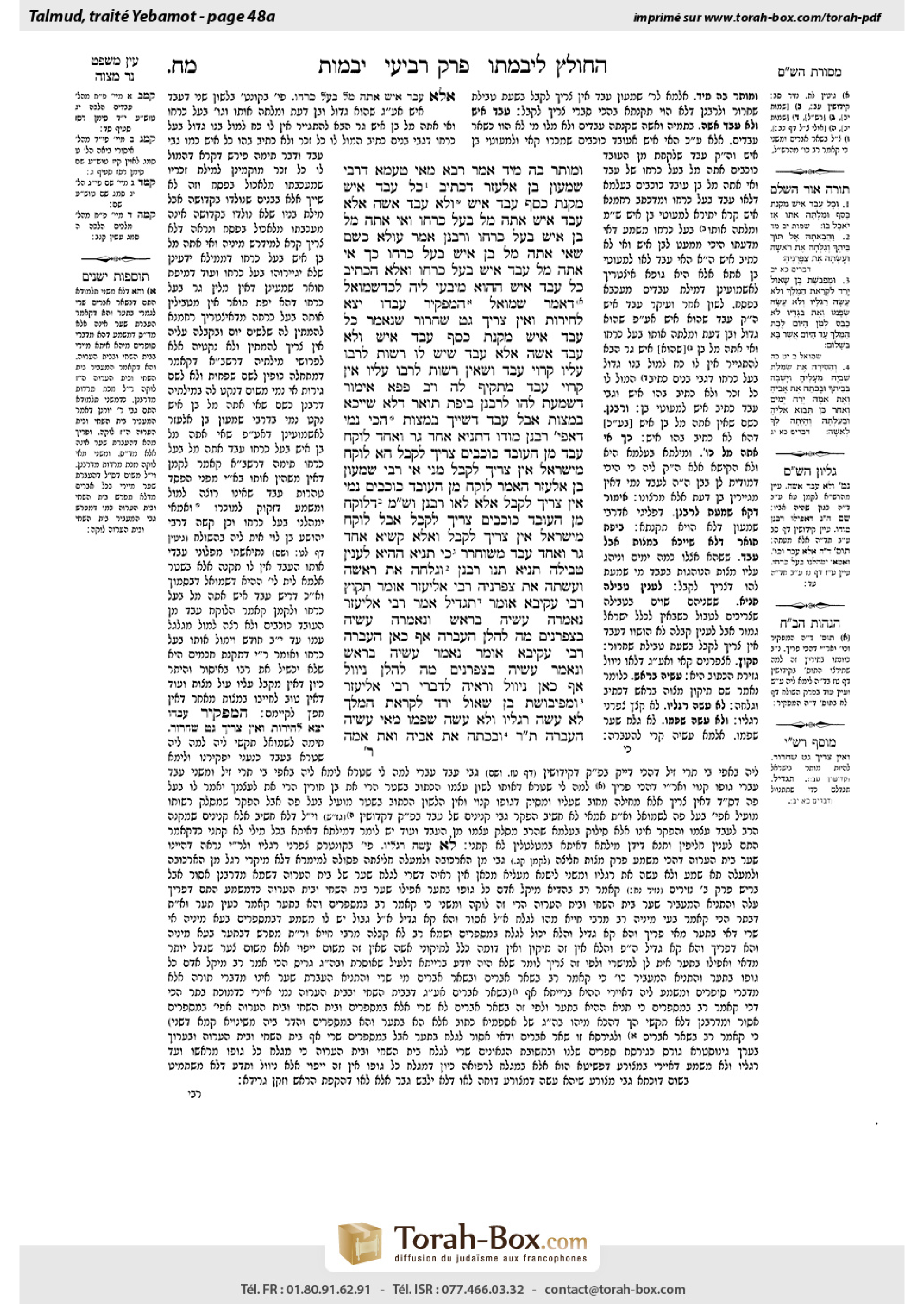
Yevamot 48a: Talmud study for Daf Yomi
Daf Yomi is the daily study of one Talmud folio. Explore 37 tractates with scans, Hebrew text, Sefaria English and AI-generated French translations where annotated.
Passage selection and English or AI-generated French translation are available where the scan has annotations. Daf Study is independent of Torah-Box and Sefaria.
Browse Yevamot · יבמות · All tractatesYevamot 48a text and translations
This page of Yevamot includes the Aramaic text, an English translation and an AI-generated French translation, alongside the scan above.
יבמות מ״ח א · Aramaic and Hebrew text
וּמוּתָּר בָּהּ מִיָּד.
אָמַר רָבָא: מַאי טַעְמָא דְּרַבִּי שִׁמְעוֹן בֶּן אֶלְעָזָר — דִּכְתִיב: ״כׇּל עֶבֶד אִישׁ מִקְנַת כָּסֶף״. ״עֶבֶד אִישׁ״, וְלֹא עֶבֶד אִשָּׁה? אֶלָּא ״עֶבֶד אִישׁ״ — אַתָּה מָל בְּעַל כׇּרְחוֹ, וְאִי אַתָּה מָל בֶּן אִישׁ בְּעַל כׇּרְחוֹ.
וְרַבָּנַן? אָמַר עוּלָּא: כְּשֵׁם שֶׁאִי אַתָּה מָל בֶּן אִישׁ בְּעַל כׇּרְחוֹ, כָּךְ אִי אַתָּה מָל עֶבֶד אִישׁ בְּעַל כׇּרְחוֹ. וְאֶלָּא הָכְתִיב ״כׇּל עֶבֶד אִישׁ״? הַהוּא מִיבְּעֵי לֵיהּ לִכְדִשְׁמוּאֵל.
דְּאָמַר שְׁמוּאֵל: הַמַּפְקִיר עַבְדּוֹ יָצָא לְחֵירוּת וְאֵין צָרִיךְ גֵּט שִׁחְרוּר, שֶׁנֶּאֱמַר: ״כׇּל עֶבֶד אִישׁ מִקְנַת כָּסֶף״. ״עֶבֶד אִישׁ״, וְלֹא עֶבֶד אִשָּׁה? אֶלָּא: עֶבֶד שֶׁיֵּשׁ לוֹ רְשׁוּת לְרַבּוֹ עָלָיו — קָרוּי עֶבֶד, וְשֶׁאֵין רְשׁוּת לְרַבּוֹ עָלָיו — אֵין קָרוּי עֶבֶד.
מַתְקֵיף לַהּ רַב פָּפָּא: אֵימוֹר דְּשָׁמְעַתְּ לְהוּ לְרַבָּנַן בִּיפַת תּוֹאַר, דְּלָא שָׁיְיכָא בְּמִצְוֹת. אֲבָל עֶבֶד, דְּשָׁיֵיךְ בְּמִצְוֹת, הָכִי נָמֵי דַּאֲפִילּוּ רַבָּנַן מוֹדוּ.
דְּתַנְיָא: אֶחָד גֵּר וְאֶחָד לוֹקֵחַ עֶבֶד מִן הַגּוֹי — צָרִיךְ לְקַבֵּל. הָא לוֹקֵחַ מִיִּשְׂרָאֵל — אֵין צָרִיךְ לְקַבֵּל.
מַנִּי? אִי רַבִּי שִׁמְעוֹן בֶּן אֶלְעָזָר, הָאָמַר: לוֹקֵחַ מִן הַגּוֹי נָמֵי אֵין צָרִיךְ לְקַבֵּל! אֶלָּא לָאו רַבָּנַן, וּשְׁמַע מִינַּהּ: דְּלוֹקֵחַ מִן הַגּוֹי — צָרִיךְ לְקַבֵּל, אֲבָל לוֹקֵחַ מִיִּשְׂרָאֵל — אֵין צָרִיךְ לְקַבֵּל.
וְאֶלָּא קַשְׁיָא אֶחָד גֵּר וְאֶחָד עֶבֶד מְשׁוּחְרָר! כִּי תַּנְיָא הָהִיא — לְעִנְיַן טְבִילָה תַּנְיָא.
תָּנוּ רַבָּנַן: ״וְגִלְּחָה אֶת רֹאשָׁהּ וְעָשְׂתָה אֶת צִפׇּרְנֶיהָ״, רַבִּי אֱלִיעֶזֶר אוֹמֵר: תָּקוֹץ, רַבִּי עֲקִיבָא אוֹמֵר: תְּגַדֵּיל.
אָמַר רַבִּי אֱלִיעֶזֶר: נֶאֶמְרָה עֲשִׂיָּה בָּרֹאשׁ, וְנֶאֶמְרָה עֲשִׂיָּה בַּצִּפׇּרְנַיִם. מָה לְהַלָּן הַעֲבָרָה — אַף כָּאן הַעֲבָרָה. רַבִּי עֲקִיבָא אוֹמֵר: נֶאֶמְרָ[ה] עֲשִׂיָּה בָּרֹאשׁ, וְנֶאֶמְרָ[ה] עֲשִׂיָּה בַּצִּפׇּרְנַיִם. מָה לְהַלָּן נִיוּוּל — אַף כָּאן נִיוּוּל.
וּרְאָיָה לְדִבְרֵי רַבִּי אֱלִיעֶזֶר: ״וּמְפִבֹשֶׁת בֶּן שָׁאוּל יָרַד לִקְרַאת הַמֶּלֶךְ לֹא עָשָׂה רַגְלָיו וְלֹא עָשָׂה שְׂפָמוֹ״, מַאי עֲשִׂיָּה — הַעֲבָרָה.
תָּנוּ רַבָּנַן: ״וּבָכְתָה אֶת אָבִיהָ וְאֶת אִמָּהּ״,
Yevamot 48a · English translation
And he is permitted to marry her immediately afterward, without the need for her to undergo the process described in the Torah. The fact that the Rabbis do not suggest this course of action is evidently because they hold that even if she were to be rendered a slave and then immersed for the sake of emancipation, she would become Jewish only if she also accepted upon herself the yoke of mitzvot. Rav Sheshet assumes that the Rabbis would similarly rule that a regular slave who was immersed for the sake of emancipation becomes Jewish only if he also accepts upon himself the yoke of mitzvot.
Rava said: What is the rationale for Rabbi Shimon ben Elazar’s opinion? As it is written with regard to the Paschal lamb: “Every slave of a man that is bought for money, when you have circumcised him, then he may eat of it” (Exodus 12:44). Could the use of the phrase “slave of a man,” rather than just: Slave, possibly indicate that the verse applies only to a man’s slave but not a woman’s slave? Certainly not; rather, the phrase “slave of a man” means that the slave himself is a man, i.e., an adult, and teaches that a slave who is a man you may circumcise against his will, and there is no need for him to accept upon himself the yoke of mitzvot, but you may not circumcise a gentile’s son who is a man, i.e., an adult who is not a slave, against his will.
The Gemara asks: And how would the Rabbis counter this argument? Ulla said that the Rabbis reason that just as you may not circumcise a son who is a man against his will, so too, you may not circumcise a slave who is a man against his will. The Gemara asks: But isn’t it written: “Every slave of a man”? The Gemara explains: The Rabbis require that verse for that which Shmuel said.
As Shmuel said: With regard to one who renounces ownership of his slave, the slave is emancipated, and he does not even require a bill of emancipation, as it is stated: “But every slave of a man that is bought for money.” Could the use of the phrase “slave of a man,” rather than just: Slave, possibly indicate that the verse applies only to a man’s slave but not a woman’s slave? Certainly not; rather, the use of the phrase indicates that only a slave whose master has possession of him, and can rightfully be described as: a slave of a man, is called a slave, but a slave whose master does not have possession of him is not called a slave, and therefore he is considered a freeman and does not require a bill of emancipation.
Rav Pappa strongly objects to Rav Sheshet’s claim that the Rabbis of the baraita would hold that a regular slave who was immersed for the sake of emancipation becomes Jewish only if he also accepts upon himself the yoke of mitzvot: Say that you heard that the Rabbis insist on the acceptance of the yoke of mitzvot with regard to the case of a beautiful female prisoner of war, who was not involved in any mitzvot before being emancipated; however, with regard to a slave, who was initially involved in mitzvot before his emancipation, since as a slave he was obligated to observe certain mitzvot, perhaps even the Rabbis would agree that there is no need for the slave to accept upon himself the yoke of mitzvot.
As it is taught in a baraita: Both in the case of a convert and in the case of one who purchases a slave from a gentile whom he is now emancipating, the convert and the slave need to accept upon themselves the yoke of mitzvot in order to become Jewish. The Gemara infers: The baraita states the need to accept the yoke of mitzvot only in the case where one purchases a slave from a gentile, but if one purchases a slave from a Jew, then the slave does not need to accept upon himself the yoke of mitzvot, since he was involved in mitzvot before his emancipation.
In accordance with whose opinion is this taught? If one suggests that it is in accordance with the opinion of Rabbi Shimon ben Elazar, that is incorrect because didn’t he say that also in the case of one who purchases a slave from a gentile, the slave does not need to accept upon himself the yoke of mitzvot? Rather, must it not be in accordance with the opinion of the Rabbis? And so, conclude from this baraita that in the case of one who purchases a slave from a gentile, the slave needs to accept upon himself the yoke of mitzvot, but in the case of one who purchases a slave from a Jew, the slave does not need to accept upon himself the yoke of mitzvot.
The Gemara asks: But if so, it is difficult to understand the meaning of the baraita cited above: This applies both for a convert and for an emancipated slave. That phrase appears to refer to the need for both a convert and an emancipated slave to accept the yoke of mitzvot, which is mentioned in the baraita beforehand. The Gemara explains: When that clause is taught, it is taught only with regard to the matter of immersion, which is mentioned immediately beforehand, but not with regard to the need to accept the yoke of mitzvot that is mentioned prior to that.
§ Having cited it above, the Gemara focuses on the case of the beautiful female prisoner of war: The Sages taught: The verse states: “And she shall shave her head and do her nails” (Deuteronomy 21:12). The phrase “do her nails” is ambiguous. Rabbi Eliezer says: It means she cuts her nails. Rabbi Akiva says: It means she grows them.
Each tanna explains the basis of his opinion: Rabbi Eliezer said: An act of doing is stated with regard to the head, that she should shave it, and an act of doing is stated with regard to the nails; just as there, with regard to the hair on her head, the Torah requires its removal, so too, here, with regard to her nails, the Torah requires their removal. Rabbi Akiva says: An act of doing is stated with regard to the head, that she should shave it, and an act of doing is stated with regard to the nails; just as there, with regard to the hair on her head, the Torah requires that she do something that makes her repulsive, so too, here, with regard to her nails, the Torah requires she do something that makes her repulsive, i.e., allowing them to grow.
And a proof for the statement of Rabbi Eliezer may be adduced from the verse that states: “And Mephibosheth, the son of Saul, came down to meet the king; and he had neither done his feet nor done his mustache” (II Samuel 19:25). What is the meaning of doing in that context? Clearly it means the removal of his toenails and his mustache.
The Sages taught in a baraita: The verse states: “And she shall bewail her father and her mother a month of days and after that you may come to her” (Deuteronomy 21:13).
Yevamot 48a · Traduction française (IA)
Et il lui est permis de l’épouser immédiatement après, sans qu’elle ait besoin de suivre la procédure décrite dans la Torah. Si les rabbins ne proposent pas cette marche à suivre, c’est manifestement parce qu’ils estiment que même si elle était réduite en esclavage puis immergée en vue de son affranchissement, elle ne deviendrait juive que si elle acceptait également sur elle le joug des mitsvot. Rav Sheshet suppose que les rabbins statueraient de même au sujet d’un esclave ordinaire immergé en vue de son affranchissement : il ne deviendrait juif que s’il acceptait également sur lui le joug des mitsvot.
Rava dit : Quel est le fondement de l’opinion de Rabbi Shimon ben Elazar ? Car il est écrit au sujet de l’agneau pascal : « Tout esclave d’un homme acheté à prix d’argent, lorsque tu l’auras circoncis, alors il pourra en manger » (Exode 12,44). L’expression « esclave d’un homme », plutôt que simplement « esclave », pourrait-elle signifier que le verset ne s’applique qu’à l’esclave d’un homme, et non à celui d’une femme ? Certainement pas. L’expression « esclave d’un homme » signifie plutôt que l’esclave lui-même est un homme, c’est-à-dire un adulte, et enseigne qu’on peut circoncire contre son gré un esclave adulte, sans qu’il ait à accepter sur lui le joug des mitsvot ; mais on ne peut pas circoncire contre son gré le fils adulte d’un non-Juif, qui n’est pas esclave.
La Guemara demande : Et comment les rabbins répondraient-ils à cet argument ? Ulla dit que, selon les rabbins, de même qu’on ne peut pas circoncire contre son gré un fils adulte, on ne peut pas non plus circoncire contre son gré un esclave adulte. La Guemara demande : Mais n’est-il pas écrit : « Tout esclave d’un homme » ? La Guemara explique : Les rabbins ont besoin de ce verset pour l’enseignement de Shmuel.
Car Shmuel a dit : Celui qui renonce à ses droits sur son esclave l’affranchit, et l’esclave n’a même pas besoin d’un acte d’affranchissement, comme il est écrit : « Tout esclave d’un homme acheté à prix d’argent ». L’expression « esclave d’un homme », plutôt que simplement « esclave », pourrait-elle signifier que le verset ne s’applique qu’à l’esclave d’un homme, et non à celui d’une femme ? Certainement pas. Cette expression indique plutôt que seul est appelé esclave celui dont le maître a la possession et qui peut donc être qualifié d’« esclave d’un homme » ; celui dont le maître n’a pas la possession n’est pas appelé esclave. Il est donc considéré comme un homme libre et n’a pas besoin d’un acte d’affranchissement.
Rav Pappa s’oppose vivement à l’affirmation de Rav Sheshet selon laquelle les rabbins de la baraïta estimeraient qu’un esclave ordinaire immergé en vue de son affranchissement ne devient juif que s’il accepte également sur lui le joug des mitsvot : Tu as entendu que les rabbins exigent l’acceptation du joug des mitsvot dans le cas d’une belle captive, qui n’était astreinte à aucune mitsva avant d’être affranchie ; mais, s’agissant d’un esclave qui, avant son affranchissement, était déjà astreint à certaines mitsvot, puisqu’en tant qu’esclave il avait l’obligation d’en observer certaines, peut-être même les rabbins conviendraient-ils qu’il n’a pas besoin d’accepter sur lui le joug des mitsvot.
Comme il est enseigné dans une baraïta : tant le converti que celui qui achète un esclave à un non-Juif et l’affranchit doivent accepter sur eux le joug des mitsvot pour devenir juifs. La Guemara en déduit que la baraïta n’exige l’acceptation du joug des mitsvot que dans le cas où l’on achète un esclave à un non-Juif ; mais si l’on achète un esclave à un Juif, celui-ci n’a pas besoin d’accepter sur lui le joug des mitsvot, puisqu’il était déjà astreint à des mitsvot avant son affranchissement.
Selon quelle opinion cet enseignement est-il formulé ? Si l’on suggère qu’il suit l’opinion de Rabbi Shimon ben Elazar, cela ne convient pas, car n’a-t-il pas dit que même celui qui achète un esclave à un non-Juif n’a pas besoin d’accepter sur lui le joug des mitsvot ? Ne faut-il donc pas conclure qu’il suit l’opinion des rabbins ? Il faut donc déduire de cette baraïta que, lorsqu’on achète un esclave à un non-Juif, celui-ci doit accepter sur lui le joug des mitsvot, tandis que lorsqu’on achète un esclave à un Juif, il n’a pas besoin de l’accepter.
La Guemara demande : Mais si tel est le cas, comment comprendre la baraïta citée plus haut : « Cela s’applique tant au converti qu’à l’esclave affranchi » ? Cette formule semble renvoyer à l’obligation, mentionnée auparavant dans la baraïta, pour le converti comme pour l’esclave affranchi d’accepter le joug des mitsvot. La Guemara explique : Cette clause, lorsqu’elle est enseignée, ne concerne que l’immersion, mentionnée juste avant, et non l’obligation d’accepter le joug des mitsvot, mentionnée précédemment.
§ Après l’avoir citée plus haut, la Guemara examine le cas de la belle captive : Les Sages ont enseigné : Le verset dit : « Elle se rasera la tête et se fera les ongles » (Deutéronome 21,12). L’expression « se fera les ongles » est ambiguë. Rabbi Eliezer dit : cela signifie qu’elle se coupe les ongles. Rabbi Akiva dit : cela signifie qu’elle les laisse pousser.
Chaque tanna expose le fondement de son opinion : Rabbi Eliezer dit : une action est prescrite au sujet de la tête, puisqu’elle doit la raser, et une action est prescrite au sujet des ongles ; de même que, pour les cheveux de sa tête, la Torah exige qu’elle les enlève, de même, pour ses ongles, la Torah exige qu’elle les enlève. Rabbi Akiva dit : une action est prescrite au sujet de la tête, puisqu’elle doit la raser, et une action est prescrite au sujet des ongles ; de même que, pour les cheveux de sa tête, la Torah exige qu’elle fasse quelque chose qui la rende repoussante, de même, pour ses ongles, la Torah exige qu’elle fasse quelque chose qui la rende repoussante, c’est-à-dire qu’elle les laisse pousser.
On peut apporter à l’appui de la déclaration de Rabbi Eliezer le verset qui dit : « Mephibosheth, fils de Saül, descendit à la rencontre du roi ; il n’avait ni fait ses pieds ni fait sa moustache » (II Samuel 19,25). Que signifie ici « faire » ? Cela signifie clairement qu’il n’avait ni coupé les ongles de ses pieds ni taillé sa moustache.
Les Sages ont enseigné dans une baraïta : Le verset dit : « Elle pleurera son père et sa mère pendant un mois entier, et après cela tu pourras aller vers elle » (Deutéronome 21,13).
Traduction française générée par IA à partir de l’édition anglaise de Sefaria. Vérifie toujours un passage avec le texte source.
Text from Sefaria: William Davidson Edition - Vocalized Aramaic (CC BY NC); William Davidson Edition - English (CC BY NC).