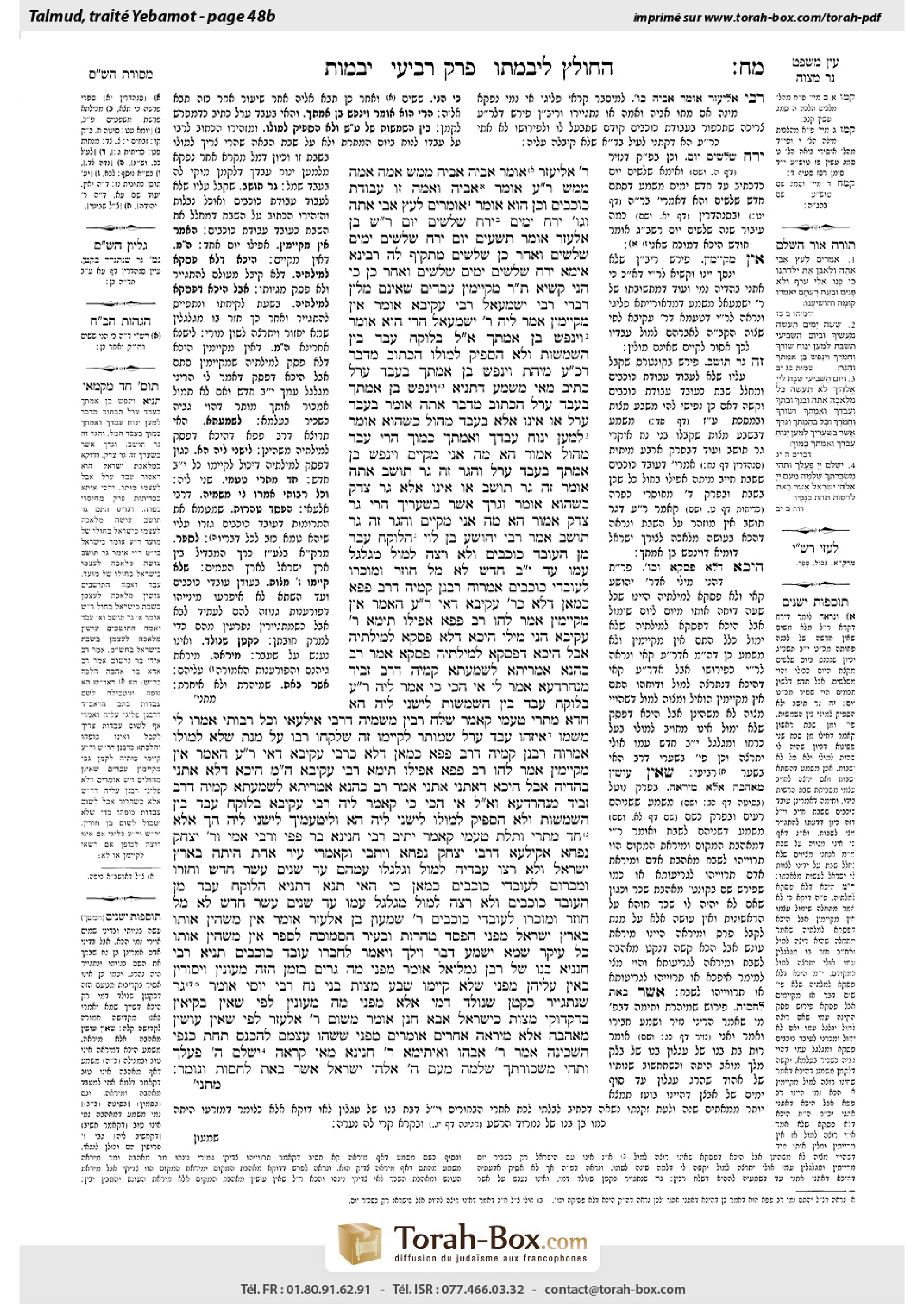
Yevamot 48b: Talmud study for Daf Yomi
Daf Yomi is the daily study of one Talmud folio. Explore 37 tractates with scans, Hebrew text, Sefaria English and AI-generated French translations where annotated.
Passage selection and English or AI-generated French translation are available where the scan has annotations. Daf Study is independent of Torah-Box and Sefaria.
Browse Yevamot · יבמות · All tractatesYevamot 48b text and translations
This page of Yevamot includes the Aramaic text, an English translation and an AI-generated French translation, alongside the scan above.
יבמות מ״ח ב · Aramaic and Hebrew text
רַבִּי אֱלִיעֶזֶר אוֹמֵר: ״אָבִיהָ״ — אָבִיהָ מַמָּשׁ, ״אִמָּהּ״ — אִמָּהּ מַמָּשׁ. רַבִּי עֲקִיבָא אוֹמֵר: ״אָבִיהָ וְאִמָּהּ״ — זוֹ עֲבוֹדָה זָרָה. וְכֵן הוּא אוֹמֵר: ״אוֹמְרִים לָעֵץ אָבִי אַתָּה וְגוֹ׳״.
״יֶרַח יָמִים״ — יֶרַח שְׁלֹשִׁים יוֹם. רַבִּי שִׁמְעוֹן בֶּן אֶלְעָזָר אוֹמֵר, תִּשְׁעִים יוֹם: ״יֶרַח״ — שְׁלֹשִׁים, ״יָמִים״ — שְׁלֹשִׁים, ״וְאַחַר כֵּן״ — שְׁלֹשִׁים.
מַתְקֵיף לַהּ רָבִינָא: אֵימָא: ״יֶרַח״ — שְׁלֹשִׁים, ״יָמִים״ — שְׁלֹשִׁים, ״וְאַחַר כֵּן״ — כִּי הָנֵי? קַשְׁיָא.
תָּנוּ רַבָּנַן: מְקַיְּימִין עֲבָדִים שֶׁאֵינָם מָלִין, דִּבְרֵי רַבִּי יִשְׁמָעֵאל. רַבִּי עֲקִיבָא אוֹמֵר: אֵין מְקַיְּימִין. אָמַר לוֹ רַבִּי יִשְׁמָעֵאל, הֲרֵי הוּא אוֹמֵר: ״וְיִנָּפֵשׁ בֶּן אֲמָתְךָ״! אָמַר לוֹ: בְּלוֹקֵחַ עֶבֶד בֵּין הַשְּׁמָשׁוֹת וְלֹא הִסְפִּיק לְמוּלוֹ הַכָּתוּב מְדַבֵּר.
דְּכוּלֵּי עָלְמָא מִיהַת ״וְיִנָּפֵשׁ בֶּן אֲמָתְךָ״ — בְּעֶבֶד עָרֵל כְּתִיב, מַאי מַשְׁמַע? דְּתַנְיָא: ״וְיִנָּפֵשׁ בֶּן אֲמָתְךָ״ — בְּעֶבֶד עָרֵל הַכָּתוּב מְדַבֵּר. אַתָּה אוֹמֵר בְּעֶבֶד עָרֵל, אוֹ אֵינוֹ אֶלָּא בְּעֶבֶד מָהוּל? כְּשֶׁהוּא אוֹמֵר ״לְמַעַן יָנוּחַ עַבְדְּךָ וַאֲמָתְךָ כָּמוֹךָ״, הֲרֵי עֶבֶד מָהוּל אָמוּר. הָא מָה אֲנִי מְקַיֵּים ״וְיִנָּפֵשׁ בֶּן אֲמָתְךָ״ — בְּעֶבֶד עָרֵל.
״וְהַגֵּר״ — זֶה גֵּר תּוֹשָׁב. אַתָּה אוֹמֵר זֶה גֵּר תּוֹשָׁב, אוֹ אֵינוֹ אֶלָּא גֵּר צֶדֶק? כְּשֶׁהוּא אוֹמֵר ״וְגֵרְךָ אֲשֶׁר בִּשְׁעָרֶיךָ״, הֲרֵי גֵּר צֶדֶק אָמוּר. הָא מָה אֲנִי מְקַיֵּים ״וְהַגֵּר״ — זֶה גֵּר תּוֹשָׁב.
אָמַר רַבִּי יְהוֹשֻׁעַ בֶּן לֵוִי: הַלּוֹקֵחַ עֶבֶד מִן הַגּוֹי וְלֹא רָצָה לָמוּל — מְגַלְגֵּל עִמּוֹ עַד שְׁנֵים עָשָׂר חֹדֶשׁ. לֹא מָל — חוֹזֵר וּמוֹכְרוֹ לְגוֹיִם.
אַמְרוּהָ רַבָּנַן קַמֵּיהּ דְּרַב פָּפָּא, כְּמַאן — דְּלָא כְּרַבִּי עֲקִיבָא. דְּאִי רַבִּי עֲקִיבָא, הָאָמַר: אֵין מְקַיְּימִין! אֲמַר לְהוּ רַב פָּפָּא: אֲפִילּוּ תֵּימָא רַבִּי עֲקִיבָא, הָנֵי מִילֵּי הֵיכָא דְּלָא פַּסְקַהּ לְמִילְּתֵיהּ, אֲבָל הֵיכָא דְּפַסְקַהּ לְמִילְּתֵיהּ — פַּסְקַהּ.
אָמַר רַב כָּהֲנָא: אַמְרִיתָא לִשְׁמַעְתָּא קַמֵּיהּ דְּרַב זְבִיד מִנְּהַרְדְּעָא, אָמַר לִי: אִי הָכִי, כִּי אֲמַר לֵיהּ רַבִּי עֲקִיבָא בְּלוֹקֵחַ עֶבֶד בֵּין הַשְּׁמָשׁוֹת, לִישַׁנֵּי לֵיהּ הָא! חֲדָא מִתְּרֵי טַעְמֵי קָאָמַר.
שְׁלַח רָבִין מִשְּׁמֵיהּ דְּרַבִּי אִילְעַאי, וְכׇל רַבּוֹתַי אָמְרוּ לִי מִשְּׁמוֹ: אֵיזֶהוּ עֶבֶד עָרֵל שֶׁמּוּתָּר לְקַיְּימוֹ — זֶה שֶׁלְּקָחוֹ רַבּוֹ עַל מְנָת שֶׁלֹּא לְמוּלוֹ. אַמְרוּהָ רַבָּנַן קַמֵּיהּ דְּרַב פָּפָּא: כְּמַאן? דְּלָא כְּרַבִּי עֲקִיבָא, דְּאִי רַבִּי עֲקִיבָא, הָאָמַר: אֵין מְקַיְּימִין! אֲמַר לְהוּ רַב פָּפָּא: אֲפִילּוּ תֵּימָא רַבִּי עֲקִיבָא, הָנֵי מִילֵּי הֵיכָא דְּלָא אַתְנִי בַּהֲדֵיהּ, אֲבָל הֵיכָא דְּאַתְנִי — אַתְנִי.
אָמַר רַב כָּהֲנָא: אַמְרִיתָא לִשְׁמַעְתָּא קַמֵּיהּ דְּרַב זְבִיד מִנְּהַרְדְּעָא, וַאֲמַר לִי: אִי הָכִי, כִּי קָאָמַר לֵיהּ רַבִּי עֲקִיבָא בְּלוֹקֵחַ עֶבֶד בֵּין הַשְּׁמָשׁוֹת וְלֹא הִסְפִּיק לְמוּלוֹ — לִישַׁנֵּי לֵיהּ הָא!
וְלִיטַעְמָיךְ, לִישַׁנֵּי לֵיהּ הָךְ! אֶלָּא, חַד מִתְּרֵי וּתְלָת טַעְמֵי קָאָמַר.
יְתֵיב רַבִּי חֲנִינָא בַּר פַּפִּי וְרַבִּי אַמֵּי וְרַבִּי יִצְחָק נַפָּחָא אַקִּילְעָא דְּרַבִּי יִצְחָק נַפָּחָא, וְיָתְבִי וְקָאָמְרִי: עִיר אַחַת הָיְתָה בְּאֶרֶץ יִשְׂרָאֵל וְלֹא רָצוּ עֲבָדֶיהָ לָמוּל, וְגִלְגְּלוּ עִמָּהֶם עַד שְׁנֵים עָשָׂר חֹדֶשׁ, וְחָזְרוּ וּמְכָרוּם לְגוֹיִם. כְּמַאן —
כִּי הַאי תַּנָּא, דְּתַנְיָא: הַלּוֹקֵחַ עֶבֶד מִן הַגּוֹי וְלֹא רָצָה לָמוּל — מְגַלְגֵּל עִמּוֹ עַד שְׁנֵים עָשָׂר חֹדֶשׁ, לֹא מָל — חוֹזֵר וּמוֹכְרוֹ לְגוֹיִם. רַבִּי שִׁמְעוֹן בֶּן אֶלְעָזָר אוֹמֵר: אֵין מְשַׁהִין אוֹתוֹ בְּאֶרֶץ יִשְׂרָאֵל, מִפְּנֵי הֶפְסֵד טְהָרוֹת. וּבָעִיר הַסְּמוּכָה לַסְּפָר אֵין מְשַׁהִין אוֹתוֹ כׇּל עִיקָּר, שֶׁמָּא יִשְׁמַע דָּבָר וְיֵלֵךְ וְיֹאמַר לַחֲבֵרוֹ גּוֹי.
תַּנְיָא, רַבִּי חֲנַנְיָא בְּנוֹ שֶׁל רַבָּן גַּמְלִיאֵל אוֹמֵר: מִפְּנֵי מָה גֵּרִים בִּזְמַן הַזֶּה מְעוּנִּין, וְיִסּוּרִין בָּאִין עֲלֵיהֶן — מִפְּנֵי שֶׁלֹּא קִיְּימוּ שֶׁבַע מִצְוֹת בְּנֵי נֹחַ. רַבִּי יוֹסֵי אוֹמֵר: גֵּר שֶׁנִּתְגַּיֵּיר — כְּקָטָן שֶׁנּוֹלַד דָּמֵי. אֶלָּא מִפְּנֵי מָה מְעוּנִּין — לְפִי שֶׁאֵין בְּקִיאִין בְּדִקְדּוּקֵי מִצְוֹת כְּיִשְׂרָאֵל. אַבָּא חָנָן אוֹמֵר מִשּׁוּם רַבִּי אֶלְעָזָר: לְפִי שֶׁאֵין עוֹשִׂין מֵאַהֲבָה, אֶלָּא מִיִּרְאָה.
אֲחֵרִים אוֹמְרִים: מִפְּנֵי שֶׁשִּׁהוּ עַצְמָם לְהִכָּנֵס תַּחַת כַּנְפֵי הַשְּׁכִינָה. אָמַר רַבִּי אֲבָהוּ, וְאִיתֵּימָא רַבִּי חֲנִינָא, מַאי קְרָאָה: ״יְשַׁלֵּם ה׳ פׇּעֳלֵךְ וּתְהִי מַשְׂכֻּרְתֵּךְ שְׁלֵמָה מֵעִם ה׳ אֱלֹהֵי יִשְׂרָאֵל אֲשֶׁר בָּאת לַחֲסוֹת וְגוֹמֵר״.
Yevamot 48b · English translation
Rabbi Eliezer says: “Her father” means her actual father and “her mother” means her actual mother. Rabbi Akiva says: Her father and her mother; this is referring to the idolatrous deity that she had worshiped but will no longer be able to worship, and so it says: “They say to a tree: You are my father, and to a stone: You have given birth to us” (Jeremiah 2:27).
The verses states: “A month of days and after that you may come to her” (Deuteronomy 21:13). This means a thirty-day month. Rabbi Shimon ben Elazar says: She must wait ninety days. This is derived as follows: The phrase “a month” connotes thirty days; the word “days” adds another thirty days; and the words “after that” indicate another period equal to one previously mentioned, i.e., a further thirty days.
Ravina strongly objects to this: If the words “after that” indicate another period equal to one previously mentioned, then one should say: The phrase “a month” connotes thirty days; the word “days” adds another thirty days; and then the words “after that” add another period which is equal to the total sum of all those days she has already waited, i.e., an additional sixty days. The Gemara concedes: Indeed, this is difficult.
§ The Sages taught in a baraita: One may maintain slaves that are not circumcised under one’s control; this is the statement of Rabbi Yishmael. Rabbi Akiva says: One may not maintain such slaves, even for a moment. Rabbi Yishmael said to him: But it says with regard to Shabbat: “And the son of your maidservant will be refreshed” (Exodus 23:12). The verse prohibits a Jewish master from allowing his slave to perform labor on Shabbat. The Gemara will explain that this is referring to an uncircumcised slave. It is therefore apparent that it is permitted to keep such a slave. Rabbi Akiva said to him: The verse speaks of one who purchases a slave at twilight on the eve of Shabbat and therefore does not have the opportunity to circumcise him before the onset of Shabbat.
The Gemara notes: In any event, in the opinion of everyone the verse: “And the son of your maidservant will be refreshed,” is written with regard to an uncircumcised slave. From where is this inferred? As it is taught in a baraita: “And the son of your maidservant will be refreshed”; the verse speaks of an uncircumcised slave. Do you say it speaks of an uncircumcised slave, or perhaps it is speaking only of a circumcised slave? When it says elsewhere: “And the seventh day is a Shabbat to the Lord your God, you shall not do any labor, you, and your son, and your daughter, and your slave, and your maidservant…so that your slave and your maidservant may rest like you” (Deuteronomy 5:13), a circumcised slave is already mentioned; how, then, do I uphold the verse “And the son of your maidservant will be refreshed”? It must refer to an uncircumcised slave.
The verse continues: “And the stranger [ger]” (Exodus 23:12). This is referring to a gentile who observes certain mitzvot [ger toshav]. Do you say that this is a ger toshav, or perhaps it is only a righteous convert [ger tzedek], who is a Jew in every sense? When it says elsewhere: “And your stranger [ger] that is within your gates” (Deuteronomy 5:13), a righteous convert is already mentioned. How, then, do I uphold the verse “And the stranger [ger]”? It must be that this is a ger toshav.
Rabbi Yehoshua ben Levi said: In the case of one who purchases a slave from a gentile and the slave does not wish to be circumcised, he abides with him up to twelve months. If, after this period, he will still not be circumcised, he then sells him on to gentiles.
The Sages said this halakha before Rav Pappa and asked: In accordance with whose opinion is it? It seems that it is not in accordance with the opinion of Rabbi Akiva, as, if it were in accordance with the opinion of Rabbi Akiva, didn’t he say: One may not maintain an uncircumcised slave even for a moment? Rav Pappa said to them: You can even say that it is in accordance with the opinion of Rabbi Akiva, since perhaps that halakha of Rabbi Yehoshua ben Levi applies only where the slave did not make his refusal to be circumcised explicit; however, where he did make his refusal to be circumcised explicit, since he has made it explicit, it is prohibited to maintain him, as Rabbi Akiva rules.
Rav Kahana said: I said this halakha before Rav Zevid from Neharde’a. He said to me: If so, that Rabbi Akiva agrees that one may temporarily maintain a slave who has not explicitly refused to be circumcised, then when Rabbi Akiva said to Rabbi Yishmael that the verse with regard to an uncircumcised slave is referring to one who purchases a slave at twilight on the eve of Shabbat, let him instead answer him that the verse is referring to this case of a slave who has not explicitly refused to be circumcised. The Gemara explains: Rabbi Akiva said only one out of two possible reasons why it would be permitted to be in possession of such a slave.
Ravin sent a message citing a halakha in the name of Rabbi Ilai: And all of my teachers said to me in his name: What is the case of an uncircumcised slave whom it is permitted to maintain? This is one whose master purchased him on condition not to circumcise him. The Sages said this halakha before Rav Pappa and asked: In accordance with whose opinion is it? It seems that it is not in accordance with the opinion of Rabbi Akiva, as, if it were in accordance with the opinion of Rabbi Akiva, didn’t he say: One may not maintain an uncircumcised slave even for a moment? Rav Pappa said to them: You can even say it is in accordance with the opinion of Rabbi Akiva, since perhaps that ruling of Rabbi Akiva applies only where the master did not make a condition with regard to the slave that he would not be circumcised; however, where he did make such a condition, since he made a condition, even Rabbi Akiva would concede it is permitted to maintain him.
Rav Kahana said: I said this halakha before Rav Zevid from Neharde’a and he said to me: If so, that Rabbi Akiva agrees that one may maintain a slave who was purchased on condition that he would not be circumcised, then when Rabbi Akiva said to Rabbi Yishmael that the verse with regard to an uncircumcised slave is referring to one who purchases a slave at twilight on the eve of Shabbat and therefore does not have the opportunity to circumcise him before the onset of Shabbat, let him instead answer him that the verse is referring to this case of a slave who was purchased on condition that he would not be circumcised.
The Gemara responds: But even according to your reasoning that Rabbi Akiva disagrees, since you do agree with Rav Pappa’s resolution of Rabbi Akiva’s opinion with the halakha of Rabbi Yehoshua ben Levi, let Rabbi Akiva answer him that the verse is referring to that case of a slave who has not explicitly refused to be circumcised. The Gemara answers: Rabbi Akiva said only one out of two or three possible reasons that it would be permitted to be in possession of such a slave.
Rabbi Ḥanina bar Pappi, and Rabbi Ami, and Rabbi Yitzḥak Nappaḥa were sitting in the courtyard of Rabbi Yitzḥak Nappaḥa. They were sitting and saying: There was one city in Eretz Yisrael whose slaves did not wish to be circumcised. Their masters abided with them until twelve months had passed and then sold them to gentiles. In accordance with whose opinion did they act?
It is in accordance with the opinion of this tanna, as it is taught in a baraita: In the case of one who purchases a slave from a gentile and the slave does not wish to be circumcised, the master abides with him for up to twelve months. If, after this period, the slave will still not be circumcised, the master then sells him to gentiles. Rabbi Shimon ben Elazar says: One may not allow him to remain in Eretz Yisrael due to the loss of ritually pure items he could cause. As long as the slave remains uncircumcised, he is considered to be a gentile; therefore, by rabbinic decree, ritually pure items that he touches are considered to be impure. And in a city that is near to the border he may not be allowed to remain at all, lest he hear some secret matter concerning security and go and say it over to his fellow gentile in an enemy country. However, once he has been circumcised and accepted the yoke of mitzvot, this concern no longer exists.
§ It is taught in a baraita: Rabbi Ḥananya, son of Rabban Gamliel, says: For what reason are converts at the present time tormented and hardships come upon them? It is because when they were gentiles they did not observe the seven Noahide mitzvot. Rabbi Yosei says: They would not be punished for their deeds prior to their conversion because a convert who just converted is like a child just born in that he retains no connection to his past life. Rather, for what reason are they tormented? It is because they are not as well-versed in the intricacies of the mitzvot as a born Jew, and consequently they often inadvertently transgress mitzvot. Abba Ḥanan says in the name of Rabbi Elazar: It is because they observe mitzvot not out of love of God, but only out of fear of the punishments for failing to observe them.
Others say: It is because they waited before entering under the wings of the Divine Presence, i.e., they are punished for not converting sooner than they did. Rabbi Abbahu said, and some say it was Rabbi Ḥanina who said: What is the verse from which it is derived that one should convert at the earliest opportunity? Boaz said to Ruth: “The Lord shall recompense your work, and your reward shall be complete from the Lord, the God of Israel, under whose wings you have come to take refuge” (Ruth 2:12).
Yevamot 48b · Traduction française (IA)
Rabbi Eliezer dit : « Son père » désigne son père biologique et « sa mère » désigne sa mère biologique. Rabbi Akiva dit : « Son père et sa mère » désignent la divinité idolâtre qu’elle adorait et qu’elle ne pourra désormais plus adorer. C’est pourquoi il est dit : « Ils disent à un arbre : “Tu es mon père”, et à une pierre : “Tu nous as enfantés” » (Jérémie 2, 27).
Le verset dit : « Un mois de jours, et après cela tu pourras venir à elle » (Deutéronome 21, 13). Cela signifie un mois de trente jours. Rabbi Shimon ben Elazar dit : Elle doit attendre quatre-vingt-dix jours. On le déduit ainsi : l’expression « un mois » désigne trente jours ; le mot « jours » ajoute trente autres jours ; et les mots « après cela » indiquent une période supplémentaire égale à l’une de celles déjà mentionnées, c’est-à-dire trente jours de plus.
Ravina soulève une objection vigoureuse : si les mots « après cela » indiquent une période supplémentaire égale à l’une de celles déjà mentionnées, il faudrait dire que l’expression « un mois » désigne trente jours, que le mot « jours » ajoute trente autres jours, puis que les mots « après cela » ajoutent une période égale au total des jours qu’elle a déjà attendus, c’est-à-dire soixante jours de plus. La Guemara reconnaît : En effet, c’est une difficulté.
§ Les Sages ont enseigné dans une baraïta : On peut garder sous son autorité des esclaves non circoncis ; telle est l’opinion de Rabbi Yishmael. Rabbi Akiva dit : On ne peut pas garder de tels esclaves, même un instant. Rabbi Yishmael lui dit : Pourtant, à propos du Chabbat, il est dit : « Le fils de ta servante se reposera » (Exode 23, 12). Le verset interdit à un maître juif de laisser son esclave travailler le Chabbat. La Guemara expliquera que cela concerne un esclave non circoncis. Il apparaît donc qu’il est permis de garder un tel esclave. Rabbi Akiva lui dit : Le verset parle de quelqu’un qui achète un esclave au crépuscule, à la veille du Chabbat, et n’a donc pas l’occasion de le circoncire avant le début du Chabbat.
La Guemara fait remarquer : Quoi qu’il en soit, de l’avis de tous, le verset « Le fils de ta servante se reposera » concerne un esclave non circoncis. D’où le déduit-on ? Car il est enseigné dans une baraïta : « Le fils de ta servante se reposera » ; le verset parle d’un esclave non circoncis. Dites-vous qu’il parle d’un esclave non circoncis, ou peut-être parle-t-il seulement d’un esclave circoncis ? Puisqu’il est dit ailleurs : « Le septième jour est un Chabbat pour l’Éternel ton Dieu ; tu ne feras aucun travail, ni toi, ni ton fils, ni ta fille, ni ton esclave, ni ta servante… afin que ton esclave et ta servante se reposent comme toi » (Deutéronome 5, 13), un esclave circoncis est déjà mentionné. Comment donc comprendre le verset « Le fils de ta servante se reposera » ? Il doit se référer à un esclave non circoncis.
Le verset poursuit : « Et l’étranger [ger] » (Exode 23, 12). Cela désigne un non-Juif qui observe certaines mitsvot [ger toshav]. Dites-vous qu’il s’agit d’un ger toshav, ou peut-être seulement d’un converti pieux [ger tzedek], qui est juif à tous égards ? Puisqu’il est dit ailleurs : « Et ton étranger [ger] qui se trouve dans tes portes » (Deutéronome 5, 13), un converti pieux est déjà mentionné. Comment donc comprendre le verset « Et l’étranger [ger] » ? Il doit s’agir d’un ger toshav.
Rabbi Yehoshua ben Levi dit : Dans le cas de celui qui achète un esclave à un non-Juif et dont l’esclave refuse d’être circoncis, il le garde jusqu’à douze mois. Si, au terme de cette période, l’esclave refuse toujours d’être circoncis, il le revend à des non-Juifs.
Les Sages exposèrent cette halakha devant Rav Pappa et demandèrent : De l’avis de qui est-elle ? Il semble qu’elle ne soit pas conforme à l’opinion de Rabbi Akiva, car, si elle l’était, n’a-t-il pas dit : On ne peut pas garder un esclave non circoncis, même un instant ? Rav Pappa leur dit : On peut même dire qu’elle est conforme à l’opinion de Rabbi Akiva, car peut-être la halakha de Rabbi Yehoshua ben Levi ne s’applique-t-elle que lorsque l’esclave n’a pas explicitement refusé d’être circoncis. En revanche, lorsqu’il a explicitement exprimé son refus, il est interdit de le garder, conformément à l’opinion de Rabbi Akiva.
Rav Kahana dit : J’ai exposé cette halakha devant Rav Zevid de Nehardea. Il me dit : Si c’est ainsi, si Rabbi Akiva admet qu’on peut garder temporairement un esclave qui n’a pas explicitement refusé d’être circoncis, alors, lorsque Rabbi Akiva a dit à Rabbi Yishmael que le verset relatif à un esclave non circoncis parle de celui qui achète un esclave au crépuscule, à la veille du Chabbat, qu’il lui réponde plutôt que le verset parle de ce cas : celui d’un esclave qui n’a pas explicitement refusé d’être circoncis. La Guemara explique : Rabbi Akiva n’a avancé qu’une seule des deux raisons possibles pour lesquelles il serait permis de garder un tel esclave.
Ravin envoya un message citant une halakha au nom de Rabbi Ilai : Tous mes maîtres me l’ont enseignée en son nom : dans quel cas est-il permis de garder un esclave non circoncis ? Lorsqu’un maître l’a acheté à la condition de ne pas le circoncire. Les Sages exposèrent cette halakha devant Rav Pappa et demandèrent : De l’avis de qui est-elle ? Il semble qu’elle ne soit pas conforme à l’opinion de Rabbi Akiva, car, si elle l’était, n’a-t-il pas dit : On ne peut pas garder un esclave non circoncis, même un instant ? Rav Pappa leur dit : On peut même dire qu’elle est conforme à l’opinion de Rabbi Akiva, car peut-être cette décision de Rabbi Akiva ne s’applique-t-elle que lorsque le maître n’a pas stipulé que l’esclave ne serait pas circoncis. En revanche, lorsqu’il l’a stipulé, puisqu’il en a fait une condition, même Rabbi Akiva admettrait qu’il est permis de le garder.
Rav Kahana dit : J’ai exposé cette halakha devant Rav Zevid de Nehardea, et il me dit : Si c’est ainsi, si Rabbi Akiva admet qu’on peut garder un esclave acheté à la condition qu’il ne soit pas circoncis, alors, lorsque Rabbi Akiva a dit à Rabbi Yishmael que le verset relatif à un esclave non circoncis parle de celui qui achète un esclave au crépuscule, à la veille du Chabbat, et n’a donc pas l’occasion de le circoncire avant le début du Chabbat, qu’il lui réponde plutôt que le verset parle de ce cas : celui d’un esclave acheté à la condition qu’il ne soit pas circoncis.
La Guemara répond : Mais même selon ton raisonnement, si Rabbi Akiva est en désaccord, puisque tu acceptes bien la résolution de Rav Pappa concernant l’opinion de Rabbi Akiva et la halakha de Rabbi Yehoshua ben Levi, que Rabbi Akiva lui réponde que le verset parle du cas de cet esclave qui n’a pas explicitement refusé d’être circoncis. La Guemara répond : Rabbi Akiva n’a avancé qu’une seule des deux ou trois raisons possibles pour lesquelles il serait permis de garder un tel esclave.
Rabbi Ḥanina bar Pappi, Rabbi Ami et Rabbi Yitzḥak Nappaḥa étaient assis dans la cour de Rabbi Yitzḥak Nappaḥa. Ils discutaient et disaient : Il y avait en Eretz Israël une ville dont les esclaves ne voulaient pas être circoncis. Leurs maîtres les gardèrent jusqu’à ce que douze mois se soient écoulés, puis les vendirent à des non-Juifs. De l’avis de qui ont-ils agi ?
C’est conforme à l’opinion de ce tanna, comme il est enseigné dans une baraïta : Dans le cas de celui qui achète un esclave à un non-Juif et dont l’esclave refuse d’être circoncis, le maître le garde jusqu’à douze mois. Si, au terme de cette période, l’esclave refuse toujours d’être circoncis, le maître le vend à des non-Juifs. Rabbi Shimon ben Elazar dit : On ne peut pas le laisser demeurer en Eretz Israël, à cause de la perte d’objets rituellement purs qu’il pourrait provoquer. Tant que l’esclave reste non circoncis, il est considéré comme un non-Juif ; par conséquent, selon un décret rabbinique, les objets rituellement purs qu’il touche sont considérés comme impurs. Dans une ville proche de la frontière, on ne peut pas le laisser demeurer du tout, de crainte qu’il n’entende une information secrète concernant la sécurité et ne parte la rapporter à un autre non-Juif, son compatriote, dans un pays ennemi. Toutefois, une fois circoncis et ayant accepté le joug des mitsvot, ce risque disparaît.
§ Il est enseigné dans une baraïta : Rabbi Ḥananya, fils de Rabban Gamliel, dit : Pour quelle raison les convertis, à l’époque actuelle, sont-ils tourmentés et connaissent-ils des épreuves ? Parce que, lorsqu’ils étaient non-Juifs, ils n’observaient pas les sept mitsvot noahides. Rabbi Yosei dit : Ils ne seraient pas punis pour leurs actes antérieurs à leur conversion, car un converti qui vient de se convertir est comme un nouveau-né, en ce qu’il n’a plus aucun lien avec sa vie passée. Pourquoi donc sont-ils tourmentés ? Parce qu’ils ne connaissent pas aussi bien les subtilités des mitsvot qu’un Juif de naissance et qu’ils transgressent donc souvent des mitsvot par inadvertance. Abba Ḥanan dit au nom de Rabbi Elazar : C’est parce qu’ils accomplissent les mitsvot non par amour de Dieu, mais seulement par crainte des punitions encourues s’ils ne les observent pas.
D’autres disent : C’est parce qu’ils ont tardé à entrer sous les ailes de la Présence divine ; autrement dit, ils sont punis de ne pas s’être convertis plus tôt. Rabbi Abbahu dit, et certains disent que c’est Rabbi Ḥanina qui l’a dit : Quel est le verset dont on déduit qu’il faut se convertir dès que possible ? Boaz dit à Ruth : « Que l’Éternel récompense tes actes et que ta récompense soit entière auprès de l’Éternel, Dieu d’Israël, sous les ailes de qui tu es venue chercher refuge » (Ruth 2, 12).
Traduction française générée par IA à partir de l’édition anglaise de Sefaria. Vérifie toujours un passage avec le texte source.
Text from Sefaria: William Davidson Edition - Vocalized Aramaic (CC BY NC); William Davidson Edition - English (CC BY NC).