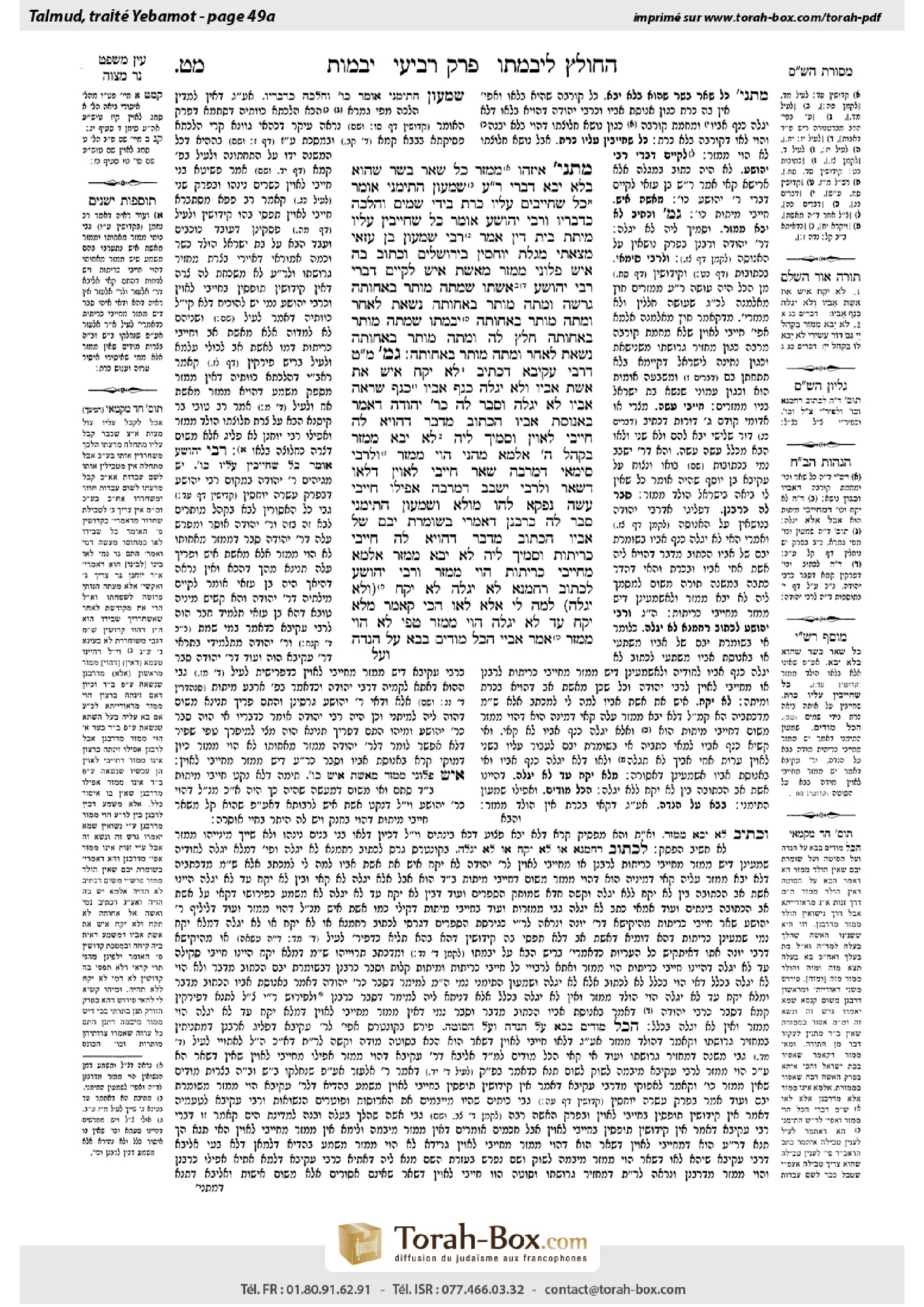
Yevamot 49a: Talmud study for Daf Yomi
Daf Yomi is the daily study of one Talmud folio. Explore 37 tractates with scans, Hebrew text, Sefaria English and AI-generated French translations where annotated.
Passage selection and English or AI-generated French translation are available where the scan has annotations. Daf Study is independent of Torah-Box and Sefaria.
Browse Yevamot · יבמות · All tractatesYevamot 49a text and translations
This page of Yevamot includes the Aramaic text, an English translation and an AI-generated French translation, alongside the scan above.
יבמות מ״ט א · Aramaic and Hebrew text
מַתְנִי׳ אֵיזֶהוּ מַמְזֵר — כׇּל שְׁאֵר בָּשָׂר שֶׁהוּא בְּ״לֹא יָבֹא״, דִּבְרֵי רַבִּי עֲקִיבָא. שִׁמְעוֹן הַתִּימְנִי אוֹמֵר: כֹּל שֶׁחַיָּיבִים עָלָיו כָּרֵת בִּידֵי שָׁמַיִם, וַהֲלָכָה כִּדְבָרָיו. וְרַבִּי יְהוֹשֻׁעַ אוֹמֵר: כֹּל שֶׁחַיָּיבִין עָלָיו מִיתַת בֵּית דִּין.
אָמַר רַבִּי שִׁמְעוֹן בֶּן עַזַּאי: מָצָאתִי מְגִלַּת יוּחֲסִין בִּירוּשָׁלַיִם, וְכָתוּב בָּהּ: אִישׁ פְּלוֹנִי מַמְזֵר מֵאֵשֶׁת אִישׁ, לְקַיֵּים דִּבְרֵי רַבִּי יְהוֹשֻׁעַ.
אִשְׁתּוֹ שֶׁמֵּתָה — מוּתָּר בַּאֲחוֹתָהּ. גֵּרְשָׁהּ וּמֵתָה — מוּתָּר בַּאֲחוֹתָהּ. נִשֵּׂאת לְאַחֵר וּמֵתָה — מוּתָּר בַּאֲחוֹתָהּ. יְבִמְתּוֹ שֶׁמֵּתָה — מוּתָּר בַּאֲחוֹתָהּ. חָלַץ לָהּ וּמֵתָה — מוּתָּר בַּאֲחוֹתָהּ. נִשֵּׂאת לְאַחֵר וּמֵתָה — מוּתָּר בַּאֲחוֹתָהּ.
גְּמָ׳ מַאי טַעְמָא דְּרַבִּי עֲקִיבָא? דִּכְתִיב: ״לֹא יִקַּח אִישׁ אֶת אֵשֶׁת אָבִיו וְלֹא יְגַלֶּה כְּנַף אָבִיו״. כָּנָף שֶׁרָאָה אָבִיו — לֹא יְגַלֶּה.
וְסָבַר לַהּ כְּרַבִּי יְהוּדָה, דְּאָמַר: בַּאֲנוּסַת אָבִיו הַכָּתוּב מְדַבֵּר, דְּהָוְיָא לַהּ חַיָּיבֵי לָאוִין,
וּסְמִיךְ לֵיהּ: ״לֹא יָבֹא מַמְזֵר בִּקְהַל ה׳״, אַלְמָא מֵהָנֵי הָוֵי מַמְזֵר.
וּלְרַבִּי סִימַאי, דִּמְרַבֵּה שְׁאָר חַיָּיבֵי לָאוִין דְּלָאו דִּ״שְׁאֵר״, וּלְרַבִּי יְשֵׁבָב, דִּמְרַבֵּה אֲפִילּוּ חַיָּיבֵי עֲשֵׂה —
נָפְקָא לְהוּ מִ״וְּלֹא״.
וְשִׁמְעוֹן הַתִּימְנִי סָבַר לַהּ כְּרַבָּנַן, דְּאָמְרִי: בְּשׁוֹמֶרֶת יָבָם שֶׁל אָבִיו הַכָּתוּב מְדַבֵּר, דְּהָוְיָא לַהּ חַיָּיבֵי כָּרֵיתוֹת, וּסְמִיךְ לֵיהּ ״לֹא יָבֹא מַמְזֵר״. אַלְמָא: מֵחַיָּיבֵי כָּרֵיתוֹת הָוֵי מַמְזֵר.
וְרַבִּי יְהוֹשֻׁעַ — לִכְתּוֹב רַחֲמָנָא ״לֹא יְגַלֶּה״. ״לֹא יִקַּח״ (״וְלֹא יְגַלֶּה״) לְמָה לִי? אֶלָּא לָאו, הָכִי קָאָמַר: מִ״לֹּא יִקַּח״ עַד ״לֹא יְגַלֶּה״ — הָוֵי מַמְזֵר, טְפֵי — לָא הָוֵי מַמְזֵר.
אָמַר אַבָּיֵי: הַכֹּל מוֹדִים בְּבָא עַל הַנִּדָּה
Yevamot 49a · English translation
MISHNA: Which offspring of forbidden relations have the status of a mamzer? It is the offspring of a union with any next of kin that is subject to a Torah prohibition that he should not engage in sexual relations with them; this is the statement of Rabbi Akiva. Shimon HaTimni says: It is the offspring of a union with any forbidden relation for which one is liable to receive karet at the hand of Heaven. And the halakha is in accordance with his statement. Rabbi Yehoshua says: It is the offspring of a union with any forbidden relation for which one is liable to receive court-imposed capital punishment.
Rabbi Shimon ben Azzai said: I found a scroll recording people’s lineages in Jerusalem, and it was written in it that so-and-so is a mamzer from an adulterous union with a married woman, a sin punishable by court-imposed capital punishment. The only reason for the scroll to state the reason that this individual is a mamzer is in order to support the statement of Rabbi Yehoshua.
The mishna delineates the circumstances in which it is prohibited to engage in relations with the sister of one’s wife and the sister of one’s yevama: If a man’s wife died, he is permitted to her sister. If he divorced her and then she died, he is permitted to her sister. If he divorced his wife and then she was married to another and then died, he is permitted to her sister. If his yevama died, he is permitted to her sister. If he performed ḥalitza with her and then she died, he is permitted to her sister. If after ḥalitza she was married to another and then died, he is permitted to her sister. The principle underlying all these cases is that the prohibition against engaging in relations with her sister only applies while the wife or yevama remain alive, irrespective of their current relationship to the man.
GEMARA: What is Rabbi Akiva’s reasoning? As it is written: “A man shall not take his father’s wife, and he shall not uncover his father’s cloak” (Deuteronomy 23:1). This teaches that a cloak that his father saw, i.e., a woman with whom his father engaged in sexual relations, the son may not uncover.
And in this interpretation of the verse, Rabbi Akiva holds in accordance with the opinion of Rabbi Yehuda, who said: The verse states only that such relations are forbidden, but they would not render him liable to receive karet; perforce the verse speaks of a woman raped by one’s father, since she is one of the women with whom relations render one liable for violating a prohibition. The verse could not refer to one’s father’s wife since relations with her render one liable to receive karet.
The Gemara completes its explanation of Rabbi Akiva’s opinion: And in close proximity to that verse is the verse: “A mamzer shall not enter into the congregation of the Lord” (Deuteronomy 23:3). Apparently, even from these forbidden relations, which render one liable for the violation of a prohibition, the offspring is a mamzer.
The Gemara asks: But according to Rabbi Simai, who holds that Rabbi Akiva includes as a mamzer the offspring of all other forbidden relations for which one is liable for violation of a prohibition, even those that are not with his next of kin; and also according to Rabbi Yeshevav, who holds that Rabbi Akiva includes even the offspring of relations for which one is liable for the violation of a positive mitzva; since according to them, Rabbi Akiva includes cases that are not similar to the case of a woman raped by his father, what is his source?
The Gemara answers: They derive it from the verse that states: “And he shall not uncover his father’s cloak” (Deuteronomy 23:1). The word “and” is superfluous and serves to include additional cases.
And Shimon HaTimni holds in accordance with the opinion of the Rabbis, who say: It is with regard to the widow waiting for his father to perform levirate marriage that the verse is speaking, and it indicates that she is one of the women with whom relations render one liable to receive karet. And in close proximity to that verse is the verse: “A mamzer shall not enter into the congregation of the Lord” (Deuteronomy 23:3). Apparently, only the offspring of a union for which one is liable to receive karet is a mamzer.
And how does Rabbi Yehoshua derive his opinion? If the verses should be derived as Rabbi Akiva and Shimon HaTimni suggest, let the Merciful One write only: “He shall not uncover his father’s cloak.” It is unnecessary for the verse to mention the prohibition with regard to one’s father’s wife, as the fact that the offspring of that union is a mamzer would be known through an a fortiori inference, since that prohibition is more stringent than the one derived from the verse: “And shall not uncover his father’s cloak.” Why do I need both the clause “a man shall not take his father’s wife” and the clause “and shall not uncover his father’s cloak”? Rather, is it not that this is what the Torah is saying: Only the offspring of relations with the woman mentioned in the verse after the words “a man shall not take” until the words “he shall not uncover,” i.e., his father’s wife, is a mamzer, but the offspring of relations with the woman mentioned beyond that point, i.e., the woman referred to as “his father’s cloak,” is not a mamzer.
§ Abaye said: All tanna’im in the mishna agree with regard to one who engages in sexual relations with a menstruating woman,
Yevamot 49a · Traduction française (IA)
MICHNA : Quelles sont les descendance d'interdictions qui ont le statut de mamzer ? Il s'agit de la descendance d'une union avec un proche parent soumis à une interdiction de la Torah, avec lequel il ne doit pas avoir de relations sexuelles ; c'est l'avis de Rabbi Akiva. Shimon HaTimni dit : Il s'agit de la descendance d'une union avec un proche parent interdit pour lequel on est passible de la peine de karet infligée par le Ciel. Et la halakha est conforme à son avis. Rabbi Yehoshua dit : Il s'agit de la descendance d'une union avec un proche parent interdit pour lequel on est passible de la peine capitale infligée par le tribunal.
Rabbi Shimon ben Azzai a dit : J'ai trouvé un rouleau à Jérusalem qui consigne les généalogies des gens, et il y était écrit que tel est un mamzer issu d'une union adultère avec une femme mariée, péché passible de la peine capitale infligée par le tribunal. La seule raison pour laquelle le rouleau mentionne la raison pour laquelle cet individu est un mamzer est de soutenir l'avis de Rabbi Yehoshua.
La mishna délimite les circonstances dans lesquelles il est interdit d'avoir des relations avec la sœur de son épouse et la sœur de sa yevama : Si l'épouse d'un homme est morte, il est autorisé à épouser sa sœur. S'il l'a répudiée puis qu'elle est morte, il est autorisé à épouser sa sœur. S'il a répudié son épouse puis qu'elle s'est mariée à un autre et qu'elle est morte, il est autorisé à épouser sa sœur. Si sa yevama est morte, il est autorisé à épouser sa sœur. S'il a accompli la ḥalitza avec elle puis qu'elle est morte, il est autorisé à épouser sa sœur. Si, après la ḥalitza, elle s'est mariée à un autre puis qu'elle est morte, il est autorisé à épouser sa sœur. Le principe sous-jacent à tous ces cas est que l'interdiction d'avoir des relations avec sa sœur ne s'applique que tant que l'épouse ou la yevama est en vie, indépendamment de leur relation actuelle avec l'homme.
Guemara : Quel est le raisonnement de Rabbi Akiva ? Comme il est écrit : « Un homme ne prendra pas la femme de son père, et il ne découvrira pas le manteau de son père » (Deutéronome 23:1). Cela enseigne qu'un manteau que son père a vu, c'est-à-dire une femme avec laquelle son père a eu des relations sexuelles, le fils ne doit pas la découvrir.
Et dans cette interprétation du verset, Rabbi Akiva est d'accord avec l'avis de Rabbi Yehuda, qui a dit : Le verset ne stipule que de telles relations sont interdites, mais elles ne rendraient pas passible de la peine de karet ; par conséquent, le verset parle d'une femme violée par son père, car elle est l'une des femmes avec lesquelles les relations rendent passible de la violation d'une interdiction. Le verset ne pouvait pas faire référence à la femme de son père, car les relations avec elle rendent passible de la peine de karet.
La Guemara complète son explication de l'avis de Rabbi Akiva : Et à proximité de ce verset se trouve le verset : « Un mamzer n'entrera pas dans l'assemblée de l'Éternel » (Deutéronome 23:3). Apparemment, même de ces relations interdites, qui rendent passible de la violation d'une interdiction, la descendance est un mamzer.
La Guemara demande : Mais selon Rabbi Simai, qui soutient que Rabbi Akiva considère comme mamzer la descendance de toutes les autres relations interdites pour lesquelles on encourt la peine de la violation d'une interdiction, même celles qui ne sont pas avec ses proches parents ; et aussi selon Rabbi Yeshevav, qui soutient que Rabbi Akiva inclut même la descendance de relations pour lesquelles on encourt la violation d'une mitsva positive ; puisque, selon eux, Rabbi Akiva inclut des cas qui ne sont pas similaires au cas d'une femme violée par son père, quelle est sa source ?
La Guemara répond : Ils le déduisent du verset qui dit : « Et il ne découvrira pas le manteau de son père » (Deutéronome 23:1). Le mot « et » est superflu et sert à inclure des cas supplémentaires.
Et Shimon HaTimni est d'accord avec l'avis des Sages, qui disent : C'est à propos de la veuve qui attend que son père accomplisse le mariage lévirat que le verset parle, et cela indique qu'elle est l'une des femmes avec lesquelles les relations rendent passible de la peine de karet. Et à proximité de ce verset se trouve le verset : « Un mamzer n'entrera pas dans l'assemblée de l'Éternel » (Deutéronome 23:3). Apparemment, seule la descendance d'une union pour laquelle on est passible de la peine de karet est un mamzer.
Et comment Rabbi Yehoshua déduit-il son avis ? Si les versets devaient être interprétés comme le suggèrent Rabbi Akiva et Shimon HaTimni, que le Tout-Puissant écrive seulement : « Il ne découvrira pas le manteau de son père. » Il n'est pas nécessaire que le verset mentionne l'interdiction concernant la femme de son père, car le fait que la descendance de cette union soit un mamzer serait connu par une inférence a fortiori, puisque cette interdiction est plus stricte que celle déduite du verset : « Et il ne découvrira pas le manteau de son père. » Pourquoi ai-je besoin à la fois de la clause « un homme ne prendra pas la femme de son père » et de la clause « et il ne découvrira pas le manteau de son père » ? Plutôt, n'est-ce pas que c'est ce que la Torah dit : Seule la descendance de relations avec la femme mentionnée dans le verset après les mots « un homme ne prendra pas » jusqu'aux mots « il ne découvrira pas », c'est-à-dire la femme de son père, est un mamzer, mais la descendance de relations avec la femme mentionnée au-delà de ce point, c'est-à-dire la femme désignée par « le manteau de son père », n'est pas un mamzer.
§ Abaye a dit : Tous les tannaïm de la Michna sont d'accord à propos de celui qui a des relations sexuelles avec une femme en période menstruelle,
Traduction française générée par IA à partir de l’édition anglaise de Sefaria. Vérifie toujours un passage avec le texte source.
Text from Sefaria: William Davidson Edition - Vocalized Aramaic (CC BY NC); William Davidson Edition - English (CC BY NC).