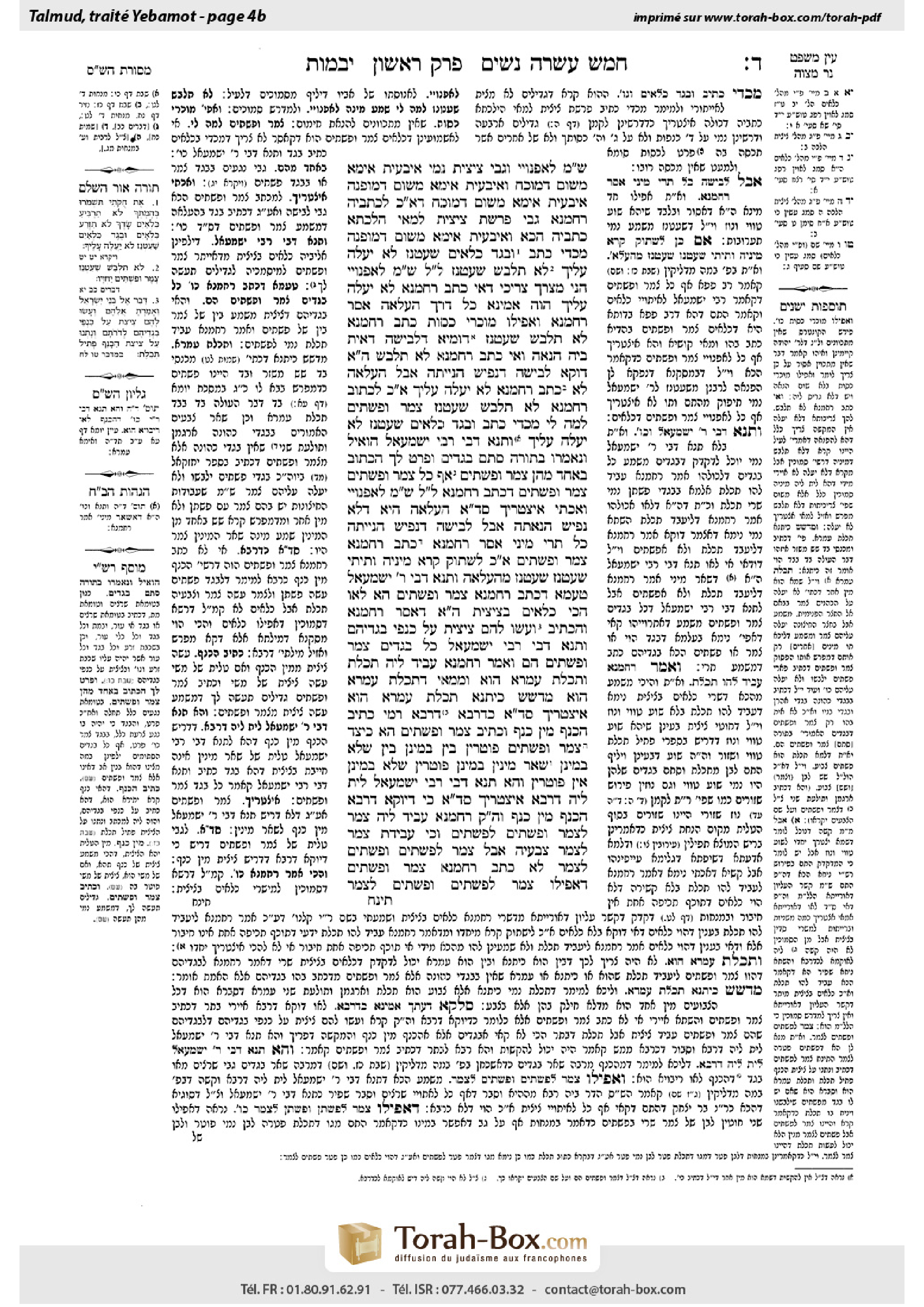
Yevamot 4b: Talmud study for Daf Yomi
Daf Yomi is the daily study of one Talmud folio. Explore 37 tractates with scans, Hebrew text, Sefaria English and AI-generated French translations where annotated.
Passage selection and English or AI-generated French translation are available where the scan has annotations. Daf Study is independent of Torah-Box and Sefaria.
Browse Yevamot · יבמות · All tractatesYevamot 4b text and translations
This page of Yevamot includes the Aramaic text, an English translation and an AI-generated French translation, alongside the scan above.
יבמות ד׳ ב · Aramaic and Hebrew text
שְׁמַע מִינַּהּ לְאַפְנוֹיֵי. וְגַבֵּי צִיצִית נָמֵי, אִיבָּעֵית אֵימָא — מִשּׁוּם דְּמוֹכַח, וְאִיבָּעֵית אֵימָא — מִשּׁוּם דְּמוּפְנֶה.
אִיבָּעֵית אֵימָא מִשּׁוּם דְּמוֹכַח — דְּאִם כֵּן לִכְתְּבֵיהּ רַחֲמָנָא גַּבֵּי פָּרָשַׁת צִיצִית, לְמַאי הִלְכְתָא כַּתְבֵיהּ הָכָא? וְאִיבָּעֵית אֵימָא מִשּׁוּם דְּמוּפְנֶה — מִכְּדִי כְּתַב: ״וּבֶגֶד כִּלְאַיִם שַׁעַטְנֵז לֹא יַעֲלֶה עָלֶיךָ״, ״לֹא תִלְבַּשׁ שַׁעַטְנֵז״ לְמָה לִי? שְׁמַע מִינַּהּ לְאַפְנוֹיֵי.
הָנֵי מִצְרָךְ צְרִיכִי, דְּאִי כְּתַב רַחֲמָנָא ״לֹא יַעֲלֶה עָלֶיךָ״, הָוֵה אָמֵינָא: כׇּל דֶּרֶךְ הַעֲלָאָה אֲסַר רַחֲמָנָא, וַאֲפִילּוּ מוֹכְרֵי כְסוּת, כְּתַב רַחֲמָנָא ״לֹא תִלְבַּשׁ שַׁעַטְנֵז״, דּוּמְיָא דִלְבִישָׁה, דְּאִית בֵּיהּ הֲנָאָה.
וְאִי כְּתַב רַחֲמָנָא ״לֹא תִלְבַּשׁ״, הֲוָה אָמֵינָא: דַּוְקָא לְבִישָׁה, דִּנְפִישׁ הֲנָיָיתַהּ, אֲבָל הַעֲלָאָה — לָא, כְּתַב רַחֲמָנָא ״לֹא יַעֲלֶה עָלֶיךָ״.
אִם כֵּן, לִכְתּוֹב רַחֲמָנָא ״לֹא תִלְבַּשׁ שַׁעַטְנֵז״, ״צֶמֶר וּפִשְׁתִּים״ לְמָה לִי?
מִכְּדִי כְּתַב ״וּבֶגֶד כִּלְאַיִם שַׁעַטְנֵז לֹא יַעֲלֶה עָלֶיךָ״, וְתָנָא דְּבֵי רַבִּי יִשְׁמָעֵאל: הוֹאִיל וְנֶאֶמְרוּ בַּתּוֹרָה סְתָם ״בְּגָדִים״, וּפָרַט לְךָ הַכָּתוּב בְּאֶחָד מֵהֶן צֶמֶר וּפִשְׁתִּים — אַף כֹּל צֶמֶר וּפִשְׁתִּים, ״צֶמֶר וּפִשְׁתִּים״ דִּכְתַב רַחֲמָנָא לְמָה לִי? שְׁמַע מִינַּהּ לְאַפְנוֹיֵי.
וְאַכַּתִּי אִיצְטְרִיךְ, סָלְקָא דַּעְתָּךְ אָמֵינָא: הַעֲלָאָה הִיא דְּלָא נְפִישׁ הֲנָאָתַהּ, אֲבָל לְבִישָׁה דִּנְפִישׁ הֲנָיָיתַהּ — כֹּל תְּרֵי מִינֵי אֲסַר רַחֲמָנָא, כְּתַב רַחֲמָנָא ״צֶמֶר וּפִשְׁתִּים״!
אִם כֵּן, לִשְׁתּוֹק קְרָא מִינֵּיהּ, וְתֵיתֵי ״שַׁעַטְנֵז״ ״שַׁעַטְנֵז״ מֵהַעֲלָאָה.
וְתַנָּא דְּבֵי רַבִּי יִשְׁמָעֵאל: טַעְמָא דִּכְתַב רַחֲמָנָא ״צֶמֶר וּפִשְׁתִּים״, הָא לָאו הָכִי, כִּלְאַיִם בְּצִיצִית הֲוָה אָמֵינָא דַּאֲסַר רַחֲמָנָא? וְהָכְתִיב: ״וְעָשׂוּ לָהֶם צִיצִית עַל כַּנְפֵי בִגְדֵיהֶם״,
וְתַנָּא דְּבֵי רַבִּי יִשְׁמָעֵאל: כָּל בְּגָדִים צֶמֶר וּפִשְׁתִּים הֵם, וְאָמַר רַחֲמָנָא עֲבֵיד לֵיהּ תְּכֵלֶת, וּתְכֵלֶת עַמְרָא הוּא. וּמִמַּאי דִּתְכֵלֶת עַמְרָא הוּא? מִדְּשֵׁשׁ — כִּיתָּנָא, תְּכֵלֶת — עַמְרָא הוּא.
אִיצְטְרִיךְ, סָלְקָא דַּעְתָּךְ אָמֵינָא כִּדְרָבָא, דְּרָבָא רָמֵי: כְּתִיב ״הַכָּנָף״ — מִין כָּנָף, וּכְתִיב ״צֶמֶר וּפִשְׁתִּים״!
הָא כֵּיצַד? צֶמֶר וּפִשְׁתִּים פּוֹטְרִין בֵּין בְּמִינָן, בֵּין שֶׁלֹּא בְּמִינָן. שְׁאָר מִינִין, בְּמִינָן פּוֹטְרִין, שֶׁלֹּא בְּמִינָן אֵין פּוֹטְרִין.
וְהָא תַּנָּא דְּבֵי רַבִּי יִשְׁמָעֵאל לֵית לֵיהּ דְּרָבָא!
אִיצְטְרִיךְ, סָלְקָא דַּעְתָּךְ אָמֵינָא, כִּי דִיּוּקָא דְּרָבָא: ״הַכָּנָף״ — מִין כָּנָף, וְהָכִי קָאָמַר רַחֲמָנָא: עָבֵיד לֵיהּ צֶמֶר לְצֶמֶר וּפִשְׁתִּים לְפִשְׁתִּים. וְכִי עָבְידַתְּ צֶמֶר לְצֶמֶר — צִבְעֵיהּ, אֲבָל צֶמֶר לְפִשְׁתִּים וּפִשְׁתִּים לְצֶמֶר — לָא, כְּתַב רַחֲמָנָא ״צֶמֶר וּפִשְׁתִּים״, דַּאֲפִילּוּ צֶמֶר לְפִשְׁתִּים וּפִשְׁתִּים לְצֶמֶר.
Yevamot 4b · English translation
Learn from this that this phrase is free to teach an additional halakha. And with regard to ritual fringes as well, there is a particular reason to derive a homiletic interpretation from the juxtaposition of verses. If you wish, say that it is because it is evident from the context, and if you wish, say instead that it is because this verse is free for this inference.
The Gemara elaborates: If you wish, say it is because it is evident; as, if it is so that no inference should be drawn from the adjacent verses, let the Merciful One write this verse by the portion of ritual fringes (Numbers, chapter 15). With regard to what halakha did the Torah write it here? Clearly, the Torah is teaching a halakha from the adjacent verses. And if you wish, say it is because this verse is free, since the Torah has already written: “Neither shall there come upon you a garment of diverse kinds mingled together” (Leviticus 19:19). Why, then, do I need the verse: “You shall not wear diverse kinds, wool and linen together” (Deuteronomy 22:11)? Learn from this that the verse is free for the derivation of a homiletic interpretation from juxtaposed verses.
The Gemara rejects this explanation: Both of these verses are necessary, as, had the Merciful One written only: “Neither shall there come upon you,” I would say that the Merciful One prohibits every manner by which a garment of diverse kinds comes upon you, and this applies even to sellers of coverings, who do not wear the garments but merely rest them on their shoulders. Therefore, the Merciful One writes: “You shall not wear diverse kinds,” to teach that the prohibition applies only in cases similar to wearing, which provides benefit and does not simply involve placing the covering upon oneself.
And had the Merciful One written only: “You shall not wear,” I would say that this means specifically wearing, which provides significant benefit, both warmth and adornment, but merely placing a garment of diverse kinds upon oneself is not prohibited, even if one is warmed by the clothing. Therefore, the Merciful One writes: “Neither shall there come upon you.”
The Gemara challenges: In any case part of the verse is superfluous, as, if so, let the Merciful One write only: “You shall not wear diverse kinds.” Why do I need the addition of “wool and linen”? The definition of diverse kinds in clothing is already known from another source.
How so? Since it is written: “Neither shall there come upon you a garment of diverse kinds mingled together” (Leviticus 19:19), and the school of Rabbi Yishmael taught: Since the word garments is stated in the Torah unmodified, without stating from what materials those garments were made, and the verse specified in one of its references to garments, in the context of the halakhot of ritual impurity of leprosy: “A woolen garment or a linen garment” (Leviticus 13:47), the following conclusion can be drawn: Just as when the Torah mentions a garment in the case of leprosy it is referring to one made of wool or linen, so too, all garments mentioned in the Torah are those made from wool or linen. Other fabrics are not classified as those used for garments. If so, why do I need the phrase: “Wool and linen” that the Merciful One wrote with regard to diverse kinds? Learn from this that the superfluous passage is free.
The Gemara raises a difficulty: But the verse is still necessary, as it could enter your mind to say that it is referring only to placing a garment on oneself, which does not provide great benefit; however, with regard to the actual wearing of a garment, which entails great benefit, the Merciful One prohibits wearing any two types together. Therefore, the Merciful One writes “wool and linen” with regard to wearing garments of diverse kinds as well.
The Gemara responds: If so, let the verse be silent and refrain from mentioning wool and linen at all, and the halakha that only wearing wool and linen together is prohibited can be derived by means of a verbal analogy between the terms “diverse kinds” (Deuteronomy 22:11), and “diverse kinds” from placing a covering of diverse kinds upon oneself (Leviticus 19:19). The repetition of wool and linen must be coming to teach that one should derive a homiletic interpretation from these juxtaposed verses.
The Gemara asks: And according to that which the school of Rabbi Yishmael taught, that the mention of wool and linen is superfluous and teaches that they are not prohibited in the case of ritual fringes, the reason is that the Merciful One specifically writes wool and linen. From here it may be inferred that if that were not so, I would say that the Merciful One prohibits a mixture of diverse kinds in ritual fringes. Can it be considered that this is the case? But isn’t it written: “That they make themselves fringes on the corners of their garments” (Numbers 15:38)?
And the school of Rabbi Yishmael taught: All garments mentioned in the Torah are of wool or linen, and the Merciful One says, with regard to ritual fringes: Prepare it with a sky-blue dye, and a sky-blue dyed thread is prepared from wool. The Torah explicitly commands that at least one woolen thread of sky-blue dye must be tied even to a linen cloth, which proves that diverse kinds are permitted in the context of ritual fringes. The Gemara establishes the previous claim: And from where is it derived that the sky-blue thread is made of wool? From the fact that the Torah specifies that one of the strands of the priestly garments was made of shesh, which means linen, this indicates that the other threads, including the sky-blue thread, are from wool.
§ Returning to the question, the Gemara explains that the mention of wool and linen is necessary, as it could enter your mind to state an argument in accordance with the opinion of Rava. As Rava raised a contradiction from the following verse: It is written: “That they make themselves fringes on the corners of their garments” (Numbers 15:38). The phrase “the corners” indicates that it must be from the same type of thread as the corner, i.e., the threads of the fringes must consist of the same kind of material as the corner of the garment. And yet it is written: “Wool and linen” (Deuteronomy 22:11), which indicates that ritual fringes may be prepared from only those materials and no others.
How so? How can this contradiction be resolved? Fringes made of wool and linen fulfill the obligation of ritual fringes whether the clothing is of the same type of material, i.e., wool or linen, or whether it is not of the same type of fabric. Conversely, with regard to all other kinds of material, if the ritual fringes are of the same kind, e.g., silk fringes on silk clothing, they fulfill the obligation, but if the cloth is not of the same type, they do not fulfill the obligation of ritual fringes. Consequently, were it not for the phrase “wool and linen,” it would have been necessary to prepare ritual fringes from the same material as the garment itself, even when using wool or linen.
The Gemara asks: But the tanna from the school of Rabbi Yishmael does not maintain in accordance with this opinion of Rava, since that tanna holds that there is no obligation to place ritual fringes on clothing that is not made of wool or linen. The reason is that when the Torah speaks of garments it is referring exclusively to clothes made of wool or linen. Consequently, Rava’s interpretation with regard to different types of material does not apply to the opinion of the tanna from the school of Rabbi Yishmael.
The Gemara responds: It is nevertheless necessary to state: “Wool and linen,” as it could enter your mind to say, in accordance with the inference of Rava, that the phrase “the corners” indicates that it must be from the same type of thread as the corner, but in a different manner: This is what the Merciful One is saying: Prepare for it wool fringes for a wool garment and linen fringes for a linen garment, and when you prepare wool fringes for wool clothing, dye it sky-blue. However, if you prepare wool fringes for linen garments or linen for wool clothing, you need not include a sky-blue thread. Therefore, the Merciful One states: “Wool and linen,” which teaches that one fulfills the obligation of fringes even with wool fringes for a linen garment or linen fringes for a woolen one.
Yevamot 4b · Traduction française (IA)
Déduis-en que cette expression est libre et permet d’enseigner une halakha supplémentaire. De même, au sujet des franges rituelles, il y a une raison particulière de tirer une interprétation homilétique du rapprochement des versets. Si tu le souhaites, dis que c’est parce que cela ressort clairement du contexte ; sinon, dis que c’est parce que ce verset est disponible pour cette déduction.
La Guemara développe : si tu le souhaites, dis que c’est parce que cela ressort clairement du contexte. En effet, si aucune déduction ne devait être tirée des versets voisins, que le Miséricordieux écrive ce verset dans le passage consacré aux franges rituelles (Nombres, chapitre 15). Quelle halakha la Torah enseigne-t-elle en l’écrivant ici ? De toute évidence, la Torah enseigne une halakha à partir des versets voisins. Sinon, dis que c’est parce que ce verset est disponible, puisque la Torah a déjà écrit : « Tu ne porteras pas un vêtement de deux espèces mélangées » (Lévitique 19,19). Pourquoi ai-je donc besoin du verset : « Tu ne porteras pas de vêtements tissés de deux espèces, laine et lin ensemble » (Deutéronome 22,11) ? Déduis-en que ce verset est disponible pour tirer une interprétation homilétique du rapprochement des versets.
La Guemara rejette cette explication : ces deux versets sont nécessaires. En effet, si le Miséricordieux avait écrit uniquement : « Tu ne porteras pas un vêtement de deux espèces mélangées », j’aurais dit que le Miséricordieux interdit toute manière de porter sur soi un vêtement de deux espèces mélangées, y compris aux vendeurs de couvertures, qui ne portent pas ces vêtements, mais les posent seulement sur leurs épaules. C’est pourquoi le Miséricordieux écrit : « Tu ne porteras pas de vêtements tissés de deux espèces », pour enseigner que l’interdit ne s’applique qu’aux cas comparables au fait de porter un vêtement, ce qui procure un avantage, et non au simple fait de poser la couverture sur soi.
Et si le Miséricordieux avait écrit uniquement : « Tu ne porteras pas de vêtements tissés de deux espèces », j’aurais dit que cela concerne spécifiquement le fait de porter un vêtement, ce qui procure un grand avantage, à la fois en tenant chaud et en parant, mais que le simple fait de poser sur soi un vêtement de deux espèces mélangées n’est pas interdit, même si l’on en est réchauffé. C’est pourquoi le Miséricordieux écrit : « Tu ne porteras pas un vêtement de deux espèces mélangées ».
La Guemara objecte : quoi qu’il en soit, une partie du verset est superflue. En effet, si tel est le cas, que le Miséricordieux écrive seulement : « Tu ne porteras pas de vêtements tissés de deux espèces ». Pourquoi ai-je besoin de l’ajout « laine et lin » ? La définition des deux espèces interdites dans les vêtements est déjà connue d’une autre source.
Comment cela ? Puisqu’il est écrit : « Tu ne porteras pas un vêtement de deux espèces mélangées » (Lévitique 19,19), et que l’école de Rabbi Yishmaël a enseigné : le terme « vêtements » est mentionné dans la Torah sans précision, sans indiquer de quelles matières ils sont faits. Or, dans l’un des passages où elle parle de vêtements, au sujet des lois d’impureté rituelle liées à la lèpre, la Torah précise : « un vêtement de laine ou un vêtement de lin » (Lévitique 13,47). On peut donc en conclure que, de même que le vêtement mentionné à propos de la lèpre désigne un vêtement de laine ou de lin, de même, tous les vêtements mentionnés dans la Torah sont faits de laine ou de lin. Les autres tissus ne sont pas considérés comme des vêtements. Si tel est le cas, pourquoi ai-je besoin de l’expression « laine et lin » que le Miséricordieux a écrite au sujet du mélange des espèces ? Déduis-en que le passage superflu est disponible.
La Guemara soulève une difficulté : mais le verset est encore nécessaire, car on pourrait penser qu’il ne concerne que le fait de poser un vêtement sur soi, ce qui ne procure pas un grand avantage ; en revanche, s’agissant du fait de porter réellement un vêtement, ce qui procure un grand avantage, le Miséricordieux interdit de porter ensemble deux espèces quelconques. C’est pourquoi le Miséricordieux écrit aussi « laine et lin » au sujet du port de vêtements de deux espèces mélangées.
La Guemara répond : si tel était le cas, que le verset garde le silence et ne mentionne pas du tout la laine et le lin ; on pourrait déduire que seul le port conjoint de laine et de lin est interdit au moyen d’une analogie verbale entre les expressions « deux espèces » (Deutéronome 22,11) et « deux espèces », à propos du fait de poser sur soi un vêtement de deux espèces mélangées (Lévitique 19,19). La répétition de « laine et lin » doit donc servir à enseigner qu’il faut tirer une interprétation homilétique du rapprochement de ces versets.
La Guemara demande : selon l’enseignement de l’école de Rabbi Yishmaël, d’après lequel la mention de la laine et du lin est superflue et enseigne que leur mélange n’est pas interdit dans le cas des franges rituelles, la raison en est que le Miséricordieux mentionne précisément la laine et le lin. On peut en déduire que, sans cela, j’aurais dit que le Miséricordieux interdit un mélange d’espèces dans les franges rituelles. Peut-on considérer que tel est le cas ? N’est-il pas écrit : « Qu’ils se fassent des franges aux coins de leurs vêtements » (Nombres 15,38) ?
Et l’école de Rabbi Yishmaël a enseigné : tous les vêtements mentionnés dans la Torah sont en laine ou en lin, et le Miséricordieux dit, au sujet des franges rituelles : « Fais-les avec un fil teint en bleu ciel », or un fil teint en bleu ciel est fait de laine. La Torah ordonne explicitement qu’au moins un fil de laine teint en bleu ciel soit attaché même à un vêtement de lin, ce qui prouve que le mélange d’espèces est permis dans le contexte des franges rituelles. La Guemara établit l’affirmation précédente : d’où déduit-on que le fil bleu ciel est en laine ? Du fait que la Torah précise qu’un des fils des vêtements sacerdotaux était en shesh, c’est-à-dire en lin ; cela indique que les autres fils, notamment le fil bleu ciel, sont en laine.
§ Revenant à la question, la Guemara explique que la mention de la laine et du lin est nécessaire, car on pourrait être amené à avancer un raisonnement conforme à l’opinion de Rava. Rava a en effet soulevé une contradiction à partir du verset suivant : « Qu’ils se fassent des franges aux coins de leurs vêtements » (Nombres 15,38). L’expression « les coins » indique que les fils doivent être de la même matière que le coin, c’est-à-dire que les fils des franges doivent être faits de la même matière que le coin du vêtement. Pourtant, il est écrit : « Laine et lin » (Deutéronome 22,11), ce qui indique que les franges rituelles ne peuvent être faites qu’avec ces matières, à l’exclusion de toute autre.
Comment cela ? Comment résoudre cette contradiction ? Des franges faites de laine et de lin remplissent l’obligation des franges rituelles, que le vêtement soit fait de la même matière — c’est-à-dire de laine ou de lin — ou d’une matière différente. En revanche, pour toutes les autres matières, si les franges sont de la même matière, par exemple des franges de soie sur un vêtement de soie, elles remplissent l’obligation ; mais si le vêtement est d’une matière différente, elles ne remplissent pas l’obligation des franges rituelles. Par conséquent, sans l’expression « laine et lin », il aurait fallu faire les franges rituelles dans la même matière que le vêtement lui-même, même lorsqu’on utilise de la laine ou du lin.
La Guemara demande : mais le tanna de l’école de Rabbi Yishmaël ne suit pas cette opinion de Rava, puisque ce tanna considère qu’il n’y a pas d’obligation de mettre des franges rituelles sur un vêtement qui n’est ni en laine ni en lin. En effet, lorsque la Torah parle de vêtements, elle désigne exclusivement ceux qui sont faits de laine ou de lin. Par conséquent, l’interprétation de Rava concernant les différentes matières ne s’applique pas à l’opinion du tanna de l’école de Rabbi Yishmaël.
La Guemara répond : il est néanmoins nécessaire de mentionner « laine et lin », car on pourrait être amené à dire, conformément à la déduction de Rava, que l’expression « les coins » indique que les fils doivent être de la même matière que le coin, mais avec une autre interprétation : voici ce que dit le Miséricordieux : fais des franges de laine pour un vêtement de laine et des franges de lin pour un vêtement de lin ; lorsque tu fais des franges de laine pour un vêtement de laine, teins l’un des fils en bleu ciel. Toutefois, si tu fais des franges de laine pour un vêtement de lin, ou des franges de lin pour un vêtement de laine, tu n’as pas besoin d’y inclure un fil bleu ciel. C’est pourquoi le Miséricordieux écrit : « Laine et lin », pour enseigner que l’on remplit l’obligation des franges même avec des franges de laine sur un vêtement de lin ou des franges de lin sur un vêtement de laine.
Traduction française générée par IA à partir de l’édition anglaise de Sefaria. Vérifie toujours un passage avec le texte source.
Text from Sefaria: William Davidson Edition - Vocalized Aramaic (CC BY NC); William Davidson Edition - English (CC BY NC).