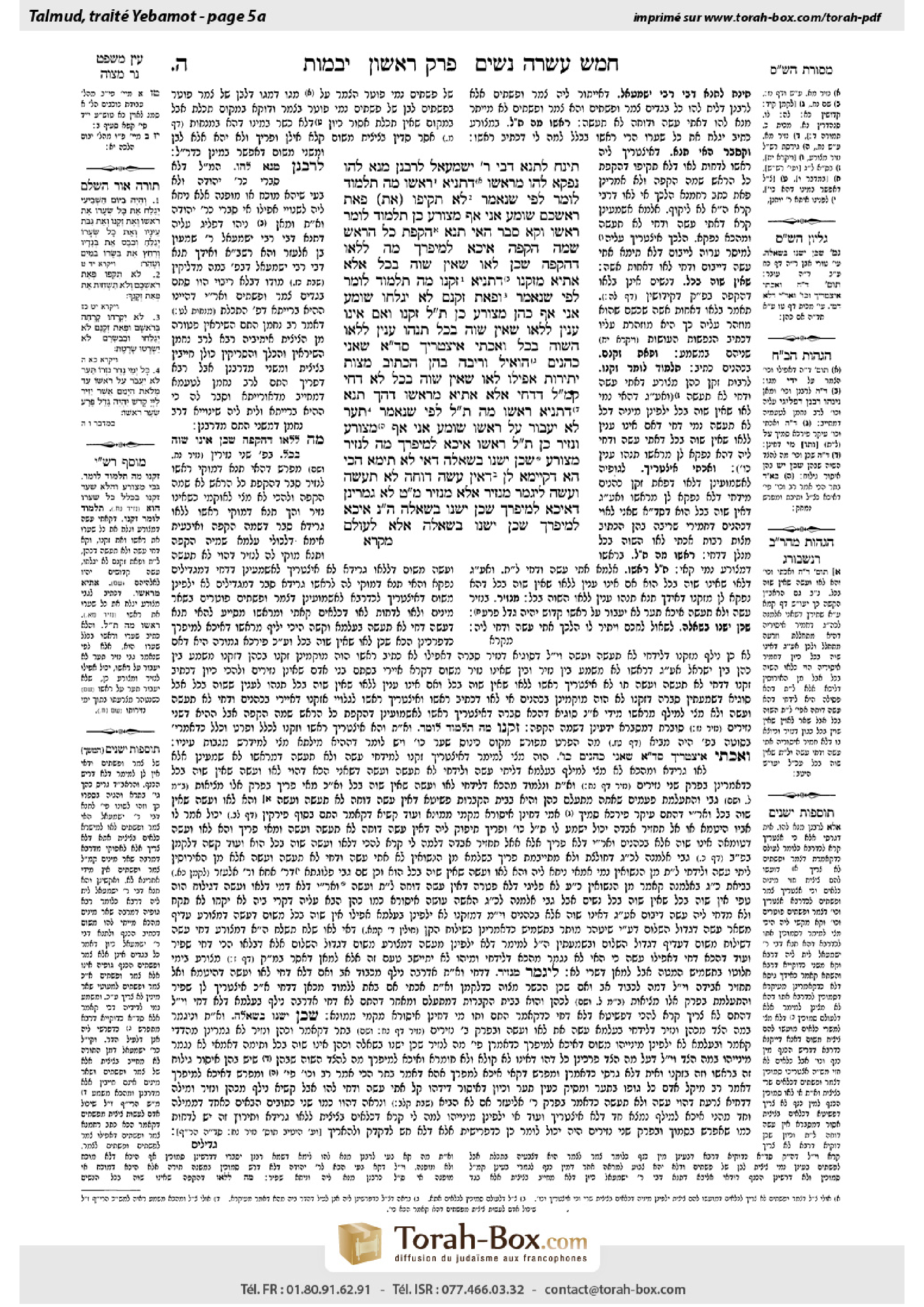
Yevamot 5a: Talmud study for Daf Yomi
Daf Yomi is the daily study of one Talmud folio. Explore 37 tractates with scans, Hebrew text, Sefaria English and AI-generated French translations where annotated.
Passage selection and English or AI-generated French translation are available where the scan has annotations. Daf Study is independent of Torah-Box and Sefaria.
Browse Yevamot · יבמות · All tractatesYevamot 5a text and translations
This page of Yevamot includes the Aramaic text, an English translation and an AI-generated French translation, alongside the scan above.
יבמות ה׳ א · Aramaic and Hebrew text
תִּינַח לְתַנָּא דְּבֵי רַבִּי יִשְׁמָעֵאל. לְרַבָּנַן, מְנָא לְהוּ?
נָפְקָא לְהוּ מֵ״רֹאשׁוֹ״. דְּתַנְיָא: ״רֹאשׁוֹ״ מָה תַּלְמוּד לוֹמַר? לְפִי שֶׁנֶּאֱמַר: ״לֹא תַקִּיפוּ (אֶת) פְּאַת רֹאשְׁכֶם״, שׁוֹמֵעַ אֲנִי אַף מְצוֹרָע כֵּן,
תַּלְמוּד לוֹמַר: ״רֹאשׁוֹ״. וְקָא סָבַר הַאי תַּנָּא הַקָּפַת כׇּל הָרֹאשׁ שְׁמָהּ הַקָּפָה.
אִיכָּא לְמִיפְרַךְ: מָה לְלָאו דְּהַקָּפָה, שֶׁכֵּן לָאו שֶׁאֵין שָׁוֶה בַּכֹּל!
אֶלָּא: אָתְיָא מִ״זְּקָנוֹ״. דְּתַנְיָא: ״זְקָנוֹ״ מָה תַּלְמוּד לוֹמַר? לְפִי שֶׁנֶּאֱמַר: ״וּפְאַת זְקָנָם לֹא יְגַלֵּחוּ״, שׁוֹמֵעַ אֲנִי אַף כֹּהֵן מְצוֹרָע כֵּן — תַּלְמוּד לוֹמַר ״זְקָנוֹ״.
וְאִם אֵינוֹ עִנְיָן לְלָאו שֶׁאֵין שָׁוֶה בַּכֹּל, תְּנֵהוּ עִנְיָן לְלָאו הַשָּׁוֶה בַּכֹּל.
וְאַכַּתִּי אִיצְטְרִיךְ, סָלְקָא דַּעְתָּךְ אָמֵינָא: שָׁאנֵי כֹּהֲנִים, הוֹאִיל וְרִיבָּה בָּהֶן הַכָּתוּב מִצְוֹת יְתֵירוֹת, אֲפִילּוּ לָאו שֶׁאֵין שָׁוֶה בַּכֹּל לָא דָּחֵי, קָא מַשְׁמַע לַן דְּדָחֵי!
אֶלָּא, אָתְיָא מֵ״רֹאשׁוֹ״ דְּהָךְ תַּנָּא. דְּתַנְיָא: ״רֹאשׁוֹ״, מָה תַּלְמוּד לוֹמַר? לְפִי שֶׁנֶּאֱמַר ״תַּעַר לֹא יַעֲבוֹר עַל רֹאשׁוֹ״, שׁוֹמֵעַ אֲנִי אַף מְצוֹרָע וְנָזִיר כֵּן, תַּלְמוּד לוֹמַר: ״רֹאשׁוֹ״.
אִיכָּא לְמִיפְרַךְ: מָה לְנָזִיר מְצוֹרָע שֶׁכֵּן יֶשְׁנוֹ בִּשְׁאֵלָה. דְּאִי לָא תֵּימָא הָכִי — הָא דְּקַיְימָא לַן דְּאֵין עֲשֵׂה דּוֹחֶה לֹא תַעֲשֶׂה וַעֲשֵׂה,
לִיגְמַר מִנָּזִיר! אֶלָּא, מִנָּזִיר מַאי טַעְמָא לָא גָּמְרִינַן, דְּאִיכָּא לְמִיפְרַךְ שֶׁכֵּן יֶשְׁנוֹ בִּשְׁאֵלָה. הָכִי נָמֵי אִיכָּא לְמִיפְרַךְ שֶׁכֵּן יֶשְׁנוֹ בִּשְׁאֵלָה.
אֶלָּא, לְעוֹלָם
Yevamot 5a · English translation
§ The Gemara comments: This works out well with regard to that which the school of Rabbi Yishmael taught, that all garments mentioned in the Torah are composed of linen or wool. However, according to the opinion of the Rabbis, who do not accept this opinion, from where do they derive the principle that a positive mitzva overrides a prohibition? As stated previously, the conclusion that the positive mitzva to place fringes on a garment overrides the prohibition against mixing linen and wool is derived from a free expression in a biblical verse; however, the expression is free for interpretation only in the opinion of the tanna from the school of Rabbi Yishmael.
The Gemara responds: They derive it from the verse mentioned with regard to the halakhot of the purification of a leper from his leprosy [tzara’at]: “And it shall be on the seventh day, that he shall shave all his hair off his head and his beard and his eyebrows, even all his hair he shall shave off” (Leviticus 14:9). As it is taught in a baraita: Since it states “all his hair,” what is the meaning when the verse states “his head”? The baraita explains that as it is stated: “You shall not round the corners of your heads” (Leviticus 19:27), i.e., it is prohibited to shave the corners of the head, I would derive that even a leper is included in this prohibition.
Therefore, the verse states explicitly: “His head,” to teach that the mitzva that a leper must shave overrides the prohibition against rounding the corners of one’s head by shaving. The Gemara adds: And this tanna holds that the shaving of the entire head is considered rounding. Some Sages maintain that one violates the prohibition against rounding the corners of his head only when he leaves some hair intact and removes the corners alone. Conversely, this tanna holds that even when one removes all of the hair on the head, as a leper does when he performs his ritual shaving, as this act includes the corners, he thereby transgresses the prohibition against rounding the corners. This demonstrates that a positive mitzva overrides a prohibition.
The Gemara raises an objection against that claim. This proof can be refuted: What about the fact that the prohibition against rounding is specific in that this prohibition is not equally applicable for all, as it does not apply to women, and therefore other cases cannot be derived from it? One cannot learn from this halakha that a positive mitzva that applies only to some people overrides even a prohibition that applies equally to all people.
Rather, the Gemara provides an alternative suggestion: The principle that a positive mitzva overrides a prohibition is derived from the superfluous phrase: “His beard” (Leviticus 14:9). As it is taught in a different baraita: What is the meaning when the verse states: “His beard”? After all, a beard is already included in the phrase: “All his hair.” The baraita answers: As it is stated with regard to priests: “Neither shall they shave off the corners of their beard” (Leviticus 21:5), I would derive that even a leper who is a priest is included in this prohibition against shaving his beard. Therefore, the verse states “his beard” in the case of a leper.
However, the shaving of one’s beard is also a prohibition that is not equally applicable for all, as it does not apply to women. Therefore, it is necessary to develop this argument further. And if this derivation from the term “his beard” is not referring to the matter of a prohibition that is not equally applicable for all, as the principle that a positive mitzva overrides a prohibition that does not apply equally for all has already been derived from the phrase “his head,” then the repetition of this specific scenario must serve to expand upon the teaching. Consequently, refer it to the matter of a prohibition that is equally applicable for all, i.e., that a positive mitzva that is not equally applicable for all overrides even prohibitions that apply equally to all people.
The Gemara rejects this proof: Still, it is necessary for the verse to state: “His beard.” This phrase is not in fact superfluous at all, as it has a novelty: It could enter your mind to say that priests are different; since the verse includes for them additional mitzvot it is appropriate to be more stringent with them, and therefore one might think that a positive mitzva should not even override a prohibition that is not equally applicable for all. Consequently, the verse states: “His beard,” and it thereby teaches us that even with regard to priests a positive mitzva overrides a prohibition that is not equally applicable for all. This means that the principle that a positive mitzva overrides even a prohibition that is equally applicable for all cannot be derived from here.
§ Rather, the Gemara rejects this line of reasoning in favor of an alternative answer. The principle that a positive mitzva overrides a prohibition is derived from a different interpretation of the phrase “his head,” cited by this tanna. As it is taught in a baraita with regard to the verse: “He shall shave all his hair off his head” (Leviticus 14:9); what is the meaning when the verse states: “His head”? The baraita explains: As it is stated with regard to a nazirite: “No razor shall come upon his head” (Numbers 6:5), I would derive that even a leper who is a nazirite is prohibited from shaving his head upon purification. Therefore, the verse states: “His head.” This teaches that the positive mitzva for a leper to shave overrides the prohibition of a nazirite.
The Gemara responds that this proof can be refuted as well: What about the fact that the prohibition of a nazirite is not especially severe, as a leprous nazirite can request to have his nazirite vow dissolved by a Sage? Since he can nullify the prohibition against shaving, this prohibition is evidently not very severe, and therefore one cannot prove anything with regard to all of the prohibitions of the Torah from this case. The Gemara adds: As, if you do not say this, that the prohibitions of a nazirite are not as severe as other prohibitions, that halakhic ruling that we maintain that a positive mitzva does not override both a prohibition and a positive mitzva would be negated.
The Gemara explains the previous claim: Let us derive the opposite of this principle from the case of a nazirite, as in this case the positive mitzva for a leper to shave apparently overrides both the positive mitzva for a nazirite to grow hair and the prohibition against shaving. Rather, what is the reason that we do not derive this principle from the case of a nazirite? The reason is that there is room to refute this proof in the aforementioned manner: One cannot learn from a nazirite, as a leprous nazirite can request to have his nazirite vow dissolved. So too, there is room to refute the proof from the halakha of a nazirite that a positive mitzva overrides a prohibition, as he can request to have his vow dissolved.
§ If so, no proof can be brought from the case of a nazirite. Rather, the Gemara offers a different explanation: Actually,
Yevamot 5a · Traduction française (IA)
§ La Guemara fait remarquer : Cela convient bien selon l’enseignement de l’école de Rabbi Yishmael, selon lequel tous les vêtements mentionnés dans la Torah sont en lin ou en laine. Mais, selon l’avis des Rabbins, qui ne retiennent pas cette opinion, d’où tirent-ils le principe qu’une mitsva positive l’emporte sur une interdiction ? Comme cela a été dit précédemment, la conclusion selon laquelle la mitsva positive d’ajouter des franges à un vêtement l’emporte sur l’interdiction de mélanger le lin et la laine est déduite d’une expression superflue dans un verset biblique. Toutefois, cette expression n’est disponible pour l’interprétation que selon le tanna de l’école de Rabbi Yishmael.
La Guemara répond : Ils le déduisent du verset relatif aux halakhot de purification du lépreux atteint de tzara’at [tzara’at] : « Le septième jour, il rasera tous les poils de sa tête, sa barbe et ses sourcils ; il rasera tous ses poils » (Lévitique 14,9). En effet, il est enseigné dans une baraïta : Puisqu’il est écrit « tous ses poils », que vient enseigner le verset en disant « sa tête » ? La baraïta explique : Puisqu’il est écrit « Vous ne vous raserez pas les coins de la tête » (Lévitique 19,27), c’est-à-dire qu’il est interdit de raser les coins de la tête, j’aurais déduit que même un lépreux est soumis à cette interdiction.
C’est pourquoi le verset précise : « Sa tête », pour enseigner que la mitsva imposant au lépreux de se raser l’emporte sur l’interdiction de raser les coins de la tête. La Guemara ajoute : Ce tanna considère que le rasage de toute la tête équivaut à raser les coins. Certains Sages soutiennent qu’on ne transgresse l’interdiction de raser les coins de la tête que si l’on laisse une partie des cheveux et que l’on ne rase que les coins. À l’inverse, ce tanna considère que même celui qui enlève tous les cheveux de sa tête, comme le fait le lépreux lors de son rasage rituel, transgresse l’interdiction de raser les coins, puisque cet acte inclut les coins. Cela démontre qu’une mitsva positive l’emporte sur une interdiction.
La Guemara soulève une objection contre cette affirmation. Cette preuve peut être réfutée : l’interdiction de raser les coins présente la particularité de ne pas s’appliquer également à tous, puisqu’elle ne concerne pas les femmes ; on ne peut donc pas en tirer de règle pour d’autres cas. On ne peut pas déduire de cette halakha qu’une mitsva positive qui ne s’applique qu’à certaines personnes l’emporte même sur une interdiction qui s’applique également à tous.
La Guemara propose plutôt une autre possibilité : le principe selon lequel une mitsva positive l’emporte sur une interdiction est déduit de l’expression superflue « sa barbe » (Lévitique 14,9). En effet, il est enseigné dans une autre baraïta : Que vient enseigner le verset en disant « sa barbe » ? Après tout, la barbe est déjà incluse dans l’expression « tous ses poils ». La baraïta répond : Puisqu’il est écrit au sujet des prêtres : « Ils ne se raseront pas les coins de leur barbe » (Lévitique 21,5), j’aurais déduit que même un lépreux qui est prêtre est soumis à cette interdiction de se raser la barbe. C’est pourquoi, dans le cas du lépreux, le verset dit « sa barbe ».
Cependant, l’interdiction de se raser la barbe, elle aussi, ne s’applique pas également à tous, puisqu’elle ne concerne pas les femmes. Il faut donc poursuivre le raisonnement. Si cette déduction à partir du terme « sa barbe » ne porte pas sur une interdiction qui ne s’applique pas également à tous, puisque le principe selon lequel une mitsva positive l’emporte sur une interdiction qui ne s’applique pas également à tous a déjà été déduit de l’expression « sa tête », alors la répétition de ce cas précis doit servir à étendre l’enseignement. Il faut donc la rapporter au cas d’une interdiction qui s’applique également à tous : une mitsva positive qui ne s’applique pas également à tous l’emporte même sur des interdictions qui, elles, s’appliquent également à tous.
La Guemara rejette cette preuve : Il reste nécessaire que le verset dise « sa barbe ». Cette expression n’est en réalité pas du tout superflue, car elle apporte un enseignement nouveau : on pourrait penser que les prêtres constituent un cas particulier ; puisque la Torah leur impose des mitsvot supplémentaires, il convient d’être plus strict à leur égard, et l’on pourrait donc croire qu’une mitsva positive ne l’emporte même pas sur une interdiction qui ne s’applique pas également à tous. Par conséquent, le verset dit « sa barbe » et nous enseigne ainsi que, même pour les prêtres, une mitsva positive l’emporte sur une interdiction qui ne s’applique pas également à tous. Cela signifie que le principe selon lequel une mitsva positive l’emporte même sur une interdiction qui s’applique également à tous ne peut pas être déduit de ce passage.
§ La Guemara écarte plutôt cette ligne de raisonnement au profit d’une autre réponse. Le principe selon lequel une mitsva positive l’emporte sur une interdiction est déduit d’une autre interprétation de l’expression « sa tête », citée par ce tanna. En effet, il est enseigné dans une baraïta au sujet du verset « Il rasera tous les poils de sa tête » (Lévitique 14,9) : que vient enseigner le verset en disant « sa tête » ? La baraïta explique : Puisqu’il est écrit au sujet du nazir : « Le rasoir ne passera pas sur sa tête » (Nombres 6,5), j’aurais déduit que même un lépreux qui est nazir n’a pas le droit de se raser la tête lors de sa purification. C’est pourquoi le verset dit « sa tête ». Cela enseigne que la mitsva positive imposant au lépreux de se raser l’emporte sur l’interdiction qui s’applique au nazir.
La Guemara répond que cette preuve peut elle aussi être réfutée : l’interdiction qui s’applique au nazir n’est-elle pas particulièrement peu sévère, puisque le nazir lépreux peut demander à un Sage de délier son vœu de naziréat ? Puisqu’il peut faire annuler l’interdiction de se raser, cette interdiction n’est manifestement pas très sévère ; on ne peut donc rien déduire de ce cas au sujet de toutes les interdictions de la Torah. La Guemara ajoute : En effet, si l’on ne dit pas que les interdictions du nazir sont moins sévères que les autres interdictions, la règle que nous retenons — selon laquelle une mitsva positive ne l’emporte pas à la fois sur une interdiction et sur une mitsva positive — serait remise en cause.
La Guemara explique l’affirmation précédente : Déduisons le principe inverse du cas du nazir, puisque, dans ce cas, la mitsva positive imposant au lépreux de se raser semble l’emporter à la fois sur la mitsva positive du nazir de laisser pousser ses cheveux et sur l’interdiction de se raser. Alors, pourquoi ne déduisons-nous pas ce principe du cas du nazir ? Parce que cette preuve peut être réfutée de la manière indiquée : on ne peut rien déduire du cas du nazir, puisque le nazir lépreux peut demander à faire délier son vœu de naziréat. De même, on peut réfuter la preuve tirée de la halakha du nazir selon laquelle une mitsva positive l’emporte sur une interdiction, puisqu’il peut demander à faire délier son vœu.
§ Dans ce cas, on ne peut tirer aucune preuve du cas du nazir. La Guemara propose plutôt une autre explication : en réalité,
Traduction française générée par IA à partir de l’édition anglaise de Sefaria. Vérifie toujours un passage avec le texte source.
Text from Sefaria: William Davidson Edition - Vocalized Aramaic (CC BY NC); William Davidson Edition - English (CC BY NC).