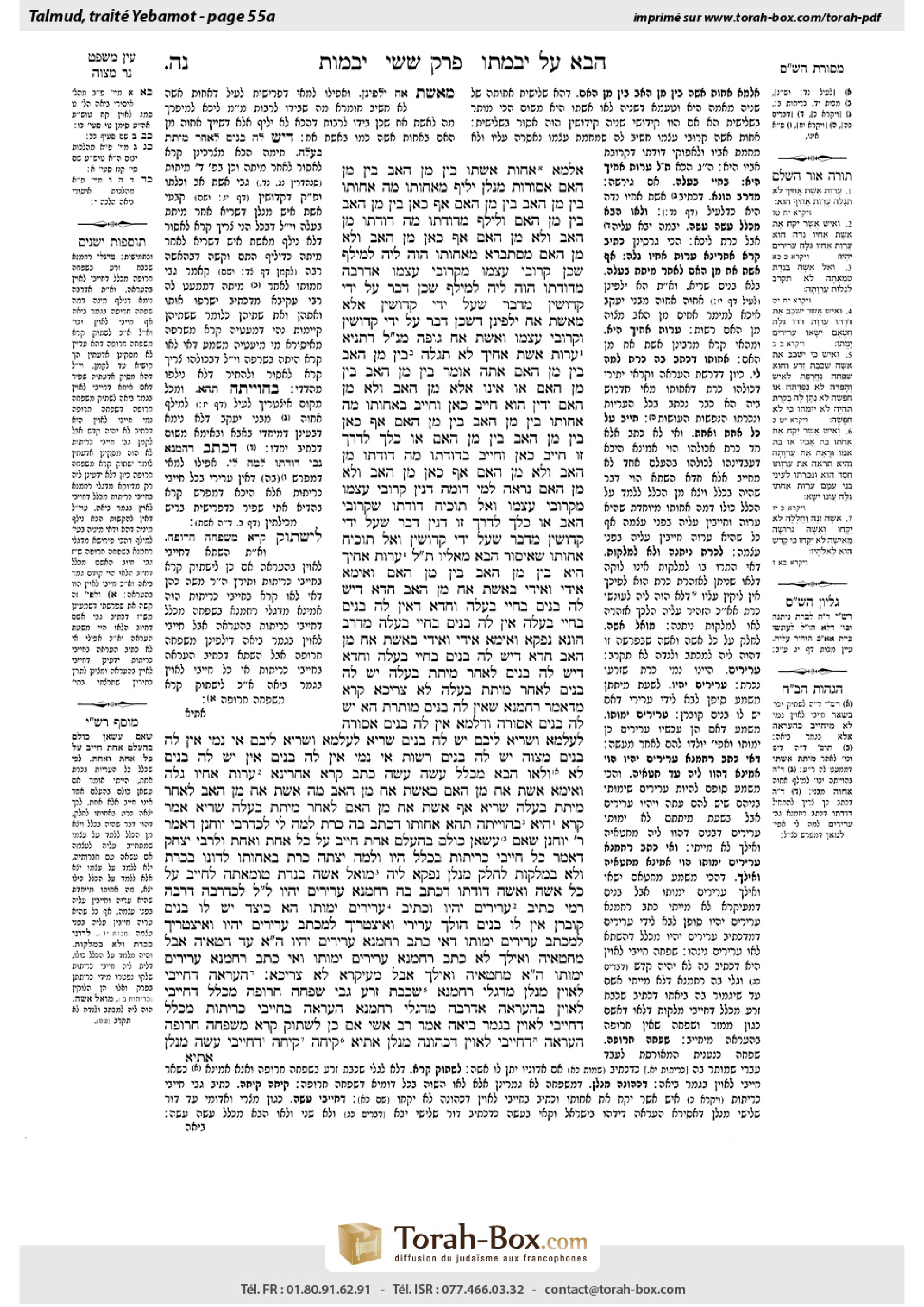
Yevamot 55a: Talmud study for Daf Yomi
Daf Yomi is the daily study of one Talmud folio. Explore 37 tractates with scans, Hebrew text, Sefaria English and AI-generated French translations where annotated.
Passage selection and English or AI-generated French translation are available where the scan has annotations. Daf Study is independent of Torah-Box and Sefaria.
Browse Yevamot · יבמות · All tractatesYevamot 55a text and translations
This page of Yevamot includes the Aramaic text, an English translation and an AI-generated French translation, alongside the scan above.
יבמות נ״ה א · Aramaic and Hebrew text
אַלְמָא אֲחוֹת אִשְׁתּוֹ, בֵּין מִן הָאָב בֵּין מִן הָאֵם — אֲסוּרוֹת. מְנָלַן? יָלֵיף מֵאֲחוֹתוֹ. מָה אֲחוֹתוֹ — בֵּין מִן הָאָב בֵּין מִן הָאֵם, אַף כָּאן — בֵּין מִן הָאָב בֵּין מִן הָאֵם.
וְלֵילַף מִדּוֹדָתוֹ: מָה דּוֹדָתוֹ מִן הָאָב וְלֹא מִן הָאֵם, אַף כָּאן מִן הָאָב וְלֹא מִן הָאֵם! מִסְתַּבְּרָא מֵאֲחוֹתוֹ הֲוָה לֵיהּ לְמֵילַף, שֶׁכֵּן קְרוֹבֵי עַצְמוֹ מִקְּרוֹבֵי עַצְמוֹ.
אַדְּרַבָּה מִדּוֹדָתוֹ הֲוָה לֵיהּ לְמֵילַף, שֶׁכֵּן דָּבָר עַל יְדֵי קִדּוּשִׁין מִדָּבָר שֶׁעַל יְדֵי קִדּוּשִׁין. אֶלָּא מֵאֵשֶׁת אָח יָלְפִינַן, דְּשֶׁכֵּן דָּבָר עַל יְדֵי קִדּוּשִׁין, וּקְרוֹבֵי עַצְמוֹ.
וְאֵשֶׁת אָח גּוּפַהּ מְנָא לַן? דְּתַנְיָא: ״עֶרְוַת אֵשֶׁת אָחִיךָ לֹא תְגַלֵּה״, בֵּין מִן הָאָב בֵּין מִן הָאֵם.
אַתָּה אוֹמֵר בֵּין מִן הָאָב בֵּין מִן הָאֵם, אוֹ אֵינוֹ אֶלָּא מִן הָאָב וְלֹא מִן הָאֵם? וְדִין הוּא: חַיָּיב כָּאן, וְחַיָּיב בַּאֲחוֹתוֹ. מָה אֲחוֹתוֹ — בֵּין מִן הָאָב בֵּין מִן הָאֵם, אַף כָּאן — בֵּין מִן הָאָב בֵּין מִן הָאֵם.
אוֹ כְּלָךְ לְדֶרֶךְ זוֹ: חַיָּיב כָּאן וְחַיָּיב בְּדוֹדָתוֹ, מָה דּוֹדָתוֹ — מִן הָאָב וְלֹא מִן הָאֵם, אַף כָּאן — מִן הָאָב וְלֹא מִן הָאֵם?!
נִרְאֶה לְמִי דּוֹמֶה: דָּנִין קְרוֹבֵי עַצְמוֹ מִקְּרוֹבֵי עַצְמוֹ, וְאַל תּוֹכִיחַ דּוֹדָתוֹ שֶׁקְּרוֹבֵי הָאָב. אוֹ כְּלָךְ לְדֶרֶךְ זוֹ: דָּנִין דָּבָר שֶׁעַל יְדֵי קִדּוּשִׁין, מִדָּבָר שֶׁעַל יְדֵי קִדּוּשִׁין, וְאַל תּוֹכִיחַ אֲחוֹתוֹ, שֶׁאִיסּוּר הַבָּא מֵאֵלָיו.
תַּלְמוּד לוֹמַר: ״עֶרְוַת אָחִיךָ הִיא״, בֵּין מִן הָאָב בֵּין מִן הָאֵם.
וְאֵימָא אִידֵּי וְאִידֵּי בְּאֵשֶׁת אָח מִן הָאָב, חֲדָא דְּיֵשׁ לָהּ בָּנִים בְּחַיֵּי בַּעְלָהּ, וַחֲדָא דְּאֵין לָהּ בָּנִים בְּחַיֵּי בַּעְלָהּ! אֵין לָהּ בָּנִים בְּחַיֵּי בַּעְלָהּ מִדְּרַב הוּנָא נָפְקָא.
וְאֵימָא אִידֵּי וְאִידֵּי בְּאֵשֶׁת אָח מִן הָאָב, חֲדָא דְּיֵשׁ לָהּ בָּנִים בְּחַיֵּי בַּעְלָהּ, וַחֲדָא דְּיֵשׁ לָהּ בָּנִים לְאַחַר מִיתַת בַּעְלָהּ!
יֵשׁ לָהּ בָּנִים לְאַחַר מִיתַת בַּעְלָהּ לָא צְרִיכָא קְרָא, מִדְּאָמַר רַחֲמָנָא שֶׁאֵין לָהּ בָּנִים מוּתֶּרֶת, הָא יֵשׁ לָהּ בָּנִים אֲסוּרָה.
וְדִלְמָא: אֵין לָהּ בָּנִים אֲסוּרָה לְעָלְמָא וְשַׁרְיָא לְיָבָם, יֵשׁ לָהּ בָּנִים שַׁרְיָא לְעָלְמָא וְשַׁרְיָא לְיָבָם! אִי נָמֵי: אֵין לָהּ בָּנִים מִצְוָה, יֵשׁ לָהּ בָּנִים רְשׁוּת!
אִי נָמֵי: אֵין לָהּ בָּנִים — אִין, יֵשׁ לָהּ בָּנִים — לָא, וְלָאו הַבָּא מִכְּלַל עֲשֵׂה — עֲשֵׂה!
כְּתַב קְרָא אַחֲרִינָא: ״עֶרְוַת אָחִיו גִּלָּה״.
וְאֵימָא אֵשֶׁת אָח מִן הָאֵם — כְּאֵשֶׁת אָח מִן הָאָב: מָה אֵשֶׁת אָח מִן הָאָב — לְאַחַר מִיתַת בַּעְלָהּ שַׁרְיָא, אַף אֵשֶׁת אָח מִן הָאֵם — לְאַחַר מִיתַת בַּעְלָהּ שַׁרְיָא! אָמַר קְרָא ״הִיא״, בַּהֲוָיָיתָהּ תְּהֵא.
אֲחוֹתוֹ דִּכְתַב בָּהּ כָּרֵת לְמָה לִי?
לְכִדְרַבִּי יוֹחָנָן: דְּאָמַר רַבִּי יוֹחָנָן שֶׁאִם עֲשָׂאָן כּוּלָּם בְּהֶעְלֵם אַחַת — חַיָּיב עַל כׇּל אַחַת וְאַחַת.
וּלְרַבִּי יִצְחָק דְּאָמַר: כׇּל חַיָּיבֵי כָּרֵיתוֹת בַּכְּלָל הָיוּ, וְלָמָּה יָצְתָה כָּרֵת בַּאֲחוֹתוֹ — לְדוּנוֹ בְּכָרֵת וְלֹא בְּמַלְקוֹת. לְחַלֵּק, מְנָלַן?
נָפְקָא לֵיהּ מִ״וְּאֶל אִשָּׁה בְּנִדַּת טוּמְאָתָהּ״, לְחַיֵּיב עַל כׇּל אִשָּׁה וְאִשָּׁה.
דּוֹדָתוֹ דִּכְתַב בַּהּ רַחֲמָנָא ״עֲרִירִים יִהְיוּ״, לְמָה לִי? לְכִדְרַבָּה. דְּרַבָּה רָמֵי, כְּתִיב: ״עֲרִירִים יִהְיוּ״, וּכְתִיב: ״עֲרִירִים יָמֻתוּ״, הָא כֵּיצַד? יֵשׁ לוֹ בָּנִים — קוֹבְרָן, אֵין לוֹ בָּנִים — הוֹלֵךְ עֲרִירִי.
וְאִיצְטְרִיךְ לְמִכְתַּב ״עֲרִירִים יִהְיוּ״, וְאִיצְטְרִיךְ לְמִכְתַּב ״עֲרִירִים יָמֻתוּ״, דְּאִי כְּתַב רַחֲמָנָא ״עֲרִירִים יִהְיוּ״, הֲוָה אָמֵינָא: עַד חִטְאֵיהּ, אֲבָל מֵחִטְאֵיהּ וְאֵילָךְ — לָא. כְּתַב רַחֲמָנָא ״עֲרִירִים יָמֻתוּ״, וְאִי כְּתַב רַחֲמָנָא ״עֲרִירִים יָמֻתוּ״, הֲוָה אָמֵינָא: מֵחִטְאֵיהּ וְאֵילָךְ, אֲבָל מֵעִיקָּרָא — לָא, צְרִיכָא.
הַעֲרָאָה דְּחַיָּיבֵי לָאוִין, מְנָלַן?
מִדְּגַלִּי רַחֲמָנָא ״שִׁכְבַת זֶרַע״ גַּבֵּי שִׁפְחָה חֲרוּפָה. מִכְּלָל דְּחַיָּיבֵי לָאוִין — בְּהַעֲרָאָה.
אַדְּרַבָּה: מִדְּגַלִּי רַחֲמָנָא הַעֲרָאָה בְּחַיָּיבֵי כָּרֵיתוֹת, מִכְּלָל דְּחַיָּיבֵי לָאוִין בִּגְמַר בִּיאָה! אָמַר רַב אָשֵׁי: אִם כֵּן — לִשְׁתּוֹק קְרָא מִשִּׁפְחָה חֲרוּפָה.
הַעֲרָאָה דְּחַיָּיבֵי לָאוִין דִּכְהוּנָּה מְנָלַן? אָתְיָא ״קִיחָה״ ״קִיחָה״.
דְּחַיָּיבֵי עֲשֵׂה מְנָלַן?
Yevamot 55a · English translation
Apparently, this mishna indicates that his wife’s sister, whether from the father, i.e., a paternal sister, or from the mother, i.e., a maternal sister, is forbidden. From where do we derive this halakha that the prohibition applies even to his wife’s maternal sister? The Gemara responds: It is derived from the prohibition proscribing his sister. Just as his sister is forbidden whether she is his sister from his father or from his mother, so too here, a wife’s sister is forbidden whether from the father or from the mother.
The Gemara challenges the validity of this source: And let it be derived from the halakha with regard to his aunt: Just as the prohibition with regard to his aunt applies only to the wife of his father’s brother from his father but not from his mother, i.e., the wife of his father’s paternal brother but not the wife of his father’s maternal brother, so too here, the prohibition with regard to his wife’s sister should apply only to her sister from her father but not to her sister from her mother. The Gemara answers: It is reasonable that he should derive the halakha in this case from the case of his sister, as the tanna thereby derives the halakha of one’s own relatives from another case of his own relatives, whereas his aunt is forbidden as his father’s relative.
The Gemara counters: On the contrary, he should derive the halakha in this instance from the case of his aunt, as he thereby derives the halakha in a matter prohibited through betrothal from another matter prohibited through betrothal. The Gemara concludes: Rather, the halakha of a wife’s sister is derived from that of a brother’s wife, as they are both something forbidden by means of betrothal and they are his own relatives.
The Gemara asks: And in the case of a brother’s wife itself, from where do we derive that the prohibition applies to the wife of both a paternal and a maternal brother? As it is taught in a baraita: “You shall not uncover the nakedness of your brother’s wife” (Leviticus 18:16), which indicates: Whether from the father or from the mother.
The baraita elaborates: Do you say the prohibition applies whether she is the wife of one’s brother from his father or from his mother, i.e., whether she is the wife of one’s paternal brother or maternal brother? Or perhaps it is only the wife of one’s brother from his father and not from his mother? It may be inferred logically from the fact that the Torah rendered him liable here and rendered him liable with regard to his sister: Just as with regard to his sister he is liable to receive punishment whether she is his sister from his father or from his mother, so too here, he is liable to receive punishment whether she is the wife of his brother from his father or from his mother.
Or perhaps go this way and compare this case to the case of an aunt. The Torah rendered him liable here and rendered him liable with regard to his aunt, i.e., the wife of his father’s brother: Just as with regard to his aunt, he is liable to receive punishment only for the wife of his father’s brother from his father and not for the wife of his father’s brother from his mother, so too here, he is liable to receive punishment only for the wife of his brother from his father and not from his mother.
The Gemara analyzes these two possibilities: Let us see to which case it is more similar. We should derive the halakha with regard to his own relatives, i.e., his brother’s wife, from another case of his own relatives, i.e., his sister, and the halakha with regard to his aunt cannot be used to prove otherwise, as she is his father’s relative. Or perhaps go this way: We should derive the halakha of a matter prohibited through betrothal, i.e., a brother’s wife, from another matter prohibited through betrothal, i.e., his father’s brother’s wife, and the halakha with regard to his sister cannot be used to prove otherwise, as it is a prohibition that comes on its own.
Since it is impossible to prove which halakha should serve as the model for the case of a brother’s wife, the verse states a second time in the same verse: “It is your brother’s nakedness” (Leviticus 18:16), in order to emphasize that she is forbidden whether she is the wife of his brother from his father or from his mother.
The Gemara challenges this interpretation of the extra phrase in the verse: Say that both this first part of the verse and that latter part refer to the wife of a brother from the father, i.e., the wife of one’s paternal brother. As for the repetition, one part of the verse renders prohibited a woman who has children, who is prohibited from marrying her husband’s brother during her husband’s lifetime even after they are divorced, and the other one renders prohibited a woman who does not have children, who is also prohibited from marrying her husband’s brother during her husband’s lifetime, even after she is divorced. The Gemara responds: The prohibition proscribing a woman who does not have children for the duration of her husband’s lifetime is derived from the statement of Rav Huna (54b), and it requires no further source.
The Gemara presents another challenge: Say that both this first part of the verse and that latter part refer to the wife of a brother from the father, i.e., the wife of one’s paternal brother. As for the repetition, one part of the verse renders a woman who has children prohibited from marrying her husband’s brother for the duration of her husband’s lifetime, even after she is divorced, and the other one renders prohibited a woman who has children and indicates that it is prohibited for her to marry her husband’s brother even after her husband’s death.
The Gemara responds: The halakha that it is prohibited for a woman who has children to marry her husband’s brother even after her husband’s death does not require a verse. From the fact that the Merciful One says that one who has no children is permitted to marry the brother after her husband’s death, it can be inferred that if she has children, it is prohibited for her to marry her husband’s brother.
The Gemara raises another challenge: But perhaps if she does not have children it is prohibited for her to marry everyone else and permitted for her to marry her yavam, as specified by the Torah. However, if she does have children it is permitted for her to marry everyone and it is permitted for her to marry her yavam as well. Alternatively, perhaps if she does not have children it is a mitzva for her husband’s brother to marry her, and if she does have children it is optional. Consequently, the extra phrase in the verse should be necessary in order to indicate that the prohibition against marriage applies in all of these cases.
Alternatively, if she does not have children, yes, she is permitted to her husband’s brother, and if she does have children, no, she is not permitted to him, but the punishment of karet does not apply to this prohibition. This is because the source of the prohibition is the mitzva for them to marry after the husband’s death, and a prohibition that stems from a positive mitzva has the status of a positive mitzva, but nothing more. Consequently, the extra phrase in the verse should be necessary in order to indicate that the punishment of karet is still applicable.
The Gemara responds: The Torah wrote a different verse to teach that the prohibition against marrying one’s brother’s wife is in full force, including the punishment of karet, in these cases: “He has uncovered his brother’s nakedness; they shall be childless” (Leviticus 20:21). Therefore, the extra phrase mentioned in the baraita can indicate that the prohibition against marrying one’s brother’s wife applies both to the wife of a paternal brother and to the wife of a maternal brother.
The Gemara suggests: Say that the halakha of the wife of a brother from one’s mother should be just like that of the wife of a brother from his father: Just as the wife of a brother from one’s father is permitted, i.e., one can marry her, after her husband’s death, so too, the wife of a brother from his mother should be permitted after her husband’s death. The Gemara responds: The verse states: “She is your brother’s nakedness,” thereby emphasizing that she shall remain after her husband’s death as she is during his life.
§ The Gemara above stated that all of the instances of forbidden intercourse are compared to one another. Therefore, since there is already a verse that states: “For whoever shall do any of these abominations, the souls that do them shall be cut off from among their people” (Leviticus 18:29), the Gemara asks: Why do I need the phrase written with regard to one’s sister that states that intercourse is punishable by karet?
The Gemara answers that it is necessary for that which Rabbi Yoḥanan said, as Rabbi Yoḥanan said that if he performed all of them, i.e., he violated every prohibition against engaging in forbidden intercourse in a single lapse of awareness, he is liable to receive punishment for each and every one. One might have thought that there is one prohibition against engaging in forbidden intercourse, and many different ways to violate the prohibition. Therefore, if one violated the prohibition in different ways during one lapse of awareness, one is liable to bring only one sin-offering. This verse therefore indicates that each act of intercourse with a relative with whom intercourse is forbidden is a violation of an independent prohibition.
The Gemara asks: And according to Rabbi Yitzḥak, who said that all forbidden relations for which one is liable to receive karet were included in the verse: “The souls that do them shall be cut off from among their people,” why was the punishment of karet with regard to one’s sister singled out? In order to sentence him to karet and not to flogging. Although he has violated a prohibition, which generally carries a punishment of flogging, he is not flogged due to the fact that he is liable to receive the more severe punishment of karet. Since he has used the verse to teach this halakha, from where do we know to divide the prohibitions against engaging in forbidden intercourse and consider each an independent prohibition?
The Gemara answers: He derives it from the verse “And you shall not approach a woman to uncover her nakedness as long as she is impure by her uncleanness” (Leviticus 18:19), which serves to render him liable to receive punishment for each and every woman.
The Gemara poses another question: Why do I need the phrase that the Merciful One writes with regard to one’s aunt, which states: They shall be childless? The death of one’s children is included in the punishment of karet, and it has already been established that all of the forbidden intercourse is punishable by karet. The Gemara answers that it is necessary for that which Rabba said, as Rabba raised a contradiction: It is written with regard to one who had intercourse with his brother’s wife: “They shall be childless” (Leviticus 20:22), and it also states with regard to one who had intercourse with his aunt: “They shall die childless” (Leviticus 20:21). How so? If he already has children, he will eventually bury them; if he does not have children, he will go childless.
The Gemara comments: And it is necessary to state: They shall be childless, and it is also necessary to state: They shall die childless. As, if the Merciful One had written only: They shall be childless, I would have said that only those children he had before his sin will die, but those born to him from the time of his sin and on, no, they will not die. The Torah therefore states: They shall die childless, indicating that even if he has children afterward they will die and he will remain childless. And similarly, if the Merciful One had written only: They shall die childless, I would have said that this is referring to children born from the time of his sin and on, but those born from the beginning, before he sinned, no, they will not die. It is therefore necessary to mention both expressions.
§ The Gemara above (54a–54b) derived that the initial stage of intercourse is considered an act of sexual intercourse with regard to prohibitions that are punishable by capital punishment or karet. The Gemara asks: From where do we derive that the initial stage of intercourse is considered an act of sexual intercourse with regard to those liable to receive punishment for violating ordinary Torah prohibitions?
The Gemara answers: From the fact that the Merciful One reveals with regard to a designated maidservant that the prohibition has been violated only through an act of cohabitation with seed, i.e., a complete act of sexual intercourse, in the verse “And whoever lies with a woman in cohabitation with seed, and she is a bondmaid designated to a man” (Leviticus 19:20), by inference, those liable to receive punishment for violating ordinary prohibitions are liable even through the initial stage of intercourse.
The Gemara responds: On the contrary, from the fact that the Merciful One reveals that the initial stage of intercourse is considered sexual intercourse with regard to forbidden relationships for which one is liable to receive karet, then, by inference, those liable for violating ordinary prohibitions are liable only through the completion of the act of sexual intercourse and not merely for the initial stage of intercourse. Rav Ashi said: If so, let the verse remain silent in the case of a designated maidservant, and it would be assumed that one is liable to receive punishment only for completing the act of sexual intercourse. The fact that the Torah specified that in this case one is liable to receive punishment only for completing the act of sexual intercourse indicates that with regard to other ordinary prohibitions one is liable even for the initial stage of intercourse.
The Gemara asks: From where do we derive that the initial stage of intercourse is considered an act of sexual intercourse with regard to those liable to receive punishment for violating prohibitions specific to the priesthood? Since these prohibitions are unique in that they apply only to priests, their parameters cannot be derived from prohibitions that apply to the entire population. The Gemara answers: It is derived from a verbal analogy between the words taking and taking. This verb appears in prohibitions punishable by karet, e.g., “And if a man shall take his sister” (Leviticus 20:17), and in prohibitions of the priesthood, where it states: “They shall not take a woman that is a harlot” (Leviticus 21:7).
The Gemara asks further: From where do we derive that the initial stage of intercourse is considered an act of sexual intercourse with regard to those liable to receive punishment for violating a positive mitzva, e.g., one who has intercourse with an Egyptian or Edomite convert? The verse states: “The children that are born to them of the third generation may enter into the assembly of the Lord” (Deuteronomy 23:9). It is therefore a positive mitzva that only the grandchildren of these converts may have intercourse with a Jew.
Yevamot 55a · Traduction française (IA)
Apparemment, cette Michna indique que la sœur de son épouse, qu’elle soit sa sœur du côté paternel ou du côté maternel, lui est interdite. D’où déduisons-nous cette halakha, selon laquelle l’interdiction s’applique même à la sœur maternelle de son épouse ? La Guemara répond : On la déduit de l’interdiction concernant sa sœur. De même que sa sœur lui est interdite, qu’elle soit sa sœur du côté de son père ou de sa mère, de même, la sœur de son épouse lui est interdite, qu’elle soit la sœur de celle-ci du côté de son père ou de sa mère.
La Guemara conteste la validité de cette source : Ne devrait-on pas plutôt déduire cela de la halakha concernant sa tante ? De même que l’interdiction concernant sa tante ne s’applique qu’à l’épouse du frère de son père du côté paternel, mais non à l’épouse du frère de son père du côté maternel, de même, ici, l’interdiction concernant la sœur de son épouse ne devrait s’appliquer qu’à la sœur de celle-ci du côté de son père, mais non du côté de sa mère. La Guemara répond : Il est logique de déduire la halakha dans ce cas de celle concernant sa sœur, car le tanna déduit ainsi la halakha relative à ses propres parentes d’un autre cas concernant ses propres parentes, tandis que sa tante est une parente de son père.
La Guemara rétorque : Au contraire, il devrait déduire la halakha dans ce cas de celle concernant sa tante, car il déduit ainsi la halakha relative à une interdiction liée au mariage d’une autre interdiction liée au mariage. La Guemara conclut : Il faut plutôt déduire la halakha concernant la sœur de son épouse de celle concernant l’épouse de son frère, car, dans les deux cas, il s’agit d’une personne interdite par le biais du mariage et d’une parente à lui.
La Guemara demande : Et pour l’épouse du frère elle-même, d’où déduisons-nous que l’interdiction s’applique à l’épouse aussi bien d’un frère paternel que d’un frère maternel ? Car il est enseigné dans une baraïta : « Tu ne découvriras pas la nudité de la femme de ton frère » (Lévitique 18:16), ce qui signifie : qu’il soit du côté du père ou de la mère.
La baraïta développe : Veut-on dire que l’interdiction s’applique que la femme soit l’épouse du frère de son père ou de sa mère, c’est-à-dire l’épouse de son frère paternel ou maternel ? Ou peut-être s’agit-il seulement de l’épouse de son frère paternel, mais non de celle de son frère maternel ? On peut le déduire logiquement du fait que la Torah l’a rendu passible ici et l’a rendu passible concernant sa sœur : de même que, concernant sa sœur, il est passible d’une peine, qu’elle soit sa sœur du côté de son père ou de sa mère, de même, ici, il est passible d’une peine, que la femme soit l’épouse de son frère du côté de son père ou de sa mère.
Ou peut-être faut-il suivre une autre voie et comparer ce cas à celui d’une tante. La Torah l’a rendu passible ici et l’a rendu passible concernant sa tante, c’est-à-dire l’épouse du frère de son père : de même que, concernant sa tante, il n’est passible d’une peine que pour l’épouse du frère de son père du côté paternel, mais non pour celle du frère de son père du côté maternel, de même, ici, il ne serait passible d’une peine que pour l’épouse de son frère du côté paternel, mais non pour celle de son frère du côté maternel.
La Guemara examine ces deux possibilités : Voyons à quel cas celui-ci ressemble davantage. Nous devrions déduire la halakha concernant ses propres parentes, c’est-à-dire l’épouse de son frère, d’un autre cas concernant ses propres parentes, c’est-à-dire sa sœur ; et la halakha concernant sa tante ne peut servir à prouver le contraire, puisqu’elle est une parente de son père. Ou peut-être faut-il suivre cette autre voie : Nous devrions déduire la halakha relative à une interdiction liée au mariage, c’est-à-dire l’épouse d’un frère, d’une autre interdiction liée au mariage, c’est-à-dire l’épouse du frère de son père ; et la halakha concernant sa sœur ne peut servir à prouver le contraire, car l’interdiction dans ce cas existe indépendamment du mariage.
Puisqu’il est impossible de déterminer quelle halakha doit servir de modèle pour le cas de l’épouse d’un frère, le verset répète, dans le même verset : « C’est la nudité de ton frère » (Lévitique 18:16), afin de souligner que cette femme lui est interdite, qu’elle soit l’épouse de son frère paternel ou de son frère maternel.
La Guemara conteste cette interprétation de l’expression supplémentaire dans le verset : Disons que la première partie du verset et sa dernière partie concernent toutes deux l’épouse d’un frère paternel. Quant à la répétition, une partie du verset interdit à une femme qui a des enfants d’épouser le frère de son mari du vivant de celui-ci, même après leur divorce, et l’autre partie interdit à une femme qui n’a pas d’enfants d’épouser le frère de son mari, elle aussi du vivant de celui-ci, même après son divorce. La Guemara répond : L’interdiction faite à une femme sans enfants de se marier tant que son mari est en vie se déduit de l’enseignement de Rav Houna (54b) et ne nécessite aucune autre source.
La Guemara présente une autre objection : Disons que la première partie du verset et sa dernière partie concernent toutes deux l’épouse d’un frère paternel. Quant à la répétition, une partie du verset interdit à une femme qui a des enfants d’épouser le frère de son mari tant que celui-ci est en vie, même après leur divorce, tandis que l’autre partie interdit à une femme qui a des enfants d’épouser le frère de son mari et indique qu’elle ne peut pas non plus l’épouser après la mort de son mari.
La Guemara répond : Il n’est pas nécessaire d’avoir un verset pour établir qu’une femme qui a des enfants ne peut pas épouser le frère de son mari, même après la mort de celui-ci. Du fait que le Miséricordieux dit que celle qui n’a pas d’enfants est autorisée à épouser le frère après la mort de son mari, on peut déduire que si elle a des enfants, il lui est interdit d’épouser le frère de son mari.
La Guemara soulève une autre objection : Mais peut-être que, si elle n’a pas d’enfants, il lui est interdit d’épouser toute autre personne et qu’elle est autorisée à épouser son yavam, comme le précise la Torah. En revanche, si elle a des enfants, elle est autorisée à épouser tout le monde, y compris son yavam. Ou peut-être que, si elle n’a pas d’enfants, c’est une mitsva pour le frère de son mari de l’épouser, tandis que si elle a des enfants, c’est facultatif. Par conséquent, l’expression supplémentaire dans le verset devrait être nécessaire pour indiquer que l’interdiction de se marier s’applique dans tous ces cas.
Ou encore, si elle n’a pas d’enfants, elle est autorisée à épouser le frère de son mari ; mais si elle a des enfants, elle ne lui est pas autorisée, sans que cette interdiction soit passible de karet. En effet, la source de l’interdiction est la mitsva qui leur enjoint de se marier après la mort du mari, et une interdiction qui découle d’une mitsva positive a le statut d’une mitsva positive, mais rien de plus. Par conséquent, l’expression supplémentaire dans le verset devrait être nécessaire pour indiquer que la peine de karet s’applique malgré tout.
La Guemara répond : La Torah a écrit un autre verset pour enseigner que l’interdiction d’épouser la femme de son frère s’applique pleinement, y compris la peine de karet, dans ces cas : « Il a découvert la nudité de son frère ; ils seront sans enfants » (Lévitique 20:21). Par conséquent, l’expression supplémentaire mentionnée dans la baraïta peut indiquer que l’interdiction d’épouser la femme de son frère s’applique aussi bien à l’épouse d’un frère paternel qu’à celle d’un frère maternel.
La Guemara propose : Disons que la halakha concernant l’épouse du frère de sa mère devrait être identique à celle concernant l’épouse du frère de son père : de même que l’épouse du frère de son père lui est permise, c’est-à-dire qu’il peut l’épouser, après la mort de son mari, de même, l’épouse du frère de sa mère devrait lui être permise après la mort de son mari. La Guemara répond : Le verset dit : « Elle est la nudité de ton frère », soulignant ainsi qu’elle doit conserver après la mort de son mari le même statut que de son vivant.
§ La Guemara a dit plus haut que tous les cas de relations sexuelles interdites sont comparés les uns aux autres. Par conséquent, puisqu’un verset dit déjà : « Quiconque commet l’une de ces abominations, les personnes qui les commettent seront retranchées du sein de leur peuple » (Lévitique 18:29), la Guemara demande : Pourquoi ai-je besoin de l’expression écrite au sujet de sa sœur, qui indique que les rapports sexuels sont passibles de karet ?
La Guemara répond que cette expression est nécessaire pour ce qu’a dit Rabbi Yoḥanan : si un homme les commet toutes, c’est-à-dire s’il transgresse chacune des interdictions de relations sexuelles prohibées au cours d’une seule et même inadvertance, il est passible d’une peine pour chacune d’elles. On aurait pu penser qu’il n’existe qu’une seule interdiction de relations sexuelles prohibées, mais de nombreuses manières de la transgresser ; par conséquent, si quelqu’un la transgresse de différentes façons au cours d’une seule inadvertance, il n’est tenu d’apporter qu’un seul sacrifice expiatoire. Ce verset indique donc que chaque rapport sexuel avec une parente avec laquelle les rapports sont interdits constitue la transgression d’une interdiction distincte.
La Guemara demande : Et selon Rabbi Yitzḥak, qui a dit que toutes les relations interdites passibles de karet sont incluses dans le verset : « Les personnes qui les commettent seront retranchées du sein de leur peuple », pourquoi la peine de karet concernant sa sœur a-t-elle été mentionnée séparément ? Afin de lui faire encourir le karet et non la flagellation. Bien qu’il ait transgressé une interdiction, laquelle entraîne généralement la flagellation, il ne reçoit pas de coups, car il est passible de la peine plus sévère de karet. Puisqu’il a utilisé le verset pour enseigner cette halakha, d’où savons-nous qu’il faut distinguer les interdictions de relations sexuelles prohibées et considérer chacune comme une interdiction distincte ?
La Guemara répond : Il le déduit du verset : « Tu ne t’approcheras pas d’une femme pour découvrir sa nudité tant qu’elle est impure de son impureté » (Lévitique 18:19), qui le rend passible d’une peine pour chacune des femmes.
La Guemara pose une autre question : Pourquoi ai-je besoin de l’expression que le Miséricordieux écrit au sujet de sa tante, qui dit : « Ils seront sans enfants » ? La mort de ses enfants est incluse dans la peine de karet, et il a déjà été établi que toutes les relations sexuelles interdites sont passibles de karet. La Guemara répond que cette expression est nécessaire pour ce qu’a dit Rabba, car Rabba a relevé une contradiction : Il est écrit, au sujet de celui qui a eu des rapports avec la femme de son frère : « Ils seront sans enfants » (Lévitique 20:22), et il est également écrit, au sujet de celui qui a eu des rapports avec sa tante : « Ils mourront sans enfants » (Lévitique 20:21). Comment comprendre cela ? S’il a déjà des enfants, il finira par les enterrer ; s’il n’a pas d’enfants, il restera sans enfants.
La Guemara fait remarquer : Il est nécessaire de dire « Ils seront sans enfants », et il est également nécessaire de dire « Ils mourront sans enfants ». En effet, si le Miséricordieux avait écrit seulement « Ils seront sans enfants », j’aurais dit que seuls les enfants qu’il avait avant sa faute mourraient, mais que ceux qui lui naîtraient à partir du moment de sa faute ne mourraient pas. La Torah dit donc : « Ils mourront sans enfants », ce qui indique que même s’il a des enfants par la suite, ils mourront et il restera sans enfants. De même, si le Miséricordieux avait écrit seulement « Ils mourront sans enfants », j’aurais dit que cela concerne les enfants nés à partir du moment de sa faute, mais que ceux qui sont nés auparavant, avant qu’il ne pèche, ne mourraient pas. Il est donc nécessaire de mentionner les deux expressions.
§ La Guemara a établi plus haut (54a–54b) que le stade initial du rapport est considéré comme un acte sexuel pour les interdictions passibles de la peine capitale ou de karet. La Guemara demande : D’où déduisons-nous que le stade initial du rapport est considéré comme un acte sexuel pour ceux qui sont passibles d’une peine pour avoir transgressé les interdictions ordinaires de la Torah ?
La Guemara répond : Du fait que le Miséricordieux révèle, au sujet d’une servante désignée, que l’interdiction n’est transgressée que par un rapport avec émission de semence, c’est-à-dire un acte sexuel complet, dans le verset : « Si un homme couche avec une femme par un rapport avec émission de semence, et qu’elle est une servante désignée pour un homme » (Lévitique 19:20), on déduit que ceux qui sont passibles d’une peine pour la transgression des interdictions ordinaires le sont même pour le stade initial du rapport.
La Guemara répond : Au contraire, du fait que le Miséricordieux révèle que le stade initial du rapport est considéré comme un acte sexuel dans le cas des relations interdites passibles de karet, on déduit que ceux qui sont passibles d’une peine pour la transgression des interdictions ordinaires ne le sont qu’à l’achèvement de l’acte sexuel, et non pour le seul stade initial du rapport. Rav Ashi a dit : Dans ce cas, que le verset garde le silence au sujet d’une servante désignée ; on supposerait alors qu’on n’est passible d’une peine qu’à l’achèvement de l’acte sexuel. Le fait que la Torah ait précisé que, dans ce cas, on n’est passible d’une peine qu’à l’achèvement de l’acte sexuel indique que, pour les autres interdictions ordinaires, on est passible même pour le stade initial du rapport.
La Guemara demande : D’où déduisons-nous que le stade initial du rapport est considéré comme un acte sexuel pour ceux qui sont passibles d’une peine pour avoir transgressé les interdictions propres à la prêtrise ? Puisque ces interdictions sont particulières en ce qu’elles ne s’appliquent qu’aux prêtres, leurs paramètres ne peuvent pas être déduits des interdictions qui s’appliquent à l’ensemble de la population. La Guemara répond : On le déduit d’une analogie verbale entre les mots « prendre » et « prendre ». Ce verbe apparaît dans des interdictions passibles de karet, par exemple : « Si un homme prend sa sœur » (Lévitique 20:17), et dans les interdictions propres à la prêtrise, où il est dit : « Ils ne prendront pas pour épouse une femme prostituée » (Lévitique 21:7).
La Guemara demande encore : D’où déduisons-nous que le stade initial du rapport est considéré comme un acte sexuel pour ceux qui sont passibles d’une peine pour avoir transgressé une mitsva positive, par exemple celui qui a des rapports avec une convertie égyptienne ou édomite ? Le verset dit : « Les enfants qui leur naîtront à la troisième génération pourront entrer dans l’assemblée de l’Éternel » (Deutéronome 23:9). Il s’agit donc d’une mitsva positive selon laquelle seuls les petits-enfants de ces convertis peuvent avoir des rapports avec un Juif.
Traduction française générée par IA à partir de l’édition anglaise de Sefaria. Vérifie toujours un passage avec le texte source.
Text from Sefaria: William Davidson Edition - Vocalized Aramaic (CC BY NC); William Davidson Edition - English (CC BY NC).