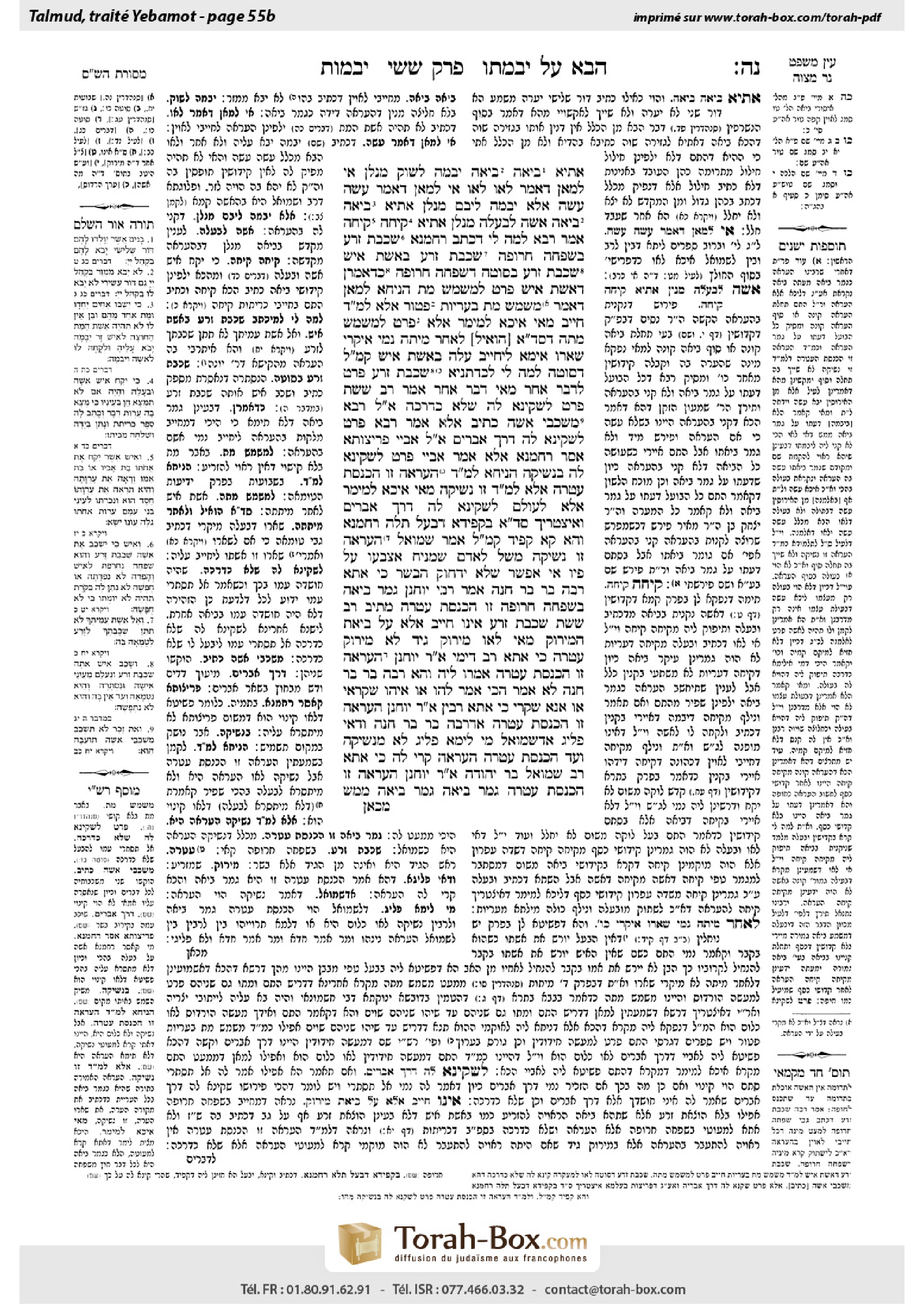
Yevamot 55b: Talmud study for Daf Yomi
Daf Yomi is the daily study of one Talmud folio. Explore 37 tractates with scans, Hebrew text, Sefaria English and AI-generated French translations where annotated.
Passage selection and English or AI-generated French translation are available where the scan has annotations. Daf Study is independent of Torah-Box and Sefaria.
Browse Yevamot · יבמות · All tractatesYevamot 55b text and translations
This page of Yevamot includes the Aramaic text, an English translation and an AI-generated French translation, alongside the scan above.
יבמות נ״ה ב · Aramaic and Hebrew text
אָתְיָא ״בִּיאָה״ ״בִּיאָה״.
יְבָמָה לַשּׁוּק, מְנָלַן? אִי לְמַאן דְּאָמַר לָאו — לָאו, אִי לְמַאן דְּאָמַר עֲשֵׂה — עֲשֵׂה.
אֶלָּא: יְבָמָה לְיָבָם מְנָלַן? אָתְיָא ״בִּיאָה״ ״בִּיאָה״.
אִשָּׁה לְבַעְלָהּ מְנָלַן? אָתְיָא ״קִיחָה״ ״קִיחָה״.
אָמַר רָבָא: לְמָה לִי דִּכְתַב רַחֲמָנָא ״שִׁכְבַת זֶרַע״ בְּשִׁפְחָה חֲרוּפָה, ״שִׁכְבַת זֶרַע״ בְּאֵשֶׁת אִישׁ, ״שִׁכְבַת זֶרַע״ בְּסוֹטָה?
דְּשִׁפְחָה חֲרוּפָה — כְּדַאֲמַרַן. דְּאֵשֶׁת אִישׁ פְּרָט לִמְשַׁמֵּשׁ מֵת.
הָנִיחָא לְמַאן דְּאָמַר מְשַׁמֵּשׁ מֵת בַּעֲרָיוֹת פָּטוּר, אֶלָּא לְמַאן דְּאָמַר חַיָּיב, מַאי אִיכָּא לְמֵימַר? אֶלָּא: פְּרָט לִמְשַׁמֵּשׁ מֵתָה. דְּסָלְקָא דַּעְתָּךְ אָמֵינָא [הוֹאִיל] לְאַחַר מִיתָה נָמֵי אִיקְּרַי ״שְׁאֵרוֹ״, אֵימָא לִיחַיַּיב עֲלַהּ בְּאֵשֶׁת אִישׁ, קָא מַשְׁמַע לַן.
דְּסוֹטָה לְמָה לִי? לְכִדְתַנְיָא: ״שִׁכְבַת זָרַע״, פְּרָט לְדָבָר אַחֵר. מַאי ״דָּבָר אַחֵר״? אָמַר רַב שֵׁשֶׁת: פְּרָט לְשֶׁקִּינֵּא לָהּ שֶׁלֹּא כְּדַרְכָּהּ. אֲמַר לֵיהּ רָבָא: ״מִשְׁכְּבֵי אִשָּׁה״ כְּתִיב!
אֶלָּא אָמַר רָבָא: פְּרָט לְשֶׁקִּינֵּא לָהּ דֶּרֶךְ אֵבָרִים. אֲמַר לֵיהּ אַבָּיֵי: פְּרִיצוּתָא אֲסַר רַחֲמָנָא?
אֶלָּא אָמַר אַבָּיֵי: פְּרָט לְשֶׁקִּינֵּא לָהּ בִּנְשִׁיקָה. הָנִיחָא לְמַאן דְּאָמַר הַעֲרָאָה זוֹ הַכְנָסַת עֲטָרָה. אֶלָּא לְמַאן דְּאָמַר זוֹ נְשִׁיקָה, מַאי אִיכָּא לְמֵימַר?
אֶלָּא, לְעוֹלָם לְשֶׁקִּינֵּא לָהּ דֶּרֶךְ אֵבָרִים, וְאִיצְטְרִיךְ, סָלְקָא דַּעְתָּךְ אָמֵינָא: בִּקְפֵידָא דְבַעַל תְּלָה רַחֲמָנָא, וְהָא קָא קָפֵיד, קָא מַשְׁמַע לַן.
אָמַר שְׁמוּאֵל: הַעֲרָאָה זוֹ נְשִׁיקָה. מָשָׁל לְאָדָם שֶׁמַּנִּיחַ אֶצְבָּעוֹ עַל פִּיו, אִי אֶפְשָׁר שֶׁלֹּא יִדְחוֹק הַבָּשָׂר.
כִּי אֲתָא רַבָּה בַּר בַּר חָנָה, אָמַר רַבִּי יוֹחָנָן: גְּמַר בִּיאָה בְּשִׁפְחָה חֲרוּפָה זוֹ הַכְנָסַת עֲטָרָה. מֵתִיב רַב שֵׁשֶׁת: ״שִׁכְבַת זֶרַע״, אֵינוֹ חַיָּיב אֶלָּא עַל בִּיאַת הַמֵּירוּק. מַאי לָאו — מֵירוּק גִּיד?! לָא, מֵירוּק עֲטָרָה.
כִּי אֲתָא רַב דִּימִי, אָמַר רַבִּי יוֹחָנָן הַעֲרָאָה זוֹ הַכְנָסַת עֲטָרָה. אֲמַרוּ לֵיהּ: וְהָא רַבָּה בַּר בַּר חָנָה לָא אָמַר הָכִי! אֲמַר לְהוּ: אוֹ אִיהוּ שַׁקְרַאי אוֹ אֲנָא שַׁקְרַי.
כִּי אֲתָא רָבִין, אָמַר רַבִּי יוֹחָנָן: הַעֲרָאָה זוֹ הַכְנָסַת עֲטָרָה. אַדְּרַבָּה בַּר בַּר חָנָה וַדַּאי פְּלִיג. אַדִּשְׁמוּאֵל מִי לֵימָא פְּלִיג?
לֹא, מִנְּשִׁיקָה וְעַד הַכְנָסַת עֲטָרָה — הַעֲרָאָה קָרֵי לַהּ.
כִּי אֲתָא רַב שְׁמוּאֵל בַּר יְהוּדָה, אָמַר רַבִּי יוֹחָנָן: הַעֲרָאָה זוֹ הַכְנָסַת עֲטָרָה, גְּמַר בִּיאָה — גְּמַר בִּיאָה מַמָּשׁ.
Yevamot 55b · English translation
It is derived from a verbal analogy between the terms entering and entering. The verse states in the context of a prohibition: “A mamzer shall not enter into the assembly of the Lord” (Deuteronomy 23:3), and in the context of a prohibition derived from a positive mitzva: “The children that are born to them of the third generation may enter into the assembly of the Lord” (Deuteronomy 23:9). Consequently, these types of prohibitions are equated.
The Gemara poses another question: From where do we derive that the initial stage of intercourse is considered sexual intercourse with regard to the prohibition against a yevama having intercourse with a man from the general public? The Gemara answers that there is no need for an independent source in this case: If you are asking according to the one who said that this is an ordinary prohibition, it is a prohibition like any other. If you are asking according to the one who said that this is a positive mitzva, it is a positive mitzva like any other.
Rather, the question is as follows: From where do we derive that a yevama is acquired by her yavam via the initial stage of intercourse? The Gemara answers: It is derived from a verbal analogy between the words entering and entering. This verb is used with regard to ordinary Torah prohibitions, as mentioned above, and also with regard to levirate marriage, in the verse “Her brother-in-law will have intercourse with her” (Deuteronomy 25:5).
The Gemara asks further: From where do we derive that a woman is betrothed to her husband through the initial stage of intercourse? The Gemara answers: It is derived from a verbal analogy between the words taking and taking. With regard to betrothal, the verse states: “When a man takes a wife and marries her” (Deuteronomy 24:1). This verb is also used with regard to forbidden intercourse, as in the verse: “And if a man shall take his sister” (Leviticus 20:17).
§ Rava said: Now that it has been established that the initial stage of intercourse is considered an act of sexual intercourse, why do I need the expression “cohabitation with seed” (Leviticus 19:20) that the Merciful One writes with regard to a designated maidservant; the expression “cohabitation with seed” (Leviticus 18:20) written with regard to a married woman; and the expression “cohabitation with seed” (Numbers 5:13) written with regard to a sota?
The Gemara explains that the expression is necessary with regard to a designated maidservant as we said above (55a), because it indicates that one is liable to receive punishment only for a complete act of intercourse with a designated maidservant but not for the initial stage of intercourse. With regard to a married woman, the word seed excludes one who has intercourse with a dead organ, i.e., one that is not erect, as this cannot lead to childbirth.
The Gemara questions this resolution: This works out well according to the one who said that one who has intercourse while his organ is dead with those with whom relations are forbidden, is exempt, as this is not considered an act of intercourse. However, according to the one who said that he is liable, what is there to say? Rather, according to this opinion, the verse excludes one who has intercourse with a dead woman. As it might enter your mind to say: Since after death she is also called her husband’s kin, say that one who had intercourse with her should be liable to receive punishment for committing adultery with a married woman. It therefore teaches us that intercourse with a dead woman is not considered intercourse at all.
The Gemara addresses the third case: Why do I need the expression cohabitation with seed in the context of a sota? It is needed for that which is taught in a baraita, that the expression a cohabitation with seed excludes something else. The Gemara asks: What is this something else? Rav Sheshet said: It excludes a case where the husband was jealous with regard to her and warned her not to seclude herself and have atypical, i.e., anal, sexual intercourse with another man. Rava objected to this explanation and said to him: It is written: “The cohabitations of a woman” (Leviticus 18:22), indicating that there are two types of intercourse with a woman, and the same halakha applies to both.
Rather, Rava said: It excludes a situation where the husband was jealous with regard to her and warned her not to seclude herself with another man and engage in intimate contact by way of other limbs. The verse indicates that the wife does not become prohibited to her husband if she secludes herself with the man after this warning. Abaye said to him: Does the Merciful One prohibit a woman to her husband due merely to licentious behavior without sexual intercourse? Since this behavior would not render a woman prohibited to her husband, it is obvious that a warning that explicitly mentions this behavior is insufficient to cause the woman to become a sota if she then secludes herself with the man.
Rather, Abaye said: It excludes a case where he was jealous with regard to her and warned her not to seclude herself with another man and kiss, i.e., have external contact of the sexual organs. The Gemara asks: This works out well according to the one who said that the definition of the initial stage of intercourse is the insertion of the corona; therefore, mere external contact is not considered sexual intercourse. However, according to the one who said that the definition of the initial stage of intercourse is a kiss, what is there to say?
Rather, the expression: Something else, in the baraita, is actually referring to a case where the husband was jealous with regard to her and warned her not to seclude herself with another man and engage in intimate contact by way of other limbs. And it is necessary to state that the woman does not become prohibited to her husband as a sota in this case, as it might enter your mind to say that the Merciful One made this halakha dependent on the husband’s objection, as it is his decision to warn his wife, and since he objects to contact of this nature, she becomes a sota if she secludes herself after this warning. The Torah therefore teaches us that this is not considered a warning.
§ The Gemara returns to the precise definition of the initial stage of intercourse. Shmuel said: The definition of the initial stage of intercourse is a kiss, i.e., external contact of the sexual organs. Shmuel explains: This is comparable to a person who places his finger on his mouth; it is impossible that he not press the flesh of his lips. Similarly, when there is contact of the sexual organs, there will certainly be at least a small amount of penetration, and this is considered an act of sexual intercourse.
When Rabba bar bar Ḥana came from Eretz Yisrael, he said that Rabbi Yoḥanan said: The completion of intercourse stated with regard to a designated maidservant is the insertion of the corona, and no more. Rav Sheshet raised an objection based upon the following baraita: The phrase cohabitation with seed indicates that one is liable to receive punishment only for a complete act of sexual intercourse. What, does this not refer to the complete insertion of the member? The Gemara responds: No, it is possible that it is referring to the complete insertion of the corona.
When Rav Dimi came from Eretz Yisrael he said that Rabbi Yoḥanan said: The definition of the initial stage of intercourse is the insertion of the corona. They said to him: But Rabba bar bar Ḥana did not say so, as he taught that Rabbi Yoḥanan said that the insertion of the corona constitutes a complete act of sexual intercourse and is not considered merely the initial stage of intercourse. He said to them: Either he lied or I am lying. There is clearly a contradiction, and one of us cited Rabbi Yoḥanan’s opinion incorrectly.
When Ravin came from Eretz Yisrael he said that Rabbi Yoḥanan said: The definition of the initial stage of intercourse is the insertion of the corona. The Gemara comments: He certainly disagrees with Rabba bar bar Ḥana, who cited Rabbi Yoḥanan as stating that insertion of the corona constitutes a complete act of sexual intercourse. Shall we say that he also disagrees with Shmuel, who defined the initial stage of intercourse as external contact of the sexual organs?
The Gemara responds: No; it is possible that there is no dispute between them, and Ravin said that Rabbi Yoḥanan calls the entire process from a kiss until the insertion of the corona the initial stage of intercourse, while anything beyond that point is a complete act of sexual intercourse.
When Rav Shmuel bar Yehuda came from Eretz Yisrael he reported that Rabbi Yoḥanan said: The definition of the initial stage of intercourse is the insertion of the corona, whereas a complete act of sexual intercourse is literally a complete act of sexual intercourse, i.e., insertion of the male organ beyond the corona.
Yevamot 55b · Traduction française (IA)
Cela se déduit d’une analogie verbale entre les termes « entrer » et « entrer ». À propos d’une interdiction, le verset dit : « Un mamzer ne pourra pas entrer dans l’assemblée de l’Éternel » (Deutéronome 23,3), et à propos d’une interdiction déduite d’une mitsva positive : « Les enfants qui leur naîtront à la troisième génération pourront entrer dans l’assemblée de l’Éternel » (Deutéronome 23,9). Ces deux types d’interdictions sont donc assimilés.
La Guemara pose une autre question : d’où déduit-on que le début du rapport est considéré comme un rapport sexuel au regard de l’interdiction faite à une yevama d’avoir des rapports avec un homme qui ne serait pas son yavam ? La Guemara répond qu’il n’est pas nécessaire de disposer d’une source indépendante dans ce cas : si vous posez la question selon celui qui dit qu’il s’agit d’une interdiction ordinaire, c’est une interdiction comme les autres. Si vous posez la question selon celui qui dit qu’il s’agit d’une mitsva positive, c’est une mitsva positive comme les autres.
La question est plutôt la suivante : d’où déduit-on qu’une yevama est acquise par son yavam par le début du rapport ? La Guemara répond : cela se déduit d’une analogie verbale entre les termes « entrer » et « entrer ». Ce verbe est employé à propos des interdictions ordinaires de la Torah, comme mentionné plus haut, ainsi qu’à propos du mariage léviratique, dans le verset : « Son beau-frère aura des rapports avec elle » (Deutéronome 25,5).
La Guemara demande ensuite : d’où déduit-on qu’une femme est fiancée à son mari par le début du rapport ? La Guemara répond : cela se déduit d’une analogie verbale entre les termes « prendre » et « prendre ». À propos des fiançailles, le verset dit : « Lorsqu’un homme prend une femme et l’épouse » (Deutéronome 24,1). Ce verbe est également employé à propos d’un rapport interdit, comme dans le verset : « Si un homme prend sa sœur » (Lévitique 20,17).
§ Rava dit : Maintenant qu’il a été établi que le début du rapport est considéré comme un rapport sexuel, pourquoi ai-je besoin de l’expression « cohabitation avec semence » (Lévitique 19,20), que le Miséricordieux emploie à propos d’une servante désignée ; de l’expression « cohabitation avec semence » (Lévitique 18,20), employée à propos d’une femme mariée ; et de l’expression « cohabitation avec semence » (Nombres 5,13), employée à propos d’une sota ?
La Guemara explique que l’expression est nécessaire à propos d’une servante désignée, comme nous l’avons dit plus haut (55a), car elle indique que l’on n’encourt une peine que pour un rapport complet avec une servante désignée, et non pour le début du rapport. À propos d’une femme mariée, le mot « semence » exclut celui qui a un rapport avec un organe mort, c’est-à-dire non en érection, car cela ne peut pas entraîner une naissance.
La Guemara met cette réponse en question : cela convient selon celui qui dit que celui qui a un rapport avec une personne avec laquelle les relations sont interdites alors que son organe est mort est exempt, car cela n’est pas considéré comme un rapport. Mais selon celui qui dit qu’il est passible, que peut-on répondre ? Selon cette opinion, le verset exclut plutôt celui qui a un rapport avec une femme morte. On aurait pu penser : puisqu’après sa mort elle est également appelée la proche parente de son mari, celui qui a un rapport avec elle devrait être passible pour adultère avec une femme mariée. Le verset nous enseigne donc qu’un rapport avec une femme morte n’est pas du tout considéré comme un rapport.
La Guemara aborde le troisième cas : pourquoi ai-je besoin de l’expression « cohabitation avec semence » dans le contexte d’une sota ? Elle est nécessaire pour ce qui est enseigné dans une baraïta : l’expression « cohabitation avec semence » exclut une autre situation. La Guemara demande : quelle est cette autre situation ? Rav Sheshet dit : elle exclut le cas où le mari s’est montré jaloux à son sujet et l’a avertie de ne pas s’isoler avec un autre homme pour avoir avec lui un rapport atypique, c’est-à-dire anal. Rava conteste cette explication et lui dit : il est écrit « les cohabitations d’une femme » (Lévitique 18,22), ce qui indique qu’il existe deux types de rapports avec une femme et que la même halakha s’applique aux deux.
Rava dit plutôt : cela exclut le cas où le mari s’est montré jaloux à son sujet et l’a avertie de ne pas s’isoler avec un autre homme pour avoir avec lui un contact intime par d’autres parties du corps. Le verset indique que l’épouse ne devient pas interdite à son mari si elle s’isole avec cet homme après cet avertissement. Abaye lui dit : le Miséricordieux interdit-il une femme à son mari pour un comportement licencieux dépourvu de rapport sexuel ? Puisque ce comportement ne rendrait pas une femme interdite à son mari, il est évident qu’un avertissement mentionnant explicitement ce comportement ne suffit pas à faire d’elle une sota si elle s’isole ensuite avec cet homme.
Abaye dit plutôt : cela exclut le cas où le mari s’est montré jaloux à son sujet et l’a avertie de ne pas s’isoler avec un autre homme pour l’embrasser, c’est-à-dire avoir un contact extérieur entre les organes sexuels. La Guemara demande : cela convient selon celui qui dit que le début du rapport consiste en l’introduction du gland ; un simple contact extérieur n’est donc pas considéré comme un rapport sexuel. Mais selon celui qui dit que le début du rapport consiste en un baiser, que peut-on répondre ?
L’expression « une autre situation » dans la baraïta renvoie plutôt au cas où le mari s’est montré jaloux à son sujet et l’a avertie de ne pas s’isoler avec un autre homme pour avoir avec lui un contact intime par d’autres parties du corps. Il est nécessaire de préciser que, dans ce cas, la femme ne devient pas interdite à son mari en tant que sota, car on aurait pu penser que le Miséricordieux a fait dépendre cette halakha de l’objection du mari : puisqu’il lui appartient de mettre en garde son épouse et qu’il s’oppose à un contact de cette nature, elle devient une sota si elle s’isole après cet avertissement. La Torah nous enseigne donc que cela ne constitue pas un avertissement.
§ La Guemara revient à la définition précise du début du rapport. Shmuel dit : le début du rapport consiste en un baiser, c’est-à-dire en un contact extérieur des organes sexuels. Shmuel explique : cela ressemble à une personne qui pose son doigt sur sa bouche ; il est impossible qu’elle n’appuie pas sur la chair de ses lèvres. De même, lorsque les organes sexuels sont en contact, il y a nécessairement au moins une légère pénétration, ce qui est considéré comme un rapport sexuel.
Lorsque Rabba bar bar Ḥana vint d’Eretz Israël, il rapporta que Rabbi Yoḥanan avait dit : l’achèvement du rapport dont il est question à propos d’une servante désignée correspond à l’introduction du gland, sans aller plus loin. Rav Sheshet souleva une objection fondée sur la baraïta suivante : l’expression « cohabitation avec semence » indique que l’on n’encourt une peine que pour un rapport sexuel complet. Cela ne désigne-t-il pas l’introduction complète du membre ? La Guemara répond : non, il se peut que cela désigne l’introduction complète du gland.
Lorsque Rav Dimi vint d’Eretz Israël, il rapporta que Rabbi Yoḥanan avait dit : le début du rapport consiste en l’introduction du gland. On lui dit : pourtant, Rabba bar bar Ḥana ne l’a pas dit ainsi, car il enseigna que Rabbi Yoḥanan avait dit que l’introduction du gland constitue un rapport sexuel complet et n’est pas considérée comme le simple début du rapport. Il leur dit : soit lui a menti, soit c’est moi qui mens. Il y a manifestement une contradiction, et l’un de nous a rapporté incorrectement l’opinion de Rabbi Yoḥanan.
Lorsque Ravin vint d’Eretz Israël, il rapporta que Rabbi Yoḥanan avait dit : le début du rapport consiste en l’introduction du gland. La Guemara remarque : il est certainement en désaccord avec Rabba bar bar Ḥana, qui rapporta que Rabbi Yoḥanan avait dit que l’introduction du gland constitue un rapport sexuel complet. Faut-il en conclure qu’il est également en désaccord avec Shmuel, qui définissait le début du rapport comme un contact extérieur des organes sexuels ?
La Guemara répond : non ; il se peut qu’il n’y ait aucun désaccord entre eux et que Ravin ait rapporté que Rabbi Yoḥanan appelle « début du rapport » tout le processus allant du baiser jusqu’à l’introduction du gland, tandis que tout ce qui va au-delà de ce point constitue un rapport sexuel complet.
Lorsque Rav Shmuel bar Yehuda vint d’Eretz Israël, il rapporta que Rabbi Yoḥanan avait dit : le début du rapport consiste en l’introduction du gland, tandis qu’un rapport sexuel complet est littéralement un rapport complet, c’est-à-dire l’introduction du membre au-delà du gland.
Traduction française générée par IA à partir de l’édition anglaise de Sefaria. Vérifie toujours un passage avec le texte source.
Text from Sefaria: William Davidson Edition - Vocalized Aramaic (CC BY NC); William Davidson Edition - English (CC BY NC).