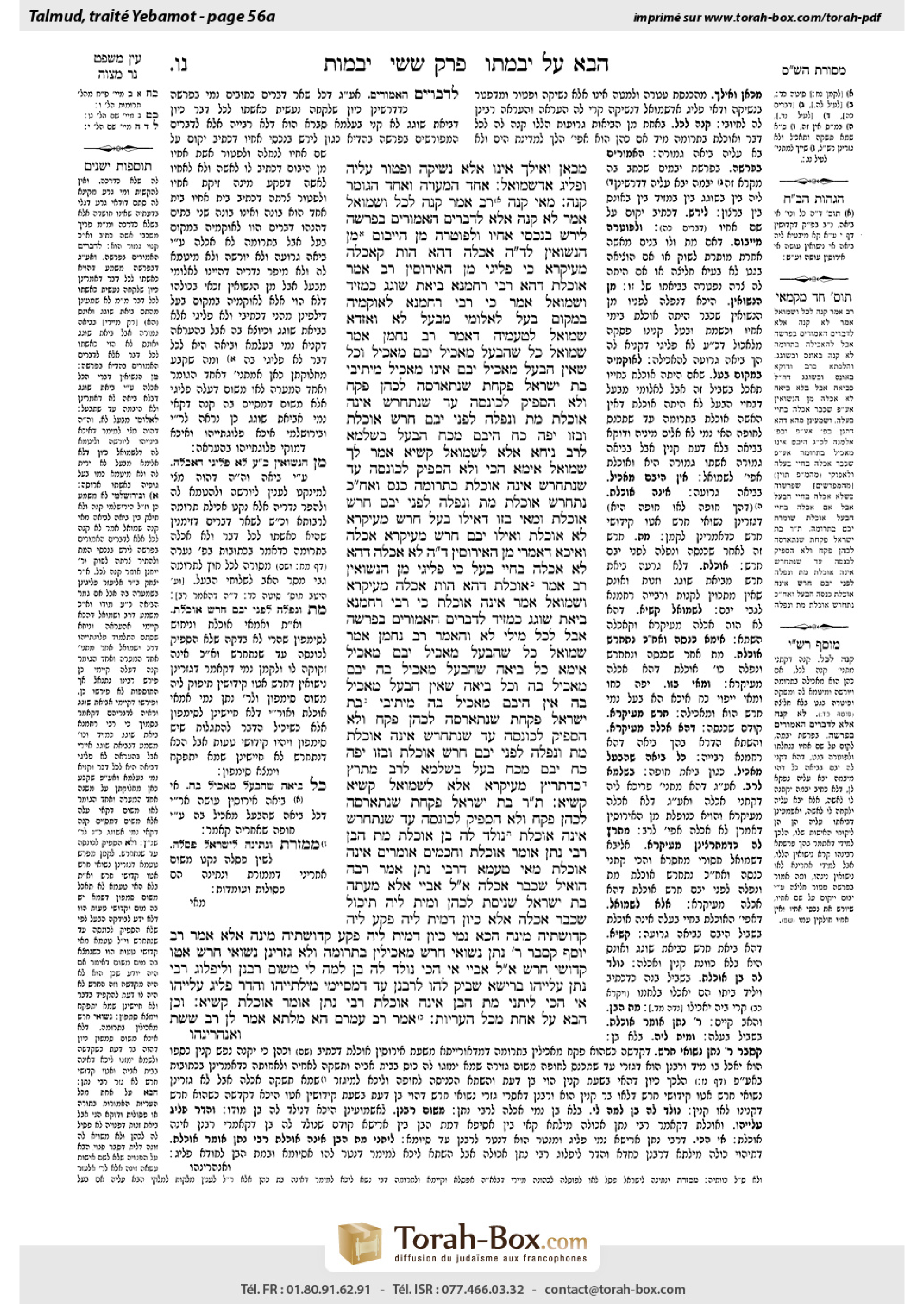
Yevamot 56a: Talmud study for Daf Yomi
Daf Yomi is the daily study of one Talmud folio. Explore 37 tractates with scans, Hebrew text, Sefaria English and AI-generated French translations where annotated.
Passage selection and English or AI-generated French translation are available where the scan has annotations. Daf Study is independent of Torah-Box and Sefaria.
Browse Yevamot · יבמות · All tractatesYevamot 56a text and translations
This page of Yevamot includes the Aramaic text, an English translation and an AI-generated French translation, alongside the scan above.
יבמות נ״ו א · Aramaic and Hebrew text
מִכָּאן וְאֵילָךְ — אֵינוֹ אֶלָּא נְשִׁיקָה, וּפָטוּר עָלֶיהָ. וּפְלִיג אַדִּשְׁמוּאֵל.
אֶחָד הַמְעָרֶה וְאֶחָד הַגּוֹמֵר — קָנָה. מַאי קָנָה? רַב אָמַר: קָנָה לַכֹּל, וּשְׁמוּאֵל אָמַר: לֹא קָנָה אֶלָּא לִדְבָרִים הָאֲמוּרִים בַּפָּרָשָׁה: לִירַשׁ בְּנִכְסֵי אֶחָיו, וּלְפוֹטְרָהּ מִן הַיִּיבּוּם.
מִן הַנִּשּׂוּאִין — לְדִבְרֵי הַכֹּל אָכְלָה, דְּהָא הֲוָת קָאָכְלָה מֵעִיקָּרָא. כִּי פְּלִיגִי מִן הָאֵירוּסִין. רַב אָמַר: אוֹכֶלֶת, דְּהָא רַבִּי רַחֲמָנָא בִּיאַת שׁוֹגֵג כְּמֵזִיד.
וּשְׁמוּאֵל אָמַר: כִּי רַבִּי רַחֲמָנָא, לְאוֹקְמֵיהּ בִּמְקוֹם בַּעַל, לְאַלּוֹמֵי מִבַּעַל — לָא.
וְאַזְדָּא שְׁמוּאֵל לְטַעְמֵיהּ, דְּאָמַר רַב נַחְמָן אָמַר שְׁמוּאֵל: כֹּל שֶׁהַבַּעַל מַאֲכִיל — יָבָם מַאֲכִיל, וְכֹל שֶׁאֵין הַבַּעַל מַאֲכִיל — יָבָם אֵינוֹ מַאֲכִיל.
מֵיתִיבִי: בַּת יִשְׂרָאֵל פִּקַּחַת שֶׁנִּתְאָרְסָה לְכֹהֵן פִּקֵּחַ, וְלֹא הִסְפִּיק לְכוֹנְסָהּ עַד שֶׁנִּתְחָרֵשׁ — אֵינָהּ אוֹכֶלֶת. מֵת, וְנָפְלָה לִפְנֵי יָבָם חֵרֵשׁ — אוֹכֶלֶת, וּבָזוֹ יָפֶה כֹּחַ הַיָּבָם מִכֹּחַ הַבַּעַל.
בִּשְׁלָמָא לְרַב נִיחָא — אֶלָּא לִשְׁמוּאֵל קַשְׁיָא!
אָמַר לְךָ שְׁמוּאֵל, אֵימָא הָכִי: וְלֹא הִסְפִּיק לְכוֹנְסָהּ עַד שֶׁנִּתְחָרֵשׁ — אֵינָהּ אוֹכֶלֶת בִּתְרוּמָה, כָּנַס וְאַחַר כָּךְ נִתְחָרֵשׁ — אוֹכֶלֶת. מֵת וְנָפְלָה לִפְנֵי יָבָם חֵרֵשׁ — אוֹכֶלֶת.
וּמַאי ״בָּזוֹ״? דְּאִילּוּ בַּעַל חֵרֵשׁ מֵעִיקָּרָא — לֹא אוֹכֶלֶת. וְאִילּוּ יָבָם חֵרֵשׁ מֵעִיקָּרָא — אָכְלָה.
וְאִיכָּא דְּאָמְרִי: מִן הָאֵירוּסִין — דִּבְרֵי הַכֹּל לָא אָכְלָה, דְּהָא לָא אָכְלָה בְּחַיֵּי בַעַל.
כִּי פְּלִיגִי מִן הַנִּשּׂוּאִין. רַב אָמַר: אוֹכֶלֶת, דְּהָא הֲוָת אָכְלָה מֵעִיקָּרָא, וּשְׁמוּאֵל אָמַר: אֵינָהּ אוֹכֶלֶת, כִּי רַבִּי רַחֲמָנָא בִּיאַת שׁוֹגֵג כְּמֵזִיד — לִדְבָרִים הָאֲמוּרִים בַּפָּרָשָׁה, אֲבָל לְכֹל מִילֵּי — לָא.
וְהָאָמַר רַב נַחְמָן אָמַר שְׁמוּאֵל: כֹּל שֶׁהַבַּעַל מַאֲכִיל — יָבָם מַאֲכִיל! אֵימָא: כׇּל בִּיאָה שֶׁהַבַּעַל מַאֲכִיל בָּהּ — יָבָם מַאֲכִיל בָּהּ, וְכׇל בִּיאָה שֶׁאֵין הַבַּעַל מַאֲכִיל בָּהּ — אֵין הַיָּבָם מַאֲכִיל בָּהּ.
מֵיתִיבִי: בַּת יִשְׂרָאֵל פִּקַּחַת שֶׁנִּתְאָרְסָה לְכֹהֵן פִּקֵּחַ, וְלֹא הִסְפִּיק לְכוֹנְסָהּ עַד שֶׁנִּתְחָרֵשׁ — אֵינָהּ אוֹכֶלֶת. מֵת, וְנָפְלָה לִפְנֵי יָבָם חֵרֵשׁ — אוֹכֶלֶת. וּבָזוֹ יָפֶה כֹּחַ יָבָם מִכֹּחַ בַּעַל. בִּשְׁלָמָא לְרַב — מְתָרֵץ כִּדְתָרֵיץ מֵעִיקָּרָא. אֶלָּא לִשְׁמוּאֵל קַשְׁיָא! קַשְׁיָא.
תָּנוּ רַבָּנַן: בַּת יִשְׂרָאֵל פִּקַּחַת שֶׁנִּתְאָרְסָה לְכֹהֵן פִּקֵּחַ, וְלֹא הִסְפִּיק לְכוֹנְסָהּ עַד שֶׁנִּתְחָרֵשׁ — אֵינָהּ אוֹכֶלֶת. נוֹלַד לָהּ בֵּן — אוֹכֶלֶת. מֵת הַבֵּן, רַבִּי נָתָן אוֹמֵר: אוֹכֶלֶת, וַחֲכָמִים אוֹמְרִים: אֵינָהּ אוֹכֶלֶת.
מַאי טַעְמָא דְּרַבִּי נָתָן? אָמַר רַבָּה: הוֹאִיל שֶׁכְּבָר אָכְלָה. אֲמַר לֵיהּ אַבָּיֵי: אֶלָּא מֵעַתָּה, בַּת יִשְׂרָאֵל שֶׁנִּיסֵּת לְכֹהֵן וּמִית לֵיהּ, תֵּיכוֹל, שֶׁכְּבָר אָכְלָה! אֶלָּא כֵּיוָן דְּמִית לֵיהּ, פְּקַעָ לֵיהּ קְדוּשְׁתֵּיהּ מִינַּהּ. הָכָא נָמֵי: כֵּיוָן דְּמִית לֵיהּ, פְּקַעָ קְדוּשְׁתֵּיהּ מִינַּהּ!
אֶלָּא אָמַר רַב יוֹסֵף: קָסָבַר רַבִּי נָתָן נִשּׂוּאֵי חֵרֵשׁ מַאֲכִילִין בִּתְרוּמָה, וְלָא גָּזְרִינַן נִשּׂוּאֵי חֵרֵשׁ אַטּוּ קִדּוּשֵׁי חֵרֵשׁ. אֲמַר לֵיהּ אַבָּיֵי: אִי הָכִי, נוֹלַד לָהּ בֵּן לְמָה לִי? מִשּׁוּם רַבָּנַן.
וְלִיפְלוֹג רַבִּי נָתָן עֲלַיְיהוּ בְּרֵישָׁא! שָׁבֵיק לְהוּ לְרַבָּנַן עַד דִּמְסַיְּימִי מִילְּתַיְיהוּ וַהֲדַר פְּלִיג עֲלַיְיהוּ. אִי הָכִי, לִיתְנֵי: מֵת הַבֵּן אֵינָהּ אוֹכֶלֶת, רַבִּי נָתָן אוֹמֵר: אוֹכֶלֶת! קַשְׁיָא.
וְכֵן הַבָּא עַל אַחַת מִכׇּל הָעֲרָיוֹת. אָמַר רַב עַמְרָם: הָא מִלְּתָא אֲמַר לַן רַב שֵׁשֶׁת,
Yevamot 56a · English translation
From this point forward, insertion of anything less than the corona is only considered a kiss, for which he is exempt. And this statement disagrees with that of Shmuel, who maintains that one is liable to receive punishment for external contact of the sexual organs.
§ It was taught in the mishna that both one who merely engages in the initial stage of intercourse and one who completes the act of intercourse have thereby acquired the yevama. The Gemara asks: What does it mean that he has acquired his yevama? Rav said: He has acquired her for everything. In other words, she is considered his wife in all regards. Therefore, if he is a priest, she may partake of teruma. And Shmuel said he has only acquired her with regard to the matters stated in the chapter of levirate marriage, i.e., to inherit his brother’s property and to exempt her from levirate marriage if he then dies and leaves behind children from another wife.
The Gemara adds: If she was a yevama from marriage, everyone agrees that she may partake of teruma after the initial stage of intercourse, as she was already partaking at the outset, when she was married to the deceased brother. Therefore, even a minimal act of intercourse is enough to allow her to continue to partake of teruma. When they disagree it is with regard to a yevama from betrothal. Rav said: She may partake, as the Merciful One includes unwitting intercourse and the other forms of intercourse listed in the mishna, and considers them like intentional intercourse.
And Shmuel said: When the Merciful One includes these forms of intercourse, He does so only to establish the yavam in place of the husband, but to strengthen him more than the husband, no. Since she was merely betrothed to the deceased brother, she was not permitted to partake of teruma, and therefore she may not partake of teruma at this point either.
The Gemara comments: And Shmuel follows his regular line of reasoning, as Rav Naḥman said that Shmuel said: In any case where the woman’s marriage to her original husband entitles her to partake of teruma, intercourse with the yavam in any of the manners described in the mishna also entitles her to partake of teruma, and any case where her relationship with her original husband does not entitle her to partake of teruma, i.e., if she had been betrothed but not married, intercourse with the yavam in the manners described in the mishna also does not entitle her to partake of teruma.
The Gemara raises an objection from the following baraita: In the case of a mentally competent daughter of an Israelite who was betrothed to a competent priest, and he did not have a chance to marry her before he became a deaf-mute and was no longer mentally competent, she may not partake of teruma, as marriage to a deaf-mute does not enable a woman to partake of teruma. If the deaf-mute husband subsequently died and the yevama happened before a deaf-mute yavam for levirate marriage, she may partake of teruma. And in this regard the strength of the yavam is greater than the strength of the husband.
Granted, according Rav, this works out well, as intercourse with the deaf-mute yavam, which is comparable to the unwitting intercourse mentioned in the mishna because the deaf-mute is not mentally competent, effects the levirate marriage and allows her to partake of teruma despite the fact that she could not do so during the lifetime of her first husband. However, according to Shmuel, this is difficult, as he maintains that a yavam cannot have more rights than the deceased husband due to intercourse undertaken without intent to perform levirate marriage.
The Gemara answers: Shmuel could have said to you: Amend the baraita and say as follows: If he did not have a chance to marry her before he became a deaf-mute, she may not partake of teruma. If he married her and afterward became a deaf-mute, she may partake of teruma. If he then died, and she happened before a deaf-mute yavam for levirate marriage, she may partake of teruma.
And what is the meaning of the phrase: In this regard the strength of the yavam is greater than the strength of the husband? It means to say that if the original husband was a deaf-mute from the outset, i.e., before consummating the marriage, she would not have been allowed to partake of teruma, whereas if the yavam was a deaf-mute from the outset she may partake of teruma once they perform levirate marriage, because she had been fully married to the deceased brother.
And some say a different version of the dispute between Rav and Shmuel: If she was a yevama from betrothal, i.e., her marriage with the deceased brother had never been completed, and she and the brother-in-law engaged in an inferior form of intercourse as described in the mishna, everyone agrees that she may not partake of teruma, as she did not partake of teruma in her husband’s lifetime.
When they disagree, it is with regard to a yevama from marriage. Rav says: She may partake of teruma as she was permitted to partake of teruma initially, while married to the deceased brother. And Shmuel says she may not partake of teruma, because when the Merciful One includes unwitting intercourse and considers it like intentional intercourse, it was only with regard to the matters stated in the chapter of levirate marriage, but for every other issue, no.
The Gemara raises a difficulty: Didn’t Rav Naḥman say that Shmuel himself said: In any case where the woman’s marriage to her original husband entitles her to partake of teruma, intercourse with the yavam in one of the manners listed in the mishna also entitles her to partake of teruma? The Gemara answers: Emend the wording and say as follows: With regard to any act of intercourse through which the husband entitles her to partake of teruma, a yavam also entitles her to partake of teruma; and with regard to any act of intercourse through which the husband does not entitle her to partake of teruma, a yavam also does not entitle her to partake of teruma. Just as betrothal cannot be performed via an unwitting act of intercourse, this act does not entitle a yevama to partake of teruma.
The Gemara raises an objection from the following baraita: In the case of a mentally competent daughter of an Israelite who was betrothed to a competent priest, and he did not have a chance to marry her before he became a deaf-mute and was no longer mentally competent, she may not partake of teruma. If the deaf-mute husband subsequently died, and the yevama happened before a deaf-mute yavam for levirate marriage, she may partake of teruma. And in this regard the strength of the yavam is greater than the strength of the husband. Granted, according to Rav, he can answer as Shmuel answered initially, i.e., according to the first version of the dispute between Rav and Shmuel. However, according to Shmuel, it is difficult. The Gemara concludes: Indeed, it is difficult.
§ The Sages taught: In the case of a mentally competent daughter of an Israelite who was betrothed to a mentally competent priest, and he did not have a chance to marry her before he became a deaf-mute and was no longer mentally competent, she may not partake of teruma. If a son was born to her from this priest, she may partake of teruma on account of her son. If the son died, Rabbi Natan says she may continue to partake of teruma, and the Rabbis say she may not continue to partake of teruma.
The Gemara asks: What is the reasoning of Rabbi Natan? Rabba said: Since she has already partaken of teruma in a permitted manner, she may continue. Abaye said to him: However, if that is so, in the case of the daughter of an Israelite who was married to a priest, and he died childless, she should be allowed to partake of teruma, as she has already partaken of it in the past. Rather, it must be that since he has passed away, his priestly sanctity has left her, and she is considered a regular Israelite in all regards. Here too, since the son has passed away, his priestly sanctity has left her, and therefore she should not be entitled to partake of teruma. Rabba’s explanation should consequently be rejected.
Rather, Rav Yosef said: Rabbi Natan holds that the marriage of a deaf-mute who was competent when he betrothed his wife entitles her to partake of teruma, and we do not issue a decree against the wife partaking of teruma through marriage to a deaf-mute due to the case of betrothal to a deaf-mute. Although the betrothal of a deaf-mute does not take effect, his consummation of a marriage does take effect and entitles his wife to partake of teruma. Abaye said to him: If so, why do I need the baraita to specify that a son was born to her? She should be entitled to eat teruma even if she did not have a son. Rav Yosef responded: That case is mentioned due to the opinion of the Rabbis, who hold that she is entitled to partake of teruma only if she has a child.
Abaye asks further: And let Rabbi Natan disagree with them in the first clause of the baraita as well. Rav Yosef responds: Rabbi Natan left the Rabbis until they finished their statement, and then disagreed with them with regard to their entire statement. The Gemara asks: If so, let the baraita first teach that if the son died she may not partake of teruma, and subsequently state: Rabbi Natan said she may eat. Why is Rabbi Natan’s opinion mentioned before the Rabbis finished stating their opinion? The Gemara concludes: Indeed, this is difficult according to Rav Yosef.
§ It was taught in the mishna: And so too, one who had intercourse with any one of those with whom relations are forbidden by the Torah in any form is liable to receive punishment. Rav Amram said: This matter was said to us by Rav Sheshet,
Yevamot 56a · Traduction française (IA)
À partir de ce stade, toute pénétration moindre que celle de la couronne est considérée comme un simple baiser, et n’entraîne donc pas de sanction. Cette affirmation contredit celle de Chmouel, qui soutient qu’un contact externe entre les organes sexuels entraîne une sanction.
§ Il a été enseigné dans la Michna que celui qui ne fait que commencer le rapport sexuel et celui qui l’accomplit jusqu’au bout ont tous deux acquis la yevama. La Guemara demande : Que signifie « il a acquis sa yevama » ? Rav dit : Il l’a acquise à tous égards. Autrement dit, elle est considérée comme son épouse sous tous les rapports. Par conséquent, s’il est prêtre, elle peut consommer de la terouma. Chmouel dit qu’il ne l’a acquise que pour les questions énoncées dans le chapitre du mariage léviratique, c’est-à-dire pour hériter des biens de son frère et pour la dispenser du mariage léviratique s’il meurt ensuite en laissant des enfants d’une autre épouse.
La Guemara ajoute : Si elle était une yevama issue d’un mariage, tous reconnaissent qu’elle peut consommer de la terouma après le début du rapport sexuel, puisqu’elle en consommait déjà au départ, lorsqu’elle était mariée au frère défunt. Par conséquent, même un rapport sexuel minimal suffit pour lui permettre de continuer à consommer de la terouma. Leur désaccord porte sur le cas d’une yevama issue de fiançailles. Rav dit : Elle peut en consommer, car le Miséricordieux inclut les rapports involontaires et les autres formes de rapports énumérées dans la Michna, et les considère comme des rapports intentionnels.
Et Chmouel dit : Lorsque le Miséricordieux inclut ces formes de rapports, c’est uniquement pour placer le yavam à la place du mari ; mais lui accorder davantage de droits qu’au mari, non. Puisqu’elle était simplement fiancée au frère défunt, elle n’était pas autorisée à consommer de la terouma ; elle ne peut donc pas non plus en consommer à présent.
La Guemara fait remarquer que Chmouel suit son raisonnement habituel, car Rav Naḥman a dit au nom de Chmouel : dans tout cas où son mariage avec son mari initial lui donne le droit de consommer de la terouma, les rapports avec le yavam, sous l’une des formes décrites dans la Michna, lui donnent également le droit d’en consommer ; et dans tout cas où sa relation avec son mari initial ne lui donne pas le droit d’en consommer, c’est-à-dire si elle était fiancée mais non mariée, les rapports avec le yavam, sous les formes décrites dans la Michna, ne lui donnent pas non plus le droit d’en consommer.
La Guemara soulève une objection à partir de la baraïta suivante : dans le cas d’une fille d’Israélite saine d’esprit qui était fiancée à un prêtre sain d’esprit, et que celui-ci n’a pas eu l’occasion d’épouser avant de devenir sourd-muet et de perdre ainsi sa pleine capacité mentale, elle ne peut pas consommer de terouma, car le mariage avec un sourd-muet ne permet pas à une femme d’en consommer. Si le mari sourd-muet meurt ensuite et que la yevama se présente devant un yavam sourd-muet pour le mariage léviratique, elle peut consommer de la terouma. À cet égard, le pouvoir du yavam est supérieur à celui du mari.
Certes, selon Rav, cela s’explique bien : les rapports avec le yavam sourd-muet, comparables aux rapports involontaires mentionnés dans la Michna puisque le sourd-muet n’a pas sa pleine capacité mentale, réalisent le mariage léviratique et lui permettent de consommer de la terouma, bien qu’elle n’ait pas pu le faire du vivant de son premier mari. Mais selon Chmouel, cela pose difficulté, car il soutient que le yavam ne peut avoir davantage de droits que le mari défunt du fait de rapports accomplis sans intention de réaliser le mariage léviratique.
La Guemara répond : Chmouel aurait pu te dire : Corrige la baraïta et lis comme suit : s’il n’a pas eu l’occasion de l’épouser avant de devenir sourd-muet, elle ne peut pas consommer de terouma. S’il l’a épousée puis est devenu sourd-muet, elle peut consommer de la terouma. S’il meurt ensuite et qu’elle se présente devant un yavam sourd-muet pour le mariage léviratique, elle peut consommer de la terouma.
Et que signifie l’expression : « À cet égard, le pouvoir du yavam est supérieur à celui du mari » ? Elle signifie que si le mari initial était sourd-muet dès le départ, c’est-à-dire avant la consommation du mariage, elle n’aurait pas été autorisée à consommer de la terouma ; tandis que si le yavam était sourd-muet dès le départ, elle peut consommer de la terouma dès lors qu’ils réalisent le mariage léviratique, car elle avait été pleinement mariée au frère défunt.
Certains rapportent une autre version du désaccord entre Rav et Chmouel : si elle était une yevama issue de fiançailles, c’est-à-dire que son mariage avec le frère défunt n’avait jamais été consommé, et qu’elle et son beau-frère ont eu des rapports d’une forme inférieure, comme le décrit la Michna, tous reconnaissent qu’elle ne peut pas consommer de terouma, puisqu’elle n’en consommait pas du vivant de son mari.
Leur désaccord porte sur le cas d’une yevama issue d’un mariage. Rav dit : Elle peut consommer de la terouma, puisqu’elle était autorisée à en consommer initialement, lorsqu’elle était mariée au frère défunt. Chmouel dit qu’elle ne peut pas en consommer, car lorsque le Miséricordieux inclut les rapports involontaires et les considère comme des rapports intentionnels, c’est uniquement pour les questions énoncées dans le chapitre du mariage léviratique, mais pas pour toute autre question.
La Guemara soulève une difficulté : Rav Naḥman n’a-t-il pas dit que Chmouel lui-même avait déclaré : dans tout cas où son mariage avec son mari initial lui donne le droit de consommer de la terouma, les rapports avec le yavam, sous l’une des formes énumérées dans la Michna, lui donnent également le droit d’en consommer ? La Guemara répond : Corrige la formulation et lis comme suit : tout acte de rapport par lequel le mari lui donne le droit de consommer de la terouma permet aussi au yavam de le lui donner ; et tout acte de rapport par lequel le mari ne lui donne pas le droit d’en consommer ne permet pas non plus au yavam de le lui donner. De même que les fiançailles ne peuvent pas être réalisées au moyen d’un rapport involontaire, cet acte ne donne pas à une yevama le droit de consommer de la terouma.
La Guemara soulève une objection à partir de la baraïta suivante : dans le cas d’une fille d’Israélite saine d’esprit qui était fiancée à un prêtre sain d’esprit, et que celui-ci n’a pas eu l’occasion d’épouser avant de devenir sourd-muet et de perdre ainsi sa pleine capacité mentale, elle ne peut pas consommer de terouma. Si le mari sourd-muet meurt ensuite et que la yevama se présente devant un yavam sourd-muet pour le mariage léviratique, elle peut consommer de la terouma. À cet égard, le pouvoir du yavam est supérieur à celui du mari. Certes, selon Rav, il peut répondre comme Chmouel l’a fait initialement, c’est-à-dire selon la première version du désaccord entre Rav et Chmouel. Mais selon Chmouel, cela pose difficulté. La Guemara conclut : en effet, cela pose difficulté.
§ Les Sages ont enseigné : dans le cas d’une fille d’Israélite saine d’esprit qui était fiancée à un prêtre sain d’esprit, et que celui-ci n’a pas eu l’occasion d’épouser avant de devenir sourd-muet et de perdre ainsi sa pleine capacité mentale, elle ne peut pas consommer de terouma. Si elle a eu un fils de ce prêtre, elle peut consommer de la terouma en raison de son fils. Si le fils meurt, Rabbi Natan dit qu’elle peut continuer à consommer de la terouma, tandis que les Rabbins disent qu’elle ne peut pas continuer à en consommer.
La Guemara demande : Quel est le raisonnement de Rabbi Natan ? Rabba dit : puisqu’elle a déjà consommé de la terouma de manière autorisée, elle peut continuer. Abayé lui dit : Pourtant, s’il en est ainsi, dans le cas d’une fille d’Israélite mariée à un prêtre qui meurt sans enfant, elle devrait être autorisée à consommer de la terouma, puisqu’elle en a déjà consommé par le passé. Il faut plutôt dire que, puisqu’il est mort, sa sainteté sacerdotale l’a quittée, et qu’elle est considérée à tous égards comme une Israélite ordinaire. De même ici, puisque son fils est mort, sa sainteté sacerdotale l’a quittée, et elle ne devrait donc pas avoir le droit de consommer de la terouma. Il faut par conséquent rejeter l’explication de Rabba.
Rav Yossef dit plutôt : Rabbi Natan considère que le mariage avec un sourd-muet qui était sain d’esprit lorsqu’il a fiancé sa femme lui donne le droit de consommer de la terouma, et nous ne décrétons pas qu’une épouse ne puisse consommer de la terouma en vertu de son mariage avec un sourd-muet à cause du cas de fiançailles avec un sourd-muet. Bien que les fiançailles d’un sourd-muet ne prennent pas effet, la consommation du mariage par celui-ci prend effet et donne à son épouse le droit de consommer de la terouma. Abayé lui dit : Si c’est ainsi, pourquoi la baraïta doit-elle préciser qu’elle a eu un fils ? Elle devrait avoir le droit de consommer de la terouma même si elle n’a pas eu de fils. Rav Yossef répondit : Ce cas est mentionné en raison de l’opinion des Rabbins, qui considèrent qu’elle n’a le droit de consommer de la terouma que si elle a un enfant.
Abayé demande encore : Rabbi Natan aurait également dû être en désaccord avec eux dans la première partie de la baraïta. Rav Yossef répond : Rabbi Natan a laissé les Rabbins achever leur propos, puis s’est opposé à l’ensemble de leur affirmation. La Guemara demande : Si c’est ainsi, que la baraïta enseigne d’abord que si le fils est mort, elle ne peut pas consommer de terouma, puis précise : Rabbi Natan dit qu’elle peut en consommer. Pourquoi l’opinion de Rabbi Natan est-elle mentionnée avant que les Rabbins aient achevé d’exposer la leur ? La Guemara conclut : en effet, cela pose difficulté selon Rav Yossef.
§ Il a été enseigné dans la Michna : de même, celui qui a eu des rapports, quelle qu’en soit la forme, avec l’une des personnes avec lesquelles la Torah interdit les relations encourt une sanction. Rav Amram dit : Rav Chéchet nous a transmis cette règle,
Traduction française générée par IA à partir de l’édition anglaise de Sefaria. Vérifie toujours un passage avec le texte source.
Text from Sefaria: William Davidson Edition - Vocalized Aramaic (CC BY NC); William Davidson Edition - English (CC BY NC).