Yevamot 56b: Talmud study for Daf Yomi
Daf Yomi is the daily study of one Talmud folio. Explore 37 tractates with scans, Hebrew text, Sefaria English and AI-generated French translations where annotated.
Passage selection and English or AI-generated French translation are available where the scan has annotations. Daf Study is independent of Torah-Box and Sefaria.
Browse Yevamot · יבמות · All tractatesYevamot 56b text and translations
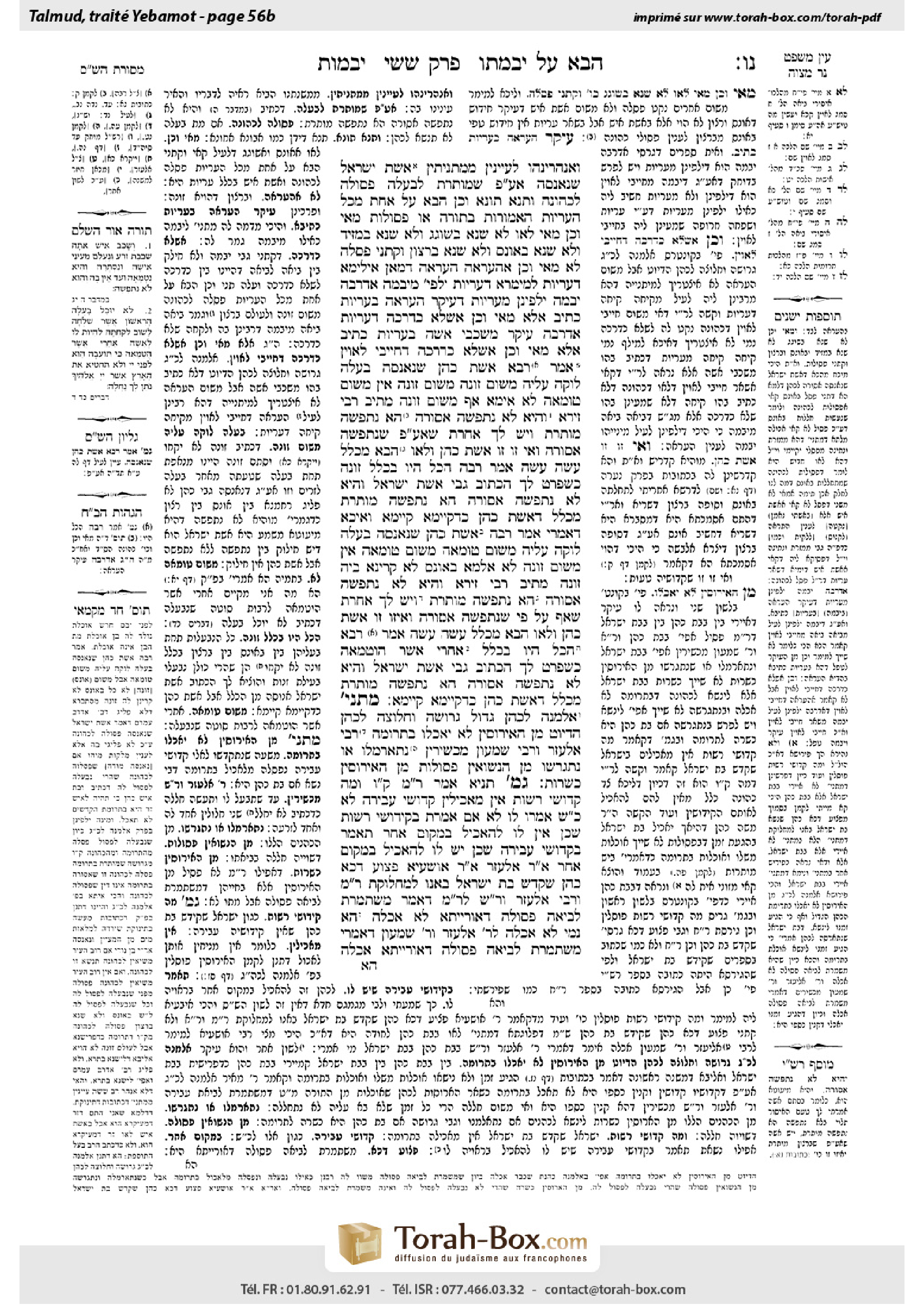
This page of Yevamot includes the Aramaic text, an English translation and an AI-generated French translation, alongside the scan above.
יבמות נ״ו ב · Aramaic and Hebrew text
וְאַנְהֲרִינְהוּ לְעַיְינִין מִמַּתְנִיתִין: אֵשֶׁת יִשְׂרָאֵל שֶׁנֶּאֶנְסָה, אַף עַל פִּי שֶׁמּוּתֶּרֶת לְבַעְלָהּ — פְּסוּלָה לִכְהוּנָּה. וְתַנָּא תּוּנָא: וְכֵן הַבָּא עַל אַחַת מִכׇּל הָעֲרָיוֹת הָאֲמוּרוֹת בְּתוֹרָה, אוֹ פְּסוּלוֹת.
מַאי ״וְכֵן״? מַאי לָאו: לָא שְׁנָא בְּשׁוֹגֵג, וְלָא שְׁנָא בְּמֵזִיד, וְלָא שְׁנָא בְּאוֹנֶס, וְלָא שְׁנָא בְּרָצוֹן, וְקָתָנֵי: פְּסָלָהּ.
לָא. מַאי ״וְכֵן״ — אַהַעֲרָאָה. הַעֲרָאָה דְּמַאן, אִילֵימָא דַּעֲרָיוֹת — לְמֵימְרָא דַּעֲרָיוֹת יָלְפִינַן מִיְּבָמָה? אַדְּרַבָּה: יְבָמָה יָלְפִינַן מֵעֲרָיוֹת, דְּעִיקַּר הַעֲרָאָה בַּעֲרָיוֹת כְּתִיב!
אֶלָּא, מַאי ״וְכֵן״? אַשֶּׁלֹּא כְּדַרְכָּהּ דַּעֲרָיוֹת. אַדְּרַבָּה: עִיקַּר ״מִשְׁכְּבֵי אִשָּׁה״ בַּעֲרָיוֹת כְּתִיב!
אֶלָּא, מַאי ״וְכֵן״? אַשֶּׁלֹּא כְּדַרְכָּהּ דְּחַיָּיבֵי לָאוִין.
אָמַר רָבָא: אֵשֶׁת כֹּהֵן שֶׁנֶּאֶנְסָה, בַּעְלָהּ — לוֹקֶה עָלֶיהָ מִשּׁוּם זוֹנָה. מִשּׁוּם זוֹנָה אִין, מִשּׁוּם טוּמְאָה לָא? אֵימָא אַף מִשּׁוּם זוֹנָה.
מֵתִיב רַבִּי זֵירָא: ״וְהִיא לֹא נִתְפָּשָׂה״ — אֲסוּרָה, הָא נִתְפָּשָׂה — מוּתֶּרֶת. וְיֵשׁ לְךָ אַחֶרֶת שֶׁאַף עַל פִּי שֶׁנִּתְפָּשָׂה — אֲסוּרָה, וְאֵי זוֹ — זוֹ אֵשֶׁת כֹּהֵן.
וְלָאו הַבָּא מִכְּלַל עֲשֵׂה, עֲשֵׂה!
אָמַר רַבָּה: הַכֹּל הָיוּ בִּכְלַל זוֹנָה, כְּשֶׁפָּרַט לְךָ הַכָּתוּב גַּבֵּי אֵשֶׁת יִשְׂרָאֵל ״וְהִיא לֹא נִתְפָּשָׂה״ אֲסוּרָה, הָא נִתְפָּשָׂה מוּתֶּרֶת — מִכְּלָל דְּאֵשֶׁת כֹּהֵן כִּדְקָיְימָא קָיְימָא.
וְאִיכָּא דְּאָמְרִי, אָמַר רַבָּה: אֵשֶׁת כֹּהֵן שֶׁנֶּאֶנְסָה — בַּעְלָהּ לוֹקֶה עָלֶיהָ מִשּׁוּם טוּמְאָה. מִשּׁוּם טוּמְאָה — אִין, מִשּׁוּם זוֹנָה — לָא, אַלְמָא בְּאוֹנֶס לָא קָרֵינָא בַּיהּ זוֹנָה.
מֵתִיב רַבִּי זֵירָא: ״וְהִיא לֹא נִתְפָּשָׂה״ — אֲסוּרָה, הָא נִתְפָּשָׂה — מוּתֶּרֶת. וְיֵשׁ לְךָ אַחֶרֶת, שֶׁאַף עַל פִּי שֶׁנִּתְפָּשָׂה — אֲסוּרָה, וְאֵיזוֹ — זוֹ אֵשֶׁת כֹּהֵן, וְלָאו הַבָּא מִכְּלַל עֲשֵׂה, עֲשֵׂה!
אָמַר רָבָא: הַכֹּל הָיוּ בִּכְלַל ״אַחֲרֵי אֲשֶׁר הֻטַּמָּאָה״, כְּשֶׁפָּרַט לְךָ הַכָּתוּב גַּבֵּי אֵשֶׁת יִשְׂרָאֵל ״וְהִיא לֹא נִתְפָּשָׂה״ — אֲסוּרָה, הָא נִתְפָּשָׂה — מוּתֶּרֶת, מִכְּלַל דְּאֵשֶׁת כֹּהֵן כִּדְקָיְימָא — קָיְימָא.
מַתְנִי׳ אַלְמָנָה לְכֹהֵן גָּדוֹל, גְּרוּשָׁה וַחֲלוּצָה לְכֹהֵן הֶדְיוֹט, מִן הָאֵירוּסִין — לֹא יֹאכְלוּ בִּתְרוּמָה. רַבִּי אֶלְעָזָר וְרַבִּי שִׁמְעוֹן מַכְשִׁירִין.
נִתְאַרְמְלוּ אוֹ נִתְגָּרְשׁוּ, מִן הַנִּשּׂוּאִין — פְּסוּלוֹת, מִן הָאֵירוּסִין — כְּשֵׁרוֹת.
גְּמָ׳ תַּנְיָא, אָמַר רַבִּי מֵאִיר: קַל וָחוֹמֶר, וּמָה קִדּוּשֵׁי רְשׁוּת — אֵין מַאֲכִילִין, קִדּוּשֵׁי עֲבֵירָה — לֹא כׇּל שֶׁכֵּן?!
אָמְרוּ לוֹ: לֹא. אִם אָמַרְתָּ בְּקִידּוּשֵׁי רְשׁוּת שֶׁכֵּן אֵין לוֹ לְהַאֲכִיל בְּמָקוֹם אַחֵר, תֹּאמַר בְּקִדּוּשֵׁי עֲבֵירָה, שֶׁכֵּן יֵשׁ לוֹ לְהַאֲכִיל בְּמָקוֹם אַחֵר.
אָמַר רַבִּי אֶלְעָזָר אָמַר רַבִּי אוֹשַׁעְיָא: פְּצוּעַ דַּכָּא כֹּהֵן שֶׁקִּדֵּשׁ בַּת יִשְׂרָאֵל, בָּאנוּ לְמַחְלוֹקֶת רַבִּי מֵאִיר וְרַבִּי אֶלְעָזָר וְרַבִּי שִׁמְעוֹן.
לְרַבִּי מֵאִיר, דְּאָמַר מִשְׁתַּמֶּרֶת לְבִיאָה פְּסוּלָה דְּאוֹרָיְיתָא לָא אָכְלָה — הָא נָמֵי לָא אָכְלָה. לְרַבִּי אֶלְעָזָר וְרַבִּי שִׁמְעוֹן, דְּאָמְרִי מִשְׁתַּמֶּרֶת לְבִיאָה פְּסוּלָה דְּאוֹרָיְיתָא אָכְלָה —
Yevamot 56b · English translation
and he illuminated our eyes from the mishna, i.e., he demonstrated that the mishna serves as the basis for his opinion: With regard to the wife of an Israelite who was raped, although she is permitted to her husband, she is disqualified for the priesthood. Therefore, if her husband dies, she may not marry a priest. And the tanna of our mishna also taught: And so too, in the case of one who had intercourse with any one of those with whom relations are forbidden [arayot] by the Torah or with those who are unfit to marry him even though they are not in the category of arayot, the woman is disqualified from marrying a priest.
What is the meaning of the phrase: And so too? What, is it not that it is no different whether they have intercourse unwittingly or intentionally, and it is no different whether they have intercourse due to coercion or willingly? And it is taught that he has rendered her disqualified from marrying a priest.
The Gemara refutes this proof: No, what is the meaning of the phrase: And so too? It is referring to the initial stage of intercourse, as this too invalidates her. The Gemara asks: The initial stage of intercourse of whom? If we say it is referring to those with whom relations are prohibited and carry a punishment of karet or death [arayot], is this to say that the halakha with regard to those with whom relations are prohibited is derived from the halakha with regard to a yevama, as implied by the phrase: And so too? On the contrary, we derive the halakha of a yevama from the halakha with regard to those with whom relations are prohibited, as the main source that indicates that the initial stage of intercourse is considered intercourse is stated in the context of those with whom relations are prohibited and not in the context of a yevama.
Rather, what is the meaning of the phrase: And so too? It is referring to atypical, i.e., anal, sexual intercourse with those with whom relations are prohibited [arayot]. The Gemara rejects this suggestion: On the contrary, the main source that atypical intercourse is considered intercourse, which is based upon the verse “The cohabitations of a woman” (Leviticus 18:22) is written with regard to those with whom relations are prohibited [arayot].
Rather, what is the meaning of the phrase: And so too? It is referring to atypical intercourse by those liable for violating an ordinary prohibition not punishable by karet, with regard to whom the expression: The cohabitations of a woman, does not appear. In any event, Rav Sheshet’s proof from the mishna is not conclusive.
§ Rava said: With regard to the wife of a priest who was raped, her husband is flogged if he later has intercourse with her, due to the fact that it is prohibited for a priest to have intercourse with a zona. The Gemara expresses surprise: Due to the prohibition proscribing a zona, yes; due to ritual impurity, no? The Torah refers to a married woman who has had intercourse with another man as ritually impure, and she is forbidden to her husband. The Gemara emends Rava’s statement: Say that he is also flogged due to the prohibition with regard to a zona.
Rabbi Zeira raised an objection based upon a verse with regard to a sota: “And neither was she taken” (Numbers 5:13) indicates that she is forbidden to her husband because she willingly committed adultery, but if she was forcibly taken, i.e., raped, she is permitted to her husband. The term “And…she” indicates that although these principles apply in this case, you have another case of a woman who is prohibited even though she was forcibly taken. And which is this? This is the wife of a priest.
And a prohibition that stems from a positive mitzva, e.g., the prohibition proscribing a priest’s wife to her husband if she has been raped, which is derived from the fact that the Torah indicates that the wife of an Israelite remains permitted, has the status of a positive mitzva, not a prohibition. Consequently, one should not be flogged for this offense, as one is flogged only for violating a prohibition.
Rabba said in response: All married women who engaged in extramarital intercourse were included in the category of zona. When the verse specified with regard to the wife of an Israelite: “And neither was she taken,” as it is only in that case that she is forbidden, it thereby indicates that if in fact she was forcibly taken, she is permitted. By inference, unlike the wife of an Israelite, the wife of a priest remains as she was. Since the Torah does not limit the category of zona with regard to the wife of a priest, she is considered a zona even if she was raped.
And some say a different version of this discussion. Rabba said: With regard to the wife of a priest who was raped, her husband is flogged for having intercourse with her due to her ritual impurity. The Gemara asks: Due to ritual impurity, yes; due to the prohibition proscribing a zona, no? Apparently, in a case of rape, the victim is not called a zona.
Rabbi Zeira raised an objection from the verse: “And neither was she taken” indicates that she is forbidden to her husband because she willingly committed adultery, but if she was forcibly taken, she is permitted to her husband. The term: “And…she,” indicates that although these principles apply in this case, you have another case of a woman who is forbidden even though she was forcibly taken. And which is this? This is the wife of a priest. And a prohibition that stems from a positive mitzva has the status of a positive mitzva, not a prohibition. Consequently, one should not be flogged for this offense, as one is flogged only for violating a prohibition.
Rava said: All were included in the verse “Her former husband, who sent her away, may not take her again to be his wife after she was made ritually impure” (Deuteronomy 24:4). When the verse specified with regard to the wife of an Israelite: “And neither was she taken,” as it is only in that case that she is forbidden, it thereby indicates that if she was forcibly taken she is permitted. By inference, the wife of a priest remains as she was, and she is forbidden.
MISHNA: A widow to a High Priest, a divorcée, or a ḥalutza to a common priest, even if they had only engaged in betrothal and had not yet had intercourse, may not partake of teruma. Since they are forbidden to the men who betrothed them, the betrothal itself disqualifies them from the privileges of priesthood even if they are the daughters of priests. Rabbi Elazar and Rabbi Shimon declare them fit to partake of teruma. Since the prohibition is violated through the act of intercourse and not betrothal, the women are disqualified only once they have intercourse.
In a case where these women were widowed or divorced, if it was from marriage, they are disqualified from the priesthood and may not partake of teruma. This is because a woman prohibited from marrying a priest who has intercourse with a priest becomes a ḥalala, and is thereby disqualified from partaking of teruma. However, if they were widowed or divorced from their state of betrothal, they are once again fit to partake of teruma according to all opinions.
GEMARA: It is taught in a baraita that Rabbi Meir said: This is an a fortiori inference: Just as optional betrothal, e.g., in the case of an Israelite who betroths the daughter of a priest, does not entitle her to partake of teruma, as her betrothal to a non-priest disqualifies her from partaking of her father’s teruma, is it not all the more so true in a case of betrothal that constitutes a transgression, as in the cases in the mishna?
They said to him: No, if you say that this is true with regard to an Israelite, whose status cannot entitle her to partake of teruma in another case, as one betrothed to an Israelite may never partake of teruma, shall you also say that this is the case with regard to betrothal to a priest that constitutes a transgression, where his status does entitle her to partake of teruma in a different case, as marriage to a priest entitles a woman to partake of teruma in a case where it is permitted for them to marry?
Rabbi Elazar said that Rabbi Oshaya said: In the case of a priest with crushed testicles or with other wounds to his genitals who betrothed the daughter of an Israelite, which is prohibited by the verse “He that is crushed or maimed shall not enter into the congregation of the Lord” (Deuteronomy 23:2), we have arrived at the dispute between Rabbi Meir on the one hand and Rabbi Elazar and Rabbi Shimon on the other.
According to Rabbi Meir, who said that a woman who is reserved for intercourse that is invalid, i.e., prohibited, by Torah law may not partake of teruma, this one may also not partake of teruma, as it is prohibited by Torah law for her to have intercourse with a man with crushed testicles. According to Rabbi Elazar and Rabbi Shimon, who say that a woman who is reserved for intercourse that is invalid by Torah law may partake of teruma until she actually engages in the prohibited act of intercourse,
Yevamot 56b · Traduction française (IA)
et il éclaira nos yeux à partir de la Michna, c’est-à-dire qu’il démontra que la Michna fonde son opinion : la femme d’un Israélite qui a été violée, bien qu’elle soit permise à son mari, est disqualifiée pour la prêtrise. Par conséquent, si son mari meurt, elle ne peut pas épouser un prêtre. Le tanna de notre Michna a également enseigné : « De même », dans le cas de celui qui a eu des relations avec l’une des personnes avec lesquelles les rapports sont interdits par la Torah [arayot], ou avec celles qu’il ne peut épouser bien qu’elles ne relèvent pas de la catégorie des arayot, la femme est disqualifiée pour épouser un prêtre.
Que signifie l’expression « de même » ? Ne veut-elle pas dire que cela vaut aussi bien lorsque les relations ont eu lieu involontairement que lorsqu’elles ont eu lieu intentionnellement, et aussi bien lorsqu’elles ont eu lieu sous la contrainte que de plein gré ? Il est donc enseigné que cet homme l’a disqualifiée pour épouser un prêtre.
La Guemara réfute cette preuve : Non, que signifie l’expression « de même » ? Elle fait référence au début de la pénétration, qui suffit également à la disqualifier. La Guemara demande : Le début de la pénétration de qui ? Si l’on dit qu’il s’agit des relations avec ceux qui sont interdits et passibles de karet ou de mort [arayot], cela reviendrait-il à dire que la halakha relative aux relations interdites est déduite de celle qui concerne une yevama, comme le suggère l’expression « de même » ? C’est le contraire : nous déduisons la halakha relative à une yevama de celle qui concerne les relations interdites, puisque la principale source indiquant que le début de la pénétration est considéré comme un rapport sexuel est énoncée à propos des relations interdites, et non à propos d’une yevama.
Mais que signifie l’expression « de même » ? Elle fait référence aux relations sexuelles atypiques, c’est-à-dire anales, avec ceux qui sont interdits [arayot]. La Guemara rejette cette proposition : c’est le contraire. La principale source établissant que les relations atypiques sont considérées comme des rapports sexuels, fondée sur le verset « les cohabitations d’une femme » (Lévitique 18:22), est énoncée à propos des relations interdites [arayot].
Mais que signifie l’expression « de même » ? Elle fait référence aux relations atypiques avec des personnes passibles d’avoir transgressé une interdiction ordinaire, qui n’entraîne pas de peine de karet, et à propos desquelles l’expression « les cohabitations d’une femme » n’apparaît pas. En tout état de cause, la preuve que Rav Chéchet tire de la Michna n’est pas concluante.
§ Rava a dit : Si la femme d’un prêtre a été violée, son mari reçoit la flagellation s’il a ensuite des relations avec elle, car il est interdit à un prêtre d’avoir des relations avec une zona. La Guemara s’étonne : Il reçoit la flagellation en raison de l’interdiction relative à une zona, mais pas en raison de l’impureté rituelle ? La Torah qualifie d’impure rituellement une femme mariée qui a eu des relations avec un autre homme, et elle est interdite à son mari. La Guemara rectifie les propos de Rava : dis plutôt qu’il reçoit aussi la flagellation en raison de l’interdiction relative à une zona.
Rabbi Zeira soulève une objection à partir d’un verset relatif à une sota : « Et elle n’a pas été prise » (Nombres 5:13) indique qu’elle est interdite à son mari parce qu’elle a commis un adultère de son plein gré ; mais si elle a été prise de force, c’est-à-dire violée, elle lui est permise. L’expression « et…elle » indique que, bien que ces principes s’appliquent dans ce cas, il existe un autre cas où une femme est interdite alors même qu’elle a été prise de force. Quel est ce cas ? Celui de la femme d’un prêtre.
Or, une interdiction qui découle d’une mitsva positive — par exemple, l’interdiction faite au mari de s’unir à la femme d’un prêtre si elle a été violée, déduite du fait que la Torah indique que la femme d’un Israélite reste permise — a le statut d’une mitsva positive, et non d’une interdiction. Par conséquent, cette transgression ne devrait pas entraîner la flagellation, car on ne reçoit la flagellation que pour la violation d’une interdiction.
Rabba répond : Toutes les femmes mariées qui ont eu des relations extraconjugales étaient incluses dans la catégorie des zona. Lorsque le verset précise, au sujet de la femme d’un Israélite, « et elle n’a pas été prise », indiquant que c’est seulement dans ce cas qu’elle est interdite, cela montre que si, en réalité, elle a été prise de force, elle est permise. On en déduit que, contrairement à la femme d’un Israélite, la femme d’un prêtre conserve son statut antérieur. Puisque la Torah ne limite pas la catégorie des zona dans le cas de la femme d’un prêtre, elle est considérée comme une zona même si elle a été violée.
Certains transmettent une autre version de cet échange. Rabba a dit : Si la femme d’un prêtre a été violée, son mari reçoit la flagellation s’il a des relations avec elle, en raison de son impureté rituelle. La Guemara demande : Il reçoit la flagellation en raison de l’impureté rituelle, mais pas en raison de l’interdiction relative à une zona ? Il semble donc que la victime d’un viol n’est pas appelée zona.
Rabbi Zeira soulève une objection à partir du verset : « Et elle n’a pas été prise » indique qu’elle est interdite à son mari parce qu’elle a commis un adultère de son plein gré ; mais si elle a été prise de force, elle lui est permise. L’expression « et…elle » indique que, bien que ces principes s’appliquent dans ce cas, il existe un autre cas où une femme est interdite alors même qu’elle a été prise de force. Quel est ce cas ? Celui de la femme d’un prêtre. Or, une interdiction qui découle d’une mitsva positive a le statut d’une mitsva positive, et non d’une interdiction. Par conséquent, cette transgression ne devrait pas entraîner la flagellation, car on ne reçoit la flagellation que pour la violation d’une interdiction.
Rava a dit : Toutes étaient incluses dans le verset « Son premier mari, qui l’a renvoyée, ne pourra pas la reprendre pour qu’elle soit sa femme après qu’elle a été rendue rituellement impure » (Deutéronome 24:4). Lorsque le verset précise, au sujet de la femme d’un Israélite, « et elle n’a pas été prise », indiquant que c’est seulement dans ce cas qu’elle est interdite, cela montre que si elle a été prise de force, elle est permise. On en déduit que la femme d’un prêtre conserve son statut antérieur et qu’elle est interdite.
MICHNA : Une veuve promise à un Grand Prêtre, une divorcée promise à un prêtre ordinaire ou une ḥaloutsa promise à un prêtre ordinaire ne peuvent pas consommer de terouma, même si elles n’ont été que fiancées et n’ont pas encore eu de relations. Puisqu’elles sont interdites aux hommes qui les ont fiancées, les fiançailles elles-mêmes les disqualifient des privilèges de la prêtrise, même si elles sont filles de prêtres. Rabbi Elazar et Rabbi Shimon les déclarent aptes à consommer de la terouma. Puisque l’interdiction n’est transgressée que par l’acte sexuel, et non par les fiançailles, les femmes ne sont disqualifiées qu’après avoir eu des relations.
Si ces femmes sont devenues veuves ou ont été divorcées à la suite d’un mariage, elles sont disqualifiées pour la prêtrise et ne peuvent pas consommer de terouma. En effet, une femme à qui il est interdit d’épouser un prêtre et qui a des relations avec un prêtre devient une ḥalala, et est ainsi disqualifiée pour consommer de la terouma. Toutefois, si elles sont devenues veuves ou ont été divorcées alors qu’elles n’étaient encore que fiancées, elles redeviennent aptes à consommer de la terouma selon toutes les opinions.
GUEMARA : Il est enseigné dans une baraïta que Rabbi Meïr a dit : Voici une déduction a fortiori : de même que des fiançailles facultatives — par exemple lorsqu’un Israélite fiance la fille d’un prêtre — ne lui donnent pas le droit de consommer de la terouma, puisque ses fiançailles avec un non-prêtre la disqualifient de la terouma de son père, n’est-il pas d’autant plus vrai qu’il en va ainsi dans le cas de fiançailles qui constituent une transgression, comme dans les cas de la Michna ?
Ils lui dirent : Non. Si tu affirmes cela à propos d’un Israélite, dont le statut ne peut lui donner le droit de consommer de la terouma dans aucun autre cas, puisqu’une femme fiancée à un Israélite ne pourra jamais consommer de terouma, diras-tu aussi qu’il en va de même lorsqu’elle est fiancée à un prêtre dans une situation qui constitue une transgression, alors que son statut à lui peut lui donner le droit de consommer de la terouma dans un autre cas, puisque le mariage avec un prêtre permet à une femme de consommer de la terouma lorsqu’ils ont le droit de se marier ?
Rabbi Elazar a dit au nom de Rabbi Ochaïa : Dans le cas d’un prêtre aux testicules écrasés ou présentant d’autres lésions aux organes génitaux, qui a fiancé la fille d’un Israélite — union interdite par le verset « Celui qui a les testicules écrasés ou mutilés n’entrera pas dans l’assemblée de l’Éternel » (Deutéronome 23:2) —, nous retrouvons le désaccord entre Rabbi Meïr, d’une part, et Rabbi Elazar et Rabbi Shimon, d’autre part.
Selon Rabbi Meïr, qui affirme qu’une femme réservée à des relations invalides, c’est-à-dire interdites, par la Torah ne peut pas consommer de terouma, cette femme ne peut pas non plus consommer de terouma, car la Torah lui interdit d’avoir des relations avec un homme aux testicules écrasés. Selon Rabbi Elazar et Rabbi Shimon, qui affirment qu’une femme réservée à des relations invalides selon la Torah peut consommer de la terouma jusqu’à ce qu’elle accomplisse effectivement l’acte sexuel interdit,
Traduction française générée par IA à partir de l’édition anglaise de Sefaria. Vérifie toujours un passage avec le texte source.
Text from Sefaria: William Davidson Edition - Vocalized Aramaic (CC BY NC); William Davidson Edition - English (CC BY NC).