Yevamot 57a: Talmud study for Daf Yomi
Daf Yomi is the daily study of one Talmud folio. Explore 37 tractates with scans, Hebrew text, Sefaria English and AI-generated French translations where annotated.
Passage selection and English or AI-generated French translation are available where the scan has annotations. Daf Study is independent of Torah-Box and Sefaria.
Browse Yevamot · יבמות · All tractatesYevamot 57a text and translations
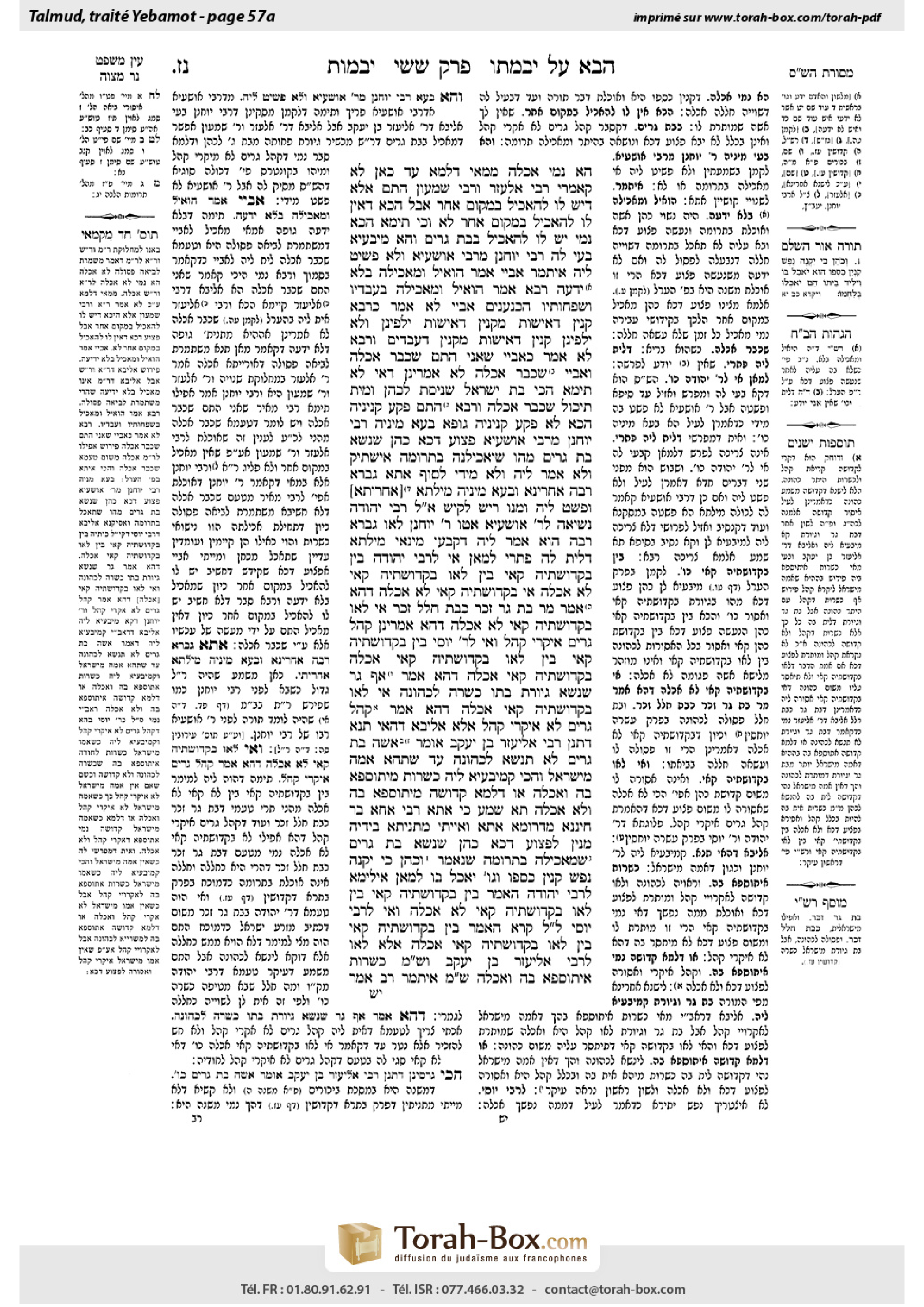
This page of Yevamot includes the Aramaic text, an English translation and an AI-generated French translation, alongside the scan above.
יבמות נ״ז א · Aramaic and Hebrew text
הָא נָמֵי אָכְלָה. מִמַּאי? דִּלְמָא עַד כָּאן לָא קָאָמְרִי רַבִּי אֶלְעָזָר וְרַבִּי שִׁמְעוֹן הָתָם, אֶלָּא דְּיֵשׁ לוֹ לְהַאֲכִיל בְּמָקוֹם אַחֵר. אֲבָל הָכָא, דְּאֵין לוֹ לְהַאֲכִיל בְּמָקוֹם אַחֵר — לָא.
וְכִי תֵּימָא: הָכָא נָמֵי יֵשׁ לוֹ לְהַאֲכִיל בְּבַת גֵּרִים, וְהָא מִיבַּעְיָא בְּעָא לַהּ רַבִּי יוֹחָנָן מֵרַבִּי אוֹשַׁעְיָא, וְלָא פְּשַׁיט לֵיהּ.
אִיתְּמַר, אַבָּיֵי אָמַר: הוֹאִיל וּמַאֲכִילָהּ בְּלֹא יְדָעָהּ.
רָבָא אָמַר: הוֹאִיל וּמַאֲכִילָהּ בַּעֲבָדָיו וְשִׁפְחוֹתָיו הַכְּנַעֲנִים.
אַבָּיֵי לָא אָמַר כְּרָבָא — קִנְיָן דְּאִישׁוּת מִקִּנְיָן דְּאִישׁוּת יָלְפִינַן, וְלָא יָלְפִינַן קִנְיָן דְּאִישׁוּת מִקִּנְיָן דַּעֲבָדִים.
וְרָבָא לָא אָמַר כְּאַבַּיֵּי — שָׁאנֵי הָתָם, שֶׁכְּבָר אָכְלָה. וְאַבָּיֵי: שֶׁכְּבָר אָכְלָה לָא אָמְרִינַן, דְּאִי לָא תֵּימָא הָכִי, בַּת יִשְׂרָאֵל שֶׁנִּיסֵּת לְכֹהֵן וּמִית — תֵּיכוֹל, שֶׁכְּבָר אָכְלָה. וְרָבָא: הָתָם פָּקַע קִנְיָנֵיהּ, הָכָא לָא פָּקַע קִנְיָנֵיהּ.
גּוּפָא, בְּעָא מִינֵּיהּ רַבִּי יוֹחָנָן מֵרַבִּי אוֹשַׁעְיָא: פְּצוּעַ דַּכָּא כֹּהֵן שֶׁנָּשָׂא בַּת גֵּרִים. מַהוּ שֶׁיַּאֲכִילֶנָּה בִּתְרוּמָה? אִישְׁתִּיק וְלָא אֲמַר לֵיהּ וְלָא מִידֵּי. לְסוֹף אֲתָא גַּבְרָא רַבָּה אַחֲרִינָא וּבְעָא מִינֵּיהּ מִילְּתָא [אַחְרִיתָא] וּפְשַׁט לֵיהּ. וּמַנּוּ — רֵישׁ לָקִישׁ. אֲמַר לֵיהּ רַבִּי יְהוּדָה נְשִׂיאָה לְרַבִּי אוֹשַׁעְיָא: אַטּוּ רַבִּי יוֹחָנָן לָאו גַּבְרָא רַבָּה הוּא? אֲמַר לֵיהּ: דְּקָבָעֵי מִינַּאי מִילְּתָא דְּלֵית לַהּ פָּתְרִי.
לְמַאן? אִי לְרַבִּי יְהוּדָה, בֵּין בִּקְדוּשְׁתֵּיהּ קָאֵי בֵּין לָאו בִּקְדוּשְׁתֵּיהּ קָאֵי — לָא אָכְלָה. אִי בִּקְדוּשְׁתֵּיהּ קָאֵי — לָא אָכְלָה, דְּהָא אָמַר מָר: בַּת גֵּר זָכָר כְּבַת חָלָל זָכָר.
אִי לָאו בִּקְדוּשְׁתֵּיהּ קָאֵי — לָא אָכְלָה, דְּהָא אָמְרִינַן: קְהַל גֵּרִים אִיקְּרִי קָהָל.
וְאִי לְרַבִּי יוֹסֵי, בֵּין בִּקְדוּשְׁתֵּיהּ קָאֵי בֵּין לָאו בִּקְדוּשְׁתֵּיהּ קָאֵי — אָכְלָה. בִּקְדוּשְׁתֵּיהּ קָאֵי — אָכְלָה, דְּהָא אָמַר: אַף גֵּר שֶׁנָּשָׂא גִּיּוֹרֶת — בִּתּוֹ כְּשֵׁרָה לִכְהוּנָּה. אִי לָאו בִּקְדוּשְׁתֵּיהּ קָאֵי — אָכְלָה, דְּהָא אָמַר: קְהַל גֵּרִים לָא אִיקְּרִי קָהָל.
אֶלָּא אַלִּיבָּא דְּהַאי תַּנָּא: דִּתְנַן, רַבִּי אֱלִיעֶזֶר בֶּן יַעֲקֹב אוֹמֵר: אִשָּׁה בַּת גֵּרִים לֹא תִּנָּשֵׂא לִכְהוּנָּה עַד שֶׁתְּהֵא אִמָּהּ מִיִּשְׂרָאֵל.
וְהָכִי קָמִיבַּעְיָא לֵיהּ: כַּשְׁרוּת מִיתּוֹסְפָא בַּהּ — וְאָכְלָה, אוֹ דִלְמָא קְדוּשָּׁה מִיתּוֹסְפָא בַּהּ — וְלָא אָכְלָה.
תָּא שְׁמַע: כִּי אֲתָא רַבִּי אַחָא בַּר חִינָּנָא מִדָּרוֹמָא, אֲתָא וְאַיְיתִי מַתְנִיתָא בִּידֵיהּ: מִנַּיִן לִפְצוּעַ דַּכָּא כֹּהֵן שֶׁנָּשָׂא בַּת גֵּרִים שֶׁמַּאֲכִילָהּ בִּתְרוּמָה, שֶׁנֶּאֱמַר: ״וְכֹהֵן כִּי יִקְנֶה נֶפֶשׁ קִנְיַן כַּסְפּוֹ וְגוֹ׳ יֹאכַל בּוֹ״.
לְמַאן? אִילֵימָא לְרַבִּי יְהוּדָה, הָאָמַר: בֵּין בִּקְדוּשְׁתֵּיהּ קָאֵי בֵּין לָאו בִּקְדוּשְׁתֵּיהּ קָאֵי — לָא אָכְלָה. וְאִי לְרַבִּי יוֹסֵי — לְמָה לִי קְרָא, הָאָמַר: בֵּין בִּקְדוּשְׁתֵּיהּ קָאֵי בֵּין לָאו בִּקְדוּשְׁתֵּיהּ קָאֵי — אָכְלָה! אֶלָּא לָאו, לְרַבִּי אֱלִיעֶזֶר בֶּן יַעֲקֹב, וּשְׁמַע מִינַּהּ כַּשְׁרוּת אִיתּוֹסַפָא בַּהּ וְאָכְלָה. שְׁמַע מִינַּהּ.
אִיתְּמַר, רַב אָמַר:
Yevamot 57a · English translation
this one may also partake of teruma until that time. The Gemara refutes this argument: From where do we know that this is correct? Perhaps Rabbi Elazar and Rabbi Shimon stated their opinion there only with regard to a priest whose status can entitle her to partake of teruma in another case, but here, in the case of a priest with crushed testicles, whose status cannot entitle her to partake of teruma in another case, as it is forbidden for him to marry a woman who was born Jewish, no, they did not state their opinion.
And if you say that here too, his status can at least entitle his wife to partake of teruma if he marries the daughter of converts, wasn’t it already raised as a dilemma by Rabbi Yoḥanan before Rabbi Oshaya whether the daughter of converts who married a priest with crushed testicles may partake of teruma, and he was unable to resolve it for him? Therefore, there is a difference between a priest with crushed testicles and other priests who betroth women who are disqualified by their intercourse.
It was stated that Abaye said: Women betrothed to a priest with crushed testicles may eat teruma since his status entitles his wife to partake of teruma in a case where he has not known her. If a priest was properly married and then his testicles became crushed, as long as he has not known his wife, i.e., engaged in intercourse with her, after that point in time, she may continue partaking of teruma as his wife.
Rava said she may continue to partake of teruma for a different reason: She may eat teruma since the status of this priest entitles his Canaanite slaves and maidservants to partake of teruma. Because he has the power to enable others to partake of teruma, the case of a woman betrothed to a priest with crushed testicles is comparable to the cases in the mishna, and Rabbi Elazar and Rabbi Shimon would permit the woman to partake of teruma.
The Gemara clarifies the two opinions. Abaye did not say in accordance with the opinion of Rava because he claims that we derive the halakhot related to the acquisition of marriage from the acquisition of marriage, and we do not derive the halakhot related to the acquisition of marriage from the acquisition of slaves.
And Rava did not state his opinion in accordance with the opinion of Abaye, as he maintains that it is different there, as she had already partaken of teruma before her husband’s testicles were crushed and therefore she may continue to partake of it. And Abaye would respond that we do not say that the case is different because she had already partaken of teruma, as, if you do not say so, the daughter of an Israelite who was married to a priest who died childless should be allowed to partake of teruma, as she had already partaken of teruma while her husband was alive. And Rava replies that there is no comparison between the two cases: There, his acquisition lapses upon his death; here, his acquisition does not lapse, as she is still his wife.
§ The Gemara earlier mentioned a question that Rabbi Yoḥanan posed to Rabbi Oshaya, and it now turns its attention to that matter itself. Rabbi Yoḥanan raised a dilemma before Rabbi Oshaya: With regard to a priest with crushed testicles or with other wounds to his genitals who married the daughter of converts, what is the halakha concerning whether his status entitles her to partake of teruma? Rabbi Oshaya was silent and said nothing to him. Eventually another great man came and raised a different dilemma before Rabbi Oshaya, and he resolved his question. And who was this great man? Reish Lakish. Rabbi Yehuda Nesia said to Rabbi Oshaya: Is Rabbi Yoḥanan not a great man? Why didn’t you address his dilemma? Rabbi Oshaya said to him: I did not respond because he raised a dilemma before me that has no resolution.
The Gemara explains: According to whom did he raise his dilemma? If it was in accordance with the opinion of Rabbi Yehuda, then, whether the priest with crushed testicles retains his priestly sanctity or whether he does not retain his priestly sanctity and may marry women forbidden to priests, she may not partake of teruma. The reasoning is as follows: If he retains his priestly sanctity she may not partake of teruma, as the Master said: The status of the daughter of a male convert is like that of the daughter of a male ḥalal. They are both prohibited from marrying a priest, and therefore even if they marry a priest, it is prohibited for them to eat teruma.
Even if he does not retain his priestly sanctity she may not eat, as we say that according to Rabbi Yehuda, the congregation of converts is called the congregation of the Lord. Therefore, when the Torah renders it prohibited for a man with crushed testicles to marry into the congregation of the Lord (see Deuteronomy 23:2), it renders it prohibited for him to marry converts.
And if he raised his dilemma in accordance with the opinion of Rabbi Yosei, then, whether he retains his priestly sanctity or whether he does not retain his priestly sanctity, she may partake of teruma. If he retains his sanctity she may partake, as Rabbi Yosei said: Even if a convert married a convert, his daughter is fit for marrying into the priesthood. If he does not retain his sanctity she may partake, as Rabbi Yosei said: The congregation of converts is not called the congregation of the Lord, and therefore even those forbidden from entering the congregation may marry converts. Consequently, it is certainly permitted for the priest with crushed testicles to marry the daughter of converts.
Rather, Rabbi Yoḥanan raised his dilemma in accordance with the opinion of this tanna, as we learned in a mishna (Bikkurim 1:5) that Rabbi Eliezer ben Ya’akov says: A woman who is the daughter of converts may not marry into the priesthood unless her mother was Jewish from birth.
And his dilemma was as follows: Is the reason she may marry a priest if her mother was Jewish from birth that fitness to marry a priest has been added to her, but she is not considered a member of the congregation of the Lord and may therefore marry a man with crushed testicles? If so, since she may marry a priest, she may partake of teruma once she does so. Or perhaps sanctity has been added to her and she is considered a member of the congregation of the Lord. Consequently, she may not marry a man with crushed testicles, and if she does, she may not partake of teruma even if he is a priest.
The Gemara suggests an answer to this dilemma. Come and hear: When Rabbi Aḥa bar Ḥinnana came from the south, he came and brought this baraita in hand: From where is it derived that a priest with crushed testicles or with other wounds to his genitals who married the daughter of converts entitles her to partake of teruma? As it is stated: “But if a priest buys any soul, the purchase of his money, he may eat of it” (Leviticus 22:11). In this context, a wife is also considered his monetary acquisition, and therefore she may partake of teruma.
The Gemara analyzes this source: According to whom is this baraita stated? If we say it is in accordance with the opinion of Rabbi Yehuda, didn’t he say that whether this priest retains his sanctity or whether he does not retain his sanctity, she may not partake of teruma? And if it is in accordance with the opinion of Rabbi Yosei, why do I need a special verse to teach this halakha? Didn’t he say that whether he retains his sanctity or whether he does not retain his sanctity, she may partake of teruma? Rather, is it not in accordance with the opinion of Rabbi Eliezer ben Ya’akov? And you can learn from this baraita that fitness was added to her, and therefore she may partake of teruma. The Gemara concludes: Indeed, learn from this that it is so.
§ The Gemara cites a dispute with regard to an issue related to the previous discussion. It was stated that the amora’im disagreed about the following question. Rav said:
Yevamot 57a · Traduction française (IA)
Celle-ci aussi peut consommer de la terouma jusque-là. La Guemara réfute cet argument : d’où savons-nous que cela est exact ? Peut-être Rabbi Elazar et Rabbi Shimon n’ont-ils exprimé leur opinion là-bas qu’au sujet d’un prêtre dont le statut peut, dans un autre cas, permettre à son épouse de consommer de la terouma ; mais ici, dans le cas d’un prêtre aux testicules écrasés, dont le statut ne peut pas, dans un autre cas, permettre à son épouse de consommer de la terouma, puisqu’il lui est interdit d’épouser une femme née juive, ils n’ont pas exprimé leur opinion.
Et si tu dis qu’ici aussi, son statut peut au moins permettre à son épouse de consommer de la terouma s’il épouse la fille de convertis, n’a-t-on pas déjà soulevé devant Rabbi Oshaya la question que Rabbi Yoḥanan se posait : la fille de convertis qui a épousé un prêtre aux testicules écrasés peut-elle consommer de la terouma ? Il n’a pas pu lui apporter de réponse. Il y a donc une différence entre un prêtre aux testicules écrasés et les autres prêtres qui se fiancent avec des femmes que leurs relations sexuelles rendent inaptes.
Il a été rapporté qu’Abaye a dit : les femmes fiancées à un prêtre aux testicules écrasés peuvent consommer de la terouma, puisque son statut permet à son épouse de consommer de la terouma lorsqu’il n’a pas eu de relations avec elle. Si un prêtre s’est marié régulièrement, puis que ses testicules ont été écrasés, tant qu’il n’a pas eu de relations avec son épouse après cela, elle peut continuer à consommer de la terouma en tant que son épouse.
Rava a dit qu’elle peut continuer à consommer de la terouma pour une autre raison : elle peut en consommer parce que le statut de ce prêtre permet à ses esclaves et à ses servantes cananéens d’en consommer. Puisqu’il a le pouvoir de permettre à d’autres d’en consommer, le cas d’une femme fiancée à un prêtre aux testicules écrasés est comparable aux cas de la Michna, et Rabbi Elazar et Rabbi Shimon autoriseraient cette femme à consommer de la terouma.
La Guemara précise les deux opinions. Abaye ne s’est pas rangé à l’opinion de Rava, car il affirme que nous déduisons les halakhot relatives à l’acquisition par le mariage de celles qui concernent l’acquisition par le mariage, et non celles qui concernent l’acquisition d’esclaves.
Rava, lui, n’a pas exprimé son opinion conformément à celle d’Abaye, car il soutient que ce cas est différent : elle avait déjà consommé de la terouma avant que les testicules de son mari ne soient écrasés et peut donc continuer à en consommer. Abaye répondrait que nous ne considérons pas que le cas est différent au motif qu’elle avait déjà consommé de la terouma. En effet, si tu ne dis pas cela, la fille d’un Israélite mariée à un prêtre mort sans enfant devrait être autorisée à consommer de la terouma, puisqu’elle en consommait déjà du vivant de son mari. Rava répond qu’il n’y a pas de comparaison entre les deux cas : là, l’acquisition de son mari prend fin à sa mort ; ici, son acquisition ne prend pas fin, car elle est toujours son épouse.
§ La Guemara a mentionné plus tôt une question que Rabbi Yoḥanan avait posée à Rabbi Oshaya ; elle revient à présent sur cette question elle-même. Rabbi Yoḥanan posa cette question à Rabbi Oshaya : s’agissant d’un prêtre aux testicules écrasés ou présentant d’autres lésions aux organes génitaux, qui a épousé la fille de convertis, quelle est la halakha quant au fait que son statut lui permette de consommer de la terouma ? Rabbi Oshaya resta silencieux et ne lui répondit rien. Par la suite, un autre grand sage vint soulever une autre question devant Rabbi Oshaya, qui y répondit. Et qui était ce grand sage ? Reish Lakish. Rabbi Yehuda Nesia dit à Rabbi Oshaya : Rabbi Yoḥanan n’est-il pas un grand sage ? Pourquoi n’as-tu pas répondu à sa question ? Rabbi Oshaya lui répondit : Je ne lui ai pas répondu parce qu’il m’a posé une question sans réponse.
La Guemara explique : selon l’opinion de qui a-t-il posé sa question ? Si c’était conformément à l’opinion de Rabbi Yehuda, alors, que le prêtre aux testicules écrasés conserve ou non sa sainteté sacerdotale et puisse épouser des femmes interdites aux prêtres, elle ne peut pas consommer de terouma. Voici le raisonnement : s’il conserve sa sainteté sacerdotale, elle ne peut pas consommer de terouma, car le maître a dit : le statut de la fille d’un converti est comme celui de la fille d’un mâle ḥalal. Toutes deux n’ont pas le droit d’épouser un prêtre et, par conséquent, même si elles en épousent un, il leur est interdit de consommer de la terouma.
Même s’il ne conserve pas sa sainteté sacerdotale, elle ne peut pas consommer de terouma, car, selon Rabbi Yehuda, la communauté des convertis est appelée « communauté de l’Éternel ». Ainsi, lorsque la Torah interdit à un homme aux testicules écrasés de s’unir à la communauté de l’Éternel (voir Deutéronome 23:2), elle lui interdit d’épouser des convertis.
Et s’il a posé sa question conformément à l’opinion de Rabbi Yosei, alors, qu’il conserve ou non sa sainteté sacerdotale, elle peut consommer de la terouma. S’il conserve sa sainteté, elle peut en consommer, car Rabbi Yosei a dit : même si un converti épouse une convertie, leur fille peut épouser un membre de la prêtrise. S’il ne conserve pas sa sainteté, elle peut en consommer, car Rabbi Yosei a dit : la communauté des convertis n’est pas appelée « communauté de l’Éternel » et, par conséquent, même ceux à qui il est interdit d’entrer dans la communauté peuvent épouser des convertis. Il est donc certainement permis au prêtre aux testicules écrasés d’épouser la fille de convertis.
Il faut plutôt dire que Rabbi Yoḥanan a posé sa question conformément à l’opinion de ce tanna, car nous avons appris dans une Michna (Bikkourim 1:5) que Rabbi Eliezer ben Ya’akov dit : une femme, fille de convertis, ne peut pas épouser un membre de la prêtrise, à moins que sa mère ne soit née juive.
Et voici quelle était sa question : la raison pour laquelle elle peut épouser un prêtre si sa mère est née juive est-elle que l’aptitude à épouser un prêtre lui a été ajoutée, sans qu’elle soit considérée comme membre de la communauté de l’Éternel, de sorte qu’elle peut épouser un homme aux testicules écrasés ? Si tel est le cas, puisqu’elle peut épouser un prêtre, elle peut consommer de la terouma une fois qu’elle l’a épousé. Ou peut-être est-ce la sainteté qui lui a été ajoutée, si bien qu’elle est considérée comme membre de la communauté de l’Éternel ? Par conséquent, elle ne peut pas épouser un homme aux testicules écrasés et, si elle le fait, elle ne peut pas consommer de la terouma, même s’il est prêtre.
La Guemara propose une réponse à cette question. Viens et écoute : lorsque Rabbi Aḥa bar Ḥinnana arriva du Sud, il apporta cette baraïta : d’où déduit-on qu’un prêtre aux testicules écrasés ou présentant d’autres lésions aux organes génitaux, qui a épousé la fille de convertis, lui permet de consommer de la terouma ? Car il est dit : « Si un prêtre achète une personne, acquisition de son argent, celle-ci pourra en manger » (Lévitique 22:11). Dans ce contexte, une épouse est également considérée comme son acquisition pécuniaire ; elle peut donc consommer de la terouma.
La Guemara analyse cette source : selon l’opinion de qui cette baraïta est-elle enseignée ? Si nous disons qu’elle est conforme à l’opinion de Rabbi Yehuda, n’a-t-il pas dit que, que ce prêtre conserve ou non sa sainteté, elle ne peut pas consommer de la terouma ? Et si elle est conforme à l’opinion de Rabbi Yosei, pourquoi faut-il un verset particulier pour enseigner cette halakha ? N’a-t-il pas dit que, qu’il conserve ou non sa sainteté, elle peut consommer de la terouma ? N’est-elle pas plutôt conforme à l’opinion de Rabbi Eliezer ben Ya’akov ? On peut donc déduire de cette baraïta que l’aptitude à épouser un prêtre lui a été ajoutée et qu’elle peut donc consommer de la terouma. La Guemara conclut : en effet, déduis de là que c’est bien le cas.
§ La Guemara rapporte une controverse portant sur une question liée à la discussion précédente. Il a été rapporté que les amoraïm étaient en désaccord sur la question suivante. Rav a dit :
Traduction française générée par IA à partir de l’édition anglaise de Sefaria. Vérifie toujours un passage avec le texte source.
Text from Sefaria: William Davidson Edition - Vocalized Aramaic (CC BY NC); William Davidson Edition - English (CC BY NC).