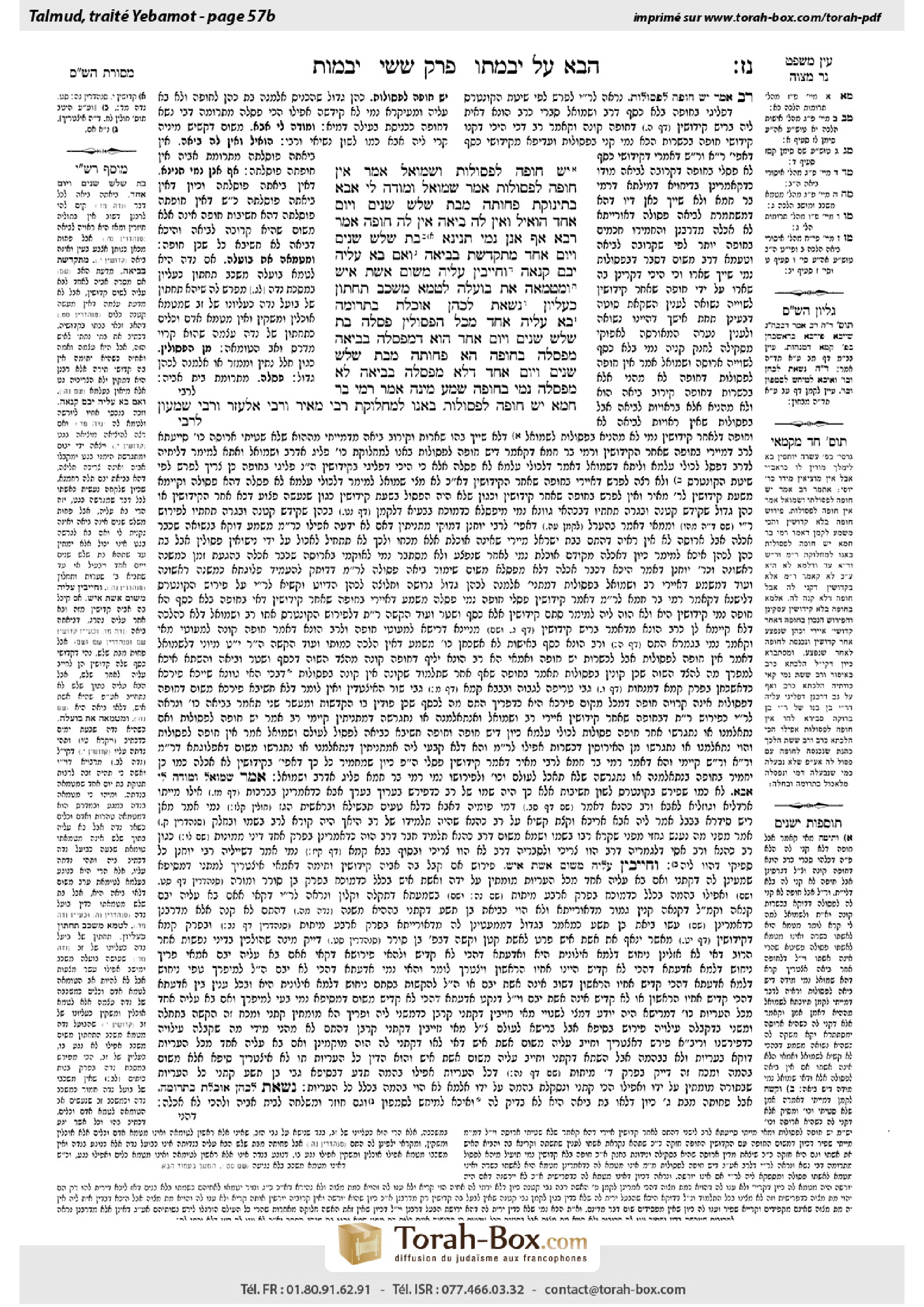
Yevamot 57b: Talmud study for Daf Yomi
Daf Yomi is the daily study of one Talmud folio. Explore 37 tractates with scans, Hebrew text, Sefaria English and AI-generated French translations where annotated.
Passage selection and English or AI-generated French translation are available where the scan has annotations. Daf Study is independent of Torah-Box and Sefaria.
Browse Yevamot · יבמות · All tractatesYevamot 57b text and translations
This page of Yevamot includes the Aramaic text, an English translation and an AI-generated French translation, alongside the scan above.
יבמות נ״ז ב · Aramaic and Hebrew text
יֵשׁ חוּפָּה לִפְסוּלוֹת. וּשְׁמוּאֵל אָמַר: אֵין חוּפָּה לִפְסוּלוֹת.
אָמַר שְׁמוּאֵל: וּמוֹדֶה לִי אַבָּא בְּתִינוֹקֶת פְּחוּתָה מִבַּת שָׁלֹשׁ שָׁנִים וְיוֹם אֶחָד, הוֹאִיל וְאֵין לָהּ בִּיאָה, אֵין לָהּ חוּפָּה.
אָמַר רָבָא, אַף אֲנַן נָמֵי תְּנֵינָא: בַּת שָׁלֹשׁ שָׁנִים וְיוֹם אֶחָד מִתְקַדֶּשֶׁת בְּבִיאָה, וְאִם בָּא עָלֶיהָ יָבָם — קְנָאָהּ, וְחַיָּיבִין עָלֶיהָ מִשּׁוּם אֵשֶׁת אִישׁ, וּמְטַמְּאָה אֶת בּוֹעֲלָהּ לְטַמֵּא מִשְׁכָּב תַּחְתּוֹן כְּעֶלְיוֹן.
נִשֵּׂאת לְכֹהֵן — אוֹכֶלֶת בִּתְרוּמָה. בָּא עָלֶיהָ אֶחָד מִכׇּל הַפְּסוּלִין — פְּסָלָהּ.
בַּת שָׁלֹשׁ שָׁנִים וְיוֹם אֶחָד, הוּא דְּמִפַּסְלָה בְּבִיאָה — מִפַּסְלָה בְּחוּפָּה. הָא פְּחוּתָה מִבַּת שָׁלֹשׁ שָׁנִים וְיוֹם אֶחָד, דְּלָא מִפַּסְלָה בְּבִיאָה — לָא מִפַּסְלָה נָמֵי בְּחוּפָּה. שְׁמַע מִינַּהּ.
אָמַר רָמֵי בַּר חָמָא: יֵשׁ חוּפָּה לִפְסוּלוֹת — בָּאנוּ לְמַחְלוֹקֶת רַבִּי מֵאִיר וְרַבִּי אֶלְעָזָר וְרַבִּי שִׁמְעוֹן.
Yevamot 57b · English translation
There is significance to a priest entering a wedding canopy with women who are unfit to marry a priest. If a priest’s daughter who is unfit to marry a priest enters the wedding canopy with a priest, she becomes disqualified from partaking of teruma from her father’s household. This is the case even if the priest did not betroth her and they did not engage in sexual intercourse. And Shmuel said: There is no significance to a priest entering the wedding canopy with women who are unfit to marry a priest. Only sexual intercourse disqualifies her from the privileges of priesthood.
Shmuel said: And Abba, i.e., Rav, whose first name was Abba, concedes to me, with regard to a girl less than three years and one day old, that she is not disqualified by merely entering the wedding canopy. Since there is no legal significance to an act of intercourse with her, there is no legal significance to entering the wedding canopy with her.
Rava said: We, too, learn in the following baraita that there is no legal significance to an act of intercourse with a girl less than three years old: A girl three years and one day old can be betrothed via sexual intercourse; and if she was a yevama and her yavam had intercourse with her, he has acquired her; and a man who has intercourse with her while she is married to someone else is liable on her account because of the prohibition of intercourse with a married woman; and if she experiences a menstrual discharge she renders ritually impure a man who has intercourse with her, so that he renders impure the object upon which he lies like the upper one.
If she is married to a priest she may partake of teruma. If one of those who render women unfit for marrying a priest had intercourse with her, he has disqualified her from being able to partake of teruma.
Rava infers from this baraita that it is a girl three years and one day old who is disqualified via intercourse, and consequently she is also disqualified via the wedding canopy. However, a girl who is less than three years and one day old, who is not disqualified via intercourse, is also not disqualified via the wedding canopy. The Gemara concludes: Indeed, learn from this that it is so.
Rami bar Ḥama said: With regard to the question of whether there is legal significance to a priest entering the wedding canopy with women who are unfit to marry a priest, we have arrived at the dispute cited in the mishna between Rabbi Meir on the one hand and Rabbi Elazar and Rabbi Shimon on the other.
Yevamot 57b · Traduction française (IA)
Le fait qu’un prêtre entre sous le dais nuptial avec une femme qui n’est pas apte à épouser un prêtre a une portée juridique. Si une fille de prêtre qui n’est pas apte à épouser un prêtre entre sous le dais nuptial avec un prêtre, elle perd le droit de consommer la terouma provenant de la maison de son père. Cela vaut même si le prêtre ne l’a pas fiancée et qu’ils n’ont pas eu de rapports sexuels. Shmuel a dit : le fait qu’un prêtre entre sous le dais nuptial avec une femme qui n’est pas apte à épouser un prêtre n’a aucune portée juridique. Seuls les rapports sexuels lui font perdre les privilèges liés à la prêtrise.
Shmuel a dit : Abba, c’est-à-dire Rav, dont le prénom était Abba, reconnaît lui aussi, au sujet d’une fille de moins de trois ans et un jour, qu’elle ne perd pas ce droit du seul fait d’entrer sous le dais nuptial. Puisqu’un rapport sexuel avec elle n’a aucune portée juridique, le fait d’entrer sous le dais nuptial avec elle n’en a pas non plus.
Rava a dit : Nous aussi, nous apprenons dans la baraïta suivante qu’un rapport sexuel avec une fille de moins de trois ans n’a aucune portée juridique : une fille âgée de trois ans et un jour peut être fiancée par un rapport sexuel ; si elle était une yevama et que son yavam a eu un rapport sexuel avec elle, il l’a acquise ; un homme qui a un rapport sexuel avec elle alors qu’elle est mariée à un autre est passible d’une peine en raison de l’interdiction des rapports sexuels avec une femme mariée ; si elle a un écoulement menstruel, elle rend rituellement impur l’homme qui a un rapport sexuel avec elle, de sorte qu’il rend impur l’objet sur lequel il est couché, selon le principe du supérieur qui rend impur l’inférieur.
Si elle est mariée à un prêtre, elle peut consommer la terouma. Si l’un de ceux qui rendent une femme inapte à épouser un prêtre a eu un rapport sexuel avec elle, il lui a fait perdre le droit de consommer la terouma.
Rava déduit de cette baraïta que c’est une fille âgée de trois ans et un jour qui perd ce droit à la suite d’un rapport sexuel et que, par conséquent, elle le perd également en entrant sous le dais nuptial. En revanche, une fille de moins de trois ans et un jour, qui ne perd pas ce droit à la suite d’un rapport sexuel, ne le perd pas non plus en entrant sous le dais nuptial. La Guemara conclut : En effet, apprends de là qu’il en est bien ainsi.
Rami bar Ḥama a dit : Quant à la question de savoir si le fait qu’un prêtre entre sous le dais nuptial avec une femme qui n’est pas apte à épouser un prêtre a une portée juridique, nous voici parvenus à la controverse citée dans la Michna entre Rabbi Meïr, d’une part, et Rabbi Elazar et Rabbi Shimon, d’autre part.
Traduction française générée par IA à partir de l’édition anglaise de Sefaria. Vérifie toujours un passage avec le texte source.
Text from Sefaria: William Davidson Edition - Vocalized Aramaic (CC BY NC); William Davidson Edition - English (CC BY NC).