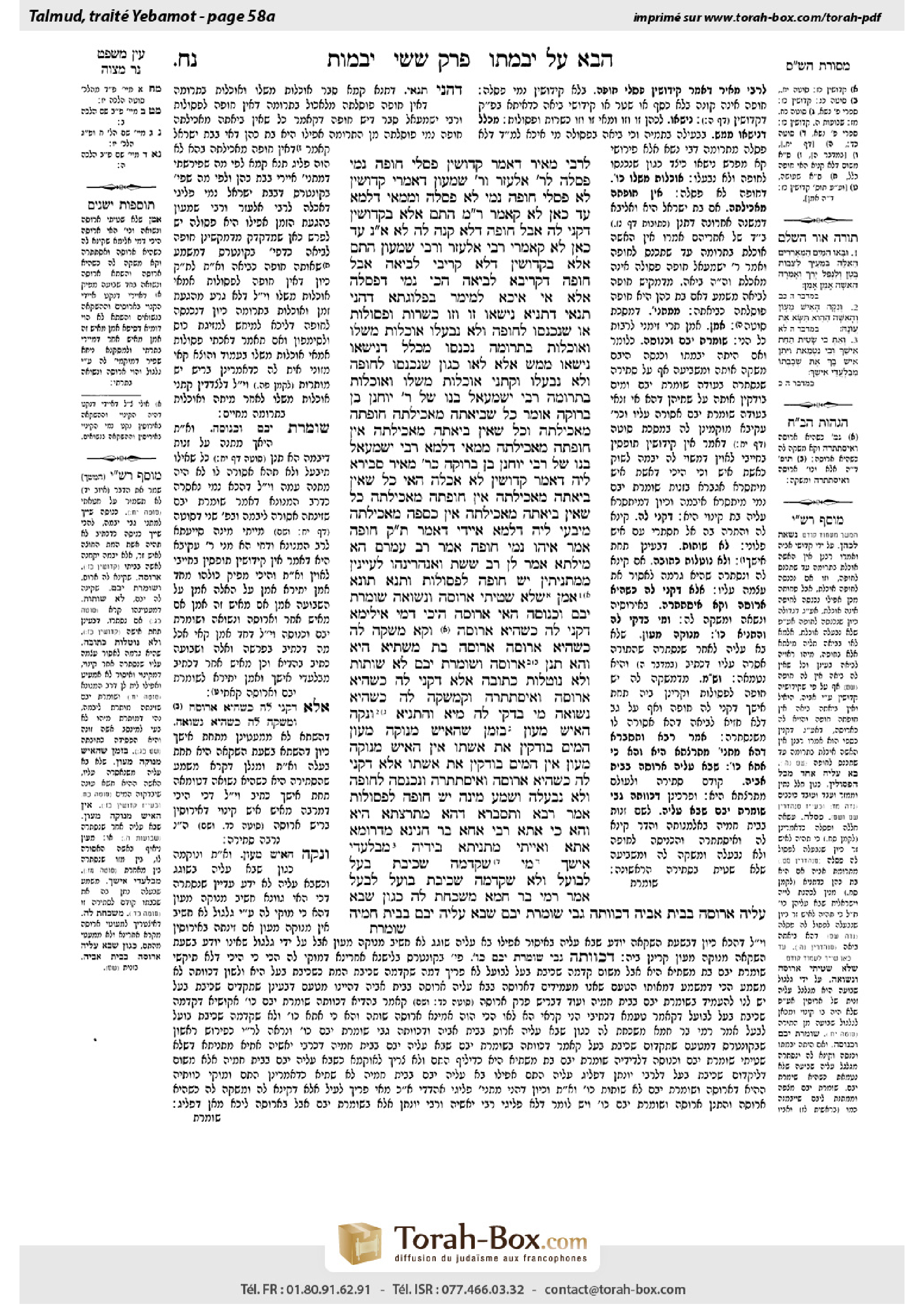
Yevamot 58a: Talmud study for Daf Yomi
Daf Yomi is the daily study of one Talmud folio. Explore 37 tractates with scans, Hebrew text, Sefaria English and AI-generated French translations where annotated.
Passage selection and English or AI-generated French translation are available where the scan has annotations. Daf Study is independent of Torah-Box and Sefaria.
Browse Yevamot · יבמות · All tractatesYevamot 58a text and translations
This page of Yevamot includes the Aramaic text, an English translation and an AI-generated French translation, alongside the scan above.
יבמות נ״ח א · Aramaic and Hebrew text
לְרַבִּי מֵאִיר, דְּאָמַר קִדּוּשִׁין פָּסְלִי — חוּפָּה נָמֵי פָּסְלָה. לְרַבִּי אֶלְעָזָר וְרַבִּי שִׁמְעוֹן, דְּאָמְרִי קִדּוּשִׁין לָא פָּסְלִי — חוּפָּה נָמֵי לָא פָּסְלָה.
וּמִמַּאי? דִּלְמָא עַד כָּאן לָא קָאָמַר רַבִּי מֵאִיר הָתָם אֶלָּא בְּקִדּוּשִׁין, דְּקָנֵי לַהּ, אֲבָל חוּפָּה דְּלָא קָנֵי לַהּ — לָא.
אִי נָמֵי: עַד כָּאן לָא קָאָמְרִי רַבִּי אֶלְעָזָר וְרַבִּי שִׁמְעוֹן הָתָם אֶלָּא בְּקִדּוּשִׁין, דְּלָא קְרִיבִי לְבִיאָה, אֲבָל חוּפָּה דִּקְרִיבָא לְבִיאָה — הָכִי נָמֵי דְּפָסְלָה.
אֶלָּא אִי אִיכָּא לְמֵימַר, בִּפְלוּגְתָּא דְּהָנֵי תַּנָּאֵי, דְּתַנְיָא: נִישְּׂאוּ זוֹ וָזוֹ, כְּשֵׁרוֹת וּפְסוּלוֹת, אוֹ שֶׁנִּכְנְסוּ לְחוּפָּה וְלֹא נִבְעֲלוּ — אוֹכְלוֹת מִשֶּׁלּוֹ, וְאוֹכְלוֹת בִּתְרוּמָה.
נִכְנְסוּ, מִכְּלָל דְּ״נִישְּׂאוּ״ — נִישְּׂאוּ מַמָּשׁ?!
אֶלָּא לָאו: כְּגוֹן שֶׁנִּכְנְסוּ לְחוּפָּה וְלֹא נִבְעֲלוּ. וְקָתָנֵי: אוֹכְלוֹת מִשֶּׁלּוֹ וְאוֹכְלוֹת בִּתְרוּמָה.
רַבִּי יִשְׁמָעֵאל בְּנוֹ שֶׁל רַבִּי יוֹחָנָן בֶּן בְּרוֹקָה אוֹמֵר: כֹּל שֶׁבִּיאָתָהּ מַאֲכִילָתָהּ — חוּפָּתָהּ מַאֲכִילָתָהּ, וְכֹל שֶׁאֵין בִּיאָתָהּ מַאֲכִילָתָהּ — אֵין חוּפָּתָהּ מַאֲכִילָתָהּ.
מִמַּאי? דִּלְמָא רַבִּי יִשְׁמָעֵאל בְּנוֹ שֶׁל רַבִּי יוֹחָנָן בֶּן בְּרוֹקָה כְּרַבִּי מֵאִיר סְבִירָא לֵיהּ, דְּאָמַר קִדּוּשִׁין לָא אָכְלָה?
הַאי ״כֹּל שֶׁאֵין בִּיאָתָהּ מַאֲכִילָתָהּ אֵין חוּפָּתָהּ מַאֲכִילָתָהּ״, ״כֹּל שֶׁאֵין בִּיאָתָהּ מַאֲכִילָתָהּ אֵין כַּסְפָּהּ מַאֲכִילָתָהּ״ מִיבְּעֵי לֵיהּ! דִּלְמָא, אַיְּידֵי דְּאָמַר תַּנָּא קַמָּא חוּפָּה, אָמַר אִיהוּ נָמֵי חוּפָּה.
אָמַר רַב עַמְרָם: הָא מִילְּתָא אֲמַר לַן רַב שֵׁשֶׁת, וְאַנְהֲרִינְהוּ לְעַיְינִין מִמַּתְנִיתִין: יֵשׁ חוּפָּה לִפְסוּלוֹת. וְתַנָּא תּוּנָא: אָמֵן שֶׁלֹּא שָׂטִיתִי אֲרוּסָה וּנְשׂוּאָה, שׁוֹמֶרֶת יָבָם וּכְנוּסָה.
הַאי אֲרוּסָה הֵיכִי דָמֵי? אִילֵּימָא דְּקַנִּי לַהּ כְּשֶׁהִיא אֲרוּסָה וְקָא מַשְׁקֵה לַהּ כְּשֶׁהִיא אֲרוּסָה — אֲרוּסָה בַּת מִשְׁתְּיָא הִיא? וְהָא תְּנַן: אֲרוּסָה וְשׁוֹמֶרֶת יָבָם — לֹא שׁוֹתוֹת וְלֹא נוֹטְלוֹת כְּתוּבָה!
אֶלָּא דְּקַנִּי לַהּ כְּשֶׁהִיא אֲרוּסָה וְאִיסְתְּתַר, וְקָמַשְׁקֵה לַהּ כְּשֶׁהִיא נְשׂוּאָה, מִי בָּדְקִי לַהּ מַיָּא? וְהָתַנְיָא: ״וְנִקָּה הָאִישׁ מֵעָוֹן״, בִּזְמַן שֶׁהָאִישׁ מְנוּקֶּה מֵעָוֹן — הַמַּיִם בּוֹדְקִין אֶת אִשְׁתּוֹ, אֵין הָאִישׁ מְנוּקֶּה מֵעָוֹן — אֵין הַמַּיִם בּוֹדְקִין אֶת אִשְׁתּוֹ.
אֶלָּא, דְּקַנִּי לָהּ כְּשֶׁהִיא אֲרוּסָה, וְאִיסְתְּתַר, וְנִכְנְסָה לְחוּפָּה וְלֹא נִבְעֲלָה — וּשְׁמַע מִינַּהּ יֵשׁ חוּפָּה לִפְסוּלוֹת.
אָמַר רָבָא: וְתִסְבְּרָא דְּהָא מְתָרַצְתָּא הִיא? וְהָא כִּי אֲתָא רַבִּי אַחָא בַּר חֲנִינָא מִדָּרוֹמָא, אֲתָא וְאַיְיתִי מַתְנִיתָא בִּידֵיהּ: ״מִבַּלְעֲדֵי אִישֵׁךְ״, מִי שֶׁקָּדְמָה שְׁכִיבַת בַּעַל לַבּוֹעֵל, וְלֹא שֶׁקָּדְמָה שְׁכִיבַת בּוֹעֵל לַבַּעַל.
אָמַר רָמֵי בַּר חָמָא: מַשְׁכַּחַתְּ לַהּ כְּגוֹן שֶׁבָּא עָלֶיהָ אֲרוּסָהּ בְּבֵית אָבִיהָ.
דִּכְווֹתַהּ גַּבֵּי שׁוֹמֶרֶת יָבָם — שֶׁבָּא עָלֶיהָ יָבָם בְּבֵית חָמִיהָ,
Yevamot 58a · English translation
According to Rabbi Meir, who says that betrothal to a priest disqualifies a woman who is unfit to marry him from partaking of teruma even if she is the daughter of a priest, entering the wedding canopy with a priest also disqualifies her. Conversely, according to Rabbi Elazar and Rabbi Shimon, who say that betrothal does not disqualify her, entering the wedding canopy also does not disqualify her.
The Gemara refutes this claim: And from where do we know that these tanna’im would apply their opinions with regard to betrothal to entering the wedding canopy? Perhaps Rabbi Meir only stated his opinion there, with regard to betrothal, which acquires her. However, in the case of a wedding canopy, which does not acquire her, no, she is not disqualified.
Alternatively, perhaps Rabbi Elazar and Rabbi Shimon stated their opinion only there, with regard to betrothal, as it is not close to an act of sexual intercourse. However, with regard to entering the wedding canopy, which is close to an act of sexual intercourse, as it is the place where the bride and groom are secluded together and symbolizes the woman’s entrance into her husband’s home, it is possible that it also disqualifies her from partaking of teruma.
Rather, if it can be said that this issue was already discussed by earlier Sages, it was in the dispute between these other tanna’im, as it is taught in a baraita: If they married one another, i.e., either a woman who is fit or a woman who is unfit married a priest, or they entered the wedding canopy and did not yet have intercourse with him, they are entitled to eat of his food and to partake of teruma.
The Gemara interrupts its presentation of the baraita to examine its wording. The fact that the baraita mentions a case where they entered the wedding canopy but did not yet have intercourse proves by inference that the earlier case, where they married, is referring to actual marriage. However, this is difficult because if they were actually married and had engaged in intercourse, the woman who was unfit to marry a priest is certainly disqualified from partaking of teruma due to the prohibited act of intercourse.
Rather, is it not that the baraita is referring to a single case: Where they were married, and they entered the canopy, and had not had intercourse? And it is taught in the baraita that they are entitled to partake of his food and to partake of teruma. This indicates that entrance into the wedding canopy does not disqualify a woman who is unfit to marry a priest from eating teruma, although the act of intercourse does.
The baraita continues: Conversely, Rabbi Yishmael, son of Rabbi Yoḥanan ben Beroka, says: Any woman whose act of intercourse entitles her to partake of teruma, her wedding canopy also entitles her to partake of teruma; and any woman whose act of intercourse does not entitle her to partake of teruma, her wedding canopy also does not entitle her to partake of teruma. Consequently, it appears that the tanna’im cited in this baraita disagree over the very question of whether the entry of a priest and a woman unfit to marry him into the wedding canopy has legal significance.
The Gemara refutes this claim: From where do we know that this is correct? Perhaps Rabbi Yishmael, son of Rabbi Yoḥanan ben Beroka, holds in accordance with the opinion of Rabbi Meir, who said that in the case of the betrothal of a woman unfit for a priest she may not partake of teruma?
The Gemara expresses surprise: According to this suggestion, this expression in the baraita is difficult: Any woman whose act of intercourse does not entitle her to partake of teruma, her wedding canopy also does not entitle her to partake of teruma. It should have said: Any woman whose act of intercourse does not entitle her to partake of teruma, her betrothal money also does not entitle her to partake of teruma, as it was the betrothal that disqualified her. The Gemara counters this argument: Perhaps it can be suggested that since the first tanna said his ruling with regard to a wedding canopy, Rabbi Yishmael, son of Rabbi Yoḥanan ben Beroka, also said his ruling with regard to a wedding canopy, even though he holds that she was already disqualified from the time of her betrothal.
§ Rav Amram said: This matter was said to us by Rav Sheshet, and he illuminated our eyes from the mishna, i.e., he demonstrated that the mishna serves as the basis for his opinion. Rav Sheshet’s statement was as follows: There is significance to a priest entering the wedding canopy with women who are unfit to marry a priest. And the tanna of the mishna also taught this halakha with regard to a sota (Sota 18a–b): When a sota is brought to the Temple to drink the bitter waters, she affirms the oath imposed on her by a priest that she has not committed adultery. The mishna explains that when she says amen, it is as though she herself states that: I did not go astray while betrothed, or married, or as a widow waiting for her yavam, or as a fully married woman.
The Gemara inquires: This case of a betrothed woman, what are the circumstances? If we say that he was jealous of her and warned her not to seclude herself with a particular man when she was betrothed, and he also causes her to drink the waters when she is betrothed, is a betrothed woman fit to drink the waters of a sota? Didn’t we learn in a mishna (Sota 23b): A betrothed woman and a widow waiting for her yavam do not drink, as the halakha of the sota waters applies only to married women; and they do not collect their marriage contract if they secluded themselves after being warned, as they have acted in a licentious fashion?
Rather, the case in the first mishna cited above is that he was jealous of her and warned her not to seclude herself with a particular man when she was betrothed, and she secluded herself with that man, and her husband causes her to drink when she is already married. However, in that case do the waters examine her? Isn’t it taught in a baraita with regard to the verse: “And the man shall be clear from iniquity, and that woman shall bear her iniquity” (Numbers 5:31), that when the man is clear of iniquity the waters examine his wife, but if the man is not clear of iniquity the waters do not examine his wife? By secluding herself with the other man when she was betrothed, the woman rendered herself forbidden to her husband. If he then married her, he cannot be described as clear of iniquity, and therefore the sota waters are ineffective.
Rather, it must be that he was jealous of her when she was betrothed, and she secluded herself with the other man anyway, and she had entered the wedding canopy but did not yet have intercourse with her husband when he brought her to the priest. Consequently, she is made to drink the sota waters as a married woman, and her husband has not committed a transgression, as he has not had intercourse with her. Learn from this that there is significance to a priest entering the wedding canopy with women who are unfit to marry a priest, as demonstrated by the fact that the sota waters will examine her in these circumstances.
Rava said: Do you hold that this baraita is sufficiently accurate to rely upon? But when Rabbi Aḥa bar Ḥanina came from the South, he came with this baraita in hand: The verse states with regard to the oath of the sota: “And some man has lain with you besides your husband” (Numbers 5:20), which indicates that it applies only when the cohabitation of the husband preceded that of the adulterer, but not when the cohabitation of the adulterer preceded that of the husband. Consequently, in the case under discussion, drinking the sota waters would not be effective.
Rami bar Ḥama said: You find it in a case such as where her betrothed had intercourse with her licentiously when she was a betrothed woman in her father’s house. Since the act of intercourse was committed licentiously rather than for the purpose of consummating the marriage, the woman is still considered betrothed. Subsequently, her betrothed warned her not to seclude herself with a particular man, and she disobeyed. Then, they entered the wedding canopy together, despite the fact that they are forbidden to one another. Once they entered the wedding canopy, the woman can be made to drink the bitter waters. This proves that there is significance to entering the wedding canopy with a woman that is unfit for one to marry.
The Gemara asks: If so, in the corresponding case with regard to a widow waiting for her yavam, in which the yavam had licentious intercourse with her in her father-in-law’s house,
Yevamot 58a · Traduction française (IA)
Selon Rabbi Meïr, qui affirme que les kidouchin avec un prêtre empêchent une femme inapte à l’épouser de consommer la terouma, même si elle est fille de prêtre, l’entrée sous la houppa avec un prêtre l’en empêche également. À l’inverse, selon Rabbi Elazar et Rabbi Shimon, qui affirment que les kidouchin ne l’en empêchent pas, l’entrée sous la houppa ne l’en empêche pas non plus.
La Guemara réfute cette affirmation : d’où savons-nous que ces tannaïm appliqueraient leurs opinions sur les kidouchin à l’entrée sous la houppa ? Peut-être Rabbi Meïr n’a-t-il exprimé son opinion que dans le cas des kidouchin, qui l’acquièrent. Mais dans le cas de la houppa, qui ne l’acquiert pas, non : elle n’est pas disqualifiée.
Ou peut-être Rabbi Elazar et Rabbi Shimon n’ont-ils exprimé leur opinion que dans le cas des kidouchin, car ceux-ci ne sont pas proches d’un acte sexuel. Mais concernant l’entrée sous la houppa, qui est proche d’un acte sexuel, puisqu’il s’agit du lieu où les mariés se retrouvent seuls et que cela symbolise l’entrée de la femme dans le foyer de son mari, il est possible que cela l’empêche également de consommer la terouma.
Mais s’il est possible de dire que des Sages antérieurs ont déjà débattu de cette question, c’est dans le différend entre ces autres tannaïm, comme l’enseigne une baraïta : si un homme et une femme se sont mariés — c’est-à-dire qu’une femme apte ou une femme inapte a épousé un prêtre —, ou s’ils sont entrés sous la houppa sans encore avoir eu de rapports sexuels, elles ont le droit de consommer sa nourriture et de consommer la terouma.
La Guemara interrompt la présentation de la baraïta pour examiner sa formulation. Le fait que la baraïta mentionne le cas où ils sont entrés sous la houppa sans encore avoir eu de rapports sexuels implique que le cas précédent, où ils se sont mariés, concerne un mariage effectif. Mais cela pose problème : s’ils étaient véritablement mariés et avaient eu des rapports sexuels, la femme inapte à épouser un prêtre serait certainement empêchée de consommer la terouma en raison de l’acte sexuel interdit.
Mais la baraïta ne vise-t-elle pas plutôt un seul et même cas : ils se sont mariés, sont entrés sous la houppa et n’ont pas eu de rapports sexuels ? Or la baraïta enseigne qu’elles ont le droit de consommer sa nourriture et de consommer la terouma. Cela indique que l’entrée sous la houppa n’empêche pas une femme inapte à épouser un prêtre de consommer la terouma, bien que les rapports sexuels l’en empêchent.
La baraïta poursuit : à l’inverse, Rabbi Yishmaël, fils de Rabbi Yoḥanan ben Beroka, dit : toute femme qui, après avoir eu des rapports sexuels, est autorisée à consommer la terouma, y est également autorisée après être entrée sous la houppa ; et toute femme qui, après avoir eu des rapports sexuels, n’est pas autorisée à consommer la terouma, ne l’est pas non plus après être entrée sous la houppa. Par conséquent, il semble que les tannaïm cités dans cette baraïta soient en désaccord sur la question même de savoir si l’entrée sous la houppa d’un prêtre avec une femme inapte à l’épouser a une portée juridique.
La Guemara réfute cette affirmation : d’où savons-nous que c’est bien le cas ? Peut-être Rabbi Yishmaël, fils de Rabbi Yoḥanan ben Beroka, suit-il l’opinion de Rabbi Meïr, selon laquelle une femme inapte à épouser un prêtre ne peut pas consommer la terouma après ses kidouchin ?
La Guemara s’étonne : selon cette hypothèse, cette formulation de la baraïta pose problème : « Toute femme qui, après avoir eu des rapports sexuels, n’est pas autorisée à consommer la terouma ne l’est pas non plus après être entrée sous la houppa. » Elle aurait dû dire : « Toute femme qui, après avoir eu des rapports sexuels, n’est pas autorisée à consommer la terouma ne l’est pas non plus après ses kidouchin », puisque ce sont les kidouchin qui l’ont disqualifiée. La Guemara répond à cet argument : on peut peut-être dire que, puisque le premier tanna a énoncé sa règle à propos de la houppa, Rabbi Yishmaël, fils de Rabbi Yoḥanan ben Beroka, a lui aussi énoncé sa règle à propos de la houppa, bien qu’il considère qu’elle avait déjà été disqualifiée dès ses kidouchin.
§ Rav Amram dit : Rav Sheshet nous a enseigné cette question et nous a ouvert les yeux grâce à la Michna, c’est-à-dire qu’il a montré que la Michna sert de fondement à son opinion. Voici ce qu’a déclaré Rav Sheshet : l’entrée sous la houppa d’un prêtre avec des femmes inaptes à épouser un prêtre a une portée juridique. Le tanna de la Michna a également enseigné cette halakha au sujet d’une sota (Sota 18a–b) : lorsqu’on amène une sota au Temple pour lui faire boire les eaux amères, elle confirme le serment que lui a fait prêter un prêtre, selon lequel elle n’a pas commis d’adultère. La Michna explique que lorsqu’elle dit « amen », c’est comme si elle déclarait elle-même : « Je ne me suis pas égarée lorsque j’étais fiancée, mariée, veuve en attente de son yavam ou femme pleinement mariée. »
La Guemara demande : dans quelles circonstances s’agit-il de cette femme fiancée ? Si l’on dit qu’il était jaloux d’elle et l’avait avertie, alors qu’elle était fiancée, de ne pas s’isoler avec un homme en particulier, et qu’il lui fait également boire les eaux alors qu’elle est fiancée, une femme fiancée peut-elle boire les eaux de la sota ? N’avons-nous pas appris dans une Michna (Sota 23b) qu’une femme fiancée et une veuve en attente de son yavam ne boivent pas, car la halakha des eaux de la sota ne s’applique qu’aux femmes mariées ; et qu’elles ne perçoivent pas leur contrat de mariage si elles se sont isolées après avoir été averties, car elles ont agi de manière licencieuse ?
Il faut plutôt dire que, dans le cas de la première Michna citée plus haut, il était jaloux d’elle et l’avait avertie, alors qu’elle était fiancée, de ne pas s’isoler avec un homme en particulier ; elle s’est isolée avec cet homme, puis son mari lui fait boire les eaux alors qu’elle est déjà mariée. Mais, dans ce cas, les eaux peuvent-elles vérifier son innocence ? N’est-il pas enseigné dans une baraïta, à propos du verset : « L’homme sera quitte de faute, mais cette femme portera sa faute » (Nombres 5, 31), que les eaux vérifient l’innocence de la femme lorsque l’homme est quitte de faute, mais que si l’homme n’est pas quitte de faute, elles ne vérifient pas l’innocence de sa femme ? En s’isolant avec l’autre homme alors qu’elle était fiancée, la femme s’est rendue interdite à son mari. S’il l’a ensuite épousée, on ne peut pas dire qu’il est quitte de faute ; les eaux de la sota sont donc sans effet.
Il faut plutôt dire qu’il était jaloux d’elle alors qu’elle était fiancée, qu’elle s’est malgré tout isolée avec l’autre homme et qu’elle était entrée sous la houppa sans encore avoir eu de rapports sexuels avec son mari lorsque celui-ci l’a amenée devant le prêtre. Par conséquent, on lui fait boire les eaux de la sota en tant que femme mariée, et son mari n’a pas commis de transgression, puisqu’il n’a pas eu de rapports sexuels avec elle. Déduis-en que l’entrée sous la houppa d’un prêtre avec des femmes inaptes à épouser un prêtre a une portée juridique, comme le montre le fait que les eaux de la sota vérifieront son innocence dans ces circonstances.
Rava dit : pensez-vous que cette baraïta soit suffisamment exacte pour qu’on puisse s’y fier ? Pourtant, lorsque Rabbi Aḥa bar Ḥanina est venu du Sud, il a apporté cette baraïta : au sujet du serment de la sota, le verset dit : « Un homme a couché avec toi en dehors de ton mari » (Nombres 5, 20), ce qui indique que cela ne s’applique que lorsque les rapports sexuels avec le mari ont précédé ceux avec l’adultère, mais pas lorsque les rapports sexuels avec l’adultère ont précédé ceux avec le mari. Par conséquent, dans le cas dont nous parlons, boire les eaux de la sota serait sans effet.
Rami bar Ḥama dit : cela s’applique dans un cas où son fiancé a eu avec elle des rapports sexuels de manière licencieuse alors qu’elle était fiancée et vivait dans la maison de son père. Puisque ces rapports étaient licencieux et ne visaient pas à consommer le mariage, la femme est toujours considérée comme fiancée. Par la suite, son fiancé l’a avertie de ne pas s’isoler avec un homme en particulier, mais elle a désobéi. Puis ils sont entrés ensemble sous la houppa, bien qu’ils soient interdits l’un à l’autre. Une fois entrés sous la houppa, la femme peut être amenée à boire les eaux amères. Cela prouve que l’entrée sous la houppa avec une femme qu’il est interdit d’épouser a une portée juridique.
La Guemara demande : si tel est le cas, dans la situation correspondante concernant une veuve en attente de son yavam, où le yavam a eu avec elle des rapports sexuels de manière licencieuse dans la maison de son beau-père,
Traduction française générée par IA à partir de l’édition anglaise de Sefaria. Vérifie toujours un passage avec le texte source.
Text from Sefaria: William Davidson Edition - Vocalized Aramaic (CC BY NC); William Davidson Edition - English (CC BY NC).