Yevamot 58b: Talmud study for Daf Yomi
Daf Yomi is the daily study of one Talmud folio. Explore 37 tractates with scans, Hebrew text, Sefaria English and AI-generated French translations where annotated.
Passage selection and English or AI-generated French translation are available where the scan has annotations. Daf Study is independent of Torah-Box and Sefaria.
Browse Yevamot · יבמות · All tractatesYevamot 58b text and translations
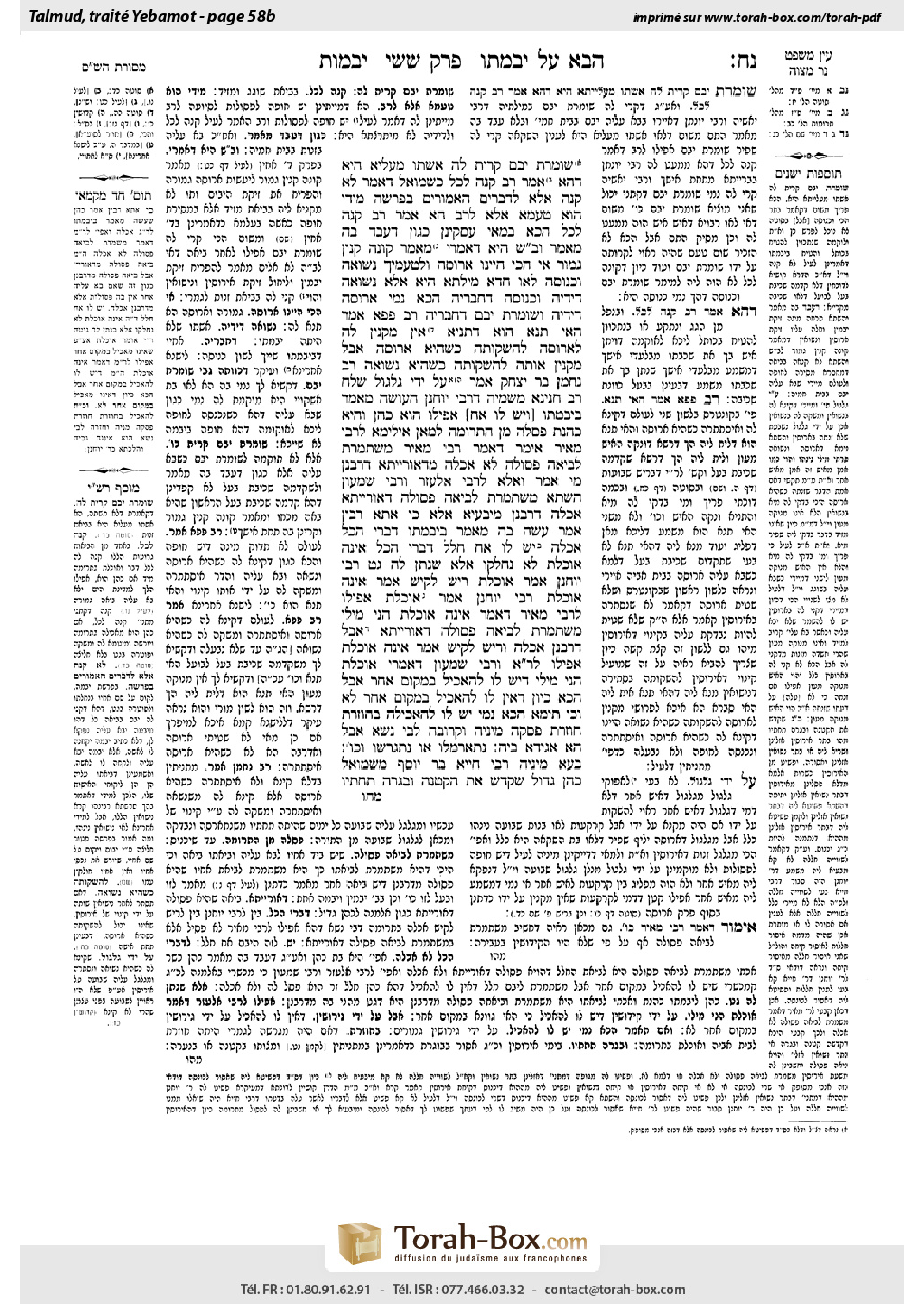
This page of Yevamot includes the Aramaic text, an English translation and an AI-generated French translation, alongside the scan above.
יבמות נ״ח ב · Aramaic and Hebrew text
שׁוֹמֶרֶת יָבָם קָרֵית לַהּ? אִשְׁתּוֹ מְעַלְּיָא הִיא, דְּהָא אָמַר רַב: קָנָה לַכֹּל! כִּשְׁמוּאֵל, דְּאָמַר: לֹא קָנָה אֶלָּא לִדְבָרִים הָאֲמוּרִים בַּפָּרָשָׁה.
מִידֵּי הוּא טַעְמָא אֶלָּא לְרַב. הָא אָמַר רַב: קָנָה לַכֹּל. הָכָא בְּמַאי עָסְקִינַן — כְּגוֹן דַּעֲבַד בַּהּ מַאֲמָר, וּבֵית שַׁמַּאי הִיא, דְּאָמְרִי: מַאֲמָר קוֹנֶה קִנְיָן גָּמוּר.
אִי הָכִי — הַיְינוּ אֲרוּסָה? וּלְטַעְמָיךְ, נְשׂוּאָה וּכְנוּסָה לָאו חֲדָא מִילְּתָא הִיא?! אֶלָּא: נְשׂוּאָה דִּידֵיהּ, וּכְנוּסָה דְּחַבְרֵיהּ. הָכָא נָמֵי: אֲרוּסָה דִּידֵיהּ, וְשׁוֹמֶרֶת יָבָם דְּחַבְרֵיהּ.
רַב פָּפָּא אָמַר: הַאי תַּנָּא הוּא, דְּתַנְיָא: אֵין מְקַנִּין לָהּ לָאֲרוּסָה לְהַשְׁקוֹתָהּ כְּשֶׁהִיא אֲרוּסָה, אֲבָל מְקַנִּין אוֹתָהּ לְהַשְׁקוֹתָהּ כְּשֶׁהִיא נְשׂוּאָה.
רַב נַחְמָן בַּר יִצְחָק אָמַר: עַל יְדֵי גִלְגּוּל.
שְׁלַח רַב חֲנִינָא מִשְּׁמֵיהּ דְּרַבִּי יוֹחָנָן: הָעוֹשֶׂה מַאֲמָר בִּיבִמְתּוֹ [וְיֵשׁ לוֹ אָח], אֲפִילּוּ הוּא כֹּהֵן וְהִיא כֹּהֶנֶת — פְּסָלָהּ מִן הַתְּרוּמָה.
לְמַאן? אִילֵּימָא לְרַבִּי מֵאִיר — אֵימַר דְּאָמַר רַבִּי מֵאִיר מִשְׁתַּמֶּרֶת לְבִיאָה פְּסוּלָה לָא אָכְלָה מִדְּאוֹרָיְיתָא, דְּרַבָּנַן מִי אָמַר? וְאֶלָּא לְרַבִּי אֶלְעָזָר וְרַבִּי שִׁמְעוֹן. הַשְׁתָּא מִשְׁתַּמֶּרֶת לְבִיאָה פְּסוּלָה דְּאוֹרָיְיתָא אָכְלָה — דְּרַבָּנַן מִיבַּעְיָא?!
אֶלָּא, כִּי אֲתָא רָבִין, אָמַר: עָשָׂה בָּהּ מַאֲמָר בִּיבִמְתּוֹ — דִּבְרֵי הַכֹּל אָכְלָה, יֵשׁ לוֹ אָח חָלָל — דִּבְרֵי הַכֹּל אֵינָהּ אוֹכֶלֶת. לֹא נֶחְלְקוּ אֶלָּא שֶׁנָּתַן לָהּ גֵּט. רַבִּי יוֹחָנָן אָמַר: אוֹכֶלֶת. רֵישׁ לָקִישׁ אָמַר: אֵינָהּ אוֹכֶלֶת.
רַבִּי יוֹחָנָן אָמַר אוֹכֶלֶת — אֲפִילּוּ לְרַבִּי מֵאִיר דְּאָמַר אֵינָהּ אוֹכֶלֶת, הָנֵי מִילֵּי מִשְׁתַּמֶּרֶת לְבִיאָה פְּסוּלָה דְּאוֹרָיְיתָא, אֲבָל דְּרַבָּנַן — אָכְלָה.
וְרֵישׁ לָקִישׁ אָמַר אֵינָהּ אוֹכֶלֶת — אֲפִילּוּ לְרַבִּי אֶלְעָזָר וְרַבִּי שִׁמְעוֹן דְּאָמְרִי אוֹכֶלֶת, הָנֵי מִילֵּי דְּיֵשׁ לוֹ לְהַאֲכִיל בְּמָקוֹם אַחֵר, אֲבָל הָכָא, כֵּיוָן דְּאֵין לוֹ לְהַאֲכִיל בְּמָקוֹם אַחֵר — לָא.
וְכִי תֵּימָא: הָכָא נָמֵי יֵשׁ לוֹ לְהַאֲכִילָהּ בְּחוֹזֶרֶת — חוֹזֶרֶת פָּסְקָה מִינֵּיהּ, וּקְרוֹבָה לְבֵי נָשָׁא, אֲבָל הָא אֲגִידָא בֵּיהּ.
נִתְאַרְמְלוּ אוֹ נִתְגָּרְשׁוּ וְכוּ׳. בְּעָא מִינֵּיהּ רַבִּי חִיָּיא בַּר יוֹסֵף מִשְּׁמוּאֵל: כֹּהֵן גָּדוֹל שֶׁקִּדֵּשׁ אֶת הַקְּטַנָּה וּבָגְרָה תַּחְתָּיו,
Yevamot 58b · English translation
do you call her a widow waiting for her yavam? Once they have engaged in intercourse, she is his proper wife, as Rav said that one who has intercourse with his yevama, even without intending to thereby perform levirate marriage, has acquired her for all matters. The Gemara responds: This is in accordance with the opinion of Shmuel, who said that he has acquired her only with regard to the matters stated in the chapter of levirate marriage, but not with regard to other matters, and therefore she is not considered his wife with regard to the halakhot of sota.
The Gemara responds: The only reason this proof was presented is to support the opinion of Rav, who is the one who holds that there is legal significance to a priest entering the wedding canopy with a woman who is unfit to marry him. Didn’t Rav say he has acquired her for all matters? The Gemara answers: With what are we dealing here? For example, a case where the yavam performed levirate betrothal with her and afterward had intercourse with her for the sake of promiscuity. And this is in accordance with the opinion of Beit Shammai, who say: Levirate betrothal acquires a yevama in a full-fledged manner and removes the levirate bond. Therefore, when they have intercourse, they do not become fully married.
The Gemara raises a difficulty: If so, the case of the yevama who was betrothed is the same as the case of a betrothed woman. What is the difference between the two cases? The Gemara responds: And according to your reasoning, are the examples in the mishna of a married woman and a fully married woman not a single matter? Rather, the mishna must be referring to two very similar cases, with the following difference: A married woman means his own wife and a fully married woman is referring to that of his fellow, i.e., his brother’s wife who became his wife through levirate marriage. Here too, the case of a betrothed woman is referring to his own wife and the case of a widow waiting for her yavam is that of his fellow, i.e., his yevama, who is now betrothed to him.
Rav Pappa said: Rava’s question can be resolved in a manner unrelated to the question about a priest entering the wedding canopy with a woman unfit for him. The baraita he cited is in accordance with this tanna, who does not require the man to be clear of iniquity, as it is taught in a baraita: One cannot be jealous over a betrothed woman and warn her not to seclude herself with a particular man in order to cause her to drink the sota waters when she is betrothed, but one can be jealous over her to cause her to drink the sota waters when she is married, even if she secluded herself with the man when she was still betrothed.
Rav Naḥman bar Yitzḥak said: The question never arises at all, as the oath is formulated by means of extension. The woman cannot be forced to drink the sota waters for events that took place while she was betrothed. However, if she is obligated to drink due to events that took place when she was married, the oath may be extended to include any possible acts of infidelity when she was betrothed.
§ Rav Ḥanina sent in the name of Rabbi Yoḥanan: One who performs levirate betrothal with his yevama and he has a brother, even if he is a priest and she is the daughter of a priest, he has disqualified her from partaking of teruma. By Torah law, the other brother may still have intercourse with her and thereby perform levirate marriage, but by rabbinic law only the brother who betrothed her may perform levirate marriage. Due to the fact that she is considered to be waiting for levirate marriage even vis-à-vis the brother who is rabbinically prohibited from marrying her, she is classified as a woman who is waiting for an invalid act of intercourse. Consequently, she may not partake of teruma until the consummation of the levirate marriage.
The Gemara asks: According to whom did Rabbi Yoḥanan make this statement? If we say it is in accordance with the opinion of Rabbi Meir, say that Rabbi Meir said that a woman who is reserved for an invalid act of intercourse may not eat teruma when the act of intercourse is prohibited by Torah law. However, if the act of intercourse is prohibited by rabbinic law, did Rabbi Meir actually say that the woman is disqualified from eating teruma? Rather, if we say it is in accordance with the opinions of Rabbi Elazar and Rabbi Shimon, now that they hold that even a woman who is reserved for intercourse prohibited by Torah law may partake of teruma, is it necessary to state that she may partake of teruma if she is reserved for intercourse prohibited by rabbinic law?
Rather, when Ravin came from Eretz Yisrael he said an accurate version of Rabbi Yoḥanan’s statement: If a yavam who performed levirate betrothal with his yevama has a brother, all agree that the yevama may partake of teruma. If he has a brother who is a ḥalal, e.g., his mother was a divorcée and therefore unfit to marry his father, who was a priest, all agree that the yevama may not partake of teruma, as she is considered reserved for an invalid act of intercourse. They disagreed only in a case when he gave her a bill of divorce. Rabbi Yoḥanan said she may partake of teruma, as she is considered to have returned to her father’s house, while Reish Lakish said that she may not partake of teruma.
The Gemara analyzes the two opinions: Rabbi Yoḥanan said she may eat teruma because even according to Rabbi Meir, who said in the mishna that she may not partake of teruma, this applies only when she is waiting for intercourse that is invalid by Torah law, but if the intercourse is prohibited by rabbinic law, she may partake of teruma. In this case, since they have not yet performed ḥalitza, the levirate bond still applies by Torah law, but they are prohibited by rabbinic law from consummating the levirate marriage.
And Reish Lakish said: She may not partake of teruma because even according to Rabbi Elazar and Rabbi Shimon, who say in the mishna that she may partake of teruma, this applies only to a case of betrothal, as a priest can entitle a woman to partake of teruma in another case via betrothal. But here, where he gave her a bill of divorce, since he cannot entitle a woman to partake of teruma in any other case by giving her a bill of divorce, no.
And lest you say here too, in the case of a bill of divorce, he can entitle her to partake of teruma when she returns to her father’s house, this case is different for the following reason: A woman who returns to her father’s house has been severed from her husband and she is close to her father’s house [bei nasha], and therefore she may once again partake of teruma on her father’s account. However, this yevama who has received a bill of divorce is still bound to her yavam until they perform ḥalitza, and she is therefore disqualified from eating teruma.
§ It was taught in the mishna that in the case of women who married priests despite the fact that they were unfit to do so, if they were widowed or divorced from that marriage, they are disqualified from eating teruma, but if they were widowed or divorced while they were only betrothed, they are fit to partake of teruma. Rabbi Ḥiyya bar Yosef raised a dilemma before Shmuel: In the case of a High Priest who betrothed a minor and she matured under him, i.e., while betrothed to him,
Yevamot 58b · Traduction française (IA)
La considères-tu comme une veuve en attente de son yavam ? Dès lors qu’ils ont eu des relations, elle est son épouse à part entière, car Rav a dit que celui qui a des relations avec sa yevama, même sans avoir l’intention d’accomplir ainsi le mariage léviratique, l’a acquise à tous égards. La Guemara répond : cela correspond à l’opinion de Shmuel, qui a dit qu’il l’a acquise uniquement pour les questions traitées dans le chapitre du mariage léviratique, mais non pour les autres questions ; elle n’est donc pas considérée comme son épouse au regard des halakhot de la sota.
La Guemara répond : cette preuve n’a été apportée que pour étayer l’opinion de Rav, qui estime qu’un prêtre qui entre sous la houppa avec une femme qu’il lui est interdit d’épouser produit un effet juridique. Rav n’a-t-il pas dit qu’il l’a acquise à tous égards ? La Guemara répond : de quoi s’agit-il ici ? Par exemple, le yavam a accompli les fiançailles léviratiques avec elle, puis a eu des relations avec elle sans intention d’accomplir le mariage léviratique. Cela correspond à l’opinion de Beit Shammaï, qui disent que les fiançailles léviratiques acquièrent pleinement une yevama et suppriment le lien léviratique. Par conséquent, lorsqu’ils ont des relations, ils ne deviennent pas entièrement mariés.
La Guemara soulève une difficulté : dans ce cas, celui d’une yevama fiancée est identique à celui d’une femme fiancée. Quelle est la différence entre les deux cas ? La Guemara répond : et selon ton raisonnement, les exemples de la Michna — une femme mariée et une femme pleinement mariée — ne désignent-ils pas une seule et même situation ? La Michna doit plutôt viser deux cas très semblables, qui se distinguent ainsi : « une femme mariée » désigne sa propre épouse, tandis que « une femme pleinement mariée » désigne celle d’un autre, c’est-à-dire l’épouse de son frère, devenue son épouse par le mariage léviratique. Ici aussi, le cas d’une femme fiancée désigne sa propre épouse, tandis que celui d’une veuve en attente de son yavam concerne l’épouse d’un autre, c’est-à-dire sa yevama, qui est maintenant fiancée à lui.
Rav Pappa a dit : la question de Rava peut être résolue indépendamment de la question concernant un prêtre qui entre sous la houppa avec une femme qu’il lui est interdit d’épouser. La baraïta qu’il a citée suit l’opinion de ce tanna, qui n’exige pas que l’homme soit exempt de faute, comme on l’enseigne dans une baraïta : on ne peut pas rendre jalouse une femme fiancée ni l’avertir de ne pas s’isoler avec un homme particulier afin de la faire boire aux eaux de la sota alors qu’elle est fiancée ; mais on peut la rendre jalouse afin de la faire boire aux eaux de la sota lorsqu’elle est mariée, même si elle s’est isolée avec cet homme alors qu’elle était encore fiancée.
Rav Naḥman bar Yitzḥak a dit : la question ne se pose pas du tout, car le serment est formulé par extension. On ne peut pas contraindre la femme à boire les eaux de la sota pour des faits survenus lorsqu’elle était fiancée. Toutefois, si elle est tenue de boire en raison de faits survenus alors qu’elle était mariée, le serment peut être étendu afin d’inclure tout éventuel acte d’infidélité commis lorsqu’elle était fiancée.
§ Rav Ḥanina a transmis au nom de Rabbi Yoḥanan : celui qui accomplit les fiançailles léviratiques avec sa yevama et qui a un frère, même si lui-même est prêtre et qu’elle est la fille d’un prêtre, l’a rendue inapte à consommer la terouma. Selon la Torah, l’autre frère peut encore avoir des relations avec elle et ainsi accomplir le mariage léviratique, mais, selon la loi rabbinique, seul le frère qui l’a fiancée peut accomplir le mariage léviratique. Puisqu’elle est considérée comme étant en attente du mariage léviratique même à l’égard du frère auquel la loi rabbinique interdit de l’épouser, elle est classée parmi les femmes en attente d’un rapport sexuel interdit. Par conséquent, elle ne peut pas consommer la terouma avant la consommation du mariage léviratique.
La Guemara demande : selon l’opinion de qui Rabbi Yoḥanan a-t-il formulé cette déclaration ? Si l’on dit qu’elle correspond à l’opinion de Rabbi Meïr, rappelons que Rabbi Meïr a dit qu’une femme en attente d’un rapport sexuel interdit ne peut pas consommer la terouma lorsque ce rapport est interdit par la Torah. Mais Rabbi Meïr a-t-il vraiment dit que la femme est rendue inapte à consommer la terouma lorsque le rapport est interdit par la loi rabbinique ? En revanche, si l’on dit que cela correspond aux opinions de Rabbi Elazar et de Rabbi Shimon, puisqu’ils estiment qu’une femme en attente d’un rapport interdit par la Torah peut elle-même consommer la terouma, est-il nécessaire de préciser qu’elle peut la consommer lorsqu’elle est en attente d’un rapport interdit par la loi rabbinique ?
Mais lorsque Ravin est venu d’Eretz Israël, il a rapporté la version exacte de la déclaration de Rabbi Yoḥanan : si un yavam qui a accompli les fiançailles léviratiques avec sa yevama a un frère, tous conviennent que la yevama peut consommer la terouma. S’il a un frère qui est un ḥalal, par exemple parce que sa mère était divorcée et donc inapte à épouser son père, qui était prêtre, tous conviennent que la yevama ne peut pas consommer la terouma, car elle est considérée comme étant en attente d’un rapport sexuel interdit. Ils ne sont en désaccord que dans le cas où il lui a remis un acte de divorce. Rabbi Yoḥanan a dit qu’elle peut consommer la terouma, car on considère qu’elle est retournée dans la maison de son père, tandis que Reish Lakish a dit qu’elle ne peut pas consommer la terouma.
La Guemara analyse les deux opinions : Rabbi Yoḥanan a dit qu’elle peut consommer la terouma car, même selon Rabbi Meïr, qui a dit dans la Michna qu’elle ne peut pas consommer la terouma, cela ne s’applique que lorsqu’elle est en attente d’un rapport sexuel interdit par la Torah ; si le rapport est interdit par la loi rabbinique, elle peut consommer la terouma. Dans ce cas, puisqu’ils n’ont pas encore accompli la ḥalitsa, le lien léviratique subsiste selon la Torah, mais la loi rabbinique leur interdit de consommer le mariage léviratique.
Et Reish Lakish a dit qu’elle ne peut pas consommer la terouma car, même selon Rabbi Elazar et Rabbi Shimon, qui disent dans la Michna qu’elle peut consommer la terouma, cela ne s’applique qu’au cas des fiançailles : un prêtre peut en effet permettre à une femme de consommer la terouma dans une autre situation au moyen de fiançailles. Mais ici, où il lui a remis un acte de divorce, puisqu’un prêtre ne peut permettre à une femme de consommer la terouma dans aucune autre situation en lui remettant un acte de divorce, elle ne le peut pas.
Et ne pourrait-on pas dire qu’ici aussi, dans le cas d’un acte de divorce, il peut lui permettre de consommer la terouma lorsqu’elle retourne dans la maison de son père ? Ce cas est différent pour la raison suivante : une femme qui retourne dans la maison de son père a été séparée de son mari et se trouve proche de la maison de son père [bei nasha] ; elle peut donc de nouveau consommer la terouma grâce à son père. Mais cette yevama qui a reçu un acte de divorce reste liée à son yavam jusqu’à ce qu’ils accomplissent la ḥalitsa ; elle est donc inapte à consommer la terouma.
§ La Michna enseigne que, dans le cas de femmes qui ont épousé des prêtres alors qu’elles n’étaient pas aptes à le faire, si elles sont devenues veuves ou ont été divorcées après ce mariage, elles sont inaptes à consommer la terouma ; mais si elles sont devenues veuves ou ont été divorcées alors qu’elles étaient seulement fiancées, elles sont aptes à consommer la terouma. Rabbi Ḥiyya bar Yosef a soumis une question à Shmuel : dans le cas d’un Grand Prêtre qui a fiancé une mineure et qui est devenue majeure alors qu’elle était sous ses auspices, c’est-à-dire alors qu’elle était fiancée à lui,
Traduction française générée par IA à partir de l’édition anglaise de Sefaria. Vérifie toujours un passage avec le texte source.
Text from Sefaria: William Davidson Edition - Vocalized Aramaic (CC BY NC); William Davidson Edition - English (CC BY NC).