Yevamot 59a: Talmud study for Daf Yomi
Daf Yomi is the daily study of one Talmud folio. Explore 37 tractates with scans, Hebrew text, Sefaria English and AI-generated French translations where annotated.
Passage selection and English or AI-generated French translation are available where the scan has annotations. Daf Study is independent of Torah-Box and Sefaria.
Browse Yevamot · יבמות · All tractatesYevamot 59a text and translations
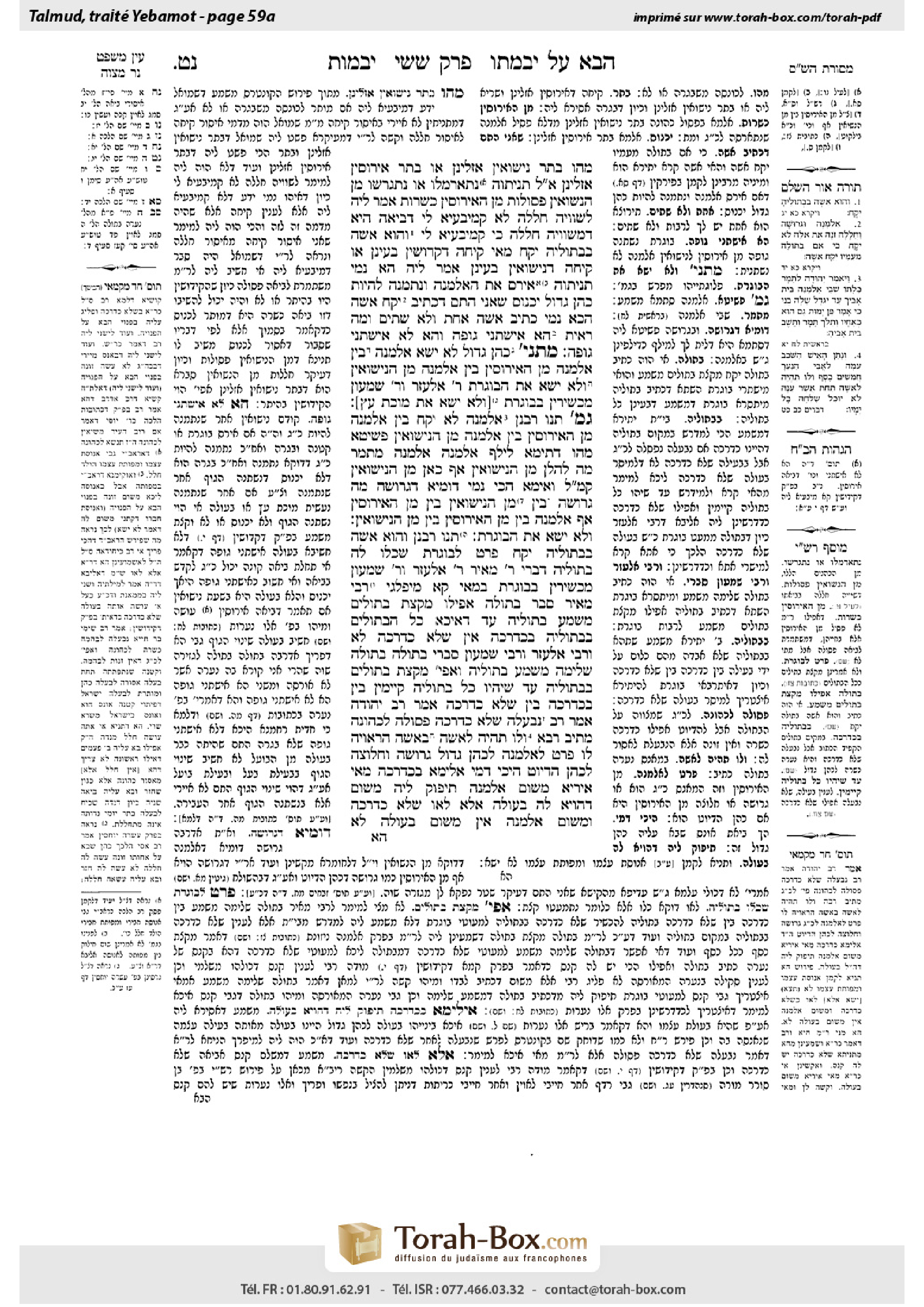
This page of Yevamot includes the Aramaic text, an English translation and an AI-generated French translation, alongside the scan above.
יבמות נ״ט א · Aramaic and Hebrew text
מַהוּ? בָּתַר נִישּׂוּאִין אָזְלִינַן, אוֹ בָּתַר אֵירוּסִין אָזְלִינַן.
אֲמַר לֵיהּ, תְּנֵיתוּהָ: נִתְאַרְמְלוּ אוֹ נִתְגָּרְשׁוּ, מִן הַנִּשּׂוּאִין — פְּסוּלוֹת, מִן הָאֵירוּסִין — כְּשֵׁרוֹת.
אֲמַר לֵיהּ: לְשַׁוּוֹיֵהּ חֲלָלָה לָא קָמִיבַּעְיָא לִי, דְּבִיאָה הִיא דִּמְשַׁוְּויָה חֲלָלָה. כִּי קָמִיבַּעְיָא לִי: ״וְהוּא אִשָּׁה בִבְתוּלֶיהָ יִקָּח״, מַאי? קִיחָה דְקִדּוּשִׁין בָּעֵינַן, אוֹ קִיחָה דְנִישּׂוּאִין בָּעֵינַן.
אֲמַר לֵיהּ, הָא נָמֵי תְּנֵיתוּהָ: אֵירַס אֶת הָאַלְמָנָה וְנִתְמַנָּה לִהְיוֹת כֹּהֵן גָּדוֹל — יִכְנוֹס. שָׁאנֵי הָתָם, דִּכְתִיב: ״יִקַּח אִשָּׁה״.
הָכָא נָמֵי, כְּתִיב ״אִשָּׁה״! אַחַת וְלֹא שְׁתַּיִם.
וּמָה רָאִיתָ? הָא — אִישְׁתַּנִּי גּוּפַהּ, וְהָא — לָא אִישְׁתַּנִּי גּוּפַהּ.
מַתְנִי׳ כֹּהֵן גָּדוֹל לֹא יִשָּׂא אַלְמָנָה, בֵּין אַלְמָנָה מִן הָאֵירוּסִין, בֵּין אַלְמָנָה מִן הַנִּישּׂוּאִין. וְלֹא יִשָּׂא אֶת הַבּוֹגֶרֶת. רַבִּי אֶלְעָזָר וְרַבִּי שִׁמְעוֹן מַכְשִׁירִין בְּבוֹגֶרֶת [וְלֹא יִשָּׂא אֶת מוּכַּת עֵץ].
גְּמָ׳ תָּנוּ רַבָּנַן: ״אַלְמָנָה ... לֹא יִקַּח״ — בֵּין אַלְמָנָה מִן הָאֵירוּסִין, בֵּין אַלְמָנָה מִן הַנִּישּׂוּאִין. פְּשִׁיטָא! מַהוּ דְּתֵימָא: לֵילַף ״אַלְמָנָה״ ״אַלְמָנָה״ מִתָּמָר, מָה לְהַלָּן מִן הַנִּישּׂוּאִין — אַף כָּאן מִן הַנִּישּׂוּאִין, קָא מַשְׁמַע לַן.
וְאֵימָא הָכִי נָמֵי?! דּוּמְיָא דִּגְרוּשָׁה: מָה גְּרוּשָׁה — בֵּין מִן הַנִּישּׂוּאִין בֵּין מִן הָאֵירוּסִין, אַף אַלְמָנָה — בֵּין מִן הָאֵירוּסִין בֵּין מִן הַנִּישּׂוּאִין.
וְלֹא יִשָּׂא אֶת הַבּוֹגֶרֶת. תָּנוּ רַבָּנַן: ״וְהוּא אִשָּׁה בִבְתוּלֶיהָ יִקָּח״, פְּרָט לַבּוֹגֶרֶת — שֶׁכָּלוּ לָהּ בְּתוּלֶיהָ. דִּבְרֵי רַבִּי מֵאִיר. רַבִּי אֶלְעָזָר וְרַבִּי שִׁמְעוֹן מַכְשִׁירִין בְּבוֹגֶרֶת.
בְּמַאי קָא מִיפַּלְגִי? רַבִּי מֵאִיר סָבַר: ״בְּתוּלָה״ — אֲפִילּוּ מִקְצָת בְּתוּלִים מַשְׁמַע. ״בְּתוּלֶיהָ״ — עַד דְּאִיכָּא כׇּל הַבְּתוּלִים. ״בִּבְתוּלֶיהָ״, בִּכְדַרְכָּהּ — אִין, שֶׁלֹּא כְּדַרְכָּהּ — לָא.
וְרַבִּי אֶלְעָזָר וְרַבִּי שִׁמְעוֹן סָבְרִי: ״בְּתוּלָה״ — בְּתוּלָה שְׁלֵימָה מַשְׁמַע. ״בְּתוּלֶיהָ״ — וַאֲפִילּוּ מִקְצָת בְּתוּלִים. ״בִּבְתוּלֶיהָ״ — עַד שֶׁיִּהְיוּ כׇּל בְּתוּלֶיהָ קַיָּימִין, בֵּין בִּכְדַרְכָּהּ, בֵּין שֶׁלֹּא כְּדַרְכָּהּ.
אָמַר רַב יְהוּדָה אָמַר רַב: נִבְעֲלָה שֶׁלֹּא כְּדַרְכָּהּ — פְּסוּלָה לַכְּהוּנָּה. מֵתִיב רָבָא: ״וְלוֹ תִהְיֶה לְאִשָּׁה״ — בְּאִשָּׁה הָרְאוּיָה לוֹ, פְּרָט לְאַלְמָנָה לְכֹהֵן גָּדוֹל, גְּרוּשָׁה וַחֲלוּצָה לְכֹהֵן הֶדְיוֹט.
הֵיכִי דָּמֵי? אִלֵּימָא בִּכְדַרְכָּהּ, מַאי אִירְיָא מִשּׁוּם אַלְמָנָה? תִּיפּוֹק לֵיהּ מִשּׁוּם דְּהָוְיָא לַהּ בְּעוּלָה, אֶלָּא לָאו: שֶׁלֹּא כְּדַרְכָּהּ, וּמִשּׁוּם אַלְמָנָה — אִין, מִשּׁוּם בְּעוּלָה — לָא!
Yevamot 59a · English translation
what is the halakha? The Gemara clarifies the dilemma: Do we follow the time of marriage, at which point she was unfit for him according to most tanna’im, who hold that a High Priest may not marry a grown woman, as she is no longer called “a wife in her virginity” (Leviticus 21:13)? Or do we follow the time of betrothal, at which point she was of suitable age?
Shmuel said to him: You learned it in the mishna: If they were widowed or divorced from marriage, they are disqualified from partaking of teruma, but if they were widowed or divorced from betrothal, they are fit to partake of teruma. This indicates that disqualifications from the privileges of priesthood are determined based upon marriage rather than betrothal.
Rabbi Ḥiyya bar Yosef said to Shmuel: With regard to causing her to become a ḥalala I did not raise a dilemma, as it is clear that it is intercourse that causes her to become a ḥalala. When I raised a dilemma, it was with regard to the verse pertaining to a High Priest: “And he shall take a wife in her virginity” (Leviticus 21:13). What does “take” mean in this verse? Do we require that only the taking of betrothal must occur when she is in her virginity, i.e., when she is a minor or a young woman, or perhaps we require even the taking of marriage to be performed when she is a minor or young woman?
Shmuel said to him: This, too, you learned in a mishna (61a): If he betrothed a widow and was subsequently appointed to be High Priest, he may marry her, despite the fact that a High Priest is prohibited from marrying a widow. This indicates that her permissibility to him is determined according to the time of the betrothal rather than the time of marriage. The Gemara refutes this proof: There it is different, as it is written: “He shall take for a wife” (Leviticus 21:14). The superfluous expression “for a wife” indicates that he is permitted to marry the widow in this case.
The Gemara objects: Here, too, with regard to a woman who matured after betrothal, it is written: “And he shall take a wife in her virginity,” and this should indicate that he may marry the grown woman in this case. The Gemara answers that the term “wife” allows for the inclusion of one case but not two. Consequently, since a High Priest may marry a widow he had betrothed before he was appointed High Priest, it cannot also be derived that he may marry a grown woman that he had betrothed before she matured.
The Gemara asks: And what did you see that led you to include the case of a widow and exclude that of a grown woman? The Gemara answers: In this case, of the grown woman, her body has changed, and therefore she is forbidden to him even though she was betrothed before she matured. In that case, of the widow, her body has not changed. It is the priest’s personal status that has changed, and therefore she remains permitted.
MISHNA: A High Priest may not marry a widow, whether she is a widow from betrothal or a widow from marriage. And he may not marry a grown woman. He may marry only a minor or a young woman. Rabbi Elazar and Rabbi Shimon declare a grown woman fit to marry a High Priest. And he may not marry a woman whose hymen was torn accidentally.
GEMARA: The Sages taught: The verse states with regard to a High Priest: “A widow…he shall not take” (Leviticus 21:14), which prohibits him from marrying any widow, whether she is a widow from betrothal or a widow from marriage. The Gemara is surprised by this statement: This is obvious, as the verse is referring to a widow without further specification. The Gemara answers: It is necessary; lest you say that one should derive a verbal analogy between the words “widow” and “widow,” based upon the usage of that term in a verse with regard to Tamar, Judah’s daughter-in-law (Genesis 38:11), as follows: Just as there, Tamar was a widow from marriage, so too here the verse is referring only to a widow from marriage. The tanna therefore teaches us that this is not the case.
The Gemara asks: And say that it is indeed so, that the suggested verbal analogy is correct. The Gemara answers: It is similar to the case of a divorcée: Just as a divorcée is forbidden to a priest whether she was divorced from marriage or from betrothal, so too a widow is forbidden to a High Priest whether she is a widow from marriage or from betrothal.
§ It was taught in the mishna: And a High Priest may not marry a grown woman. The Sages taught that the verse: “And he shall take a wife in her virginity” (Leviticus 21:13) excludes a grown woman, whose hymen has worn away, i.e., it is no longer as complete as that of a minor or a young woman; this is the statement of Rabbi Meir. Rabbi Elazar and Rabbi Shimon declare a grown woman fit to marry a High Priest.
The Gemara asks: With regard to what do they disagree? The Gemara explains: Rabbi Meir holds that were the verse referring simply to a virgin it would have indicated that even a woman with partial signs of virginity, i.e., a grown woman, is permitted. Since the verse states “her virginity,” it means that she is fit to marry a High Priest only if all of the signs of her virginity are intact, which excludes a grown woman. The full expression “in her virginity” indicates that if she has experienced sexual intercourse in a typical manner, which takes place in the area of her virginity, i.e., her hymen, yes, she is disqualified from marrying a High Priest; but if she has experienced sexual intercourse in an atypical manner i.e., anal intercourse, no, she is not disqualified.
And Rabbi Elazar and Rabbi Shimon hold that were the verse referring simply to a virgin, it would have indicated that only a complete virgin is fit to marry a High Priest, but not a grown woman. When it states “her virginity,” it indicates that even a woman with partial signs of virginity, i.e., a grown woman, is fit to marry the High Priest. The full expression “in her virginity” indicates that she is not fit to marry a High Priest unless all of her virginity is intact, i.e., she has not engaged in intercourse of any kind, whether typical sexual intercourse or atypical sexual intercourse.
Rav Yehuda said that Rav said: If she had atypical sexual intercourse, she is disqualified from the High Priesthood, i.e., from marrying the High Priest. Rava raised an objection based upon a baraita: The verse states with regard to rape: “And she shall be his wife” (Deuteronomy 22:19), and the Sages explained that this is referring only to a woman suitable for him, excluding a widow for a High Priest and a divorcée or a ḥalutza for a common priest. In these cases, the rapist is not permitted to marry his victim.
The Gemara clarifies: What are the circumstances of this halakha? If we say that the High Priest raped her by engaging in typical intercourse, why does the baraita specifically state that she is forbidden to him because she is a widow? Let him derive this halakha from the fact that she is now a non-virgin. Rather, is it not that he had atypical intercourse with her, and due to the fact that she is a widow, yes, that is the reason she is forbidden, but due to the fact that she is a non-virgin, no, that is not the reason she is forbidden? This indicates that a woman who had intercourse in an atypical manner is not considered a non-virgin and is not disqualified from marrying a High Priest.
Yevamot 59a · Traduction française (IA)
Quelle est la halakha ? La Guemara précise le dilemme : faut-il s’en tenir au moment du mariage, où elle n’était pas apte à l’épouser selon la majorité des tannaïm, qui considèrent qu’un grand prêtre ne peut pas épouser une femme adulte, puisqu’elle n’est plus appelée « une femme dans sa virginité » (Lévitique 21:13) ? Ou faut-il s’en tenir au moment des fiançailles, où elle avait l’âge requis ?
Chmouel lui dit : Tu l’as appris dans la Michna : si elles sont devenues veuves ou ont été répudiées après le mariage, elles sont disqualifiées pour consommer la terouma ; mais si elles sont devenues veuves ou ont été répudiées après les fiançailles, elles peuvent consommer la terouma. Cela indique que les disqualifications des privilèges sacerdotaux sont déterminées selon le mariage, et non selon les fiançailles.
Rabbi Ḥiyya bar Yossef dit à Chmouel : Je ne soulève pas de dilemme au sujet du fait de la rendre ḥalala, car il est clair que c’est la relation sexuelle qui la rend ḥalala. Mon dilemme porte sur le verset concernant le grand prêtre : « Il prendra une femme dans sa virginité » (Lévitique 21:13). Que signifie « prendre » dans ce verset ? Exige-t-on seulement que les fiançailles aient lieu alors qu’elle est encore dans sa virginité, c’est-à-dire alors qu’elle est mineure ou jeune fille, ou exige-t-on peut-être aussi que le mariage soit célébré alors qu’elle est mineure ou jeune fille ?
Chmouel lui dit : Tu l’as aussi appris dans une Michna (61a) : s’il a fiancé une veuve puis a été nommé grand prêtre, il peut l’épouser, bien qu’un grand prêtre ait l’interdiction d’épouser une veuve. Cela indique que la permission de l’épouser se détermine selon le moment des fiançailles plutôt que selon celui du mariage. La Guemara réfute cette preuve : ce cas est différent, car il est écrit : « Il la prendra pour femme » (Lévitique 21:14). L’expression superflue « pour femme » indique qu’il lui est permis d’épouser la veuve dans ce cas.
La Guemara objecte : Ici aussi, au sujet d’une femme qui a atteint la majorité après les fiançailles, il est écrit : « Il prendra une femme dans sa virginité », ce qui devrait indiquer qu’il peut épouser la femme majeure dans ce cas. La Guemara répond que le terme « femme » permet d’inclure un cas, mais pas deux. Par conséquent, puisque le grand prêtre peut épouser une veuve qu’il avait fiancée avant d’être nommé grand prêtre, on ne peut pas en déduire aussi qu’il peut épouser une femme qui a atteint la majorité après qu’il l’a fiancée.
La Guemara demande : Qu’est-ce qui t’a conduit à inclure le cas de la veuve et à exclure celui de la femme majeure ? La Guemara répond : Dans le cas de la femme majeure, son corps a changé ; elle lui est donc interdite, même si elle avait été fiancée avant d’atteindre la majorité. Dans le cas de la veuve, son corps n’a pas changé. C’est le statut personnel du prêtre qui a changé ; elle reste donc permise.
MICHNA : Un grand prêtre ne peut épouser une veuve, qu’elle soit devenue veuve après les fiançailles ou après le mariage. Il ne peut pas non plus épouser une femme majeure. Il ne peut épouser qu’une mineure ou une jeune fille. Rabbi Elazar et Rabbi Chimon déclarent qu’une femme majeure est apte à épouser un grand prêtre. Il ne peut pas non plus épouser une femme dont l’hymen s’est déchiré accidentellement.
GUEMARA : Les Sages ont enseigné : Au sujet du grand prêtre, le verset dit : « Une veuve… il ne la prendra pas » (Lévitique 21:14), ce qui lui interdit d’épouser toute veuve, qu’elle soit devenue veuve après les fiançailles ou après le mariage. La Guemara s’étonne : c’est évident, puisque le verset parle d’une veuve sans autre précision. La Guemara répond : c’est nécessaire, de peur que tu dises qu’il faut établir une analogie verbale entre les termes « veuve » et « veuve », en se fondant sur l’emploi de ce terme dans un verset concernant Tamar, la belle-fille de Juda (Genèse 38:11), comme suit : de même que là-bas Tamar était veuve après le mariage, ici aussi le verset ne viserait qu’une veuve après le mariage. Le tanna nous enseigne donc que ce n’est pas le cas.
La Guemara demande : Et dis que c’est bien ainsi, que l’analogie verbale proposée est correcte. La Guemara répond : Le cas est comparable à celui d’une femme répudiée : de même qu’une femme répudiée est interdite à un prêtre, qu’elle ait été répudiée après le mariage ou après les fiançailles, de même une veuve est interdite à un grand prêtre, qu’elle soit devenue veuve après le mariage ou après les fiançailles.
§ Il a été enseigné dans la Michna : Un grand prêtre ne peut pas épouser une femme majeure. Les Sages ont enseigné que le verset « Il prendra une femme dans sa virginité » (Lévitique 21:13) exclut une femme majeure, dont l’hymen s’est usé, c’est-à-dire qu’il n’est plus aussi intact que celui d’une mineure ou d’une jeune fille ; telle est l’opinion de Rabbi Meïr. Rabbi Elazar et Rabbi Chimon déclarent qu’une femme majeure est apte à épouser un grand prêtre.
La Guemara demande : Sur quoi porte leur désaccord ? La Guemara explique : Rabbi Meïr considère que, si le verset faisait simplement référence à une vierge, cela aurait indiqué qu’une femme présentant des signes partiels de virginité, c’est-à-dire une femme majeure, est également permise. Puisque le verset dit « sa virginité », cela signifie qu’elle n’est apte à épouser un grand prêtre que si tous les signes de sa virginité sont intacts, ce qui exclut une femme majeure. L’expression complète « dans sa virginité » indique que si elle a eu des relations sexuelles de manière habituelle, dans la région de sa virginité, c’est-à-dire au niveau de l’hymen, oui, elle est disqualifiée pour épouser un grand prêtre ; mais si elle a eu des relations sexuelles de manière inhabituelle, c’est-à-dire par voie anale, non, elle n’est pas disqualifiée.
Rabbi Elazar et Rabbi Chimon considèrent, quant à eux, que si le verset faisait simplement référence à une vierge, cela aurait indiqué que seule une vierge complète est apte à épouser un grand prêtre, mais pas une femme majeure. Lorsqu’il dit « sa virginité », cela indique qu’une femme présentant des signes partiels de virginité, c’est-à-dire une femme majeure, est elle aussi apte à épouser le grand prêtre. L’expression complète « dans sa virginité » indique qu’elle n’est apte à épouser un grand prêtre que si toute sa virginité est intacte, c’est-à-dire si elle n’a eu aucun type de rapport sexuel, qu’il soit habituel ou inhabituel.
Rav Yehouda a dit au nom de Rav : Si elle a eu des relations sexuelles de manière inhabituelle, elle est disqualifiée pour épouser le grand prêtre. Rava souleva une objection fondée sur une baraïta : Au sujet du viol, le verset dit : « Elle deviendra sa femme » (Deutéronome 22:19), et les Sages expliquent que cela ne concerne qu’une femme qui lui est permise, à l’exclusion d’une veuve pour un grand prêtre et d’une femme répudiée ou ḥaloutsa pour un prêtre ordinaire. Dans ces cas, le violeur n’est pas autorisé à épouser sa victime.
La Guemara précise : Quelles sont les circonstances de cette halakha ? Si l’on dit que le grand prêtre l’a violée en ayant avec elle des relations sexuelles de manière habituelle, pourquoi la baraïta précise-t-elle qu’elle lui est interdite parce qu’elle est veuve ? Qu’il déduise plutôt cette halakha du fait qu’elle n’est désormais plus vierge. N’est-ce pas plutôt qu’il a eu avec elle des relations sexuelles de manière inhabituelle, et que c’est parce qu’elle est veuve qu’elle lui est interdite, mais non parce qu’elle n’est plus vierge ? Cela indique qu’une femme qui a eu des relations sexuelles de manière inhabituelle n’est pas considérée comme non vierge et n’est pas disqualifiée pour épouser un grand prêtre.
Traduction française générée par IA à partir de l’édition anglaise de Sefaria. Vérifie toujours un passage avec le texte source.
Text from Sefaria: William Davidson Edition - Vocalized Aramaic (CC BY NC); William Davidson Edition - English (CC BY NC).