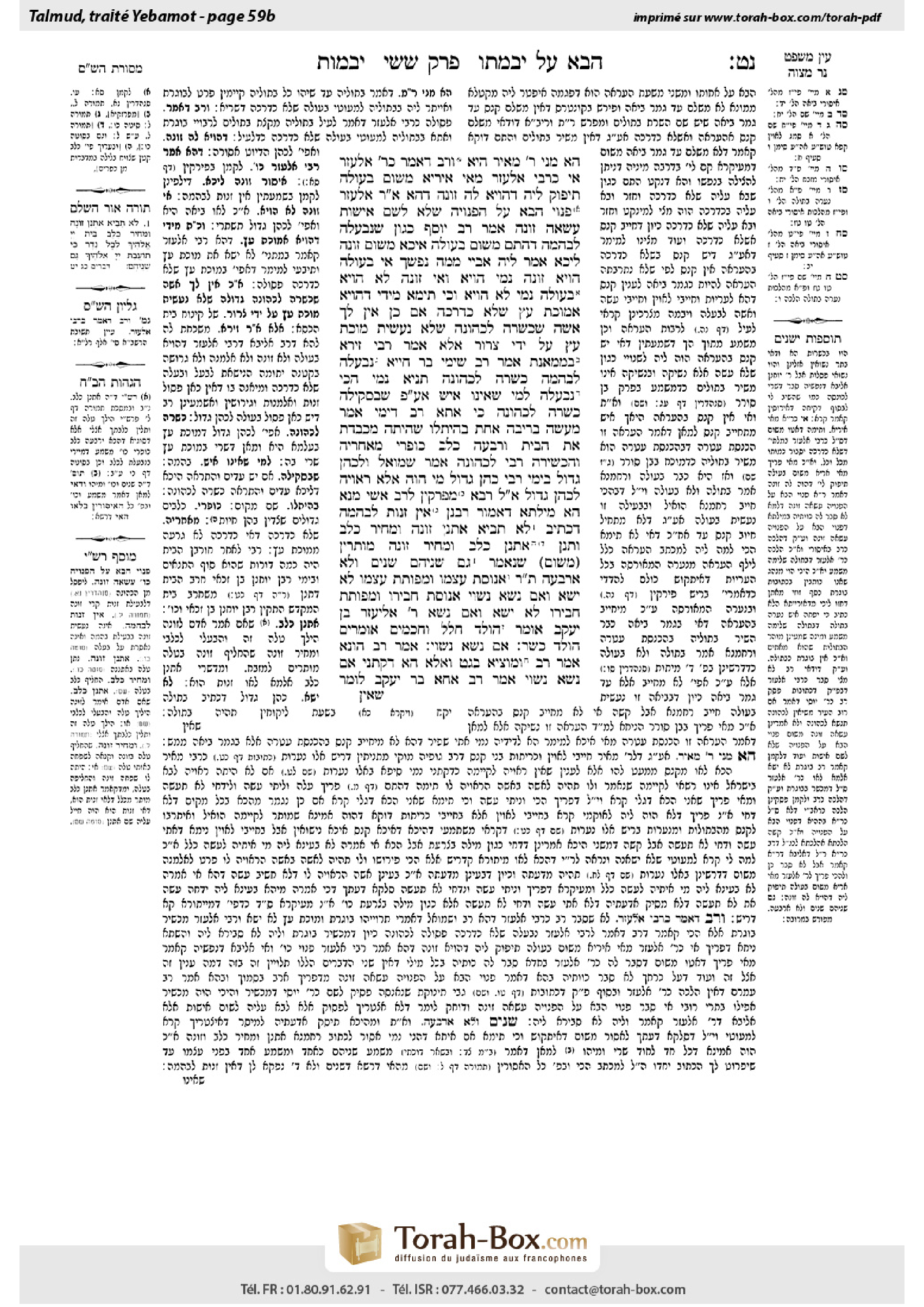
Yevamot 59b: Talmud study for Daf Yomi
Daf Yomi is the daily study of one Talmud folio. Explore 37 tractates with scans, Hebrew text, Sefaria English and AI-generated French translations where annotated.
Passage selection and English or AI-generated French translation are available where the scan has annotations. Daf Study is independent of Torah-Box and Sefaria.
Browse Yevamot · יבמות · All tractatesYevamot 59b text and translations
This page of Yevamot includes the Aramaic text, an English translation and an AI-generated French translation, alongside the scan above.
יבמות נ״ט ב · Aramaic and Hebrew text
הָא מַנִּי — רַבִּי מֵאִיר הִיא, וְרַב דְּאָמַר כְּרַבִּי אֶלְעָזָר.
אִי כְּרַבִּי אֶלְעָזָר, מַאי אִירְיָא מִשּׁוּם בְּעוּלָה? תִּיפּוֹק לֵיהּ דְּהָוְיָא לַהּ זוֹנָה! דְּהָא אָמַר רַבִּי אֶלְעָזָר: פָּנוּי הַבָּא עַל הַפְּנוּיָה שֶׁלֹּא לְשֵׁם אִישׁוּת — עֲשָׂאָהּ זוֹנָה.
אָמַר רַב יוֹסֵף: כְּגוֹן שֶׁנִּבְעֲלָה לִבְהֵמָה, דְּהָתָם מִשּׁוּם בְּעוּלָה אִיכָּא, מִשּׁוּם זוֹנָה לֵיכָּא.
אֲמַר לֵיהּ אַבָּיֵי, מִמָּה נַפְשָׁךְ: אִי בְּעוּלָה הָוְיָא — זוֹנָה נָמֵי הָוְיָא. וְאִי זוֹנָה לָא הָוְיָא — בְּעוּלָה נָמֵי לָא הָוְיָא. וְכִי תֵּימָא: מִידֵי דְּהָוֵיא אַמוּכַּת עֵץ שֶׁלֹּא כְּדַרְכָּהּ, אִם כֵּן, אֵין לְךָ אִשָּׁה שֶׁכְּשֵׁרָה לַכְּהוּנָּה, שֶׁלֹּא נַעֲשֵׂית מוּכַּת עֵץ עַל יְדֵי צְרוֹר.
אֶלָּא, אָמַר רַבִּי זֵירָא: בִּמְמָאֶנֶת.
אָמַר רַב שִׁימִי בַּר חִיָּיא: נִבְעֲלָה לִבְהֵמָה — כְּשֵׁרָה לַכְּהוּנָּה. תַּנְיָא נָמֵי הָכִי: נִבְעֲלָה לְמִי שֶׁאֵינוֹ אִישׁ, אַף עַל פִּי שֶׁבִּסְקִילָה — כְּשֵׁרָה לַכְּהוּנָּה.
כִּי אֲתָא רַב דִּימִי, אָמַר: מַעֲשֵׂה בְּרִיבָה אַחַת בְּהַיְתָלוֹ שֶׁהָיְתָה מְכַבֶּדֶת אֶת הַבַּיִת, וּרְבָעָהּ כֶּלֶב כּוּפְרִי מֵאַחֲרֶיהָ, וְהִכְשִׁירָהּ רַבִּי לַכְּהוּנָּה. אָמַר שְׁמוּאֵל: וּלְכֹהֵן גָּדוֹל. בִּימֵי רַבִּי כֹּהֵן גָּדוֹל מִי הֲוָה? אֶלָּא — רְאוּיָה לְכֹהֵן גָּדוֹל.
אֲמַר לֵיהּ רָבָא מִפַּרְזַקְיָא לְרַב אָשֵׁי: מְנַָא הָא מִילְּתָא דַּאֲמוּר רַבָּנַן אֵין זְנוּת לִבְהֵמָה? דִּכְתִיב: ״לֹא תָבִיא אֶתְנַן זוֹנָה וּמְחִיר כֶּלֶב״.
וּתְנַן: אֶתְנַן כֶּלֶב וּמְחִיר זוֹנָה — מוּתָּרִין, (מִשּׁוּם) שֶׁנֶּאֱמַר: ״גַּם שְׁנֵיהֶם״ — שְׁנַיִם וְלֹא אַרְבָּעָה.
תָּנוּ רַבָּנַן: אֲנוּסַת עַצְמוֹ וּמְפוּתַּת עַצְמוֹ — לֹא יִשָּׂא, וְאִם נָשָׂא — נָשׂוּי. אֲנוּסַת חֲבֵירוֹ וּמְפוּתַּת חֲבֵירוֹ — לֹא יִשָּׂא, וְאִם נָשָׂא, רַבִּי אֱלִיעֶזֶר בֶּן יַעֲקֹב אוֹמֵר: הַוָּלָד חָלָל, וַחֲכָמִים אוֹמְרִים: הַוָּלָד כָּשֵׁר.
אִם נָשָׂא — נָשׂוּי, אָמַר רַב הוּנָא אָמַר רַב: וּמוֹצִיא בְּגֵט. וְאֶלָּא הָא דְּקָתָנֵי: אִם נָשָׂא נָשׂוּי! אָמַר רַב אַחָא בַּר יַעֲקֹב: לוֹמַר
Yevamot 59b · English translation
The Gemara refutes this proof: In accordance with whose opinion is this baraita? It is in accordance with the opinion of Rabbi Meir, who maintains that a woman who engaged in atypical intercourse is permitted to a High Priest, and when Rav said his statement, it was in accordance with the opinion of Rabbi Elazar, who holds that such a woman is disqualified from marrying a High Priest.
The Gemara asks: If Rav’s statement is in accordance with the opinion of Rabbi Elazar, why did he specifically state that she is forbidden to him because she is a non-virgin? Let him derive it from the fact that she is a zona, as Rabbi Elazar said: Even in the case of an unmarried man who had intercourse with an unmarried woman not for the purpose of marriage, he has thereby caused her to become a zona.
Rav Yosef said: When Rav said that a woman who had anal intercourse is disqualified from marrying a High Priest, he was referring to a woman who had intercourse with an animal, as there she is disqualified because she is a non-virgin, but she is not disqualified because of the prohibition of a zona.
Abaye said to him: Whichever way you look at it, there is a difficulty with this answer: If she is considered a non-virgin, she is also a zona, and if she is not a zona she is also not a non-virgin. And lest you say that it is analogous to a case of a woman who lost her virginity via penetration by a foreign object atypically, i.e., anally, whose hymen was therefore not damaged and she is not forbidden as a zona, yet she is no longer considered a virgin, that is not correct: If so, if such a woman is considered a non-virgin and forbidden to a High Priest, you would have no woman who is fit for the High Priesthood, who has not lost her virginity via penetration by a foreign object atypically, i.e., by a pebble used to clean herself in the lavatory.
Rather, Rabbi Zeira said that Rav was referring to one who refused her husband after having only atypical intercourse with him. Although the act of intercourse was not licentious, as she was married at the time, she is nevertheless disqualified from marrying into the priesthood because she is not a virgin.
§ Rabbi Shimi bar Ḥiyya said: A woman who had intercourse with an animal is like one whose hymen was torn accidentally. Consequently, she is not a zona and is fit for the priesthood. This is also taught in a baraita: If a woman had intercourse with one who is not a man, i.e., an animal, although she is liable to stoning if she did so intentionally and in the presence of witnesses who forewarned her of her punishment, she is nevertheless fit for the priesthood.
When Rav Dimi came from Eretz Yisrael he said: There was an incident involving a certain girl [riva] in the village of Hitlu who was sweeping the house, and a village [kufri] dog used for hunting sodomized her from behind. And Rabbi Yehuda HaNasi permitted her to the priesthood, as she was not considered a zona. Shmuel said: And Rabbi Yehuda HaNasi permitted her even to a High Priest, as she was still considered a virgin. The Gemara is puzzled by this comment: Was there a High Priest in the days of Rabbi Yehuda HaNasi? Rather, Shmuel meant that she is fit for a High Priest.
Rava of Pirkin said to Rav Ashi: From where is this matter derived that the Sages stated that there is no harlotry with regard to an animal? Rav Ashi responded that it is as it is written: “You shall not bring the hire of a harlot or the price of a dog into the House of the Lord your God for any vow; for both of them are an abomination to the Lord your God” (Deuteronomy 23:19). This verse prohibits one from sacrificing an animal as an offering if that animal was ever used to pay a harlot for her services, or if it was ever used as payment in the purchase of a dog.
And we learned in a mishna (Temura 30a): The hire of a dog, i.e., a kosher animal that a man or woman gave as payment to the owner of a dog in order to have sexual intercourse with it, and similarly the price of a prostitute, a kosher animal used to purchase a prostitute as a maidservant, are permitted to be sacrificed as offerings. This is because it is stated that both of them, the specific items listed in the verse, are abominations. Consequently, only two items are prohibited, i.e., the payment given to a prostitute for her services, and the payment used in the purchase of a dog, and not four, as the reverse cases are excluded from this halakha.
§ The Sages taught: A High Priest may not marry a woman that he himself raped and a woman that he himself seduced, as he is commanded to marry a virgin. And if he married her, he is married. With regard to a woman who was raped by another man and a woman seduced by another man, he may not marry her. And if he married her, Rabbi Eliezer ben Ya’akov says that the child born from this union is a ḥalal, and the Rabbis say the lineage of the offspring is unflawed.
The Gemara analyzes this baraita. It states that if he married the woman that he himself raped or seduced, he is married. Rav Huna said that Rav said: And he must divorce her with a bill of divorce. The Gemara asks: But consider that which the baraita teaches: If he married her, he is married. Since it is obvious that the marriage is technically valid, it must be saying that they are permitted to remain married. Rav Aḥa bar Ya’akov said: No, it means to say
Yevamot 59b · Traduction française (IA)
La Guemara réfute cette preuve : Selon l'avis de qui est cette baraïta ? Elle est conforme à l'avis de Rabbi Meïr, qui soutient qu'une femme qui a eu des rapports atypiques est permise à un Cohen Gadol, et lorsque Rav a émis son affirmation, c'était conformément à l'avis de Rabbi Elazar, qui estime qu'une telle femme est disqualifiée pour épouser un Cohen Gadol.
La Guemara demande : Si l'affirmation de Rav est conforme à l'avis de Rabbi Elazar, pourquoi a-t-il spécifiquement déclaré qu'elle lui est interdite parce qu'elle n'est plus vierge ? Qu'il en déduise l'interdit du fait qu'elle est une zona, comme l'a dit Rabbi Elazar : Même dans le cas d'un homme célibataire qui a eu des rapports avec une femme célibataire non dans le but du mariage, il l'a par là même rendue zona.
Rav Yossef a dit : Lorsque Rav a dit qu'une femme qui a eu des rapports anaux est disqualifiée pour épouser un Cohen Gadol, il faisait référence à une femme qui a eu des rapports avec un animal, car dans ce cas, elle est disqualifiée parce qu'elle n'est plus vierge, mais elle n'est pas disqualifiée en raison de l'interdit de la zona.
Abaye lui dit : Quelle que soit la manière dont on envisage la question, il y a une difficulté avec cette réponse : Si elle est considérée comme non vierge, elle est aussi une zona, et si elle n'est pas une zona, elle n'est pas non plus non vierge. Et de peur que vous ne disiez que c'est analogue au cas d'une femme qui a perdu sa virginité par pénétration atypique par un objet étranger, c'est-à-dire par voie anale, dont l'hymen n'a donc pas été endommagé et qui n'est pas interdite en tant que zona, mais qui n'est plus considérée comme vierge, cela n'est pas correct : Si c'était le cas, si une telle femme est considérée comme non vierge et interdite à un Cohen Gadol, il n'y aurait aucune femme apte au sacerdoce qui n'ait pas perdu sa virginité par pénétration atypique par un objet étranger, c'est-à-dire par un caillou utilisé pour se nettoyer aux toilettes.
Plutôt, Rabbi Zeïra a dit que Rav faisait référence à une femme qui a refusé son mari après avoir eu seulement des rapports atypiques avec lui. Bien que l'acte de rapport n'ait pas été licencieux, car elle était mariée à ce moment-là, elle est néanmoins disqualifiée pour entrer dans le sacerdoce parce qu'elle n'est pas vierge.
§ Rabbi Chimi bar Ḥiyya a dit : Une femme qui a eu des rapports avec un animal est comme une femme dont l'hymen a été déchiré accidentellement. Par conséquent, elle n'est pas une zona et est apte au sacerdoce. Cela est également enseigné dans une baraïta : Si une femme a eu des rapports avec quelqu'un qui n'est pas un homme, c'est-à-dire un animal, bien qu'elle soit passible de la lapidation si elle l'a fait intentionnellement et en présence de témoins qui l'ont avertie de sa punition, elle est néanmoins apte au sacerdoce.
Lorsque Rav Dimi est venu d'Eretz Yisrael, il a dit : Il y a eu un incident impliquant une certaine fille [riva] dans le village de Hitlu qui balayait la maison, et un chien de village [kufri] utilisé pour la chasse l'a sodomisée par derrière. Et Rabbi Yehouda HaNassi l'a permise au sacerdoce, car elle n'était pas considérée comme une zona. Chmouël a dit : Et Rabbi Yehouda HaNassi l'a permise même à un Cohen Gadol, car elle était encore considérée comme vierge. La Guemara est perplexe face à ce commentaire : Y avait-il un Cohen Gadol aux jours de Rabbi Yehouda HaNassi ? Plutôt, Chmouël voulait dire qu'elle est apte pour un Cohen Gadol.
Rava de Pirkin a dit à Rav Ashi : D'où est dérivé ce fait que les Sages ont déclaré qu'il n'y a pas de prostitution concernant un animal ? Rav Ashi a répondu que c'est comme il est écrit : « Tu ne porteras pas le salaire d'une prostituée ni le prix d'un chien dans la Maison de l'Éternel, ton Dieu, pour quelque vœu que ce soit ; car l'un et l'autre sont une abomination pour l'Éternel, ton Dieu » (Deutéronome 23:19). Ce verset interdit de sacrifier un animal en offrande si cet animal a jamais été utilisé pour payer une prostituée pour ses services, ou s'il a jamais été utilisé comme paiement dans l'achat d'un chien.
Et nous avons appris dans une Michna (Temoura 30a) : Le salaire d'un chien, c'est-à-dire un animal casher qu'un homme ou une femme a donné en paiement au propriétaire d'un chien afin d'avoir des rapports sexuels avec lui, et de même le prix d'une prostituée, un animal casher utilisé pour acheter une prostituée comme servante, sont permis à être sacrifiés en offrandes. C'est parce qu'il est déclaré que l'un et l'autre, les éléments spécifiques énumérés dans le verset, sont des abominations. Par conséquent, seuls deux éléments sont interdits, c'est-à-dire le paiement donné à une prostituée pour ses services, et le paiement utilisé dans l'achat d'un chien, et non quatre, car les cas inversés sont exclus de cette halakha.
§ Les Sages ont enseigné : Un Grand Prêtre ne peut pas épouser une femme qu'il a lui-même violée ni une femme qu'il a lui-même séduite, car il est commandé d'épouser une vierge. Et s'il l'a épousée, le mariage est valide. Concernant une femme qui a été violée par un autre homme et une femme séduite par un autre homme, il ne peut pas l'épouser. Et s'il l'a épousée, Rabbi Eliezer ben Ya'akov dit que l'enfant né de cette union est un ḥalal, et les Rabbins disent que la lignée de la descendance est sans défaut.
La Guemara analyse cette baraïta. Elle indique que s'il a épousé la femme qu'il a lui-même violée ou séduite, le mariage est valide. Rav Houna a dit que Rav a dit : Et il doit la divorcer par un acte de divorce. La Guemara demande : Mais considérez ce que la baraïta enseigne : S'il l'a épousée, le mariage est valide. Puisqu'il est évident que le mariage est techniquement valide, cela doit signifier qu'ils sont autorisés à rester mariés. Rav Aḥa bar Ya'akov a dit : Non, cela signifie dire
Traduction française générée par IA à partir de l’édition anglaise de Sefaria. Vérifie toujours un passage avec le texte source.
Text from Sefaria: William Davidson Edition - Vocalized Aramaic (CC BY NC); William Davidson Edition - English (CC BY NC).