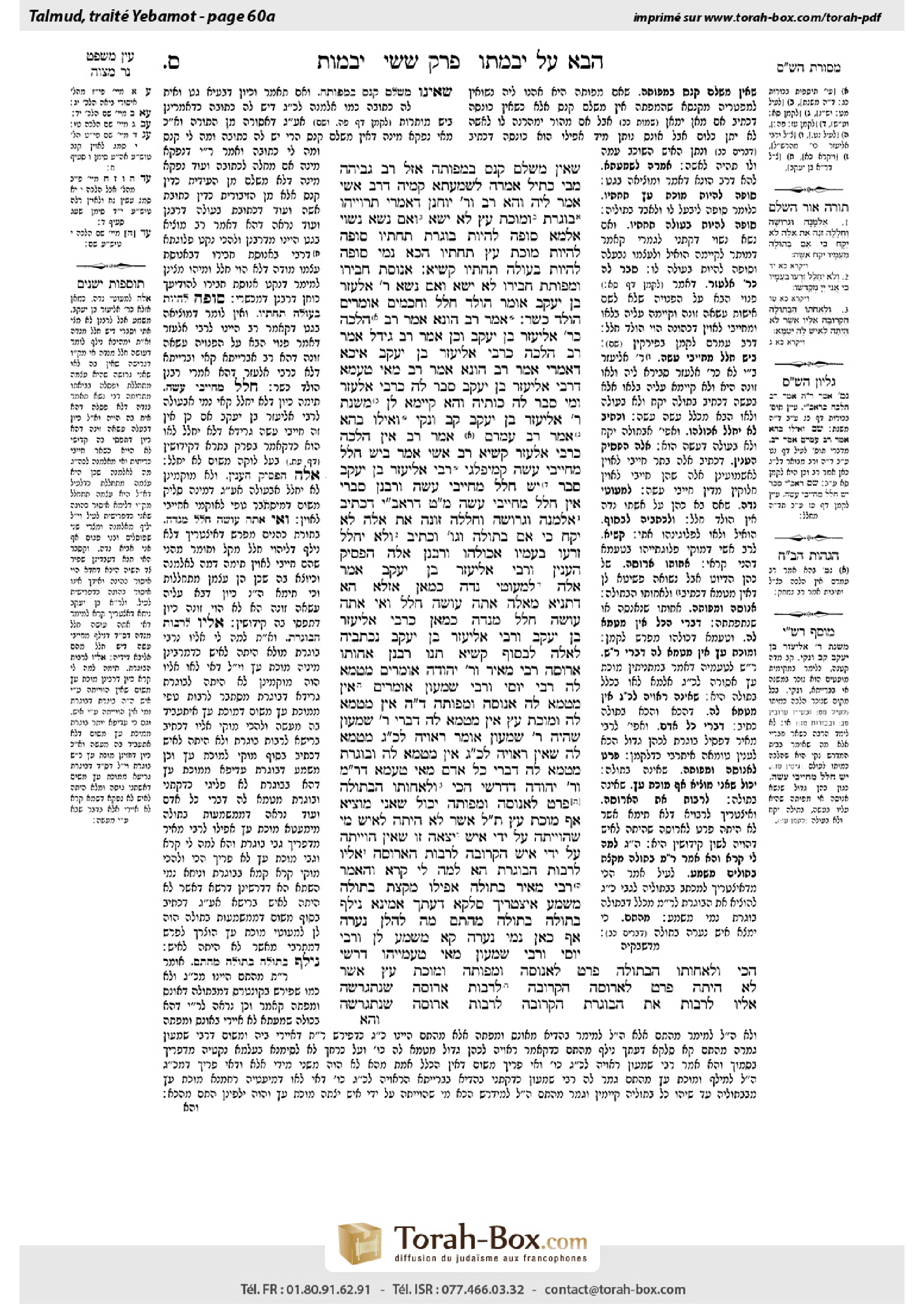
Yevamot 60a: Talmud study for Daf Yomi
Daf Yomi is the daily study of one Talmud folio. Explore 37 tractates with scans, Hebrew text, Sefaria English and AI-generated French translations where annotated.
Passage selection and English or AI-generated French translation are available where the scan has annotations. Daf Study is independent of Torah-Box and Sefaria.
Browse Yevamot · יבמות · All tractatesYevamot 60a text and translations
This page of Yevamot includes the Aramaic text, an English translation and an AI-generated French translation, alongside the scan above.
יבמות ס׳ א · Aramaic and Hebrew text
שֶׁאֵין מְשַׁלֵּם קְנָס בִּמְפוּתָּה.
אֲזַל רַב גְּבִיהָה מִבֵּי כָתִיל, אַמְרַהּ לִשְׁמַעְתָּא קַמֵּיהּ דְּרַב אָשֵׁי. אֲמַר לֵיהּ: וְהָא רַב וְרַבִּי יוֹחָנָן דְּאָמְרִי תַּרְוַיְיהוּ: בּוֹגֶרֶת וּמוּכַּת עֵץ — לֹא יִשָּׂא, וְאִם נָשָׂא — נָשׂוּי.
אַלְמָא: סוֹפָהּ לִהְיוֹת בּוֹגֶרֶת תַּחְתָּיו, סוֹפָהּ לִהְיוֹת מוּכַּת עֵץ תַּחְתָּיו. הָכָא נָמֵי: סוֹפָהּ לִהְיוֹת בְּעוּלָה תַּחְתָּיו. קַשְׁיָא.
אֲנוּסַת חֲבֵירוֹ וּמְפוּתַּת חֲבֵירוֹ — לֹא יִשָּׂא. וְאִם נָשָׂא — רַבִּי אֱלִיעֶזֶר בֶּן יַעֲקֹב אוֹמֵר: הַוָּלָד חָלָל, וַחֲכָמִים אוֹמְרִים: הַוָּלָד כָּשֵׁר. אָמַר רַב הוּנָא אָמַר רַב: הֲלָכָה כְּרַבִּי אֱלִיעֶזֶר בֶּן יַעֲקֹב. וְכֵן אָמַר רַב גִּידֵּל אָמַר רַב: הֲלָכָה כְּרַבִּי אֱלִיעֶזֶר בֶּן יַעֲקֹב.
אִיכָּא דְּאָמְרִי, אָמַר רַב הוּנָא אָמַר רַב: מַאי טַעְמָא דְּרַבִּי אֱלִיעֶזֶר בֶּן יַעֲקֹב — סָבַר לַהּ כְּרַבִּי אֶלְעָזָר.
וּמִי סָבַר לַהּ כְּוָתֵיהּ? וְהָא קַיְימָא לַן: מִשְׁנַת רַבִּי אֱלִיעֶזֶר בֶּן יַעֲקֹב קַב וְנָקִי. וְאִילּוּ בְּהָא אָמַר רַב עַמְרָם אָמַר רַב: אֵין הֲלָכָה כְּרַבִּי אֶלְעָזָר. קַשְׁיָא.
רַב אָשֵׁי אָמַר: בְּיֵשׁ חָלָל מֵחַיָּיבֵי עֲשֵׂה קָמִיפַּלְגִי. רַבִּי אֱלִיעֶזֶר בֶּן יַעֲקֹב סָבַר: יֵשׁ חָלָל מֵחַיָּיבֵי עֲשֵׂה, וְרַבָּנַן סָבְרִי: אֵין חָלָל מֵחַיָּיבֵי עֲשֵׂה.
מַאי טַעְמָא דְּרַבִּי אֱלִיעֶזֶר בֶּן יַעֲקֹב — דִּכְתִיב: ״אַלְמָנָה וּגְרוּשָׁה וַחֲלָלָה זוֹנָה אֶת אֵלֶּה לֹא יִקָּח כִּי אִם בְּתוּלָה וְגוֹ׳״, וּכְתִיב: ״וְלֹא יְחַלֵּל זַרְעוֹ בְּעַמָּיו״, אַכּוּלְּהוּ.
וְרַבָּנַן: ״אֵלֶּה״ הִפְסִיק הָעִנְיָן. וְרַבִּי אֱלִיעֶזֶר בֶּן יַעֲקֹב אָמַר: ״אֵלֶּה״ לְמַעוֹטֵי נִדָּה.
כְּמַאן אָזְלָא הָא דְּתַנְיָא: מֵ״אֵלֶּה״ אַתָּה עוֹשֶׂה חָלָל, וְאִי אַתָּה עוֹשֶׂה חָלָל מִנִּדָּה. כְּמַאן — כְּרַבִּי אֱלִיעֶזֶר בֶּן יַעֲקֹב. וְרַבִּי אֱלִיעֶזֶר בֶּן יַעֲקֹב, נִכְתְּבֵיהּ לְ״אֵלֶּה״ לְבַסּוֹף? קַשְׁיָא.
תָּנוּ רַבָּנַן: אֲחוֹתוֹ אֲרוּסָה, רַבִּי מֵאִיר וְרַבִּי יְהוּדָה אוֹמְרִים: מִטַּמֵּא לָהּ. רַבִּי יוֹסֵי וְרַבִּי שִׁמְעוֹן אוֹמְרִים: אֵין מִטַּמֵּא לָהּ. אֲנוּסָה וּמְפוּתָּה — דִּבְרֵי הַכֹּל אֵין מִטַּמֵּא לָהּ. וּמוּכַּת עֵץ — אֵין מִטַּמֵּא לָהּ, דִּבְרֵי רַבִּי שִׁמְעוֹן. שֶׁהָיָה רַבִּי שִׁמְעוֹן אוֹמֵר: רְאוּיָה לְכֹהֵן גָּדוֹל — מִטַּמֵּא לָהּ, שֶׁאֵין רְאוּיָה לְכֹהֵן גָּדוֹל — אֵין מִטַּמֵּא לָהּ.
וּבוֹגֶרֶת — מִטַּמֵּא לָהּ, דִּבְרֵי כׇּל אָדָם.
מַאי טַעְמָא דְּרַבִּי מֵאִיר וְרַבִּי יְהוּדָה — דְּדָרְשִׁי הָכִי: ״וְלַאֲחוֹתוֹ הַבְּתוּלָה״ — פְּרָט לַאֲנוּסָה וּמְפוּתָּה.
יָכוֹל שֶׁאֲנִי מוֹצִיא אַף מוּכַּת עֵץ — תַּלְמוּד לוֹמַר: ״אֲשֶׁר לֹא הָיְתָה לְאִישׁ״. מִי שֶׁהֲוָיָיתָהּ עַל יְדֵי אִישׁ, יָצְאָה זוֹ שֶׁאֵין הֲוָיָיתָהּ עַל יְדֵי אִישׁ. ״הַקְּרוֹבָה״ — לְרַבּוֹת הָאֲרוּסָה. ״אֵלָיו״ — לְרַבּוֹת הַבּוֹגֶרֶת.
הָא לְמָה לִי קְרָא? וְהָאָמַר רַבִּי מֵאִיר: ״בְּתוּלָה״ — אֲפִילּוּ מִקְצָת בְּתוּלָה מַשְׁמַע! אִיצְטְרִיךְ, סָלְקָא דַּעְתָּךְ אָמֵינָא נֵילַף ״בְּתוּלָה״ ״בְּתוּלָה״ מֵהָתָם: מָה לְהַלָּן נַעֲרָה, אַף כָּאן נָמֵי נַעֲרָה, קָא מַשְׁמַע לַן.
וְרַבִּי יוֹסֵי וְרַבִּי שִׁמְעוֹן, מַאי טַעְמַיְיהוּ — דָּרְשִׁי הָכִי: ״וְלַאֲחוֹתוֹ הַבְּתוּלָה״ — פְּרָט לַאֲנוּסָה וּמְפוּתָּה וּמוּכַּת עֵץ, ״אֲשֶׁר לֹא הָיְתָה״ — פְּרָט לַאֲרוּסָה, ״הַקְּרוֹבָה״ — לְרַבּוֹת אֲרוּסָה שֶׁנִּתְגָּרְשָׁה, ״אֵלָיו״ — לְרַבּוֹת אֶת הַבּוֹגֶרֶת. ״הַקְּרוֹבָה״ — לְרַבּוֹת אֲרוּסָה שֶׁנִּתְגָּרְשָׁה,
Yevamot 60a · English translation
that he does not pay the fine of a seduced woman. One who seduced a woman and does not wish to marry her must pay a fine (see Exodus 22:14–15). Since in this case he did marry her, he is not liable to pay the fine even though he is required to divorce her.
The Gemara relates that when Rav Geviha went from Bei Ketil he stated this halakha before Rav Ashi, who said to him: Isn’t it Rav and Rabbi Yoḥanan who both say: A High Priest may not marry a grown woman and a woman whose hymen was torn accidentally, but if he married one of them he is married?
Apparently, the reason for this halakha is that since she will eventually be a grown woman under him, i.e., while married to him, and she will eventually be a woman whose hymen was torn under him, as she will not remain a virgin, they are permitted to remain married after the fact. Here too, in the case of a High Priest who married a woman he raped or seduced, since she will eventually be a non-virgin under him, the baraita should be understood as stating that they may remain married. The Gemara concludes: Indeed, this is difficult for Rav Huna.
§ The baraita cited above taught: With regard to a woman who was raped by another man and a woman seduced by another man, the High Priest may not marry her. And if he married her, Rabbi Eliezer ben Ya’akov says that the child born from this union is a ḥalal, and the Rabbis say the lineage of the offspring is unflawed. Rav Huna said that Rav said: The halakha is in accordance with the opinion of Rabbi Eliezer ben Ya’akov. And, so too, Rav Giddel said that Rav said: The halakha is in accordance with the opinion of Rabbi Eliezer ben Ya’akov.
Some say a different version of this statement. Rav Huna said that Rav said: What is the reason of Rabbi Eliezer ben Ya’akov? He holds in accordance with the opinion of Rabbi Elazar, that an unmarried man who has intercourse with an unmarried woman has thereby caused her to become a zona. Consequently, since the other man had intercourse with this woman outside of the context of marriage, she is a zona.
The Gemara asks: Does he really hold in accordance with the opinion of Rabbi Elazar? Don’t we maintain that the teaching of Rabbi Eliezer ben Ya’akov measures a kav but is clean, i.e., not many of his rulings have been recorded, but those that have been recorded are considered authoritative, and the halakha is always in accordance with his opinion? However, with regard to this ruling of Rabbi Elazar, Rav Amram said that Rav said that the halakha is not in accordance with Rabbi Elazar. The Gemara comments: This is indeed difficult.
Rav Ashi said: This is not the reason for the dispute. Rather, they disagree with regard to whether there is a ḥalal from a relationship for which the man and woman are liable for transgressing a positive mitzva. The marriage of a High Priest to a non-virgin is a violation of the mitzva that a High Priest marry a virgin, but it is not expressed in the Torah as a prohibition against a High Priest marrying a non-virgin. Rabbi Eliezer ben Ya’akov holds that there is a ḥalal from a relationship for which the man and woman are liable for violating a positive mitzva, and the Rabbis hold that there is no ḥalal from a relationship for which the man and woman are liable for violating a positive mitzva.
What is the reason of Rabbi Eliezer ben Ya’akov? As it is written: “A widow, or one divorced, or a ḥalala, or a zona, these shall he not take; but a virgin of his own people shall he take for a wife” (Leviticus 21:14), and it states subsequently: “And he shall not profane his seed among his people” (Leviticus 21:15). Rabbi Eliezer ben Ya’akov maintains that this profanation is referring to all of them, i.e., he profanes his seed by marrying any woman unfit for him, including a non-virgin.
And what do the Sages hold? The word “these” concluded discussion of that matter. Consequently, only the prohibitions listed before the phrase “these shall he not take” result in the offspring being a ḥalal. And Rabbi Eliezer ben Ya’akov said: The word “these” comes to exclude a menstruating woman. If a priest has relations with a menstruating woman, the offspring is not a ḥalal, as this is not a prohibition specific to priests.
The Gemara asks: In accordance with whose opinion is that which is taught in the following baraita: From the prohibitions preceding the phrase “these shall he not take” you cause your offspring to be a ḥalal, but you do not cause your offspring to be a ḥalal by having a child with a menstruating woman. In accordance with whose opinion is it? It is in accordance with the opinion of Rabbi Eliezer ben Ya’akov. The Gemara asks: And according to Rabbi Eliezer ben Ya’akov, let the verse write the word these at the end, after stating that a High Priest must marry a virgin, in order to make it clear that if he marries a non-virgin their child is a ḥalal. The Gemara responds: Indeed, this is difficult.
§ The Sages taught: With regard to a priest’s betrothed sister, Rabbi Meir and Rabbi Yehuda say: He must become impure for her upon her death. Rabbi Yosei and Rabbi Shimon say: He may not become impure for her. With regard to his sister who has been raped or seduced, all agree that he may not become impure for her upon her death. With regard to his sister whose hymen was torn accidentally, he may not become impure for her; this is the statement of Rabbi Shimon, as Rabbi Shimon would say the following principle: If his sister was fit for a High Priest, he must become impure for her, but if she was not fit for a High Priest, he may not become impure for her.
And if his sister was a grown woman, he must become impure for her according to everyone. Even those who hold that a High Priest may not marry a grown woman because her hymen is no longer whole agree that with regard to a priest becoming impure, she is considered a virgin and he must therefore become impure for her upon her death.
The Gemara analyzes this baraita: What is the reason of Rabbi Meir and Rabbi Yehuda? They expound the verse as follows: “And for his virgin sister, who is near to him, who has had no man, for her must he defile himself” (Leviticus 21:3). “And for his virgin sister” excludes one who has been raped or seduced, as they are not virgins.
One might have thought that I should exclude even a woman whose hymen was torn accidentally via a foreign object. The verse therefore states: “Who has had no man,” to include only one whose becoming a non-virgin was caused by a man, i.e., through intercourse. This case of a woman whose becoming a non-virgin was not caused by a man but rather by an object is thereby excluded from the category of a non-virgin, and her brother does become impure for her. “Who is near”; this is to include a betrothed sister. “To him”; this is to include a grown woman.
The Gemara asks: Why do I need a verse to include a grown woman? Didn’t Rabbi Meir say that the word “virgin” indicates even a woman who is partly a virgin, i.e., a grown woman, whose hymen is partially intact? Consequently, when the verse states that the priest becomes impure for his virgin sister, a grown woman is included. The Gemara answers: The derivation from the verse is necessary, as it might enter your mind to say that we should derive a verbal analogy from the word “virgin” in this context and the word “virgin” from there, the context of a High Priest: In the analogy, just as there the virgin referred to is a young woman and not a grown woman, so too here she must be a young woman. The verse therefore teaches us that a priest becomes impure for his sister even if she is a grown woman.
And Rabbi Yosei and Rabbi Shimon, what is their reason? They expound as follows: “And for his virgin sister” excludes a woman who was raped or seduced and a woman whose hymen was torn accidentally, who is also not considered a virgin. “Who has had no man” excludes a betrothed sister, although she is not yet fully married. “Who is near”; this is to include a betrothed woman who was then divorced, as she is once again near to her brother. “To him”; this is to include a grown woman. The Gemara asks: Can the term “who is near” come to include a betrothed woman who was divorced?
Yevamot 60a · Traduction française (IA)
qu’il ne paie pas l’amende due pour une femme séduite. Celui qui a séduit une femme et ne souhaite pas l’épouser doit lui payer une amende (voir Exode 22,14-15). Dans ce cas, puisqu’il l’a épousée, il n’est pas tenu de payer l’amende, même s’il doit divorcer d’elle.
La Guemara rapporte que, lorsque Rav Geviha partit de Bei Ketil, il énonça cette halakha devant Rav Ashi, qui lui dit : Rav et Rabbi Yoḥanan ne disent-ils pas tous deux qu’un Grand Prêtre ne peut épouser ni une femme adulte ni une femme dont l’hymen a été déchiré accidentellement, mais que, s’il en épouse une, le mariage est valide ?
Il semble que la raison de cette halakha soit que, puisqu’elle deviendra un jour adulte alors qu’elle est mariée à lui et que son hymen finira par être déchiré alors qu’elle est mariée à lui, puisqu’elle ne restera pas vierge, ils peuvent rester mariés après coup. Ici aussi, dans le cas d’un Grand Prêtre qui a épousé une femme qu’il a violée ou séduite, puisqu’elle ne sera plus vierge alors qu’elle est mariée à lui, il faudrait comprendre la baraïta comme indiquant qu’ils peuvent rester mariés. La Guemara conclut : En effet, cela pose une difficulté à Rav Huna.
§ La baraïta citée plus haut enseignait : Une femme violée par un autre homme et une femme séduite par un autre homme ne peuvent être épousées par le Grand Prêtre. S’il en a épousé une, Rabbi Eliezer ben Ya’akov dit que l’enfant issu de cette union est un ḥalal, tandis que les Sages disent que la lignée de l’enfant n’est pas entachée. Rav Huna a dit au nom de Rav : La halakha est conforme à l’opinion de Rabbi Eliezer ben Ya’akov. De même, Rav Giddel a dit au nom de Rav : La halakha est conforme à l’opinion de Rabbi Eliezer ben Ya’akov.
Certains transmettent une version différente de cette déclaration. Rav Huna a dit au nom de Rav : Quelle est la raison de Rabbi Eliezer ben Ya’akov ? Il est d’avis comme Rabbi Elazar, selon qui un homme célibataire qui a des relations avec une femme célibataire la rend ainsi zona. Par conséquent, puisque l’autre homme a eu des relations avec cette femme hors du cadre du mariage, elle est zona.
La Guemara demande : Est-il vraiment d’avis comme Rabbi Elazar ? Ne tenons-nous pas pour établi que l’enseignement de Rabbi Eliezer ben Ya’akov est comme un kav, mais pur, c’est-à-dire que peu de ses décisions ont été consignées, mais que celles qui l’ont été font autorité et que la halakha est toujours conforme à son opinion ? Pourtant, au sujet de cette décision de Rabbi Elazar, Rav Amram a dit au nom de Rav que la halakha n’est pas conforme à l’opinion de Rabbi Elazar. La Guemara remarque : Cela pose effectivement une difficulté.
Rav Ashi a dit : Ce n’est pas là la raison du désaccord. Ils sont plutôt en désaccord sur la question de savoir si une relation pour laquelle l’homme et la femme sont passibles d’avoir transgressé une mitsva positive produit un ḥalal. Le mariage d’un Grand Prêtre avec une femme qui n’est pas vierge transgresse la mitsva selon laquelle un Grand Prêtre doit épouser une vierge, mais la Torah ne formule pas cela comme une interdiction faite à un Grand Prêtre d’épouser une femme qui n’est pas vierge. Rabbi Eliezer ben Ya’akov est d’avis qu’une relation pour laquelle l’homme et la femme sont passibles d’avoir transgressé une mitsva positive produit un ḥalal, tandis que les Sages sont d’avis qu’une telle relation ne produit pas de ḥalal.
Quelle est la raison de Rabbi Eliezer ben Ya’akov ? Car il est écrit : « Une veuve, une femme répudiée, une ḥalala ou une zona, il ne les prendra pas ; mais il prendra pour épouse une vierge de son peuple » (Lévitique 21,14), puis il est écrit : « Il ne profanera pas sa descendance parmi son peuple » (Lévitique 21,15). Rabbi Eliezer ben Ya’akov estime que cette profanation se rapporte à toutes ces femmes : il profane sa descendance en épousant toute femme qui ne lui convient pas, y compris une femme qui n’est pas vierge.
Et qu’estiment les Sages ? Le mot « celles-ci » clôt la discussion sur ce sujet. Par conséquent, seules les interdictions énumérées avant l’expression « il ne les prendra pas » font que les enfants sont des ḥalalim. Et Rabbi Eliezer ben Ya’akov a dit : Le mot « celles-ci » vient exclure une femme menstruée. Si un prêtre a des relations avec une femme menstruée, l’enfant n’est pas un ḥalal, car il ne s’agit pas d’une interdiction propre aux prêtres.
La Guemara demande : Selon l’opinion de qui faut-il comprendre ce qui est enseigné dans la baraïta suivante : Les interdictions qui précèdent l’expression « il ne les prendra pas » rendent ta descendance ḥalal, mais tu ne rends pas ta descendance ḥalal en ayant un enfant avec une femme menstruée. Selon l’opinion de qui est-ce ? Selon celle de Rabbi Eliezer ben Ya’akov. La Guemara demande : Et selon Rabbi Eliezer ben Ya’akov, le verset aurait dû placer le mot « celles-ci » à la fin, après avoir indiqué qu’un Grand Prêtre doit épouser une vierge, afin de préciser que, s’il épouse une femme qui n’est pas vierge, leur enfant est un ḥalal. La Guemara répond : En effet, cela pose une difficulté.
§ Les Sages ont enseigné : À propos de la sœur fiancée d’un prêtre, Rabbi Meïr et Rabbi Yehouda disent : À sa mort, il doit se rendre impur pour elle. Rabbi Yosei et Rabbi Shimon disent : Il ne doit pas se rendre impur pour elle. À propos de sa sœur qui a été violée ou séduite, tous conviennent qu’à sa mort il ne doit pas se rendre impur pour elle. À propos de sa sœur dont l’hymen a été déchiré accidentellement, il ne doit pas se rendre impur pour elle ; telle est la déclaration de Rabbi Shimon, car Rabbi Shimon énonçait le principe suivant : Si sa sœur était apte à épouser un Grand Prêtre, il doit se rendre impur pour elle ; mais si elle n’était pas apte à épouser un Grand Prêtre, il ne doit pas se rendre impur pour elle.
Et si sa sœur est une femme adulte, tous conviennent qu’il doit se rendre impur pour elle. Même ceux qui estiment qu’un Grand Prêtre ne peut épouser une femme adulte, parce que son hymen n’est plus intact, conviennent que, pour ce qui est de l’impureté d’un prêtre, elle est considérée comme vierge ; il doit donc se rendre impur pour elle à sa mort.
La Guemara analyse cette baraïta : Quelle est la raison de Rabbi Meïr et de Rabbi Yehouda ? Ils interprètent le verset ainsi : « Pour sa sœur vierge, qui lui est proche et qui n’a pas connu d’homme, pour elle, il doit se rendre impur » (Lévitique 21,3). L’expression « sa sœur vierge » exclut celle qui a été violée ou séduite, puisqu’elle n’est pas vierge.
On aurait pu penser qu’il fallait également exclure une femme dont l’hymen a été déchiré accidentellement par un objet étranger. Le verset dit donc : « Qui n’a pas connu d’homme », pour n’inclure que celle qui est devenue non vierge du fait d’un homme, c’est-à-dire par une relation sexuelle. Le cas de la femme qui n’est pas devenue non vierge du fait d’un homme, mais plutôt à cause d’un objet, est ainsi exclu de la catégorie des femmes non vierges, et son frère peut se rendre impur pour elle. « Qui lui est proche » inclut une sœur fiancée. « À lui » inclut une femme adulte.
La Guemara demande : Pourquoi faut-il un verset pour inclure une femme adulte ? Rabbi Meïr n’a-t-il pas dit que le mot « vierge » désigne également une femme partiellement vierge, c’est-à-dire une femme adulte dont l’hymen est partiellement intact ? Par conséquent, lorsque le verset indique que le prêtre se rend impur pour sa sœur vierge, une femme adulte est incluse. La Guemara répond : L’interprétation du verset est nécessaire, car on aurait pu penser qu’il fallait établir une analogie verbale entre le mot « vierge » dans ce contexte et le mot « vierge » dans l’autre contexte, celui du Grand Prêtre : de même que là, la vierge désignée est une jeune femme et non une femme adulte, de même ici, il doit s’agir d’une jeune femme. Le verset nous enseigne donc qu’un prêtre se rend impur pour sa sœur même si elle est une femme adulte.
Et quelle est la raison de Rabbi Yosei et de Rabbi Shimon ? Ils interprètent ainsi : « Sa sœur vierge » exclut une femme qui a été violée ou séduite, ainsi qu’une femme dont l’hymen a été déchiré accidentellement, qui elle non plus n’est pas considérée comme vierge. « Qui n’a pas connu d’homme » exclut une sœur fiancée, bien qu’elle ne soit pas encore pleinement mariée. « Qui lui est proche » inclut une femme fiancée qui a ensuite été répudiée, car elle est de nouveau proche de son frère. « À lui » inclut une femme adulte. La Guemara demande : L’expression « qui lui est proche » peut-elle servir à inclure une femme fiancée qui a été répudiée ?
Traduction française générée par IA à partir de l’édition anglaise de Sefaria. Vérifie toujours un passage avec le texte source.
Text from Sefaria: William Davidson Edition - Vocalized Aramaic (CC BY NC); William Davidson Edition - English (CC BY NC).