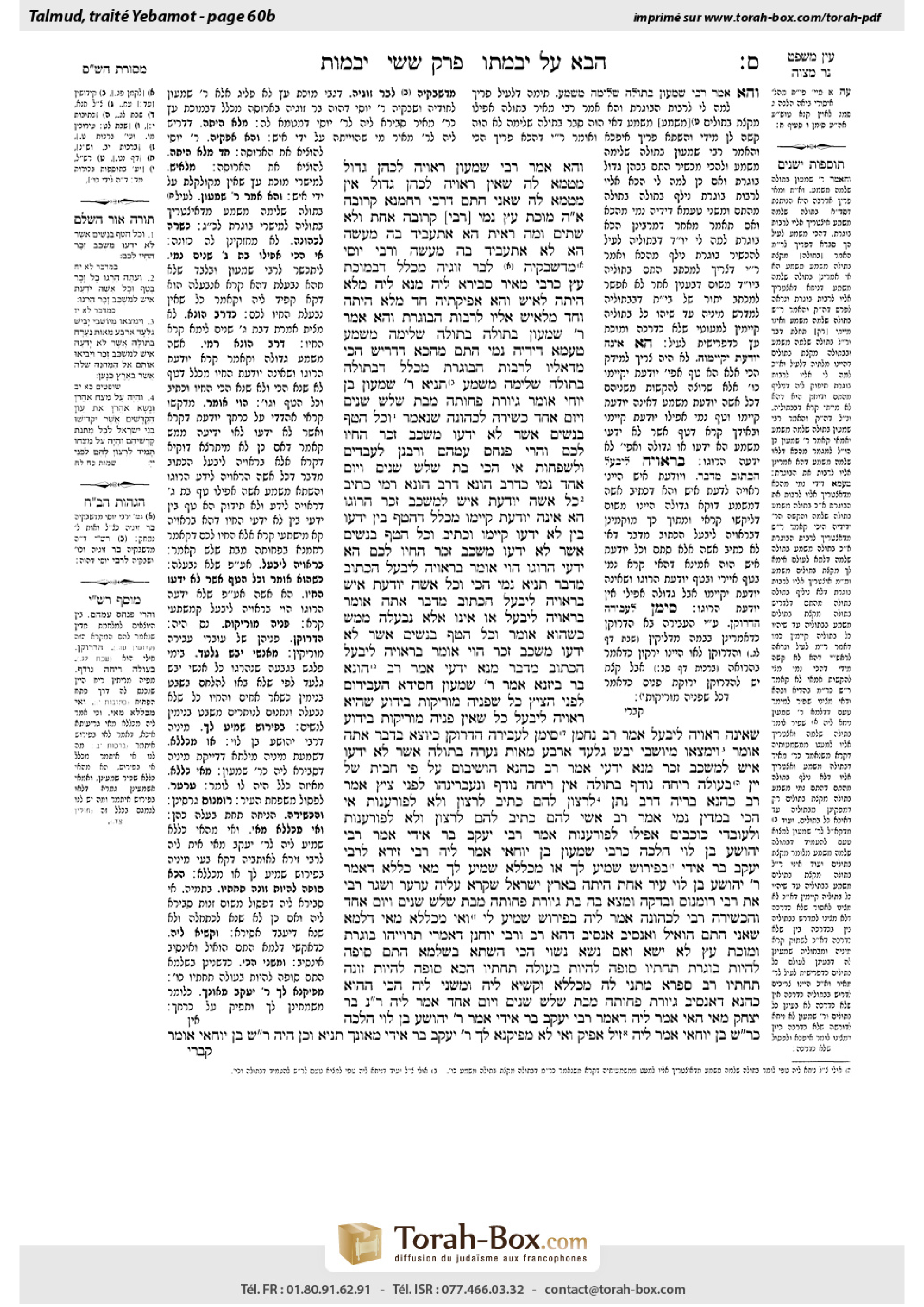
Yevamot 60b: Talmud study for Daf Yomi
Daf Yomi is the daily study of one Talmud folio. Explore 37 tractates with scans, Hebrew text, Sefaria English and AI-generated French translations where annotated.
Passage selection and English or AI-generated French translation are available where the scan has annotations. Daf Study is independent of Torah-Box and Sefaria.
Browse Yevamot · יבמות · All tractatesYevamot 60b text and translations
This page of Yevamot includes the Aramaic text, an English translation and an AI-generated French translation, alongside the scan above.
יבמות ס׳ ב · Aramaic and Hebrew text
וְהָא אָמַר רַבִּי שִׁמְעוֹן: רְאוּיָה לְכֹהֵן גָּדוֹל — מִטַּמֵּא לָהּ, שֶׁאֵין רְאוּיָה לְכֹהֵן גָּדוֹל — אֵין מִטַּמֵּא לָהּ. שָׁאנֵי הָתָם, דְּרַבִּי רַחֲמָנָא ״קְרוֹבָה״.
אִי הָכִי, מוּכַּת עֵץ נָמֵי! [רַבִּי] ״קְרוֹבָה״ — אַחַת וְלֹא שְׁתַּיִם. וּמָה רָאִיתָ? הָא — אִתְעֲבִיד בַּהּ מַעֲשֶׂה, הָא — לָא אִתְעֲבִיד בַּהּ מַעֲשֵׂה.
וְרַבִּי יוֹסֵי, מִדְּשַׁבְקֵיהּ לְבַר זוּגֵיהּ, מִכְּלָל דִּבְמוּכַּת עֵץ כְּרַבִּי מֵאִיר סְבִירָא לֵיהּ, מְנָא לֵיהּ — מִ״לֹּא הָיְתָה לְאִישׁ״.
וְהָא אַפֵּיקְתֵּיהּ! חַד מִ״לֹּא הָיְתָה״, וְחַד מִ״לְּאִישׁ״.
״אֵלָיו״ — לְרַבּוֹת הַבּוֹגֶרֶת. וְהָא אָמַר רַבִּי שִׁמְעוֹן: ״בְּתוּלָה״ — בְּתוּלָה שְׁלֵימָה מַשְׁמַע! טַעְמָא דִּידֵיהּ נָמֵי הָתָם מֵהָכָא, דְּדָרֵישׁ הָכִי מִדְּ״אֵלָיו״ — לְרַבּוֹת הַבּוֹגֶרֶת, מִכְלָל דִּ״בְתוּלָה״ — בְּתוּלָה שְׁלֵימָה מַשְׁמַע.
תַּנְיָא, רַבִּי שִׁמְעוֹן בֶּן יוֹחַי אוֹמֵר: גִּיּוֹרֶת פְּחוּתָה מִבַּת שָׁלֹשׁ שָׁנִים וְיוֹם אֶחָד — כְּשֵׁירָה לַכְּהוּנָּה, שֶׁנֶּאֱמַר: ״וְכֹל הַטַּף בַּנָּשִׁים אֲשֶׁר לֹא יָדְעוּ מִשְׁכַּב זָכָר הַחֲיוּ לָכֶם״, וַהֲרֵי פִּנְחָס עִמָּהֶם.
וְרַבָּנַן? לַעֲבָדִים וְלִשְׁפָחוֹת. אִי הָכִי, בַּת שָׁלֹשׁ שָׁנִים וְיוֹם אֶחָד נָמֵי?
כִּדְרַב הוּנָא. דְּרַב הוּנָא רָמֵי, כְּתִיב: ״כׇּל אִשָּׁה יֹדַעַת אִישׁ לְמִשְׁכַּב זָכָר הֲרֹגוּ״, הָא אֵינָהּ יוֹדַעַת — קַיֵּימוּ, מִכְּלָל דְּהַטַּף, בֵּין יָדְעוּ בֵּין לֹא יָדְעוּ — קַיֵּימוּ. וּכְתִיב: ״וְכׇל הַטַּף בַּנָּשִׁים אֲשֶׁר לֹא יָדְעוּ מִשְׁכַּב זָכָר הַחֲיוּ לָכֶם״, הָא יָדְעִי — הֲרוֹגוּ!
הֱוֵי אוֹמֵר בִּרְאוּיָה לִיבָּעֵל הַכָּתוּב מְדַבֵּר.
תַּנְיָא נָמֵי הָכִי: ״וְכׇל אִשָּׁה יוֹדַעַת אִישׁ״ — בִּרְאוּיָה לִיבָּעֵל הַכָּתוּב מְדַבֵּר. אַתָּה אוֹמֵר בִּרְאוּיָה לִיבָּעֵל, אוֹ אֵינוֹ אֶלָּא נִבְעֲלָה מַמָּשׁ? כְּשֶׁהוּא אוֹמֵר: ״וְכׇל הַטַּף בַּנָּשִׁים אֲשֶׁר לֹא יָדְעוּ מִשְׁכַּב זָכָר״, הֱוֵי אוֹמֵר: בִּרְאוּיָה לִיבָּעֵל הַכָּתוּב מְדַבֵּר.
מְנָא יָדְעִי? אָמַר רַב הוּנָא בַּר בִּיזְנָא אָמַר רַבִּי שִׁמְעוֹן חֲסִידָא: הֶעֱבִירוּם לִפְנֵי הַצִּיץ. כׇּל שֶׁפָּנֶיהָ מוֹרִיקוֹת — בְּיָדוּעַ שֶׁהִיא רְאוּיָה לִיבָּעֵל, כֹּל שֶׁאֵין פָּנֶיהָ מוֹרִיקוֹת — בְּיָדוּעַ שֶׁאֵינָהּ רְאוּיָה לִיבָּעֵל. אָמַר רַב נַחְמָן: סִימָן לַעֲבֵירָה — הִדְרוֹקָן.
כַּיּוֹצֵא בַּדָּבָר, אַתָּה אוֹמֵר: ״וַיִּמְצְאוּ מִיּוֹשְׁבֵי יָבֵשׁ גִּלְעָד אַרְבַּע מֵאוֹת נַעֲרָה בְתוּלָה אֲשֶׁר לֹא יָדְעוּ אִישׁ לְמִשְׁכַּב זָכָר״, מְנָא יָדְעִי? אָמַר רַב כָּהֲנָא: הוֹשִׁיבוּם עַל פִּי חָבִית שֶׁל יַיִן, בְּעוּלָה — רֵיחָהּ נוֹדֵף, בְּתוּלָה — אֵין רֵיחָהּ נוֹדֵף.
וּנְעַבְּרִינְהוּ לִפְנֵי צִיץ? אֲמַר רַב כָּהֲנָא בְּרֵיהּ דְּרַב נָתָן: ״לְרָצוֹן לָהֶם״ כְּתִיב, לְרָצוֹן וְלֹא לְפוּרְעָנוּת. אִי הָכִי בְּמִדְיָן נָמֵי? אָמַר רַב אָשֵׁי: ״לָהֶם״ כְּתִיב, לָהֶם — לְרָצוֹן וְלֹא לְפוּרְעָנוּת, וּלְגוֹיִם — אֲפִילּוּ לְפוּרְעָנוּת.
אָמַר רַבִּי יַעֲקֹב בַּר אִידִי אָמַר רַבִּי יְהוֹשֻׁעַ בֶּן לֵוִי: הֲלָכָה כְּרַבִּי שִׁמְעוֹן בֶּן יוֹחַאי. אֲמַר לֵיהּ רַבִּי זֵירָא לְרַבִּי יַעֲקֹב בַּר אִידִי: בְּפֵירוּשׁ שְׁמִיעַ לָךְ, אוֹ מִכְּלָלָא שְׁמִיעַ לָךְ?
מַאי כְּלָלָא? דְּאָמַר רַבִּי יְהוֹשֻׁעַ בֶּן לֵוִי: עִיר אַחַת הָיְתָה בְּאֶרֶץ יִשְׂרָאֵל שֶׁקָּרָא עָלֶיהָ עַרְעָר, וְשִׁגֵּר רַבִּי אֶת רַבִּי רוֹמָנוּס וּבְדָקָהּ, וּמָצָא בָּהּ בַּת גִּיּוֹרֶת פְּחוּתָה מִבַּת שָׁלֹשׁ שָׁנִים וְיוֹם אֶחָד, וְהִכְשִׁירָהּ רַבִּי לַכְּהוּנָּה. אֲמַר לֵיהּ: בְּפֵירוּשׁ שְׁמִיעַ לִי.
וְאִי מִכְּלָלָא מַאי? דִּלְמָא שָׁאנֵי הָתָם: הוֹאִיל וְאִנְּסִיב — אִנְּסִיב. דְּהָא רַב וְרַבִּי יוֹחָנָן דְּאָמְרִי תַּרְוַיְיהוּ: בּוֹגֶרֶת וּמוּכַּת עֵץ לֹא יִשָּׂא, וְאִם נָשָׂא — נָשׂוּי.
הָכִי הַשְׁתָּא?! בִּשְׁלָמָא הָתָם: סוֹפָהּ לִהְיוֹת בּוֹגֶרֶת תַּחְתָּיו, סוֹפָהּ לִהְיוֹת בְּעוּלָה תַּחְתָּיו. הָכָא, סוֹפָהּ לִהְיוֹת זוֹנָה תַּחְתָּיו?!
רַב סָפְרָא מַתְנֵי לַהּ מִכְּלָלָא וְקַשְׁיָא לֵיהּ, וּמְשַׁנֵּי (לֵיהּ) הָכִי.
הָהוּא כָּהֲנָא דְּאִנְּסִיב גִּיּוֹרֶת פְּחוּתָה מִבַּת שָׁלֹשׁ שָׁנִים וְיוֹם אֶחָד. אֲמַר לֵיהּ רַב נַחְמָן בַּר יִצְחָק: מַאי הַאי? אֲמַר לֵיהּ, דְּאָמַר רַבִּי יַעֲקֹב בַּר אִידִי אָמַר רַבִּי יְהוֹשֻׁעַ בֶּן לֵוִי: הֲלָכָה כְּרַבִּי שִׁמְעוֹן בֶּן יוֹחַאי. אֲמַר לֵיהּ: זִיל אַפֵּיק, וְאִי לָא — מַפֵּיקְנָא לָךְ רַבִּי יַעֲקֹב בַּר אִידִי מֵאוּנָּךְ.
תַּנְיָא, וְכֵן הָיָה רַבִּי שִׁמְעוֹן בֶּן יוֹחַאי אוֹמֵר:
Yevamot 60b · English translation
Didn’t Rabbi Shimon say: If she was fit for a High Priest, her brother must become impure for her, and if she was not fit for a High Priest, her brother may not become impure for her? A divorced woman is not fit for a High Priest even if she had been only betrothed before her divorce. The Gemara answers: It is different there, as the Merciful One includes her by the term: Who is near, which includes any sister who is close to him, even if she is unfit for a High Priest.
The Gemara asks: If so, a woman whose hymen was torn accidentally should also be included. The Gemara responds that the term: Who is near, which is written in the singular, includes only one additional case and not two. The Gemara asks: And what did you see to render forbidden a woman whose hymen was accidentally torn and permit a divorcée who had previously been only betrothed, and not the opposite? The Gemara answers: In this case of the woman whose hymen was torn, an action has been performed on her body, whereas in that case of the divorcée, no action has been performed on her body.
The baraita cites Rabbi Yosei and Rabbi Shimon as holding that a priest may not become impure for his sister who was betrothed and then divorced, and it cites only Rabbi Shimon as holding that he may not become impure for his sister who was a grown woman. Based on this, the Gemara asks: From the fact that Rabbi Yosei left his partner, Rabbi Shimon, it may be inferred that with regard to a woman whose hymen was torn accidentally he holds in accordance with the opinion of Rabbi Meir, that a priest does become impure. From where does he derive this halakha? The Gemara explains that he derives it from the phrase: “Who has had no man,” as a woman whose hymen was torn accidentally has not been with a man.
The Gemara asks: Haven’t you already derived the halakha of a betrothed woman from that phrase? The Gemara answers: Rabbi Yosei learns one halakha from the phrase “has had no,” which indicates that she has not even been betrothed, and he derives one halakha from the term “man,” which indicates that only a woman who was with a man is no longer considered a virgin with regard to this halakha, but not one whose hymen was torn accidentally.
It was stated previously that according to Rabbi Shimon, the term “to him,” comes to include a grown woman. The Gemara asks: Didn’t Rabbi Shimon say with regard to a High Priest that the term virgin indicates a complete virgin, which does not include a grown woman? The Gemara answers: His reason there is also derived from here, as he expounds as follows: From the fact that the expression “to him” is needed to include a grown woman, it may be inferred that the term virgin by itself indicates a complete virgin.
§ The Gemara cites another ruling of Rabbi Shimon ben Yoḥai, also related to the discussion of defining who is considered a virgin. It is taught in a baraita that Rabbi Shimon ben Yoḥai says: A female convert who converted when she was less than three years and one day old is permitted to marry into the priesthood, as it is stated: “But all the women children that have not known man by lying with him, keep alive for yourselves” (Numbers 31:18). This verse indicates that these women were fit for all of the warriors, and since Pinehas the priest was with them (see Numbers 31:6), it is clear that young converts are permitted to priests.
The Gemara asks: And how do the Rabbis, who disagree with Rabbi Shimon, interpret this verse? The Gemara responds: They understand the phrase “keep alive for yourselves” to mean that they could keep them as slaves and as maidservants, but they could not necessarily marry them. The Gemara asks: If so, if the source for Rabbi Shimon’s ruling is this verse, a girl who converted at the age of three years and one day old should also be permitted to a priest, as long as she has never had intercourse, as stated by the verse.
The Gemara replies: His reasoning is as stated by Rav Huna, as Rav Huna raised a contradiction: It is written in one verse: “Kill every woman that has known man by lying with him” (Numbers 31:17), which indicates that a woman who has not known a man in this way you may keep alive. This proves by inference that the female children, who are not classified as women, you may keep alive regardless of whether they knew a man or they did not know a man. And it is written in a different verse: “But all the women children that have not known man by lying with him, keep alive for yourselves” (Numbers 31:18), which indicates that if they have known men, you must kill them. This is an apparent contradiction.
Rav Huna explains: You must say that the verse is speaking of a woman who is fit for intercourse. The verse does not mean to distinguish between women who have actually engaged in sexual intercourse and those who have not. Rather, it distinguishes between a girl over the age of three, with whom an act of intercourse is recognized as such, and a girl below the age of three.
This is also taught in a baraita: “Every woman that has known man”; the verse is speaking of a woman who is fit for intercourse. The baraita proceeds to discuss this halakha: Do you say it is referring to one who is fit for intercourse, or perhaps it is referring only to one who has actually had intercourse? When the verse states: “But all the women children that have not known man by lying with him, keep alive for yourselves,” which indicates that grown women must be killed even if they have not had intercourse with a man, you must say that the verse is speaking of a woman who is fit for intercourse.
The Gemara asks a practical question with regard to the events described by the Torah: From where did they know whether a particular girl was already three years old and fit for intercourse? Rav Huna bar Bizna said that Rabbi Shimon Ḥasida said: They passed them before the frontplate of the High Priest. Any girl whose face miraculously turned sallow, it was known that she was fit for intercourse, and any girl whose face did not turn sallow, it was thereby known that she was not fit for intercourse. Similarly, Rav Naḥman said: A sign of transgression in the area of sexual morality is the disease hidrokan, which causes one’s face to turn sallow.
Similarly, you can say with regard to the verse: “And they found among the inhabitants of Jabesh-gilead four hundred young virgins that had not known man by lying with him” (Judges 21:12). From where did they know that they were virgins? Rav Kahana said: They sat them on the opening of a barrel of wine. If she was a non-virgin, her breath would smell like wine; if she was a virgin, her breath did not smell like wine.
The Gemara suggests: They should have passed them before the frontplate, as described previously with regard to the daughters of Midian. Rav Kahana, son of Rav Natan, said: The verse states with regard to the frontplate: “And it shall be upon Aaron’s forehead…that they may be accepted before the Lord” (Exodus 28:38), which indicates that the frontplate is worn for acceptance but not for calamity. The Gemara raises a difficulty: If so, the frontplate should also not have been used with regard to the women of Midian. Rav Ashi said: The word “they” is written in the verse, indicating that for them, the Jewish people, the frontplate is for acceptance but not for calamity; but for gentiles it can be used even for calamity.
Rabbi Ya’akov bar Idi said that Rabbi Yehoshua ben Levi said: The halakha is in accordance with the opinion of Rabbi Shimon ben Yoḥai. Rabbi Zeira said to Rabbi Ya’akov bar Idi: Did you hear Rabbi Yehoshua ben Levi say this explicitly or did you learn it by inference?
The Gemara asks: What inference was Rabbi Zeira hinting at? The Gemara explains: As Rabbi Yehoshua ben Levi said: There was a certain city in Eretz Yisrael where they contested the lineage of a particular family. And Rabbi Yehuda HaNasi sent Rabbi Romanus, and he examined the family’s lineage and found that it included the daughter of a convert who had converted when she was less than three years and one day old, and she had married a priest. And Rabbi Yehuda HaNasi permitted her to the priesthood. This indicates that Rabbi Yehoshua ben Levi ruled in accordance with Rabbi Shimon. Rabbi Ya’akov bar Idi said to him: I heard explicitly that Rabbi Yehoshua ben Levi ruled in this manner.
The Gemara asks: And if Rabbi Yehoshua ben Levi’s opinion had been derived by inference, what of it? The Gemara answers: Perhaps it was different there, because since she had already married a priest, she could remain married after the fact, but it would not be permitted for her to marry a priest ab initio, as it is Rav and Rabbi Yoḥanan who both say: A High Priest may not marry a grown woman and a woman whose hymen was torn accidentally, but if he married one of them he is married and not required to divorce her.
The Gemara refutes this claim: How can these cases be compared? Granted, there, in the case of a grown woman, it is reasonable for her to be permitted after the fact, as a young woman will eventually be a grown woman under him, i.e., while married to him, and she will eventually be a non-virgin under him. However, here, in the case of a convert, will she eventually be a zona under him? If she is forbidden to a priest ab initio it is because she has the status of a zona, in which case she should be prohibited after the fact as well. Consequently, it can be proven from the incident cited previously that Rabbi Yehoshua ben Levi rules in accordance with the opinion of Rabbi Shimon.
The Gemara comments: Rav Safra taught this halakha after deriving Rabbi Yehoshua ben Levi’s ruling by inference, although he had never heard this ruling explicitly. And the question mentioned above was difficult for him, and he resolved it in this same manner.
The Gemara relates another incident related to this halakha: A certain priest married a convert, who had converted when she was less than three years and one day old. Rav Naḥman bar Yitzḥak said to him: What is this? Why are you violating the halakha? He said to him: It is permitted for me to marry her, as Rabbi Ya’akov bar Idi said that Rabbi Yehoshua ben Levi said that the halakha is in accordance with the opinion of Rabbi Shimon ben Yoḥai. He said to him: Go remove her, i.e., divorce her. And if not, I will remove Rabbi Ya’akov bar Idi from your ear [me’unekh] for you. In other words, I will take the necessary action to ensure that you obey and divorce her, so that you can no longer follow Rabbi Ya’akov bar Idi’s opinion.
§ It is taught in a baraita: And similarly, Rabbi Shimon ben Yoḥai would say:
Yevamot 60b · Traduction française (IA)
Rabbi Shimon n’a-t-il pas dit : « Si elle était apte à épouser un grand prêtre, son frère doit se rendre impur pour elle ; si elle n’était pas apte à épouser un grand prêtre, son frère ne peut pas se rendre impur pour elle » ? Une femme divorcée n’est pas apte à épouser un grand prêtre, même si elle n’avait été que fiancée avant son divorce. La Guemara répond : Le cas est différent, car le Miséricordieux l’inclut par l’expression « qui est proche », laquelle inclut toute sœur qui lui est proche, même si elle n’est pas apte à épouser un grand prêtre.
La Guemara demande : Dans ce cas, une femme dont l’hymen a été déchiré accidentellement devrait elle aussi être incluse. La Guemara répond que l’expression « qui est proche », écrite au singulier, n’inclut qu’un seul cas supplémentaire, et non deux. La Guemara demande : Et qu’est-ce qui t’a conduit à interdire une femme dont l’hymen a été déchiré accidentellement et à permettre une divorcée qui n’avait auparavant été que fiancée, plutôt que l’inverse ? La Guemara répond : Dans le cas de la femme dont l’hymen a été déchiré, une action a été accomplie sur son corps, tandis que, dans celui de la divorcée, aucune action n’a été accomplie sur son corps.
La baraïta cite Rabbi Yosei et Rabbi Shimon comme soutenant qu’un prêtre ne peut pas se rendre impur pour sa sœur qui a été fiancée puis divorcée, mais elle ne cite que Rabbi Shimon comme soutenant qu’il ne peut pas se rendre impur pour sa sœur qui était une femme adulte. Sur cette base, la Guemara demande : Du fait que Rabbi Yosei s’est séparé de son partenaire, Rabbi Shimon, on peut déduire qu’au sujet d’une femme dont l’hymen a été déchiré accidentellement, il est d’accord avec l’opinion de Rabbi Meir, selon laquelle un prêtre se rend impur pour elle. De quelle source tire-t-il cette halakha ? La Guemara explique qu’il la déduit de l’expression « qui n’a connu aucun homme », car une femme dont l’hymen a été déchiré accidentellement n’a pas été avec un homme.
La Guemara demande : N’as-tu pas déjà déduit de cette expression la halakha concernant une femme fiancée ? La Guemara répond : Rabbi Yosei tire une halakha de l’expression « n’a pas eu », qui indique qu’elle n’a même pas été fiancée, et une autre du terme « homme », qui indique que seule une femme qui a été avec un homme n’est plus considérée comme vierge pour cette halakha, mais pas celle dont l’hymen a été déchiré accidentellement.
Il a été dit précédemment que, selon Rabbi Shimon, l’expression « pour lui » vient inclure une femme adulte. La Guemara demande : Rabbi Shimon n’a-t-il pas dit, au sujet d’un grand prêtre, que le terme « vierge » désigne une vierge intacte, ce qui n’inclut pas une femme adulte ? La Guemara répond : Là aussi, sa raison se déduit d’ici, car il raisonne ainsi : Du fait que l’expression « pour lui » est nécessaire pour inclure une femme adulte, on peut déduire que le terme « vierge », à lui seul, désigne une vierge intacte.
§ La Guemara cite une autre décision de Rabbi Shimon ben Yoḥai, également liée à la discussion sur la définition de la femme considérée comme vierge. Il est enseigné dans une baraïta que Rabbi Shimon ben Yoḥai dit : Une convertie qui s’est convertie alors qu’elle avait moins de trois ans et un jour est autorisée à épouser un prêtre, comme il est dit : « Mais toutes les filles parmi les enfants, qui n’ont pas connu d’homme en couchant avec lui, gardez-les vivantes pour vous » (Nombres 31,18). Ce verset indique que ces femmes étaient aptes à épouser tous les guerriers ; et puisque Pinḥas le prêtre était parmi eux (voir Nombres 31,6), il est clair que les jeunes converties sont autorisées à épouser des prêtres.
La Guemara demande : Et comment les Sages, qui ne sont pas d’accord avec Rabbi Shimon, interprètent-ils ce verset ? La Guemara répond : Ils comprennent l’expression « gardez-les vivantes pour vous » comme signifiant qu’ils pouvaient les garder comme esclaves et servantes, mais pas nécessairement les épouser. La Guemara demande : Dans ce cas, si ce verset est la source de la décision de Rabbi Shimon, une fille qui s’est convertie à l’âge de trois ans et un jour devrait elle aussi être autorisée à épouser un prêtre, tant qu’elle n’a jamais eu de rapports sexuels, comme le dit le verset.
La Guemara répond : Son raisonnement est celui qu’a exposé Rav Huna, qui a relevé une contradiction : Il est écrit dans un verset : « Tuez toute femme qui a connu un homme en couchant avec lui » (Nombres 31,17), ce qui indique que vous pouvez garder vivante une femme qui n’a pas connu d’homme de cette manière. Il s’ensuit que vous pouvez garder vivantes les filles, qui ne sont pas qualifiées de femmes, qu’elles aient connu un homme ou non. Or, il est écrit dans un autre verset : « Mais toutes les filles parmi les enfants, qui n’ont pas connu d’homme en couchant avec lui, gardez-les vivantes pour vous » (Nombres 31,18), ce qui indique que, si elles ont connu des hommes, vous devez les tuer. C’est là une contradiction apparente.
Rav Huna explique : Il faut dire que le verset parle d’une femme qui est apte aux rapports sexuels. Le verset ne vise pas à distinguer celles qui ont effectivement eu des rapports sexuels de celles qui n’en ont pas eu. Il distingue plutôt une fille de plus de trois ans, avec laquelle un rapport sexuel est reconnu comme tel, d’une fille de moins de trois ans.
Cela est également enseigné dans une baraïta : « Toute femme qui a connu un homme » ; le verset parle d’une femme qui est apte aux rapports sexuels. La baraïta poursuit l’examen de cette halakha : Dis-tu qu’il s’agit de celle qui est apte aux rapports sexuels, ou peut-être s’agit-il uniquement de celle qui a effectivement eu des rapports sexuels ? Lorsque le verset dit : « Mais toutes les filles parmi les enfants, qui n’ont pas connu d’homme en couchant avec lui, gardez-les vivantes pour vous », ce qui indique que les femmes adultes doivent être tuées même si elles n’ont pas eu de rapports sexuels avec un homme, il faut dire que le verset parle d’une femme qui est apte aux rapports sexuels.
La Guemara pose une question pratique au sujet des événements décrits par la Torah : Comment savaient-ils si une fille donnée avait déjà trois ans et était apte aux rapports sexuels ? Rav Huna bar Bizna dit au nom de Rabbi Shimon Ḥasida : Ils les firent passer devant le pectoral du grand prêtre. Le visage de toute fille qui devenait miraculeusement blême indiquait qu’elle était apte aux rapports sexuels ; si son visage ne devenait pas blême, cela indiquait qu’elle ne l’était pas. De même, Rav Naḥman dit : Un signe de transgression dans le domaine de la moralité sexuelle est la maladie appelée hidrokan, qui fait pâlir le visage.
De même, on peut dire au sujet du verset : « Ils trouvèrent parmi les habitants de Yabesh-Guiléad quatre cents jeunes vierges qui n’avaient pas connu d’homme en couchant avec lui » (Juges 21,12) : Comment savaient-ils qu’elles étaient vierges ? Rav Kahana dit : Ils les firent asseoir sur l’ouverture d’un tonneau de vin. Si elle n’était pas vierge, son haleine sentait le vin ; si elle était vierge, son haleine ne sentait pas le vin.
La Guemara suggère : Ils auraient dû les faire passer devant le pectoral, comme cela a été décrit précédemment au sujet des filles de Midian. Rav Kahana, fils de Rav Natan, dit : Au sujet du pectoral, le verset dit : « Il sera sur le front d’Aaron… afin qu’elles soient agréées devant le Seigneur » (Exode 28,38), ce qui indique que le pectoral est porté pour obtenir l’agrément, mais non pour provoquer un malheur. La Guemara soulève une difficulté : Dans ce cas, le pectoral n’aurait pas non plus dû être utilisé pour les femmes de Midian. Rav Ashi dit : Le mot « elles » est écrit dans le verset, ce qui indique que, pour elles, le peuple juif, le pectoral sert à obtenir l’agrément, mais non à provoquer un malheur ; en revanche, pour les non-Juifs, il peut être utilisé même pour provoquer un malheur.
Rabbi Ya’akov bar Idi dit au nom de Rabbi Yehoshua ben Levi : La halakha est conforme à l’opinion de Rabbi Shimon ben Yoḥai. Rabbi Zeira dit à Rabbi Ya’akov bar Idi : As-tu entendu Rabbi Yehoshua ben Levi le dire explicitement, ou l’as-tu déduit ?
La Guemara demande : À quelle déduction Rabbi Zeira faisait-il allusion ? La Guemara explique : Rabbi Yehoshua ben Levi a dit : Il y avait une ville en Eretz Israël où l’on contestait la lignée d’une certaine famille. Rabbi Yehuda HaNasi envoya Rabbi Romanus, qui examina la lignée de la famille et découvrit qu’elle comprenait la fille d’une convertie qui s’était convertie alors qu’elle avait moins de trois ans et un jour, et qui avait épousé un prêtre. Rabbi Yehuda HaNasi l’autorisa à épouser un prêtre. Cela indique que Rabbi Yehoshua ben Levi statua conformément à l’opinion de Rabbi Shimon. Rabbi Ya’akov bar Idi lui dit : J’ai entendu explicitement que Rabbi Yehoshua ben Levi avait statué ainsi.
La Guemara demande : Et si l’opinion de Rabbi Yehoshua ben Levi avait été déduite, qu’est-ce que cela changerait ? La Guemara répond : Peut-être le cas était-il différent, car, puisqu’elle avait déjà épousé un prêtre, elle pouvait rester mariée après coup, mais elle n’aurait pas été autorisée à épouser un prêtre a priori ; en effet, Rav et Rabbi Yoḥanan disent tous deux : Un grand prêtre ne peut pas épouser une femme adulte ni une femme dont l’hymen a été déchiré accidentellement ; mais s’il en a épousé une, le mariage est valide et il n’est pas tenu de divorcer.
La Guemara réfute cette affirmation : Comment peut-on comparer ces cas ? Certes, dans le cas d’une femme adulte, il est raisonnable qu’elle soit permise après coup, car une jeune fille deviendra finalement une femme adulte alors qu’elle sera mariée avec lui, et elle finira aussi par ne plus être vierge pendant qu’elle sera mariée avec lui. Mais, dans le cas d’une convertie, deviendra-t-elle finalement une zona pendant qu’elle sera mariée avec lui ? Si elle est interdite à un prêtre a priori, c’est parce qu’elle a le statut de zona ; elle devrait donc également lui être interdite après coup. Par conséquent, l’incident cité précédemment permet de prouver que Rabbi Yehoshua ben Levi statue conformément à l’opinion de Rabbi Shimon.
La Guemara fait remarquer : Rav Safra enseigna cette halakha après avoir déduit la décision de Rabbi Yehoshua ben Levi, bien qu’il ne l’ait jamais entendue explicitement. La question mentionnée plus haut lui posait difficulté, et il la résolut de cette même manière.
La Guemara rapporte un autre incident lié à cette halakha : Un certain prêtre épousa une convertie qui s’était convertie alors qu’elle avait moins de trois ans et un jour. Rav Naḥman bar Yitzḥak lui dit : Qu’est-ce que cela ? Pourquoi transgresses-tu la halakha ? Il lui répondit : Je peux l’épouser, car Rabbi Ya’akov bar Idi a dit au nom de Rabbi Yehoshua ben Levi que la halakha est conforme à l’opinion de Rabbi Shimon ben Yoḥai. Il lui dit : Va la répudier. Sinon, je te retirerai Rabbi Ya’akov bar Idi de l’oreille [me’unekh]. Autrement dit, je prendrai les mesures nécessaires pour que tu obéisses et la répudies, afin que tu ne puisses plus suivre l’opinion de Rabbi Ya’akov bar Idi.
§ Il est enseigné dans une baraïta : De même, Rabbi Shimon ben Yoḥai disait :
Traduction française générée par IA à partir de l’édition anglaise de Sefaria. Vérifie toujours un passage avec le texte source.
Text from Sefaria: William Davidson Edition - Vocalized Aramaic (CC BY NC); William Davidson Edition - English (CC BY NC).