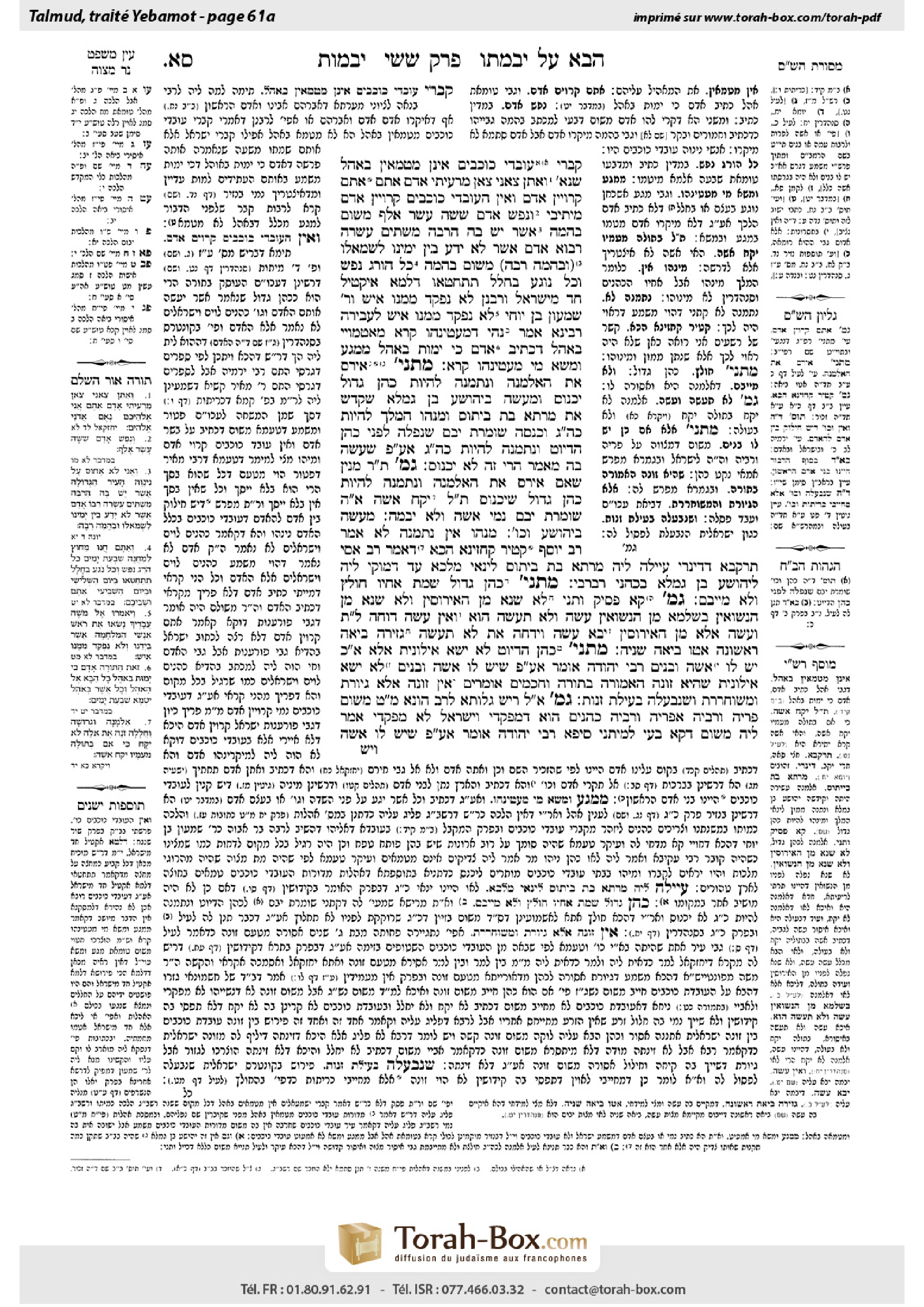
Yevamot 61a: Talmud study for Daf Yomi
Daf Yomi is the daily study of one Talmud folio. Explore 37 tractates with scans, Hebrew text, Sefaria English and AI-generated French translations where annotated.
Passage selection and English or AI-generated French translation are available where the scan has annotations. Daf Study is independent of Torah-Box and Sefaria.
Browse Yevamot · יבמות · All tractatesYevamot 61a text and translations
This page of Yevamot includes the Aramaic text, an English translation and an AI-generated French translation, alongside the scan above.
יבמות ס״א א · Aramaic and Hebrew text
קִבְרֵי גוֹיִם אֵינָן מְטַמְּאִין בְּאֹהֶל, שֶׁנֶּאֱמַר: ״וְאַתֵּן צֹאנִי צֹאן מַרְעִיתִי אָדָם אַתֶּם״. אַתֶּם קְרוּיִין אָדָם, וְאֵין הַגּוֹיִם קְרוּיִין אָדָם.
מֵיתִיבִי: ״וְנֶפֶשׁ אָדָם שִׁשָּׁה עָשָׂר אָלֶף״! מִשּׁוּם בְּהֵמָה.
״אֲשֶׁר יֶשׁ בָּהּ הַרְבֵּה מִשְׁתֵּים עֶשְׂרֵה רִבּוֹא אָדָם אֲשֶׁר לֹא יָדַע בֵּין יְמִינוֹ לִשְׂמֹאלוֹ (וּבְהֵמָה רַבָּה)״! מִשּׁוּם בְּהֵמָה.
״כֹּל הוֹרֵג נֶפֶשׁ וְכֹל נוֹגֵעַ בֶּחָלָל תִּתְחַטְּאוּ״! דִּלְמָא אִיקְּטִיל חַד מִיִּשְׂרָאֵל. וְרַבָּנַן: ״לֹא נִפְקַד מִמֶּנּוּ אִישׁ״. וְרַבִּי שִׁמְעוֹן בֶּן יוֹחַי: ״לֹא נִפְקַד מִמֶּנּוּ אִישׁ״ — לַעֲבֵירָה.
רָבִינָא אָמַר: נְהִי דְּמַעֲטִינְהוּ קְרָא מֵאִטַּמּוֹיֵי בְּאֹהֶל, דִּכְתִיב: ״אָדָם כִּי יָמוּת בְּאֹהֶל״, מִמַּגָּע וּמַשָּׂא מִי מַעֲטִינְהוּ קְרָא?
מַתְנִי׳ אֵירַס אֶת הָאַלְמָנָה וְנִתְמַנָּה לִהְיוֹת כֹּהֵן גָּדוֹל — יִכְנוֹס. וּמַעֲשֶׂה בִּיהוֹשֻׁעַ בֶּן גַּמְלָא שֶׁקִּדֵּשׁ אֶת מָרְתָּא בַּת בַּיְתּוֹס, וּמִנָּהוּ הַמֶּלֶךְ לִהְיוֹת כֹּהֵן גָּדוֹל, וּכְנָסָהּ. שׁוֹמֶרֶת יָבָם שֶׁנָּפְלָה לִפְנֵי כֹּהֵן הֶדְיוֹט, וְנִתְמַנָּה לִהְיוֹת כֹּהֵן גָּדוֹל, אַף עַל פִּי שֶׁעָשָׂה בָּהּ מַאֲמָר — הֲרֵי זֶה לֹא יִכְנוֹס.
גְּמָ׳ תָּנוּ רַבָּנַן: מִנַּיִן שֶׁאִם אֵירַס אֶת הָאַלְמָנָה וְנִתְמַנָּה לִהְיוֹת כֹּהֵן גָּדוֹל שֶׁיִּכְנוֹס — תַּלְמוּד לוֹמַר: ״יִקַּח אִשָּׁה״. אִי הָכִי, שׁוֹמֶרֶת יָבָם נָמֵי! ״אִשָּׁה״, וְלֹא יְבָמָה.
מַעֲשֶׂה בִּיהוֹשֻׁעַ וְכוּ׳. מִנָּהוּ — אִין, נִתְמַנָּה — לָא. אָמַר רַב יוֹסֵף: קְטִיר קָחָזֵינָא הָכָא. דְּאָמַר רַב אַסִּי: תַּרְקַבָּא דְּדִינָרֵי עַיִּילָהּ לֵיהּ מָרְתָּא בַּת בַּיְתּוֹס לְיַנַּאי מַלְכָּא עַד דְּמוֹקֵי לֵיהּ לִיהוֹשֻׁעַ בֶּן גַּמְלָא בְּכָהֲנֵי רַבְרְבֵי.
מַתְנִי׳ כֹּהֵן גָּדוֹל שֶׁמֵּת אָחִיו — חוֹלֵץ וְלֹא מְיַיבֵּם.
גְּמָ׳ קָא פָּסֵיק וְתָנֵי, לָא שְׁנָא מִן הָאֵירוּסִין וְלָא שְׁנָא מִן הַנִּשּׂוּאִין. בִּשְׁלָמָא מִן הַנִּשּׂוּאִין, עֲשֵׂה וְלֹא תַעֲשֶׂה הוּא, וְאֵין עֲשֵׂה דּוֹחֶה לֹא תַעֲשֶׂה וַעֲשֵׂה. אֶלָּא מִן הָאֵירוּסִין, יָבֹא עֲשֵׂה וְיִדְחֶה אֶת לֹא תַעֲשֶׂה?!
גְּזֵירָה בִּיאָה רִאשׁוֹנָה אַטּוּ בִּיאָה שְׁנִיָּה.
מַתְנִי׳ כֹּהֵן הֶדְיוֹט לֹא יִשָּׂא אַיְלוֹנִית, אֶלָּא אִם כֵּן יֵשׁ לוֹ אִשָּׁה וּבָנִים. רַבִּי יְהוּדָה אוֹמֵר: אַף עַל פִּי שֶׁיֵּשׁ לוֹ אִשָּׁה וּבָנִים לֹא יִשָּׂא אַיְלוֹנִית, שֶׁהִיא זוֹנָה הָאֲמוּרָה בַּתּוֹרָה. וַחֲכָמִים אוֹמְרִים: אֵין זוֹנָה אֶלָּא גִּיּוֹרֶת וּמְשׁוּחְרֶרֶת וְשֶׁנִּבְעֲלָה בְּעִילַת זְנוּת.
גְּמָ׳ אֲמַר לֵיהּ רֵישׁ גָּלוּתָא לְרַב הוּנָא: מַאי טַעְמָא — מִשּׁוּם פְּרִיָּה וּרְבִיָּה, אַפְּרִיָּה וּרְבִיָּה כֹּהֲנִים הוּא דְּמִפַּקְּדִי וְיִשְׂרָאֵל לָא מִפַּקְּדִי?! אֲמַר לֵיהּ: מִשּׁוּם דְּקָא בָּעֵי לְמִיתְנֵי סֵיפָא, רַבִּי יְהוּדָה אוֹמֵר: אַף עַל פִּי שֶׁיֵּשׁ לוֹ אִשָּׁה
Yevamot 61a · English translation
The graves of gentiles do not render items impure through a tent, as it is stated: “And you My sheep, the sheep of My pasture, are men [adam]” (Ezekiel 34:31), from which it is derived that you, the Jewish people, are called men [adam] but gentiles are not called men [adam]. Since the Torah introduces the halakha of ritual impurity of a tent with the words: “When a man [adam] dies in a tent” (Numbers 19:14), this halakha applies only to corpses of Jews but not those of gentiles.
The Gemara raises an objection based upon the verse with regard to captives taken during the war against Midian: “And the persons [nefesh adam] were sixteen thousand” (Numbers 31:40), which indicates that gentiles are also referred to as adam. The Gemara answers: They are given this title due to the need to distinguish the people taken captive from the animals that were taken as spoils of war.
The Gemara raises another difficulty based upon a verse with regard to the city of Nineveh: “Wherein are more than one hundred and twenty thousand men [adam] that cannot discern between their right hand and their left hand, and also much cattle” (Jonah 4:11). The Gemara answers: There, too, the gentiles are given this title due to the need to distinguish them from the animals mentioned in the verse.
The Gemara continues to question Rabbi Shimon’s ruling based upon a verse pertaining to the war against Midian: “Whoever has killed anyone, and whoever has touched any slain, purify yourselves” (Numbers 31:19). This indicates that gentile corpses convey ritual impurity. The Gemara answers: Perhaps a Jew was killed, and the concern was for impurity caused by his corpse. And the Rabbis reply that the verse attests: “Not one man of us is missing” (Numbers 31:49). No Jewish soldiers fell in battle, and therefore the concern for impurity must have been due to the corpses of gentiles. And Rabbi Shimon ben Yoḥai responds: The intent of that verse is that not one man of us is missing due to transgression, i.e., none of them sinned.
Ravina said that the explanation above is unnecessary: Granted, the verse excluded gentiles from rendering items impure through a tent, as it is written: “When a man [adam] dies in a tent” (Numbers 19:14); but did the verse exclude them from rendering items impure via touching and carrying? Since gentile corpses convey impurity in these ways, they could have rendered impure the Jews involved in the war with Midian, even according to Rabbi Shimon ben Yoḥai.
MISHNA: If a priest betrothed a widow and was subsequently appointed to be High Priest, he may marry her. And there was an incident with Yehoshua ben Gamla, who betrothed Marta bat Baitos, a widow, and the king subsequently appointed him to be High Priest, and he nevertheless married her. Conversely, in the case of a widow waiting for her yavam who happened before a common priest, i.e., the priest was her yavam, and he was subsequently appointed to be High Priest, then even if he had already performed levirate betrothal with her, he may not marry her, because she is a widow.
GEMARA: The Sages taught: From where is it derived that if a priest betrothed a widow and was subsequently appointed to be High Priest, that he may marry her? The verse states: “Shall he take for a wife” (Leviticus 21:14), an inclusive phrase that indicates that he may marry her in this situation despite the general prohibition for a High Priest to marry a widow. The Gemara asks: If so, a widow waiting for her yavam should also be permitted to a High Priest. The Gemara answers: The word “wife” indicates that this does not include a yevama, who was not initially his wife but his brother’s.
The mishna related an incident with Yehoshua ben Gamla. The Gemara notes that the mishna states that the king appointed him, yes, but not that he was worthy of being appointed. Rav Yosef said: I see a conspiracy here, as this was clearly not a proper appointment by the priests and the Sanhedrin but rather a political appointment, as Rav Asi said: Marta bat Baitos brought a vessel the size of a half-se’a [tarkav] full of dinars to King Yannai until he appointed Yehoshua ben Gamla High Priest.
MISHNA: A High Priest whose brother died without children performs ḥalitza and he does not perform levirate marriage, as he may not marry a widow.
GEMARA: The Gemara comments: The mishna teaches this halakha categorically, indicating that it is no different if she is his brother’s widow from betrothal, and it is no different if she is his widow from marriage. The Gemara analyzes this halakha: Granted, she is forbidden to him if she was widowed from marriage, as, if he were to marry her, it would be a violation of both the positive mitzva that the High Priest marry a virgin and the prohibition for him to marry a widow. And a positive mitzva, i.e., levirate marriage, does not override a prohibition and a positive mitzva together. However, if she was a widow from betrothal and is therefore still a virgin, the positive mitzva of levirate marriage should come and override the prohibition for a High Priest to marry a widow.
The Gemara answers: By Torah law, levirate marriage is permitted in this case. However, there is a rabbinic decree prohibiting their first act of intercourse due to their second act of intercourse. After they have engaged in intercourse once, they have fulfilled the mitzva of levirate marriage, and any subsequent act of intercourse would constitute a violation of the prohibition without the fulfillment of a mitzva.
MISHNA: A common priest may not marry a sexually underdeveloped woman [aylonit], who is incapable of bearing children, unless he already has a wife and children. Rabbi Yehuda says: Even if he has a wife and children, he may not marry a sexually underdeveloped woman, as she is the zona about whom it is stated in the Torah that a priest may not marry her. Intercourse with her is considered a licentious act because she is incapable of bearing children. And the Rabbis say: The only women in the category of zona, who are therefore forbidden to a priest, are a female convert, a freed maidservant, and any woman who engaged in licentious sexual intercourse with a man she is prohibited from marrying.
GEMARA: The Exilarch said to Rav Huna: What is the reason for the halakha that a priest may not marry a sexually underdeveloped woman? It is because he is obligated to fulfill the mitzva to be fruitful and multiply. Is it only priests who were commanded to be fruitful and multiply, but Israelites were not commanded? Why does the mishna specify that a priest may not marry a sexually underdeveloped woman? Rav Huna said to him: This halakha does in fact apply even to Israelites, and the tanna mentions priests because he wants to teach it in a way that would parallel the latter clause of the mishna, which states that Rabbi Yehuda says: Even if he has a wife
Yevamot 61a · Traduction française (IA)
Les tombes des non-Juifs ne transmettent pas l’impureté aux objets par le biais d’une tente, comme il est dit : « Et vous, mes brebis, les brebis de mon pâturage, vous êtes des hommes [adam] » (Ézéchiel 34:31). On en déduit que vous, le peuple juif, êtes appelés « hommes » [adam], mais que les non-Juifs ne sont pas appelés « hommes » [adam]. Puisque la Torah introduit la halakha de l’impureté rituelle transmise par le biais d’une tente par ces mots : « Lorsqu’un homme [adam] meurt dans une tente » (Nombres 19:14), cette halakha ne s’applique qu’aux cadavres de Juifs, et non à ceux des non-Juifs.
La Guemara soulève une objection à partir du verset concernant les captifs faits pendant la guerre contre Midian : « Et les personnes [nefesh adam] étaient au nombre de seize mille » (Nombres 31:40), ce qui indique que les non-Juifs sont eux aussi désignés par le terme adam. La Guemara répond qu’ils reçoivent cette appellation parce qu’il faut distinguer les captifs des animaux pris comme butin de guerre.
La Guemara soulève une autre difficulté à partir d’un verset concernant la ville de Ninive : « où se trouvent plus de cent vingt mille hommes [adam] qui ne savent pas distinguer leur droite de leur gauche, ainsi que beaucoup de bétail » (Jonas 4:11). La Guemara répond que là aussi, les non-Juifs reçoivent cette appellation parce qu’il faut les distinguer des animaux mentionnés dans le verset.
La Guemara poursuit la mise en question de l’avis de Rabbi Shimon à partir d’un verset relatif à la guerre contre Midian : « Quiconque a tué une personne et quiconque a touché un mort, purifiez-vous » (Nombres 31:19). Cela indique que les cadavres de non-Juifs transmettent l’impureté rituelle. La Guemara répond : Peut-être un Juif a-t-il été tué et l’inquiétude portait-elle sur l’impureté causée par son cadavre. Les Rabbins répliquent que le verset atteste : « Aucun homme parmi nous ne manque » (Nombres 31:49). Aucun soldat juif n’est tombé au combat ; l’inquiétude concernant l’impureté devait donc être due aux cadavres de non-Juifs. Rabbi Shimon ben Yoḥai répond que ce verset signifie qu’aucun homme parmi nous ne manque à cause d’une transgression, c’est-à-dire qu’aucun d’entre eux n’a péché.
Ravina dit que l’explication précédente est inutile : certes, le verset a exclu les non-Juifs de la transmission de l’impureté par le biais d’une tente, comme il est écrit : « Lorsqu’un homme [adam] meurt dans une tente » (Nombres 19:14) ; mais le verset les a-t-il exclus de la transmission de l’impureté par contact et par portage ? Puisque les cadavres de non-Juifs transmettent l’impureté de ces façons, ils auraient pu rendre impurs les Juifs qui participaient à la guerre contre Midian, même selon Rabbi Shimon ben Yoḥai.
MICHNA : Si un prêtre a contracté des kidouchin avec une veuve, puis a été nommé grand prêtre, il peut l’épouser. Un incident est survenu avec Yehoshua ben Gamla, qui avait contracté des kidouchin avec Marta bat Baitos, une veuve ; le roi le nomma ensuite grand prêtre, et il l’épousa néanmoins. À l’inverse, si une veuve attendant le yiboum de son beau-frère se présente devant un prêtre ordinaire — c’est-à-dire que le prêtre est son yavam — et que celui-ci est ensuite nommé grand prêtre, il ne peut pas l’épouser, même s’il avait déjà accompli avec elle les fiançailles léviratiques, car elle est veuve.
GUEMARA : Les Sages ont enseigné : D’où sait-on que si un prêtre a contracté des kidouchin avec une veuve, puis a été nommé grand prêtre, il peut l’épouser ? Le verset dit : « Il la prendra pour épouse » (Lévitique 21:14), formule inclusive qui indique qu’il peut l’épouser dans cette situation, malgré l’interdiction générale faite au grand prêtre d’épouser une veuve. La Guemara demande : Dans ce cas, une veuve attendant le yiboum de son beau-frère devrait elle aussi être permise au grand prêtre. La Guemara répond : Le mot « épouse » indique que cela ne comprend pas une yevama, qui n’était pas à l’origine son épouse, mais celle de son frère.
La Michna a rapporté un incident concernant Yehoshua ben Gamla. La Guemara relève que la Michna dit que le roi l’a nommé, mais ne dit pas qu’il était digne d’être nommé. Rav Yosef dit : « Je vois là une manœuvre », car il ne s’agissait manifestement pas d’une nomination régulière par les prêtres et le Sanhédrin, mais d’une nomination politique. En effet, Rav Asi a dit : Marta bat Baitos apporta au roi Yannai un récipient d’une capacité d’un demi-sé’a [tarkav], rempli de dinars, jusqu’à ce qu’il nomme Yehoshua ben Gamla grand prêtre.
MICHNA : Si le frère d’un grand prêtre meurt sans enfant, celui-ci accomplit la ḥalitsa, mais ne contracte pas de mariage léviratique, car il ne peut pas épouser une veuve.
GUEMARA : La Guemara fait remarquer que la Michna enseigne cette halakha sans distinction : qu’elle soit veuve de son frère depuis les kidouchin ou qu’elle soit devenue veuve après le mariage. La Guemara examine cette halakha : certes, elle lui est interdite si elle est devenue veuve après le mariage, car s’il l’épousait, il transgresserait à la fois la mitsva positive imposant au grand prêtre d’épouser une vierge et l’interdiction faite au grand prêtre d’épouser une veuve. Or une mitsva positive — le mariage léviratique — ne prévaut pas sur une interdiction et une mitsva positive réunies. Cependant, si elle est devenue veuve après les kidouchin et est donc encore vierge, la mitsva positive du mariage léviratique devrait prévaloir sur l’interdiction faite au grand prêtre d’épouser une veuve.
La Guemara répond : Selon la Torah, le mariage léviratique est permis dans ce cas. Cependant, un décret rabbinique interdit leur premier rapport sexuel par crainte du second. Après avoir eu un rapport une première fois, ils ont accompli la mitsva du mariage léviratique ; tout rapport ultérieur constituerait donc une transgression de l’interdiction, sans accomplissement d’une mitsva.
MICHNA : Un prêtre ordinaire ne peut pas épouser une femme sexuellement sous-développée [aylonit], incapable d’avoir des enfants, à moins d’avoir déjà une épouse et des enfants. Rabbi Yehuda dit : Même s’il a une épouse et des enfants, il ne peut pas épouser une femme sexuellement sous-développée, car elle est la zona dont la Torah dit qu’un prêtre ne peut pas l’épouser. Un rapport sexuel avec elle est considéré comme un acte de débauche, puisqu’elle est incapable d’avoir des enfants. Les Rabbins disent : Les seules femmes relevant de la catégorie des zona, et donc interdites à un prêtre, sont une convertie, une servante affranchie et toute femme qui a eu des rapports sexuels illicites avec un homme qu’il lui est interdit d’épouser.
GUEMARA : L’Exilarque dit à Rav Huna : Quelle est la raison de la halakha selon laquelle un prêtre ne peut pas épouser une femme sexuellement sous-développée ? C’est qu’il est tenu d’accomplir la mitsva de procréer. Seuls les prêtres ont-ils reçu l’ordre de procréer, tandis que les Israélites n’en ont pas reçu l’ordre ? Pourquoi la Michna précise-t-elle qu’un prêtre ne peut pas épouser une femme sexuellement sous-développée ? Rav Huna lui dit : Cette halakha s’applique en réalité aussi aux Israélites, et le tanna mentionne les prêtres parce qu’il veut l’enseigner de manière à faire pendant à la suite de la Michna, où Rabbi Yehuda dit : « Même s’il a une épouse »
Traduction française générée par IA à partir de l’édition anglaise de Sefaria. Vérifie toujours un passage avec le texte source.
Text from Sefaria: William Davidson Edition - Vocalized Aramaic (CC BY NC); William Davidson Edition - English (CC BY NC).