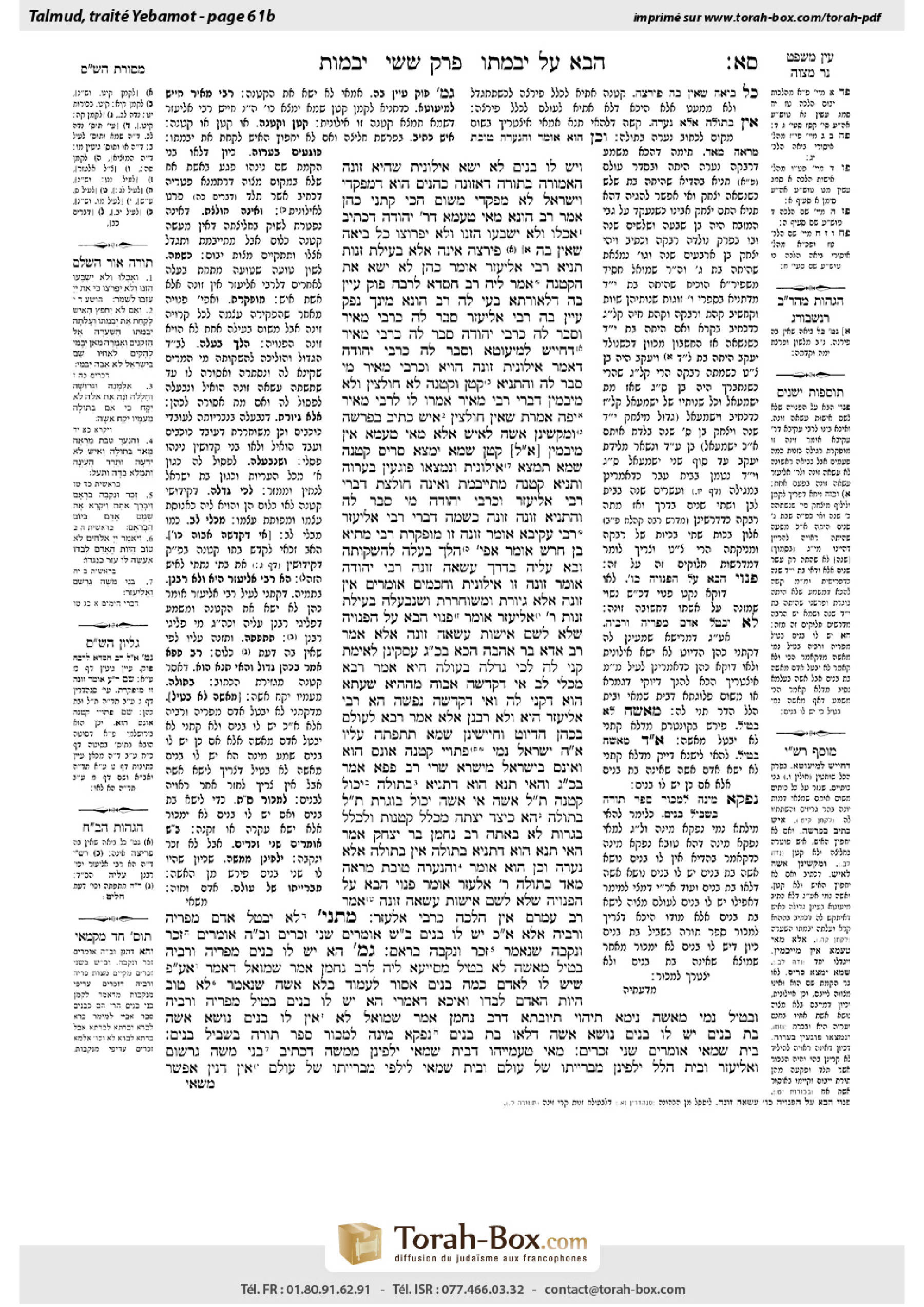
Yevamot 61b: Talmud study for Daf Yomi
Daf Yomi is the daily study of one Talmud folio. Explore 37 tractates with scans, Hebrew text, Sefaria English and AI-generated French translations where annotated.
Passage selection and English or AI-generated French translation are available where the scan has annotations. Daf Study is independent of Torah-Box and Sefaria.
Browse Yevamot · יבמות · All tractatesYevamot 61b text and translations
This page of Yevamot includes the Aramaic text, an English translation and an AI-generated French translation, alongside the scan above.
יבמות ס״א ב · Aramaic and Hebrew text
וְיֵשׁ לוֹ בָּנִים — לֹא יִשָּׂא אַיְלוֹנִית, שֶׁהִיא זוֹנָה הָאֲמוּרָה בַּתּוֹרָה. דְּאַזּוֹנָה כֹּהֲנִים הוּא דְּמִפַּקְדִי וְיִשְׂרָאֵל לָא מִפַּקְּדִי, מִשּׁוּם הָכִי קָתָנֵי כֹּהֵן.
אָמַר רַב הוּנָא: מַאי טַעְמָא דְּרַבִּי יְהוּדָה, דִּכְתִיב: ״אָכְלוּ וְלֹא יִשְׂבָּעוּ הִזְנוּ וְלֹא יִפְרֹצוּ״, כׇּל בִּיאָה שֶׁאֵין בָּהּ פִּירְצָה — אֵינָהּ אֶלָּא בְּעִילַת זְנוּת.
תַּנְיָא, רַבִּי אֱלִיעֶזֶר אוֹמֵר: כֹּהֵן לֹא יִשָּׂא אֶת הַקְּטַנָּה. אֲמַר לֵיהּ רַב חִסְדָּא לְרַבָּה: פּוֹק עַיֵּין בָּהּ, דִּלְאוּרְתָּא בָּעֵי לַהּ רַב הוּנָא מִינָּךְ. נְפַק עַיֵּין בָּהּ: רַבִּי אֱלִיעֶזֶר סָבַר לַהּ כְּרַבִּי מֵאִיר, וְסָבַר לַהּ כְּרַבִּי יְהוּדָה.
סָבַר לַהּ כְּרַבִּי מֵאִיר, דְּחָיֵישׁ לְמִיעוּטָא. וְסָבַר לַהּ כְּרַבִּי יְהוּדָה, דְּאָמַר: אַיְלוֹנִית זוֹנָה הָוְיָא.
וּכְרַבִּי מֵאִיר מִי סָבַר לַהּ? וְהָתַנְיָא: קָטָן וּקְטַנָּה לֹא חוֹלְצִין וְלֹא מְיַבְּמִין, דִּבְרֵי רַבִּי מֵאִיר. אָמְרוּ לוֹ לְרַבִּי מֵאִיר: יָפֶה אָמַרְתָּ שֶׁאֵין חוֹלְצִין. ״אִישׁ״ כְּתִיב בַּפָּרָשָׁה, וּמַקְּשִׁינַן אִשָּׁה לְאִישׁ. אֶלָּא מַאי טַעְמָא אֵין מְיַבְּמִין?
[אָמַר לָהֶם:] קָטָן — שֶׁמָּא יִמָּצֵא סָרִיס, קְטַנָּה — שֶׁמָּא תִּמָּצֵא אַיְלוֹנִית, וְנִמְצְאוּ פּוֹגְעִין בְּעֶרְוָה. וְתַנְיָא: קְטַנָּה מִתְיַיבֶּמֶת וְאֵינָהּ חוֹלֶצֶת, דִּבְרֵי רַבִּי אֱלִיעֶזֶר.
וּכְרַבִּי יְהוּדָה מִי סָבַר לַהּ? וְהָתַנְיָא: ״זוֹנָה״ — זוֹנָה כִּשְׁמָהּ, דִּבְרֵי רַבִּי אֱלִיעֶזֶר. רַבִּי עֲקִיבָא אוֹמֵר: ״זוֹנָה״ זוֹ מוּפְקֶרֶת. רַבִּי מַתְיָא בֶּן חָרָשׁ אוֹמֵר: אֲפִילּוּ הָלַךְ בַּעְלָהּ לְהַשְׁקוֹתָהּ, וּבָא עָלֶיהָ בַּדֶּרֶךְ — עֲשָׂאָהּ זוֹנָה.
רַבִּי יְהוּדָה אוֹמֵר: זוֹנָה — זוֹ אַיְלוֹנִית. וַחֲכָמִים אוֹמְרִים: אֵין זוֹנָה אֶלָּא גִּיּוֹרֶת וּמְשׁוּחְרֶרֶת וְשֶׁנִּבְעֲלָה בְּעִילַת זְנוּת. רַבִּי אֶלְעָזָר אוֹמֵר: פָּנוּי הַבָּא עַל הַפְּנוּיָה שֶׁלֹּא לְשֵׁם אִישׁוּת — עֲשָׂאָהּ זוֹנָה.
אֶלָּא אָמַר רַב אַדָּא בַּר אַהֲבָה: הָכָא בְּכֹהֵן גָּדוֹל עָסְקִינַן. לְאֵימַת קָנֵי לַה, לְכִי גָדְלָה [לְכִי גָדְלָה] — בְּעוּלָה הִיא.
אָמַר רָבָא: מְכַלֵּי לֵב, אִי דְּקַדְּשַׁהּ אֲבוּהּ — מֵהַהִיא שַׁעְתָּא הוּא דְּקָנֵי לַהּ. וְאִי דְּקַדִּשָׁה נַפְשַׁהּ — הָא רַבִּי אֱלִיעֶזֶר הִיא וְלָא רַבָּנַן?
אֶלָּא אָמַר רָבָא: לְעוֹלָם בְּכֹהֵן הֶדְיוֹט — וְחָיְישִׁינַן שֶׁמָּא תִּתְפַּתֶּה עָלָיו. אִי הָכִי יִשְׂרָאֵל נָמֵי! פִּתּוּיי קְטַנָּה אוֹנֶס הוּא, וְאוֹנֶס בְּיִשְׂרָאֵל מִישְׁרָא שְׁרֵי.
רַב פָּפָּא אָמַר: בְּכֹהֵן גָּדוֹל, וְהַאי תַּנָּא הוּא דְּתַנְיָא: ״בְּתוּלָה״, יָכוֹל קְטַנָּה — תַּלְמוּד לוֹמַר: ״אִשָּׁה״. אִי אִשָּׁה, יָכוֹל בּוֹגֶרֶת — תַּלְמוּד לוֹמַר: ״בְּתוּלָה״. הָא כֵּיצַד? יָצְתָה מִכְּלַל קַטְנוּת, וְלִכְלַל בַּגְרוּת לֹא בָּאתָה.
רַב נַחְמָן בַּר יִצְחָק אָמַר: הַאי תַּנָּא הוּא דְּתַנְיָא: ״בְּתוּלָה״, אֵין בְּתוּלָה אֶלָּא נַעֲרָה. וְכֵן הוּא אוֹמֵר: ״וְהַנַּעֲרָה טוֹבַת מַרְאֶה מְאֹד בְּתוּלָה״.
רַבִּי אֶלְעָזָר אוֹמֵר: פָּנוּי הַבָּא עַל הַפְּנוּיָה שֶׁלֹּא לְשֵׁם אִישׁוּת — עֲשָׂאָהּ זוֹנָה. אָמַר רַב עַמְרָם: אֵין הֲלָכָה כְּרַבִּי אֶלְעָזָר.
מַתְנִי׳ לֹא יִבָּטֵל אָדָם מִפְּרִיָּה וּרְבִיָּה אֶלָּא אִם כֵּן יֵשׁ לוֹ בָּנִים. בֵּית שַׁמַּאי אוֹמְרִים: שְׁנֵי זְכָרִים, וּבֵית הִלֵּל אוֹמְרִים: זָכָר וּנְקֵבָה, שֶׁנֶּאֱמַר: ״זָכָר וּנְקֵבָה בְּרָאָם״.
גְּמָ׳ הָא יֵשׁ לוֹ בָּנִים — מִפְּרִיָּה וּרְבִיָּה בָּטֵיל, מֵאִשָּׁה לָא בָּטֵיל. מְסַיְּיעָא לֵיהּ לְרַב נַחְמָן אָמַר שְׁמוּאֵל. דְּאָמַר: אַף עַל פִּי שֶׁיֵּשׁ לוֹ לְאָדָם כַּמָּה בָּנִים, אָסוּר לַעֲמוֹד בְּלֹא אִשָּׁה, שֶׁנֶּאֱמַר: ״לֹא טוֹב הֱיוֹת הָאָדָם לְבַדּוֹ״.
וְאִיכָּא דְּאָמְרִי: הָא יֵשׁ לוֹ בָּנִים — בָּטֵיל מִפְּרִיָּה וּרְבִיָּה, וּבָטֵיל נָמֵי מֵאִשָּׁה. נֵימָא תֶּיהְוֵי תְּיוּבְתָּא דְּרַב נַחְמָן אָמַר שְׁמוּאֵל! לָא: אֵין לוֹ בָּנִים — נוֹשֵׂא אִשָּׁה בַּת בָּנִים, יֵשׁ לוֹ בָּנִים — נוֹשֵׂא אִשָּׁה דְּלָאו בַּת בָּנִים. נָפְקָא מִינַּהּ לִמְכּוֹר סֵפֶר תּוֹרָה בִּשְׁבִיל בָּנִים.
בֵּית שַׁמַּאי אוֹמְרִים: שְׁנֵי זְכָרִים. מַאי טַעְמַיְיהוּ דְּבֵית שַׁמַּאי? יָלְפִינַן מִמֹּשֶׁה, דִּכְתִיב: ״בְּנֵי מֹשֶׁה גֵּרְשׁוֹם וֶאֱלִיעֶזֶר״. וּבֵית הִלֵּל: יָלְפִינַן מִבְּרִיָּיתוֹ שֶׁל עוֹלָם. וּבֵית שַׁמַּאי, לֵילְפֵי מִבְּרִיָּיתוֹ שֶׁל עוֹלָם? אֵין דָּנִין אֶפְשָׁר
Yevamot 61b · English translation
and he has children, he may not marry a sexually underdeveloped woman, as she is the zona about whom it is stated in the Torah that a priest may not marry her. It is priests who were commanded not to marry a zona, but Israelites were not commanded this. It is due to that reason that he taught the first clause of the mishna about a priest, even though that halakha applies equally to Israelites.
Rav Huna said: What is the reason for the opinion of Rabbi Yehuda? As it is written: “And they shall eat, and not have enough, they shall commit harlotry, and shall not increase” (Hosea 4:10). He expounds the verse as follows: Any intercourse that does not have the possibility to increase the population because the woman is incapable of having children, is nothing other than licentious sexual intercourse.
§ It is taught in a baraita that Rabbi Eliezer says: A priest may not marry a minor. Rav Ḥisda said to Rabba: Go and investigate this halakha, as in the evening Rav Huna will ask you the reason for Rabbi Eliezer’s ruling. He went and investigated it, and arrived at the following conclusion: Rabbi Eliezer holds in accordance with the opinion of Rabbi Meir, and he also holds in accordance with the opinion of Rabbi Yehuda.
Rabba explains: He holds in accordance with the opinion of Rabbi Meir, who says that one must be concerned for the minority. Rabbi Meir does not allow one to assume that an unknown case is similar to the majority of cases. Consequently, one must take into account the possibility that a minor will turn out to be sexually underdeveloped, although this will not be true of most individuals. And he also holds in accordance with the opinion of Rabbi Yehuda, who said that a sexually underdeveloped woman is a zona and therefore forbidden to a priest.
The Gemara challenges Rabba’s explanation: And does Rabbi Eliezer hold in accordance with the opinion of Rabbi Meir? Isn’t it taught in a baraita: A boy minor and a girl minor may not perform ḥalitza or levirate marriage; this is the statement of Rabbi Meir. The Rabbis said to Rabbi Meir: You spoke well when you said that they may not perform ḥalitza, as the term “man” is written in the passage of ḥalitza (Deuteronomy 25:7–10), which limits the halakha to an adult male, and we compare a woman to a man and therefore limit ḥalitza to an adult woman. However, what is the reason that they may not perform levirate marriage?
Rabbi Meir said to them: A boy minor may not perform levirate marriage lest he be found to be a eunuch, i.e., one who is incapable of fathering children for his late brother. Similarly, a girl minor may not perform levirate marriage lest she be found to be sexually underdeveloped when she grows up. In either case, the mitzva of levirate marriage does not apply, and they turn out to have encountered a forbidden relative. And it was taught in a different baraita: A girl minor enters into levirate marriage but does not perform ḥalitza; this is the statement of Rabbi Eliezer. This proves that Rabbi Eliezer disagrees with Rabbi Meir and is not concerned that a girl may turn out to be sexually underdeveloped.
The Gemara continues to challenge Rabba’s explanation of Rabbi Eliezer’s ruling. And does Rabbi Eliezer hold in accordance with the opinion of Rabbi Yehuda? Wasn’t it is taught in a baraita: The zona forbidden to a priest is as the name zona implies, i.e., a married woman who committed adultery; this is the statement of Rabbi Eliezer. Rabbi Akiva says: A zona is a woman, even an unmarried woman, who is available to all, i.e., she has intercourse with whoever is interested. Rabbi Matya ben Ḥarash says: Even if her husband went to make her drink the bitter waters after she disregarded his warning not to seclude herself with a certain man, and he had intercourse with her on the way, he has thereby caused her to become a zona because she was forbidden to him at the time, despite the fact that she is his wife.
Rabbi Yehuda says: A zona is a sexually underdeveloped woman. And the Rabbis say: The term zona applies only to a female convert, a freed maidservant, and one who engaged in licentious sexual intercourse. Rabbi Elazar says: Even in the case of an unmarried man who had intercourse with an unmarried woman not for the purpose of marriage, he has thereby caused her to become a zona. This baraita proves that Rabbi Eliezer does not agree with Rabbi Yehuda.
Rather, Rav Adda bar Ahava said that Rabbi Eliezer’s ruling that a priest may not marry a minor must be explained differently: Here we are dealing with a High Priest, and the problem is as follows: When can he acquire her as his wife? Only when she is grown up. However, if they had started living together as husband and wife when she was a minor, then when she is grown up and the marriage can legally take effect, she is already a non-virgin, and a High Priest is commanded to marry a virgin.
Rava said: This explanation is without reason. If her father betrothed her to her husband, her husband acquired her from that time, as betrothal that a father carries out on his daughter’s behalf when she is a minor is effective by Torah law. And if the minor betrothed herself, is this Rabbi Eliezer’s opinion and not that of the Rabbis? The Rabbis would certainly agree that a High Priest may not marry a minor under these circumstances.
Rather, Rava said: Actually, Rabbi Eliezer’s ruling includes a common priest, and the reason he cannot marry a minor is that we are concerned lest she be seduced by another man, due to her tender age and naïveté, while married to him. The Gemara asks: If so, the same concern should apply to an Israelite also. The Gemara answers: The seduction of a minor is considered rape, and a rape victim remains permitted to her husband in a case where she is married to an Israelite, but not if she is married to a priest.
Rav Pappa said: Rabbi Eliezer’s ruling applies specifically to a High Priest, and it is the opinion of this tanna, as it is taught in a baraita that when the verse states: “A virgin of his own people shall he take for a wife [isha]” (Leviticus 21:14), one might have thought a High Priest may marry a minor; the verse therefore states that he must marry a woman [isha], i.e., an adult. If he must marry a woman, one might have thought it means a grown woman. The verse therefore states that he must marry a virgin, which excludes a grown woman, who is considered only a partial virgin because her hymen is not fully intact. How so? He must marry a woman who has left the class of minority but who has not yet reached the class of grown womanhood, i.e., he must marry a maiden.
Rav Naḥman bar Yitzḥak said: It is the opinion of this tanna, as it is taught in a baraita: The High Priest must marry a virgin, and the term virgin refers only to a maiden. And a verse similarly states: “And the maiden was very fair to look upon, a virgin, and no man had known her” (Genesis 24:16).
The baraita cited above mentioned that Rabbi Elazar says: In the case of an unmarried man who had intercourse with an unmarried woman not for the purpose of marriage, he has caused her to become a zona. Rav Amram said: The halakha is not in accordance with the opinion of Rabbi Elazar.
MISHNA: A man may not neglect the mitzva to be fruitful and multiply unless he already has children. Beit Shammai say: One fulfills this mitzva with two males, and Beit Hillel say: A male and a female, as it is stated: “Male and female He created them” (Genesis 5:2).
GEMARA: The Gemara infers from the mishna’s wording that if he already has children he may neglect the mitzva to be fruitful and multiply, but he may not neglect the mitzva to have a wife. This supports what Rav Naḥman said in the name of Shmuel, who said: Even if a man has several children, it is prohibited to remain without a wife, as it is stated: “It is not good that the man should be alone” (Genesis 2:18).
And some say a different version of the inference from the mishna: If he already has children, he may neglect the mitzva to be fruitful and multiply and he may also neglect the mitzva to have a wife. Shall we say this is a conclusive refutation of what Rav Naḥman said that Shmuel said? The Gemara responds: No, it means that if he does not have children he must marry a woman capable of bearing children, whereas if he has children he may marry a woman who is not capable of bearing children. A practical difference between a man who has children and one who does not is whether he is permitted to sell a Torah scroll in order to marry a woman capable of having children. This is permitted only for one who does not yet have children.
§ The mishna states that Beit Shammai say that one fulfills the mitzva to be fruitful and multiply when he has two males. The Gemara asks: What is the reason of Beit Shammai? The Gemara answers: We learn this from Moses as it is written: “The sons of Moses, Gershom and Eliezer” (I Chronicles 23:15). Since Moses did not have any other children, two sons must be sufficient to fulfill the mitzva. And the reason of Beit Hillel is that we learn from the creation of the world, as mankind was created male and female. The Gemara asks: And Beit Shammai, let them learn from the creation of the world as well. The Gemara answers that Beit Shammai could say to you: We do not derive a case where it is possible
Yevamot 61b · Traduction française (IA)
et s'il a des enfants, il ne peut pas épouser une femme sexuellement sous-développée, car elle est la zona dont il est dit dans la Torah écrite qu'un prêtre ne peut pas l'épouser. Ce sont les prêtres qui ont reçu la mitsva de ne pas épouser une zona, mais les Israélites n'ont pas reçu cette mitsva. C'est pour cette raison qu'il a enseigné la première clause de la Michna à propos d'un prêtre, bien que cette halakha s'applique également aux Israélites.
Rav Huna a dit : Quelle est la raison de l'opinion de Rabbi Yehuda ? Comme il est écrit : « Ils mangeront, mais ne seront pas rassasiés ; ils commettront la prostitution, mais ne s'augmenteront pas » (Osée 4:10). Il interprète le verset comme suit : Tout rapport sexuel qui n'a pas la possibilité d'augmenter la population parce que la femme est incapable d'avoir des enfants, n'est rien d'autre qu'un rapport sexuel licencieux.
§ Il est enseigné dans une baraïta que Rabbi Eliezer dit : Un prêtre ne peut pas épouser une mineure. Rav Ḥisda a dit à Rabba : Va et enquête sur cette halakha, car le soir Rav Huna te demandera la raison du jugement de Rabbi Eliezer. Il est allé et a enquêté, et est arrivé à la conclusion suivante : Rabbi Eliezer est d'accord avec l'opinion de Rabbi Meir, et il est également d'accord avec l'opinion de Rabbi Yehuda.
Rabba explique : Il est d'accord avec l'opinion de Rabbi Meir, qui enseigne qu'il faut se préoccuper de la minorité. Rabbi Meir ne permet pas de supposer qu'un cas inconnu est similaire à la majorité des cas. Par conséquent, il faut prendre en compte la possibilité qu'une mineure s'avère sexuellement sous-développée, bien que ce ne soit pas le cas de la plupart des individus. Et il est également d'accord avec l'opinion de Rabbi Yehuda, qui a dit qu'une femme sexuellement sous-développée est une zona et est donc interdite à un prêtre.
La Guemara conteste l'explication de Rabba : Rabbi Eliezer est-il d'accord avec l'opinion de Rabbi Meir ? N'est-il pas enseigné dans une baraïta : Un garçon mineur et une fille mineure ne peuvent pas effectuer la ḥalitza ou le mariage lévirat ; c'est l'énoncé de Rabbi Meir. Les Sages ont dit à Rabbi Meir : Tu as bien parlé quand tu as dit qu'ils ne peuvent pas effectuer la ḥalitza, car le terme « homme » est écrit dans le passage de la ḥalitza (Deutéronome 25:7–10), ce qui limite la halakha à un homme adulte, et nous comparons une femme à un homme et limitons donc la ḥalitza à une femme adulte. Cependant, quelle est la raison pour laquelle ils ne peuvent pas effectuer le mariage lévirat ?
Rabbi Meir leur a dit : Un garçon mineur ne peut pas effectuer le mariage lévirat de peur qu'il ne s'avère être un eunuque, c'est-à-dire quelqu'un qui est incapable de procréer pour son frère défunt. De même, une fille mineure ne peut pas effectuer le mariage lévirat de peur qu'elle ne s'avère sexuellement sous-développée lorsqu'elle grandira. Dans les deux cas, la mitsva du mariage lévirat ne s'applique pas, et ils s'avèrent avoir rencontré un parent interdit. Et il a été enseigné dans une autre baraïta : Une fille mineure entre dans le mariage lévirat mais ne peut pas effectuer la ḥalitza ; c'est l'énoncé de Rabbi Eliezer. Cela prouve que Rabbi Eliezer est en désaccord avec Rabbi Meir et ne se préoccupe pas qu'une fille puisse s'avérer sexuellement sous-développée.
La Guemara continue de contester l'explication de Rabba concernant le décret de Rabbi Eliezer. Rabbi Eliezer est-il d'accord avec l'opinion de Rabbi Yehuda ? N'est-il pas enseigné dans une baraïta : La zona interdite à un prêtre est, comme l'indique le terme zona, une femme mariée qui a commis l'adultère ; c'est l'avis de Rabbi Eliezer. Rabbi Akiva dit : Une zona est une femme, même une femme non mariée, qui est accessible à tous, c'est-à-dire qu'elle a des rapports sexuels avec quiconque le souhaite. Rabbi Matya ben Ḥarash dit : Même si son mari est allé lui faire boire les eaux amères après qu'elle a ignoré son avertissement de ne pas se mettre en retrait avec un certain homme, et qu'il a eu des rapports sexuels avec elle en chemin, il l'a ainsi rendue zona, car elle lui était interdite à ce moment-là, bien qu'elle soit son épouse.
Rabbi Yehuda dit : Une zona est une femme sexuellement sous-développée. Et les Sages disent : Le terme zona ne s'applique qu'à une convertie, à une servante affranchie, et à celle qui a eu des rapports sexuels licencieux. Rabbi Elazar dit : Même dans le cas d'un homme non marié qui a eu des rapports sexuels avec une femme non mariée non dans le but du mariage, il l'a ainsi rendue zona. Cette baraïta prouve que Rabbi Eliezer n'est pas d'accord avec Rabbi Yehuda.
Plutôt, Rav Adda bar Ahava a dit que le décret de Rabbi Eliezer selon lequel un prêtre ne peut pas épouser une mineure doit être expliqué différemment : Ici, nous avons affaire à un Grand Prêtre, et le problème est le suivant : Quand peut-il l'acquérir comme son épouse ? Seulement lorsqu'elle est adulte. Cependant, s'ils ont commencé à vivre ensemble comme mari et femme lorsqu'elle était mineure, alors lorsqu'elle est adulte et que le mariage peut légalement prendre effet, elle est déjà une non-vierge, et un Grand Prêtre est commandé d'épouser une vierge.
Rava a dit : Cette explication est sans fondement. Si son père l'a fiancée à son mari, son mari l'a acquise à partir de ce moment, car les fiançailles qu'un père effectue au nom de sa fille lorsqu'elle est mineure sont valides par la loi de la Torah écrite. Et si la mineure s'est fiancée elle-même, est-ce l'opinion de Rabbi Eliezer et non celle des Sages ? Les Sages seraient certainement d'accord pour dire qu'un Grand Prêtre ne peut pas épouser une mineure dans ces circonstances.
Plutôt, Rava a dit : En réalité, le jugement de Rabbi Eliezer inclut un prêtre commun, et la raison pour laquelle il ne peut pas épouser une mineure est que nous craignons qu'elle ne soit séduite par un autre homme, en raison de son jeune âge et de sa naïveté, alors qu'elle est mariée à lui. La Guemara demande : Si c'est le cas, la même préoccupation devrait s'appliquer à un Israélite aussi. La Guemara répond : La séduction d'une mineure est considérée comme un viol, et une victime de viol reste permise à son mari dans le cas où elle est mariée à un Israélite, mais pas si elle est mariée à un prêtre.
Rav Pappa a dit : Le décret de Rabbi Eliezer s'applique spécifiquement au Grand Prêtre, et c'est l'opinion de ce tanna, comme il est enseigné dans une baraïta : lorsque le verset dit : « Il prendra pour femme [isha] une vierge de sa propre nation » (Lévitique 21:14), on aurait pu penser qu'un Grand Prêtre peut épouser une mineure ; le verset indique donc qu'il doit épouser une femme [isha], c'est-à-dire une adulte. S'il doit épouser une femme, on aurait pu penser que cela signifie une femme mûre. Le verset indique donc qu'il doit épouser une vierge, ce qui exclut une femme mûre, qui est considérée comme une vierge partielle seulement, car son hymen n'est pas entièrement intact. Comment cela ? Il doit épouser une femme qui a quitté la classe de la minorité mais qui n'a pas encore atteint la classe de la maturité, c'est-à-dire qu'il doit épouser une jeune fille.
Rav Naḥman bar Yitzḥak a dit : C'est l'opinion de ce tanna, comme il est enseigné dans une baraïta : Le Grand Prêtre doit épouser une vierge, et le terme vierge ne désigne qu'une jeune fille. Et un verset dit de même : « Et la jeune fille était très belle à voir, vierge, et aucun homme ne l'avait connue » (Genèse 24:16).
La baraïta citée ci-dessus mentionne que Rabbi Elazar dit : Dans le cas d'un homme célibataire qui a eu des rapports sexuels avec une femme célibataire non dans le but du mariage, il l'a rendue zona. Rav Amram a dit : La halakha ne suit pas l'opinion de Rabbi Elazar.
MICHNA : Un homme ne peut négliger la mitsva de se multiplier et de croître s'il n'a pas déjà d'enfants. Beit Chammaï disent : On accomplit cette mitsva avec deux fils mâles, et Beit Hillel disent : Un fils mâle et une fille, comme il est écrit : « Mâle et femelle Il les créa » (Genèse 5:2).
GUEMARA : La Guemara déduit du libellé de la Michna que s'il a déjà des enfants, il peut négliger la mitsva de se multiplier et de croître, mais il ne peut pas négliger la mitsva d'avoir une épouse. Cela soutient ce que Rav Naḥman a dit au nom de Shmuel, qui a dit : Même si un homme a plusieurs enfants, il est interdit de rester sans épouse, comme il est écrit : « Il n'est pas bon que l'homme soit seul » (Genèse 2:18).
Et certains avancent une autre version de la déduction tirée de la Michna : S'il a déjà des enfants, il peut négliger la mitsva de se multiplier et de croître, et il peut également négliger la mitsva d'avoir une épouse. Devons-nous dire que c'est une réfutation définitive de ce que Rav Naḥman a rapporté au nom de Shmuel ? La Guemara répond : Non, cela signifie que s'il n'a pas d'enfants, il doit épouser une femme capable de procréer, alors que s'il a des enfants, il peut épouser une femme qui n'est pas capable de procréer. Une différence pratique entre un homme qui a des enfants et un qui n'en a pas réside dans la permission de vendre un rouleau de la Torah afin d'épouser une femme capable d'avoir des enfants. Cela n'est permis que pour celui qui n'a pas encore d'enfants.
§ La Michna indique que Beit Chammaï disent qu'on accomplit la mitsva de se multiplier et de croître lorsqu'on a deux fils mâles. La Guemara demande : Quelle est la raison de Beit Chammaï ? La Guemara répond : Nous en apprenons de Moïse, comme il est écrit : « Les fils de Moïse, Gershom et Eliezer » (I Chroniques 23:15). Puisque Moïse n'avait pas d'autres enfants, deux fils doivent être suffisants pour accomplir la mitsva. Et la raison de Beit Hillel est que nous en apprenons de la création du monde, puisque l'humanité a été créée mâle et femelle. La Guemara demande : Et Beit Chammaï, qu'ils en apprennent aussi de la création du monde. La Guemara répond que Beit Chammaï pourraient vous dire : Nous ne dérivons pas un cas où c'est possible
Traduction française générée par IA à partir de l’édition anglaise de Sefaria. Vérifie toujours un passage avec le texte source.
Text from Sefaria: William Davidson Edition - Vocalized Aramaic (CC BY NC); William Davidson Edition - English (CC BY NC).