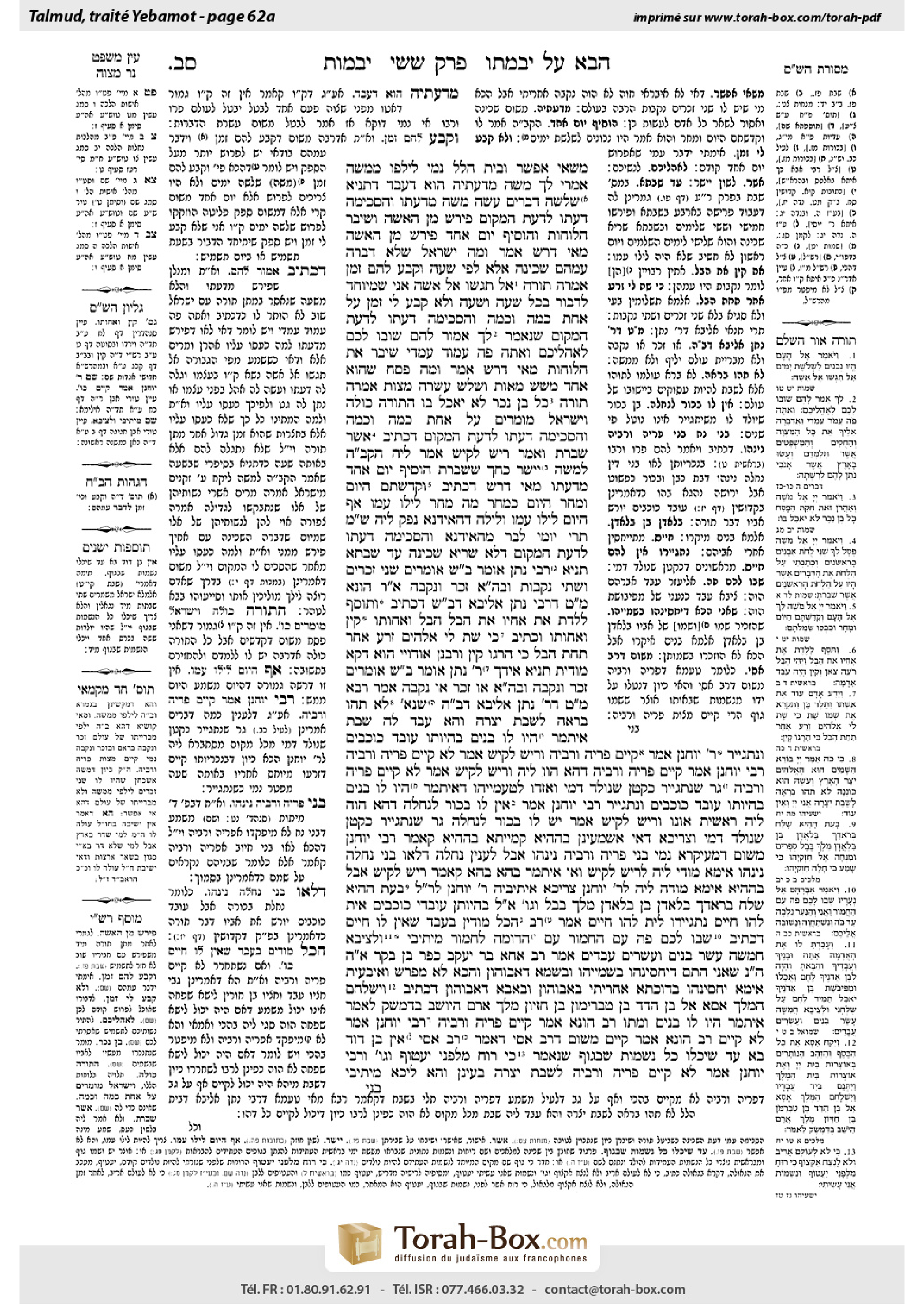
Yevamot 62a: Talmud study for Daf Yomi
Daf Yomi is the daily study of one Talmud folio. Explore 37 tractates with scans, Hebrew text, Sefaria English and AI-generated French translations where annotated.
Passage selection and English or AI-generated French translation are available where the scan has annotations. Daf Study is independent of Torah-Box and Sefaria.
Browse Yevamot · יבמות · All tractatesYevamot 62a text and translations
This page of Yevamot includes the Aramaic text, an English translation and an AI-generated French translation, alongside the scan above.
יבמות ס״ב א · Aramaic and Hebrew text
מִשֶּׁאִי אֶפְשָׁר. וּבֵית הִלֵּל נָמֵי, לֵילְפוּ מִמֹּשֶׁה! אָמְרִי לָךְ: מֹשֶׁה מִדַּעְתֵּיהּ הוּא דַּעֲבַד. דְּתַנְיָא: שְׁלֹשָׁה דְּבָרִים עָשָׂה מֹשֶׁה מִדַּעְתּוֹ, וְהִסְכִּימָה דַּעְתּוֹ לְדַעַת הַמָּקוֹם: פֵּירַשׁ מִן הָאִשָּׁה, וְשִׁיבֵּר הַלּוּחוֹת, וְהוֹסִיף יוֹם אֶחָד.
פֵּירַשׁ מִן הָאִשָּׁה, מַאי דְּרַשׁ? אֲמַר: וּמָה יִשְׂרָאֵל, שֶׁלֹּא דִּבְּרָה עִמָּהֶם שְׁכִינָה אֶלָּא לְפִי שָׁעָה, וְקָבַע לָהֶם זְמַן, אָמְרָה תּוֹרָה: ״אַל תִּגְּשׁוּ אֶל אִשָּׁה״ — אֲנִי, שֶׁמְּיוּחָד לְדִבּוּר בְּכׇל שָׁעָה וְשָׁעָה, וְלֹא קָבַע לִי זְמַן — עַל אַחַת כַּמָּה וְכַמָּה. וְהִסְכִּימָה דַּעְתּוֹ לְדַעַת הַמָּקוֹם, שֶׁנֶּאֱמַר: ״לֵךְ אֱמוֹר לָהֶם שׁוּבוּ לָכֶם לְאׇהֳלֵיכֶם. וְאַתָּה פֹּה עֲמוֹד עִמָּדִי״.
שִׁיבֵּר אֶת הַלּוּחוֹת, מַאי דְּרַשׁ? אָמַר: וּמָה פֶּסַח, שֶׁהוּא אֶחָד מִשֵּׁשׁ מֵאוֹת וּשְׁלֹשׁ עֶשְׂרֵה מִצְוֹת, אָמְרָה תּוֹרָה ״כׇּל בֶּן נֵכָר לֹא יֹאכַל בּוֹ״. הַתּוֹרָה כּוּלָּהּ, וְיִשְׂרָאֵל מְשׁוּמָּדִים — עַל אַחַת כַּמָּה וְכַמָּה.
וְהִסְכִּימָה דַּעְתּוֹ לְדַעַת הַמָּקוֹם, דִּכְתִיב: ״אֲשֶׁר שִׁבַּרְתָּ״, וְאָמַר רֵישׁ לָקִישׁ: אָמַר לוֹ הַקָּדוֹשׁ בָּרוּךְ הוּא לְמֹשֶׁה: יִישַׁר כֹּחֲךָ שֶׁשִּׁבַּרְתָּ.
הוֹסִיף יוֹם אֶחָד מִדַּעְתּוֹ, מַאי דְּרַשׁ? דִּכְתִיב: ״וְקִדַּשְׁתָּם הַיּוֹם וּמָחָר״. הַיּוֹם כְּמָחָר: מָה מָחָר לֵילוֹ עִמּוֹ, אַף הַיּוֹם לֵילוֹ עִמּוֹ. וְלַיְלָה דְּהָאִידָּנָא נְפַק לֵיהּ, שְׁמַע מִינַּהּ תְּרֵי יוֹמֵי לְבַר מֵהָאִידָּנָא. וְהִסְכִּימָה דַּעְתּוֹ לְדַעַת הַמָּקוֹם — דְּלָא שָׁרְיָא שְׁכִינָה עַד שַׁבְּתָא.
תַּנְיָא, רַבִּי נָתָן אוֹמֵר: בֵּית שַׁמַּאי אוֹמְרִים: שְׁנֵי זְכָרִים וּשְׁתֵּי נְקֵבוֹת, וּבֵית הִלֵּל אוֹמְרִים: זָכָר וּנְקֵבָה.
אָמַר רַב הוּנָא: מַאי טַעְמָא דְּרַבִּי נָתָן אַלִּיבָּא דְּבֵית שַׁמַּאי? דִּכְתִיב: ״וַתּוֹסֶף לָלֶדֶת אֶת אָחִיו אֶת הָבֶל״: הֶבֶל וַאֲחוֹתוֹ, קַיִן וַאֲחוֹתוֹ, וּכְתִיב: ״כִּי שָׁת לִי אֱלֹהִים זֶרַע אַחֵר תַּחַת הֶבֶל כִּי הֲרָגוֹ קָיִן״. וְרַבָּנַן? אוֹדוֹיֵי הוּא דְּקָא מוֹדְיָא.
תַּנְיָא אִידַּךְ, רַבִּי נָתָן אוֹמֵר: בֵּית שַׁמַּאי אוֹמְרִים: זָכָר וּנְקֵבָה, וּבֵית הִלֵּל אוֹמְרִים: אוֹ זָכָר אוֹ נְקֵבָה. אָמַר רָבָא: מַאי טַעְמָא דְּרַבִּי נָתָן אַלִּיבָּא דְּבֵית הִלֵּל, שֶׁנֶּאֱמַר: ״לֹא תֹהוּ בְרָאָהּ לָשֶׁבֶת יְצָרָהּ״, וְהָא עֲבַד לַהּ שֶׁבֶת.
אִיתְּמַר: הָיוּ לוֹ בָּנִים בְּגַיּוּתוֹ וְנִתְגַּיֵּיר, רַבִּי יוֹחָנָן אָמַר: קִיֵּים פְּרִיָּה וּרְבִיָּה. וְרֵישׁ לָקִישׁ אָמַר: לֹא קִיֵּים פְּרִיָּה וּרְבִיָּה. רַבִּי יוֹחָנָן אָמַר: קִיֵּים פְּרִיָּה וּרְבִיָּה — דְּהָא הֲווֹ לֵיהּ. וְרֵישׁ לָקִישׁ אָמַר: לֹא קִיֵּים פְּרִיָּה וּרְבִיָּה — גֵּר שֶׁנִּתְגַּיֵּיר כְּקָטָן שֶׁנּוֹלַד דָּמֵי.
וְאָזְדוּ לְטַעְמַיְיהוּ, דְּאִיתְּמַר: הָיוּ לוֹ בָּנִים בְּגַיּוּתוֹ וְנִתְגַּיֵּיר, רַבִּי יוֹחָנָן אָמַר: אֵין לוֹ בְּכוֹר לְנַחֲלָה, דְּהָא הֲוָה לֵיהּ ״רֵאשִׁית אוֹנוֹ״. וְרֵישׁ לָקִישׁ אָמַר: יֵשׁ לוֹ בְּכוֹר לְנַחֲלָה, גֵּר שֶׁנִּתְגַּיֵּיר כְּקָטָן שֶׁנּוֹלַד דָּמֵי.
וּצְרִיכָא: דְּאִי אַשְׁמְעִינַן בְּהָהִיא קַמַּיְיתָא, בְּהַהִיא קָאָמַר רַבִּי יוֹחָנָן — מִשּׁוּם דְּמֵעִיקָּרָא נָמֵי בְּנֵי פְּרִיָּה וּרְבִיָּה נִינְהוּ, אֲבָל לְעִנְיַן נַחֲלָה, דְּלָאו בְּנֵי נַחֲלָה נִינְהוּ — אֵימָא מוֹדֵי לֵיהּ לְרֵישׁ לָקִישׁ.
וְאִי אִיתְּמַר בְּהָא — בְּהָא קָאָמַר רֵישׁ לָקִישׁ, אֲבָל בְּהַהִיא — אֵימָא מוֹדֶה לֵיהּ לְרַבִּי יוֹחָנָן, צְרִיכָא.
אֵיתִיבֵיהּ רַבִּי יוֹחָנָן לְרֵישׁ לָקִישׁ: ״בָּעֵת הַהִיא שָׁלַח בְּרֹאדַךְ בַּלְאֲדָן בֶּן בַּלְאֲדָן מֶלֶךְ בָּבֶל וְגוֹ׳״! אֲמַר לֵיהּ בְּגַיּוּתָן — אִית לְהוּ חַיִיס, נִתְגַּיְּירוּ — לֵית לְהוּ חַיִיס.
אָמַר רַב: הַכֹּל מוֹדִין בְּעֶבֶד שֶׁאֵין לוֹ חַיִיס, דִּכְתִיב: ״שְׁבוּ לָכֶם פֹּה עִם הַחֲמוֹר״: עַם הַדּוֹמֶה לַחֲמוֹר. מֵיתִיבִי: ״וּלְצִיבָא חֲמִשָּׁה עָשָׂר בָּנִים וְעֶשְׂרִים עֲבָדִים״! אָמַר רַב אַחָא בַּר יַעֲקֹב: כְּ״פַר בֶּן בָּקָר״.
אִי הָכִי, הָכָא נָמֵי! שָׁאנֵי הָתָם, דְּיַחֲסִינְהוּ בִּשְׁמַיְיהוּ וּבִשְׁמָא דַאֲבוּהוֹן, וְהָכָא לָא מְפָרֵשׁ. וְאִיבָּעֵית אֵימָא: יַחֲסִינְהוּ בְּדוּכְתָּא אַחֲרִיתִי בַּאֲבוּהוֹן וּבְאַבָּא דַאֲבוּהוֹן, דִּכְתִיב: ״וַיִּשְׁלָחֵם הַמֶּלֶךְ אָסָא אֶל בֶּן הֲדַד בֶּן טַבְרִימּוֹן בֶּן חֶזְיוֹן מֶלֶךְ אֲרָם הַיּוֹשֵׁב בְּדַמֶּשֶׂק לֵאמֹר״.
אִיתְּמַר: הָיוּ לוֹ בָּנִים וּמֵתוּ, רַב הוּנָא אָמַר: קִיֵּים פְּרִיָּה וּרְבִיָּה. רַבִּי יוֹחָנָן אָמַר: לֹא קִיֵּים.
רַב הוּנָא אָמַר: קִיֵּים — מִשּׁוּם דְּרַב אַסִּי. דְּאָמַר רַב אַסִּי: אֵין בֶּן דָּוִד בָּא עַד שֶׁיִּכְלוּ כׇּל נְשָׁמוֹת שֶׁבַּגּוּף, שֶׁנֶּאֱמַר: ״כִּי רוּחַ מִלְּפָנַי יַעֲטוֹף וְגוֹ׳״, וְרַבִּי יוֹחָנָן אָמַר: לֹא קִיֵּים פְּרִיָּה וּרְבִיָּה — ״לָשֶׁבֶת יְצָרָהּ״ בָּעֵינַן, וְהָא לֵיכָּא.
מֵיתִיבִי:
Yevamot 62a · English translation
from one that is not possible. Mankind was initially created with a male and female because otherwise reproduction would not have been possible. However, this fact cannot serve as a source that the mitzva to be fruitful and multiply is fulfilled only once one has a son and a daughter. The Gemara asks: And Beit Hillel, let them also learn from Moses. Beit Hillel could say to you: Moses acted based on his own perception when he separated from his wife, but this does not mean that a man is permitted to neglect the mitzva to be fruitful and multiply after fathering two males, as it is taught in a baraita: Moses did three things based on his own perception, and his perception agreed with the perception of the Omnipresent: He separated from his wife, he broke the tablets, and he added one day to the days of separation before the revelation at Sinai.
The Gemara clarifies: When Moses separated from his wife after the revelation at Sinai, what did he interpret that led him to do so? He said: If in the case of Israel, with whom the Divine Presence spoke only temporarily and for whom God set a specific time for revelation, the Torah stated: “Do not approach a woman” (Exodus 19:15), I, Moses, who am set aside for divine speech all the time and for whom God did not set a specific time, all the more so I must separate from my wife. And his perception agreed with the perception of the Omnipresent, as it is stated after the revelation at Sinai: “Go say to them: Return to your tents; and you, stand here with Me” (Deuteronomy 5:26–27). This indicates that whereas others could return to their homes and normal married life after the revelation at Sinai, Moses was to stay with God and not return to his wife.
Moses broke the tablets following the sin of the Golden Calf. What did he interpret that led him to do so? Moses said: If in the case of the Paschal lamb, which is only one of 613 mitzvot, the Torah states: “No alien shall eat of it” (Exodus 12:43), excluding not only gentiles but apostate Jews as well, then here, in the case of the Golden Calf, where the tablets represent the entire Torah and where the Jewish people are apostates, as they are worshipping the calf, all the more so must they be excluded from receiving them.
And his perception agreed with the perception of the Omnipresent, as it is written: “The first tablets that you broke [asher shibbarta]” (Exodus 34:1), and Reish Lakish said: The word asher is an allusion to the fact that the Holy One, Blessed be He, said to Moses: May your strength be true [yishar koḥakha] that you broke the tablets.
When Moses added one day to the days of separation before the revelation at Sinai based on his own perception, what did he interpret that led him to do so? He reasoned that since it is written: “And sanctify them today and tomorrow” (Exodus 19:10), the juxtaposition of the words “today” and “tomorrow” teaches that today is like tomorrow: Just as tomorrow the men and women will separate for that day and the night preceding it, so too, today requires separation for the day and the night preceding it. Since God spoke to him in the morning, and the night of that day already passed, Moses said: Conclude from this that separation must be in effect for two days aside from now, i.e., not including the day of the command. Therefore, he extended the mitzva of separation by one day. And his perception agreed with the perception of the Omnipresent, as the Divine Presence did not rest upon Mount Sinai until Shabbat morning, as Moses had determined.
§ It is taught in a baraita that Rabbi Natan says that Beit Shammai say: The mitzva to be fruitful and multiply is fulfilled with two males and two females. And Beit Hillel say: A male and a female.
Rav Huna said: What is the reason of Rabbi Natan, in accordance with the opinion of Beit Shammai? It is as it is written: “And again she bore his brother [et aḥiv] Abel [et Hevel]” (Genesis 4:2). The use of the superfluous word “et” indicates that she gave birth to Abel and his sister, in addition to Cain and his sister. And it states: “For God has appointed me another seed instead of Abel; for Cain slew him” (Genesis 4:25). This indicates that one must have at least four children. And the Rabbis, how do they understand this verse? In their opinion, Eve was thanking God for granting her another child, but one is not obligated to have four children.
It is taught in another baraita that Rabbi Natan says that Beit Shammai say: The mitzva to be fruitful and multiply is fulfilled with a male and a female. And Beit Hillel say: Either a male or a female. Rava said: What is the reason of Rabbi Natan in accordance with the opinion of Beit Hillel? It is as it is stated: “He did not create it a waste; He formed it to be inhabited” (Isaiah 45:18), and one has made the earth inhabited to a greater degree by adding even one child to the world.
§ It was stated that amora’im disagreed over the following issue: If a man had children when he was a gentile and he subsequently converted, Rabbi Yoḥanan said: He has already fulfilled the mitzva to be fruitful and multiply, and Reish Lakish said: He has not fulfilled the mitzva to be fruitful and multiply. Rabbi Yoḥanan said he has fulfilled the mitzva to be fruitful and multiply, as he already had children. And Reish Lakish said he has not fulfilled the mitzva to be fruitful and multiply, as the legal status of a convert who just converted is like that of a child just born, and it is considered as though he did not have children.
The Gemara comments: And they follow their regular line of reasoning, as it was stated: If one had children when he was a gentile and he subsequently converted, Rabbi Yoḥanan said: He does not have a firstborn with regard to inheritance, i.e., the first son born to him after his conversion does not inherit a double portion, as this man already had “the first of his strength” (Deuteronomy 21:17), the Torah’s description of the firstborn in this context, before he converted. And Reish Lakish said: He does have a firstborn with regard to inheritance, as the legal status of a convert who just converted is like that of a child just born.
The Gemara adds: And it is necessary to state their opinions in both cases. As, had it only been taught to us with regard to that first case of the mitzva to be fruitful and multiply, one might have said that it is only in that case that Rabbi Yoḥanan said his opinion, because from the outset, gentiles are also subject to the mitzva to be fruitful and multiply. However, with regard to inheritance, since they are not subject to the halakhot of inheritance, one might say that Rabbi Yoḥanan concedes to Reish Lakish.
And conversely, if their dispute was stated only with regard to this issue of inheritance, I would have said that it is only in this case that Reish Lakish said his opinion, as the halakhot of inheritance do not apply to gentiles. But with regard to that case, the mitzva to be fruitful and multiply, one might say that he concedes to Rabbi Yoḥanan. Consequently, it is necessary for both disputes to be recorded.
Rabbi Yoḥanan raises an objection to Reish Lakish based upon the verse: “At that time Berodach-baladan, son of Baladan, king of Babylon, sent a letter” (II Kings 20:12), which indicates that gentiles are considered to be the children of their parents. Therefore, when they convert, they should already have fulfilled the mitzva to be fruitful and multiply. Reish Lakish said to Rabbi Yoḥanan: When they are gentiles they do have family lineage, but when they convert they do not have lineage, as they now belong to the family of the Jewish people and their previous lineage is disregarded.
Rav said: Everyone agrees with regard to a Canaanite slave, that he does not have lineage, as it is written that Abraham said to his slaves: “Remain here with the donkey” (Genesis 22:5). This verse is interpreted to mean that they are a nation comparable to a donkey, which has no lineage. The Gemara raises an objection based upon a verse pertaining to Jonathan’s Canaanite slave: “And Ziba had fifteen sons and twenty servants” (II Samuel 9:10), which indicates that a slave’s sons are in fact considered his sons. Rav Aḥa bar Ya’akov said: This is like the expression: A bullock, son of a bull. The word son in this context merely denotes progeny, not lineage.
The Gemara asks: If so, here too, with regard to gentiles, there is no proof from the verse about Berodach-baladan that they have family lineage. The Gemara answers: There it is different, as the Bible identified him by his name and by his father’s name, thereby emphasizing the family connection. But here, it does not specify the names of Ziba’s children. And if you wish, say instead that the Bible identified gentiles elsewhere by their father and their father’s father, as it is written: “And King Asa sent them to Ben-hadad, son of Tabrimmon, son of Hezion, king of Aram, who dwelled in Damascus, saying” (I Kings 15:18). This indicates that there is lineage for gentiles.
§ It was stated that amora’im disagreed over the following issue: If a man had children and they died, Rav Huna said: He has fulfilled the mitzva to be fruitful and multiply through these children. Rabbi Yoḥanan said: He has not fulfilled the mitzva.
The Gemara clarifies the reasons for their opinions: Rav Huna said he has fulfilled the mitzva due to a statement of Rav Asi, as Rav Asi said that the reason for this mitzva is that the Messiah, son of David, will not come until all the souls of the body have been finished, i.e., until all souls that are destined to inhabit physical bodies will do so, as it is stated: “For the spirit that enwraps itself is from Me, and the souls that I have made” (Isaiah 57:16). Consequently, once a child has been born and his soul has entered a body the mitzva has been fulfilled, even if the child subsequently dies. And Rabbi Yoḥanan said he has not fulfilled the mitzva, as we require “He formed it to be inhabited” (Isaiah 45:18), and this is not fulfilled when the children have passed away and no longer inhabit the earth.
The Gemara raises an objection with regard to the opinion of Rav Huna based upon the following baraita:
Yevamot 62a · Traduction française (IA)
… d’une chose impossible. L’humanité fut initialement créée avec un homme et une femme, car autrement la reproduction aurait été impossible. Toutefois, cela ne peut servir de preuve que la mitsva de procréer n’est accomplie que lorsqu’on a un fils et une fille. La Guemara demande : Et Beit Hillel, qu’ils apprennent eux aussi de Moïse ! Beit Hillel pourrait te répondre : Moïse a agi selon son propre raisonnement lorsqu’il s’est séparé de sa femme, mais cela ne signifie pas qu’un homme soit autorisé à négliger la mitsva de procréer après avoir engendré deux garçons, ainsi qu’il est enseigné dans une baraïta : Moïse a fait trois choses selon son propre raisonnement, et celui-ci concordait avec celui du Tout-Puissant : il s’est séparé de sa femme, il a brisé les tables et il a ajouté un jour à la période d’abstinence précédant la révélation au Sinaï.
La Guemara précise : Qu’a interprété Moïse qui l’a amené à se séparer de sa femme après la révélation au Sinaï ? Il s’est dit : Si, dans le cas d’Israël, à qui la Présence divine n’a parlé que temporairement et pour qui Dieu a fixé un moment précis de révélation, la Torah dit : « N’approchez pas d’une femme » (Exode 19:15), alors moi, Moïse, qui suis constamment réservé à la parole divine et pour qui Dieu n’a fixé aucun moment précis, à plus forte raison dois-je me séparer de ma femme. Et son raisonnement concordait avec celui du Tout-Puissant, comme il est dit après la révélation au Sinaï : « Va leur dire : Retournez à vos tentes ; et toi, reste ici auprès de Moi » (Deutéronome 5:26–27). Cela indique que, tandis que les autres pouvaient rentrer chez eux et reprendre leur vie conjugale normale après la révélation au Sinaï, Moïse devait rester auprès de Dieu et ne pas retourner auprès de sa femme.
Moïse brisa les tables à la suite du péché du Veau d’or. Qu’a-t-il interprété qui l’a amené à agir ainsi ? Moïse se dit : Si, dans le cas de l’agneau pascal, qui n’est qu’une des 613 mitsvot, la Torah dit : « Aucun étranger n’en mangera » (Exode 12:43), excluant non seulement les non-Juifs, mais aussi les Juifs apostats, alors ici, dans le cas du Veau d’or, où les tables représentent toute la Torah et où le peuple juif est apostat puisqu’il adore le veau, à plus forte raison doit-il être exclu de les recevoir.
Et son raisonnement concordait avec celui du Tout-Puissant, comme il est écrit : « Les premières tables que tu as brisées [asher shibbarta] » (Exode 34:1). Reish Lakish a dit que le mot asher fait allusion au fait que le Saint, béni soit-Il, a dit à Moïse : « Que ta force soit louée [yishar koḥakha] d’avoir brisé les tables. »
Lorsque Moïse ajouta de son propre chef un jour à la période d’abstinence précédant la révélation au Sinaï, qu’interpréta-t-il qui l’amena à agir ainsi ? Il raisonna ainsi : puisqu’il est écrit « Sanctifie-les aujourd’hui et demain » (Exode 19:10), la juxtaposition des mots « aujourd’hui » et « demain » enseigne qu’aujourd’hui est comme demain : de même que demain, les hommes et les femmes s’abstiendront pendant cette journée et la nuit qui la précède, de même aujourd’hui exige une abstinence pendant la journée et la nuit qui la précède. Puisque Dieu lui parla le matin et que la nuit de ce jour était déjà passée, Moïse en conclut que l’abstinence devait durer deux jours à partir de maintenant, c’est-à-dire sans compter le jour où l’ordre avait été donné. Il prolongea donc la mitsva d’abstinence d’un jour. Et son raisonnement concordait avec celui du Tout-Puissant, car la Présence divine ne reposa sur le mont Sinaï que le matin du Chabbat, comme Moïse l’avait déterminé.
§ Il est enseigné dans une baraïta que Rabbi Natan rapporte que, selon Beit Shammaï, la mitsva de procréer est accomplie avec deux garçons et deux filles. Selon Beit Hillel, elle l’est avec un garçon et une fille.
Rav Houna a dit : Quelle est la raison de Rabbi Natan, conformément à l’opinion de Beit Shammaï ? Elle se trouve dans ce qui est écrit : « Elle enfanta encore son frère [et aḥiv], Abel [et Hevel] » (Genèse 4:2). L’emploi du mot « et », superflu, indique qu’elle donna naissance à Abel et à sa sœur, en plus de Caïn et de sa sœur. Et il est dit : « Car Dieu m’a accordé une autre descendance à la place d’Abel, puisque Caïn l’a tué » (Genèse 4:25). Cela indique qu’il faut avoir au moins quatre enfants. Et comment les Rabbins comprennent-ils ce verset ? Selon eux, Ève remerciait Dieu de lui avoir accordé un autre enfant, mais on n’est pas tenu d’avoir quatre enfants.
Il est enseigné dans une autre baraïta que Rabbi Natan rapporte que, selon Beit Shammaï, la mitsva de procréer est accomplie avec un garçon et une fille. Selon Beit Hillel, elle l’est avec un garçon ou une fille. Rava a dit : Quelle est la raison de Rabbi Natan, conformément à l’opinion de Beit Hillel ? Elle se trouve dans ce qui est dit : « Il ne l’a pas créée pour être un désert ; Il l’a formée pour être habitée » (Isaïe 45:18). On contribue davantage à peupler la terre en ajoutant au monde ne serait-ce qu’un enfant.
§ Il a été rapporté que des amoraïm sont en désaccord sur la question suivante : si un homme a eu des enfants alors qu’il était non-Juif, puis s’est converti, Rabbi Yoḥanan a dit : Il a déjà accompli la mitsva de procréer ; Reish Lakish a dit : Il ne l’a pas accomplie. Rabbi Yoḥanan estime qu’il l’a accomplie puisqu’il a déjà eu des enfants. Reish Lakish estime qu’il ne l’a pas accomplie, car le statut juridique d’un converti qui vient de se convertir est celui d’un enfant qui vient de naître ; on considère donc qu’il n’a pas eu d’enfants.
La Guemara fait remarquer qu’ils suivent chacun leur raisonnement habituel, car il a été rapporté : si un homme a eu des enfants alors qu’il était non-Juif, puis s’est converti, Rabbi Yoḥanan a dit : Il n’a pas de fils premier-né en matière d’héritage, c’est-à-dire que le premier fils qui lui naît après sa conversion n’hérite pas d’une double part, puisque cet homme avait déjà eu « le premier fruit de sa vigueur » (Deutéronome 21:17), expression par laquelle la Torah désigne ici le premier-né, avant sa conversion. Reish Lakish a dit : Il a bien un fils premier-né en matière d’héritage, car le statut juridique d’un converti qui vient de se convertir est celui d’un enfant qui vient de naître.
La Guemara ajoute qu’il est nécessaire d’énoncer leurs opinions dans les deux cas. En effet, si seul le premier cas, celui de la mitsva de procréer, nous avait été enseigné, on aurait pu dire que Rabbi Yoḥanan n’a exprimé son opinion que dans ce cas, parce que, dès le départ, les non-Juifs sont eux aussi soumis à la mitsva de procréer. Toutefois, en matière d’héritage, puisqu’ils ne sont pas soumis aux lois de l’héritage, on aurait pu dire que Rabbi Yoḥanan se range à l’opinion de Reish Lakish.
Inversement, si leur désaccord n’avait été rapporté qu’à propos de la question de l’héritage, j’aurais dit que Reish Lakish n’a exprimé son opinion que dans ce cas, puisque les lois de l’héritage ne s’appliquent pas aux non-Juifs. Mais à propos de l’autre cas, celui de la mitsva de procréer, on aurait pu dire qu’il se range à l’opinion de Rabbi Yoḥanan. Il est donc nécessaire que les deux désaccords soient rapportés.
Rabbi Yoḥanan soulève contre Reish Lakish une objection fondée sur le verset : « En ce temps-là, Berodach-baladan, fils de Baladan, roi de Babylone, envoya une lettre » (II Rois 20:12), qui indique que les non-Juifs sont considérés comme les enfants de leurs parents. Par conséquent, lorsqu’ils se convertissent, ils devraient déjà avoir accompli la mitsva de procréer. Reish Lakish dit à Rabbi Yoḥanan : Lorsqu’ils sont non-Juifs, ils ont bien une filiation, mais lorsqu’ils se convertissent, ils n’ont plus de filiation, car ils appartiennent désormais à la famille du peuple juif et leur ancienne filiation est écartée.
Rav a dit : Tout le monde reconnaît qu’un esclave cananéen n’a pas de filiation, comme il est écrit qu’Abraham dit à ses esclaves : « Restez ici avec l’âne » (Genèse 22:5). Ce verset est interprété comme signifiant qu’ils forment un peuple comparable à un âne, qui n’a pas de filiation. La Guemara soulève une objection fondée sur un verset concernant l’esclave cananéen de Jonathan : « Tsiba avait quinze fils et vingt serviteurs » (II Samuel 9:10), ce qui indique que les fils d’un esclave sont bel et bien considérés comme ses fils. Rav Aḥa bar Ya’akov a dit : Cela relève de l’expression « un jeune taureau, fils d’un taureau ». Le mot « fils » dans ce contexte désigne simplement la progéniture, et non une filiation.
La Guemara demande : Si tel est le cas, ici aussi, concernant les non-Juifs, le verset sur Berodach-baladan ne prouve pas qu’ils ont une filiation. La Guemara répond : Là, c’est différent, car la Bible l’a désigné par son nom et par celui de son père, mettant ainsi en évidence le lien familial. Mais ici, elle ne précise pas les noms des enfants de Tsiba. Et si tu veux, dis plutôt que la Bible désigne ailleurs des non-Juifs par le nom de leur père et de leur grand-père, comme il est écrit : « Le roi Asa les envoya à Ben-Hadad, fils de Tabrimmon, fils de Hezion, roi d’Aram, qui habitait à Damas, en disant » (I Rois 15:18). Cela indique que les non-Juifs ont une filiation.
§ Il a été rapporté que des amoraïm sont en désaccord sur la question suivante : si un homme a eu des enfants et qu’ils sont morts, Rav Houna a dit : Il a accompli la mitsva de procréer grâce à ces enfants. Rabbi Yoḥanan a dit : Il n’a pas accompli la mitsva.
La Guemara précise les raisons de leurs opinions : Rav Houna estime que l’homme a accompli la mitsva en s’appuyant sur une déclaration de Rav Assi. Rav Assi a en effet dit que la raison de cette mitsva est que le Messie, fils de David, ne viendra pas avant que toutes les âmes du corps aient été épuisées, c’est-à-dire avant que toutes les âmes destinées à habiter des corps physiques y soient entrées, comme il est dit : « Car le souffle qui s’enveloppe vient de Moi, ainsi que les âmes que J’ai créées » (Isaïe 57:16). Par conséquent, dès qu’un enfant est né et que son âme est entrée dans un corps, la mitsva est accomplie, même si l’enfant meurt par la suite. Rabbi Yoḥanan estime que l’homme n’a pas accompli la mitsva, car nous avons besoin que « la terre soit habitée » (Isaïe 45:18), ce qui n’est pas réalisé lorsque les enfants sont morts et n’habitent plus la terre.
La Guemara soulève une objection à l’opinion de Rav Houna, fondée sur la baraïta suivante :
Traduction française générée par IA à partir de l’édition anglaise de Sefaria. Vérifie toujours un passage avec le texte source.
Text from Sefaria: William Davidson Edition - Vocalized Aramaic (CC BY NC); William Davidson Edition - English (CC BY NC).