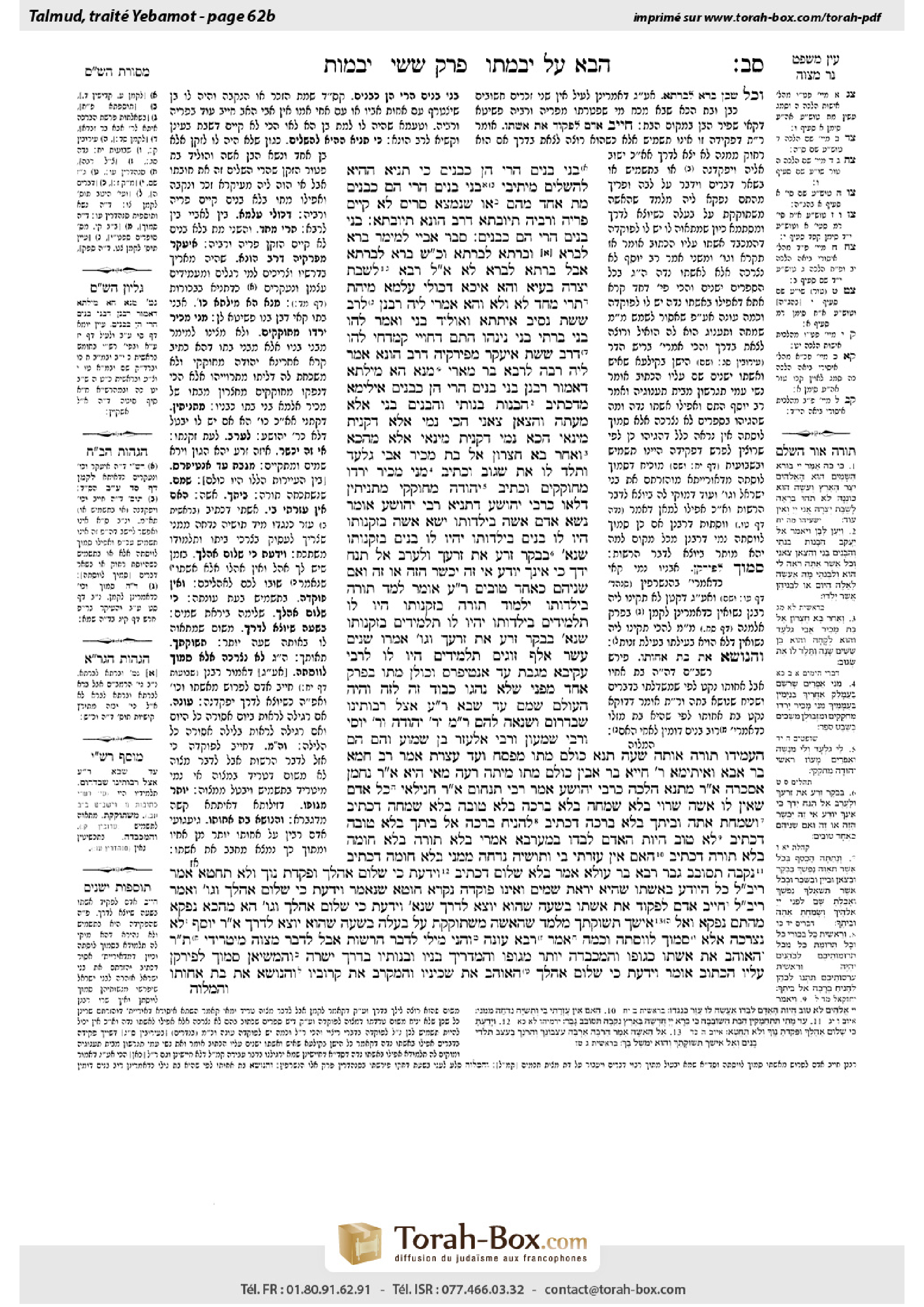
Yevamot 62b: Talmud study for Daf Yomi
Daf Yomi is the daily study of one Talmud folio. Explore 37 tractates with scans, Hebrew text, Sefaria English and AI-generated French translations where annotated.
Passage selection and English or AI-generated French translation are available where the scan has annotations. Daf Study is independent of Torah-Box and Sefaria.
Browse Yevamot · יבמות · All tractatesYevamot 62b text and translations
This page of Yevamot includes the Aramaic text, an English translation and an AI-generated French translation, alongside the scan above.
יבמות ס״ב ב · Aramaic and Hebrew text
בְּנֵי בָנִים הֲרֵי הֵן כְּבָנִים! כִּי תַּנְיָא הָהִיא, לְהַשְׁלִים.
מֵיתִיבִי: בְּנֵי בָנִים הֲרֵי הֵם כְּבָנִים, מֵת אֶחָד מֵהֶם אוֹ שֶׁנִּמְצָא סָרִיס — לֹא קִיֵּים פְּרִיָּה וּרְבִיָּה. תְּיוּבְתָּא דְרַב הוּנָא תְּיוּבְתָּא.
בְּנֵי בָנִים הֲרֵי הֵם כְּבָנִים. סְבַר אַבָּיֵי לְמֵימַר, בְּרָא לִבְרָא וּבְרַתָּא לִבְרַתָּא, וְכׇל שֶׁכֵּן בְּרָא לִבְרַתָּא. אֲבָל בְּרַתָּא לִבְרָא — לָא. אֲמַר לֵיהּ רָבָא: ״לָשֶׁבֶת יְצָרָהּ״ בָּעֲיָא, וְהָא אִיכָּא.
דְּכוּלֵּי עָלְמָא מִיהַת תְּרֵי מֵחַד לָא. וְלָא? וְהָא אָמְרִי לֵיהּ רַבָּנַן לְרַב שֵׁשֶׁת: נְסֵיב אִיתְּתָא וְאוֹלֵיד בְּנֵי, וַאֲמַר לְהוּ: בְּנֵי בְרַתִּי — בְּנֵי נִינְהוּ!
הָתָם דַּחוֹיֵי קָמְדַחֵי לְהוּ, דְּרַב שֵׁשֶׁת אִיעֲקַר מִפִּירְקֵיהּ דְּרַב הוּנָא.
אֲמַר לֵיהּ רַבָּה לְרָבָא בַּר מָארִי: מְנַָא הָא מִילְּתָא דַּאֲמוּר רַבָּנַן בְּנֵי בָנִים הֲרֵי הֵן כְּבָנִים? אִילֵּימָא מִדִּכְתִיב ״הַבָּנוֹת בְּנוֹתַי וְהַבָּנִים בָּנַי״, אֶלָּא מֵעַתָּה: ״וְהַצֹּאן צֹאנִי״ הָכִי נָמֵי?! אֶלָּא דִּקְנֵית מִינַּאי, הָכָא נָמֵי — דִּקְנֵית מִינַּאי.
אֶלָּא מֵהָכָא: ״וְאַחַר בָּא חֶצְרוֹן אֶל בַּת מָכִיר אֲבִי גִלְעָד וַתֵּלֶד לוֹ אֶת שְׂגוּב״, וּכְתִיב: ״מִנִּי מָכִיר יָרְדוּ מְחוֹקְקִים״, וּכְתִיב ״יְהוּדָה מְחוֹקְקִי״.
מַתְנִיתִין דְּלָאו כְּרַבִּי יְהוֹשֻׁעַ, דְּתַנְיָא, רַבִּי יְהוֹשֻׁעַ אוֹמֵר: נָשָׂא אָדָם אִשָּׁה בְּיַלְדוּתוֹ — יִשָּׂא אִשָּׁה בְּזִקְנוּתוֹ. הָיוּ לוֹ בָּנִים בְּיַלְדוּתוֹ — יִהְיוּ לוֹ בָּנִים בְּזִקְנוּתוֹ, שֶׁנֶּאֱמַר: ״בַּבֹּקֶר זְרַע אֶת זַרְעֶךָ וְלָעֶרֶב אַל תַּנַּח יָדֶךָ כִּי אֵינְךָ יוֹדֵעַ אֵי זֶה יִכְשָׁר הֲזֶה אוֹ זֶה וְאִם שְׁנֵיהֶם כְּאֶחָד טוֹבִים״.
רַבִּי עֲקִיבָא אוֹמֵר: לָמַד תּוֹרָה בְּיַלְדוּתוֹ — יִלְמוֹד תּוֹרָה בְּזִקְנוּתוֹ. הָיוּ לוֹ תַּלְמִידִים בְּיַלְדוּתוֹ — יִהְיוּ לוֹ תַּלְמִידִים בְּזִקְנוּתוֹ, שֶׁנֶּאֱמַר: ״בַּבֹּקֶר זְרַע אֶת זַרְעֶךָ וְגוֹ׳״. אָמְרוּ: שְׁנֵים עָשָׂר אָלֶף זוּגִים תַּלְמִידִים הָיוּ לוֹ לְרַבִּי עֲקִיבָא מִגְּבָת עַד אַנְטִיפְרַס, וְכוּלָּן מֵתוּ בְּפֶרֶק אֶחָד, מִפְּנֵי שֶׁלֹּא נָהֲגוּ כָּבוֹד זֶה לָזֶה.
וְהָיָה הָעוֹלָם שָׁמֵם, עַד שֶׁבָּא רַבִּי עֲקִיבָא אֵצֶל רַבּוֹתֵינוּ שֶׁבַּדָּרוֹם וּשְׁנָאָהּ לָהֶם: רַבִּי מֵאִיר, וְרַבִּי יְהוּדָה, וְרַבִּי יוֹסֵי, וְרַבִּי שִׁמְעוֹן, וְרַבִּי אֶלְעָזָר בֶּן שַׁמּוּעַ, וְהֵם הֵם הֶעֱמִידוּ תּוֹרָה אוֹתָהּ שָׁעָה.
תָּנָא, כּוּלָּם מֵתוּ מִפֶּסַח וְעַד עֲצֶרֶת. אָמַר רַב חָמָא בַּר אַבָּא וְאִיתֵּימָא רַבִּי חִיָּיא בַּר אָבִין: כּוּלָּם מֵתוּ מִיתָה רָעָה. מַאי הִיא? אָמַר רַב נַחְמָן: אַסְכָּרָה.
אָמַר רַב מַתְנָא: הֲלָכָה כְּרַבִּי יְהוֹשֻׁעַ.
אָמַר רַבִּי תַּנְחוּם אָמַר רַבִּי חֲנִילַאי: כׇּל אָדָם שֶׁאֵין לוֹ אִשָּׁה — שָׁרוּי בְּלֹא שִׂמְחָה, בְּלֹא בְּרָכָה, בְּלֹא טוֹבָה. בְּלֹא שִׂמְחָה, דִּכְתִיב: ״וְשָׂמַחְתָּ אַתָּה וּבֵיתֶךָ״. בְּלֹא בְּרָכָה, דִּכְתִיב: ״לְהָנִיחַ בְּרָכָה אֶל בֵּיתֶךָ״. בְּלֹא טוֹבָה, דִּכְתִיב: ״לֹא טוֹב הֱיוֹת הָאָדָם לְבַדּוֹ״.
בְּמַעְרְבָא אָמְרִי: בְּלֹא תּוֹרָה, בְּלֹא חוֹמָה. בְּלֹא תּוֹרָה, דִּכְתִיב: ״הַאִם אֵין עֶזְרָתִי בִי וְתוּשִׁיָּה נִדְּחָה מִמֶּנִּי״. בְּלֹא חוֹמָה, דִּכְתִיב: ״נְקֵבָה תְּסוֹבֵב גָּבֶר״.
רָבָא בַּר עוּלָּא אָמַר: בְּלֹא שָׁלוֹם, דִּכְתִיב: ״וְיָדַעְתָּ כִּי שָׁלוֹם אׇהֳלֶךָ וּפָקַדְתָּ נָוְךָ וְלֹא תֶחֱטָא״.
אָמַר רַבִּי יְהוֹשֻׁעַ בֶּן לֵוִי: כׇּל הַיּוֹדֵעַ בְּאִשְׁתּוֹ שֶׁהִיא יִרְאַת שָׁמַיִם וְאֵינוֹ פּוֹקְדָהּ — נִקְרָא חוֹטֵא, שֶׁנֶּאֱמַר: ״וְיָדַעְתָּ כִּי שָׁלוֹם אׇהֳלֶךָ וְגוֹ׳״. וְאָמַר רַבִּי יְהוֹשֻׁעַ בֶּן לֵוִי: חַיָּיב אָדָם לִפְקוֹד אֶת אִשְׁתּוֹ בְּשָׁעָה שֶׁהוּא יוֹצֵא לַדֶּרֶךְ, שֶׁנֶּאֱמַר: ״וְיָדַעְתָּ כִּי שָׁלוֹם אׇהֳלֶךָ וְגוֹ׳״.
הָא מֵהָכָא נָפְקָא? מֵהָתָם נָפְקָא: ״וְאֶל אִישֵׁךְ תְּשׁוּקָתֵךְ״, מְלַמֵּד שֶׁהָאִשָּׁה מִשְׁתּוֹקֶקֶת עַל בַּעְלָהּ בְּשָׁעָה שֶׁהוּא יוֹצֵא לְדֶרֶךְ! אָמַר רַב יוֹסֵף: לֹא נִצְרְכָה אֶלָּא סָמוּךְ לְוִוסְתָּהּ.
וְכַמָּה? אָמַר רָבָא: עוֹנָה. וְהָנֵי מִילֵּי לִדְבַר הָרְשׁוּת, אֲבָל לִדְבַר מִצְוָה — מִיטְּרִידִי.
תָּנוּ רַבָּנַן: הָאוֹהֵב אֶת אִשְׁתּוֹ כְּגוּפוֹ, וְהַמְכַבְּדָהּ יוֹתֵר מִגּוּפוֹ, וְהַמַּדְרִיךְ בָּנָיו וּבְנוֹתָיו בְּדֶרֶךְ יְשָׁרָה, וְהַמַּשִּׂיאָן סָמוּךְ לְפִירְקָן — עָלָיו הַכָּתוּב אוֹמֵר: ״וְיָדַעְתָּ כִּי שָׁלוֹם אׇהֳלֶךָ״. הָאוֹהֵב אֶת שְׁכֵינָיו, וְהַמְקָרֵב אֶת קְרוֹבָיו, וְהַנּוֹשֵׂא אֶת בַּת אֲחוֹתוֹ,
Yevamot 62b · English translation
Grandchildren are considered like children. This indicates that if one’s children have passed away, he has fulfilled the mitzva to be fruitful and multiply only if they had children of their own, as they are considered like his own children. The Gemara responds: When that baraita is taught it is with regard to completing the required number of children, e.g., if he had only a son, but his son had a daughter, he has fulfilled the mitzva to be fruitful and multiply.
The Gemara raises an objection to the opinion of Rav Huna from another baraita: Grandchildren are considered like children. If one of a man’s children died or was discovered to be a eunuch, the father has not fulfilled the mitzva to be fruitful and multiply. This directly contradicts Rav Huna’s statement that one fulfills the mitzva even if his children die. The Gemara concludes: The refutation of the opinion of Rav Huna is indeed a conclusive refutation.
§ It was taught in the baraita that grandchildren are considered like children. Abaye thought to say that if one’s children die, he fulfills the mitzva to be fruitful and multiply through grandchildren, provided a son was born to his son and a daughter to his daughter, and all the more so if a son was born to his daughter, as his grandchildren take the place of his children in these cases. However, if a daughter was born to his son, no, she cannot take the place of her father. Rava said to him: We require merely fulfillment of the verse: “He formed it to be inhabited,” and there is fulfillment in this case, as the earth is inhabited by his descendants.
The Gemara comments: In any event, everyone agrees that if one has two grandchildren from one child, no, he has not fulfilled the mitzva to be fruitful and multiply, even if he has both a grandson and a granddaughter. The Gemara asks: And has he not? Didn’t the Rabbis say to Rav Sheshet: Marry a woman and have sons, as you have not yet fathered any sons, and Rav Sheshet said to them: The sons of my daughter are my sons? This indicates that one can fulfill the mitzva through grandchildren even if he did not have a son and daughter of his own.
The Gemara answers: There, Rav Sheshet was merely putting them off. The real reason he did not want to get remarried was because Rav Sheshet became impotent from Rav Huna’s discourse. Rav Huna’s discourses were so lengthy that Rav Sheshet became impotent after waiting for so long without relieving himself.
Rabba said to Rava bar Mari: From where is this matter that the Sages stated derived, that grandchildren are considered like children? If we say it is derived from the fact that it is written in Laban’s speech to Jacob: “The daughters are my daughters and the children are my children” (Genesis 31:43), which indicates that Jacob’s children were also considered to be the children of their grandfather Laban, if that is so, does the continuation of Laban’s statement: “And the flocks are my flocks” (Genesis 31:43), indicate that so too, Jacob’s flocks were considered as belonging to Laban? Rather, Laban was saying that you, Jacob, acquired them from me. Here too, with regard to the children, Laban was saying: You acquired them from me, i.e., it is only due to me that you have children.
Rather, the proof is from here: “And afterward Hezron went in to the daughter of Machir, the father of Gilead…and she bore him Segub” (I Chronicles 2:21), and it is written: “Out of Machir came down governors” (Judges 5:14), and it is written: “Judah is my governor” (Psalms 60:9). Consequently, the governors, who were from the tribe of Judah, were also called the sons of Machir, who was from the tribe of Manasseh. This must be because they were the children of Machir’s daughter and Hezron, indicating that grandchildren are considered like children.
§ The Gemara comments: The mishna is not in accordance with the opinion of Rabbi Yehoshua. As it is taught in a baraita that Rabbi Yehoshua says: If a man married a woman in his youth, and she passed away, he should marry another woman in his old age. If he had children in his youth, he should have more children in his old age, as it is stated: “In the morning sow your seed, and in the evening do not withhold your hand; for you do not know which shall prosper, whether this or that, or whether they both alike shall be good” (Ecclesiastes 11:6). This verse indicates that a man should continue having children even after he has fulfilled the mitzva to be fruitful and multiply.
Rabbi Akiva says that the verse should be understood as follows: If one studied Torah in his youth he should study more Torah in his old age; if he had students in his youth he should have additional students in his old age, as it is stated: “In the morning sow your seed, etc.” They said by way of example that Rabbi Akiva had twelve thousand pairs of students in an area of land that stretched from Gevat to Antipatris in Judea, and they all died in one period of time, because they did not treat each other with respect.
And the world was desolate of Torah until Rabbi Akiva came to our Rabbis in the South and taught his Torah to them. This second group of disciples consisted of Rabbi Meir, Rabbi Yehuda, Rabbi Yosei, Rabbi Shimon, and Rabbi Elazar ben Shamua. And these are the very ones who upheld the study of Torah at that time. Although Rabbi Akiva’s earlier students did not survive, his later disciples were able to transmit the Torah to future generations.
With regard to the twelve thousand pairs of Rabbi Akiva’s students, the Gemara adds: It is taught that all of them died in the period from Passover until Shavuot. Rav Ḥama bar Abba said, and some say it was Rabbi Ḥiyya bar Avin: They all died a bad death. The Gemara inquires: What is it that is called a bad death? Rav Naḥman said: Diphtheria.
Rav Mattana said: The halakha is in accordance with the opinion of Rabbi Yehoshua, who said that one must attempt to have more children even if he has already fulfilled the mitzva to be fruitful and multiply.
§ Apropos the discussion with regard to the mitzva to have children, the Gemara cites statements about marriage in general. Rabbi Tanḥum said that Rabbi Ḥanilai said: Any man who does not have a wife is left without joy, without blessing, without goodness. He proceeds to quote verses to support each part of his statement. He is without joy, as it is written: “And you shall rejoice, you and your household” (Deuteronomy 14:26), which indicates that a man is in a joyful state only when he is with his household, i.e., his wife. He is without blessing, as it is written: “To cause a blessing to rest in your house” (Ezekiel 44:30), which indicates that blessing comes through one’s house, i.e., one’s wife. He is without goodness, as it is written: “It is not good that man should be alone” (Genesis 2:18), i.e., without a wife.
In the West, Eretz Yisrael, they say: One who lives without a wife is left without Torah, and without a wall of protection. He is without Torah, as it is written: “Is it that I have no help in me, and that sound wisdom is driven from me?” (Job 6:13), indicating that one who does not have a wife lacks sound wisdom, i.e., Torah. He is without a wall, as it is written: “A woman shall go round a man” (Jeremiah 31:22), similar to a protective wall.
Rava bar Ulla said: One who does not have a wife is left without peace, as it is written: “And you shall know that your tent is in peace; and you shall visit your habitation and shall miss nothing” (Job 5:24). This indicates that a man has peace only when he has a tent, i.e., a wife.
On the same verse, Rabbi Yehoshua ben Levi said: Whoever knows that his wife fears Heaven and she desires him, and he does not visit her, i.e., have intercourse with her, is called a sinner, as it is stated: And you shall know that your tent is in peace; and you shall visit your habitation. And Rabbi Yehoshua ben Levi said: A man is obligated to visit his wife for the purpose of having intercourse when he is about to depart on a journey, as it is stated: “And you shall know that your tent is in peace, etc.”
The Gemara asks: Is this last statement derived from here? It is derived from there: “And your desire shall be to your husband” (Genesis 3:16), which teaches that a wife desires her husband when he is about to depart on a journey. Rav Yosef said: The additional derivation cited by Rabbi Yehoshua ben Levi is necessary only near the time of her set pattern, i.e., when she expects to begin experiencing menstrual bleeding. Although the Sages generally prohibited intercourse at this time due to a concern that the couple might have intercourse after she begins bleeding, if he is about to depart on a journey he must have intercourse with her.
The Gemara asks: And how much before the expected onset of menstrual bleeding is considered near the time of her set pattern? Rava said: An interval of time, i.e., half a daily cycle, either a day or a night. The Gemara comments: And this statement that a man must have intercourse with his wife before he departs on a journey applies only if he is traveling for an optional matter, but if he is traveling in order to attend to a matter pertaining to a mitzva, he is not required to have intercourse with his wife so that he not become preoccupied and neglect the mitzva.
§ The Sages taught: One who loves his wife as he loves himself, and who honors her more than himself, and who instructs his sons and daughters in an upright path, and who marries them off near the time when they reach maturity, about him the verse states: And you shall know that your tent is in peace. As a result of his actions, there will be peace in his home, as it will be devoid of quarrel and sin. One who loves his neighbors, and who draws his relatives close, and who marries the daughter of his sister, a woman he knows and is fond of as a family relative and not only as a wife,
Yevamot 62b · Traduction française (IA)
Les petits-enfants sont considérés comme des enfants. Cela indique que si les enfants d’un homme sont décédés, il n’a accompli la mitsva de procréer que s’ils ont eux-mêmes eu des enfants, ceux-ci étant considérés comme ses propres enfants. La Guemara répond : Cette baraïta concerne le fait de compléter le nombre d’enfants requis. Par exemple, s’il n’avait eu qu’un fils, mais que celui-ci ait eu une fille, il a accompli la mitsva de procréer.
La Guemara soulève une objection à l’opinion de Rav Houna à partir d’une autre baraïta : Les petits-enfants sont considérés comme des enfants. Si l’un des enfants d’un homme est décédé ou s’est révélé être un eunuque, le père n’a pas accompli la mitsva de procréer. Cela contredit directement l’affirmation de Rav Houna selon laquelle on accomplit la mitsva même si ses enfants meurent. La Guemara conclut : La réfutation de l’opinion de Rav Houna est effectivement définitive.
§ La baraïta enseigne que les petits-enfants sont considérés comme des enfants. Abayé pensa qu’un homme dont les enfants sont décédés accomplit la mitsva de procréer grâce à ses petits-enfants, à condition qu’un fils soit né de son fils et une fille de sa fille ; à plus forte raison si un fils est né de sa fille, puisque ses petits-enfants tiennent alors lieu de ses enfants. En revanche, si une fille est née de son fils, non : elle ne peut pas tenir lieu de son père. Rava lui dit : Il nous suffit de réaliser le verset « Il l’a formée pour être habitée », et cela est réalisé dans ce cas, puisque la terre est habitée par ses descendants.
La Guemara fait remarquer : Quoi qu’il en soit, tous s’accordent à dire que si un homme a deux petits-enfants issus d’un seul de ses enfants, il n’a pas accompli la mitsva de procréer, même s’il a un petit-fils et une petite-fille. La Guemara demande : Ne l’a-t-il donc pas accomplie ? Les Rabbins n’ont-ils pas dit à Rav Chéchet : « Épouse une femme et aie des fils, car tu n’as pas encore engendré de fils », et Rav Chéchet ne leur a-t-il pas répondu : « Les fils de ma fille sont mes fils » ? Cela indique qu’on peut accomplir la mitsva grâce à ses petits-enfants, même si l’on n’a pas eu soi-même un fils et une fille.
La Guemara répond : Là, Rav Chéchet ne faisait que les éconduire. En réalité, s’il ne voulait pas se remarier, c’est parce qu’il était devenu impuissant à cause des discours de Rav Houna. Ces discours étaient si longs que Rav Chéchet était devenu impuissant après avoir attendu si longtemps sans se soulager.
Rabba dit à Rava bar Mari : D’où les Sages tirent-ils cette idée selon laquelle les petits-enfants sont considérés comme des enfants ? Si l’on dit qu’elle est déduite du fait qu’il est écrit dans les paroles de Laban à Jacob : « Les filles sont mes filles, et les enfants sont mes enfants » (Genèse 31,43), ce qui indique que les enfants de Jacob étaient également considérés comme ceux de leur grand-père Laban, alors la suite des paroles de Laban — « Et les troupeaux sont mes troupeaux » (Genèse 31,43) — indiquerait-elle aussi que les troupeaux de Jacob appartenaient à Laban ? Non, Laban voulait dire : « C’est auprès de moi que tu les as acquis. » De même ici, au sujet des enfants, Laban voulait dire : « C’est auprès de moi que tu les as acquis », c’est-à-dire que c’est uniquement grâce à moi que tu as des enfants.
La preuve vient plutôt d’ici : « Ensuite Hetsron alla vers la fille de Makir, père de Galaad… et elle lui donna Segoub » (I Chroniques 2,21). Il est également écrit : « De Makir descendirent des chefs » (Juges 5,14), et : « Juda est mon chef » (Psaumes 60,9). Par conséquent, les chefs, qui étaient de la tribu de Juda, étaient également appelés les fils de Makir, qui appartenait à la tribu de Manassé. Cela doit être parce qu’ils étaient les enfants de la fille de Makir et de Hetsron, ce qui indique que les petits-enfants sont considérés comme des enfants.
§ La Guemara fait remarquer : La Michna n’est pas conforme à l’opinion de Rabbi Yehochoua. En effet, il est enseigné dans une baraïta que Rabbi Yehochoua dit : Si un homme a épousé une femme dans sa jeunesse et qu’elle est décédée, il doit en épouser une autre dans sa vieillesse. S’il a eu des enfants dans sa jeunesse, il doit en avoir d’autres dans sa vieillesse, comme il est dit : « Le matin, sème ta semence, et le soir, ne laisse pas ta main se reposer ; car tu ne sais pas ce qui réussira, ceci ou cela, ou si les deux ensemble seront bons » (Ecclésiaste 11,6). Ce verset indique qu’un homme doit continuer à avoir des enfants même après avoir accompli la mitsva de procréer.
Rabbi Akiva dit qu’il faut comprendre le verset ainsi : Si quelqu’un a étudié la Torah dans sa jeunesse, il doit étudier davantage la Torah dans sa vieillesse ; s’il a eu des élèves dans sa jeunesse, il doit en avoir d’autres dans sa vieillesse, comme il est dit : « Le matin, sème ta semence, etc. » On rapporte à titre d’exemple que Rabbi Akiva avait douze mille paires d’élèves dans une région qui s’étendait de Gevat à Antipatris, en Judée, et qu’ils moururent tous à la même période parce qu’ils ne se témoignaient pas de respect les uns aux autres.
Le monde fut privé de Torah jusqu’à ce que Rabbi Akiva se rende auprès de nos Rabbins dans le Sud et leur enseigne sa Torah. Ce second groupe de disciples comprenait Rabbi Meïr, Rabbi Yehouda, Rabbi Yossi, Rabbi Chim‘on et Rabbi Elazar ben Chammoua. Ce sont précisément eux qui maintinrent l’étude de la Torah à cette époque. Bien que les premiers élèves de Rabbi Akiva n’aient pas survécu, ses disciples ultérieurs purent transmettre la Torah aux générations futures.
Au sujet des douze mille paires d’élèves de Rabbi Akiva, la Guemara ajoute : Il est enseigné qu’ils moururent tous entre Pessa’h et Chavouot. Rav Ḥama bar Abba a dit — et certains disent que c’est Rabbi Ḥiyya bar Avin qui l’a dit — qu’ils moururent tous d’une mort terrible. La Guemara demande : Qu’appelle-t-on une mort terrible ? Rav Naḥman répond : La diphtérie.
Rav Mattana dit : La halakha est conforme à l’opinion de Rabbi Yehochoua, qui a dit qu’il faut s’efforcer d’avoir davantage d’enfants même si l’on a déjà accompli la mitsva de procréer.
§ À propos de la discussion sur la mitsva d’avoir des enfants, la Guemara cite des propos concernant le mariage en général. Rabbi Tanḥoum a dit au nom de Rabbi Ḥanilai : Tout homme qui n’a pas de femme est privé de joie, de bénédiction et de bien. Il cite des versets à l’appui de chacun de ces points. Il est privé de joie, comme il est écrit : « Tu te réjouiras, toi et ta maison » (Deutéronome 14,26), ce qui indique qu’un homme n’est dans la joie que lorsqu’il est avec sa maisonnée, c’est-à-dire sa femme. Il est privé de bénédiction, comme il est écrit : « Afin que la bénédiction repose dans ta maison » (Ézéchiel 44,30), ce qui indique que la bénédiction vient par l’intermédiaire de sa maison, c’est-à-dire de sa femme. Il est privé de bien, comme il est écrit : « Il n’est pas bon que l’homme soit seul » (Genèse 2,18), c’est-à-dire sans femme.
En Occident, en Erets Israël, on dit : Celui qui vit sans femme est privé de Torah et d’un mur protecteur. Il est privé de Torah, comme il est écrit : « N’ai-je pas de secours en moi, et la sagesse a-t-elle été chassée loin de moi ? » (Job 6,13), ce qui indique que celui qui n’a pas de femme manque de sagesse véritable, c’est-à-dire de Torah. Il est privé d’un mur, comme il est écrit : « Une femme entourera un homme » (Jérémie 31,22), à l’image d’un mur protecteur.
Rava bar Oulla dit : Celui qui n’a pas de femme est privé de paix, comme il est écrit : « Tu sauras que ta tente est en paix ; tu visiteras ton habitation et tu ne manqueras de rien » (Job 5,24). Cela indique qu’un homme n’est en paix que lorsqu’il a une tente, c’est-à-dire une femme.
À propos du même verset, Rabbi Yehochoua ben Lévi dit : Celui qui sait que sa femme craint le Ciel et le désire, mais qui ne la rejoint pas, c’est-à-dire n’a pas de relations sexuelles avec elle, est appelé pécheur, comme il est dit : « Tu sauras que ta tente est en paix ; tu visiteras ton habitation. » Rabbi Yehochoua ben Lévi dit également : Un homme est tenu d’avoir des relations sexuelles avec sa femme lorsqu’il s’apprête à partir en voyage, comme il est dit : « Tu sauras que ta tente est en paix, etc. »
La Guemara demande : Cette dernière affirmation est-elle déduite de ce verset ? Elle est déduite de cet autre verset : « Ton désir se portera vers ton mari » (Genèse 3,16), qui enseigne qu’une femme désire son mari lorsqu’il s’apprête à partir en voyage. Rav Yossef dit : La déduction supplémentaire citée par Rabbi Yehochoua ben Lévi n’est nécessaire que lorsque approche le moment habituel où elle s’attend à commencer à avoir des saignements menstruels. Bien que les Sages aient généralement interdit les relations sexuelles à ce moment-là, par crainte que le couple n’ait des relations après le début des saignements, s’il s’apprête à partir en voyage, il doit avoir des relations sexuelles avec elle.
La Guemara demande : Combien de temps avant le début prévu des saignements menstruels considère-t-on que le moment habituel approche ? Rava répond : Un intervalle de temps, c’est-à-dire la moitié d’un cycle quotidien, soit un jour, soit une nuit. La Guemara fait remarquer : L’obligation pour un homme d’avoir des relations sexuelles avec sa femme avant de partir en voyage ne s’applique que s’il voyage pour une affaire facultative. Mais s’il voyage afin de s’occuper d’une affaire liée à une mitsva, il n’est pas tenu d’avoir des relations sexuelles avec sa femme, afin de ne pas être préoccupé et de négliger la mitsva.
§ Les Sages ont enseigné : Celui qui aime sa femme comme lui-même, la respecte plus que lui-même, enseigne à ses fils et à ses filles une conduite droite et les marie lorsqu’ils approchent de l’âge adulte, à son sujet le verset dit : « Tu sauras que ta tente est en paix. » Grâce à sa conduite, la paix régnera dans sa maison, qui sera exempte de querelles et de péché. Celui qui aime ses voisins, rapproche ses proches et épouse la fille de sa sœur, une femme qu’il connaît et qu’il affectionne en tant que parente, et pas seulement en tant qu’épouse,
Traduction française générée par IA à partir de l’édition anglaise de Sefaria. Vérifie toujours un passage avec le texte source.
Text from Sefaria: William Davidson Edition - Vocalized Aramaic (CC BY NC); William Davidson Edition - English (CC BY NC).