Yevamot 63a: Talmud study for Daf Yomi
Daf Yomi is the daily study of one Talmud folio. Explore 37 tractates with scans, Hebrew text, Sefaria English and AI-generated French translations where annotated.
Passage selection and English or AI-generated French translation are available where the scan has annotations. Daf Study is independent of Torah-Box and Sefaria.
Browse Yevamot · יבמות · All tractatesYevamot 63a text and translations
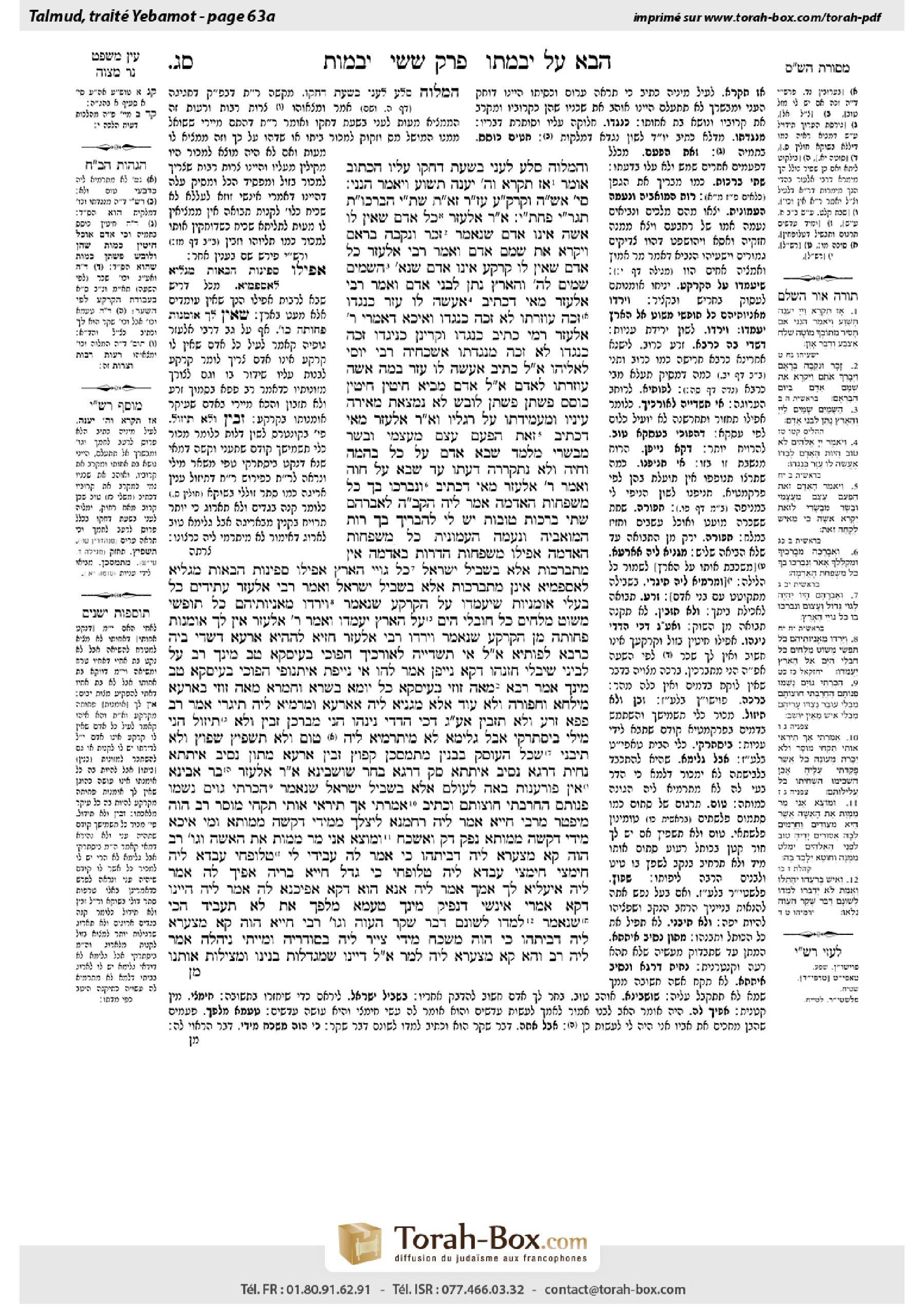
This page of Yevamot includes the Aramaic text, an English translation and an AI-generated French translation, alongside the scan above.
יבמות ס״ג א · Aramaic and Hebrew text
וְהַמַּלְוֶה סֶלַע לְעָנִי בִּשְׁעַת דׇּחְקוֹ — עָלָיו הַכָּתוּב אוֹמֵר: ״אָז תִּקְרָא וַה׳ יַעֲנֶה תְּשַׁוַּע וְיֹאמַר הִנֵּנִי״.
סִימָן: אִשָּׁה. וְקַרְקַע. עֵזֶר. זֹאת. שְׁתֵּי. הַבְרָכוֹת. תַּגָּרֵי. פָּחֲתִי. אָמַר רַבִּי אֶלְעָזָר: כׇּל אָדָם שֶׁאֵין לוֹ אִשָּׁה — אֵינוֹ אָדָם, שֶׁנֶּאֱמַר: ״זָכָר וּנְקֵבָה בְּרָאָם וַיִּקְרָא אֶת שְׁמָם אָדָם״. וְאָמַר רַבִּי אֶלְעָזָר: כׇּל אָדָם שֶׁאֵין לוֹ קַרְקַע — אֵינוֹ אָדָם, שֶׁנֶּאֱמַר: ״הַשָּׁמַיִם שָׁמַיִם לַה׳ וְהָאָרֶץ נָתַן לִבְנֵי אָדָם״.
וְאָמַר רַבִּי אֶלְעָזָר, מַאי דִּכְתִיב ״אֶעֱשֶׂה לּוֹ עֵזֶר כְּנֶגְדּוֹ״: זָכָה — עוֹזַרְתּוֹ, לֹא זָכָה — כְּנֶגְדּוֹ. וְאִיכָּא דְּאָמְרִי: רַבִּי אֶלְעָזָר רָמֵי, כְּתִיב ״כְּנַגְּדוֹ״, וְקָרֵינַן ״כְּנֶגְדּוֹ״. זָכָה — כְּנֶגְדּוֹ, לֹא זָכָה — מְנַגַּדְתּוֹ.
אַשְׁכְּחֵיהּ רַבִּי יוֹסֵי לְאֵלִיָּהוּ, אֲמַר לֵיהּ, כְּתִיב: ״אֶעֱשֶׂה לוֹ עֵזֶר״, בַּמָּה אִשָּׁה עוֹזַרְתּוֹ לָאָדָם? אֲמַר לֵיהּ: אָדָם מֵבִיא חִיטִּין — חִיטִּין כּוֹסֵס? פִּשְׁתָּן — פִּשְׁתָּן לוֹבֵשׁ? לֹא נִמְצֵאת מְאִירָה עֵינָיו וּמַעֲמִידָתוֹ עַל רַגְלָיו?!
וְאָמַר רַבִּי אֶלְעָזָר, מַאי דִּכְתִיב: ״זֹאת הַפַּעַם עֶצֶם מֵעֲצָמַי וּבָשָׂר מִבְּשָׂרִי״ — מְלַמֵּד שֶׁבָּא אָדָם עַל כׇּל בְּהֵמָה וְחַיָּה, וְלֹא נִתְקָרְרָה דַּעְתּוֹ עַד שֶׁבָּא עַל חַוָּה.
וְאָמַר רַבִּי אֶלְעָזָר, מַאי דִּכְתִיב: ״וְנִבְרְכוּ בְךָ כֹּל מִשְׁפְּחֹת הָאֲדָמָה״, אֲמַר לֵיהּ הַקָּדוֹשׁ בָּרוּךְ הוּא לְאַבְרָהָם: שְׁתֵּי הַבְרָכוֹת טוֹבוֹת יֵשׁ לִי לְהַבְרִיךְ בְּךָ: רוּת הַמּוֹאֲבִיָּה, וְנַעֲמָה הָעַמּוֹנִית. ״כֹּל מִשְׁפְּחוֹת הָאֲדָמָה״ — אֲפִילּוּ מִשְׁפָּחוֹת הַדָּרוֹת בָּאֲדָמָה אֵין מִתְבָּרְכוֹת אֶלָּא בִּשְׁבִיל יִשְׂרָאֵל. ״כׇּל גּוֹיֵי הָאָרֶץ״ — אֲפִילּוּ סְפִינוֹת הַבָּאוֹת מִגַּלְיָא לְאַסְפַּמְיָא אֵינָן מִתְבָּרְכוֹת אֶלָּא בִּשְׁבִיל יִשְׂרָאֵל.
וְאָמַר רַבִּי אֶלְעָזָר: עֲתִידִים כׇּל בַּעֲלֵי אוּמָּנִיּוֹת שֶׁיַּעַמְדוּ עַל הַקַּרְקַע, שֶׁנֶּאֱמַר: ״וְיָרְדוּ מֵאֳנִיּוֹתֵיהֶם כֹּל תֹּפְשֵׂי מָשׁוֹט מַלָּחִים כֹּל חֹבְלֵי הַיָּם עַל הָאָרֶץ יַעֲמֹדוּ״. וְאָמַר רַבִּי אֶלְעָזָר: אֵין לְךָ אוּמָּנוּת פְּחוּתָה מִן הַקַּרְקַע, שֶׁנֶּאֱמַר: ״וְיָרְדוּ״. רַבִּי אֶלְעָזָר חַזְיַהּ לְהַהִיא אַרְעָא דְּשָׁדֵי בַּיהּ כְּרָבָא לְפוּתְיָא, אֲמַר לֵיהּ: אִי תִּשְׁדְּיֵיהּ לְאוּרְכָּיךְ — הַפּוֹכֵי בְּעִיסְקָא טָב מִינָּךְ.
רַב עָל לְבֵינֵי שֻׁיבְלֵי, חֲזַנְהוּ דְּקָא נָיְיפָן, אֲמַר לְהוּ: אִי נָיְיפַתְּ — אִיתְנוֹפֵי. הַפּוֹכֵי בְּעִיסְקָא טָב מִינָּךְ. אָמַר רָבָא: מְאָה זוּזֵי בְּעִיסְקָא — כֹּל יוֹמָא בִּשְׂרָא וְחַמְרָא, מְאָה זוּזֵי בְּאַרְעָא — מִילְחָא וַחֲפוּרָה. וְלֹא עוֹד אֶלָּא מַגְנְיָא לֵיהּ אַאַרְעָא, וּמַרְמְיָא לֵיהּ תִּיגְרֵי.
אָמַר רַב פָּפָּא: זְרַע וְלָא תִּזְבֹּין. אַף עַל גַּב דְּכִי הֲדָדֵי נִינְהוּ, הָנֵי מִבָּרְכָן. זַבֵּין וְלָא תִּיזּוֹל. הָנֵי מִילֵּי בִּיסְתַּרְקֵי, אֲבָל גְּלִימָא — לָא מִיתְרַמְיָא לֵיהּ.
טוּם וְלָא תְּשַׁפֵּיץ. שַׁפֵּיץ וְלָא תִּיבְנֵי. שֶׁכׇּל הָעוֹסֵק בְּבִנְיָן — מִתְמַסְכֵּן. קְפוֹץ זְבֹין אַרְעָא, מְתוֹן נְסֵיב אִיתְּתָא. נְחֵית דַּרְגָּא נְסֵיב אִיתְּתָא. סַק דַּרְגָּא בְּחַר שׁוֹשְׁבִינָא.
אָמַר רַבִּי אֶלְעָזָר בַּר אֲבִינָא: אֵין פּוּרְעָנוּת בָּאָה לָעוֹלָם אֶלָּא בִּשְׁבִיל יִשְׂרָאֵל, שֶׁנֶּאֱמַר: ״הִכְרַתִּי גוֹיִם נָשַׁמּוּ פִּנּוֹתָם הֶחֱרַבְתִּי חוּצוֹתָם״, וּכְתִיב: ״אָמַרְתִּי אַךְ תִּירְאִי אוֹתִי תִּקְחִי מוּסָר״.
רַב הֲוָה מִיפְּטַר מֵרַבִּי חִיָּיא, אֲמַר לֵיהּ: רַחֲמָנָא לַיצְּלָךְ מִמִּידֵּי דְּקָשֵׁה מִמּוֹתָא. וּמִי אִיכָּא מִידֵּי דְּקָשֵׁה מִמּוֹתָא? נְפַק, דָּק וְאַשְׁכַּח: ״וּמוֹצֶא אֲנִי מַר מִמָּוֶת אֶת הָאִשָּׁה וְגוֹ׳״. רַב הֲוָה קָא מְצַעֲרָא לֵיהּ דְּבֵיתְהוּ, כִּי אָמַר לַהּ ״עֲבִידִי לִי טְלוֹפְחֵי״, עָבְדָא לֵיהּ חִימְצֵי. ״חִימְצֵי״, עָבְדָא לֵיהּ טְלוֹפְחֵי.
כִּי גְדַל חִיָּיא בְּרֵיהּ, אֲפֵיךְ לַהּ. אֲמַר לֵיהּ: אִיעַלַּיָא לָךְ אִמָּךְ! אֲמַר לֵיהּ: אֲנָא הוּא דְּקָא אָפֵיכְנָא לַהּ. אֲמַר לֵיהּ, הַיְינוּ דְּקָא אָמְרִי אִינָשֵׁי: דְּנָפֵיק מִינָּךְ, טַעְמָא מַלְּפָךְ. אַתְּ לָא תַּעֲבֵיד הָכִי, שֶׁנֶּאֱמַר: ״לִמְּדוּ לְשׁוֹנָם דַּבֶּר שֶׁקֶר הַעֲוֵה וְגוֹ׳״.
רַבִּי חִיָּיא הֲוָה קָא מְצַעֲרָא לֵיהּ דְּבֵיתְהוּ. כִּי הֲוָה מַשְׁכַּח מִידֵּי, צָיַיר לֵיהּ בְּסוּדָרֵיהּ וּמַיְיתֵי נִיהֲלַהּ. אֲמַר לֵיהּ רַב: וְהָא קָא מְצַעֲרָא לֵיהּ לְמָר? אֲמַר לֵיהּ: דַּיֵּינוּ שֶׁמְּגַדְּלוֹת בָּנֵינוּ, וּמַצִּילוֹת אוֹתָנוּ
Yevamot 63a · English translation
and who lends a sela to a pauper at his time of need, about him the verse states: “Then shall you call, and the Lord will answer; you shall cry, and He will say: Here I am” (Isaiah 58:9).
§ The Gemara provides a mnemonic device for a series of statements cited in the name of Rabbi Elazar: Woman; and land; helper; this; two; the blessings; merchants; lowly. The Gemara presents these statements: Rabbi Elazar said: Any man who does not have a wife is not a man, as it is stated: “Male and female He created them…and called their name Adam” (Genesis 5:2). And Rabbi Elazar said: Any man who does not have his own land is not a man, as it is stated: “The heavens are the heavens of the Lord; but the earth He has given to the children of men” (Psalms 115:16).
And Rabbi Elazar said: What is the meaning of that which is written: “I will make him a helpmate for him [kenegdo]” (Genesis 2:18)? If one is worthy his wife helps him; if he is not worthy she is against him. And some say a slightly different version: Rabbi Elazar raised a contradiction: It is written in the Torah with a spelling that allows it to be read: Striking him [kenagdo], and we read it as though it said: For him [kenegdo]. If he is worthy she is for him as his helpmate; if he is not worthy she strikes him.
The Gemara relates that Rabbi Yosei encountered Elijah the prophet and said to him: It is written: I will make him a helpmate. In what manner does a woman help a man? Elijah said to him: When a man brings wheat from the field, does he chew raw wheat? When he brings home flax, does he wear unprocessed flax? His wife turns the raw products into bread and clothing. Is his wife not found to be the one who lights up his eyes and stands him on his feet?
And Rabbi Elazar said: What is the meaning of that which is written: “This is now bone of my bones and flesh of my flesh” (Genesis 2:23)? This teaches that Adam had intercourse with each animal and beast in his search for his mate, and his mind was not at ease, in accordance with the verse: “And for Adam, there was not found a helpmate for him” (Genesis 2:20), until he had intercourse with Eve.
And Rabbi Elazar said: What is the meaning of that which is written: “And in you shall all the families of the earth be blessed [nivrekhu]” (Genesis 12:3)? The Holy One, Blessed be He, said to Abraham: I have two good shoots to graft [lehavrikh] onto you: Ruth the Moabite, the ancestress of the house of David, and Naamah the Ammonite, whose marriage with Solomon led to the ensuing dynasty of the kings of Judea. “All the families of the earth” means: Even families that live in the earth, i.e., who have land of their own, are blessed only due to the Jewish people. Similarly, when the verse states: “All the nations of the earth shall be blessed in him” (Genesis 18:18), it indicates that even ships that come from Galia to Hispania are blessed only due to the Jewish people.
And Rabbi Elazar said: All craftsmen are destined to stand upon and work the land, as it is stated: “And all that handle the oar, the mariners, and all the pilots of the sea, shall come down from their ships, they shall stand upon the land” (Ezekiel 27:29). And Rabbi Elazar said: There is no occupation lowlier than working the land, as it is stated: “And they shall come down,” implying that one who works the land is of lower stature than even a sailor. The Gemara similarly relates: Rabbi Elazar saw land that was plowed across its width. He said to it: Even if they plow you once more lengthwise, for further improvement, conducting business is better than farming with you, as the potential profits gained by selling merchandise are far greater than those from working the land.
The Gemara relates a similar incident: Rav entered between the sheaves in a field and saw them waving in the wind. He said to them: If you want to wave go ahead and wave, but conducting business is better than farming with you. Rava similarly said: One who has a hundred dinars that are invested in a business is able to eat meat and wine every day, whereas he who has a hundred dinars worth of land eats only salt and vegetables. And what is more, working the land causes him to lie on the ground at night in order to guard it, and it draws quarrels upon him with other people.
Rav Pappa said: Sow your own produce and do not buy it. Even though they are equal to each other in value, these that you sow will be blessed. Conversely, buy your clothes rather than weave [teizul] them yourself. The Gemara comments: This applies only to mats [bistarkei], but with regard to the cloak one wears, perhaps he will not find it precisely to his liking, and therefore he should make his own cloak, which fits his measurements.
Rav Pappa further advised: If there is a hole in your house, close it up and do not enlarge it and then plaster it, or at least plaster it and do not knock it down and build it again. As, whoever engages in construction becomes poor. Hurry to buy land so that you do not lose the opportunity. Be patient and marry a woman who is suitable for you. Descend a level to marry a woman of lower social status, and ascend a level to choose a friend [shushevina].
Rabbi Elazar bar Avina said: Calamity befalls the world only due to the sins of the Jewish people, as it is stated: “I have cut off nations, their corners are desolate; I have made their streets waste” (Zephaniah 3:6), and it is written: “I said: Surely you will fear Me, you will receive correction” (Zephaniah 3:7). This indicates that other nations were punished so that the Jewish people would mend their ways.
The Gemara cites more statements with regard to wives. When Rav was taking leave of his uncle and teacher, Rabbi Ḥiyya, upon his return from Eretz Yisrael to Babylonia, Rabbi Ḥiyya said to him: May the Merciful One save you from something that is worse than death. Rav was perplexed: Is there anything that is worse than death? He went, examined the sources, and found the following verse: “And I find more bitter than death the woman, etc.” (Ecclesiastes 7:26). Rabbi Ḥiyya was hinting at this verse, and indeed, Rav’s wife would constantly aggravate him. When he would say to her: Prepare me lentils, she would prepare him peas; if he asked her for peas, she would prepare him lentils.
When Ḥiyya, his son, grew up, he would reverse the requests Rav asked him to convey to her, so that Rav would get what he wanted. Rav said to his son Ḥiyya: Your mother has improved now that you convey my requests. He said to Rav: It is I who reverse your request to her. Rav said to him: This is an example of the well-known adage that people say: He who comes from you shall teach you wisdom; I should have thought of that idea myself. You, however, should not do so, i.e., reverse my request, as it is stated: “They have taught their tongue to speak lies, they weary themselves to commit iniquity, etc.” (Jeremiah 9:4). If you attribute such a request to me, you will have uttered a falsehood.
The Gemara relates a similar story. Rabbi Ḥiyya’s wife would constantly aggravate him. Nevertheless, when he would find something she would appreciate, he would wrap it in his shawl and bring it to her. Rav said to him: Doesn’t she constantly aggravate you? Why do you bring her things? Rabbi Ḥiyya said to him: It is enough for us that our wives raise our children and save us
Yevamot 63a · Traduction française (IA)
et celui qui prête un sela à un pauvre au moment où il en a besoin, à son sujet le verset déclare : « Alors tu appelleras, et le Seigneur répondra ; tu crieras, et Il dira : Me voici » (Isaïe 58:9).
§ La Guemara fournit un moyen mnémotechnique pour une série d’enseignements cités au nom de Rabbi Elazar : femme ; terre ; aide ; ceci ; deux ; les bénédictions ; marchands ; humble. La Guemara présente ces enseignements : Rabbi Elazar a dit : Tout homme qui n’a pas d’épouse n’est pas un homme, ainsi qu’il est dit : « Mâle et femelle, Il les créa… et Il les appela du nom d’Adam » (Genèse 5:2). Et Rabbi Elazar a dit : Tout homme qui ne possède pas de terre n’est pas un homme, ainsi qu’il est dit : « Les cieux sont les cieux du Seigneur, mais la terre, Il l’a donnée aux fils des hommes » (Psaumes 115:16).
Et Rabbi Elazar a dit : Quel est le sens de ce qui est écrit : « Je lui ferai une aide qui lui corresponde [kenegdo] » (Genèse 2:18) ? S’il en est digne, sa femme l’aide ; s’il n’en est pas digne, elle s’oppose à lui. Certains rapportent une version légèrement différente : Rabbi Elazar a soulevé une contradiction : dans la Torah, le mot est écrit de manière à pouvoir se lire « le frappant [kenagdo] », alors que nous le lisons comme s’il était écrit « qui lui corresponde [kenegdo] ». S’il en est digne, elle est pour lui une aide qui lui corresponde ; s’il n’en est pas digne, elle le frappe.
La Guemara raconte que Rabbi Yossei rencontra Élie le prophète et lui dit : Il est écrit : « Je lui ferai une aide ». De quelle manière une femme aide-t-elle un homme ? Élie lui répondit : Quand un homme rapporte du blé des champs, le mange-t-il cru ? Quand il rapporte du lin à la maison, porte-t-il du lin non traité ? Sa femme transforme les produits bruts en pain et en vêtements. N’est-ce pas elle qui lui ouvre les yeux et le remet sur pied ?
Et Rabbi Elazar a dit : Quel est le sens de ce qui est écrit : « Celle-ci est maintenant l’os de mes os et la chair de ma chair » (Genèse 2:23) ? Cela enseigne qu’Adam eut des rapports avec chaque animal et chaque bête à la recherche de sa compagne, sans trouver la paix intérieure, conformément au verset : « Mais pour Adam, il ne fut pas trouvé d’aide qui lui corresponde » (Genèse 2:20), jusqu’à ce qu’il ait des rapports avec Ève.
Et Rabbi Elazar a dit : Quel est le sens de ce qui est écrit : « En toi seront bénies [nivrekhu] toutes les familles de la terre » (Genèse 12:3) ? Le Saint, béni soit-Il, dit à Abraham : J’ai deux belles pousses à greffer [lehavrikh] sur toi : Ruth la Moabite, ancêtre de la maison de David, et Naama l’Ammonite, dont le mariage avec Salomon conduisit à la dynastie des rois de Judée. « Toutes les familles de la terre » signifie : même les familles qui vivent sur la terre, c’est-à-dire qui possèdent leur propre terre, ne sont bénies que grâce au peuple juif. De même, lorsque le verset déclare : « Toutes les nations de la terre seront bénies en lui » (Genèse 18:18), cela indique que même les navires qui viennent de Galia en Hispanie ne sont bénis que grâce au peuple juif.
Et Rabbi Elazar a dit : Tous les artisans finiront par se tenir sur la terre et la travailler, ainsi qu’il est dit : « Tous ceux qui manient la rame, les marins et tous les pilotes de la mer descendront de leurs navires et se tiendront sur la terre » (Ézéchiel 27:29). Et Rabbi Elazar a dit : Il n’est pas de métier plus humble que le travail de la terre, ainsi qu’il est dit : « Ils descendront », ce qui implique que celui qui travaille la terre est de rang inférieur même à un marin. La Guemara rapporte de même : Rabbi Elazar vit une terre labourée dans le sens de sa largeur. Il lui dit : Même si l’on te laboure encore une fois dans le sens de la longueur pour l’améliorer davantage, le commerce est préférable à la culture de ta terre, car les bénéfices potentiels de la vente de marchandises sont bien supérieurs à ceux du travail de la terre.
La Guemara rapporte un incident semblable : Rav passa entre les gerbes d’un champ et les vit onduler au vent. Il leur dit : Si vous voulez onduler, allez-y, ondulez ; mais le commerce est préférable à la culture de votre terre. Rava dit de même : Celui qui possède cent dinars investis dans une entreprise peut manger de la viande et boire du vin chaque jour, tandis que celui qui possède une terre valant cent dinars ne mange que du sel et des légumes. De plus, le travail de la terre l’oblige à dormir la nuit à même le sol pour la garder et suscite des querelles avec les autres.
Rav Pappa a dit : Sème tes propres produits et ne les achète pas. Même si leur valeur est la même, ceux que tu sèmes seront bénis. En revanche, achète tes vêtements plutôt que de les tisser [teizul] toi-même. La Guemara précise : Cela ne s’applique qu’aux nattes [bistarkei], mais, pour le manteau que l’on porte, il se peut qu’on n’en trouve pas un qui convienne exactement à ses goûts ; il devrait donc confectionner lui-même son manteau, ajusté à ses mesures.
Rav Pappa donna encore les conseils suivants : S’il y a un trou dans ta maison, bouche-le sans l’agrandir puis le crépir ; ou, à tout le moins, crépis-le sans démolir la maison pour la reconstruire. Car quiconque se lance dans des travaux de construction s’appauvrit. Hâte-toi d’acheter une terre afin de ne pas laisser passer l’occasion. Prends ton temps et épouse une femme qui te convient. Descends d’un rang pour épouser une femme de statut social inférieur, et monte d’un rang pour choisir un ami [shushevina].
Rabbi Elazar bar Avina a dit : Une calamité ne s’abat sur le monde qu’à cause des péchés du peuple juif, ainsi qu’il est dit : « J’ai retranché des nations, leurs coins sont dévastés ; j’ai rendu leurs rues désertes » (Sophonie 3:6), et il est écrit : « Je me disais : Au moins, tu me craindras, tu recevras la correction » (Sophonie 3:7). Cela indique que les autres nations furent punies afin que le peuple juif corrige sa conduite.
La Guemara cite d’autres enseignements concernant les épouses. Lorsque Rav prit congé de son oncle et maître, Rabbi Ḥiyya, à son retour d’Eretz Israël en Babylonie, Rabbi Ḥiyya lui dit : Que le Miséricordieux te protège de quelque chose de pire que la mort. Rav fut perplexe : Y a-t-il quelque chose de pire que la mort ? Il s’en alla, examina les sources et trouva le verset suivant : « Et je trouve plus amère que la mort la femme, etc. » (Ecclésiaste 7:26). Rabbi Ḥiyya faisait allusion à ce verset et, en effet, la femme de Rav l’exaspérait constamment. Lorsqu’il lui disait : Prépare-moi des lentilles, elle lui préparait des pois ; s’il lui demandait des pois, elle lui préparait des lentilles.
Lorsque Ḥiyya, son fils, grandit, il inversait les demandes que Rav lui demandait de transmettre à sa mère, afin que Rav obtienne ce qu’il voulait. Rav dit à son fils Ḥiyya : Ta mère s’est améliorée maintenant que tu lui transmets mes demandes. Il répondit à Rav : C’est moi qui inverse tes demandes quand je les lui transmets. Rav lui dit : Voilà un exemple du dicton bien connu : « Celui qui vient de toi t’enseignera la sagesse » ; j’aurais dû trouver cette idée moi-même. Toutefois, toi, ne fais pas cela, c’est-à-dire n’inverse pas ma demande, car il est dit : « Ils ont instruit leur langue à dire le mensonge, ils se fatiguent à commettre l’iniquité, etc. » (Jérémie 9:4). Si tu lui attribues une telle demande de ma part, tu auras proféré un mensonge.
La Guemara raconte une histoire semblable. La femme de Rabbi Ḥiyya l’exaspérait constamment. Malgré cela, lorsqu’il trouvait quelque chose qui lui ferait plaisir, il l’enveloppait dans son châle et le lui apportait. Rav lui dit : Ne t’exaspère-t-elle pas constamment ? Pourquoi lui apportes-tu des choses ? Rabbi Ḥiyya lui répondit : Il nous suffit que nos femmes élèvent nos enfants et nous épargnent
Traduction française générée par IA à partir de l’édition anglaise de Sefaria. Vérifie toujours un passage avec le texte source.
Text from Sefaria: William Davidson Edition - Vocalized Aramaic (CC BY NC); William Davidson Edition - English (CC BY NC).