Yevamot 63b: Talmud study for Daf Yomi
Daf Yomi is the daily study of one Talmud folio. Explore 37 tractates with scans, Hebrew text, Sefaria English and AI-generated French translations where annotated.
Passage selection and English or AI-generated French translation are available where the scan has annotations. Daf Study is independent of Torah-Box and Sefaria.
Browse Yevamot · יבמות · All tractatesYevamot 63b text and translations
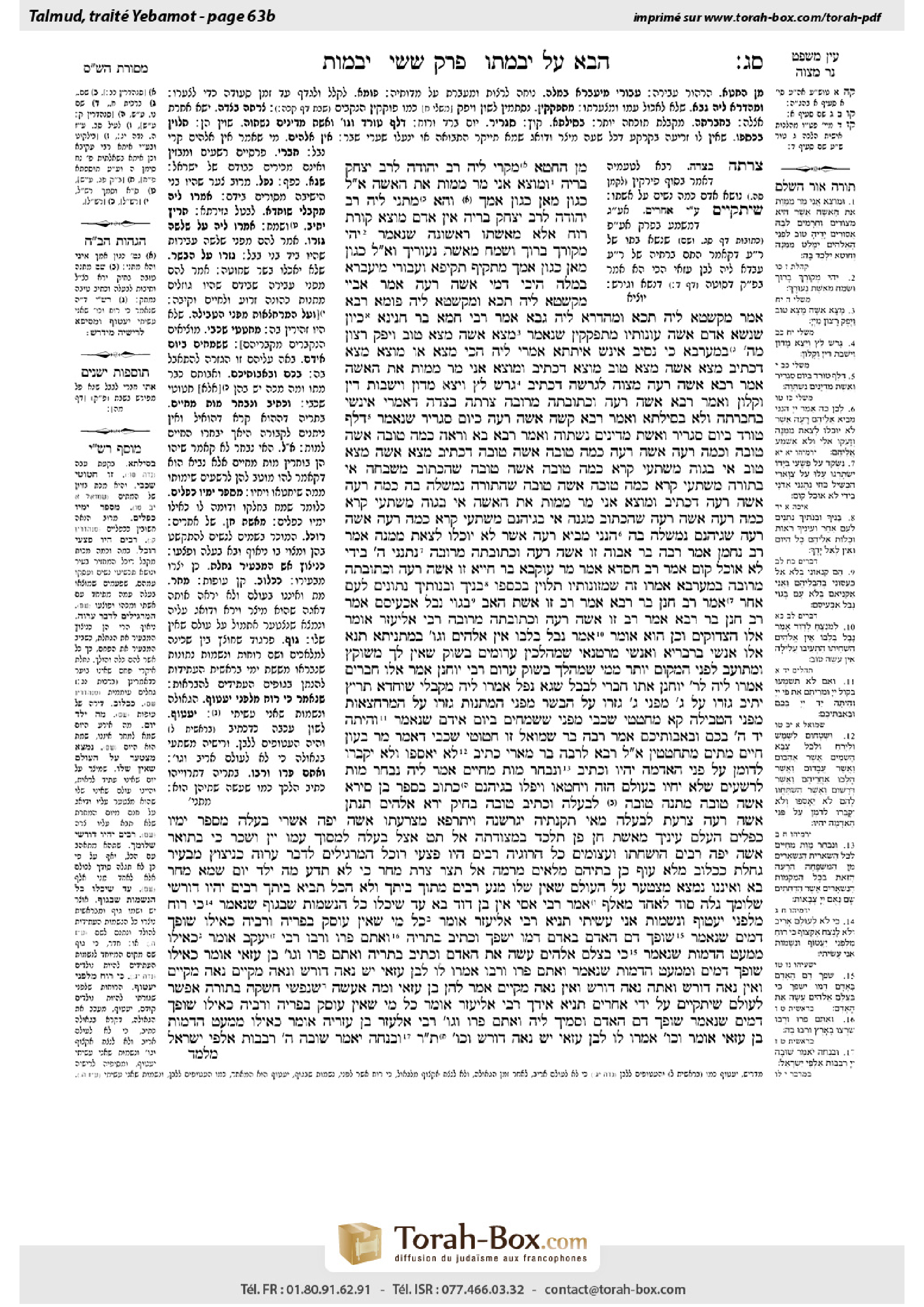
This page of Yevamot includes the Aramaic text, an English translation and an AI-generated French translation, alongside the scan above.
יבמות ס״ג ב · Aramaic and Hebrew text
מִן הַחֵטְא. מַקְרֵי לֵיהּ רַב יְהוּדָה לְרַב יִצְחָק בְּרֵיהּ ״וּמוֹצֶא אֲנִי מַר מִמָּוֶת אֶת הָאִשָּׁה״. אֲמַר לֵיהּ: כְּגוֹן מַאן? כְּגוֹן אִמָּךְ.
וְהָא מַתְנֵי לֵיהּ רַב יְהוּדָה לְרַב יִצְחָק בְּרֵיהּ: אֵין אָדָם מוֹצֵא קוֹרַת רוּחַ אֶלָּא מֵאִשְׁתּוֹ רִאשׁוֹנָה, שֶׁנֶּאֱמַר: ״יְהִי מְקוֹרְךָ בָרוּךְ וּשְׂמַח מֵאֵשֶׁת נְעוּרֶיךָ״, וַאֲמַר לֵיהּ: כְּגוֹן מַאן? כְּגוֹן אִמָּךְ! מִתְקָיף תְּקִיפָא, וְעַבּוֹרֵי מְיעַבְּרָא בְּמִלַּהּ.
הֵיכִי דָּמֵי אִשָּׁה רָעָה? אָמַר אַבָּיֵי: מְקַשְּׁטָא לֵיהּ תַּכָּא וּמְקַשְּׁטָא לֵיהּ פּוּמָּא. רָבָא אָמַר: מְקַשְּׁטָא לֵיהּ תַּכָּא וּמַהְדְּרָא לֵיהּ גַּבָּא.
אָמַר רַבִּי חָמָא בַּר חֲנִינָא: כֵּיוָן שֶׁנָּשָׂא אָדָם אִשָּׁה עֲוֹנוֹתָיו מִתְפַּקְּקִין, שֶׁנֶּאֱמַר: ״מָצָא אִשָּׁה מָצָא טוֹב וַיָּפֶק רָצוֹן מֵה׳״. בְּמַעְרְבָא כִּי נָסֵיב אִינָשׁ אִיתְּתָא, אָמְרִי לֵיהּ הָכִי: ״מָצָא״ אוֹ ״מוֹצֵא״? ״מָצָא״ דִּכְתִיב: ״מָצָא אִשָּׁה מָצָא טוֹב״, מוֹצֵא דִּכְתִיב: ״וּמוֹצֶא אֲנִי מַר מִמָּוֶת אֶת הָאִשָּׁה״.
אָמַר רָבָא: אִשָּׁה רָעָה מִצְוָה לְגָרְשָׁהּ, דִּכְתִיב: ״גָּרֵשׁ לֵץ וְיֵצֵא מָדוֹן וְיִשְׁבּוֹת דִּין וְקָלוֹן״, וְאָמַר רָבָא: אִשָּׁה רָעָה וּכְתוּבָּתָהּ מְרוּבָּה — צָרָתָהּ בְּצִדָּהּ. דְּאָמְרִי אִינָשֵׁי: בַּחֲבִרְתַּהּ, וְלָא בְּסִילְתָּא. וְאָמַר רָבָא: קָשָׁה אִשָּׁה רָעָה כְּיוֹם סַגְרִיר, שֶׁנֶּאֱמַר: ״דֶּלֶף טוֹרֵד בְּיוֹם סַגְרִיר וְאֵשֶׁת מִדְיָנִים נִשְׁתָּוָה״.
וְאָמַר רָבָא: בֹּא וּרְאֵה כַּמָּה טוֹבָה אִשָּׁה טוֹבָה, וְכַמָּה רָעָה אִשָּׁה רָעָה. כַּמָּה טוֹבָה אִשָּׁה טוֹבָה, דִּכְתִיב: ״מָצָא אִשָּׁה מָצָא טוֹב״, אִי בְּגַוַּהּ מִשְׁתַּעֵי קְרָא — כַּמָּה טוֹבָה אִשָּׁה טוֹבָה, שֶׁהַכָּתוּב מְשַׁבְּחָהּ. אִי בַּתּוֹרָה מִשְׁתַּעֵי קְרָא — כַּמָּה טוֹבָה אִשָּׁה טוֹבָה, שֶׁהַתּוֹרָה נִמְשְׁלָה בָּהּ. כַּמָּה רָעָה אִשָּׁה רָעָה, דִּכְתִיב: ״וּמוֹצֶא אֲנִי מַר מִמָּוֶת אֶת הָאִשָּׁה״. אִי בְּגַוַּהּ מִשְׁתַּעֵי קָרָא — כַּמָּה רָעָה אִשָּׁה רָעָה, שֶׁהַכָּתוּב מְגַנֶּהָ. אִי בְּגֵיהִנָּם מִשְׁתַּעֵי קְרָא — כַּמָּה רָעָה אִשָּׁה רָעָה, שֶׁגֵּיהִנָּם נִמְשְׁלָה בָּהּ.
״הִנְנִי מֵבִיא רָעָה אֲשֶׁר לֹא יוּכְלוּ לָצֵאת מִמֶּנָּה״, אָמַר רַב נַחְמָן אָמַר רַבָּה בַּר אֲבוּהּ: זוֹ אִשָּׁה רָעָה וּכְתוּבָּתָהּ מְרוּבָּה. ״נְתָנַנִי ה׳ בִּידֵי לֹא אוּכַל קוּם״, אָמַר רַב חִסְדָּא אָמַר מָר עוּקְבָא בַּר חִיָּיא: זוֹ אִשָּׁה רָעָה וּכְתוּבָּתָהּ מְרוּבָּה. בְּמַעְרְבָא אָמְרוּ: זֶה שֶׁמְּזוֹנוֹתָיו תְּלוּיִן בְּכַסְפּוֹ.
״בָּנֶיךָ וּבְנוֹתֶיךָ נְתוּנִים לְעַם אַחֵר״, אָמַר רַב חָנָן בַּר רָבָא אָמַר רַב: זוֹ אֵשֶׁת הָאָב. ״בְּגוֹי נָבָל אַכְעִיסֵם״, אָמַר רַב חָנָן בַּר רָבָא אָמַר רַב: זוֹ אִשָּׁה רָעָה וּכְתוּבָּתָהּ מְרוּבָּה. רַבִּי אֱלִיעֶזֶר אוֹמֵר: אֵלּוּ הַמִּינִים. וְכֵן הוּא אוֹמֵר: ״אָמַר נָבָל בְּלִבּוֹ אֵין אֱלֹהִים וְגוֹ׳״.
בְּמַתְנִיתָא תָּנָא: אֵלּוּ אַנְשֵׁי בַּרְבַּרְיָא וְאַנְשֵׁי מַרְטְנַאי, שֶׁמְּהַלְּכִין עֲרוּמִּים בַּשּׁוּק. שֶׁאֵין לְךָ מְשׁוּקָּץ וּמְתוֹעָב לִפְנֵי הַמָּקוֹם יוֹתֵר מִמִּי שֶׁמְּהַלֵּךְ בַּשּׁוּק עָרוֹם. רַבִּי יוֹחָנָן אָמַר: אֵלּוּ חַבָּרִים. אֲמַרוּ לֵיהּ לְרַבִּי יוֹחָנָן: אֲתוֹ חַבָּרֵי לְבָבֶל, שְׁגָא נְפַל. אֲמַרוּ לֵיהּ: מְקַבְּלִי שׁוּחְדָּא, תָּרֵיץ יְתֵיב.
גָּזְרוּ עַל שְׁלֹשָׁה מִפְּנֵי שְׁלֹשָׁה. גָּזְרוּ עַל הַבָּשָׂר — מִפְּנֵי הַמַּתָּנוֹת, גָּזְרוּ עַל הַמֶּרְחֲצָאוֹת — מִפְּנֵי הַטְּבִילָה.
קָא מְחַטְּטִי שָׁכְבֵי — מִפְּנֵי שֶׁשְּׂמֵחִים בְּיוֹם אֵידָם. שֶׁנֶּאֱמַר: ״וְהָיְתָה יַד ה׳ בָּכֶם וּבַאֲבוֹתֵיכֶם״. אָמַר רַבָּה בַּר שְׁמוּאֵל: (זוֹ) חַטּוֹטֵי שָׁכְבֵי. דְּאָמַר מָר: בַּעֲוֹן חַיִּים — מֵתִים מִתְחַטְּטִין.
אֲמַר לֵיהּ רָבָא לְרַבָּה בַּר מָארִי, כְּתִיב: ״לֹא יֵאָסְפוּ וְלֹא יִקָּבֵרוּ לְדוֹמֶן עַל פְּנֵי הָאֲדָמָה יִהְיוּ״, וּכְתִיב: ״וְנִבְחַר מָוֶת מֵחַיִּים״. אֲמַר לֵיהּ: נִבְחַר מָוֶת לָרְשָׁעִים, שֶׁלֹּא יִחְיוּ בְּעוֹלָם הַזֶּה וְיֶחֶטְאוּ, וְיִפְּלוּ בְּגֵיהִנָּם.
כָּתוּב בְּסֵפֶר בֶּן סִירָא: ״אִשָּׁה טוֹבָה מַתָּנָה טוֹבָה לְבַעְלָהּ״, וּכְתִיב: ״טוֹבָה בְּחֵיק יְרֵא אֱלֹהִים תִּנָּתֵן״. ״אִשָּׁה רָעָה צָרַעַת לְבַעְלָהּ״, מַאי תַּקַּנְתֵּיהּ — ״יְגָרְשֶׁנָּה וְיִתְרַפֵּא מִצָּרַעְתּוֹ״. ״אִשָּׁה יָפֶה אַשְׁרֵי בַּעְלָהּ, מִסְפַּר יָמָיו כִּפְלַיִם״.
״הַעְלֵם עֵינֶיךָ מֵאֵשֶׁת חֵן פֶּן תִּלָּכֵד בִּמְצוּדָתָהּ. אַל תֵּט אֵצֶל בַּעְלָהּ לִמְסוֹךְ עִמּוֹ יַיִן וְשֵׁכָר, כִּי בְּתוֹאַר אִשָּׁה יָפָה רַבִּים הוּשְׁחֲתוּ, וַעֲצוּמִים כׇּל הֲרוּגֶיהָ״. ״רַבִּים הָיוּ פִּצְעֵי רוֹכֵל״. ״הַמַּרְגִּילִים לִדְבַר עֶרְוָה כְּנִיצוֹץ מַבְעִיר גַּחֶלֶת. כִּכְלוּב מָלֵא עוֹף — כֵּן בָּתֵּיהֶם מְלֵאִים מִרְמָה״.
״אַל תֵּצַר צָרַת מָחָר, כִּי לֹא תֵדַע מַה יֵּלֶד יוֹם. שֶׁמָּא מָחָר בָּא וְאֵינֶנּוּ, נִמְצָא מִצְטַעֵר עַל הָעוֹלָם שֶׁאֵין שֶׁלּוֹ״. ״מְנַע רַבִּים מִתּוֹךְ בֵּיתֶךָ, וְלֹא הַכֹּל תָּבִיא בֵּיתֶךָ״. ״רַבִּים יִהְיוּ דּוֹרְשֵׁי שְׁלוֹמֶךָ. גַּלֵּה סוֹד לְאֶחָד מֵאָלֶף״.
אָמַר רַבִּי אַסִּי: אֵין בֶּן דָּוִד בָּא עַד שֶׁיִּכְלוּ כׇּל הַנְּשָׁמוֹת שֶׁבַּגּוּף, שֶׁנֶּאֱמַר: ״כִּי רוּחַ מִלְּפָנַי יַעֲטוֹף וּנְשָׁמוֹת אֲנִי עָשִׂיתִי״. תַּנְיָא, רַבִּי אֱלִיעֶזֶר אוֹמֵר: כׇּל מִי שֶׁאֵין עוֹסֵק בִּפְרִיָּה וּרְבִיָּה — כְּאִילּוּ שׁוֹפֵךְ דָּמִים, שֶׁנֶּאֱמַר: ״שׁוֹפֵךְ דַּם הָאָדָם בָּאָדָם דָּמוֹ יִשָּׁפֵךְ״, וּכְתִיב בָּתְרֵיהּ: ״וְאַתֶּם פְּרוּ וּרְבוּ״.
רַבִּי יַעֲקֹב אוֹמֵר: כְּאִילּוּ מְמַעֵט הַדְּמוּת, שֶׁנֶּאֱמַר: ״כִּי בְּצֶלֶם אֱלֹהִים עָשָׂה אֶת הָאָדָם״, וּכְתִיב בָּתְרֵיהּ: ״וְאַתֶּם פְּרוּ וְגוֹ׳״. בֶּן עַזַּאי אוֹמֵר: כְּאִילּוּ שׁוֹפֵךְ דָּמִים וּמְמַעֵט הַדְּמוּת, שֶׁנֶּאֱמַר: ״וְאַתֶּם פְּרוּ וּרְבוּ״.
אָמְרוּ לוֹ לְבֶן עַזַּאי: יֵשׁ נָאֶה דּוֹרֵשׁ וְנָאֶה מְקַיֵּים, נָאֶה מְקַיֵּים וְאֵין נָאֶה דּוֹרֵשׁ, וְאַתָּה נָאֶה דּוֹרֵשׁ, וְאֵין נָאֶה מְקַיֵּים. אָמַר לָהֶן בֶּן עַזַּאי: וּמָה אֶעֱשֶׂה שֶׁנַּפְשִׁי חָשְׁקָה בַּתּוֹרָה, אֶפְשָׁר לָעוֹלָם שֶׁיִּתְקַיֵּים עַל יְדֵי אֲחֵרִים.
תַּנְיָא אִידַּךְ, רַבִּי אֱלִיעֶזֶר אוֹמֵר: כׇּל מִי שֶׁאֵין עוֹסֵק בִּפְרִיָּה וּרְבִיָּה — כְּאִילּוּ שׁוֹפֵךְ דָּמִים, שֶׁנֶּאֱמַר: ״שׁוֹפֵךְ דַּם הָאָדָם״, וּסְמִיךְ לֵיהּ: ״וְאַתֶּם פְּרוּ וְגוֹ׳״. רַבִּי אֶלְעָזָר בֶּן עֲזַרְיָה אוֹמֵר: כְּאִילּוּ מְמַעֵט הַדְּמוּת. בֶּן עַזַּאי אוֹמֵר וְכוּ׳. אָמְרוּ לוֹ לְבֶן עַזַּאי: יֵשׁ נָאֶה דּוֹרֵשׁ וְכוּ׳.
תָּנוּ רַבָּנַן: ״וּבְנֻחֹה יֹאמַר שׁוּבָה ה׳ רִבְבוֹת אַלְפֵי יִשְׂרָאֵל״ —
Yevamot 63b · English translation
from sin. We should therefore show our gratitude to them. The Gemara cites a related incident: Rav Yehuda was teaching Torah to Rav Yitzḥak, his son, and they encountered the verse: “And I find more bitter than death the woman” (Ecclesiastes 7:26). His son said to him: For example, whom? His father replied: For example, your mother.
The Gemara asks: Didn’t Rav Yehuda teach Rav Yitzḥak, his son, the following baraita: A man finds peace of mind only with his first wife, as it is stated: “Let your fountain be blessed, and have joy from the wife of your youth” (Proverbs 5:18), and his son said to him: For example, whom, and his father responded in this case as well: For example, your mother. This indicates that Rav Yehuda did find peace of mind with his wife. The Gemara answers: She was aggressive and forceful, but she was easily appeased.
The Gemara asks: What are the circumstances when a woman is considered a bad wife? Abaye said: She arranges a table for him and arranges her mouth for him at the same time. In other words, although she prepares food for him, she verbally abuses him while he eats. Rava said: She arranges a table for him and then turns her back to him, displaying her lack of interest in his company.
Rabbi Ḥama bar Ḥanina said: Once a man marries a woman his iniquities crumble [mitpakekin], as it is stated: “Whoever finds a wife finds good, and obtains [veyafek] favor of the Lord” (Proverbs 18:22). In the West, i.e., Eretz Yisrael, when a man married a woman they would say to him as follows: Matza or motze? In other words, they would ask the groom if the appropriate passage for his wife is that verse, which begins with the word matza, as it is written: Whoever finds [matza] a wife finds good, or whether the more appropriate verse is the one beginning with the word motze, as it is written: “And I find [motze] more bitter than death the woman” (Ecclesiastes 7:26).
Rava said: It is a mitzva to divorce a bad wife, as it is written: “Cast out the scorner and contention will depart; strife and shame will cease” (Proverbs 22:10). And Rava said: A bad wife whose marriage contract settlement is too large for her husband to pay in the event of a divorce, her rival wife is at her side. In other words, the only way for him to improve matters is to take another wife. As people say in the well-known adage: The way to trouble a woman is with her peer and not with a thorn. And Rava said: A bad wife is as troublesome as a day of heavy rain, as it is stated: “A continual dropping on a very rainy day and a contentious woman are alike” (Proverbs 27:15).
And Rava said: Come and see how good a good wife is and how bad a bad wife is. How good is a good wife? As it is written: Whoever finds a wife finds good. If the verse speaks of her, a wife, this demonstrates how good a good wife is, as the Bible praises her. If the verse speaks metaphorically of the Torah, it nevertheless indicates how good a good wife is, as the Torah is compared to her. Conversely, how bad is a bad wife? As it is written: “And I find more bitter than death the woman.” If the verse speaks of her, this demonstrates how bad a bad wife is, as the Bible condemns her. If the verse speaks metaphorically of Gehenna, it still demonstrates how bad a bad wife is, as Gehenna is compared to her.
The Gemara cites further statements on the same issue. The verse states: “Behold, I will bring evil upon them, which they shall not be able to escape” (Jeremiah 11:11). Rav Naḥman said that Rabba bar Avuh said: This is a bad wife whose marriage contract is large. Similarly, with regard to the verse: “The Lord has given me into the hands of those against whom I cannot stand” (Lamentations 1:14), Rav Ḥisda said that Mar Ukva bar Ḥiyya said: This is a bad wife whose marriage contract is large. In the West, Eretz Yisrael, they said this verse is referring to one whose food is dependent on his money. He is forced to purchase his food with cash, as he does not possess land of his own.
With regard to the verse: “Your sons and your daughters shall be given to another people” (Deuteronomy 28:32), Rav Ḥanan bar Rava said that Rav said: This is a reference to the children’s father’s wife, their stepmother. With regard to the verse: “I will provoke them with a vile nation” (Deuteronomy 32:21), Rav Ḥanan bar Rava said that Rav said: This is a bad wife whose marriage contract is large. Rabbi Eliezer says that these are apostates, and so too the verse states: “The vile man has said in his heart: There is no God, they have dealt corruptly” (Psalms 14:1), which proves that an apostate is called vile.
It was taught in a baraita with regard to the verse: “I will provoke them with a vile nation,” that these are the inhabitants of Barbarya and the inhabitants of Martenai, who walk naked in the marketplace, as none is more despised and abominable before the Omnipresent than one who walks naked in the marketplace. Rabbi Yoḥanan said: These are the Ḥabbarim, a sect of Persian priests. The Gemara relates: When they said to Rabbi Yoḥanan: The Ḥabbarim have come to Babylonia, he shuddered and fell off his chair, out of concern for the Jews living there. They said to him: There is a way to deal with their persecution, as they accept bribes. Upon hearing that not all was lost, he straightened himself and sat in his place once again.
Apropos the Ḥabbarim, the Gemara cites the following statement of the Sages: The Ḥabbarim were able to issue decrees against the Jewish people with regard to three matters, due to three transgressions on the part of the Jewish people. They decreed against meat, i.e., they banned ritual slaughter, due to the failure of the Jewish people to give the priests the gifts of the foreleg, the jaw, and the maw. They decreed against Jews bathing in bathhouses, due to their neglect of ritual immersion.
Third, they exhumed the dead from their graves because the Jews rejoice on the holidays of the gentiles, as it is stated: “Then shall the hand of the Lord be against you and against your fathers” (I Samuel 12:15). Rabba bar Shmuel said: This verse is referring to exhuming the dead, which upsets both the living and the dead, as the Master said: Due to the iniquity of the living, the dead are exhumed.
Rava said to Rabba bar Mari: It is written: “They shall not be gathered nor buried; they shall be for dung upon the face of the earth” (Jeremiah 8:2), and it is written: “And death shall be chosen rather than life” (Jeremiah 8:3). If death will be so indecent that their bodies will not even be buried, why would people choose death over life? Rabba bar Mari said to him: The latter verse does not refer to the previously described state of affairs, but rather it means: Death is preferable for the wicked, as it is better that they not live in this world and sin and consequently descend into Gehenna.
The Gemara cites more statements concerning women. It is written in the book of Ben Sira: A good wife is a good gift for her husband. And it is written: A good one will be placed in the bosom of a God-fearing man; a bad wife is a plague to her husband. What is his remedy? He should divorce her and he will be cured of his plague. A beautiful wife, happy is her husband; the number of his days are doubled. His pleasure in her beauty makes him feel as though he has lived twice as long.
Turn your eyes from a graceful woman who is married to another man, lest you be caught in her trap. Do not turn to her husband to mix wine and strong drink with him, which can lead to temptation. For on account of the countenance of a beautiful woman many have been destroyed, and her slain is a mighty host. Furthermore, many have been the wounded peddlers. This is referring to men who travel from place to place to sell women’s jewelry. Their frequent dealings with women lead their husbands to harm the peddlers. Those who accustom themselves to licentious matters are like a spark that ignites a coal. As a cage is full of birds, so are their houses full of deceit.
The Gemara quotes additional statements from the book of Ben Sira: Do not suffer from tomorrow’s trouble, that is, do not worry about problems that might arise in the future, as you do not know what a day will bring. Perhaps when tomorrow comes, the individual who was so worried will not be among the living, and he was consequently upset over a world that is not his. Prevent a crowd from inside your house, do not let many people enter, and do not even bring all your friends into your house. Make sure, however, that a crowd seeks your welfare, and that you have many allies. Reveal a secret to only one in a thousand, since most people are unable to keep a secret.
Rabbi Asi said: The Messiah, son of David, will not come until all the souls of the body have been finished, i.e., until all souls that are destined to inhabit physical bodies will do so. As it is stated: “For the spirit that enwraps itself is from Me, and the souls that I have made” (Isaiah 57:16). It is taught in a baraita that Rabbi Eliezer says: Anyone who does not engage in the mitzva to be fruitful and multiply is considered as though he sheds blood, as it is stated: “Whoever sheds the blood of man, by man shall his blood be shed” (Genesis 9:6), and it is written immediately afterward: “And you, be fruitful and multiply” (Genesis 9:7).
Rabbi Ya’akov says: It is as though he diminishes the Divine Image, as it is stated: “For in the image of God He made man” (Genesis 9:6), and it is written immediately afterward: “And you, be fruitful and multiply” (Genesis 9:7). Ben Azzai says: It is as though he sheds blood and also diminishes the Divine Image, as it is stated: “And you, be fruitful and multiply,” after the verse that alludes to both shedding blood and the Divine Image.
They said to ben Azzai: There is a type of scholar who expounds well and fulfills his own teachings well, and another who fulfills well and does not expound well. But you, who have never married, expound well on the importance of procreation, and yet you do not fulfill well your own teachings. Ben Azzai said to them: What shall I do, as my soul yearns for Torah, and I do not wish to deal with anything else. It is possible for the world to be maintained by others, who are engaged in the mitzva to be fruitful and multiply.
It is similarly taught in another baraita that Rabbi Eliezer says: Anyone who does not engage in the mitzva to be fruitful and multiply is considered as though he sheds blood, as it is stated: “Whoever sheds the blood of man,” and it is stated near it: “And you, be fruitful and multiply.” Rabbi Elazar ben Azarya says: It is as though he diminishes the Divine Image. Ben Azzai says: It is as though he both sheds blood and diminishes the Divine Image. They said to ben Azzai: There is a type of scholar who expounds well, etc.
The Sages taught with regard to the mitzva to be fruitful and multiply: “And when it rested, he would say: Return, Lord, to the ten thousands of the thousands of Israel” (Numbers 10:36).
Yevamot 63b · Traduction française (IA)
du péché. Nous devons donc leur témoigner notre reconnaissance. La Guemara rapporte un incident lié à cette question : Rav Yehuda enseignait la Torah à son fils, Rav Yitzḥak, et ils rencontrèrent le verset : « Et je trouve la femme plus amère que la mort » (Ecclésiaste 7,26). Son fils lui demanda : « Par exemple, qui ? » Son père répondit : « Par exemple, ta mère. »
La Guemara demande : Rav Yehuda n’enseigna-t-il pas à son fils, Rav Yitzḥak, la baraïta suivante : « Un homme ne trouve la sérénité qu’auprès de sa première épouse », comme il est dit : « Que ta source soit bénie, et réjouis-toi avec la femme de ta jeunesse » (Proverbes 5,18) ? Son fils lui demanda : « Par exemple, qui ? » et son père lui répondit, là aussi : « Par exemple, ta mère. » Cela indique que Rav Yehuda trouvait bien la sérénité auprès de son épouse. La Guemara répond : Elle était agressive et autoritaire, mais se laissait facilement apaiser.
La Guemara demande : Dans quelles circonstances une femme est-elle considérée comme une mauvaise épouse ? Abaye dit : Elle lui dresse la table et, en même temps, lui adresse des paroles blessantes. Autrement dit, bien qu’elle lui prépare à manger, elle l’injurie pendant qu’il mange. Rava dit : Elle lui dresse la table, puis lui tourne le dos, montrant ainsi qu’elle ne souhaite pas sa compagnie.
Rabbi Ḥama bar Ḥanina dit : Dès qu’un homme épouse une femme, ses fautes s’effacent [mitpakekin], comme il est dit : « Celui qui trouve une femme trouve le bonheur et obtient [veyafek] la faveur du Seigneur » (Proverbes 18,22). En Occident, c’est-à-dire en Eretz Israël, lorsqu’un homme épousait une femme, on lui disait : « Matza ou motze ? » Autrement dit, on demandait au marié si le verset qui convient à son épouse est celui qui commence par le mot matza, comme il est écrit : « Celui qui trouve [matza] une femme trouve le bonheur », ou si le verset le plus approprié est celui qui commence par le mot motze, comme il est écrit : « Et je trouve [motze] la femme plus amère que la mort » (Ecclésiaste 7,26).
Rava dit : C’est une mitsva de divorcer d’une mauvaise épouse, comme il est écrit : « Chasse le moqueur, et la querelle s’en ira ; les disputes et la honte cesseront » (Proverbes 22,10). Et Rava dit : Une mauvaise épouse dont la somme prévue par la ketouba est trop élevée pour que son mari puisse la payer en cas de divorce a une épouse rivale à ses côtés. Autrement dit, la seule façon pour lui d’améliorer la situation est de prendre une autre épouse. Comme le dit le proverbe bien connu : « Pour tourmenter une femme, il faut recourir à sa rivale, et non à une épine. » Et Rava dit : Une mauvaise épouse est aussi pénible qu’un jour de fortes pluies, comme il est dit : « Un écoulement continuel par un jour de pluie battante et une femme querelleuse se ressemblent » (Proverbes 27,15).
Et Rava dit : Viens voir combien une bonne épouse est bonne et combien une mauvaise épouse est mauvaise. En quoi une bonne épouse est-elle bonne ? Comme il est écrit : « Celui qui trouve une femme trouve le bonheur. » Si le verset parle d’elle, de l’épouse, cela montre combien une bonne épouse est bonne, puisque la Bible fait son éloge. Si le verset parle métaphoriquement de la Torah, il indique néanmoins combien une bonne épouse est bonne, puisque la Torah lui est comparée. À l’inverse, en quoi une mauvaise épouse est-elle mauvaise ? Comme il est écrit : « Et je trouve la femme plus amère que la mort. » Si le verset parle d’elle, cela montre combien une mauvaise épouse est mauvaise, puisque la Bible la condamne. Si le verset parle métaphoriquement de la Géhenne, il montre tout de même combien une mauvaise épouse est mauvaise, puisque la Géhenne lui est comparée.
La Guemara rapporte d’autres propos sur la même question. Le verset dit : « Voici, je fais venir sur eux un mal auquel ils ne pourront échapper » (Jérémie 11,11). Rav Naḥman dit au nom de Rabba bar Avuh : Il s’agit d’une mauvaise épouse dont la somme prévue par la ketouba est élevée. De même, au sujet du verset : « Le Seigneur m’a livrée entre les mains de ceux auxquels je ne peux résister » (Lamentations 1,14), Rav Ḥisda dit au nom de Mar Ukva bar Ḥiyya : Il s’agit d’une mauvaise épouse dont la somme prévue par la ketouba est élevée. En Occident, en Eretz Israël, on disait que ce verset désigne celui qui doit acheter sa nourriture avec son argent. Il est contraint de la payer au comptant, car il ne possède pas de terre.
À propos du verset : « Tes fils et tes filles seront livrés à un autre peuple » (Deutéronome 28,32), Rav Ḥanan bar Rava dit au nom de Rav : Il s’agit de la femme du père des enfants, leur belle-mère. À propos du verset : « Je les provoquerai par une nation vile » (Deutéronome 32,21), Rav Ḥanan bar Rava dit au nom de Rav : Il s’agit d’une mauvaise épouse dont la somme prévue par la ketouba est élevée. Rabbi Eliezer dit qu’il s’agit d’apostats. Le verset dit également : « L’homme vil a dit dans son cœur : Il n’y a pas de Dieu ; ils ont agi de façon corrompue » (Psaumes 14,1), ce qui prouve qu’un apostat est qualifié de vil.
Une baraïta enseigne, au sujet du verset : « Je les provoquerai par une nation vile », qu’il s’agit des habitants de Barbarya et de Martenai, qui se promènent nus sur la place publique, car nul n’est plus méprisé et abominable devant le Tout-Puissant que celui qui s’y promène nu. Rabbi Yoḥanan dit : Il s’agit des Ḥabbarim, une secte de prêtres perses. La Guemara rapporte : Lorsqu’on annonça à Rabbi Yoḥanan que les Ḥabbarim étaient arrivés en Babylonie, il frissonna et tomba de sa chaise, inquiet pour les Juifs qui y vivaient. On lui dit : Il existe un moyen de faire face à leurs persécutions, car ils acceptent des pots-de-vin. En apprenant que tout n’était pas perdu, il se redressa et se rassit à sa place.
À propos des Ḥabbarim, la Guemara cite l’enseignement suivant des Sages : Les Ḥabbarim ont pu prendre des décrets contre le peuple juif dans trois domaines, à cause de trois transgressions commises par celui-ci. Ils ont pris un décret contre la viande, c’est-à-dire qu’ils ont interdit l’abattage rituel, parce que le peuple juif ne remettait pas aux prêtres les dons de la cuisse, des mâchoires et de la caillette. Ils ont pris un décret interdisant aux Juifs de se baigner dans les bains publics, parce qu’ils négligeaient l’immersion rituelle.
Troisièmement, ils exhumèrent les morts de leurs tombes parce que les Juifs se réjouissaient lors des fêtes des non-Juifs, comme il est dit : « Alors la main du Seigneur sera contre vous et contre vos pères » (I Samuel 12,15). Rabba bar Shmuel dit : Ce verset fait référence à l’exhumation des morts, qui bouleverse à la fois les vivants et les morts, car le Maître a dit : À cause de la faute des vivants, les morts sont exhumés.
Rava dit à Rabba bar Mari : Il est écrit : « Ils ne seront ni rassemblés ni enterrés ; ils seront du fumier à la surface de la terre » (Jérémie 8,2), et il est écrit : « La mort sera préférée à la vie » (Jérémie 8,3). Si la mort est si indigne que leurs corps ne seront même pas enterrés, pourquoi les gens préféreraient-ils la mort à la vie ? Rabba bar Mari lui répondit : Le second verset ne se rapporte pas à la situation décrite précédemment ; il signifie plutôt que la mort est préférable pour les méchants, car il vaut mieux qu’ils ne vivent pas dans ce monde, où ils pécheraient et descendraient par conséquent dans la Géhenne.
La Guemara cite d’autres propos concernant les femmes. Il est écrit dans le livre de Ben Sira : « Une bonne épouse est un bon cadeau pour son mari. » Et il est écrit : « Une bonne épouse sera placée dans le sein d’un homme qui craint Dieu ; une mauvaise épouse est un fléau pour son mari. » Quel remède a-t-il ? Qu’il divorce d’elle, et il sera guéri de son fléau. « Une belle épouse, heureux son mari ; le nombre de ses jours est doublé. » Le plaisir que lui procure sa beauté lui donne l’impression d’avoir vécu deux fois plus longtemps.
Détourne tes yeux d’une femme gracieuse qui est mariée à un autre homme, de peur d’être pris dans son piège. Ne va pas chez son mari pour boire du vin et des boissons fortes avec lui, car cela peut mener à la tentation. En effet, à cause du visage d’une belle femme, beaucoup ont été détruits, et ses victimes forment une puissante armée. En outre, nombreux sont les colporteurs blessés. Il s’agit d’hommes qui voyagent d’un endroit à l’autre pour vendre des bijoux aux femmes. Leurs contacts fréquents avec les femmes conduisent leurs maris à faire du mal aux colporteurs. Ceux qui s’accoutument aux pratiques licencieuses sont comme une étincelle qui embrase un charbon. Comme une cage est pleine d’oiseaux, leurs maisons sont pleines de tromperie.
La Guemara cite d’autres propos du livre de Ben Sira : « Ne te tourmente pas à cause des soucis de demain », c’est-à-dire ne t’inquiète pas des problèmes qui pourraient survenir à l’avenir, car tu ne sais pas ce qu’apportera un jour. Peut-être qu’à l’arrivée du lendemain, celui qui s’inquiétait tant ne sera plus parmi les vivants ; il se sera donc affligé pour un monde qui n’est pas le sien. « Empêche une foule d’entrer dans ta maison » : ne laisse pas entrer beaucoup de gens, et ne fais même pas venir tous tes amis chez toi. Veille toutefois à ce qu’une foule souhaite ton bien et à avoir de nombreux alliés. « Ne confie un secret qu’à une personne sur mille », car la plupart des gens sont incapables de garder un secret.
Rabbi Asi dit : Le Messie, fils de David, ne viendra pas avant que toutes les âmes destinées à habiter des corps aient été épuisées, c’est-à-dire avant qu’elles aient toutes habité un corps physique. Comme il est dit : « Car l’esprit qui s’enveloppe vient de Moi, et les âmes que J’ai faites » (Isaïe 57,16). Une baraïta enseigne que Rabbi Eliezer dit : Quiconque ne s’engage pas dans la mitsva de procréer est considéré comme s’il versait le sang, comme il est dit : « Quiconque verse le sang de l’homme, son sang sera versé par l’homme » (Genèse 9,6), et il est écrit immédiatement après : « Et vous, soyez féconds et multipliez-vous » (Genèse 9,7).
Rabbi Ya’akov dit : C’est comme s’il diminuait l’image divine, comme il est dit : « Car c’est à l’image de Dieu qu’Il a fait l’homme » (Genèse 9,6), et il est écrit immédiatement après : « Et vous, soyez féconds et multipliez-vous » (Genèse 9,7). Ben Azzai dit : C’est comme s’il versait le sang et diminuait aussi l’image divine, comme il est dit : « Et vous, soyez féconds et multipliez-vous », après le verset qui fait allusion à la fois au versement du sang et à l’image divine.
On dit à Ben Azzai : Il existe un type d’érudit qui expose bien les enseignements et les met bien en pratique, et un autre qui les met bien en pratique sans bien les exposer. Mais toi, qui ne t’es jamais marié, tu exposes bien l’importance de la procréation, et pourtant tu ne mets pas bien en pratique tes propres enseignements. Ben Azzai leur dit : Que puis-je faire, puisque mon âme aspire à la Torah et que je ne souhaite m’occuper de rien d’autre ? Le monde peut être maintenu par d’autres, qui accomplissent la mitsva de procréer.
Une autre baraïta enseigne de même que Rabbi Eliezer dit : Quiconque ne s’engage pas dans la mitsva de procréer est considéré comme s’il versait le sang, comme il est dit : « Quiconque verse le sang de l’homme », et comme il est dit à proximité : « Et vous, soyez féconds et multipliez-vous. » Rabbi Elazar ben Azarya dit : C’est comme s’il diminuait l’image divine. Ben Azzai dit : C’est comme s’il versait le sang et diminuait l’image divine. On dit à Ben Azzai : Il existe un type d’érudit qui expose bien, etc.
Les Sages ont enseigné au sujet de la mitsva de procréer : « Et lorsqu’elle s’arrêtait, il disait : Reviens, Seigneur, auprès des myriades et des milliers d’Israël » (Nombres 10,36).
Traduction française générée par IA à partir de l’édition anglaise de Sefaria. Vérifie toujours un passage avec le texte source.
Text from Sefaria: William Davidson Edition - Vocalized Aramaic (CC BY NC); William Davidson Edition - English (CC BY NC).