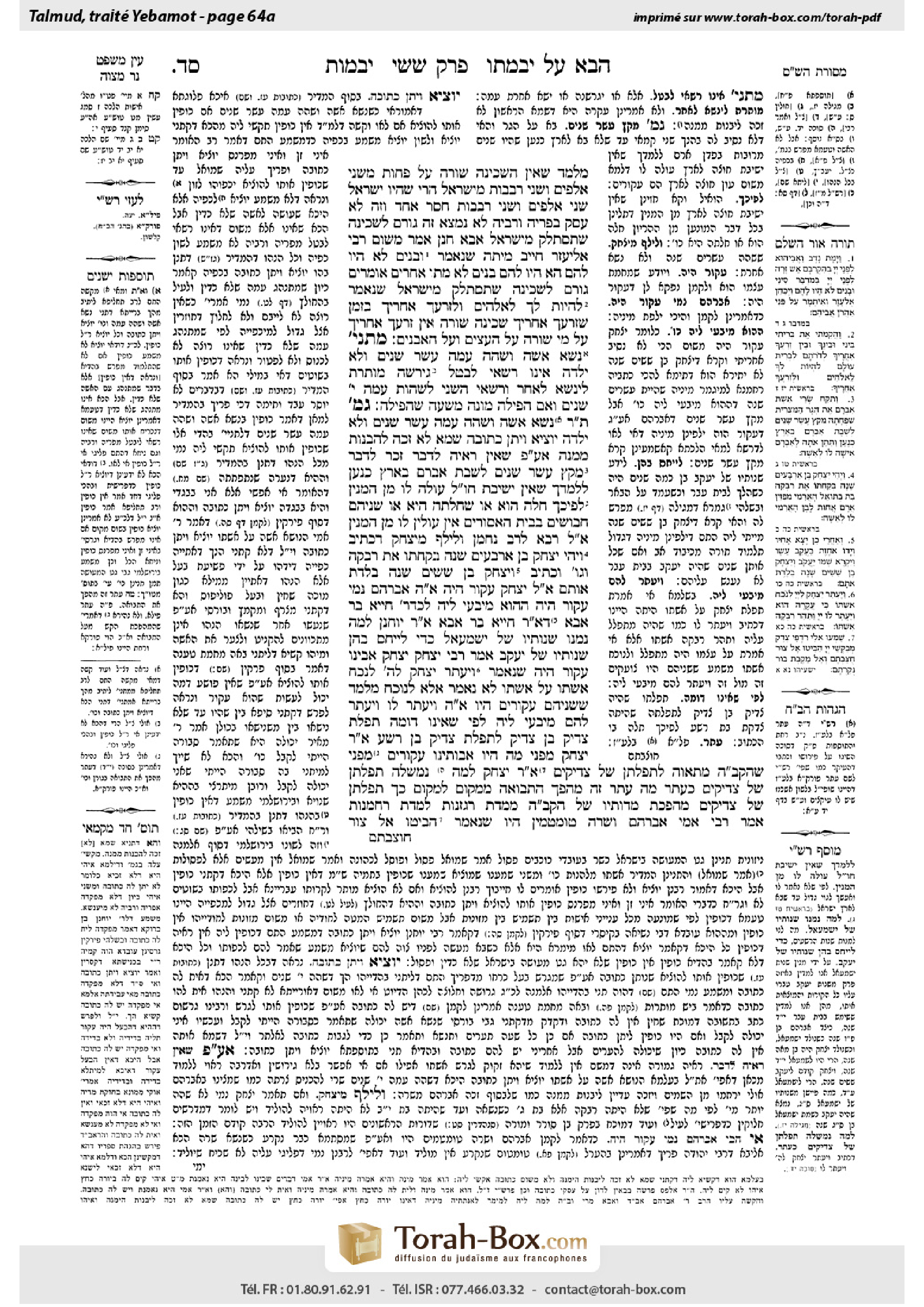
Yevamot 64a: Talmud study for Daf Yomi
Daf Yomi is the daily study of one Talmud folio. Explore 37 tractates with scans, Hebrew text, Sefaria English and AI-generated French translations where annotated.
Passage selection and English or AI-generated French translation are available where the scan has annotations. Daf Study is independent of Torah-Box and Sefaria.
Browse Yevamot · יבמות · All tractatesYevamot 64a text and translations
This page of Yevamot includes the Aramaic text, an English translation and an AI-generated French translation, alongside the scan above.
יבמות ס״ד א · Aramaic and Hebrew text
מְלַמֵּד שֶׁאֵין הַשְּׁכִינָה שׁוֹרָה עַל פָּחוֹת מִשְּׁנֵי אֲלָפִים וּשְׁנֵי רְבָבוֹת מִיִּשְׂרָאֵל. הֲרֵי שֶׁהָיוּ יִשְׂרָאֵל שְׁנֵי אֲלָפִים וּשְׁנֵי רְבָבוֹת חָסֵר אֶחָד, וְזֶה לֹא עָסַק בִּפְרִיָּה וּרְבִיָּה — לֹא נִמְצָא זֶה גּוֹרֵם לַשְּׁכִינָה שֶׁתִּסְתַּלֵּק מִיִּשְׂרָאֵל?!
אַבָּא חָנָן אָמַר מִשּׁוּם רַבִּי אֱלִיעֶזֶר: חַיָּיב מִיתָה, שֶׁנֶּאֱמַר: ״וּבָנִים לֹא הָיוּ לָהֶם״, הָא הָיוּ לָהֶם בָּנִים — לֹא מֵתוּ. אֲחֵרִים אוֹמְרִים: גּוֹרֵם לַשְּׁכִינָה שֶׁתִּסְתַּלֵּק מִיִּשְׂרָאֵל, שֶׁנֶּאֱמַר: ״לִהְיוֹת לְךָ לֵאלֹהִים וּלְזַרְעֲךָ אַחֲרֶיךָ״, בִּזְמַן שֶׁזַּרְעֲךָ אַחֲרֶיךָ — שְׁכִינָה שׁוֹרָה, אֵין ״זַרְעֲךָ אַחֲרֶיךָ״ — עַל מִי שׁוֹרָה? עַל הָעֵצִים וְעַל הָאֲבָנִים?!
מַתְנִי׳ נָשָׂא אִשָּׁה וְשָׁהָה עִמָּהּ עֶשֶׂר שָׁנִים וְלֹא יָלְדָה — אֵינוֹ רַשַּׁאי לְבַטֵּל. גֵּירְשָׁהּ — מוּתֶּרֶת לִינָּשֵׂא לְאַחֵר. וְרַשַּׁאי הַשֵּׁנִי לִשְׁהוֹת עִמָּהּ עֶשֶׂר שָׁנִים. וְאִם הִפִּילָה — מוֹנֶה מִשָּׁעָה שֶׁהִפִּילָה.
גְּמָ׳ תָּנוּ רַבָּנַן: נָשָׂא אִשָּׁה וְשָׁהָה עִמָּהּ עֶשֶׂר שָׁנִים וְלֹא יָלְדָה — יוֹצִיא וְיִתֵּן כְּתוּבָה, שֶׁמָּא לֹא זָכָה לְהִבָּנוֹת מִמֶּנָּה.
אַף עַל פִּי שֶׁאֵין רְאָיָה לַדָּבָר, זֵכֶר לַדָּבָר: ״מִקֵּץ עֶשֶׂר שָׁנִים לְשֶׁבֶת אַבְרָם בְּאֶרֶץ כְּנָעַן״ — לְלַמֶּדְךָ שֶׁאֵין יְשִׁיבַת חוּץ לָאָרֶץ עוֹלֶה לוֹ מִן הַמִּנְיָן. לְפִיכָךְ, חָלָה הוּא אוֹ שֶׁחָלְתָה הִיא, אוֹ שְׁנֵיהֶם חֲבוּשִׁים בְּבֵית הָאֲסוּרִים — אֵין עוֹלִין לוֹ מִן הַמִּנְיָן.
אֲמַר לֵיהּ רָבָא לְרַב נַחְמָן: וְלֵילַף מִיִּצְחָק, דִּכְתִיב: ״וַיְהִי יִצְחָק בֶּן אַרְבָּעִים שָׁנָה בְּקַחְתּוֹ אֶת רִבְקָה וְגוֹ׳״, וּכְתִיב: ״וְיִצְחָק בֶּן שִׁשִּׁים שָׁנָה בְּלֶדֶת אוֹתָם״! אֲמַר לֵיהּ: יִצְחָק עָקוּר הָיָה.
אִי הָכִי, אַבְרָהָם נָמֵי עָקוּר הָיָה! הַהוּא מִיבְּעֵי לֵיהּ לְכִדְרַבִּי חִיָּיא בַּר אַבָּא. דְּאָמַר רַבִּי חִיָּיא בַּר אַבָּא אָמַר רַבִּי יוֹחָנָן: לָמָּה נִמְנוּ שְׁנוֹתָיו שֶׁל יִשְׁמָעֵאל — כְּדֵי לְיַיחֵס בָּהֶן שְׁנוֹתָיו שֶׁל יַעֲקֹב.
אָמַר רַבִּי יִצְחָק: יִצְחָק אָבִינוּ עָקוּר הָיָה, שֶׁנֶּאֱמַר: ״וַיֶּעְתַּר יִצְחָק לַה׳ לְנֹכַח אִשְׁתּוֹ״. ״עַל אִשְׁתּוֹ״ לֹא נֶאֱמַר, אֶלָּא ״לְנוֹכַח״, מְלַמֵּד שֶׁשְּׁנֵיהֶם עֲקוּרִים הָיוּ. אִי הָכִי: ״וַיֵּעָתֶר לוֹ״ — ״וַיֵּעָתֵר לָהֶם״ מִיבְּעֵי לֵיהּ! לְפִי שֶׁאֵינוֹ דּוֹמֶה תְּפִלַּת צַדִּיק בֶּן צַדִּיק לִתְפִלַּת צַדִּיק בֶּן רָשָׁע.
אָמַר רַבִּי יִצְחָק: מִפְּנֵי מָה הָיוּ אֲבוֹתֵינוּ עֲקוּרִים — מִפְּנֵי שֶׁהַקָּדוֹשׁ בָּרוּךְ הוּא מִתְאַוֶּה לִתְפִלָּתָן שֶׁל צַדִּיקִים. אָמַר רַבִּי יִצְחָק: לָמָּה נִמְשְׁלָה תְּפִלָּתָן שֶׁל צַדִּיקִים כְּעֶתֶר — מָה עֶתֶר זֶה מְהַפֵּךְ הַתְּבוּאָה מִמָּקוֹם לְמָקוֹם, כָּךְ תְּפִלָּתָן שֶׁל צַדִּיקִים מְהַפֶּכֶת מִדּוֹתָיו שֶׁל הַקָּדוֹשׁ בָּרוּךְ הוּא מִמִּדַּת רַגְזָנוּת לְמִדַּת רַחֲמָנוּת. אָמַר רַבִּי אַמֵּי: אַבְרָהָם וְשָׂרָה טוּמְטְמִין הָיוּ, שֶׁנֶּאֱמַר: ״הַבִּיטוּ אֶל צוּר
Yevamot 64a · English translation
This teaches that the Divine Presence does not rest upon less than two thousands and two ten-thousands of the Jewish people, as the terms thousands and ten-thousands are both in the plural. Consequently, if there were two thousands and two ten-thousands of the Jewish people, less one, and this man did not engage in the mitzva to be fruitful and multiply, is he not found to have caused the Divine Presence to be depart from the Jewish people?
Abba Ḥanan said in the name of Rabbi Eliezer: A man who does not engage in procreation is liable to death, as it is stated with regard to the sons of Aaron: “And Nadav and Avihu died…and they had no children” (Numbers 3:4). This indicates that if they would have had children they would not have died. Others say: He causes the Divine Presence to depart from the Jewish people, as it is stated: “To be a God to you and to your seed after you” (Genesis 17:7). When your seed is after you, i.e., when you have children, the Divine Presence rests upon the Jewish people, but if your seed is not after you, upon whom can the Divine Presence rest? Upon wood and stones?
MISHNA: If a man married a woman and stayed with her for ten years and she did not give birth, he is no longer permitted to neglect the mitzva to be fruitful and multiply. Consequently, he must either divorce her and marry someone else, or take another wife while still married to her. If he divorced her she is permitted to marry another man, as it is not necessarily on her account that she and her first husband did not have children, and the second husband is permitted to stay with her for ten years. And if she had a miscarriage, he counts the ten years from the time of the miscarriage.
GEMARA: The Sages taught: If a man married a woman and stayed with her for ten years and she did not give birth, he should divorce her and pay her marriage contract, because perhaps he did not merit to be built, i.e., to have children, from her. It is not certain that their failure to have children is due to her, as it is possible that they are not a suitable match for bearing children.
Although there is no explicit proof for the matter that one must take another wife if he has not had children after ten years of marriage, there is an allusion to the matter, as the verse states: “And Sarai, Abram’s wife, took Hagar…after Abram had dwelled ten years in the land of Canaan, and gave her to Abram her husband to be his wife” (Genesis 16:3). Incidentally, this verse also comes to teach you that the years spent dwelling outside of Eretz Yisrael do not count as part of his tally. Consequently, if he was sick during this period or she was sick, or if one of the two of them was imprisoned in jail, it does not count as part of his tally.
Rava said to Rav Naḥman: Let us derive from Isaac that one may wait a longer period of time, as it is written: “And Isaac was forty years old when he took Rebekah…to be his wife” (Genesis 25:20), and it is written with regard to the birth of Jacob and Esau: “And Isaac was sixty years old when she bore them” (Genesis 25:26). This indicates that one may wait twenty years. Rav Naḥman said to him: Isaac knew that he was infertile, and therefore there was no reason for him to marry another woman, as Rebekah was not the cause of their infertility.
The Gemara responds: If so, Abraham also should not have married another woman, as he was also infertile. Rather, the tanna requires that verse that states when Jacob and Esau were born for that which Rabbi Ḥiyya bar Abba taught. This is because Rabbi Ḥiyya bar Abba said that Rabbi Yoḥanan said: Why were Ishmael’s years counted in the Torah, as they do not appear to be relevant to its narrative? In order to determine through them the years of Jacob, i.e., Jacob’s age at the time that various events took place, as explained in tractate Megilla (17a). The verse concerning Jacob’s birth was not meant to allude to a halakha about remaining married before having children, but to make it possible to determine Jacob’s age by relating it to the age of Ishmael.
Rabbi Yitzḥak said: Isaac our father was infertile, as it is stated: “And Isaac entreated the Lord concerning [lenokhaḥ] his wife because she was barren” (Genesis 25:21). It is not stated that he entreated the Lord for [al] his wife, but lenokhaḥ, which can mean opposite, against, or corresponding to; this teaches that they were both infertile. The Gemara asks: If so, why does the verse continue: “And the Lord let Himself be entreated of him”? The verse should say: And the Lord let Himself be entreated of them. The Gemara answers that their prayers were answered due to Isaac, because the prayer of a righteous individual who is the son of a righteous individual is not similar to the prayer of a righteous individual who is the son of a wicked individual, and Rebekah’s father was the wicked Bethuel.
Rabbi Yitzḥak said: For what reason were our forefathers initially infertile? Because the Holy One, Blessed be He, desires the prayers of the righteous, and He therefore wanted them to pray for children. Similarly, Rabbi Yitzḥak said: Why are the prayers of the righteous compared to a pitchfork [eter], as in the verse: “And He let Himself be entreated [vaye’ater]”? This indicates that just as this pitchfork turns over produce from one place to another, so the prayer of the righteous turns over the attributes of the Holy One, Blessed be He, from the attribute of rage to the attribute of mercy. Rabbi Ami said: Abraham and Sarah were originally tumtumin, people whose sexual organs are concealed and not functional, as it is stated: “Look to the rock
Yevamot 64a · Traduction française (IA)
Cela enseigne que la Présence divine ne repose pas sur moins de deux milliers et de deux myriades de membres du peuple juif, puisque les termes « milliers » et « myriades » sont tous deux au pluriel. Par conséquent, s’il y avait deux milliers et deux myriades de membres du peuple juif moins un, et que cet homme n’accomplissait pas la mitsva de procréer et de se multiplier, n’aurait-il pas fait en sorte que la Présence divine quitte le peuple juif ?
Abba Ḥanan a dit au nom de Rabbi Eliezer : Un homme qui ne procrée pas est passible de mort, comme il est dit au sujet des fils d’Aaron : « Nadav et Avihou moururent… et ils n’avaient pas d’enfants » (Nombres 3:4). Cela indique que s’ils avaient eu des enfants, ils ne seraient pas morts. D’autres disent : Il fait partir la Présence divine du peuple juif, comme il est dit : « Afin d’être Dieu pour toi et pour ta descendance après toi » (Genèse 17:7). Lorsque ta descendance vient après toi, c’est-à-dire lorsque tu as des enfants, la Présence divine repose sur le peuple juif ; mais si ta descendance ne vient pas après toi, sur qui la Présence divine pourrait-elle reposer ? Sur du bois et des pierres ?
Michna : Si un homme a épousé une femme et a vécu avec elle pendant dix ans sans qu’elle ait d’enfant, il ne lui est plus permis de négliger la mitsva de procréer et de se multiplier. Il doit donc soit divorcer d’elle et épouser une autre femme, soit prendre une autre épouse tout en restant marié à elle. S’il divorce d’elle, elle peut épouser un autre homme, car il n’est pas certain que leur absence d’enfants soit due à elle ; son second mari peut rester avec elle pendant dix ans. Si elle fait une fausse couche, il compte les dix ans à partir de celle-ci.
Guemara : Les Sages ont enseigné : Si un homme a épousé une femme et a vécu avec elle pendant dix ans sans qu’elle ait d’enfant, il doit divorcer d’elle et lui verser sa ketouba, car peut-être n’a-t-il pas mérité d’avoir des enfants avec elle. Il n’est pas certain que leur incapacité à avoir des enfants soit due à elle ; il est possible qu’ils ne soient pas un couple compatible pour en avoir.
Bien qu’il n’y ait pas de preuve explicite qu’un homme doive prendre une autre épouse s’il n’a pas eu d’enfants après dix ans de mariage, il existe une allusion à cette règle, comme le dit le verset : « Saraï, femme d’Abram, prit Hagar… après qu’Abram eut habité dix ans dans le pays de Canaan, et la donna pour femme à Abram, son mari » (Genèse 16:3). Incidemment, ce verset vient également t’enseigner que les années passées à habiter hors d’Eretz Israël ne sont pas comptées dans le calcul. Par conséquent, s’il a été malade pendant cette période, ou si elle a été malade, ou si l’un d’eux a été emprisonné, cette période n’entre pas dans le calcul.
Rava dit à Rav Naḥman : Déduisons d’Isaac qu’on peut attendre plus longtemps, car il est écrit : « Isaac avait quarante ans lorsqu’il prit Rébecca… pour femme » (Genèse 25:20), et il est écrit au sujet de la naissance de Jacob et d’Ésaü : « Isaac avait soixante ans lorsqu’elle les enfanta » (Genèse 25:26). Cela indique qu’on peut attendre vingt ans. Rav Naḥman lui dit : Isaac savait qu’il était stérile ; il n’y avait donc aucune raison pour lui d’épouser une autre femme, puisque Rébecca n’était pas la cause de leur stérilité.
La Guemara répond : Dans ce cas, Abraham non plus n’aurait pas dû épouser une autre femme, puisqu’il était également stérile. En réalité, le tanna a besoin du verset qui indique la naissance de Jacob et d’Ésaü pour ce que Rabbi Ḥiyya bar Abba a enseigné. En effet, Rabbi Ḥiyya bar Abba a dit que Rabbi Yoḥanan a dit : Pourquoi les années d’Ismaël sont-elles comptées dans la Torah, alors qu’elles ne semblent pas pertinentes pour son récit ? Pour déterminer grâce à elles les années de Jacob, c’est-à-dire l’âge de Jacob au moment des différents événements, comme l’explique le traité Meguila (17a). Le verset concernant la naissance de Jacob ne visait pas à suggérer une halakha sur la durée pendant laquelle on peut rester marié sans avoir d’enfants, mais à permettre de déterminer l’âge de Jacob en le rapportant à celui d’Ismaël.
Rabbi Yitzḥak a dit : Notre père Isaac était stérile, comme il est dit : « Isaac implora le Seigneur au sujet de [lenokhaḥ] sa femme, car elle était stérile » (Genèse 25:21). Il n’est pas dit qu’il implora le Seigneur pour [al] sa femme, mais lenokhaḥ, qui peut signifier « en face de », « contre » ou « en correspondance avec ». Cela enseigne qu’ils étaient tous deux stériles. La Guemara demande : Dans ce cas, pourquoi le verset poursuit-il : « Et le Seigneur se laissa implorer par lui » ? Le verset aurait dû dire : « Et le Seigneur se laissa implorer par eux. » La Guemara répond que leurs prières furent exaucées grâce à Isaac, car la prière d’un juste, fils d’un juste, n’est pas semblable à celle d’un juste, fils d’un méchant ; or, le père de Rébecca, Bethouel, était un méchant.
Rabbi Yitzḥak a dit : Pour quelle raison nos ancêtres étaient-ils stériles au départ ? Parce que le Saint, béni soit-Il, désire les prières des justes, et qu’Il voulait donc qu’ils prient pour avoir des enfants. De même, Rabbi Yitzḥak a dit : Pourquoi les prières des justes sont-elles comparées à une fourche [eter], comme dans le verset : « Et Il se laissa implorer [vaye’ater] » ? Cela indique que, tout comme cette fourche retourne les produits d’un endroit à un autre, la prière des justes transforme les attributs du Saint, béni soit-Il, faisant passer l’attribut de colère à celui de miséricorde. Rabbi Ami a dit : Abraham et Sarah étaient à l’origine des tumtumin, des personnes dont les organes sexuels étaient dissimulés et non fonctionnels, comme il est dit : « Regardez le rocher
Traduction française générée par IA à partir de l’édition anglaise de Sefaria. Vérifie toujours un passage avec le texte source.
Text from Sefaria: William Davidson Edition - Vocalized Aramaic (CC BY NC); William Davidson Edition - English (CC BY NC).