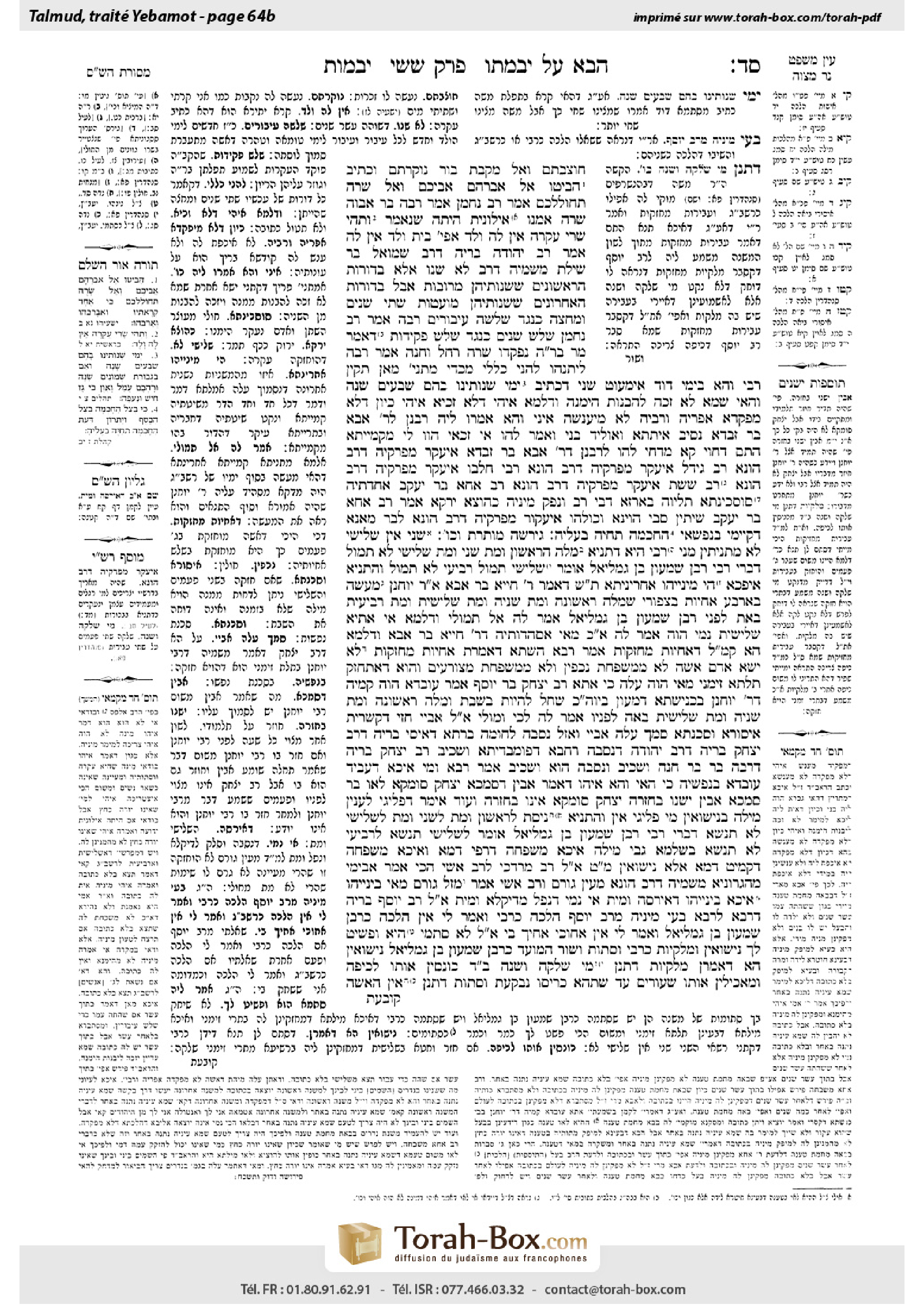
Yevamot 64b: Talmud study for Daf Yomi
Daf Yomi is the daily study of one Talmud folio. Explore 37 tractates with scans, Hebrew text, Sefaria English and AI-generated French translations where annotated.
Passage selection and English or AI-generated French translation are available where the scan has annotations. Daf Study is independent of Torah-Box and Sefaria.
Browse Yevamot · יבמות · All tractatesYevamot 64b text and translations
This page of Yevamot includes the Aramaic text, an English translation and an AI-generated French translation, alongside the scan above.
יבמות ס״ד ב · Aramaic and Hebrew text
חֻצַּבְתֶּם וְאֶל מַקֶּבֶת בּוֹר נֻקַּרְתֶּם״, וּכְתִיב, ״הַבִּיטוּ אֶל אַבְרָהָם אֲבִיכֶם וְאֶל שָׂרָה תְּחוֹלֶלְכֶם״.
אָמַר רַב נַחְמָן אָמַר רַבָּה בַּר אֲבוּהּ: שָׂרָה אִמֵּנוּ אַיְלוֹנִית הָיְתָה, שֶׁנֶּאֱמַר: ״וַתְּהִי שָׂרַי עֲקָרָה אֵין לָהּ וָלָד״, אֲפִילּוּ בֵּית וָלָד אֵין לָהּ.
אָמַר רַב יְהוּדָה בְּרֵיהּ דְּרַב שְׁמוּאֵל בַּר שִׁילַת מִשְּׁמֵיהּ דְּרַב: לֹא שָׁנוּ אֶלָּא בְּדוֹרוֹת הָרִאשׁוֹנִים, שֶׁשְּׁנוֹתֵיהֶן מְרוּבּוֹת. אֲבָל בְּדוֹרוֹת הָאַחֲרוֹנִים, שֶׁשְּׁנוֹתֵיהֶן מוּעָטוֹת — שְׁתֵּי שָׁנִים וּמֶחֱצָה, כְּנֶגֶד שְׁלֹשָׁה עִיבּוּרִים. רַבָּה אָמַר רַב נַחְמָן: שָׁלֹשׁ שָׁנִים, כְּנֶגֶד שָׁלֹשׁ פְּקִידוֹת. דְּאָמַר מָר: בְּרֹאשׁ הַשָּׁנָה נִפְקְדוּ שָׂרָה רָחֵל וְחַנָּה.
אָמַר רַבָּה: לֵיתַנְהוּ לְהָנֵי כְּלָלֵי. מִכְּדֵי מַתְנִיתִין מַאן תַּקֵּין — רַבִּי, וְהָא בִּימֵי דָוִד אִימַּעוּט שְׁנֵי, דִּכְתִיב: ״יְמֵי שְׁנוֹתֵינוּ בָהֶם שִׁבְעִים שָׁנָה״.
וְהַאי ״שֶׁמָּא לֹא זָכָה לְהִבָּנוֹת הֵימֶנָּה״, וְדִלְמָא אִיהִי דְּלָא זָכְיָא? אִיהִי כֵּיוָן דְּלָא מְפַקְּדָא אַפְּרִיָּה וּרְבִיָּה, לָא מִיעַנְשָׁה.
אִינִי? וְהָא אֲמַרוּ לֵיהּ רַבָּנַן לְרַבִּי אַבָּא בַּר זַבְדָּא: נְסֵיב אִיתְּתָא וְאוֹלֵיד בְּנֵי, וַאֲמַר לְהוּ: אִי זְכַאי — הֲווֹ לִי מִקַּמַּיְיתָא. הָתָם דַּחוֹיֵי קָא מְדַחֵי לְהוּ לְרַבָּנַן, דְּרַבִּי אַבָּא בַּר זַבְדָּא אִיעֲקַר מִפִּרְקֵיהּ דְּרַב הוּנָא.
רַב גִּידֵּל אִיעֲקַר מִפִּרְקֵיהּ דְּרַב הוּנָא. רַבִּי חֶלְבּוֹ אִיעֲקַר מִפִּרְקֵיהּ דְּרַב הוּנָא. רַב שֵׁשֶׁת אִיעֲקַר מִפִּרְקֵיהּ דְּרַב הוּנָא. רַב אַחָא בַּר יַעֲקֹב אֲחַדְתֵּיהּ סוּסְכִּינְתָּא, תַּלְיוּהּ בְּאַרְזָא דְּבֵי רַב וּנְפַק מִינֵּיהּ כְּהוּצָא יַרְקָא. אָמַר רַב אַחָא בַּר יַעֲקֹב: שִׁיתִּין סָבֵי הֲוֵינָא וְכוּלְּהוּ אִיעֲקוּר מִפִּרְקֵיהּ דְּרַב הוּנָא לְבַר מֵאֲנָא, דְּקַיֵּימִי בְּנַפְשַׁאי ״הַחׇכְמָה תְּחַיֶּה בְעָלֶיהָ״.
גֵּירְשָׁהּ מוּתֶּרֶת וְכוּ׳. שֵׁנִי — אִין, שְׁלִישִׁי — לָא.
מַתְנִיתִין מַנִּי? רַבִּי הִיא. דְּתַנְיָא: מָלָה הָרִאשׁוֹן וָמֵת, שֵׁנִי וָמֵת, שְׁלִישִׁי — לֹא תָּמוּל, דִּבְרֵי רַבִּי. רַבָּן שִׁמְעוֹן בֶּן גַּמְלִיאֵל אוֹמֵר: שְׁלִישִׁי תָּמוּל, רְבִיעִי — לֹא תָּמוּל.
וְהָתַנְיָא אִיפְּכָא, הֵי מִינַּיְיהוּ (אַחֲרִינִיתָא)?
תָּא שְׁמַע, דְּאָמַר רַבִּי חִיָּיא בַּר אַבָּא אָמַר רַבִּי יוֹחָנָן: מַעֲשֶׂה בְּאַרְבַּע אֲחָיוֹת בְּצִפּוֹרִי שֶׁמָּלָה רִאשׁוֹנָה וָמֵת, שְׁנִיָּה וָמֵת, שְׁלִישִׁית וָמֵת, רְבִיעִית בָּאת לִפְנֵי רַבָּן שִׁמְעוֹן בֶּן גַּמְלִיאֵל. אָמַר לָהּ: אַל תָּמוּלִי.
וְדִלְמָא אִי אָתְיָא שְׁלִישִׁית נָמֵי הֲוָה אָמַר לָהּ? אִם כֵּן, מַאי אַסְהָדוּתֵיהּ דְּרַבִּי חִיָּיא בַּר אַבָּא? וְדִלְמָא הָא קָא מַשְׁמַע לַן דַּאֲחָיוֹת מְחַזְּקוֹת.
אָמַר רָבָא: הַשְׁתָּא דְּאָמְרַתְּ אֲחָיוֹת מְחַזְּקוֹת, לֹא יִשָּׂא אָדָם אִשָּׁה לֹא מִמִּשְׁפַּחַת נִכְפִּין וְלֹא מִמִּשְׁפַּחַת מְצוֹרָעִים. וְהוּא דְּאִתַּחְזַק תְּלָתָא זִימְנֵי.
מַאי הֲוָה עֲלַהּ? כִּי אֲתָא רַב יִצְחָק בַּר יוֹסֵף, אָמַר: עוֹבָדָא הֲוָה קַמֵּיהּ דְּרַבִּי יוֹחָנָן בִּכְנִישְׁתָּא דְמָעוֹן בְּיוֹם הַכִּפּוּרִים שֶׁחָל לִהְיוֹת בְּשַׁבָּת, וּמָלָה רִאשׁוֹנָה וָמֵת, שְׁנִיָּה וָמֵת, שְׁלִישִׁית בָּאָה לְפָנָיו. אָמַר לָהּ: לְכִי וּמוּלִי.
אֲמַר לֵיהּ אַבָּיֵי: חֲזִי דְּקָשָׁרֵית אִיסּוּרָא וְסַכַּנְתָּא.
סְמַךְ עֲלַהּ אַבָּיֵי, וַאֲזַל נַסְבַהּ לְחוּמָה בְּרַתֵּיה דְּאִיסִי בְּרֵיהּ דְּרַב יִצְחָק בְּרֵיהּ דְּרַב יְהוּדָה, דְּנַסְבַהּ רַחֲבָא דְפוּמְבְּדִיתָא וּשְׁכֵיב, רַב יִצְחָק בְּרֵיהּ דְּרַבָּה בַּר בַּר חָנָה וּשְׁכֵיב, וְנַסְבַהּ הוּא וּשְׁכֵיב.
אָמַר רָבָא: וּמִי אִיכָּא דְּעָבֵיד עוֹבָדָא בְּנַפְשֵׁיהּ כִּי הַאי, וְהָא אִיהוּ דְּאָמַר: אָבִין — דְּסַמְכָא, יִצְחָק סוּמָּקָא — לָאו בַּר סַמְכָא. אָבִין — יֶשְׁנוֹ בַּחֲזָרָה, יִצְחָק סוּמָּקָא — אֵינוֹ בַּחֲזָרָה. וְעוֹד: אֵימַר דִּפְלִיגִי לְעִנְיַן מִילָה, בְּנִישּׂוּאִין מִי פְּלִיגִי?
אִין, וְהָתַנְיָא: נִיסֵּת לָרִאשׁוֹן וָמֵת, לַשֵּׁנִי וָמֵת, לַשְּׁלִישִׁי — לֹא תִּנָּשֵׂא, דִּבְרֵי רַבִּי. רַבָּן שִׁמְעוֹן בֶּן גַּמְלִיאֵל אוֹמֵר: לַשְּׁלִישִׁי — תִּנָּשֵׂא, לִרְבִיעִי — לֹא תִּנָּשֵׂא.
בִּשְׁלָמָא גַּבֵּי מִילָה, אִיכָּא מִשְׁפָּחָה דִּרְפֵי דְּמָא וְאִיכָּא מִשְׁפָּחָה דִּקְמִיט דְּמָא, אֶלָּא נִישּׂוּאִין מַאי טַעְמָא? אֲמַר לֵיהּ רַב מָרְדֳּכַי לְרַב אָשֵׁי: הָכִי אָמַר אֲבִימִי מֵהַגְרוֹנְיָא מִשְּׁמֵיהּ דְּרַב הוּנָא: מַעְיָן גּוֹרֵם. וְרַב אָשֵׁי אָמַר: מַזָּל גּוֹרֵם.
מַאי בֵּינַיְיהוּ? אִיכָּא בֵּינַיְיהוּ דְּאֵירְסַהּ וּמִית, אִי נָמֵי דִּנְפַל מִדִּיקְלָא וּמִית.
אֲמַר לֵיהּ רַב יוֹסֵף בְּרֵיהּ דְּרָבָא לְרָבָא, בְּעַי מִינֵּיהּ מֵרַב יוֹסֵף: הֲלָכָה כְּרַבִּי? וַאֲמַר לִי: אִין. הֲלָכָה כְּרַבָּן שִׁמְעוֹן בֶּן גַּמְלִיאֵל? וַאֲמַר לִי: אִין, אַחוֹכֵי אַחֵיךָ בִּי!
אֲמַר לֵיהּ: לָא, סְתָמֵי הִיא וּפְשַׁיט לָךְ: נִישּׂוּאִין וּמַלְקִיּוֹת — כְּרַבִּי. וְסָתוֹת וְשׁוֹר הַמּוּעָד — כְּרַבָּן שִׁמְעוֹן בֶּן גַּמְלִיאֵל.
נִישּׂוּאִין — הָא דַּאֲמַרַן. מַלְקִיּוֹת — דִּתְנַן: מִי שֶׁלָּקָה וְשָׁנָה — בֵּית דִּין כּוֹנְסִין אוֹתוֹ לְכִיפָּה וּמַאֲכִילִין אוֹתוֹ שְׂעוֹרִים עַד שֶׁתְּהֵא כְּרֵיסוֹ נִבְקַעַת. וְסָתוֹת — דִּתְנַן: אֵין הָאִשָּׁה
Yevamot 64b · English translation
from where you were hewn, and to the hole of the pit from where you were dug” (Isaiah 51:1), and it is written in the next verse: “Look to Abraham your father and to Sarah who bore you” (Isaiah 51:2), which indicates that sexual organs were fashioned for them, signified by the words hewn and dug, over the course of time.
Rav Naḥman said that Rabba bar Avuh said: Our mother Sarah was initially a sexually underdeveloped woman [aylonit], as it is stated: “And Sarah was barren; she had no child” (Genesis 11:30). The superfluous words: “She had no child,” indicate that she did not have even a place, i.e., a womb, for a child.
Rav Yehuda, son of Rav Shmuel bar Sheilat, said in the name of Rav: They taught that he waits ten years only with regard to the people who lived in former generations, whose years were numerous, i.e., they lived longer. However, with regard to the people who live in later generations, whose years are few, he waits only two and half years before divorcing her, corresponding to the time period of three pregnancies. Rabba said in the name of Rav Naḥman: He waits three years, corresponding to the three remembrances of barren women by God, as the Master said: On Rosh HaShana Sarah, Rachel, and Hannah were remembered, i.e., God gave them children. Since God determines on Rosh HaShana whether barren women will conceive that year, one may remain married until three such opportunities have passed.
However, Rabba himself said: These principles are not accepted as halakha. Why not? Now consider, who established the content of the mishna? Rabbi Yehuda HaNasi. Yet, in the days of King David, many years before the time of Rabbi Yehuda HaNasi, the years of an average lifespan were already diminished, as it is written: “The days of our years are seventy years, and if with strength eighty years” (Psalms 90:10). Consequently, if Rabbi Yehuda HaNasi included in the mishna the statement that one remains married for ten years, that must apply even nowadays.
The Gemara asks about the language of the baraita. And what about this expression: Perhaps he did not merit to be built from her; perhaps it was she who did not merit to build a family. The Gemara answers: She, since she is not commanded to be fruitful and multiply, is not punished. Their worthiness therefore depends on him, not her.
The Gemara challenges the mishna’s statement that if one did not have children after ten years he should marry a different woman. Is that so? Didn’t the Sages say to Rabbi Abba bar Zavda: Marry a woman and have children, and he said to them: If I had merited, I would already have children from my first wife? This indicates that there is no obligation to remarry if one did not have children with his first wife. The Gemara answers: There, Rabbi Abba bar Zavda was merely putting the Rabbis off with an excuse, as the real reason why he would not marry was because Rabbi Abba bar Zavda became impotent from Rav Huna’s discourse. Rav Huna’s students would hold back from relieving themselves until his lengthy sermons were finished, which caused them to become sterile.
The Gemara similarly relates that Rav Giddel became impotent from Rav Huna’s discourse, Rav Ḥelbo became impotent from Rav Huna’s discourse, and Rav Sheshet became impotent from Rav Huna’s discourse. The Gemara relates: Rav Aḥa bar Ya’akov was afflicted by suskhinta, a disease caused by holding back from urinating. They suspended him from the cedar column that supported the study hall, and a substance that was as green as a palm leaf emerged from him, and he was healed. Rav Aḥa bar Ya’akov said: We were sixty elders present at the time, and they all became impotent from Rav Huna’s discourse, aside from me, as I fulfilled with regard to myself the verse: “Wisdom preserves the life of he who has it” (Ecclesiastes 7:12). I used the above cure to avoid becoming impotent.
§ It was taught in the mishna that if a man divorced his wife after ten years without children, she is permitted to marry a second man, who may remain married to her for ten years. The Gemara comments: A second husband, yes, but a third one, no. Once she has been married to two men without children for ten years each, it is presumed that she is unable to have children.
The Gemara comments: Who is the tanna of the mishna? It is Rabbi Yehuda HaNasi, who holds that a legal presumption [ḥazaka] is established after two occurrences. As it is taught in a baraita: If a woman circumcised her first son and he died as a result of the circumcision, and she circumcised her second son and he also died, she should not circumcise her third son, as the deaths of the first two produce a presumption that this woman’s sons die as a result of circumcision. This is the statement of Rabbi Yehuda HaNasi. Rabban Shimon ben Gamliel says: She should circumcise her third son, as there is not considered to be a legal presumption that her sons die from circumcision, but she should not circumcise her fourth son if her first three sons died from circumcision.
The Gemara asks: Isn’t the reverse taught in a baraita, that Rabbi Yehuda HaNasi holds that the woman’s third son must be circumcised and Rabban Shimon ben Gamliel holds that he is not circumcised? Which of them was composed later and is therefore presumed to be more reliable?
The Gemara suggests: Come and hear, as Rabbi Ḥiyya bar Abba said that Rabbi Yoḥanan said: An incident occurred involving four sisters in Tzippori, that the first sister circumcised her son and he died, and the second sister circumcised her son and he died, and the third one circumcised her son and he too died. The fourth sister came before Rabban Shimon ben Gamliel, who said to her: Do not circumcise him. This indicates that according to Rabban Shimon ben Gamliel a presumption is established only after three occurrences.
The Gemara refutes this proof: Perhaps if the third sister had come before him he would also have said to her the same ruling. The Gemara asks: If so, what is the purpose of Rabbi Ḥiyya bar Abba’s testimony? Why would he have related this incident if it does not teach us anything? The Gemara answers: Perhaps he comes to teach us that sisters establish a presumption in a case like this even though the children who died were not from the same mother.
Rava said: Now that you have said that sisters establish a presumption, a man should not marry a woman from a family of epileptics or from a family of lepers, as these diseases might be hereditary. The Gemara adds: And this applies only if it was established three times, i.e., three members of the family are afflicted with the disease.
The Gemara asks: Which halakhic conclusion was about this matter? Is a presumption established after two occurrences or only after three? When Rav Yitzḥak bar Yosef came from Eretz Yisrael, he said: An incident occurred before Rabbi Yoḥanan in the synagogue of the town of Maon on a Yom Kippur that occurred on Shabbat. The first sister had circumcised her son and he died; the second sister circumcised her son and he also died. The third sister came before him, and he said to her: Go and circumcise your son, as a presumption is not established after only two occurrences.
Abaye said to Rav Yitzḥak: See to it that your report is accurate, as you are permitting an action that would otherwise constitute a prohibition and a danger. If the third baby should not be circumcised, doing so would be a prohibited labor and would endanger the life of the child.
The Gemara comments: Abaye relied on this report and went and married Ḥuma, the daughter of Isi, son of Rav Yitzḥak, son of Rav Yehuda. Ḥuma had previously married Raḥava of Pumbedita, and he died, and then she married Rav Yitzḥak, son of Rabba bar bar Ḥana, and he died; and he, Abaye, married her nevertheless, without concern that she had been established to be a woman whose husbands die; and he died as well while married to her.
Rava said: Is there anyone who performs an action like this and endangers himself by marrying such a woman? Wasn’t it he, Abaye, who said that Avin is reliable but Yitzḥak the Red, i.e., Rav Yitzḥak bar Yosef, is not reliable? He proceeds to explain the difference between them: Avin returns to Eretz Yisrael and hears whether the Sages there rescind their previous rulings, whereas Yitzḥak the Red does not return to Eretz Yisrael and never finds out if the Sages there rescind their rulings. And furthermore, say that they disagree with regard to whether a presumption is established by two or by three deaths due to circumcision, but do they necessarily argue with regard to marriage?
The Gemara responds: Yes, and it is taught in a baraita: If a woman was married to her first husband and he died, to a second one and he also died, she may not get married to a third husband. This is the statement of Rabbi Yehuda HaNasi. Rabban Shimon ben Gamliel says: She may get married to a third husband, but if he also dies, she may not get married to a fourth husband.
The Gemara asks: Granted with regard to circumcision a presumption of death due to circumcision can be established because there are families whose blood is thin and does not clot well, and there are families whose blood clots. However, in the case of marriage, what is the reason for concern that a subsequent husband will die? Rav Mordekhai said to Rav Ashi: Avimi of Hagron-ya said in the name of Rav Huna as follows: Her spring is the cause. In other words, the woman has some sort of condition that causes those who have intercourse with her to die. And Rav Ashi said that her constellation is the cause of her husbands’ deaths.
The Gemara asks: What is the practical difference between them? The Gemara answers: There is a difference between them in a case where a man betrothed her and died before the wedding; alternatively, in a case where he fell off a palm tree and died. If the concern is due to intercourse, then in these cases the husband’s death cannot be attributed to his wife. Conversely, if the concern is due to her bad fortune, the husband’s death can be attributed to his wife even in these cases.
Rav Yosef, son of Rava, said to Rava: I inquired of Rav Yosef whether the halakha is in accordance with the opinion of Rabbi Yehuda HaNasi, and he said to me: Yes. I subsequently asked him if the halakha is in accordance with the opinion of Rabban Shimon ben Gamliel, and he said to me: Yes. Was he mocking me by issuing contradictory rulings?
Rava said to him: No, there are unattributed mishnayot in accordance with each opinion, and he resolved for you that the halakha is in accordance with each opinion in particular cases. With regard to marriage and lashings the halakha is in accordance with the opinion of Rabbi Yehuda HaNasi that two occurrences are sufficient for a presumption. Concerning set patterns of menstrual bleeding and a forewarned ox, the halakha is in accordance with the opinion of Rabban Shimon ben Gamliel that a presumption is established after three occurrences.
The Gemara identifies the aforementioned halakhot. Marriage is referring to that which we said with regard to a woman whose husbands have died. The case of lashings is as we learned in a mishna (Nidda 63b): One who was flogged for transgressing a Torah law, and repeated the same transgression and was flogged again, if he then repeats the sin a third time, the court places him in a narrow, vaulted chamber and they feed him barley until his stomach bursts. Once he has sinned and been flogged twice he has established a presumption of wickedness, and when he sins again he is caused to die so that he will not continue to sin. The case of set patterns of menstrual bleeding is as we learned in a mishna (Nidda 63b): A woman does not
Yevamot 64b · Traduction française (IA)
« d’où vous avez été taillés et au creux de la fosse d’où vous avez été extraits » (Isaïe 51:1), et il est écrit au verset suivant : « Regardez Abraham, votre père, et Sarah, qui vous a enfantés » (Isaïe 51:2). Cela indique que leurs organes sexuels se sont formés au fil du temps, comme le suggèrent les mots « taillés » et « extraits ».
Rav Naḥman dit au nom de Rabba bar Avuh : Notre mère Sarah était à l’origine une femme dont les organes sexuels étaient sous-développés [aylonit], comme il est dit : « Sarah était stérile ; elle n’avait pas d’enfant » (Genèse 11:30). Les mots superflus « elle n’avait pas d’enfant » indiquent qu’elle n’avait même pas de place pour un enfant, c’est-à-dire pas d’utérus.
Rav Yehuda, fils de Rav Shmuel bar Sheilat, dit au nom de Rav : Ils ont enseigné qu’il attend dix ans uniquement à propos des gens des générations anciennes, dont la durée de vie était longue, c’est-à-dire qui vivaient plus longtemps. En revanche, pour les gens des générations ultérieures, dont la durée de vie est courte, il n’attend que deux ans et demi avant de divorcer, ce qui correspond à la durée de trois grossesses. Rabba dit au nom de Rav Naḥman : Il attend trois ans, correspondant aux trois fois où Dieu se souvint de femmes stériles, car le Maître a dit : À Roch Hachana, Sarah, Rachel et Hannah furent exaucées, c’est-à-dire que Dieu leur accorda des enfants. Puisque Dieu décide à Roch Hachana si les femmes stériles concevront cette année-là, on peut rester marié jusqu’à ce que trois occasions de ce genre se soient présentées.
Cependant, Rabba lui-même dit : Ces principes ne sont pas retenus comme halakha. Pourquoi ? Réfléchissons : qui a établi le contenu de la Michna ? Rabbi Yehuda HaNassi. Or, déjà à l’époque du roi David, de nombreuses années avant celle de Rabbi Yehuda HaNassi, la durée de vie moyenne avait diminué, comme il est écrit : « Les jours de nos années sont de soixante-dix ans, et, si nous sommes vigoureux, de quatre-vingts ans » (Psaumes 90:10). Par conséquent, si Rabbi Yehuda HaNassi a inclus dans la Michna l’affirmation selon laquelle on reste marié dix ans, celle-ci doit s’appliquer même de nos jours.
La Guemara interroge la formulation de la baraïta : Que signifie cette expression : « Peut-être n’a-t-il pas mérité d’être édifié par elle ; peut-être est-ce elle qui n’a pas mérité de bâtir une famille » ? La Guemara répond : Puisqu’elle n’est pas tenue d’accomplir la mitsva de procréer, elle n’est pas punie. Leur mérite dépend donc de lui, et non d’elle.
La Guemara conteste l’affirmation de la Michna selon laquelle, s’il n’a pas eu d’enfants après dix ans, il doit épouser une autre femme. En est-il vraiment ainsi ? Les Sages n’ont-ils pas dit à Rabbi Abba bar Zavda : « Épouse une femme et aie des enfants », et ne leur a-t-il pas répondu : « Si j’en avais été digne, j’aurais déjà eu des enfants de ma première femme » ? Cela indique qu’il n’est pas obligé de se remarier s’il n’a pas eu d’enfants avec sa première femme. La Guemara répond : Dans ce cas, Rabbi Abba bar Zavda ne faisait que trouver une excuse pour éconduire les Sages, car la véritable raison pour laquelle il ne voulait pas se marier était qu’il était devenu impuissant à cause des longs discours de Rav Huna. Les élèves de Rav Huna se retenaient d’uriner jusqu’à la fin de ses longs discours, ce qui les rendait stériles.
La Guemara rapporte de même que Rav Giddel était devenu impuissant à cause des discours de Rav Huna, que Rav Ḥelbo était devenu impuissant à cause des discours de Rav Huna et que Rav Sheshet était devenu impuissant à cause des discours de Rav Huna. La Guemara rapporte : Rav Aḥa bar Ya’akov fut atteint de suskhinta, une maladie provoquée par le fait de se retenir d’uriner. On le suspendit à la colonne de cèdre qui soutenait la maison d’étude, et une substance verte comme une feuille de palmier sortit de lui ; il fut alors guéri. Rav Aḥa bar Ya’akov dit : Nous étions soixante anciens présents à ce moment-là, et tous, sauf moi, étaient devenus impuissants à cause des discours de Rav Huna, car j’avais appliqué à mon propre cas le verset : « La sagesse préserve la vie de celui qui la possède » (Ecclésiaste 7:12). J’ai utilisé le remède décrit plus haut pour éviter de devenir impuissant.
§ Il a été enseigné dans la Michna que si un homme a divorcé de sa femme après dix ans sans avoir eu d’enfants, elle peut épouser un deuxième homme, qui peut rester marié avec elle pendant dix ans. La Guemara fait remarquer : Un deuxième mari, oui, mais pas un troisième. Après qu’elle a été mariée à deux hommes, dix ans avec chacun, sans avoir eu d’enfants, on présume qu’elle est incapable d’en avoir.
La Guemara fait remarquer : Qui est le tanna de la Michna ? C’est Rabbi Yehuda HaNassi, qui considère qu’une présomption juridique [ḥazaka] s’établit après deux occurrences. En effet, il est enseigné dans une baraïta : Si une femme a circoncis son premier fils et qu’il est mort des suites de la circoncision, puis qu’elle a circoncis son deuxième fils et qu’il est également mort, elle ne doit pas circoncire son troisième fils, car la mort des deux premiers établit la présomption que les fils de cette femme meurent des suites de la circoncision. Telle est l’opinion de Rabbi Yehuda HaNassi. Rabban Shimon ben Gamliel dit : Elle doit circoncire son troisième fils, car on ne considère pas qu’une présomption juridique ait été établie selon laquelle ses fils meurent des suites de la circoncision ; mais elle ne doit pas circoncire son quatrième fils si ses trois premiers fils sont morts des suites de la circoncision.
La Guemara demande : N’est-ce pas l’inverse qui est enseigné dans une baraïta, selon laquelle Rabbi Yehuda HaNassi considère que le troisième fils de la femme doit être circoncis et Rabban Shimon ben Gamliel qu’il ne doit pas l’être ? Laquelle des deux versions a été formulée plus tard et est donc présumée plus fiable ?
La Guemara propose : Viens et entends, car Rabbi Ḥiyya bar Abba a dit au nom de Rabbi Yoḥanan : Un événement impliquant quatre sœurs eut lieu à Tzippori : la première sœur circoncit son fils, qui mourut ; la deuxième sœur circoncit son fils, qui mourut ; la troisième circoncit son fils, qui mourut également. La quatrième sœur se présenta devant Rabban Shimon ben Gamliel, qui lui dit : « Ne le circoncis pas. » Cela indique que, selon Rabban Shimon ben Gamliel, une présomption ne s’établit qu’après trois occurrences.
La Guemara réfute cette preuve : Peut-être que, si la troisième sœur s’était présentée devant lui, il lui aurait également donné la même décision. La Guemara demande : Dans ce cas, à quoi sert le témoignage de Rabbi Ḥiyya bar Abba ? Pourquoi aurait-il rapporté cet événement s’il ne nous apprenait rien ? La Guemara répond : Peut-être veut-il nous enseigner que des sœurs établissent une présomption dans un cas de ce genre, même si les enfants qui sont morts n’avaient pas la même mère.
Rava dit : Puisque nous avons établi que des sœurs établissent une présomption, un homme ne doit pas épouser une femme issue d’une famille d’épileptiques ou de lépreux, car ces maladies peuvent être héréditaires. La Guemara ajoute : Cela ne s’applique que si le phénomène s’est produit trois fois, c’est-à-dire si trois membres de la famille sont atteints de la maladie.
La Guemara demande : Quelle conclusion halakhique a été tirée à ce sujet ? Une présomption s’établit-elle après deux occurrences ou seulement après trois ? Lorsque Rav Yitzḥak bar Yosef revint d’Eretz Israël, il dit : Un événement eut lieu devant Rabbi Yoḥanan, dans la synagogue de la ville de Maon, un Yom Kippour qui tombait un Chabbat. La première sœur avait circoncis son fils, qui était mort ; la deuxième sœur avait circoncis son fils, qui était lui aussi mort. La troisième sœur se présenta devant lui, et il lui dit : « Va circoncire ton fils, car une présomption ne s’établit pas après seulement deux occurrences. »
Abaye dit à Rav Yitzḥak : Veille à rapporter les faits avec exactitude, car tu autorises un acte qui, autrement, constituerait une transgression et un danger. Si le troisième bébé ne devait pas être circoncis, le circoncire constituerait un travail interdit et mettrait sa vie en danger.
La Guemara fait remarquer : Abaye se fia à ce témoignage et épousa Ḥuma, fille d’Isi, fils de Rav Yitzḥak, fils de Rav Yehuda. Ḥuma avait auparavant épousé Raḥava de Pumbedita, qui mourut ; elle épousa ensuite Rav Yitzḥak, fils de Rabba bar bar Ḥana, qui mourut lui aussi. Abaye l’épousa néanmoins, sans craindre qu’il ait été établi qu’elle était une femme dont les maris meurent ; lui aussi mourut alors qu’il était marié avec elle.
Rava dit : Qui peut agir ainsi et mettre sa vie en danger en épousant une telle femme ? N’est-ce pas Abaye lui-même qui a dit qu’Avin est fiable, mais qu’Yitzḥak le Roux, c’est-à-dire Rav Yitzḥak bar Yosef, ne l’est pas ? Il explique la différence entre eux : Avin retourne en Eretz Israël et apprend si les Sages de là-bas ont rétracté leurs décisions antérieures, tandis qu’Yitzḥak le Roux ne retourne pas en Eretz Israël et ne sait donc jamais si les Sages de là-bas ont rétracté leurs décisions. Et de plus, supposons qu’ils soient en désaccord sur la question de savoir si une présomption s’établit après deux ou trois décès dus à la circoncision ; cela signifie-t-il nécessairement qu’ils sont aussi en désaccord à propos du mariage ?
La Guemara répond : Oui, et il est enseigné dans une baraïta : Si une femme a été mariée à son premier mari et qu’il est mort, puis à un deuxième qui est lui aussi mort, elle ne peut pas épouser un troisième mari. Telle est l’opinion de Rabbi Yehuda HaNassi. Rabban Shimon ben Gamliel dit : Elle peut épouser un troisième mari, mais si celui-ci meurt également, elle ne peut pas épouser un quatrième mari.
La Guemara demande : On comprend qu’en matière de circoncision une présomption de décès dus à la circoncision puisse être établie, car certaines familles ont le sang fluide, qui coagule mal, tandis que d’autres ont un sang qui coagule bien. Mais, dans le cas du mariage, pourquoi craindre qu’un mari suivant meure ? Rav Mordekhai dit à Rav Ashi : Avimi de Hagron-ya a dit au nom de Rav Huna ce qui suit : C’est sa source qui en est la cause. Autrement dit, cette femme souffre d’une sorte d’affection qui provoque la mort de ceux qui ont des rapports sexuels avec elle. Rav Ashi dit, quant à lui, que c’est son destin astral qui cause la mort de ses maris.
La Guemara demande : Quelle différence pratique y a-t-il entre ces explications ? La Guemara répond : Elles diffèrent dans le cas où un homme s’est fiancé avec elle et est mort avant le mariage, ou dans celui où il est tombé d’un palmier et est mort. Si le danger est dû aux rapports sexuels, la mort du mari ne peut pas être attribuée à sa femme dans ces cas. En revanche, si le danger est dû à son mauvais destin, la mort du mari peut être attribuée à sa femme même dans ces cas.
Rav Yosef, fils de Rava, dit à Rava : J’ai demandé à Rav Yosef si la halakha est conforme à l’opinion de Rabbi Yehuda HaNassi, et il m’a répondu : « Oui. » Ensuite, je lui ai demandé si la halakha est conforme à l’opinion de Rabban Shimon ben Gamliel, et il m’a répondu : « Oui. » Se moquait-il de moi en donnant des décisions contradictoires ?
Rava lui dit : Non. Il existe des Michnayot anonymes conformes à chacune de ces opinions, et il t’a expliqué que la halakha suit chacune d’elles dans des cas particuliers. Pour le mariage et la flagellation, la halakha suit l’opinion de Rabbi Yehuda HaNassi, selon laquelle deux occurrences suffisent à établir une présomption. Pour les schémas réguliers de saignements menstruels et le bœuf devenu agressif, la halakha suit l’opinion de Rabban Shimon ben Gamliel, selon laquelle une présomption s’établit après trois occurrences.
La Guemara précise les halakhot mentionnées précédemment. Le mariage renvoie à ce que nous avons dit à propos d’une femme dont les maris sont morts. Le cas de la flagellation est celui que nous avons appris dans une Michna (Nidda 63b) : Celui qui a été flagellé pour avoir transgressé une loi de la Torah, puis a répété la même transgression et a été de nouveau flagellé, et qui commet ensuite le péché une troisième fois, est placé par le tribunal dans une cellule étroite et voûtée ; on lui donne de l’orge à manger jusqu’à ce que son ventre éclate. Dès lors qu’il a péché et a été flagellé deux fois, il a établi une présomption de méchanceté ; lorsqu’il pèche de nouveau, on le fait mourir afin qu’il ne continue pas à pécher. Le cas des schémas réguliers de saignements menstruels est celui que nous avons appris dans une Michna (Nidda 63b) : Une femme ne…
Traduction française générée par IA à partir de l’édition anglaise de Sefaria. Vérifie toujours un passage avec le texte source.
Text from Sefaria: William Davidson Edition - Vocalized Aramaic (CC BY NC); William Davidson Edition - English (CC BY NC).