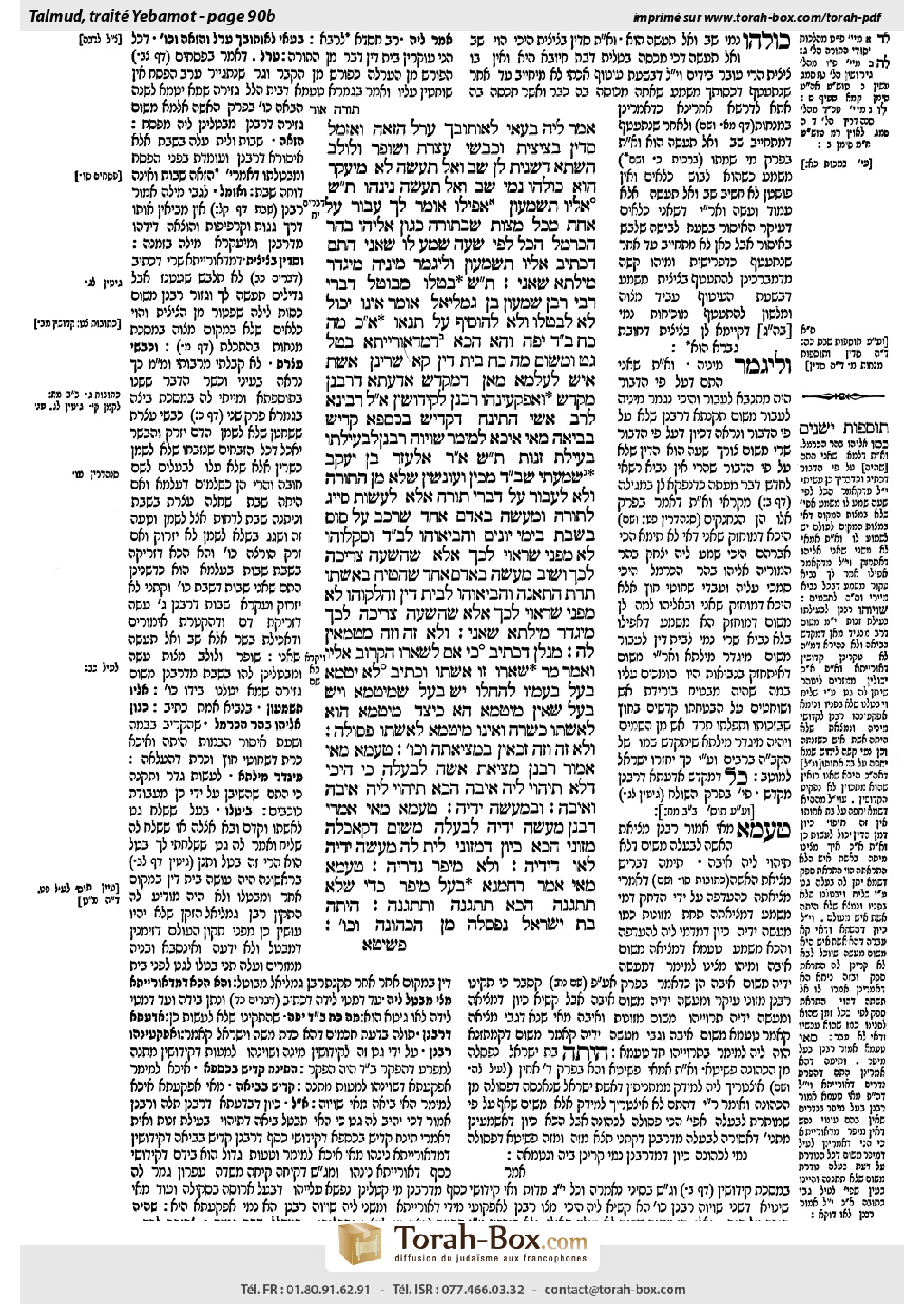
Yevamot 90b: Talmud study for Daf Yomi
Daf Yomi is the daily study of one Talmud folio. Explore 37 tractates with scans, Hebrew text, Sefaria English and AI-generated French translations where annotated.
Passage selection and English or AI-generated French translation are available where the scan has annotations. Daf Study is independent of Torah-Box and Sefaria.
Browse Yevamot · יבמות · All tractatesYevamot 90b text and translations
This page of Yevamot includes the Aramaic text, an English translation and an AI-generated French translation, alongside the scan above.
יבמות צ׳ ב · Aramaic and Hebrew text
אֲמַר לֵיהּ, בְּעַאי לְאוֹתוֹבָךְ: עָרֵל, הַזָּאָה.
וְאִזְמֵל, סָדִין בְּצִיצִית.
וְכִבְשֵׂי עֲצֶרֶת, וְשׁוֹפָר,
וְלוּלָב. הַשְׁתָּא דְּשַׁנִּית לַן ״שֵׁב וְאַל תַּעֲשֶׂה״ לָא מִיעֲקַר הוּא, כּוּלְּהוּ נָמֵי ״שֵׁב וְאַל תַּעֲשֶׂה״ נִינְהוּ.
תָּא שְׁמַע: ״אֵלָיו תִּשְׁמָעוּן״ — אֲפִילּוּ אוֹמֵר לְךָ: עֲבוֹר עַל אַחַת מִכׇּל מִצְוֹת שֶׁבַּתּוֹרָה, כְּגוֹן אֵלִיָּהוּ בְּהַר הַכַּרְמֶל, הַכֹּל לְפִי שָׁעָה — שְׁמַע לוֹ.
שָׁאנֵי הָתָם, דִּכְתִיב: ״אֵלָיו תִּשְׁמָעוּן״. וְלִיגְמַר מִינֵּיהּ! מִיגְדַּר מִילְּתָא שָׁאנֵי.
תָּא שְׁמַע: בִּטְּלוֹ — מְבוּטָּל, דִּבְרֵי רַבִּי. רַבָּן שִׁמְעוֹן בֶּן גַּמְלִיאֵל אוֹמֵר: אֵינוֹ יָכוֹל לֹא לְבַטְּלוֹ, וְלֹא לְהוֹסִיף עַל תְּנָאוֹ. אִם כֵּן — מָה כֹּחַ בֵּית דִּין יָפֶה.
וְהָא הָכָא, דְּמִדְּאוֹרָיְיתָא בָּטֵל גֵּט, וּמִשּׁוּם ״מָה כֹּחַ בֵּית דִּין״ קָא שָׁרֵינַן אֵשֶׁת אִישׁ לְעָלְמָא! מַאן דִּמְקַדֵּשׁ — אַדַּעְתָּא דְּרַבָּנַן מְקַדֵּשׁ, וְאַפְקְעִינְהוּ רַבָּנַן לְקִידּוּשִׁין,
אֲמַר לֵיהּ רָבִינָא לְרַב אָשֵׁי: הָתִינַח דְּקַדֵּישׁ בְּכַסְפָּא, קַדֵּישׁ בְּבִיאָה מַאי אִיכָּא לְמֵימַר? שַׁוְּיוּהּ רַבָּנַן לִבְעִילָתוֹ בְּעִילַת זְנוּת.
תָּא שְׁמַע, אָמַר רַבִּי אֶלְעָזָר בֶּן יַעֲקֹב: שָׁמַעְתִּי שֶׁבֵּית דִּין מַכִּין וְעוֹנְשִׁין שֶׁלֹּא מִן הַתּוֹרָה, וְלֹא לַעֲבוֹר עַל דִּבְרֵי תוֹרָה, אֶלָּא לַעֲשׂוֹת סְיָיג לַתּוֹרָה. וּמַעֲשֶׂה בְּאָדָם אֶחָד שֶׁרָכַב עַל סוּס בַּשַּׁבָּת בִּימֵי יְוָנִים — וֶהֱבִיאוּהוּ לְבֵית דִּין וּסְקָלוּהוּ, לֹא מִפְּנֵי שֶׁרָאוּי לְכָךְ, אֶלָּא שֶׁהַשָּׁעָה צְרִיכָה לְכָךְ.
וְשׁוּב מַעֲשֶׂה בְּאָדָם אֶחָד שֶׁהֵטִיחַ בְּאִשְׁתּוֹ תַּחַת הַתְּאֵנָה, וֶהֱבִיאוּהוּ לְבֵית דִּין וְהִלְקוּהוּ. לֹא מִפְּנֵי שֶׁרָאוּי לְכָךְ, אֶלָּא שֶׁהַשָּׁעָה צְרִיכָה לְכָךְ! מִיגְדַּר מִילְּתָא שָׁאנֵי.
וְלֹא זֶה וָזֶה מְטַמְּאִין לָהּ. מְנָלַן? דִּכְתִיב: ״כִּי אִם לִשְׁאֵרוֹ הַקָּרוֹב אֵלָיו״, וְאָמַר מָר: ״שְׁאֵרוֹ״ — זוֹ אִשְׁתּוֹ,
וּכְתִיב: ״לֹא יִטַּמָּא בַּעַל בְּעַמָּיו לְהֵחַלּוֹ״, יֵשׁ בַּעַל שֶׁמִּיטַּמֵּא, וְיֵשׁ בַּעַל שֶׁאֵין מִיטַּמֵּא. הָא כֵּיצַד? מִיטַּמֵּא הוּא לְאִשְׁתּוֹ כְּשֵׁרָה, וְאֵינוֹ מִיטַּמֵּא לְאִשְׁתּוֹ פְּסוּלָה.
וְלֹא זֶה וָזֶה זַכָּאִין בִּמְצִיאָתָהּ וְכוּ׳. טַעְמָא מַאי אֲמוּר רַבָּנַן מְצִיאַת אִשָּׁה לְבַעְלָהּ — כִּי הֵיכִי דְּלָא תִּיהְוֵי לֵיהּ אֵיבָה. הָכָא תִּיהְוֵי לֵיהּ אֵיבָה וְאֵיבָה.
וּבְמַעֲשֵׂה יָדֶיהָ. טַעְמָא מַאי אָמְרִי רַבָּנַן מַעֲשֵׂה יָדֶיהָ לְבַעְלָהּ — מִשּׁוּם דְּקָאָכְלָה מְזוֹנֵי, הָכָא כֵּיוָן דִּמְזוֹנֵי לֵית לַהּ — מַעֲשֵׂה יָדֶיהָ לָאו דִּידֵיהּ.
וְלֹא מֵיפֵר נְדָרֶיהָ. טַעְמָא מַאי אָמַר רַחֲמָנָא בַּעַל מֵיפֵר — כְּדֵי שֶׁלֹּא תִּתְגַּנֶּה, הָכָא תִּתְגַּנֶּה וְתִתְגַּנֶּה.
הָיְתָה בַּת יִשְׂרָאֵל נִפְסְלָה מִן הַכְּהוּנָּה וְכוּ׳.
Yevamot 90b · English translation
Rav Ḥisda said to Rabba: I wanted to raise a difficulty against you from the halakha of an uncircumcised man. The Sages decreed that one who converts on the eve of Passover may not partake of the Paschal lamb, due to his ritual impurity. According to Beit Hillel, one who separates from the foreskin by being circumcised is ritually impure like one who separates from the grave (Pesaḥim 92a). This is the halakha despite the fact that by Torah law he is obligated to bring the offering. Rav Ḥisda continued: And I also thought of asking from the case of sprinkling the waters of a purification offering for one who became ritually impure through contact with a corpse, as the Sages rendered it prohibited for one who is impure to receive the sprinkling on the eve of Passover that occurred on Shabbat, although this prevents him from partaking of the Paschal lamb.
And I was likewise going to raise a question from the case of a circumcision knife, which the Sages decreed may not be carried on Shabbat, despite the fact that this entails the neglect of a Torah mitzva. And I also wanted to raise a question from the case of a linen cloak, on which the Sages did not allow one to place ritual fringes made of wool. This is a decree that was issued lest he do the same with a garment worn only at night, which is exempt from fringes, and therefore this would be a mixture of wool and linen that is forbidden, although this means that he is unable to fulfill the mitzva of ritual fringes.
And likewise I wanted to mention a difficulty from the case of the lambs sacrificed on Shavuot. When the festival of Shavuot occurs on Shabbat, the Sages rendered it prohibited to sprinkle the blood of its sacrificial lambs if the offerings had not been slaughtered with the proper intention, despite the fact that the sprinkling itself is not prohibited by Torah law. And similarly, there is a difficulty with regard to the halakha of the shofar, which is sounded on Rosh HaShana, and yet the Sages rendered it prohibited for it to be blown on Shabbat, lest one carry it four cubits in the public domain.
And finally I wished to raise a difficulty from the case of a lulav, which may not be carried on the first day of Sukkot that occurred on Shabbat, for the same reason the Sages rendered it prohibited to sound the shofar on Rosh HaShana that occurs on Shabbat. However, now that you have resolved for us that an action defined as a case of: Sit and refrain from action, is not considered uprooting, all these are also cases of sit and refrain from action.
The Gemara suggests: Come and hear another proof. The verse states with regard to a true prophet: “To him you shall listen” (Deuteronomy 18:15). From here it is derived that even if the prophet says to you: Transgress one of the mitzvot of the Torah, for example, as in the case of Elijah at Mount Carmel, who brought an offering to God on that mountain during a period when it was forbidden on pain of karet to sacrifice offerings outside the Temple, with regard to everything that he permits for the requirement of the hour, you must listen to him. This indicates that a Torah mitzva can indeed be uprooted in an active manner.
The Gemara answers: There it is different, as it is written: “To him you shall listen,” which means that it is a positive mitzva to obey a prophet, and a positive mitzva overrides a prohibition. The Gemara asks: And let him derive from this case a principle that the Sages have the same power as a prophet. The Gemara answers: Safeguarding a matter is different. Since Elijah acted with the aim of preventing the Jewish people from worshipping idols, it was temporarily permitted for him to override a mitzva, in order to strengthen Torah observance with regard to a particular matter in which the people are lax.
The Gemara suggests another proof. Come and hear: The Sages rendered it prohibited for a man who has sent a bill of divorce to his wife to cancel it in the presence of a court without her knowledge after he has given the bill of divorce to his messenger but before she gets the document. The prohibition was instituted to prevent a situation where the messenger, who is unaware of the cancellation, gives her the bill of divorce and she marries another man under the mistaken impression that she is divorced. If he proceeded to nullify it regardless, it is nullified; this is the statement of Rabbi Yehuda HaNasi. Rabban Shimon ben Gamliel says: He cannot nullify or add to its condition in a case where the bill of divorce included a stipulation. For if so, i.e., if he has the ability to cancel the bill of divorce, what good is the power of the court in their decree that one may not do so?
The Gemara explains the proof from this source: And here it is a case where by Torah law, the bill of divorce is nullified, and yet due to the reason of: What good is the power of the court, his nullification is ineffective, which means that we permit a married woman to all men. The Gemara answers: The halakhot of marriage afford no proof, as with regard to one who betroths a woman, he betroths on the authorization of the Sages, and in this case the Sages nullified the betrothal, which they can do because their consent was required for the betrothal to be effective in the first place.
Ravina said to Rav Ashi: This works out well in a case when he betrothed with money, as it can be explained that the Sages declared the money ownerless, thereby negating the betrothal. However, if he betrothed by means of sexual relations, what can be said? The Gemara answers: The Sages equated his relations with this woman with licentious sexual intercourse. Since in this situation as well the acquisition of betrothal is effective only by authorization of the Sages, they have the power to declare it invalid.
The Gemara cites yet another relevant source. Come and hear, as Rabbi Elazar ben Ya’akov said: I have heard that the reason why the court may administer lashes and punish not by Torah law, i.e., in response to actions for which one is not liable to receive punishment by Torah law, is not so as to transgress matters of Torah, but to establish a safeguard for the Torah. And an example of this is an incident involving a certain person who rode on a horse on Shabbat in the days of the Greeks, an act that is prohibited by rabbinic law, and they brought him to the court and they stoned him as a desecrator of Shabbat. They did so not because he was deserving of this, as riding a horse is not punishable by stoning by Torah law, but because the hour required it, as at that time Jews were negligent with regard to Shabbat observance.
And again, an incident occurred involving a certain person who cohabited with his own wife under a fig tree in plain view, and they brought him to the court and flogged him, not because this punishment was fitting for him, as it is not prohibited by the Torah for one to engage in relations with his wife wherever he chooses, but because the hour required it, to discourage others from engaging in licentious behavior. This shows that the court can uproot a Torah mitzva even by means of a positive action such as stoning. The Gemara answers: Safeguarding a matter is different. As stated above, the court may uproot a Torah mitzva so as to strengthen Torah observance in general, as was the case with the prophet Elijah.
§ The mishna taught: Neither this one, her first husband, nor that one, her second, may become impure for her, if they were priests. The Gemara asks: From where do we derive this halakha? The Gemara explains that it is written: “But to his relative, who is close to him, for her he may defile himself” (Leviticus 21:2), and the Master said: “His relative” is his wife.
And it is further written: “He shall not defile himself, a husband among his people, to profane himself” (Leviticus 21:4). It may be inferred from this apparent contradiction between the verses that there is a husband who becomes impure for his wife, and there is a husband who does not become impure. How so? He becomes impure for his fit wife, but he does not become impure for his disqualified wife. Since in the case of the mishna, the woman in question is disqualified with regard to both men, neither of them may become impure for her.
§ The mishna further taught: Neither this one nor that one is entitled to her found articles. The Gemara explains: What is the reason that the Sages said that the found object of a wife belongs to her husband? So that he should not harbor enmity toward her, due to her refusal to give him the item she found. Here, however, let him harbor much enmity toward her, as the Sages want him to divorce her.
§ And the mishna also taught that neither man is entitled to her earnings. The Gemara explains: What is the reason that the Sages said that a wife’s earnings belong to her husband? Because she eats his food. In this case here, since she does not have rights to his food, her earnings are not his either.
§ And the mishna further taught that they may not nullify her vows. The Gemara similarly explains: What is the reason that the Merciful One states that a husband may nullify his wife’s vows? So that she should not have to fulfill a vow that will cause her to become repulsive to him, such as refraining from washing or from applying cosmetics. Here, let her be highly repulsive, as the Sages want their relationship to end.
§ The mishna taught that if she was an Israelite woman, she is disqualified from marrying into the priesthood.
Yevamot 90b · Traduction française (IA)
Rav Ḥisda dit à Rabba : Je voulais soulever contre toi une difficulté à partir de la halakha concernant un homme incirconcis. Les Sages ont décrété que celui qui se convertit la veille de Pessaḥ ne peut pas prendre part au sacrifice pascal, en raison de son impureté rituelle. Selon Beit Hillel, celui qui se sépare du prépuce en se faisant circoncire est rituellement impur, comme celui qui se sépare d’une tombe (Pesaḥim 92a). Telle est la halakha, bien que, selon la Torah, il soit tenu d’apporter le sacrifice. Rav Ḥisda poursuivit : J’ai également pensé à soulever une difficulté à partir du cas de l’aspersion des eaux du sacrifice de purification pour celui qui est devenu rituellement impur au contact d’un cadavre. En effet, les Sages ont interdit à une personne impure de recevoir l’aspersion la veille de Pessaḥ lorsque celle-ci tombait Chabbat, bien que cela l’empêche de prendre part au sacrifice pascal.
J’allais également soulever une difficulté à partir du cas du couteau de circoncision, dont les Sages ont interdit le transport pendant Chabbat, bien que cela entraîne la négligence d’une mitsva de la Torah. Je voulais aussi soulever une difficulté à partir du cas d’un vêtement de lin, sur lequel ils n’ont pas permis de poser des franges rituelles en laine. Il s’agit d’un décret pris de peur qu’on fasse de même avec un vêtement porté uniquement la nuit, qui est exempt de franges ; il en résulterait alors un mélange interdit de laine et de lin, bien que cela empêche d’accomplir la mitsva des franges rituelles.
Je voulais également évoquer une difficulté à partir du cas des agneaux sacrifiés à Chavouot. Lorsque la fête de Chavouot tombe Chabbat, les Sages ont interdit d’asperger le sang des agneaux sacrificiels si les sacrifices n’ont pas été égorgés avec l’intention requise, bien que l’aspersion elle-même ne soit pas interdite par la Torah. De même, une difficulté se pose concernant la halakha du chofar, que l’on sonne à Roch Hachana, mais que les Sages ont interdit de faire sonner Chabbat, de peur qu’on le transporte sur quatre coudées dans le domaine public.
Enfin, je voulais soulever une difficulté à partir du cas du loulav, qu’il est interdit de transporter le premier jour de Souccot lorsque celui-ci tombe Chabbat, pour la même raison que les Sages ont interdit de faire sonner le chofar à Roch Hachana lorsqu’il tombe Chabbat. Toutefois, maintenant que tu nous as expliqué qu’un acte consistant à s’asseoir et à s’abstenir d’agir n’est pas considéré comme une abrogation, tous ces cas relèvent eux aussi de la catégorie « s’asseoir et s’abstenir d’agir ».
La Guemara propose : Viens et écoute une autre preuve. À propos d’un véritable prophète, le verset dit : « C’est à lui que vous devrez obéir » (Deutéronome 18:15). On en déduit que même si le prophète te dit de transgresser l’une des mitsvot de la Torah — comme dans le cas d’Élie au mont Carmel, qui offrit un sacrifice à Dieu sur cette montagne à une époque où il était interdit, sous peine de karet, d’offrir des sacrifices hors du Temple —, tu dois lui obéir pour tout ce qu’il autorise en raison d’une nécessité ponctuelle. Cela indique qu’une mitsva de la Torah peut effectivement être abrogée par une action positive.
La Guemara répond : Ce cas est différent, car il est écrit : « C’est à lui que vous devrez obéir », ce qui signifie qu’obéir à un prophète est une mitsva positive, et qu’une mitsva positive l’emporte sur une interdiction. La Guemara demande : Ne peut-on pas déduire de ce cas que les Sages ont le même pouvoir qu’un prophète ? La Guemara répond : Le fait de prendre une mesure de sauvegarde est différent. Élie ayant agi dans le but d’empêcher le peuple juif de pratiquer l’idolâtrie, il lui a été temporairement permis de passer outre à une mitsva afin de renforcer l’observance de la Torah dans un domaine particulier où le peuple faisait preuve de négligence.
La Guemara propose une autre preuve. Viens et écoute : les Sages ont interdit à un homme qui a envoyé un acte de divorce à sa femme de l’annuler devant un tribunal à son insu, après l’avoir remis à son mandataire mais avant que celle-ci ne reçoive le document. Cette interdiction a été instituée pour éviter que le mandataire, ignorant l’annulation, ne lui remette l’acte de divorce et qu’elle n’épouse un autre homme en croyant à tort être divorcée. S’il l’annule malgré tout, l’annulation est valable ; telle est la déclaration de Rabbi Yehouda HaNassi. Rabban Shimon ben Gamliel dit : Il ne peut ni l’annuler ni ajouter une condition à l’acte de divorce si celui-ci comportait une stipulation. Car, dans ce cas — c’est-à-dire s’il a la capacité d’annuler l’acte de divorce —, à quoi sert le pouvoir du tribunal de décréter qu’on ne peut pas le faire ?
La Guemara explique la preuve tirée de cette source : ici, selon la Torah, l’acte de divorce est annulé, et pourtant, en raison de la question « À quoi sert le pouvoir du tribunal ? », son annulation est sans effet, ce qui signifie que nous permettons à une femme mariée d’épouser n’importe quel homme. La Guemara répond : Les lois du mariage ne constituent pas une preuve, car celui qui épouse une femme le fait avec l’autorisation des Sages ; dans ce cas, les Sages ont annulé le mariage, ce qu’ils peuvent faire puisque leur consentement était nécessaire dès le départ pour que le mariage soit valable.
Ravina dit à Rav Ashi : Cela s’explique bien dans le cas où il l’a épousée en lui donnant de l’argent, car on peut dire que les Sages ont déclaré l’argent sans propriétaire, annulant ainsi les fiançailles. Mais s’il l’a épousée par des relations sexuelles, que peut-on dire ? La Guemara répond : Les Sages ont assimilé les relations qu’il a eues avec cette femme à des rapports sexuels illicites. Puisque, dans cette situation également, l’acquisition du statut d’épouse par les fiançailles ne prend effet qu’avec l’autorisation des Sages, ils ont le pouvoir de la déclarer nulle.
La Guemara cite encore une source pertinente. Viens et écoute, car Rabbi Elazar ben Ya’akov a dit : J’ai entendu que si le tribunal peut infliger des coups et punir en dehors du cadre de la loi de la Torah, c’est-à-dire pour des actes qui n’entraînent pas de peine selon la Torah, ce n’est pas pour transgresser les prescriptions de la Torah, mais pour établir une mesure de sauvegarde de la Torah. On en trouve un exemple dans l’incident d’un homme qui montait à cheval pendant Chabbat, à l’époque des Grecs. Cet acte étant interdit par décret rabbinique, on le conduisit devant le tribunal, qui le lapida comme profanateur du Chabbat. Ils agirent ainsi non parce qu’il méritait cette peine — monter à cheval n’est pas passible de lapidation selon la Torah —, mais parce que les circonstances l’exigeaient, les Juifs faisant alors preuve de négligence dans l’observance du Chabbat.
Un autre incident se produisit : un homme eut des relations avec sa propre femme sous un figuier, à la vue de tous. On le conduisit devant le tribunal, qui le fit fouetter, non parce que cette peine lui était due — la Torah n’interdit pas d’avoir des relations avec sa femme où l’on veut —, mais parce que les circonstances l’exigeaient, afin de dissuader les autres de se livrer à des comportements licencieux. Cela montre que le tribunal peut abroger une mitsva de la Torah même au moyen d’une action positive, telle que la lapidation. La Guemara répond : Le fait de prendre une mesure de sauvegarde est différent. Comme indiqué plus haut, le tribunal peut abroger une mitsva de la Torah afin de renforcer de manière générale l’observance de la Torah, comme ce fut le cas avec le prophète Élie.
§ La Michna enseigne : Ni celui-ci, son premier mari, ni celui-là, son second mari, ne peuvent se rendre rituellement impurs pour elle s’ils sont prêtres. La Guemara demande : D’où déduisons-nous cette halakha ? La Guemara explique qu’il est écrit : « Mais pour sa parente qui lui est proche, il pourra se rendre impur pour elle » (Lévitique 21:2), et le maître a dit : « Sa parente » désigne son épouse.
Il est aussi écrit : « Il ne se rendra pas impur, étant un époux parmi son peuple, en se profanant » (Lévitique 21:4). De cette contradiction apparente entre les versets, on peut déduire qu’il y a un époux qui se rend impur pour sa femme et un époux qui ne se rend pas impur pour elle. Comment cela s’applique-t-il ? Il se rend impur pour son épouse qui lui est permise, mais il ne se rend pas impur pour son épouse dont le statut est disqualifié. Puisque, dans le cas de la Michna, la femme en question est disqualifiée à l’égard des deux hommes, aucun d’eux ne peut se rendre impur pour elle.
§ La Michna enseigne également : Ni celui-ci ni celui-là n’a droit aux objets trouvés par la femme. La Guemara explique : Pour quelle raison les Sages ont-ils dit que les objets trouvés par une épouse reviennent à son mari ? Afin qu’il ne nourrisse pas de ressentiment envers elle parce qu’elle refuse de lui donner l’objet qu’elle a trouvé. Mais ici, qu’il nourrisse un grand ressentiment envers elle, puisque les Sages veulent qu’il la répudie.
§ La Michna enseigne aussi qu’aucun des deux hommes n’a droit à ses revenus. La Guemara explique : Pour quelle raison les Sages ont-ils dit que les revenus d’une épouse reviennent à son mari ? Parce qu’elle se nourrit de ses biens. Mais ici, puisqu’elle n’a pas droit à sa nourriture, ses revenus ne lui reviennent pas non plus.
§ La Michna enseigne encore qu’ils ne peuvent pas annuler ses vœux. La Guemara explique de même : Pour quelle raison le Miséricordieux a-t-il décrété qu’un mari peut annuler les vœux de son épouse ? Afin qu’elle ne soit pas tenue d’accomplir un vœu qui la rendrait répugnante à ses yeux, par exemple en s’abstenant de se laver ou de se maquiller. Ici, qu’elle lui soit tout à fait répugnante, puisque les Sages veulent que leur relation prenne fin.
§ La Michna enseigne que si elle est une femme israélite, elle est disqualifiée pour épouser un prêtre.
Traduction française générée par IA à partir de l’édition anglaise de Sefaria. Vérifie toujours un passage avec le texte source.
Text from Sefaria: William Davidson Edition - Vocalized Aramaic (CC BY NC); William Davidson Edition - English (CC BY NC).