Yevamot 91a: Talmud study for Daf Yomi
Daf Yomi is the daily study of one Talmud folio. Explore 37 tractates with scans, Hebrew text, Sefaria English and AI-generated French translations where annotated.
Passage selection and English or AI-generated French translation are available where the scan has annotations. Daf Study is independent of Torah-Box and Sefaria.
Browse Yevamot · יבמות · All tractatesYevamot 91a text and translations
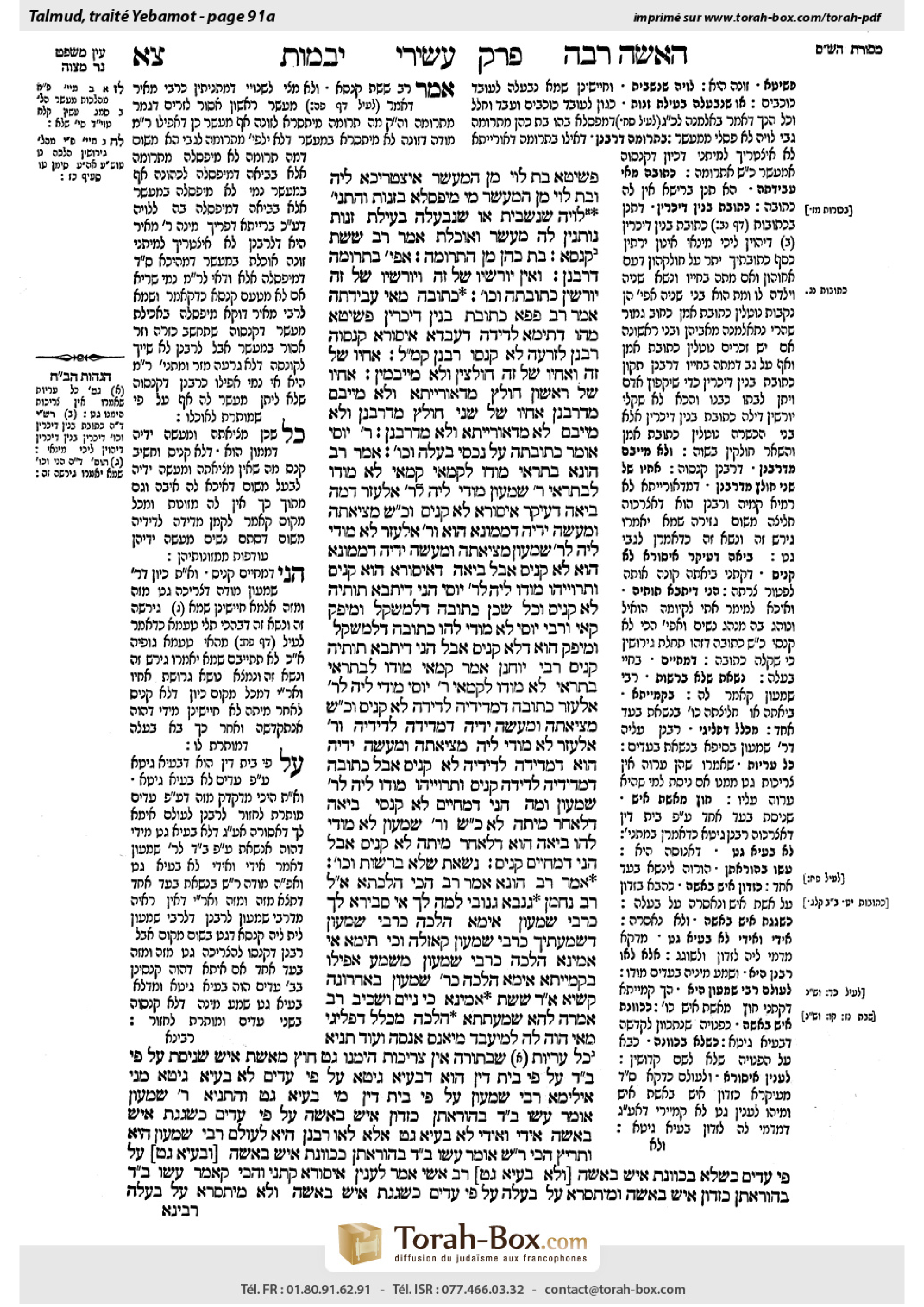
This page of Yevamot includes the Aramaic text, an English translation and an AI-generated French translation, alongside the scan above.
יבמות צ״א א · Aramaic and Hebrew text
פְּשִׁיטָא! בַּת לֵוִי מִן הַמַּעֲשֵׂר אִיצְטְרִיכָא לֵיהּ.
וּבַת לֵוִי מִן הַמַּעֲשֵׂר מִי מִיפַּסְלָא בִּזְנוּת? וְהָתַנְיָא: לְוִיָּה שֶׁנִּשְׁבֵּית, אוֹ שֶׁנִּבְעֲלָה בְּעִילַת זְנוּת — נוֹתְנִין לָהּ מַעֲשֵׂר וְאוֹכֶלֶת. אָמַר רַב שֵׁשֶׁת: קְנָסָא.
בַּת כֹּהֵן מִן הַתְּרוּמָה. אֲפִילּוּ בִּתְרוּמָה דְּרַבָּנַן.
וְאֵין יוֹרְשָׁיו שֶׁל זֶה וְיוֹרְשָׁיו שֶׁל זֶה יוֹרְשִׁין כְּתוּבָּתָהּ וְכוּ׳. כְּתוּבָּה מַאי עֲבִידְתַּהּ! אָמַר רַב פָּפָּא: כְּתוּבַּת בְּנִין דִּיכְרִין.
פְּשִׁיטָא! מַהוּ דְּתֵימָא: לְדִידַהּ דַּעֲבַדָא אִיסּוּרָא — קַנְסוּהָ רַבָּנַן, לְזַרְעַהּ לָא קְנַסוּ רַבָּנַן — קָא מַשְׁמַע לַן.
אָחִיו שֶׁל זֶה וְאָחִיו שֶׁל זֶה חוֹלְצִין וְלֹא מְיַיבְּמִין. אָחִיו שֶׁל רִאשׁוֹן חוֹלֵץ — מִדְּאוֹרָיְיתָא, וְלָא מְיַיבֵּם — מִדְּרַבָּנַן. אָחִיו שֶׁל שֵׁנִי חוֹלֵץ — מִדְּרַבָּנַן, וְלָא מְיַיבֵּם — לָא מִדְּאוֹרָיְיתָא וְלָא מִדְּרַבָּנַן.
רַבִּי יוֹסֵי אוֹמֵר: כְּתוּבָּתָהּ עַל נִכְסֵי בַּעְלָהּ וְכוּ׳. אָמַר רַב הוּנָא: בָּתְרָאֵי מוֹדוּ לְקַמָּאֵי, קַמָּאֵי לָא מוֹדוּ לְבָתְרָאֵי.
רַבִּי שִׁמְעוֹן מוֹדֵי לֵיהּ לְרַבִּי אֶלְעָזָר: דְּמָה בִּיאָה דְּעִיקַּר אִיסּוּרָא — לָא קָנֵיס, וְכׇל שֶׁכֵּן מְצִיאָתָהּ וּמַעֲשֵׂה יָדֶיהָ — דְּמָמוֹנָא הוּא. וְרַבִּי אֶלְעָזָר לָא מוֹדֵי לֵיהּ לְרַבִּי שִׁמְעוֹן: מְצִיאָתָהּ וּמַעֲשֵׂה יָדֶיהָ דְּמָמוֹנָא הוּא — לָא קָנֵיס, אֲבָל בִּיאָה דְּאִיסּוּרָא הוּא — קָנֵיס.
וְתַרְוַיְיהוּ מוֹדוּ לֵיהּ לְרַבִּי יוֹסֵי: הָנֵי דְּיָתְבָא תּוּתֵיהּ לָא קָנֵיס, וְכׇל שֶׁכֵּן כְּתוּבָּה דִּלְמִשְׁקַל וּמִיפַּק קָאֵי. וְרַבִּי יוֹסֵי לָא מוֹדֵי לְהוּ, כְּתוּבָּה דִּלְמִשְׁקַל וּמִיפַּק — הוּא דְּלָא קָנֵיס, אֲבָל הָנֵי דְּיָתְבָא תּוּתֵיהּ — קָנֵיס.
רַבִּי יוֹחָנָן אָמַר: קַמָּאֵי מוֹדוּ לְבָתְרָאֵי, בָּתְרָאֵי לָא מוֹדוּ לְקַמָּאֵי. רַבִּי יוֹסֵי מוֹדֵי לֵיהּ לְרַבִּי אֶלְעָזָר: כְּתוּבָּה, דְּמִדִּידֵיהּ לְדִידַהּ — לָא קָנֵיס, וְכׇל שֶׁכֵּן מְצִיאָתָהּ וּמַעֲשֵׂה יָדֶיהָ, דְּמִדִּידַהּ לְדִידֵיהּ.
וְרַבִּי אֶלְעָזָר לָא מוֹדֵי לֵיהּ: מְצִיאָתָהּ וּמַעֲשֵׂה יָדֶיהָ הוּא דְּמִדִּידַהּ לְדִידֵיהּ — לָא קָנֵיס, אֲבָל כְּתוּבָה דְּמִדִּידֵיהּ לְדִידַהּ — קָנֵיס.
וְתַרְוַיְיהוּ מוֹדוּ לֵיהּ לְרַבִּי שִׁמְעוֹן: וּמָה הָנֵי, דְּמֵחַיִּים — לָא קָנְסִי, בִּיאָה דִּלְאַחַר מִיתָה — לֹא כׇּל שֶׁכֵּן. וְרַבִּי שִׁמְעוֹן לָא מוֹדֵי לְהוּ: בִּיאָה הוּא דִּלְאַחַר מִיתָה לָא קָנֵיס, אֲבָל הָנֵי דְּמֵחַיִּים — קָנֵיס.
נִשֵּׂאת שֶׁלֹּא בִּרְשׁוּת וְכוּ׳. אָמַר רַב הוּנָא אֲמַר רַב: הָכִי הִלְכְתָא. אֲמַר לֵיהּ רַב נַחְמָן: גַּנָּבָא גַּנּוֹבֵי לְמָה לָךְ? אִי סְבִירָא לָךְ כְּרַבִּי שִׁמְעוֹן, אֵימָא: הֲלָכָה כְּרַבִּי שִׁמְעוֹן, דִּשְׁמַעְתָּיךְ כְּרַבִּי שִׁמְעוֹן קָאָזְלָה.
וְכִי תֵּימָא: אִי אָמֵינָא הֲלָכָה כְּרַבִּי שִׁמְעוֹן — מַשְׁמַע אֲפִילּוּ בְּקַמַּיְיתָא, אֵימָא: הֲלָכָה כְּרַבִּי שִׁמְעוֹן בָּאַחֲרוֹנָה! קַשְׁיָא.
אָמַר רַב שֵׁשֶׁת: אָמֵינָא, כִּי נָיֵים וְשָׁכֵיב רַב אַמְרַהּ לְהָא שְׁמַעְתְּתָא. הֲלָכָה מִכְּלָל דִּפְלִיגִי, מַאי הֲוָה לַהּ לְמִיעְבַּד — מֵיאנָס אֲנִיסָה?
וְעוֹד תַּנְיָא: כׇּל עֲרָיוֹת שֶׁבַּתּוֹרָה אֵין צְרִיכוֹת הֵימֶנּוּ גֵּט, חוּץ מֵאֵשֶׁת אִישׁ שֶׁנִּיסֵּת עַל פִּי בֵּית דִּין. עַל פִּי בֵּית דִּין הוּא דְּבָעֲיָא גִּיטָּא, עַל פִּי עֵדִים לָא בָּעֲיָא גִּיטָּא.
מַנִּי? אִילֵימָא רַבִּי שִׁמְעוֹן, עַל פִּי בֵּית דִּין מִי בָּעֲיָא גֵּט? וְהָתַנְיָא, רַבִּי שִׁמְעוֹן אוֹמֵר: עָשׂוּ בֵּית דִּין בְּהוֹרָאָתָן — כִּזְדוֹן אִישׁ בְּאִשָּׁה. עַל פִּי עֵדִים — כְּשִׁגְגַת אִישׁ בְּאִשָּׁה. אִידֵּי וְאִידִי לָא בָּעֲיָא גֵּט.
אֶלָּא לָאו רַבָּנַן הִיא.
לְעוֹלָם רַבִּי שִׁמְעוֹן הִיא, וְתָרֵיץ הָכִי: רַבִּי שִׁמְעוֹן אוֹמֵר: עָשׂוּ בֵּית דִּין בְּהוֹרָאָתָן — כְּכַוּוֹנַת אִישׁ בְּאִשָּׁה [וּבָעֲיָא גֵּט], עַל פִּי עֵדִים — כְּשֶׁלֹּא בְּכַוּוֹנַת אִישׁ בְּאִשָּׁה [וְלֹא בָּעֲיָא גֵּט].
רַב אָשֵׁי אָמַר, לְעִנְיַן אִיסּוּרָא קָתָנֵי, וְהָכִי קָאָמַר: עָשׂוּ בֵּית דִּין בְּהוֹרָאָתָן — כִּזְדוֹן אִישׁ בְּאִשָּׁה, וּמִיתַּסְרָא עַל בַּעְלַהּ. עַל פִּי עֵדִים — כְּשִׁגְגַת אִישׁ בְּאִשָּׁה, וְלָא מִיתַּסְרָא עַל בַּעְלַהּ.
Yevamot 91a · English translation
The Gemara asks: It is obvious that she is disqualified, as she is a zona, a woman who has had sexual relations with a man forbidden to her by the Torah and with whom she cannot establish a marital bond. The Gemara answers: Since it was necessary for the tanna to mention the disqualification of a daughter of a Levite from partaking of the tithe, he added that an Israelite woman is likewise disqualified from marrying into the priesthood.
The Gemara asks: And a daughter of a Levite, is she disqualified from partaking of the tithe by licentiousness? But isn’t it taught in a baraita: In the case of a Levite woman who was captured, who may have had intercourse with one of her captors, or even in a case where a Levite woman definitely engaged in licentious sexual relations, we nevertheless give her first tithe and she may eat it? This indicates that an act of fornication does not disqualify a woman from partaking of the tithe. Rav Sheshet said: The disqualification is a penalty imposed by the Sages on this particular woman for not taking sufficient care, as she married without witness testimony as to her first husband’s death.
§ The mishna further taught that the daughter of a priest in this situation is disqualified from partaking of teruma. The Gemara explains: This statement does not refer to teruma by Torah law, as it is obvious that she is prohibited to eat this produce. Rather, she is barred even from teruma that applies by rabbinic law.
§ And the mishna also taught: Neither the heirs of this one nor the heirs of that one inherit her marriage contract. The Gemara asks: A marriage contract, what is its purpose; why mention the inheritance of a marriage contract after the mishna has just said that she is not entitled to the payment of a marriage contract at all? The Gemara answers: Rav Pappa said: This is referring to the marriage contract payment of the male sons. One of the conditions of a marriage contract is that any male children born to this woman who inherit from their father will receive the sum of her marriage contract in addition to their share of the inheritance with their other paternal brothers.
The Gemara asks: This is obvious. Since she does not have a claim for the payment of her marriage contract, she is not entitled to the other conditions of a marriage contract either. The Gemara answers: It is necessary. Lest you say that with regard to the woman herself, who committed a prohibition, the Sages penalized her, but with regard to her offspring the Sages did not penalize them, as they did nothing wrong, the tanna therefore teaches us that the entire marriage contract is canceled, along with all its conditions.
§ The mishna further taught that the brothers of this one and the brothers of that one all perform ḥalitza, and they do not consummate levirate marriage. The Gemara explains: The brother of the first one performs ḥalitza by Torah law, as that woman is legally the wife of the first husband and therefore requires ḥalitza. But he does not consummate levirate marriage by rabbinic law, as the Sages penalized her and prohibited her from returning to the first husband. Conversely, the brother of the second one performs ḥalitza by rabbinic law, so that people do not say that a childless woman can leave her yavam without ḥalitza. But he does not consummate levirate marriage, neither by Torah law nor by rabbinic law, as her marriage to the second man was an error.
§ The mishna taught: Rabbi Yosei says that the obligation of her marriage contract is upon the property of her first husband. Rav Huna said: The last Sages in the mishna, Rabbi Elazar and Rabbi Shimon, concede to the first ones, and merely add to their statement. However, the first ones do not concede to the last Sages. In other words, the second set of Sages extend the rulings of the first Sages beyond the cases to which they specifically referred.
The Gemara clarifies this statement: Rabbi Shimon concedes to Rabbi Elazar. How so? For if with regard to sexual relations, which is the main prohibition, Rabbi Shimon did not penalize her, as he claims that the intercourse of the yavam, her first husband’s brother, acquires her and exempts her rival wife, all the more so her first husband should be entitled to her found objects and her earnings, which are merely money. And yet Rabbi Elazar does not concede to Rabbi Shimon, as he claims that in the case of her found objects and her earnings, which are only money, the Sages did not penalize her, but with regard to sexual intercourse, which is a prohibition, they did penalize her.
And Rabbi Shimon and Rabbi Elazar both concede to Rabbi Yosei with regard to a marriage contract. If in the case of these matters discussed above, which are relevant when she is living under her husband’s authority and is treated as a married woman, the Sages did not penalize her, but allowed him to retain her found articles and earnings as though she were a full-fledged wife, all the more so they did not make her forfeit the marriage contract, which is designed for her to take and then leave the marriage. And by contrast, Rabbi Yosei does not concede to them. He maintains that in the case of a marriage contract, which is for her to take and leave, the Sages did not penalize her, but with regard to these other conditions, which take effect when she is still living under his authority, they did penalize her.
In contrast to Rav Huna, Rabbi Yoḥanan said: The first Sages concede to the last ones, but the last ones do not concede to the first Sages. According to Rabbi Yoḥanan, the statements of the first Sages are more inclusive, whereas the second Sages restrict and limit the previous rulings. How so? Rabbi Yosei concedes to Rabbi Elazar, as he reasons as follows: If with regard to a marriage contract, which is given from him to her, the Sages did not penalize her, as Rabbi Yosei maintains that since she did not sin willfully she is entitled to her marriage contract, all the more so they did not enforce a penalty with regard to her found objects and her earnings, which are from her to him. The Sages certainly did not cause him to forfeit something he has the right to claim from her.
And Rabbi Elazar does not agree with Rabbi Yosei with regard to a marriage contract. He claims that it is concerning her found objects and her earnings, which are from her to him, that the Sages did not penalize her. However, as pertains to the marriage contract, which is from him to her, the Sages did penalize her, as a punishment.
And Rabbi Yosei and Rabbi Elazar both concede to Rabbi Shimon, for the following reason: And if with regard to these, i.e., her found objects and earnings or her marriage contract, which are given in his lifetime, the Sages did not penalize her, then with regard to the sexual relations of the yavam, which occur after the death of the husband, is it not all the more so that they should not penalize her, and she should remain permitted? And Rabbi Shimon does not concede to them, as it is only in the case of sexual relations, which occur after his death, that the Sages did not penalize her. However, with regard to these other matters, which apply during the husband’s lifetime, the Sages did penalize her by depriving her of them.
§ The mishna taught that if she married without the consent of the court she is permitted to return to her first husband. Rav Huna said that Rav said: This is the halakha. Rav Naḥman said to him: Why do you steal in, i.e., why do you state your opinion in a sneaky manner? If you maintain in accordance with the opinion of Rabbi Shimon, then you should explicitly say: The halakha is in accordance with the opinion of Rabbi Shimon, as your halakha follows the opinion of Rabbi Shimon.
And lest you say: If I were to say that the halakha is in accordance with the opinion of Rabbi Shimon, that would erroneously indicate that I agree with him even with regard to the first case, that of a married woman who married another on the basis of one witness. If so, you should say the following: The halakha is in accordance with the opinion of Rabbi Shimon with regard to the last case. The Gemara comments: Indeed, the question of why Rav Huna did not state his ruling in this manner is difficult.
§ Rav Sheshet said: I say that when Rav dozed and was falling asleep he said this halakha. In other words, Rav did not examine the matter carefully, as this ruling is unnecessary. Rav Sheshet explains: From the fact that Rav declared a ruling of halakha, it may be inferred that others disagree with this opinion. However, there is actually no dispute here, as what could she have done? It is as though he raped her. Since she received the testimony of witnesses that her husband was dead, she had no reason to refrain from remarrying. Her actions cannot be considered willing, as why should she refrain from marrying after receiving the testimony of witnesses that her husband was dead? Her lack of knowledge in this matter renders this case analogous to a rape. And as is well known, a woman who was raped is permitted to return to her husband.
And it was further taught in a baraita: Any of those with whom relations are forbidden by Torah law do not require a bill of divorce to dissolve a union, except for a married woman who remarried by permission of the court. The Gemara infers: It is only a woman who married by permission of the court who requires a bill of divorce, but if she married based on testimony of witnesses she does not require a bill of divorce.
The Gemara further inquires: Who is the author of this baraita? If we say it is Rabbi Shimon, in his opinion does a woman who married by permission of the court require a bill of divorce from the second man? But isn’t it taught in a baraita that Rabbi Shimon says: If the court acted merely in accordance with their own instruction when they permitted a woman to remarry and her husband later arrived, it is as though this remarriage were a willful act of a man with a woman, and she is penalized like an intentional adulteress. Conversely, if she married based on testimony of witnesses, it is considered like an unwitting act of a man with a woman. Either way, neither in this case nor in that one, i.e., whether the marriage was in accordance with a decision of the court or based on witness testimony, does she require a bill of divorce, as a woman who committed adultery, whether unwittingly or intentionally, does not require a bill of divorce from the adulterer.
Rather, is it not the case that this baraita, which states that a woman who engaged in forbidden relations, including one who married based on witnesses, does not require a bill of divorce, is in accordance with the opinion of the Rabbis? But if so, there was no need to issue a ruling to this effect, as everyone agrees that the halakha follows the majority opinion.
The Gemara refutes this suggestion: Actually, the baraita is in accordance with the opinion of Rabbi Shimon, and you should answer the difficulty as follows: Rabbi Shimon says that if the court acted in accordance with their own instruction, it is as though there was the intention of a man with a woman, i.e., as though the man had relations with the woman for the purpose of marriage, and therefore she requires a bill of divorce from him. Conversely, if she married based on testimony of witnesses they considered it as though there was no intention of a man with a woman, as he had relations with her without the intention of marriage, and in that case she does not require a bill of divorce.
Rav Ashi said that there is no difficulty here at all, as Rabbi Shimon’s statement should be explained differently. In fact, Rabbi Shimon taught his ruling with regard to the prohibition involved, not the issue of a bill of divorce, and this is what he said: If the court acted in accordance with their own instruction, it is as though this was a willful act of a man with a woman, and she is therefore forbidden to her husband like a woman who intentionally engaged in relations with another man. However, if she married based on testimony of witnesses, they considered it as though it was an unwitting act of a man with a woman, and she is not forbidden to her husband.
Yevamot 91a · Traduction française (IA)
La Guemara demande : Il est évident qu’elle est disqualifiée, puisqu’elle est une zona, une femme qui a eu des relations sexuelles avec un homme auquel la Torah lui interdit de s’unir et avec lequel elle ne peut contracter de lien matrimonial. La Guemara répond : Puisqu’il était nécessaire que le tanna mentionne qu’une fille de Lévite est disqualifiée pour consommer la dîme, il a ajouté qu’une femme israélite est, elle aussi, disqualifiée pour épouser un membre de la prêtrise.
La Guemara demande : Une fille de Lévite serait-elle disqualifiée pour consommer la dîme en raison de relations sexuelles illicites ? Pourtant, n’enseigne-t-on pas dans une baraïta : Dans le cas d’une femme lévite qui a été capturée et qui a pu avoir des relations avec l’un de ses ravisseurs, voire dans le cas où une femme lévite a certainement eu des relations sexuelles illicites, on lui donne néanmoins la première dîme et elle peut la consommer. Cela indique qu’un acte de fornication ne disqualifie pas une femme pour consommer la dîme. Rav Chéchet a dit : La disqualification est une sanction que les Sages ont imposée à cette femme en particulier, parce qu’elle n’a pas pris suffisamment de précautions : elle s’est remariée sans témoignage attestant la mort de son premier mari.
§ La Michna enseigne en outre que, dans cette situation, la fille d’un prêtre est disqualifiée pour consommer la terouma. La Guemara explique : Cette déclaration ne concerne pas la terouma relevant de la Torah écrite, car il est évident qu’il lui est interdit de consommer ce produit. Elle est plutôt exclue même de la terouma relevant du droit rabbinique.
§ La Michna enseigne également : Ni les héritiers de celui-ci ni ceux de celui-là n’héritent de sa ketouba. La Guemara demande : À quoi sert la ketouba ? Pourquoi mentionner l’héritage de la ketouba après que la Michna a dit qu’elle n’a pas du tout droit au paiement de sa ketouba ? La Guemara répond : Rav Pappa a dit : Il s’agit de la somme de la ketouba revenant aux fils. L’une des clauses de la ketouba prévoit que les fils nés de cette femme, qui héritent de leur père, reçoivent la somme de sa ketouba en plus de leur part d’héritage, aux côtés de leurs autres frères paternels.
La Guemara demande : Cela est évident. Puisqu’elle ne peut réclamer le paiement de sa ketouba, elle n’a pas non plus droit aux autres clauses de la ketouba. La Guemara répond : C’était nécessaire. De peur que tu ne dises que les Sages ont sanctionné la femme elle-même, qui a commis une transgression, mais pas ses enfants, qui n’ont rien fait de mal, le tanna nous enseigne que la ketouba tout entière est annulée, avec toutes ses clauses.
§ La Michna enseigne en outre que les frères de celui-ci et ceux de celui-là accomplissent tous la ḥalitsa, mais ne contractent pas de mariage léviratique. La Guemara explique : Le frère du premier accomplit la ḥalitsa selon la Torah, car cette femme est légalement l’épouse du premier mari et doit donc accomplir la ḥalitsa. Mais il ne contracte pas de mariage léviratique selon le droit rabbinique, car les Sages l’ont sanctionnée et lui ont interdit de retourner auprès de son premier mari. À l’inverse, le frère du second accomplit la ḥalitsa selon le droit rabbinique, afin que les gens ne disent pas qu’une femme sans enfant peut quitter son yavam sans ḥalitsa. Mais il ne contracte pas de mariage léviratique, ni selon la Torah ni selon le droit rabbinique, car son mariage avec le second homme était une erreur.
§ La Michna enseigne : Rabbi Yossé dit que l’obligation de payer sa ketouba porte sur les biens de son premier mari. Rav Houna a dit : Les derniers Sages de la Michna, Rabbi Elazar et Rabbi Chimon, sont d’accord avec les premiers et ne font qu’ajouter à leur propos. En revanche, les premiers ne sont pas d’accord avec les derniers. Autrement dit, le second groupe de Sages étend les décisions des premiers au-delà des cas auxquels ceux-ci se sont expressément référés.
La Guemara précise cette déclaration : Rabbi Chimon est d’accord avec Rabbi Elazar. Comment cela ? Si, concernant les relations sexuelles, qui constituent l’interdiction principale, Rabbi Chimon ne l’a pas sanctionnée — puisqu’il affirme que la relation du yavam, le frère de son premier mari, l’acquiert et dispense sa coépouse —, à plus forte raison son premier mari devrait-il avoir droit à ses objets trouvés et à ses revenus, qui ne sont que des biens pécuniaires. Pourtant, Rabbi Elazar n’est pas d’accord avec Rabbi Chimon, car il affirme que, s’agissant de ses objets trouvés et de ses revenus, qui ne représentent que de l’argent, les Sages ne l’ont pas sanctionnée, mais que, s’agissant des relations sexuelles, qui constituent une interdiction, ils l’ont sanctionnée.
Rabbi Chimon et Rabbi Elazar sont tous deux d’accord avec Rabbi Yossé au sujet de la ketouba. Si, dans les questions évoquées plus haut, qui se posent lorsqu’elle vit sous l’autorité de son mari et est traitée comme une femme mariée, les Sages ne l’ont pas sanctionnée, mais lui ont permis de conserver ses objets trouvés et ses revenus comme si elle était une épouse à part entière, à plus forte raison ne l’ont-ils pas privée de la ketouba, destinée à ce qu’elle la reçoive puis quitte le mariage. À l’inverse, Rabbi Yossé n’est pas d’accord avec eux. Il soutient que, dans le cas de la ketouba, destinée à ce qu’elle la reçoive puis parte, les Sages ne l’ont pas sanctionnée, mais que, pour ces autres clauses, qui s’appliquent tant qu’elle vit encore sous l’autorité de son mari, ils l’ont sanctionnée.
À l’inverse de Rav Houna, Rabbi Yoḥanan a dit : Les premiers Sages sont d’accord avec les derniers, mais les derniers ne sont pas d’accord avec les premiers. Selon Rabbi Yoḥanan, les déclarations des premiers Sages ont une portée plus large, tandis que les seconds restreignent et limitent les décisions précédentes. Comment cela ? Rabbi Yossé est d’accord avec Rabbi Elazar, car il raisonne ainsi : Si, dans le cas d’une ketouba, qui lui est versée par son mari, les Sages ne l’ont pas sanctionnée — Rabbi Yossé soutenant que, puisqu’elle n’a pas péché volontairement, elle a droit à sa ketouba —, à plus forte raison ne lui ont-ils pas imposé de sanction concernant ses objets trouvés et ses revenus, qui lui reviennent à lui. Les Sages ne lui ont certainement pas fait perdre quelque chose qu’il est en droit de réclamer d’elle.
Et Rabbi Elazar n’est pas d’accord avec Rabbi Yossé au sujet de la ketouba. Il affirme que c’est pour ses objets trouvés et ses revenus, qui lui reviennent à lui, que les Sages ne l’ont pas sanctionnée. En revanche, concernant la ketouba, qui lui revient à elle, les Sages l’ont sanctionnée à titre de punition.
Rabbi Yossé et Rabbi Elazar sont tous deux d’accord avec Rabbi Chimon, pour la raison suivante : si, pour ces questions — ses objets trouvés et ses revenus, ou sa ketouba — qui s’appliquent du vivant de son mari, les Sages ne l’ont pas sanctionnée, à plus forte raison ne devraient-ils pas la sanctionner pour les relations sexuelles avec le yavam, qui ont lieu après la mort de son mari, et elle devrait rester autorisée. Rabbi Chimon, lui, n’est pas d’accord avec eux, car ce n’est que dans le cas des relations sexuelles, qui ont lieu après la mort de son mari, que les Sages ne l’ont pas sanctionnée. En revanche, pour ces autres questions, qui s’appliquent du vivant du mari, les Sages l’ont sanctionnée en l’en privant.
§ La Michna enseigne que si elle s’est remariée sans l’autorisation du tribunal, elle peut retourner auprès de son premier mari. Rav Houna a dit au nom de Rav : Telle est la halakha. Rav Naḥman lui a dit : Pourquoi avances-tu ton opinion de façon détournée ? Si tu suis l’opinion de Rabbi Chimon, dis explicitement : « La halakha est conforme à l’opinion de Rabbi Chimon », puisque ta décision suit cette opinion.
Et de peur que tu ne dises : « Si j’affirmais que la halakha est conforme à l’opinion de Rabbi Chimon, cela indiquerait à tort que je suis d’accord avec lui même dans le premier cas, celui d’une femme mariée qui en a épousé un autre sur la foi d’un seul témoin », tu devrais dire ceci : « La halakha est conforme à l’opinion de Rabbi Chimon pour le dernier cas. » La Guemara fait remarquer : En effet, la question de savoir pourquoi Rav Houna n’a pas formulé sa décision ainsi reste difficile.
§ Rav Chéchet a dit : Je pense que Rav a énoncé cette halakha alors qu’il somnolait et s’endormait. Autrement dit, Rav n’a pas examiné la question attentivement, car cette décision est inutile. Rav Chéchet explique : Du fait que Rav a formulé une décision de halakha, on peut déduire que d’autres sont en désaccord avec cette opinion. Or, en réalité, il n’y a ici aucun désaccord, car qu’aurait-elle pu faire ? C’est comme si elle avait été violée. Puisqu’elle avait reçu le témoignage de témoins attestant que son mari était mort, rien ne l’obligeait à s’abstenir de se remarier. Ses actes ne peuvent être considérés comme volontaires : pourquoi se serait-elle abstenue de se remarier après avoir reçu le témoignage de témoins attestant que son mari était mort ? Son ignorance de la situation rend ce cas comparable à un viol. Or, comme on le sait, une femme violée peut retourner auprès de son mari.
Et l’on a également enseigné dans une baraïta : Aucune des femmes avec lesquelles les relations sont interdites par la Torah n’a besoin d’un acte de divorce pour dissoudre l’union, à l’exception d’une femme mariée qui s’est remariée avec l’autorisation du tribunal. La Guemara en déduit : Seule une femme qui s’est remariée avec l’autorisation du tribunal a besoin d’un acte de divorce ; si elle s’est remariée sur la foi du témoignage de témoins, elle n’en a pas besoin.
La Guemara demande ensuite : Qui est l’auteur de cette baraïta ? Si l’on dit qu’il s’agit de Rabbi Chimon, selon lui une femme qui s’est remariée avec l’autorisation du tribunal a-t-elle besoin d’un acte de divorce de la part du second homme ? Pourtant, n’enseigne-t-on pas dans une baraïta que Rabbi Chimon dit : Si le tribunal a agi uniquement selon sa propre décision lorsqu’il a autorisé une femme à se remarier, puis que son mari est arrivé, c’est comme si ce remariage avait été une relation volontaire entre un homme et une femme, et elle est sanctionnée comme une adultère volontaire. À l’inverse, si elle s’est remariée sur la foi du témoignage de témoins, cela est considéré comme une relation involontaire entre un homme et une femme. Dans les deux cas, qu’elle se soit remariée conformément à une décision du tribunal ou sur la foi du témoignage de témoins, elle n’a pas besoin d’un acte de divorce, car une femme qui a commis un adultère, involontairement ou volontairement, n’a pas besoin d’un acte de divorce de la part de l’homme avec lequel elle a commis l’adultère.
Mais ne faut-il pas plutôt dire que cette baraïta, qui enseigne qu’une femme ayant eu des relations interdites, y compris une femme qui s’est remariée sur la foi de témoins, n’a pas besoin d’un acte de divorce, suit l’opinion des Sages ? Mais dans ce cas, il n’était pas nécessaire de rendre une décision en ce sens, puisque tous s’accordent à dire que la halakha suit l’opinion majoritaire.
La Guemara réfute cette proposition : En réalité, la baraïta suit l’opinion de Rabbi Chimon, et il faut répondre à la difficulté ainsi : Rabbi Chimon dit que si le tribunal a agi selon sa propre décision, c’est comme s’il y avait eu intention de la part de l’homme et de la femme, c’est-à-dire comme si l’homme avait eu des relations avec la femme dans l’intention de l’épouser ; elle a donc besoin d’un acte de divorce de sa part. À l’inverse, si elle s’est remariée sur la foi du témoignage de témoins, on a considéré qu’il n’y avait pas eu intention de la part de l’homme et de la femme, puisqu’il avait eu des relations avec elle sans intention de mariage ; dans ce cas, elle n’a pas besoin d’un acte de divorce.
Rav Achi a dit qu’il n’y a là aucune difficulté, car la déclaration de Rabbi Chimon doit s’expliquer autrement. En réalité, Rabbi Chimon a enseigné sa décision au sujet de l’interdiction en jeu, et non de la question de l’acte de divorce. Voici ce qu’il a dit : Si le tribunal a agi selon sa propre décision, c’est comme s’il s’agissait d’une relation volontaire entre un homme et une femme, et elle est donc interdite à son mari comme une femme qui a volontairement eu des relations avec un autre homme. En revanche, si elle s’est remariée sur la foi du témoignage de témoins, on a considéré qu’il s’agissait d’une relation involontaire entre un homme et une femme, et elle n’est pas interdite à son mari.
Traduction française générée par IA à partir de l’édition anglaise de Sefaria. Vérifie toujours un passage avec le texte source.
Text from Sefaria: William Davidson Edition - Vocalized Aramaic (CC BY NC); William Davidson Edition - English (CC BY NC).