Yevamot 91b: Talmud study for Daf Yomi
Daf Yomi is the daily study of one Talmud folio. Explore 37 tractates with scans, Hebrew text, Sefaria English and AI-generated French translations where annotated.
Passage selection and English or AI-generated French translation are available where the scan has annotations. Daf Study is independent of Torah-Box and Sefaria.
Browse Yevamot · יבמות · All tractatesYevamot 91b text and translations
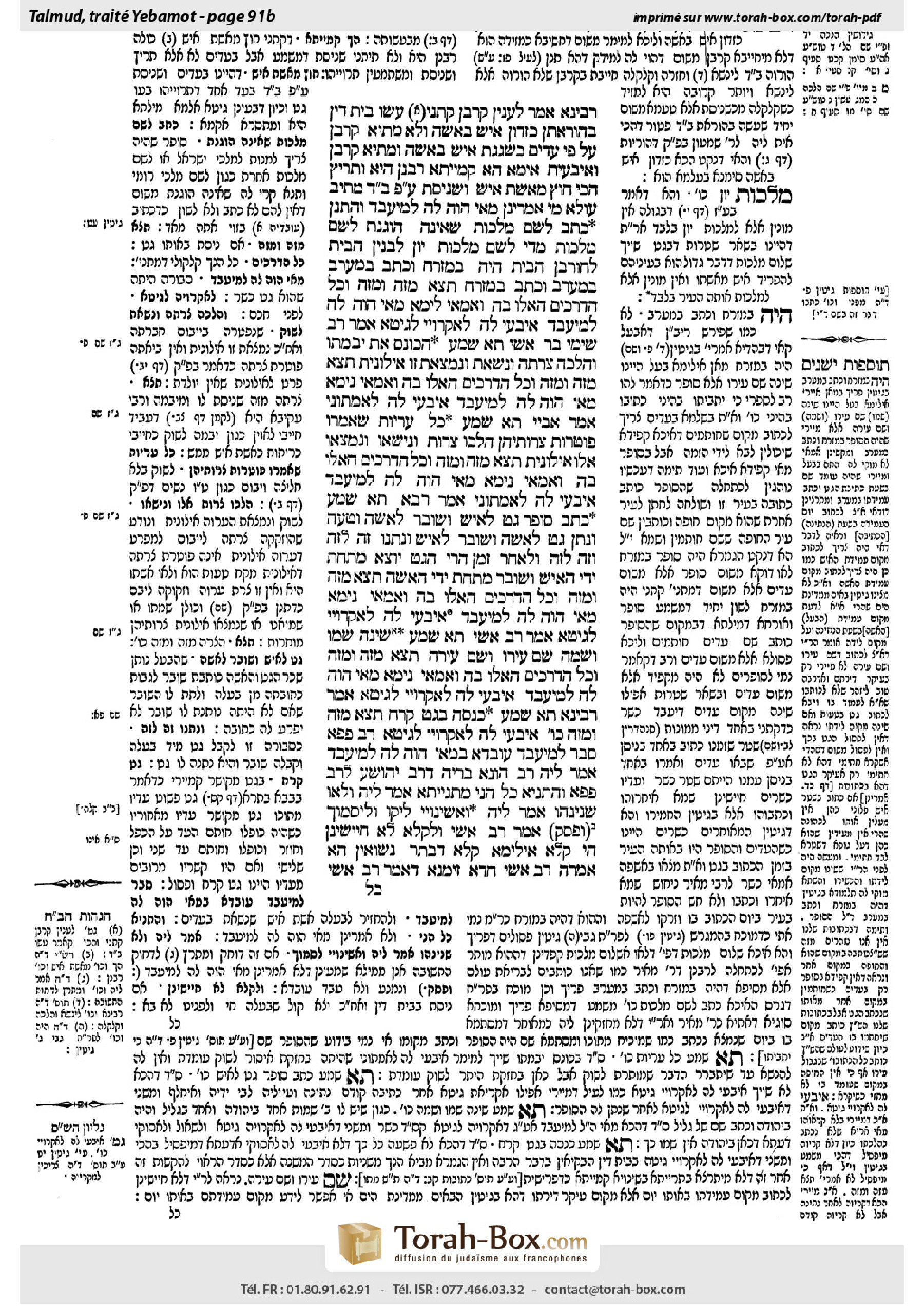
This page of Yevamot includes the Aramaic text, an English translation and an AI-generated French translation, alongside the scan above.
יבמות צ״א ב · Aramaic and Hebrew text
רָבִינָא אָמַר, לְעִנְיַן קׇרְבָּן קָתָנֵי: עָשׂוּ בֵּית דִּין בְּהוֹרָאָתָן — כִּזְדוֹן אִישׁ בָּאִשָּׁה, וְלָא מַתְיָא קׇרְבָּן. עַל פִּי עֵדִים — כְּשִׁגְגַת אִישׁ בְּאִשָּׁה, וּמַתְיָא קׇרְבָּן.
וְאִיבָּעֵית אֵימָא: הָא קַמַּיְיתָא — רַבָּנַן הִיא, וְתָרֵיץ הָכִי: חוּץ מֵאֵשֶׁת אִישׁ, וְשֶׁנִּיסֵּת עַל פִּי בֵּית דִּין.
מֵתִיב עוּלָּא: מִי אָמְרִינַן מַאי הֲוָה לַהּ לְמִיעְבַּד? וְהָתְנַן: כָּתַב לְשֵׁם מַלְכוּת שֶׁאֵינָהּ הוֹגֶנֶת, לְשֵׁם מַלְכוּת מָדַי, לְשֵׁם מַלְכוּת יָוָן, לְבִנְיַן הַבַּיִת, לְחוּרְבַּן הַבַּיִת, הָיָה בַּמִּזְרָח וְכָתַב בַּמַּעֲרָב, בַּמַּעֲרָב וְכָתַב בַּמִּזְרָח —
תֵּצֵא מִזֶּה וּמִזֶּה, וְכׇל הַדְּרָכִים הָאֵלּוּ בָּהּ. וְאַמַּאי? לֵימָא: מַאי הֲוָה לַהּ לְמִיעְבַּד! אִיבְּעִי לַהּ לְאַקְרוֹיֵי לְגִיטָּא.
אָמַר רַב שִׁימִי בַּר אָשֵׁי, תָּא שְׁמַע: הַכּוֹנֵס אֶת יְבִמְתּוֹ וְהָלְכָה צָרָתָהּ וְנִשֵּׂאת, וְנִמְצֵאת זוֹ אַיְלוֹנִית — תֵּצֵא מִזֶּה וּמִזֶּה, וְכׇל הַדְּרָכִים הָאֵלּוּ בָּהּ. וְאַמַּאי? נֵימָא: מַאי הֲוָה לַהּ לְמִיעְבַּד? אִיבְּעִי לַהּ לְאַמְתּוֹנֵי.
אָמַר אַבָּיֵי, תָּא שְׁמַע: כׇּל עֲרָיוֹת שֶׁאָמְרוּ פּוֹטְרוֹת צָרוֹתֵיהֶן, הָלְכוּ צָרוֹת וְנִישְּׂאוּ וְנִמְצְאוּ אֵלּוּ אַיְלוֹנִיּוֹת — תֵּצֵא מִזֶּה וּמִזֶּה, וְכׇל הַדְּרָכִים הָאֵלּוּ בָּהּ. וְאַמַּאי? נֵימָא: מַאי הֲוָה לַהּ לְמִיעְבַּד? אִיבְּעִי לַהּ לְאַמְתּוֹנֵי.
אָמַר רָבָא, תָּא שְׁמַע: כָּתַב סוֹפֵר גֵּט לָאִישׁ וְשׁוֹבָר לָאִשָּׁה, וְטָעָה וְנָתַן גֵּט לָאִשָּׁה וְשׁוֹבָר לָאִישׁ, וְנָתְנוּ זֶה לָזֶה וְזֶה לָזֶה,
וּלְאַחַר זְמַן הֲרֵי הַגֵּט יוֹצֵא מִתַּחַת יְדֵי הָאִישׁ, וְשׁוֹבָר מִתַּחַת יְדֵי הָאִשָּׁה — תֵּצֵא מִזֶּה וּמִזֶּה, וְכׇל הַדְּרָכִים הָאֵלּוּ בָּהּ. וְאַמַּאי? נֵימָא: מַאי הֲוָה לַהּ לְמֶיעְבַּד! אִיבְּעִי לַהּ לְאַקְרוֹיֵי לְגִיטָּא.
אָמַר רַב אָשֵׁי, תָּא שְׁמַע: שִׁינָּה שְׁמוֹ וּשְׁמָהּ, שֵׁם עִירוֹ וְשֵׁם עִירָהּ — תֵּצֵא מִזֶּה וּמִזֶּה, וְכׇל הַדְּרָכִים הָאֵלּוּ בָּהּ. וְאַמַּאי? נֵימָא: מַאי הֲוָה לַהּ לְמִיעְבַּד! אִיבְּעִי לַהּ לְאַקְרוֹיֵי לְגִיטָּא.
אָמַר רָבִינָא, תָּא שְׁמַע: כְּנָסָהּ בְּגֵט קֵרֵחַ תֵּצֵא מִזֶּה וּמִזֶּה כּוּ׳ — אִיבְּעִי לַהּ לְאַקְרוֹיֵי לְגִיטָּא.
רַב פָּפָּא סָבַר לְמִיעְבַּד עוֹבָדָא בְּמַאי הֲוָה לַהּ לְמִיעְבַּד. אֲמַר לֵיהּ רַב הוּנָא בְּרֵיהּ דְּרַב יְהוֹשֻׁעַ לְרַב פָּפָּא: וְהָתַנְיָא כׇּל הָנֵי מַתְנְיָיתָא!
אֲמַר לֵיהּ: וְלָאו שַׁנִּינְהוּ! אֲמַר לֵיהּ: וְאַשִּׁינּוּיֵי לֵיקוּ וְלִיסְמוֹךְ! (וּפְסַק).
אָמַר רַב אָשֵׁי, וּלְקָלָא לָא חָיְישִׁינַן. הֵי קָלָא? אִילֵּימָא קָלָא דְּבָתַר נִשּׂוּאִין — הָא אַמְרַהּ רַב אָשֵׁי חֲדָא זִימְנָא, דְּאָמַר רַב אָשֵׁי:
Yevamot 91b · English translation
Ravina said that this baraita is taught with regard to an offering, and it should be explained as follows: If the court acted in accordance with their own instruction, it is as though this was a willful act of a man with a woman, and she therefore does not bring an offering, as an individual who followed the ruling of the court is exempt from bringing an offering (see Horayot 2a–b). If she married based on testimony of witnesses, it is considered as though this was an unwitting act of a man with a woman, and therefore she brings an offering.
And if you wish, say and refute Rav Sheshet’s difficulty in the following manner: This first baraita, which exempts forbidden women from a bill of divorce, is the opinion of the Rabbis, who prohibit a woman in this situation to her husband, even if she had married another based on witnesses. And you should answer the difficulty by reading the relevant clause of the baraita as follows: Apart from a married woman who married on the basis of witness testimony, and this includes one who married by permission of the court, as she too requires a bill of divorce.
§ Ulla raised an objection against Rav Sheshet’s reasoning: Do we say this justification: What could she have done? Is a woman considered to have acted under duress when she had no way to avoid sin? But didn’t we learn in a mishna (Gittin 79b): If a man wrote a bill of divorce and dated it according to a kingdom that is not suitable [hogenet], i.e., one that does not reign over their place of residence; or according to the kingdom of Media or according to the kingdom of Greece, which are no longer in existence; or if he dated it according to the building of the Temple or according to the destruction of the Temple; and similarly if the bill of divorce was given in the east and he wrote in it a place in the west, or in the west and he wrote a place in the east, this bill of divorce is invalid.
Consequently, if she married another man she must leave this one and that one, both the one who gave her the bill of divorce and the new husband. And all these matters mentioned in the mishna here, the penalties imposed on a married woman who remarried unlawfully, apply to her. The Gemara asks: But why? Let us say: What could she have done. She acted under duress, as she married again only because she thought the bill of divorce was valid. The Gemara answers: This woman did not act under duress, as she should have had the bill of divorce read by a scholar, who would have told her that it was invalid.
Rav Shimi bar Ashi said: Come and hear a different proof. With regard to one who married his yevama, and the rival wife of the yevama went and married someone else, and this yevama was later discovered to be a sexually underdeveloped woman, which means that she was never eligible for levirate marriage and therefore her act of intercourse did not exempt her rival wife from levirate marriage, the rival wife must leave this one and that one, i.e., her husband must give her a bill of divorce and she may not marry the yavam, and all these matters apply to her. But why? Again, let us say: What could she have done. The Gemara answers: This is no proof, as she should have waited until it was clearly established that the other wife was not a sexually underdeveloped woman.
Abaye said: Come and hear: With regard to all those with whom relations are forbidden, with regard to whom the Sages said that they exempt their rival wives, if these rival wives went and married, and one of these forbidden women was discovered to be a sexually underdeveloped woman, which means that the obligation of levirate marriage did not apply to her at all, and it was the rival wives who should have performed levirate marriage, the rival wife must leave both this and that, and all these matters apply to her. But why? Let us say: What could she have done. The Gemara answers as before: She should have waited.
Rava said: Come and hear: A scribe wrote a bill of divorce for the man and a receipt for the woman, so that the man should give the bill of divorce to his wife and she should give him the receipt upon his delivery of the marriage contract. And the scribe erred and gave the bill of divorce to the woman and the receipt to the man, leaving them with the mistaken impression that he had the bill of divorce and she the receipt, and they gave each other the documents, this one to that one and that one to this one.
And after a while it became clear that the bill of divorce is in the man’s possession and the receipt in the woman’s possession, and no act of divorce had been performed at all. If the woman had married someone else in the meantime she must leave both this one and that one, and all these matters apply to her. But why? Let us say: What could she have done. The Gemara answers: Here too, she should have had the bill of divorce read by an expert.
Rav Ashi said: Come and hear: If a man changed his name, or his wife’s name, or the name of his city, or the name of her city, and she remarried, she must leave both this one and that one, and all these matters apply to her. But why? Let us say: What could she have done. The Gemara answers: Once again, she should have had the bill of divorce read by a scholar.
Ravina said: Come and hear: A man married a woman on the basis that she was divorced. However, she had actually received a bare bill of divorce, i.e., missing a signature. This is referring to a special type of bill of divorce, one that was folded and sewn up. It requires as many witnesses as the number of lines it contains. If a bill of divorce of this kind does not have enough witnesses, it is invalid. In the case of the baraita, if this woman married another man after receiving this bill of divorce, she must leave both this one and this one, and all these penalties apply to her. Again, the question is: What could she have done? The Gemara answers, as before: She should have had the bill of divorce read by someone who could have told her it was invalid.
The Gemara relates: Rav Pappa thought to take action and permit a woman to return to her husband based on the rationale: What could she have done. In a case where she had no means of clarifying the matter, he ruled that she should be considered to have acted under duress. Rav Huna, son of Rav Yehoshua, said to Rav Pappa: But isn’t it taught repeatedly in all these mishnayot that this argument is not accepted?
Rav Pappa said to Rav Huna, son of Rav Yehoshua: And did we not resolve these mishnayot, by explaining that in those particular cases she did have the option of clarifying the matter? He said to him: And shall we stand and rely on answers? Admittedly, we found some way of resolving these questions, but the accumulation of difficulties indicates that the rationale: What could she have done, is unacceptable. And indeed, Rav Pappa ceased to follow his original intention and did not issue a lenient ruling.
§ The Gemara discusses the case of the mishna from another perspective. Rav Ashi said: And we are not concerned about a rumor. In other words, if there was an unsubstantiated rumor that the husband was alive, the court takes no notice of it. The Gemara asks: Which kind of rumor does he mean? If we say that this is referring to a rumor that spread after the marriage of this woman to another man, Rav Ashi has already said this once, as Rav Ashi said:
Yevamot 91b · Traduction française (IA)
Ravina dit que cette baraïta est enseignée à propos d’un sacrifice, et qu’il faut l’expliquer ainsi : si le tribunal a agi conformément à sa propre décision, c’est comme si l’acte de l’homme avec la femme avait été volontaire ; elle n’apporte donc pas de sacrifice, car un particulier qui a suivi la décision du tribunal est exempt d’en apporter un (voir Horayot 2a–b). Si elle s’est mariée sur la foi du témoignage de témoins, c’est comme si l’acte de l’homme avec la femme avait été involontaire ; elle apporte donc un sacrifice.
Et si tu le souhaites, on peut réfuter la difficulté de Rav Chéchet ainsi : cette première baraïta, qui dispense les femmes interdites d’un acte de divorce, exprime l’avis des Rabbins, qui interdisent à une femme dans cette situation de retourner auprès de son mari, même si elle a épousé un autre homme sur la foi de témoins. Pour répondre à la difficulté, il faut lire ainsi la clause pertinente de la baraïta : « À l’exception d’une femme mariée qui s’est remariée sur la foi du témoignage de témoins », ce qui inclut celle qui s’est mariée avec l’autorisation du tribunal, car elle aussi a besoin d’un acte de divorce.
§ Oulla souleva une objection contre le raisonnement de Rav Chéchet : invoque-t-on cette justification : « Que pouvait-elle faire ? » Une femme est-elle considérée comme ayant agi sous la contrainte lorsqu’elle n’avait aucun moyen d’éviter la faute ? Pourtant, n’avons-nous pas appris dans une Michna (Gittin 79b) : si un homme a écrit un acte de divorce et l’a daté selon le règne d’un royaume qui ne convient pas [hogenet], c’est-à-dire qui ne règne pas sur le lieu où ils résident, ou selon le règne de la Médie ou celui de la Grèce, qui n’existent plus ; ou s’il l’a daté en fonction de la construction du Temple ou de sa destruction ; et de même, si l’acte de divorce a été remis à l’est et qu’il y a indiqué un lieu situé à l’ouest, ou s’il a été remis à l’ouest et qu’il y a indiqué un lieu situé à l’est, cet acte de divorce est invalide.
Par conséquent, si elle a épousé un autre homme, elle doit quitter celui-ci et celui-là, c’est-à-dire aussi bien celui qui lui a remis l’acte de divorce que son nouveau mari. Et toutes les dispositions mentionnées ici dans la Michna, les sanctions imposées à une femme mariée qui s’est remariée illicitement, s’appliquent à elle. La Guemara demande : mais pourquoi ? Ne peut-on pas dire : « Que pouvait-elle faire ? » Elle a agi sous la contrainte, puisqu’elle ne s’est remariée que parce qu’elle croyait que l’acte de divorce était valide. La Guemara répond : cette femme n’a pas agi sous la contrainte, car elle aurait dû faire lire l’acte de divorce par un érudit, qui lui aurait dit qu’il était invalide.
Rav Chimi bar Achi dit : Viens et entends une autre preuve. Dans le cas d’un homme qui a épousé sa yevama, si la coépouse de celle-ci est allée épouser quelqu’un d’autre et que l’on découvre par la suite que cette yevama était une femme sexuellement sous-développée — ce qui signifie qu’elle n’a jamais été apte au mariage léviratique et que, par conséquent, son rapport sexuel n’a pas exempté sa coépouse du mariage léviratique —, la coépouse doit quitter celui-ci et celui-là, c’est-à-dire que son mari doit lui remettre un acte de divorce et qu’elle ne peut pas épouser le yavam ; toutes ces dispositions s’appliquent à elle. Mais pourquoi ? Ne peut-on pas dire encore : « Que pouvait-elle faire ? » La Guemara répond : ce n’est pas une preuve, car elle aurait dû attendre qu’il soit clairement établi que l’autre femme n’était pas sexuellement sous-développée.
Abayé dit : Viens et entends : concernant toutes les femmes avec lesquelles les relations sont interdites et dont les Sages ont dit qu’elles exemptent leurs coépouses, si ces coépouses sont allées se marier et que l’on découvre que l’une de ces femmes interdites était sexuellement sous-développée — ce qui signifie que l’obligation de mariage léviratique ne s’appliquait pas du tout à elle et que ce sont les coépouses qui auraient dû accomplir le mariage léviratique —, la coépouse doit quitter les deux hommes et toutes ces dispositions s’appliquent à elle. Mais pourquoi ? Ne peut-on pas dire : « Que pouvait-elle faire ? » La Guemara répond comme précédemment : elle aurait dû attendre.
Rava dit : Viens et entends : un scribe a rédigé un acte de divorce pour l’homme et un reçu pour la femme, afin que l’homme remette l’acte de divorce à sa femme et qu’elle lui remette le reçu lorsqu’il lui verserait le montant de la ketouba. Mais le scribe s’est trompé et a remis l’acte de divorce à la femme et le reçu à l’homme, les laissant croire à tort que l’homme détenait l’acte de divorce et la femme le reçu ; ils se sont alors échangé les documents, chacun remettant le sien à l’autre.
Quelque temps après, il devint clair que l’acte de divorce était en possession de l’homme et le reçu en possession de la femme, et qu’aucun divorce n’avait été prononcé. Si, entre-temps, la femme avait épousé quelqu’un d’autre, elle doit quitter celui-ci et celui-là, et toutes ces dispositions s’appliquent à elle. Mais pourquoi ? Ne peut-on pas dire : « Que pouvait-elle faire ? » La Guemara répond : ici aussi, elle aurait dû faire lire l’acte de divorce par un expert.
Rav Achi dit : Viens et entends : si un homme a changé son nom, celui de sa femme, le nom de sa ville ou celui de la ville de sa femme, et qu’elle s’est remariée, elle doit quitter celui-ci et celui-là, et toutes ces dispositions s’appliquent à elle. Mais pourquoi ? Ne peut-on pas dire : « Que pouvait-elle faire ? » La Guemara répond : une fois encore, elle aurait dû faire lire l’acte de divorce par un érudit.
Ravina dit : Viens et entends : un homme a épousé une femme en pensant qu’elle était divorcée. En réalité, elle n’avait reçu qu’un acte de divorce dépourvu de signature. Il s’agit d’un type particulier d’acte de divorce, plié et cousu, qui exige autant de témoins que de lignes. Un acte de divorce de ce type qui ne comporte pas suffisamment de témoins est invalide. Dans le cas de la baraïta, si cette femme a épousé un autre homme après avoir reçu cet acte de divorce, elle doit quitter ces deux hommes et toutes ces sanctions s’appliquent à elle. La question se pose encore : que pouvait-elle faire ? La Guemara répond comme précédemment : elle aurait dû faire lire l’acte de divorce par quelqu’un qui aurait pu lui dire qu’il était invalide.
La Guemara rapporte : Rav Pappa envisagea de prendre une décision et d’autoriser une femme à retourner auprès de son mari, en se fondant sur le raisonnement suivant : « Que pouvait-elle faire ? » Dans un cas où elle n’avait aucun moyen de clarifier la situation, il statua qu’elle devait être considérée comme ayant agi sous la contrainte. Rav Houna, fils de Rav Yehochoua, dit à Rav Pappa : pourtant, n’est-il pas enseigné à plusieurs reprises dans toutes ces Michnayot que cet argument n’est pas accepté ?
Rav Pappa dit à Rav Houna, fils de Rav Yehochoua : n’avons-nous pas résolu ces difficultés en expliquant que, dans les cas en question, elle avait la possibilité de clarifier la situation ? Il lui répondit : allons-nous donc nous tenir là et nous en remettre à des réponses ? Certes, nous avons trouvé un moyen de résoudre ces questions, mais l’accumulation des difficultés indique que le raisonnement « Que pouvait-elle faire ? » n’est pas recevable. En effet, Rav Pappa renonça à son intention initiale et ne rendit pas de décision indulgente.
§ La Guemara examine le cas de la Michna sous un autre angle. Rav Achi dit : nous ne tenons pas compte d’une rumeur. Autrement dit, si une rumeur non confirmée selon laquelle le mari était vivant s’est répandue, le tribunal n’en tient pas compte. La Guemara demande : de quel type de rumeur parle-t-il ? Si nous disons qu’il s’agit d’une rumeur qui s’est répandue après que cette femme a épousé un autre homme, Rav Achi l’a déjà dit une fois, car Rav Achi a dit :
Traduction française générée par IA à partir de l’édition anglaise de Sefaria. Vérifie toujours un passage avec le texte source.
Text from Sefaria: William Davidson Edition - Vocalized Aramaic (CC BY NC); William Davidson Edition - English (CC BY NC).