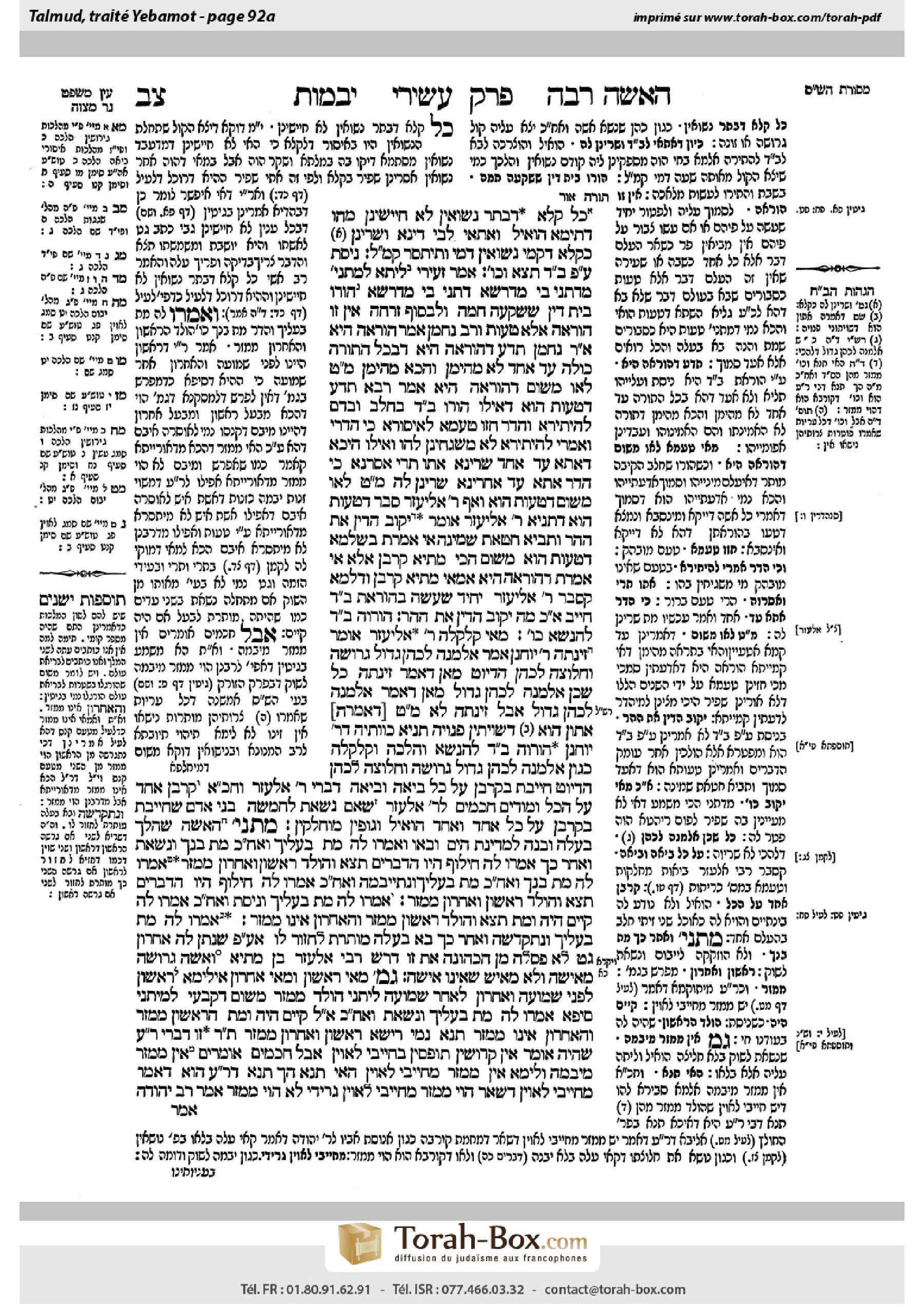
Yevamot 92a: Talmud study for Daf Yomi
Daf Yomi is the daily study of one Talmud folio. Explore 37 tractates with scans, Hebrew text, Sefaria English and AI-generated French translations where annotated.
Passage selection and English or AI-generated French translation are available where the scan has annotations. Daf Study is independent of Torah-Box and Sefaria.
Browse Yevamot · יבמות · All tractatesYevamot 92a text and translations
This page of Yevamot includes the Aramaic text, an English translation and an AI-generated French translation, alongside the scan above.
יבמות צ״ב א · Aramaic and Hebrew text
כֹּל קָלָא דְּבָתַר נִשּׂוּאִין לָא חָיְישִׁינַן! מַהוּ דְּתֵימָא: הוֹאִיל וַאֲתַאי לְבֵי דִינָא וּשְׁרֵינַן, כְּקָלָא דְּקַמֵּי נִשּׂוּאִין דָּמֵי וְתִיתְּסַר, קָא מַשְׁמַע לַן.
נִיסֵּת עַל פִּי בֵּית דִּין תֵּצֵא וְכוּ׳. אָמַר זְעֵירִי: לֵיתַהּ לְמַתְנִיתִין, מִדִּתְנַן בֵּי מִדְרְשָׁא. דְּתָנֵי בֵּי מִדְרְשָׁא: הוֹרוּ בֵּית דִּין שֶׁשָּׁקְעָה חַמָּה, וּלְבַסּוֹף זָרְחָה — אֵין זוֹ הוֹרָאָה, אֶלָּא טָעוּת.
וְרַב נַחְמָן אָמַר: הוֹרָאָה הִיא.
אָמַר רַב נַחְמָן: תֵּדַע דְּהוֹרָאָה הִיא, דִּבְכׇל הַתּוֹרָה כּוּלָּהּ עֵד אֶחָד לָא מְהֵימַן וְהָכָא מְהֵימַן, מַאי טַעְמָא? לָאו מִשּׁוּם דְּהוֹרָאָה הִיא. אָמַר רָבָא: תֵּדַע דְּטָעוּת הוּא, דְּאִילּוּ הוֹרוּ בֵּית דִּין בְּחֵלֶב וּבְדָם לְהֶיתֵּירָא, וַהֲדַר חֲזוֹ טַעְמָא לְאִיסּוּרָא, כִּי הָדְרִי וְאָמְרִי לְהֶיתֵּירָא — לָא מַשְׁגְּחִינַן בְּהוּ.
וְאִילּוּ, הֵיכָא דַּאֲתָא עֵד אֶחָד — שְׁרֵינָא. אֲתוֹ תְּרֵי — אֲסַרְנָא. כִּי הֲדַר אֲתָא עֵד אַחֲרִינָא — שָׁרֵינַן לַהּ. מַאי טַעְמָא, לָאו מִשּׁוּם דְּטָעוּת הוּא?!
וְאַף רַבִּי אֱלִיעֶזֶר סָבַר דְּטָעוּת הוּא, דְּתַנְיָא, רַבִּי אֱלִיעֶזֶר אוֹמֵר: יִקּוֹב הַדִּין אֶת הָהָר, וְתָבִיא חַטַּאת שְׁמֵינָה. אִי אָמְרַתְּ בִּשְׁלָמָא דְּטָעוּת הוּא — מִשּׁוּם הָכִי מַתְיָא קׇרְבָּן, אֶלָּא אִי אָמְרַתְּ דְּהוֹרָאָה הִיא, אַמַּאי מַתְיָא קׇרְבָּן?
וְדִלְמָא קָסָבַר רַבִּי אֱלִיעֶזֶר יָחִיד שֶׁעָשָׂה בְּהוֹרָאַת בֵּית דִּין חַיָּיב?! אִם כֵּן, מָה ״יִקּוֹב הַדִּין אֶת הָהָר״.
הוֹרוּהָ בֵּית דִּין לְהִנָּשֵׂא כּוּ׳. מַאי ״קִלְקְלָה״? רַבִּי אֶלְיעָזָר אוֹמֵר: זִינְּתָה. רַבִּי יוֹחָנָן אָמַר: אַלְמָנָה לְכֹהֵן גָּדוֹל, גְּרוּשָׁה וַחֲלוּצָה לְכֹהֵן הֶדְיוֹט.
מַאן דְּאָמַר זִינְּתָה — כׇּל שֶׁכֵּן אַלְמָנָה לְכֹהֵן גָּדוֹל. מַאן דְּאָמַר אַלְמָנָה לְכֹהֵן גָּדוֹל, אֲבָל זִינְּתָה — לָא. מַאי טַעְמָא — [דְּאָמְרָה] אַתּוּן הוּא דְּשַׁוִּיתוּן פְּנוּיָה.
תַּנְיָא כְּווֹתֵיהּ דְּרַבִּי יוֹחָנָן: הוֹרוּהָ בֵּית דִּין לְהִנָּשֵׂא וְהָלְכָה וְקִלְקְלָה, כְּגוֹן: אַלְמָנָה לְכֹהֵן גָּדוֹל, גְּרוּשָׁה וַחֲלוּצָה לְכֹהֵן הֶדְיוֹט — חַיֶּיבֶת בְּקׇרְבָּן עַל כׇּל בִּיאָה וּבִיאָה, דִּבְרֵי רַבִּי אֶלְעָזָר,
וַחֲכָמִים אוֹמְרִים: קׇרְבָּן אֶחָד עַל הַכֹּל. וּמוֹדִים חֲכָמִים לְרַבִּי אֶלְעָזָר שֶׁאִם נִשֵּׂאת לַחֲמִשָּׁה בְּנֵי אָדָם — שֶׁחַיֶּיבֶת בְּקׇרְבָּן עַל כׇּל אֶחָד וְאֶחָד, הוֹאִיל וְגוּפִין מוּחְלָקִין.
מַתְנִי׳ הָאִשָּׁה שֶׁהָלַךְ בַּעְלָהּ וּבְנָהּ לִמְדִינַת הַיָּם, וּבָאוּ וְאָמְרוּ לָהּ: מֵת בַּעְלִיךְ וְאַחַר כָּךְ מֵת בְּנֵךְ, וְנִשֵּׂאת, וְאַחַר כָּךְ אָמְרוּ לָהּ: חִילּוּף הָיוּ הַדְּבָרִים — תֵּצֵא, וְהַוָּלָד רִאשׁוֹן וְאַחֲרוֹן מַמְזֵר.
אָמְרוּ לָהּ: מֵת בְּנֵךְ וְאַחַר כָּךְ מֵת בַּעְלִיךְ, וְנִתְיַיבְּמָה, וְאַחַר כָּךְ אָמְרוּ לָהּ: חִילּוּף הָיוּ הַדְּבָרִים — תֵּצֵא, וְהַוָּלָד רִאשׁוֹן וְאַחֲרוֹן מַמְזֵר. אָמְרוּ לָהּ: מֵת בַּעְלִיךְ וְנִיסֵּת, וְאַחַר כָּךְ אָמְרוּ לָהּ: קַיָּים הָיָה וָמֵת — תֵּצֵא, וְהַוָּלָד רִאשׁוֹן — מַמְזֵר, וְהָאַחֲרוֹן — אֵינוֹ מַמְזֵר.
אָמְרוּ לָהּ: מֵת בַּעְלִיךְ, וְנִתְקַדְּשָׁה, וְאַחַר כָּךְ בָּא בַּעְלָהּ — מוּתֶּרֶת לַחְזוֹר לוֹ. אַף עַל פִּי שֶׁנָּתַן לָהּ אַחֲרוֹן גֵּט — לֹא פְּסָלָהּ מִן הַכְּהוּנָּה. אֶת זוֹ דָּרַשׁ רַבִּי אֶלְעָזָר בֶּן מַתְיָא: ״וְאִשָּׁה גְּרוּשָׁה מֵאִישָׁהּ״ — וְלֹא מֵאִישׁ שֶׁאֵינוֹ אִישָׁהּ.
גְּמָ׳ מַאי רִאשׁוֹן וּמַאי אַחֲרוֹן? אִילֵּימָא רִאשׁוֹן — לִפְנֵי שְׁמוּעָה, וְאַחֲרוֹן — לְאַחַר שְׁמוּעָה, לִיתְנֵי: הַוָּלָד מַמְזֵר!
מִשּׁוּם דְּקָבָעֵי לְמִיתְנֵי סֵיפָא: אָמְרוּ לָהּ מֵת בַּעְלִיךְ וְנִשֵּׂאת, וְאַחַר כָּךְ אָמְרוּ לָהּ קַיָּים הָיָה וּמֵת, הָרִאשׁוֹן מַמְזֵר וְהָאַחֲרוֹן אֵינוֹ מַמְזֵר — תְּנָא נָמֵי רֵישָׁא רִאשׁוֹן וְאַחֲרוֹן מַמְזֵר.
תָּנוּ רַבָּנַן: זוֹ דִּבְרֵי רַבִּי עֲקִיבָא, שֶׁהָיָה אוֹמֵר: אֵין קִדּוּשִׁין תּוֹפְסִין בְּחַיָּיבֵי לָאוִין. אֲבָל חֲכָמִים אוֹמְרִים: אֵין מַמְזֵר מִיְּבָמָה. וְלֵימָא: אֵין מַמְזֵר מֵחַיָּיבֵי לָאוִין!
הַאי תַּנָּא — הָךְ תַּנָּא דְּרַבִּי עֲקִיבָא הוּא, דְּאָמַר: מֵחַיָּיבֵי לָאוִין דִּשְׁאֵר הָוֵי מַמְזֵר, מֵחַיָּיבֵי לָאוִין גְּרִידִי — לָא הָוֵי מַמְזֵר. אָמַר רַב יְהוּדָה
Yevamot 92a · English translation
We are not concerned about any rumor after marriage. If a rumor spread about a woman after her marriage that she was forbidden to her husband, the court takes no notice of these reports. The Gemara answers: There is a novel aspect to this teaching: Lest you say that since she came to the court and they permitted her, the very fact that her case had to be discussed indicates that her status is not fully established, and consequently one might think that it should be considered like a rumor before marriage, and she should therefore be forbidden, Rav Ashi therefore teaches us that even in this case, once she is married the court takes no notice of unsubstantiated rumors.
§ The mishna further taught that if she married by permission of the court she must leave him, but she is exempt from bringing a sin-offering. On this issue, Ze’eiri said: The mishna is not accepted, and this is derived from what was taught in the study hall, as it was taught in a baraita in the study hall: If the court ruled that the sun had set at the conclusion of Shabbat, which means it is permitted to perform labor, and later the sun shone, this is not a ruling for which the court is to blame, but an error. Consequently, the court does not have to bring an offering for the unwitting communal sin. Rather, each individual is liable to bring a separate offering. Here too, although the woman married with the consent of the court, they did not issue a mistaken ruling of halakha but simply erred with regard to the facts. She is therefore an unwitting sinner and is liable to bring an offering.
And conversely, Rav Naḥman said that the court’s permission is considered a ruling that renders them liable to bring an offering for an unwitting communal sin.
Rav Naḥman said: You can know that her permission to marry is a ruling, as in the entire Torah one witness is not deemed credible, and yet here he is deemed credible. What is the reason for this? Is it not because it is considered a ruling, i.e., she does not rely on the witness but on the decision of the court? By contrast, Rava said that we can know that her permission to marry is an error. His reasoning is that had the court ruled with regard to forbidden fat or with regard to blood that it is permitted, and they went back and saw a reason to prohibit it, if they subsequently retract and say that it is permitted we take no notice of them. If they did not find a conclusive proof but merely offered a new argument, this claim does not cancel the earlier ruling that the substance is forbidden.
Whereas in the case of marriage, when one witness comes the court permits her, and when two witnesses subsequently come and testify that her husband is alive, they render her forbidden. When one other witness again comes forward, claiming that the husband is dead, they permit her. What is the reason for this? Is it not because it is considered an error of the court, as they did not issue their rulings based on their own reasoning but in reliance on the facts they had garnered from the witnesses? It is therefore considered a factual error, not a mistaken ruling.
The Gemara adds: And Rabbi Eliezer also maintains that the ruling of the court is an error, as it is taught in a baraita that Rabbi Eliezer says: If a woman married by permission of the court and it later turned out that her husband was alive, let the law pierce the mountain, i.e., the matter must be fully investigated. If it turns out that the ruling of the court is incorrect, it is nullified and she brings a choice sin-offering. Granted, if you say that it is an error, it is due to that reason that she must bring an offering. However, if you say it is a ruling, why does she bring an offering? It is the court that should be liable to bring an offering for its incorrect ruling.
The Gemara asks: But perhaps Rabbi Eliezer maintains that an individual who acted by ruling of the court is also liable to bring an offering, and this is why he obligates her to bring an offering, despite the fact that she went ahead with the consent of the court. The Gemara refutes this suggestion: If so, what need is there for the special mention of the rationale: Let the law pierce the mountain? He should simply have said that she is liable to bring an offering. Rather, Rabbi Eliezer evidently maintains that in general an individual does not have to bring an offering for a sin he committed based on the ruling of a court. Here, however, she must bring a sin-offering because there was an error with regard to the facts.
§ The mishna taught that if the court instructed her to marry, and she went and ruined herself, she is liable to bring an offering. The Gemara asks: What is the meaning of: Ruined herself? Rabbi Eliezer says: She engaged in licentious sexual relations with a man, i.e., intercourse not for the purpose of marriage. Rabbi Yoḥanan said: It means that she married in a prohibited manner, e.g., a widow to a High Priest, or a divorcée or a yevama who had performed ḥalitza [ḥalutza] to a common priest.
The Gemara elaborates: According to the one who says that she engaged in licentious sexual relations, she is all the more so liable to bring an offering if she is a widow who had sexual relations with a High Priest, as she performed an act prohibited by Torah law. Conversely, according to the one who says that the mishna is speaking of a widow who engaged in relations with a High Priest, it is only in that case that she must bring an offering; however, if she engaged in licentious sexual relations she is not liable to bring an offering. What is the reason? As she can say: It is you who deemed me unattached, and although my behavior was unseemly, I may live with whomever I choose as a single woman.
The Gemara comments: It is taught in a baraita in accordance with the opinion of Rabbi Yoḥanan: If the court ruled that she may marry, and she went and ruined herself, for example a widow who engaged in intercourse with a High Priest, or a divorcée or a ḥalutza who engaged in intercourse with a common priest, she is liable to bring an offering for each and every sexual act, as each is a separate transgression. This is the statement of Rabbi Elazar.
And the Rabbis say that she brings one offering for all of them, as she performed them all in a single lapse of awareness. And the Rabbis concede to Rabbi Elazar that if a married woman married in error, e.g., to five people, that she is liable to bring an offering for each and every one of them, since they are separate bodies. She is obligated to bring an offering for each separate man with whom she engaged in sexual relations.
MISHNA: With regard to a woman whose husband and child went overseas, and witnesses came and said to her: Your husband died and afterward your child died, she does not require levirate marriage, as she had a child when her husband died. And for this reason she married another man. And if afterward they said to her that the matters were reversed, i.e., the child died before the husband, which means that she did require levirate marriage, she is therefore a yevama who married a stranger without ḥalitza and she must consequently leave her second husband. And with regard to the first child, the one born before they heard about the reversal, and the last one, born after they realized who actually died first, each of these children is a mamzer.
Conversely, if they said to her: Your child died and afterward your husband died, and she therefore entered into levirate marriage, and afterward they said to her that the matters were reversed, which means she married her husband’s brother when there was no obligation of levirate marriage, she must leave her husband, and the first child and the last one are each a mamzer. If they said to her: Your husband died, and she married, and afterward they said to her that he was alive at the time of her marriage and he later died, she must leave the second husband. And the first child, born when her original husband was still alive, is a mamzer, and the last one, born after his death, is not a mamzer.
If they said to her: Your husband died, and she became betrothed to another man, and afterward her husband came, she is permitted to return to him, as betrothal alone does not render her forbidden to her husband. Furthermore, although the last man, i.e., her betrothed, gave her a bill of divorce, he has not thereby disqualified her from marrying into the priesthood. She was never his wife, for the betrothal was invalid, and a bill of divorce given to the wife of another man does not disqualify her. This was taught by Rabbi Elazar ben Matya: The verse states with regard to priests: “Neither shall they take a woman divorced from her husband” (Leviticus 21:7), which indicates: And not one who was divorced from a man who is not her husband, e.g., the second man in this case.
GEMARA: The Gemara asks a question with regard to the first section of the mishna: What is the meaning of first child and what is the meaning of last child in this context? If we say that the first means the one born before her hearing that the report was erroneous, and the last means the one born after she heard, let him teach simply: The offspring is a mamzer, as there is no difference between the two cases.
The Gemara explains that because the tanna wanted to teach in the latter clause: If they said to her your husband died, and she married, and afterward they said to her that he was alive and he later died, the first child is a mamzer and the last one is not a mamzer, he also taught in the first clause: The first and the last are each a mamzer, despite the fact that in this case it makes no difference whether the child was born before or after she heard.
§ The Sages taught: This mishna is the statement of Rabbi Akiva, who would say that betrothal does not take effect for those liable for violating regular prohibitions, and therefore the child of a yevama who transgressed a prohibition by marrying someone else is a mamzer. However, the Rabbis say that there is no mamzer from a yevama. The Gemara asks: And let the Rabbis say, as a principle: There is no mamzer from those liable for violating regular prohibitions.
The Gemara answers: This tanna called the Rabbis is in fact another tanna citing the opinion of Rabbi Akiva, who claims that Rabbi Akiva said that a child born from those liable for violating prohibitions proscribing sexual relations with close relatives is a mamzer, but one born from those liable for violating regular prohibitions, i.e., a prohibition that does not involve a family relationship, such as the prohibition that “the wife of the dead man shall not be married outside of the family to one not of his kin” (Deuteronomy 25:5), is not a mamzer. Rav Yehuda said
Yevamot 92a · Traduction française (IA)
Nous ne tenons pas compte d’une rumeur après le mariage. Si une rumeur se répand au sujet d’une femme après son mariage, selon laquelle elle serait interdite à son mari, le tribunal ne prête aucune attention à ces allégations. La Guemara répond : cet enseignement présente un aspect novateur. Ne pourrait-on pas dire que, puisqu’elle s’est présentée devant le tribunal et que celui-ci l’a autorisée, le fait même que son cas ait dû être examiné indique que son statut n’est pas pleinement établi ; on pourrait donc penser qu’il faut considérer cette rumeur comme une rumeur antérieure au mariage et, par conséquent, la lui interdire. Rav Ashi nous enseigne donc que, même dans ce cas, une fois qu’elle est mariée, le tribunal ne prête aucune attention aux rumeurs non étayées.
§ La Michna enseignait en outre que si elle s’est mariée avec l’autorisation du tribunal, elle doit le quitter, mais qu’elle est dispensée d’apporter un sacrifice expiatoire. À ce sujet, Ze’eiri a dit : La Michna n’est pas retenue. Cela se déduit de ce qui a été enseigné à la maison d’étude : une baraïta y enseigne que si le tribunal a statué que le soleil s’était couché à la fin du Chabbat, ce qui signifie qu’il est permis d’effectuer un travail, puis que le soleil est réapparu, il ne s’agit pas d’une décision dont le tribunal est responsable, mais d’une erreur. Par conséquent, le tribunal n’a pas à apporter de sacrifice pour une faute collective involontaire. Chaque individu est plutôt tenu d’apporter un sacrifice distinct. Ici aussi, bien que la femme se soit mariée avec l’accord du tribunal, celui-ci n’a pas rendu une décision erronée en halakha : il s’est simplement trompé sur les faits. Elle a donc péché involontairement et est tenue d’apporter un sacrifice.
À l’inverse, Rav Naḥman a dit que l’autorisation du tribunal est considérée comme une décision qui le rend passible d’apporter un sacrifice pour une faute collective involontaire.
Rav Naḥman a dit : On peut savoir que l’autorisation de se marier constitue une décision, car, dans toute la Torah, un témoin n’est pas considéré comme digne de foi, alors qu’ici, il l’est. Pour quelle raison ? N’est-ce pas parce que cette autorisation est considérée comme une décision, c’est-à-dire qu’elle ne se fie pas au témoin, mais à la décision du tribunal ? À l’inverse, Rava a dit qu’on peut savoir que l’autorisation de se marier constitue une erreur. Voici son raisonnement : si le tribunal avait statué, au sujet de graisse interdite ou de sang, que c’était permis, puis qu’il avait réexaminé la question et trouvé une raison de l’interdire, si, par la suite, il revenait sur cette décision et déclarait que c’est permis, on ne tiendrait pas compte de lui. S’il n’a pas trouvé de preuve concluante, mais a simplement avancé un nouvel argument, cette affirmation n’annule pas la décision précédente selon laquelle cette substance est interdite.
En revanche, dans le cas du mariage, lorsqu’un témoin se présente, le tribunal l’autorise, puis, lorsque deux témoins se présentent ensuite et attestent que son mari est vivant, ils la rendent interdite. Lorsqu’un autre témoin se présente à nouveau pour affirmer que son mari est mort, ils l’autorisent. Pour quelle raison ? N’est-ce pas parce qu’il s’agit d’une erreur du tribunal, puisque celui-ci n’a pas rendu ses décisions en s’appuyant sur son propre raisonnement, mais sur les faits qu’il avait recueillis auprès des témoins ? Il s’agit donc d’une erreur portant sur les faits, et non d’une décision erronée.
La Guemara ajoute : Rabbi Eliezer aussi considère que la décision du tribunal est une erreur, comme l’enseigne une baraïta où Rabbi Eliezer dit : Si une femme s’est mariée avec l’autorisation du tribunal et qu’il s’avère par la suite que son mari était vivant, que la loi perce la montagne, c’est-à-dire que l’affaire doit être examinée en profondeur. S’il s’avère que la décision du tribunal était erronée, elle est annulée et la femme apporte un sacrifice expiatoire de son choix. Il est compréhensible, si l’on dit qu’il s’agit d’une erreur, que ce soit pour cette raison qu’elle doit apporter un sacrifice. Mais si l’on dit qu’il s’agit d’une décision, pourquoi apporte-t-elle un sacrifice ? C’est le tribunal qui devrait être passible d’apporter un sacrifice pour sa décision erronée.
La Guemara demande : Mais peut-être Rabbi Eliezer considère-t-il qu’un individu qui a agi conformément à la décision du tribunal est lui aussi tenu d’apporter un sacrifice, et c’est pourquoi il l’oblige à apporter un sacrifice, bien qu’elle ait agi avec l’accord du tribunal. La Guemara réfute cette proposition : dans ce cas, pourquoi mentionner expressément la raison : « Que la loi perce la montagne » ? Il aurait simplement dû dire qu’elle est tenue d’apporter un sacrifice. Rabbi Eliezer considère donc manifestement qu’en règle générale, un individu n’a pas à apporter de sacrifice pour une faute commise sur la foi d’une décision du tribunal. Ici, cependant, elle doit apporter un sacrifice expiatoire, car il y a eu une erreur portant sur les faits.
§ La Michna enseignait que si le tribunal lui a ordonné de se marier et qu’elle est allée se débaucher, elle est tenue d’apporter un sacrifice. La Guemara demande : Que signifie « se débaucher » ? Rabbi Eliezer dit : Elle a eu des relations sexuelles licencieuses avec un homme, c’est-à-dire des rapports qui n’avaient pas pour but le mariage. Rabbi Yoḥanan dit : Cela signifie qu’elle s’est mariée d’une manière interdite, par exemple une veuve avec un grand prêtre, ou une divorcée ou une yevama ayant subi la ḥalitsa [ḥalutza] avec un prêtre ordinaire.
La Guemara précise : Selon celui qui dit qu’elle a eu des relations sexuelles licencieuses, elle est à plus forte raison tenue d’apporter un sacrifice si elle est une veuve qui a eu des relations sexuelles avec un grand prêtre, puisqu’elle a accompli un acte interdit par la Torah. À l’inverse, selon celui qui dit que la Michna parle d’une veuve ayant eu des relations avec un grand prêtre, elle n’est tenue d’apporter un sacrifice que dans ce cas ; en revanche, si elle a eu des relations sexuelles licencieuses, elle n’est pas tenue d’apporter un sacrifice. Pour quelle raison ? Elle peut dire : « C’est vous qui m’avez déclarée libre de tout lien matrimonial ; bien que mon comportement ait été inconvenant, je peux vivre avec qui je veux en tant que femme célibataire. »
La Guemara fait remarquer : Une baraïta enseigne conformément à l’opinion de Rabbi Yoḥanan : Si le tribunal a statué qu’elle pouvait se marier et qu’elle est allée se débaucher — par exemple, une veuve qui a eu des relations sexuelles avec un grand prêtre, ou une divorcée ou une ḥalutza qui a eu des relations sexuelles avec un prêtre ordinaire —, elle est tenue d’apporter un sacrifice pour chaque acte sexuel, car chacun constitue une transgression distincte. Telle est la déclaration de Rabbi Elazar.
Les Sages disent qu’elle apporte un seul sacrifice pour tous ces actes, car elle les a tous commis au cours d’une même inadvertance. Les Sages reconnaissent à Rabbi Elazar que si une femme mariée s’est mariée par erreur, par exemple avec cinq hommes, elle est tenue d’apporter un sacrifice pour chacun d’eux, puisqu’il s’agit de personnes distinctes. Elle est tenue d’apporter un sacrifice pour chaque homme distinct avec lequel elle a eu des relations sexuelles.
MICHNA : Au sujet d’une femme dont le mari et l’enfant sont partis outre-mer, et à laquelle des témoins sont venus dire : « Ton mari est mort, puis ton enfant est mort », elle n’a pas besoin d’un mariage léviratique, puisqu’elle avait un enfant lorsque son mari est mort. C’est pour cette raison qu’elle a épousé un autre homme. Si, par la suite, on lui a dit que les faits s’étaient déroulés dans l’ordre inverse, c’est-à-dire que l’enfant était mort avant le mari, ce qui signifie qu’elle devait contracter un mariage léviratique, elle est donc une yevama qui a épousé un étranger sans ḥalitsa et doit par conséquent quitter son second mari. Quant au premier enfant, celui qui est né avant qu’elle n’apprenne l’inversion de l’ordre, et au dernier, celui qui est né après qu’elle a compris lequel des deux était réellement mort en premier, chacun de ces enfants est un mamzer.
À l’inverse, si on lui a dit : « Ton enfant est mort, puis ton mari est mort », et qu’elle a donc contracté un mariage léviratique, puis qu’on lui a dit que les faits s’étaient déroulés dans l’ordre inverse, ce qui signifie qu’elle a épousé le frère de son mari alors qu’elle n’était pas tenue de contracter un mariage léviratique, elle doit quitter son mari, et le premier comme le dernier enfant sont chacun un mamzer. Si on lui a dit : « Ton mari est mort », qu’elle s’est mariée, puis qu’on lui a dit qu’il était vivant au moment de son mariage et qu’il est mort par la suite, elle doit quitter son second mari. Le premier enfant, né alors que son mari initial était encore vivant, est un mamzer, tandis que le dernier, né après sa mort, n’est pas un mamzer.
Si on lui a dit : « Ton mari est mort », qu’elle s’est fiancée à un autre homme et que, par la suite, son mari est revenu, elle est autorisée à retourner auprès de lui, car de simples fiançailles ne la rendent pas interdite à son mari. En outre, même si le dernier homme, c’est-à-dire celui auquel elle était fiancée, lui a remis un acte de divorce, cela ne l’a pas empêchée d’épouser un membre de la prêtrise. Elle n’a jamais été son épouse, car les fiançailles étaient invalides, et un acte de divorce remis à la femme d’un autre homme ne l’empêche pas de se marier dans la prêtrise. C’est ce qu’a enseigné Rabbi Elazar ben Matya : au sujet des prêtres, le verset dit : « Ils ne prendront pas une femme répudiée par son mari » (Lévitique 21, 7), ce qui indique : et non une femme répudiée par un homme qui n’est pas son mari, comme le second homme dans ce cas.
GUEMARA : La Guemara pose une question au sujet de la première partie de la Michna : dans ce contexte, que signifie « le premier enfant », et que signifie « le dernier enfant » ? Si l’on dit que « le premier » désigne celui qui est né avant qu’elle n’apprenne que le rapport était erroné, et que « le dernier » désigne celui qui est né après qu’elle l’a appris, que le tanna enseigne simplement : « L’enfant est un mamzer », car il n’y a aucune différence entre les deux cas.
La Guemara explique que, puisque le tanna voulait enseigner dans la clause suivante : « Si on lui a dit : “Ton mari est mort”, qu’elle s’est mariée, puis qu’on lui a dit qu’il était vivant et qu’il est mort par la suite, le premier enfant est un mamzer et le dernier n’est pas un mamzer », il a également enseigné dans la première clause : « Le premier et le dernier sont chacun un mamzer », bien que, dans ce cas, cela ne fasse aucune différence que l’enfant soit né avant ou après qu’elle l’a appris.
§ Les Sages ont enseigné : Cette Michna est la déclaration de Rabbi Akiva, qui soutenait que les fiançailles ne prennent pas effet pour ceux qui sont passibles de la peine prévue pour la transgression d’interdictions ordinaires. C’est pourquoi l’enfant d’une yevama qui a transgressé une interdiction en épousant un autre homme est un mamzer. Cependant, les Sages disent qu’il n’y a pas de mamzer issu d’une yevama. La Guemara demande : Pourquoi les Sages ne posent-ils pas comme principe qu’il n’y a pas de mamzer issu de ceux qui sont passibles de la peine prévue pour la transgression d’interdictions ordinaires ?
La Guemara répond : Le tanna désigné ici comme les Sages est en réalité un autre tanna qui cite l’opinion de Rabbi Akiva. Selon lui, Rabbi Akiva a dit qu’un enfant né de personnes passibles de la peine prévue pour la transgression d’interdictions proscrivant les relations sexuelles entre proches parents est un mamzer ; en revanche, un enfant né de personnes passibles de la peine prévue pour la transgression d’interdictions ordinaires, c’est-à-dire une interdiction qui n’implique pas de lien familial, telle que l’interdiction selon laquelle « la femme du défunt ne devra pas se marier au-dehors, à un homme qui n’est pas de sa parenté » (Deutéronome 25, 5), n’est pas un mamzer. Rav Yehuda a dit
Traduction française générée par IA à partir de l’édition anglaise de Sefaria. Vérifie toujours un passage avec le texte source.
Text from Sefaria: William Davidson Edition - Vocalized Aramaic (CC BY NC); William Davidson Edition - English (CC BY NC).