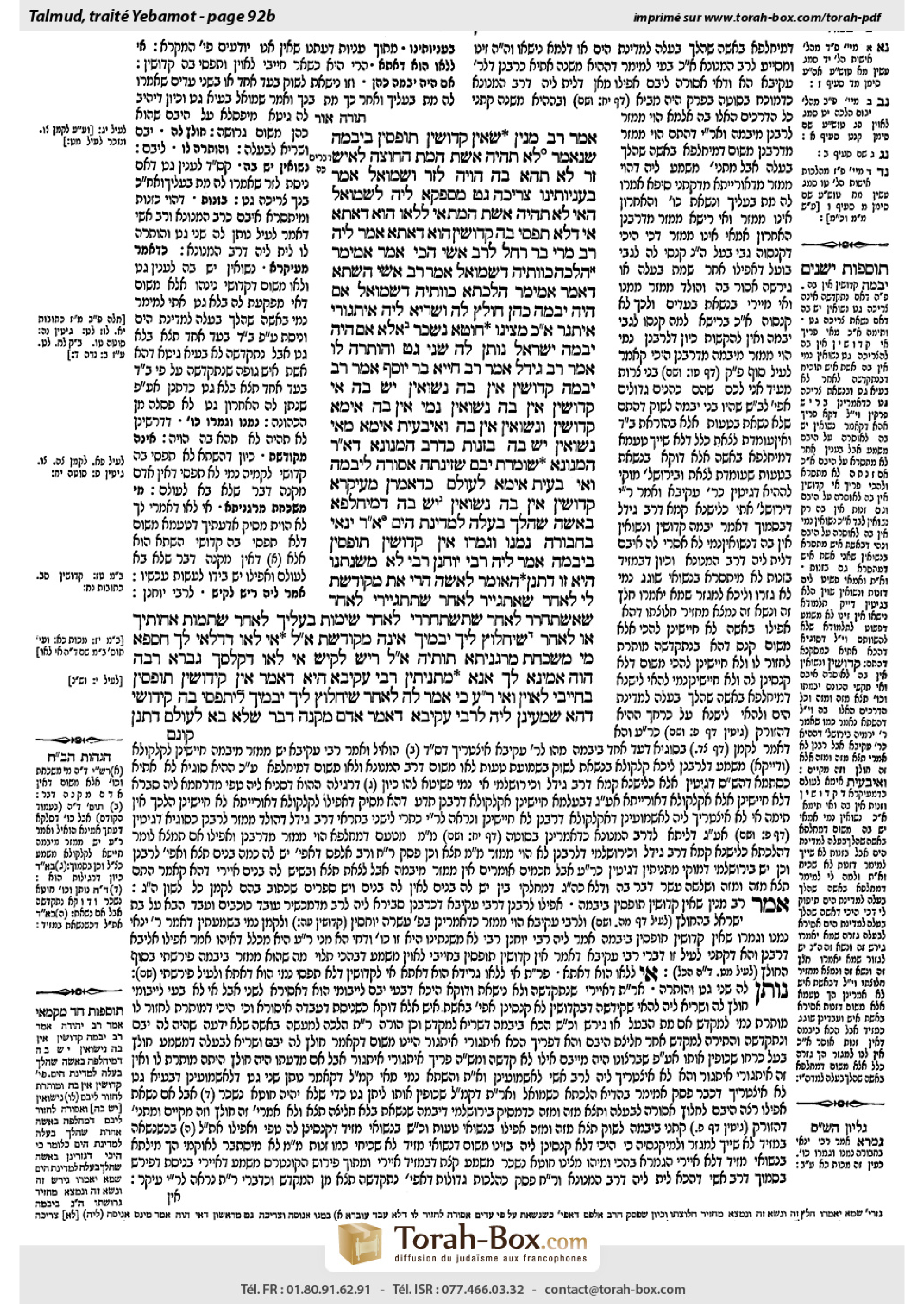
Yevamot 92b: Talmud study for Daf Yomi
Daf Yomi is the daily study of one Talmud folio. Explore 37 tractates with scans, Hebrew text, Sefaria English and AI-generated French translations where annotated.
Passage selection and English or AI-generated French translation are available where the scan has annotations. Daf Study is independent of Torah-Box and Sefaria.
Browse Yevamot · יבמות · All tractatesYevamot 92b text and translations
This page of Yevamot includes the Aramaic text, an English translation and an AI-generated French translation, alongside the scan above.
יבמות צ״ב ב · Aramaic and Hebrew text
אָמַר רַב: מִנַּיִן שֶׁאֵין קִדּוּשִׁין תּוֹפְסִין בִּיבָמָה, שֶׁנֶּאֱמַר: ״לֹא תִהְיֶה אֵשֶׁת הַמֵּת הַחוּצָה לְאִישׁ זָר״ — לֹא תְּהֵא בָּהּ הֲוָיָה לְזָר.
וּשְׁמוּאֵל אָמַר: בַּעֲנִיּוּתֵינוּ, צְרִיכָה גֵּט. מְסַפְּקָא לֵיהּ לִשְׁמוּאֵל הַאי ״לָא תִהְיֶה אֵשֶׁת הַמֵּת״, אִי לְלָאו הוּא דַּאֲתָא, אִי דְּלָא תָּפְסִי בַּהּ קִדּוּשִׁין הוּא דַּאֲתָא.
אֲמַר לֵיהּ רַב מָרִי בַּר רָחֵל לְרַב אָשֵׁי, הָכִי אָמַר אַמֵּימָר: הֲלָכָה כְּווֹתֵיהּ דִּשְׁמוּאֵל. אָמַר רַב אָשֵׁי: הַשְׁתָּא דְּאָמַר אַמֵּימָר הִלְכְתָא כְּווֹתֵיהּ דִּשְׁמוּאֵל — אִם הָיָה יְבָמָהּ כֹּהֵן, חוֹלֵץ לָהּ, וְשַׁרְיָא לֵיהּ.
אִיתְּגוֹרֵי אִיתְּגַר, אִם כֵּן מָצִינוּ חוֹטֵא נִשְׂכָּר! אֶלָּא, אִם הָיָה יְבָמָהּ יִשְׂרָאֵל, נוֹתֵן לָהּ שֵׁנִי גֵּט, וְהוּתְּרָה לוֹ.
אָמַר רַב גִּידֵּל אָמַר רַב חִיָּיא בַּר יוֹסֵף אָמַר רַב: יְבָמָה — קִדּוּשִׁין אֵין בָּהּ, נִשּׂוּאִין יֵשׁ בָּהּ. אִי קִדּוּשִׁין אֵין בָּהּ — נִשּׂוּאִין נָמֵי אֵין בָּהּ! אֵימָא: קִדּוּשִׁין וְנִשּׂוּאִין אֵין בָּהּ.
וְאִיבָּעֵית אֵימָא: מַאי ״נִשּׂוּאִין יֵשׁ בָּהּ״ — בִּזְנוּת, כִּדְרַב הַמְנוּנָא. דְּאָמַר רַב הַמְנוּנָא: שׁוֹמֶרֶת יָבָם שֶׁזִּינְּתָה — אֲסוּרָה לִיבָמָהּ.
וְאִי בָּעֵית אֵימָא, לְעוֹלָם כְּדַאֲמַרַן מֵעִיקָּרָא: קִדּוּשִׁין אֵין בָּהּ, נִשּׂוּאִין יֵשׁ בָּהּ. דְּמִיחַלְּפָא בְּאִשָּׁה שֶׁהָלַךְ בַּעְלָהּ לִמְדִינַת הַיָּם.
אָמַר רַבִּי יַנַּאי: בַּחֲבוּרָה, נִמְנוּ וְגָמְרוּ: אֵין קִדּוּשִׁין תּוֹפְסִין בִּיבָמָה. אֲמַר לֵיהּ רַבִּי יוֹחָנָן: רַבִּי, לֹא מִשְׁנָתֵנוּ הִיא זוֹ? דִּתְנַן, הָאוֹמֵר לָאִשָּׁה: ״הֲרֵי אַתְּ מְקוּדֶּשֶׁת לִי לְאַחַר שֶׁאֶתְגַּיֵּיר״, ״לְאַחַר שֶׁתִּתְגַּיְּירִי״, ״לְאַחַר שֶׁאֶשְׁתַּחְרֵר״, ״לְאַחַר שֶׁתִּשְׁתַּחְרְרִי״, ״לְאַחַר שֶׁיָּמוּת בַּעְלִיךְ״, ״לְאַחַר שֶׁתָּמוּת אֲחוֹתִיךְ״, אוֹ ״לְאַחַר שֶׁיַּחְלוֹץ לִיךְ יְבָמִיךְ״ — אֵינָהּ מְקוּדֶּשֶׁת. אֲמַר לֵיהּ: אִי לָאו דְּדַלַּאי לָךְ חַסְפָּא, מִי מַשְׁכַּחַתְּ מַרְגָּנִיתָא תּוּתֵיהּ?
אֲמַר לֵיהּ רֵישׁ לָקִישׁ: אִי לָאו דְּקַלְּסָךְ גַּבְרָא רַבָּה, הֲוָה אָמֵינָא לָךְ אֲנָא: מַתְנִיתִין רַבִּי עֲקִיבָא הִיא, דְּאָמַר: אֵין קִידּוּשִׁין תּוֹפְסִין בְּחַיָּיבֵי לָאוִין.
וְאִי רַבִּי עֲקִיבָא, כִּי אָמַר לַהּ ״לְאַחַר שֶׁיַּחֲלוֹץ לִיךְ יְבָמִיךְ״ לִיתְפְּסוּ בָּהּ קִידּוּשֵׁי! דְּהָא שָׁמְעִינַן לֵיהּ לְרַבִּי עֲקִיבָא דְּאָמַר: אָדָם מַקְנֶה דָּבָר שֶׁלֹּא בָּא לָעוֹלָם. דִּתְנַן:
Yevamot 92b · English translation
that Rav said: From where is it derived that betrothal by another man does not take effect with a yevama? As it is stated: “The wife of the dead man shall not be married outside of the family to one not of his kin” (Deuteronomy 25:5), which indicates: She shall not have the possibility of becoming married to one not of his kin, i.e., his betrothal is of no account.
And Shmuel said: In our poverty of knowledge, as we do not fully understand the verse, she requires a bill of divorce. The Gemara explains: Shmuel was uncertain with regard to this verse: “The wife of the dead man shall not be married outside,” whether it comes for a prohibition, i.e., the woman is prohibited from marrying another man but the betrothal of that other man is effective, or whether it comes to teach that betrothal by any other man does not take effect with her.
Rav Mari bar Raḥel said to Rav Ashi that Ameimar said as follows: The halakha is in accordance with the opinion of Shmuel. Rav Ashi said: Now that Ameimar said that the halakha is in accordance with the opinion of Shmuel, who maintains that one who betroths a yevama before she has performed ḥalitza must give her a bill of divorce, if her yavam was a priest, he performs ḥalitza with her, as she is forbidden to him after the man who betrothed her gave her a bill of divorce, and she is thereby permitted to the man to whom she was betrothed.
The Gemara expresses surprise at this ruling: But in that case, she thereby gains from her prohibited betrothal, as she may subsequently marry the man who betrothed her illegally. If so, we find a sinner benefiting from his transgression. Rather, the Gemara emends the teaching: If her yavam was a regular Israelite, this second man who betrothed her must give her a bill of divorce, and she is permitted to the yavam, as a non-priest may marry a divorcée.
§ Rav Giddel said that Rav Ḥiyya bar Yosef said that Rav said: With regard to a yevama, betrothal does not apply to her, but marriage does apply to her. The Gemara expresses puzzlement: If betrothal does not apply to her, marriage also should not apply to her. How can marriage take effect if the earlier and less binding stage of betrothal is of no consequence? Rather, emend the above statement and say: Neither betrothal nor marriage apply to her.
And if you wish, say a different explanation. What is the meaning of the phrase: Marriage does apply to her? It is referring to a case of licentious sexual relations. In other words, although Rav maintains that betrothal is ineffective for her, if she entered the wedding canopy with another man and had relations with him, her status changes and she is forbidden to the yavam. This is in accordance with the opinion of Rav Hamnuna, as Rav Hamnuna said that a widow awaiting her yavam who committed an act of licentious sexual relations is forbidden to her yavam.
And if you wish, say: Actually, it is as we said initially, that betrothal does not apply to her but marriage does apply to her. However, this does not mean that marriage is actually effective. Rather, the halakha is that he must give her a bill of divorce, as people might confuse this case with that of a woman whose husband went overseas. The Sages decreed that he must give her a bill of divorce so that people would not say that a woman who remarried after hearing that her husband had died likewise does not require a bill of divorce.
§ Rabbi Yannai said: In the group of Sages who discussed this matter, they counted and concluded that betrothal by another man does not take effect with a yevama. Rabbi Yoḥanan said to him: My teacher, is this not taught in a mishna that states that betrothal is of no account for such a woman? As we learned in a mishna (Bava Metzia 16b): With regard to one who says to a woman: You are hereby betrothed to me after I convert; after you convert; after I am freed from slavery; after you are freed; after your husband dies; after your sister dies; or after your yavam performs ḥalitza with you, she is not betrothed. The reason for the above ruling is that he is considered to be attempting to acquire an entity that is not yet in existence, as the betrothal cannot take effect at that point in time. This indicates that betrothal is entirely ineffective for a yevama until she performs ḥalitza. Rabbi Yannai said to Rabbi Yoḥanan: Had I not lifted the earthenware shard for you, would you have discovered the pearl [marganita] beneath it? It was only after I informed you of the halakha that you were able to cite a proof for it from a mishna.
Sometime later, Reish Lakish said to Rav Yoḥanan: If it were not for the fact that a great man, Rabbi Yannai, praised you, I would say that this is no proof, as it is possible that the mishna is in accordance with the opinion of Rabbi Akiva, who said that betrothal does not take effect for those liable for violating regular prohibitions, and therefore it is not effective with a yevama. However, according to the opinion of the Rabbis, betrothal is effective for this woman, as is the case with all regular prohibitions.
The Gemara asks: And if it is the opinion of Rabbi Akiva, when he said to her: After your yavam performs ḥalitza for you, let the betrothal take effect with her, as we have heard that Rabbi Akiva said that a man can transfer an entity that has not yet come into the world. In other words, Rabbi Akiva is of the opinion that an acquisition can take effect for something not yet in existence. If so, even if the betrothal cannot take effect now, it should be valid after she has performed ḥalitza. The proof that this is indeed Rabbi Akiva’s opinion is as we learned in a mishna (Ketubot 59a):
Yevamot 92b · Traduction française (IA)
Car Rav a dit : D’où sait-on que les kidouchin contractés avec une yevama par un autre homme ne prennent pas effet ? Comme il est dit : « La femme du défunt ne sera pas donnée en mariage au-dehors, à un homme qui n’est pas de sa parenté » (Deutéronome 25:5), ce qui indique qu’elle ne peut pas se marier à un homme qui n’est pas de sa parenté, c’est-à-dire que ses kidouchin n’ont aucune valeur.
Et Shmuel a dit : Dans notre ignorance, puisque nous ne comprenons pas pleinement le verset, elle doit recevoir un acte de divorce. La Guemara explique : Shmuel avait un doute concernant ce verset : « La femme du défunt ne sera pas donnée en mariage au-dehors » : énonce-t-il une interdiction, c’est-à-dire que la femme n’a pas le droit d’épouser un autre homme, mais que les kidouchin de cet homme prennent effet, ou enseigne-t-il que les kidouchin contractés avec elle par tout autre homme ne prennent pas effet ?
Rav Mari bar Raḥel dit à Rav Ashi qu’Ameimar avait déclaré ceci : La halakha est conforme à l’opinion de Shmuel. Rav Ashi dit : Puisqu’Ameimar a déclaré que la halakha est conforme à l’opinion de Shmuel, qui estime que celui qui contracte des kidouchin avec une yevama avant qu’elle ait accompli la ḥalitsa doit lui remettre un acte de divorce, si son yavam est un prêtre, celui-ci accomplit la ḥalitsa avec elle, car elle lui est interdite après que l’homme qui a contracté des kidouchin avec elle lui a remis un acte de divorce ; elle est alors permise à l’homme avec lequel elle avait contracté ces kidouchin.
La Guemara s’étonne de cette décision : Mais dans ce cas, elle tire profit de ses kidouchin interdits, puisqu’elle peut ensuite épouser l’homme qui a contracté illégalement des kidouchin avec elle. On aboutit donc à ce qu’un pécheur tire profit de sa transgression. La Guemara corrige plutôt l’enseignement : si son yavam est un Israélite ordinaire, ce second homme qui a contracté des kidouchin avec elle doit lui remettre un acte de divorce, et elle est alors permise à son yavam, puisqu’un non-prêtre peut épouser une femme divorcée.
§ Rav Giddel a dit au nom de Rav Ḥiyya bar Yosef, au nom de Rav : Pour une yevama, les kidouchin ne prennent pas effet, mais le mariage, lui, prend effet. La Guemara s’interroge : Si les kidouchin ne prennent pas effet, le mariage ne devrait pas non plus prendre effet. Comment le mariage peut-il prendre effet si l’étape antérieure, moins contraignante, des kidouchin est sans conséquence ? Il faut plutôt corriger la déclaration précédente et dire : Ni les kidouchin ni le mariage ne prennent effet avec elle.
Et si tu le souhaites, donne une autre explication. Que signifie l’expression « le mariage prend effet » ? Elle fait référence à un cas de relations sexuelles illicites. Autrement dit, bien que Rav soutienne que les kidouchin ne prennent pas effet avec elle, si elle entre sous la houppa avec un autre homme et a des relations avec lui, son statut change et elle devient interdite à son yavam. Cela est conforme à l’opinion de Rav Hamnuna, car Rav Hamnuna a dit qu’une veuve qui attend son yavam et a eu des relations sexuelles illicites est interdite à son yavam.
Et si tu le souhaites, dis que, en réalité, c’est bien ce que nous avons dit au départ : les kidouchin ne prennent pas effet avec elle, mais le mariage, lui, prend effet. Toutefois, cela ne signifie pas que le mariage prend réellement effet. La halakha est plutôt qu’il doit lui remettre un acte de divorce, car les gens pourraient confondre ce cas avec celui d’une femme dont le mari est parti outre-mer. Les Sages ont décrété qu’il doit lui remettre un acte de divorce, afin que les gens ne disent pas qu’une femme qui s’est remariée après avoir appris la mort de son mari n’a pas non plus besoin d’un acte de divorce.
§ Rabbi Yannai a dit : Le groupe de Sages qui a examiné cette question a délibéré et conclu que les kidouchin contractés avec une yevama par un autre homme ne prennent pas effet. Rabbi Yoḥanan lui dit : Mon maître, cela n’est-il pas enseigné dans une Michna, qui affirme que les kidouchin n’ont aucune valeur pour une telle femme ? En effet, nous avons appris dans une Michna (Bava Metzia 16b) : Celui qui dit à une femme : « Tu m’es consacrée après que je me serai converti ; après que tu te seras convertie ; après que j’aurai été affranchi de l’esclavage ; après que tu auras été affranchie ; après la mort de ton mari ; après la mort de ta sœur ; ou après que ton yavam aura accompli la ḥalitsa avec toi », elle n’est pas consacrée. La raison de cette décision est qu’il est considéré comme cherchant à acquérir une chose qui n’existe pas encore, puisque les kidouchin ne peuvent pas prendre effet à ce moment-là. Cela indique que les kidouchin ne prennent absolument pas effet avec une yevama tant qu’elle n’a pas accompli la ḥalitsa. Rabbi Yannai dit à Rabbi Yoḥanan : Si je n’avais pas soulevé pour toi le tesson de poterie, aurais-tu découvert la perle [marganita] qui se trouvait dessous ? Ce n’est qu’après t’avoir informé de la halakha que tu as pu en citer une preuve tirée d’une Michna.
Quelque temps plus tard, Reish Lakish dit à Rav Yoḥanan : Si un grand homme, Rabbi Yannai, ne t’avait pas loué, je dirais que ce n’est pas une preuve, car il est possible que la Michna soit conforme à l’opinion de Rabbi Akiva, qui a dit que les kidouchin ne prennent pas effet pour ceux qui sont passibles d’une peine pour avoir enfreint des interdictions ordinaires, et qu’ils sont donc inopérants avec une yevama. Toutefois, selon l’opinion des Rabbins, les kidouchin prennent effet avec cette femme, comme c’est le cas pour toutes les interdictions ordinaires.
La Guemara demande : Et si c’est l’opinion de Rabbi Akiva, lorsqu’il lui a dit : « Après que ton yavam aura accompli la ḥalitsa avec toi », qu’il fasse prendre effet aux kidouchin avec elle ! En effet, nous avons appris que Rabbi Akiva a dit qu’un homme peut transférer une chose qui n’est pas encore venue au monde. Autrement dit, Rabbi Akiva estime qu’une acquisition peut prendre effet sur une chose qui n’existe pas encore. Ainsi, même si les kidouchin ne peuvent pas prendre effet maintenant, ils devraient être valides après qu’elle aura accompli la ḥalitsa. La preuve que telle est bien l’opinion de Rabbi Akiva se trouve dans ce que nous avons appris dans une Michna (Ketoubot 59a) :
Traduction française générée par IA à partir de l’édition anglaise de Sefaria. Vérifie toujours un passage avec le texte source.
Text from Sefaria: William Davidson Edition - Vocalized Aramaic (CC BY NC); William Davidson Edition - English (CC BY NC).