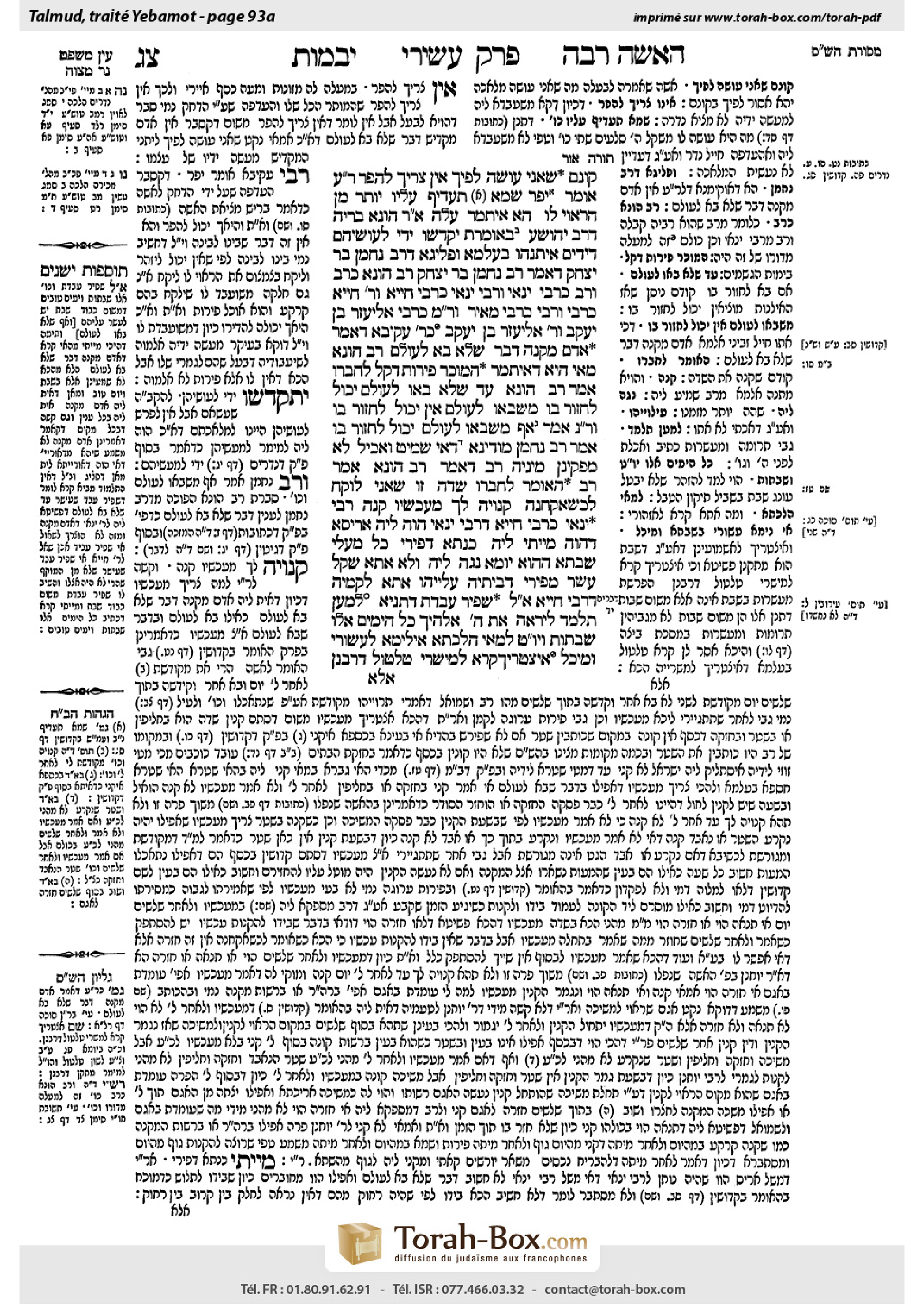
Yevamot 93a: Talmud study for Daf Yomi
Daf Yomi is the daily study of one Talmud folio. Explore 37 tractates with scans, Hebrew text, Sefaria English and AI-generated French translations where annotated.
Passage selection and English or AI-generated French translation are available where the scan has annotations. Daf Study is independent of Torah-Box and Sefaria.
Browse Yevamot · יבמות · All tractatesYevamot 93a text and translations
This page of Yevamot includes the Aramaic text, an English translation and an AI-generated French translation, alongside the scan above.
יבמות צ״ג א · Aramaic and Hebrew text
קֻוֽנָּם שֶׁאֲנִי עוֹשָׂה לְפִיךָ — אֵין צָרִיךְ לְהָפֵר.
רַבִּי עֲקִיבָא אוֹמֵר: יָפֵר, שֶׁמָּא תַּעֲדִיף עָלָיו יוֹתֵר מִן הָרָאוּי לוֹ.
הָא אִיתְּמַר עֲלַהּ: אָמַר רַב הוּנָא בְּרֵיהּ דְּרַב יְהוֹשֻׁעַ: בְּאוֹמֶרֶת: ״יִקְדְּשׁוּ יָדַי לְעוֹשֵׂיהֶם״, דְּיָדַיִם אִיתַנְהוּ בְּעָלְמָא.
וּפְלִיגָא דְּרַב נַחְמָן בַּר יִצְחָק. דְּאָמַר רַב נַחְמָן בַּר יִצְחָק: רַב הוּנָא כְּרַב, וְרַב כְּרַבִּי יַנַּאי, וְרַבִּי יַנַּאי כְּרַבִּי חִיָּיא, וְרַבִּי חִיָּיא כְּרַבִּי, וְרַבִּי כְּרַבִּי מֵאִיר, וְרַבִּי מֵאִיר כְּרַבִּי אֱלִיעֶזֶר בֶּן יַעֲקֹב, וְרַבִּי אֱלִיעֶזֶר בֶּן יַעֲקֹב כְּרַבִּי עֲקִיבָא, דְּאָמַר: אָדָם מַקְנֶה דָּבָר שֶׁלֹּא בָּא לָעוֹלָם.
רַב הוּנָא מַאי הִיא? דְּאִיתְּמַר: הַמּוֹכֵר פֵּירוֹת דֶּקֶל לַחֲבֵרוֹ, אָמַר רַב הוּנָא: עַד שֶׁלֹּא בָּאוּ לָעוֹלָם — יָכוֹל לַחְזוֹר בּוֹ. מִשֶּׁבָּאוּ לָעוֹלָם — אֵין יָכוֹל לַחְזוֹר בּוֹ.
וְרַב נַחְמָן אָמַר: אַף מִשֶּׁבָּאוּ לָעוֹלָם — יָכוֹל לַחְזוֹר בּוֹ. אָמַר רַב נַחְמָן: מוֹדֵינָא דְּאִי שָׁמֵיט וְאָכֵיל — לָא מַפְּקִינַן מִינֵּיהּ.
רַב — דְּאָמַר רַב הוּנָא אָמַר רַב: הָאוֹמֵר לַחֲבֵרוֹ ״שָׂדֶה זוֹ שֶׁאֲנִי לוֹקֵחַ לִכְשֶׁאֶקָּחֶנָּה, קְנוּיָה לְךָ מֵעַכְשָׁיו״ — קָנָה.
רַבִּי יַנַּאי כְּרַבִּי חִיָּיא — דְּרַבִּי יַנַּאי הֲוָה לֵיהּ אֲרִיסָא דַּהֲוָה מַיְיתֵי לֵיהּ כַּנְתָּא דְפֵירֵי כׇּל מַעֲלֵי שַׁבְּתָא. הָהוּא יוֹמָא נְגַהּ לֵיהּ וְלָא אֲתָא. שְׁקַל עַשַּׂר מִפֵּירֵי דְבֵיתֵיהּ עֲלַיְיהוּ. אֲתָא לְקַמֵּיהּ דְּרַבִּי חִיָּיא,
אֲמַר לֵיהּ: שַׁפִּיר עֲבַדְתְּ. דְּתַנְיָא: ״לְמַעַן תִּלְמַד לְיִרְאָה אֶת ה׳ אֱלֹהֶיךָ כׇּל הַיָּמִים״ — אֵלּוּ שַׁבָּתוֹת וְיָמִים טוֹבִים. לְמַאי הִלְכְתָא? אִילֵּימָא לְעַשּׂוֹרֵי וּמֵיכַל, אִיצְטְרִיךְ קְרָא לְמִישְׁרֵי טִלְטוּל דְּרַבָּנַן?!
Yevamot 93a · English translation
If a wife said: Konam, i.e., this is forbidden like consecrated property, in reference to anything that I will prepare for your mouth, that is, the payment for any work I perform shall be forbidden to you, he is not required to nullify the vow, as it is automatically void, since she was under a prior obligation to give him her earnings as part of their marriage agreement.
Rabbi Akiva says: He should nullify the vow, lest she exceed more than is fitting for him. A husband is entitled only to a certain sum from his wife’s earnings (see Ketubot 64b). If she earns only the sum of money to which he is entitled, the vow certainly does not go into effect. However, she might earn more, in which case the vow would apply with regard to the additional amount. To avoid this scenario, it is preferable for the husband to nullify the vow. This shows that according to the opinion of Rabbi Akiva a vow applies even with regard to an entity that has not yet come into the world. In this case, the entity is the earnings for work she has yet to perform.
The Gemara refutes this proof: But wasn’t it stated with regard to that mishna that Rav Huna, son of Rav Yehoshua, said: This mishna is not referring to a woman who renders the earnings for work she has yet to perform forbidden, but to a wife who says: Let my hands be consecrated to their Maker. In other words, she declares that it is as though her hands were sanctified, which means that anything produced by them is forbidden. Since these hands are in the world, she has not attempted to acquire something that does not exist. Therefore, there is no proof from here with regard to Rabbi Akiva’s opinion on that issue.
§ The Gemara comments: And this opinion, that Rabbi Akiva maintains that one cannot acquire an entity that has not yet come into the world, disagrees with the opinion of Rav Naḥman bar Yitzḥak, as Rav Naḥman bar Yitzḥak said: Rav Huna agrees with the opinion of Rav, and Rav agrees with the opinion of Rabbi Yannai, and Rabbi Yannai with the opinion of Rabbi Ḥiyya, and Rabbi Ḥiyya with the opinion of Rabbi Yehuda HaNasi, and Rabbi Yehuda HaNasi with the opinion of Rabbi Meir, and Rabbi Meir with the opinion of Rabbi Eliezer ben Ya’akov, and Rabbi Eliezer ben Ya’akov with the opinion of Rabbi Akiva, who said: A person can transfer to another an entity that has not yet come into the world. This shows that Rabbi Akiva indeed maintains that one can acquire something that does not yet exist.
The Gemara specifies the particular contexts in which the aforementioned opinions, all of which concur, were issued: Rav Huna, what is the source for his ruling? As it was stated: With regard to one who sells the fruit of a palm tree to another before the fruit has grown, Rav Huna said: Until the fruit has come into the world, he can retract the sale, as it has yet to take effect. However, after the fruit has come into the world, he can no longer retract, despite the fact the fruit had not yet sprouted when he made the acquisition.
And Rav Naḥman said: Even after they have come into the world he can retract, as the acquisition was defective from the outset. He maintains that one cannot transfer ownership of an entity that does not yet exist. Rav Naḥman said: Even so, I concede that if the buyer seizes the fruit and consumes it, the court does not remove them from him, because despite the faulty acquisition he was promised a sale of fruit.
The Gemara cites the proof that Rav also accepts the ruling that one can acquire an entity that does not yet exist, as Rav Huna said that Rav said: With regard to one who says to another: This field that I am about to buy, when I buy it, it is acquired by you from now, the addressee has acquired the field, despite the fact that it did not belong to the speaker at the time of his statement.
Rabbi Yannai also agrees with the opinion of Rabbi Ḥiyya, as demonstrated by the following episode: Rabbi Yannai had a sharecropper working his land who would bring him a basket [kanta] of fruit every Shabbat eve. One day he was late and did not come. Rabbi Yannai took tithe from the fruit in his house for the fruit he expected to receive. He did this in case the fruit arrived near the beginning of Shabbat, as one may not tithe on Shabbat. However, Rabbi Yannai was uncertain whether it is indeed possible to separate tithes for an entity that has not yet reached one’s possession. He therefore came before Rabbi Ḥiyya to inquire whether his separation of tithes was effective.
Rabbi Ḥiyya said to him: You acted well, as it is taught in a baraita, with regard to a verse that discusses tithes: “And you shall eat before the Lord your God…in order that you should learn to fear the Lord your God all the days” (Deuteronomy 14:23). With regard to the emphasis of “all,” these are Shabbatot and Festivals. With regard to what halakha was this stated? If we say it was stated in regard to the issue of tithing and eating on Shabbat, this halakha is redundant. Was a verse necessary to permit the prohibition against moving objects, which applies by rabbinic law? Since the prohibition against moving objects is from the Sages, the Torah is certainly not referring to this halakha.
Yevamot 93a · Traduction française (IA)
Si une épouse dit : « Konam », c’est-à-dire : « Que tout ce que je préparerai pour toi soit interdit comme un bien consacré », autrement dit, que le salaire de tout travail qu’elle effectuera lui soit interdit, son mari n’est pas tenu d’annuler le vœu, car celui-ci est automatiquement nul : elle était déjà tenue de lui remettre ses gains en vertu de leur contrat de mariage.
Rabbi Akiva dit : Il doit annuler le vœu, de peur qu’elle ne gagne davantage que la somme à laquelle il a droit. Un mari n’a droit qu’à une certaine somme sur les gains de son épouse (voir Ketoubot 64b). Si elle ne gagne que la somme à laquelle il a droit, le vœu ne prend certainement pas effet. Mais il se peut qu’elle gagne davantage ; dans ce cas, le vœu s’appliquerait à la somme supplémentaire. Pour éviter cette situation, il est préférable que le mari annule le vœu. Cela montre que, selon l’avis de Rabbi Akiva, un vœu s’applique même à une chose qui n’est pas encore venue au monde. Ici, cette chose correspond aux gains d’un travail qu’elle n’a pas encore effectué.
La Guemara réfute cette preuve : Mais n’a-t-il pas été enseigné au sujet de cette Michna que Rav Houna, fils de Rav Yehochoua, a dit : Cette Michna ne concerne pas une femme qui rend interdits les gains d’un travail qu’elle n’a pas encore effectué, mais une épouse qui dit : « Que mes mains soient consacrées à leur Créateur. » Autrement dit, elle déclare que ses mains sont comme consacrées, ce qui signifie que tout ce qu’elles produiront sera interdit. Puisque ses mains existent déjà, elle n’a pas tenté d’acquérir une chose qui n’existe pas encore. On ne peut donc tirer de là aucune preuve quant à l’avis de Rabbi Akiva sur cette question.
§ La Guemara commente : Cet avis, selon lequel Rabbi Akiva soutient qu’on ne peut pas acquérir une chose qui n’est pas encore venue au monde, est contraire à celui de Rav Naḥman bar Yitsḥak. En effet, Rav Naḥman bar Yitsḥak a dit : Rav Houna est d’accord avec Rav, Rav avec Rabbi Yannai, Rabbi Yannai avec Rabbi Ḥiyya, Rabbi Ḥiyya avec Rabbi Yehouda HaNassi, Rabbi Yehouda HaNassi avec Rabbi Meïr, Rabbi Meïr avec Rabbi Eliezer ben Yaakov, et Rabbi Eliezer ben Yaakov avec Rabbi Akiva, qui a dit : Une personne peut transférer à une autre une chose qui n’est pas encore venue au monde. Cela montre que Rabbi Akiva soutient effectivement qu’on peut acquérir une chose qui n’existe pas encore.
La Guemara précise les contextes particuliers dans lesquels les avis susmentionnés, tous concordants, ont été formulés : quelle est la source de la décision de Rav Houna ? Il a été enseigné : Au sujet de celui qui vend à une autre personne les fruits d’un palmier avant qu’ils aient poussé, Rav Houna a dit : Jusqu’à ce que les fruits viennent au monde, il peut revenir sur la vente, car celle-ci n’a pas encore pris effet. Toutefois, une fois que les fruits sont venus au monde, il ne peut plus revenir sur la vente, bien qu’ils n’aient pas encore poussé lorsqu’il a conclu l’acquisition.
Et Rav Naḥman a dit : Même après que les fruits sont venus au monde, il peut revenir sur la vente, car l’acquisition était viciée dès le départ. Il soutient qu’on ne peut pas transférer la propriété d’une chose qui n’existe pas encore. Rav Naḥman a dit : Malgré tout, je reconnais que si l’acheteur s’empare des fruits et les consomme, le tribunal ne les lui retire pas, car, malgré le vice de l’acquisition, la vente de ces fruits lui avait été promise.
La Guemara cite la preuve que Rav accepte lui aussi la décision selon laquelle on peut acquérir une chose qui n’existe pas encore : Rav Houna a dit au nom de Rav : Au sujet de celui qui dit à une autre personne : « Ce champ que je suis sur le point d’acheter, dès que je l’aurai acheté, il t’appartiendra à partir de maintenant », le destinataire acquiert le champ, bien que celui-ci n’appartienne pas à celui qui parle au moment où il prononce ces paroles.
Rabbi Yannai est également d’accord avec l’avis de Rabbi Ḥiyya, comme le montre l’épisode suivant : Rabbi Yannai avait un métayer qui cultivait ses terres et lui apportait un panier [kanta] de fruits chaque veille de Chabbat. Un jour, le métayer fut en retard et ne vint pas. Rabbi Yannai préleva la dîme sur les fruits qui se trouvaient chez lui pour les fruits qu’il s’attendait à recevoir. Il fit cela au cas où les fruits arriveraient peu avant le début de Chabbat, car il est interdit de prélever la dîme pendant Chabbat. Cependant, Rabbi Yannai ne savait pas avec certitude s’il était effectivement possible de prélever la dîme sur une chose qui n’était pas encore entrée en sa possession. Il se rendit donc auprès de Rabbi Ḥiyya pour lui demander si son prélèvement de la dîme était valide.
Rabbi Ḥiyya lui dit : Tu as bien agi, car il est enseigné dans une baraïta, au sujet d’un verset qui traite des dîmes : « Et tu mangeras devant le Seigneur ton Dieu… afin que tu apprennes à craindre le Seigneur ton Dieu tous les jours » (Deutéronome 14, 23). Quant au mot « tous », il désigne les Chabbatot et les fêtes. À propos de quelle halakha cela a-t-il été dit ? Si nous disons que cela concerne le prélèvement de la dîme et la consommation pendant Chabbat, cette halakha est superflue. Fallait-il un verset pour autoriser ce qui est interdit par décret rabbinique, à savoir déplacer des objets ? Puisque cette interdiction relève des Sages, la Torah ne saurait certainement pas faire référence à cette halakha.
Traduction française générée par IA à partir de l’édition anglaise de Sefaria. Vérifie toujours un passage avec le texte source.
Text from Sefaria: William Davidson Edition - Vocalized Aramaic (CC BY NC); William Davidson Edition - English (CC BY NC).