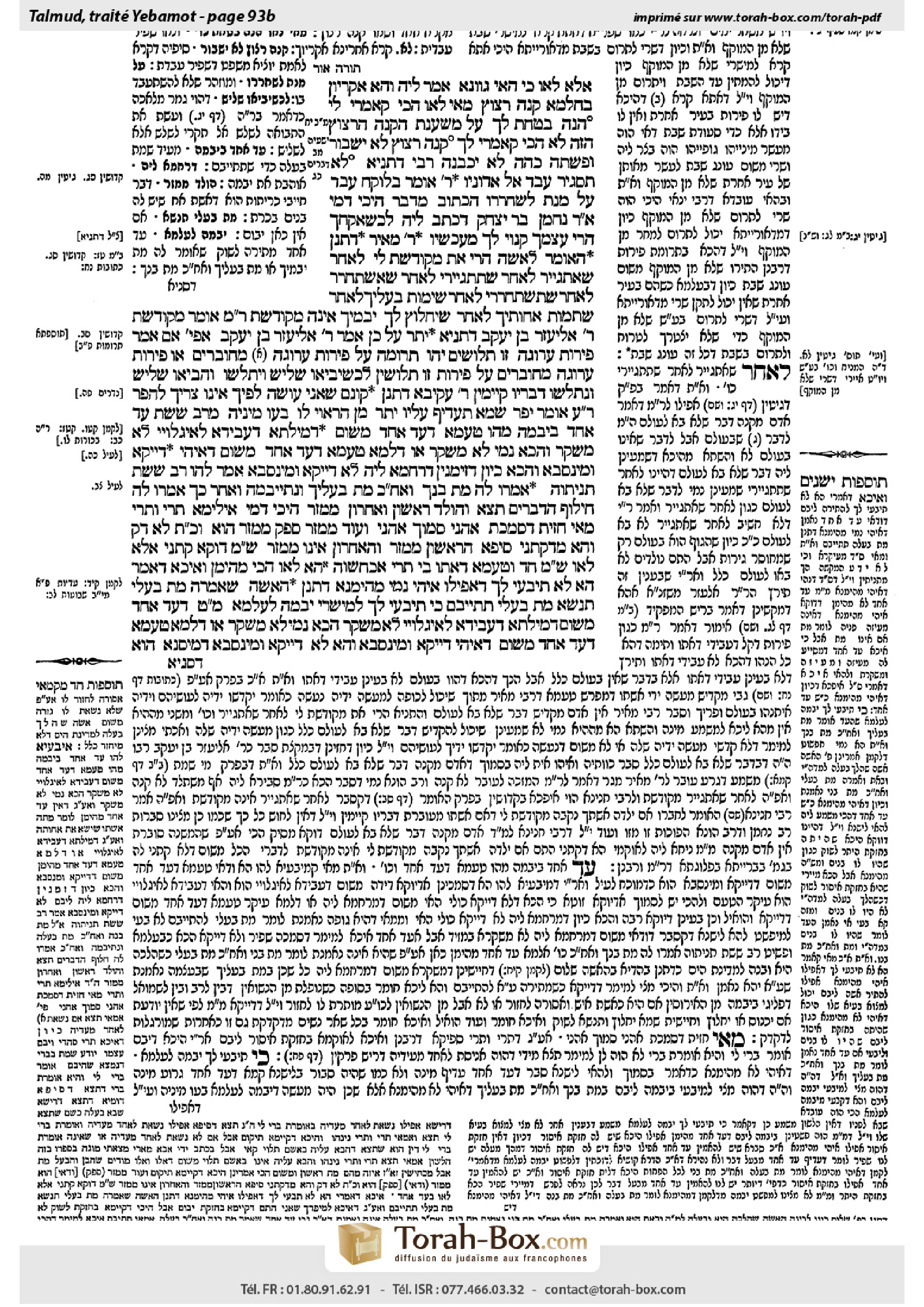
Yevamot 93b: Talmud study for Daf Yomi
Daf Yomi is the daily study of one Talmud folio. Explore 37 tractates with scans, Hebrew text, Sefaria English and AI-generated French translations where annotated.
Passage selection and English or AI-generated French translation are available where the scan has annotations. Daf Study is independent of Torah-Box and Sefaria.
Browse Yevamot · יבמות · All tractatesYevamot 93b text and translations
This page of Yevamot includes the Aramaic text, an English translation and an AI-generated French translation, alongside the scan above.
יבמות צ״ג ב · Aramaic and Hebrew text
אֶלָּא לָאו, כִּי הַאי גַוְונָא. אֲמַר לֵיהּ: וְהָא אַקְרְיוּן בְּחֶלְמָא ״קָנֶה רָצוּץ״, מַאי לָאו, הָכִי קָאָמְרִי לִי: ״הִנֵּה בָטַחְתָּ לְּךָ עַל מִשְׁעֶנֶת הַקָּנֶה הָרָצוּץ הַזֶּה״?
לָא, הָכִי קָאָמְרִי לָךְ: ״קָנֶה רָצוּץ לֹא יִשְׁבּוֹר וּפִשְׁתָּה כֵהָה לֹא יְכַבֶּנָּה״.
רַבִּי — דְּתַנְיָא: ״לֹא תַסְגִּיר עֶבֶד אֶל אֲדוֹנָיו״, רַבִּי אוֹמֵר: בְּלוֹקֵחַ עֶבֶד עַל מְנָת לְשַׁחְרְרוֹ הַכָּתוּב מְדַבֵּר. הֵיכִי דָּמֵי? אָמַר רַב נַחְמָן בַּר יִצְחָק: דִּכְתַב לֵיהּ לִכְשֶׁאֶקָּחֲךָ — הֲרֵי עַצְמְךָ קָנוּי לְךָ מֵעַכְשָׁיו.
רַבִּי מֵאִיר — דִּתְנַן, הָאוֹמֵר לְאִשָּׁה: ״הֲרֵי אַתְּ מְקוּדֶּשֶׁת לִי לְאַחַר שֶׁאֶתְגַּיֵּיר״, ״לְאַחַר שֶׁתִּתְגַּיְּירִי״, ״לְאַחַר שֶׁאֶשְׁתַּחְרֵר״, ״לְאַחַר שֶׁתִּשְׁתַּחְרְרִי״, ״לְאַחַר שֶׁיָּמוּת בַּעְלִיךְ״, ״לְאַחַר שֶׁתָּמוּת אֲחוֹתִיךְ״, ״לְאַחַר שֶׁיַּחְלוֹץ לִיךְ יְבָמִיךְ״ — אֵינָהּ מְקוּדֶּשֶׁת. רַבִּי מֵאִיר אוֹמֵר: מְקוּדֶּשֶׁת.
רַבִּי אֱלִיעֶזֶר בֶּן יַעֲקֹב — דְּתַנְיָא: יָתֵר עַל כֵּן אָמַר רַבִּי אֱלִיעֶזֶר בֶּן יַעֲקֹב: אֲפִילּוּ אִם אָמַר ״פֵּירוֹת עֲרוּגָה זוֹ תְּלוּשִׁים יְהוּ תְּרוּמָה עַל פֵּירוֹת עֲרוּגָה מְחוּבָּרִים״, אוֹ ״פֵּירוֹת עֲרוּגָה מְחוּבָּרִים עַל פֵּירוֹת זוֹ תְּלוּשִׁין, לִכְשֶׁיָּבִיאוּ שְׁלִישׁ וְיִתָּלְשׁוּ״, וְהֵבִיאוּ שְׁלִישׁ וְנִתְלְשׁוּ — דְּבָרָיו קַיָּימִין.
רַבִּי עֲקִיבָא — דִּתְנַן: ״קֻוֽנָּם שֶׁאֲנִי עוֹשָׂה לְפִיךָ״ — אֵינוֹ צָרִיךְ לְהָפֵר. רַבִּי עֲקִיבָא אוֹמֵר: יָפֵר, שֶׁמָּא תַּעֲדִיף עָלָיו יֶתֶר מִן הָרָאוּי לוֹ.
בְּעוֹ מִינֵּיהּ מֵרַב שֵׁשֶׁת: עֵד אֶחָד בִּיבָמָה, מַהוּ? טַעְמָא דְּעֵד אֶחָד — מִשּׁוּם דְּמִילְּתָא דַּעֲבִידָא לְאִיגַּלּוֹיֵי לָא מְשַׁקַּר, וְהָכָא נָמֵי לָא מְשַׁקַּר. אוֹ דִלְמָא: טַעְמָא דְּעֵד אֶחָד מִשּׁוּם — דְּאִיהִי דָּיְיקָא וּמִינַּסְבָא. וְהָכָא, כֵּיוָן דְּזִימְנִין דְּרָחֲמָא לֵיהּ — לָא דָּיְיקָא וּמִינַּסְבָא.
אֲמַר לְהוּ רַב שֵׁשֶׁת: תְּנֵיתוּהָ, אָמְרוּ לָהּ: מֵת בְּנֵךְ וְאַחַר כָּךְ מֵת בַּעְלִיךְ וְנִתְיַיבְּמָה, וְאַחַר כָּךְ אָמְרוּ לָהּ חִילּוּף הַדְּבָרִים — תֵּצֵא, וְהַוָּלָד רִאשׁוֹן וְאַחֲרוֹן מַמְזֵר. הֵיכִי דָמֵי: אִילֵּימָא תְּרֵי וּתְרֵי — מַאי חָזֵית דְּסָמְכַתְּ אַהָנֵי, סְמוֹךְ אַהָנֵי!
וְעוֹד, מַמְזֵר? סְפֵק מַמְזֵר הוּא. וְכִי תֵּימָא לָא דָּק, וְהָא מִדְּקָתָנֵי סֵיפָא: הָרִאשׁוֹן מַמְזֵר וְהָאַחֲרוֹן אֵינוֹ מַמְזֵר, שְׁמַע מִינַּהּ דַּוְקָא קָתָנֵי.
אֶלָּא לָאו שְׁמַע מִינַּהּ: חַד. וְטַעְמָא דַּאֲתוֹ בֵּי תְרֵי אַכְחֲשׁוּהּ, הָא לָאו הָכִי — מְהֵימַן.
וְאִיכָּא דְּאָמַר: הָא לָא תִּיבְּעֵי לָךְ דַּאֲפִילּוּ אִיהִי נָמֵי מְהֵימְנָא, דִּתְנַן: הָאִשָּׁה שֶׁאָמְרָה מֵת בַּעְלִי — תִּנָּשֵׂא. מֵת בַּעְלִי — תִּתְיַיבֵּם. כִּי תִּיבְּעֵי לָךְ לְמִישְׁרֵי יְבָמָה לְעָלְמָא:
מַאי טַעְמָא דְּעֵד אֶחָד — מִשּׁוּם דְּמִילְּתָא דַּעֲבִידָא לְאִיגַּלּוֹיֵי לָא מְשַׁקַּר, הָכָא נָמֵי לָא מְשַׁקַּר. אוֹ דִלְמָא: טַעְמָא דְּעֵד אֶחָד, מִשּׁוּם דְּאִיהִי דָּיְיקָא וּמִינַּסְבָא, וְהָא לָא דָּיְיקָא וּמִינַּסְבָא — דְּמִיסְנָא הוּא
Yevamot 93b · English translation
Rather, is it not referring to a case like this, of one who tithed an entity that was not yet in the world, in honor of Shabbat? Rabbi Yannai said to Rabbi Ḥiyya: But they read before me in a dream these two words: Bruised reed. What, is it not the case that they said to me as follows: “Behold you trust upon the staff of this bruised reed” (II Kings 18:21)? In other words, you rely on an unsubstantiated idea.
Rabbi Ḥiyya said to him: No; The dream referred to a different verse, one that deals with the Messiah, as they said to you as follows: “A bruised reed he shall not break and the dimly burning wick he shall not quench; according to truth he shall bring forth justice” (Isaiah 42:3). In other words, Rabbi Yannai acted correctly, in accordance with the ways of truth. This exchange shows that both Rabbi Ḥiyya and Rabbi Yannai agree that an entity not in the world can be acquired.
With regard to Rabbi Yehuda HaNasi, his opinion is as it is taught in a baraita: The verse states: “You shall not deliver a slave to his master” (Deuteronomy 23:16). Rabbi Yehuda HaNasi says: The verse is speaking of one who buys a slave on the condition to free him. This owner may not keep his acquisition as a slave. The Gemara clarifies: What are the circumstances? Rav Naḥman bar Yitzḥak said: It is referring to a case where one wrote to a slave in the document of acquisition: When I acquire you as a slave, you are acquired by yourself from now. In this case, the buyer transfers ownership of an entity not yet in the world, as the slave did not yet belong to him.
Rabbi Meir, his opinion is as we learned in a mishna (Bava Metzia 16b): One who says to a woman: You are hereby betrothed to me after I convert; after you convert; after I am freed; after you are freed; after your husband dies; after your sister dies; after your yavam performs ḥalitza with you, she is not betrothed. Rabbi Meir says she is betrothed, as the acquisition of a betrothal applies even to an entity not yet in the world, in this case, a woman available for betrothal.
Rabbi Eliezer ben Ya’akov, his opinion is as it is taught in a baraita: Moreover, Rabbi Eliezer ben Ya’akov said that even if one said: The detached fruit of this garden bed shall be teruma for the currently attached fruit of this garden bed when its fruit will be detached, or if he said: The attached fruit of this garden bed shall be teruma for the currently detached fruit of this garden bed when the fruit reach a third of their growth, i.e., a third of their ripeness, and are detached, and if they actually reached a third and were detached, then his words are upheld and the teruma takes effect, despite the fact that the stipulation was issued before the attached fruit had ripened and before the obligation of teruma applied to the detached fruit. This halakha shows that one can acquire an entity not yet in the world; in this case he acquires the fruit by applying the sanctity of teruma to it.
Rabbi Akiva, his opinion is as we learned in the aforementioned mishna, that if a wife says: Konam that I will prepare for your mouth, the husband is not required to nullify the vow. Rabbi Akiva says: He should nullify the vow, lest she exceed more than is fitting for him, as he maintains that the vow applies even to entities not yet in the world.
§ They raised a dilemma before Rav Sheshet: In a case of one witness who testifies that a woman’s husband is dead, with regard to a yevama, what is the halakha? Can the court rely on this witness? The Gemara explains the sides of the dilemma: Is the reason that the testimony of one witness in the case of a missing husband is accepted because one does not lie about something that will be discovered, and here, too, he will not lie, in case the husband later arrives? Or, perhaps the reason for the eligibility of one witness is because the woman herself is exacting in her investigation before she marries again. But here, since she sometimes loves the yavam, as she already knew him beforehand, she is not exacting in her investigation before she marries again.
Rav Sheshet said to him: You learned the answer to this question in the mishna: If they said to her: Your child died and afterward your husband died, and she entered into levirate marriage, and afterward they said to her that the matters were reversed, she must leave her husband, and the first child and the last one are each a mamzer. Rav Sheshet analyzes this case: What are the circumstances? If we say they are two and two, i.e., two witnesses came first and said one account, followed by two other witnesses who claimed the reverse, what did you see to make you rely on these second witnesses when you can equally rely on the first pair? The first witnesses do not lose their credibility merely due to the testimony of the second pair, so why should she have to leave the yavam?
And furthermore, why should the child be a definite mamzer? At worst he is an individual whose status as a mamzer is uncertain, as there are two conflicting sets of testimonies. And if you would say that the tanna of the mishna was not precise in his failure to distinguish between a definite mamzer and one of uncertain status, but from the fact that it teaches in the latter clause of the mishna: The first is a mamzer and the last is not a mamzer, one can learn from here that the mishna was taught specifically in this manner, i.e., the mamzer the tanna referred to is a definite mamzer.
Rather, isn’t it correct to conclude from here that only one witness testified at first, and the reason for the halakha is that two people came and contradicted him, as the testimony of two witnesses certainly overrules that of a single witness? It may be inferred from this that if it were not so, the lone witness is deemed credible. This shows that the court will accept the testimony of one witness even to allow a woman to enter into levirate marriage.
The Gemara provides an alternative version of the discussion. And some Sages maintain another version that says: Let the dilemma not be raised, as even a wife herself is also deemed credible when she says her husband is dead, as we learned in a mishna (114b): With regard to a woman who said: My husband is dead, she may marry. Likewise, if she claimed: My husband is dead, she should enter into levirate marriage. If so, one witness is certainly deemed credible when he says her husband has died. The case where you could raise the dilemma is with regard to permitting a yevama to all other men, if a witness claims that the yavam is dead.
In this case as well, the Gemara clarifies the sides of this dilemma: What is the reason that one witness is deemed credible? Is it because one does not lie about something that will be discovered, and therefore here too he would not lie? Or, perhaps the reason for accepting the testimony of one witness is because the wife is exacting in her investigation before she marries again, but this yevama is not exacting in her investigation before she marries again. Why not? Because she
Yevamot 93b · Traduction française (IA)
Mais ne s’agit-il pas d’un cas comme celui-ci : quelqu’un a prélevé la dîme sur un élément qui n’existait pas encore, en l’honneur du Chabbat ? Rabbi Yannai dit à Rabbi Ḥiyya : Pourtant, ces deux mots m’ont été lus dans un rêve : « Roseau meurtri ». Ne m’a-t-on pas ainsi dit : « Voici que tu te fies au bâton de ce roseau meurtri » (II Rois 18,21) ? Autrement dit, tu t’appuies sur une idée sans fondement.
Rabbi Ḥiyya lui répondit : Non ; le rêve faisait référence à un autre verset, qui parle du Messie, comme si l’on t’avait dit : « Il ne brisera pas le roseau meurtri et n’éteindra pas la mèche qui faiblit ; il fera paraître le droit selon la vérité » (Isaïe 42,3). Autrement dit, Rabbi Yannai a agi correctement, conformément aux voies de la vérité. Cet échange montre que Rabbi Ḥiyya et Rabbi Yannai sont tous deux d’accord pour dire qu’un élément qui n’existe pas encore peut être acquis.
Quant à Rabbi Yehuda HaNasi, son opinion est celle qui est enseignée dans une baraïta : le verset dit : « Tu ne livreras pas un esclave à son maître » (Deutéronome 23,16). Rabbi Yehuda HaNasi dit : le verset parle de celui qui achète un esclave à condition de le libérer. Ce propriétaire ne peut pas garder comme esclave celui qu’il a acquis. La Guemara précise : quelles sont les circonstances ? Rav Naḥman bar Yitzḥak dit : il s’agit d’un cas où l’acheteur a écrit à l’esclave, dans l’acte d’acquisition : « Lorsque je t’acquerrai comme esclave, tu t’appartiendras à toi-même dès maintenant. » Dans ce cas, l’acheteur transfère la propriété d’un élément qui n’existe pas encore, puisque l’esclave ne lui appartenait pas encore.
Quant à Rabbi Meir, son opinion est celle que nous avons apprise dans une Michna (Bava Metsia 16b) : si quelqu’un dit à une femme : « Tu m’es consacrée par les fiançailles à partir du moment où je me convertirai ; où tu te convertiras ; où je serai libéré ; où tu seras libérée ; où ton mari mourra ; où ta sœur mourra ; où ton yavam accomplira la ḥalitsa avec toi », elle n’est pas consacrée par les fiançailles. Rabbi Meir dit qu’elle l’est, car l’acquisition par les fiançailles s’applique même à un élément qui n’existe pas encore, en l’occurrence une femme qui sera disponible pour des fiançailles.
Quant à Rabbi Eliezer ben Ya’akov, son opinion est celle qui est enseignée dans une baraïta : de plus, Rabbi Eliezer ben Ya’akov a dit que même si quelqu’un dit : « Les fruits détachés de cette planche de jardin seront la terouma des fruits actuellement attachés à cette planche, lorsqu’ils seront détachés », ou s’il dit : « Les fruits attachés de cette planche seront la terouma des fruits actuellement détachés de cette planche, lorsque les fruits auront atteint le tiers de leur croissance, c’est-à-dire le tiers de leur maturité, et seront détachés », si les fruits ont effectivement atteint ce tiers et ont été détachés, ses paroles sont valides et la terouma prend effet, bien que la stipulation ait été formulée avant que les fruits attachés aient mûri et avant que l’obligation de terouma ne s’applique aux fruits détachés. Cette halakha montre qu’on peut acquérir un élément qui n’existe pas encore ; dans ce cas, il acquiert les fruits en leur appliquant la sainteté de la terouma.
Quant à Rabbi Akiva, son opinion est celle que nous avons apprise dans la Michna mentionnée plus haut : si une épouse dit : « Que ce soit konam pour moi de préparer à manger pour toi », le mari n’est pas tenu d’annuler le vœu. Rabbi Akiva dit qu’il doit l’annuler, de peur qu’elle ne fasse plus que ce qui lui convient, car il estime que le vœu s’applique même à des éléments qui n’existent pas encore.
§ On posa une question à Rav Sheshet : dans le cas d’un témoin unique qui témoigne que le mari d’une femme est mort, quelle est la halakha concernant une yevama ? Le tribunal peut-il se fier à ce témoin ? La Guemara expose les deux possibilités : le témoignage d’un témoin unique est-il accepté dans le cas d’un mari disparu parce qu’on ne ment pas sur une chose qui finira par être découverte, et le témoin ne mentira-t-il donc pas non plus ici, de peur que le mari ne revienne plus tard ? Ou bien le témoignage d’un témoin unique est-il accepté parce que la femme enquête avec minutie avant de se remarier ? Mais ici, puisqu’elle éprouve parfois de l’affection pour le yavam, qu’elle connaissait déjà auparavant, elle n’enquête pas avec minutie avant de se remarier.
Rav Sheshet lui dit : tu as appris la réponse à cette question dans la Michna : si l’on dit à une femme que son enfant est mort, puis que son mari est mort, et qu’elle contracte ensuite un mariage léviratique, puis qu’on lui annonce que les événements se sont produits dans l’ordre inverse, elle doit quitter son mari, et le premier enfant comme le dernier sont chacun un mamzer. Rav Sheshet analyse ce cas : quelles sont les circonstances ? Si l’on suppose qu’il s’agit de deux groupes de témoins, c’est-à-dire que deux témoins sont d’abord venus raconter une version, puis que deux autres témoins sont venus soutenir le contraire, qu’as-tu donc vu pour te fier à ces seconds témoins, alors que tu peux tout aussi bien te fier au premier groupe ? Les premiers témoins ne perdent pas leur crédibilité simplement du fait du témoignage du second groupe ; pourquoi devrait-elle donc quitter le yavam ?
De plus, pourquoi l’enfant serait-il certainement un mamzer ? Au pire, son statut de mamzer est incertain, puisqu’il existe deux témoignages contradictoires. Et si tu dis que le tanna de la Michna n’a pas pris soin de distinguer entre un mamzer certain et un mamzer au statut incertain, on peut toutefois déduire de la dernière partie de la Michna, qui enseigne : « Le premier est un mamzer et le dernier n’est pas un mamzer », que la Michna a été formulée précisément de cette manière, c’est-à-dire que le mamzer dont parle le tanna est un mamzer certain.
Mais ne faut-il pas plutôt conclure de là qu’un seul témoin a d’abord témoigné, et que la halakha s’explique par le fait que deux personnes sont venues le contredire, car le témoignage de deux témoins l’emporte assurément sur celui d’un seul ? On peut en déduire que, sans cela, le témoin unique aurait été considéré comme crédible. Cela montre que le tribunal accepte le témoignage d’un témoin unique, même pour permettre à une femme de contracter un mariage léviratique.
La Guemara présente une autre version de la discussion. Certains Sages proposent une autre version : il ne faut pas poser la question, car même l’épouse elle-même est considérée comme crédible lorsqu’elle affirme que son mari est mort, comme nous l’avons appris dans une Michna (114b) : si une femme dit : « Mon mari est mort », elle peut se remarier. De même, si elle affirme : « Mon mari est mort », elle doit contracter un mariage léviratique. À plus forte raison, un témoin unique est considéré comme crédible lorsqu’il dit que son mari est mort. Le cas au sujet duquel on pourrait poser la question est celui où il s’agit de permettre à une yevama d’épouser tout autre homme, si un témoin affirme que le yavam est mort.
Dans ce cas également, la Guemara précise les deux possibilités : pour quelle raison un témoin unique est-il considéré comme crédible ? Est-ce parce qu’on ne ment pas sur une chose qui finira par être découverte, et que le témoin ne mentirait donc pas non plus ici ? Ou bien le témoignage d’un témoin unique est-il accepté parce que l’épouse enquête avec minutie avant de se remarier, tandis que cette yevama n’enquête pas avec minutie avant de se remarier ? Pourquoi ? Parce qu’elle
Traduction française générée par IA à partir de l’édition anglaise de Sefaria. Vérifie toujours un passage avec le texte source.
Text from Sefaria: William Davidson Edition - Vocalized Aramaic (CC BY NC); William Davidson Edition - English (CC BY NC).