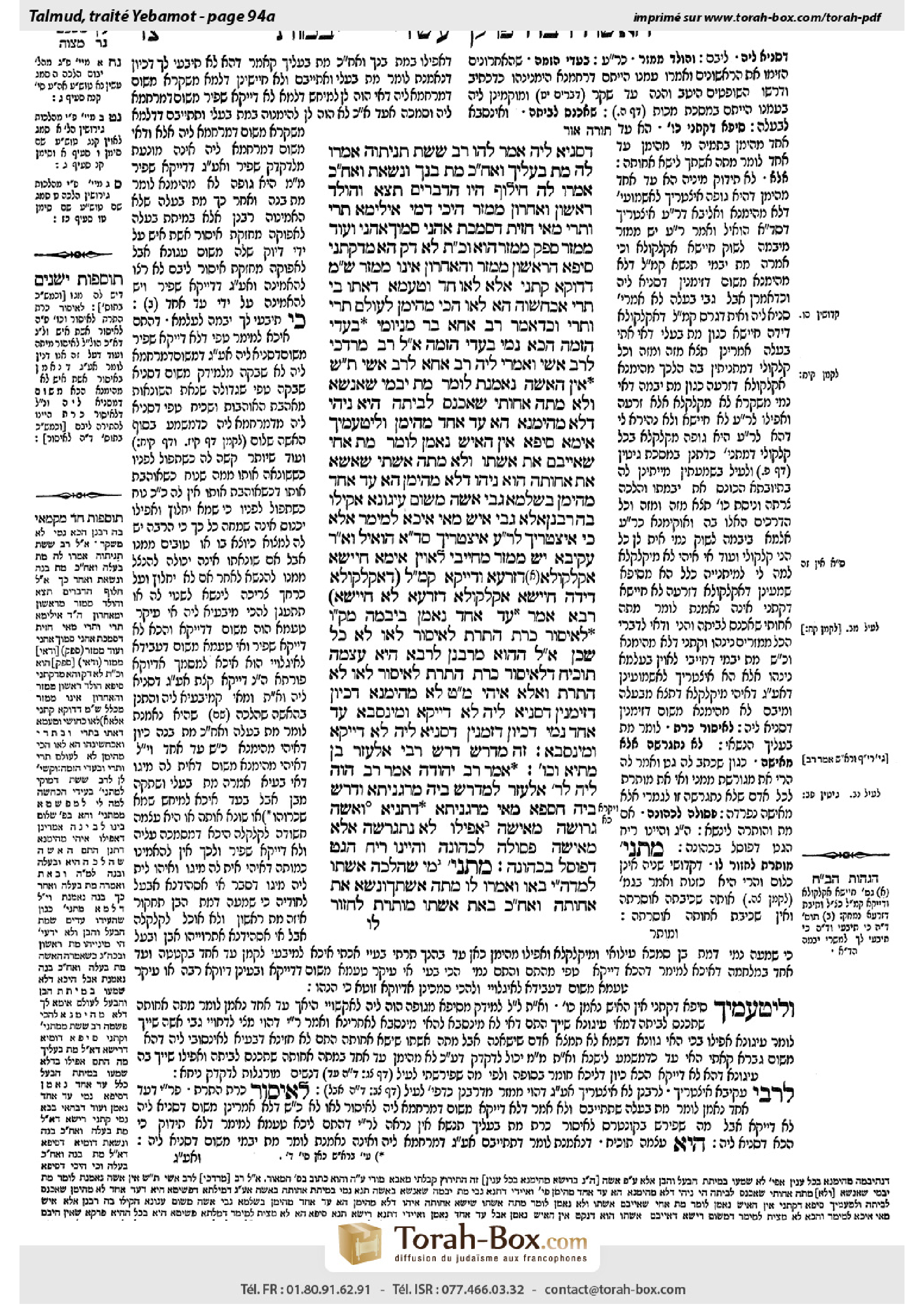
Yevamot 94a: Talmud study for Daf Yomi
Daf Yomi is the daily study of one Talmud folio. Explore 37 tractates with scans, Hebrew text, Sefaria English and AI-generated French translations where annotated.
Passage selection and English or AI-generated French translation are available where the scan has annotations. Daf Study is independent of Torah-Box and Sefaria.
Browse Yevamot · יבמות · All tractatesYevamot 94a text and translations
This page of Yevamot includes the Aramaic text, an English translation and an AI-generated French translation, alongside the scan above.
יבמות צ״ד א · Aramaic and Hebrew text
דְּסָנְיָא לֵיהּ. אֲמַר לְהוּ רַב שֵׁשֶׁת: תְּנֵיתוּהָ. אָמְרוּ לָהּ: ״מֵת בַּעְלִיךְ וְאַחַר כָּךְ מֵת בְּנֵךְ״ וְנִשֵּׂאת, וְאַחַר כָּךְ אָמְרוּ לָהּ: ״חִילּוּף הָיוּ הַדְּבָרִים״ — תֵּצֵא, וְהַוָּלָד רִאשׁוֹן וְאַחֲרוֹן מַמְזֵר.
הֵיכִי דָּמֵי: אִילֵּימָא תְּרֵי וּתְרֵי — מַאי חָזֵית דְּסָמְכַתְּ אַהָנֵי, סְמוֹךְ אַהָנֵי? וְעוֹד, מַמְזֵר? סְפֵק מַמְזֵר הוּא. וְכִי תֵּימָא לָא דָּק — הָא מִדְּקָתָנֵי סֵיפָא: הָרִאשׁוֹן מַמְזֵר וְהָאַחֲרוֹן אֵינוֹ מַמְזֵר, שְׁמַע מִינַּהּ דְּדַוְקָא קָתָנֵי!
אֶלָּא לָאו: חַד, וְטַעְמָא דַּאֲתוֹ בֵּי תְּרֵי אַכְחֲשׁוּהּ, הָא לָאו הָכִי — מְהֵימַן! לָעוֹלָם תְּרֵי וּתְרֵי, וְכִדְאָמַר רַב אַחָא בַּר מִנְיוֹמֵי, בְּעֵדֵי הֲזָמָה,
הָכָא נָמֵי בְּעֵדֵי הֲזָמָה.
אֲמַר לֵיהּ רַב מָרְדֳּכַי לְרַב אָשֵׁי, וְאָמְרִי לֵיהּ רַב אַחָא לְרַב אָשֵׁי, תָּא שְׁמַע: אֵין הָאִשָּׁה נֶאֱמֶנֶת לוֹמַר מֵת יְבָמִי, שֶׁאֶנָּשֵׂא, וְלֹא מֵתָה אֲחוֹתִי, שֶׁאֶכָּנֵס לְבֵיתָהּ. הִיא נִיהִי דְּלָא מְהֵימְנָא, הָא עֵד אֶחָד — מְהֵימַן!
וְלִיטַעְמָיךְ, אֵימָא סֵיפָא: אֵין הָאִישׁ נֶאֱמָן לוֹמַר מֵת אָחִי, שֶׁאֲיַיבֵּם אֶת אִשְׁתּוֹ, וְלֹא מֵתָה אִשְׁתִּי, שֶׁאֶשָּׂא אֶת אֲחוֹתָהּ. הוּא נִיהוּ דְּלָא מְהֵימַן, הָא עֵד אֶחָד — מְהֵימַן, בִּשְׁלָמָא גַּבֵּי אִשָּׁה, מִשּׁוּם עִיגּוּנָא אַקִּילוּ בַּהּ רַבָּנַן, אֶלָּא גַּבֵּי אִישׁ מַאי אִיכָּא לְמֵימַר?
אֶלָּא, כִּי אִיצְטְרִיךְ — לְרַבִּי עֲקִיבָא אִיצְטְרִיךְ, סָלְקָא דַּעְתָּךְ אָמֵינָא: הוֹאִיל וְאָמַר רַבִּי עֲקִיבָא יֵשׁ מַמְזֵר מֵחַיָּיבֵי לָאוִין, אֵימָא חָיְישָׁא אַקִּלְקוּלָא דְזַרְעַאּ וְדָיְיקָא, קָא מַשְׁמַע לַן (דְּאַקִּלְקוּלָא דִידַהּ חָיְישָׁא, אַקִּלְקוּלָא דְזַרְעַאּ לָא חָיְישָׁא).
רָבָא אָמַר: עֵד אֶחָד נֶאֱמָן בִּיבָמָה מִקַּל וָחוֹמֶר. לְאִיסּוּר כָּרֵת הִתַּרְתָּ, לְאִיסּוּר לָאו לֹא כׇּל שֶׁכֵּן?! אֲמַר לֵיהּ הָהוּא מֵרַבָּנַן לְרָבָא: הִיא עַצְמָהּ תּוֹכִיחַ, דִּלְאִיסּוּר כָּרֵת הִתַּרְתָּ — לְאִיסּוּר לָאו לֹא הִתַּרְתָּ!
וְאֶלָּא אִיהִי מַאי טַעְמָא לָא מְהֵימְנָא, דְּכֵיוָן דְּזִימְנִין דְּסָנְיָא לֵיהּ, לָא דָּיְיקָא וּמִינַּסְבָא, עֵד אֶחָד נָמֵי: דְּכֵיוָן דְּזִמְנִין דְּסָנְיָא לֵיהּ, לָא דָּיְיקָא וּמִינַּסְבָא.
זֶה מִדְרָשׁ דָּרַשׁ רַבִּי אֶלְעָזָר בֶּן מַתְיָא וְכוּ׳. אָמַר רַב יְהוּדָה אָמַר רַב: הֲוָה לֵיהּ לְרַבִּי אֶלְעָזָר לְמִדְרַשׁ בֵּיהּ מַרְגָּנִיתָא וּדְרַשׁ בֵּיהּ חַסְפָּא.
מַאי מַרְגָּנִיתָא — דְּתַנְיָא: ״וְאִשָּׁה גְּרוּשָׁה מֵאִישָׁהּ״, אֲפִילּוּ לֹא נִתְגָּרְשָׁה אֶלָּא מֵאִישָׁהּ — פְּסוּלָה לַכְּהוּנָּה, וְהַיְינוּ רֵיחַ הַגֵּט דְּפוֹסֵל בִּכְהוּנָּה.
מַתְנִי׳ מִי שֶׁהָלְכָה אִשְׁתּוֹ לִמְדִינַת הַיָּם, בָּאוּ וְאָמְרוּ לוֹ ״מֵתָה אִשְׁתְּךָ״, וְנָשָׂא אֶת אֲחוֹתָהּ, וְאַחַר כָּךְ בָּאת אִשְׁתּוֹ — מוּתֶּרֶת לַחְזוֹר
Yevamot 94a · English translation
hates the yavam, and she would therefore take advantage of any testimony to rid herself of him. Rav Sheshet said to them that you learned it in the mishna. If they said to her: Your husband died and afterward your child died, and she married another man, and afterward they said to her that the matters were reversed, she must leave the other man, and the first child and the last one are each a mamzer.
Again, Rav Sheshet analyzes the case: What are the circumstances? If we say that they are two and two, i.e., the account of two witnesses was contradicted by two other witnesses, what did you see to make you rely on these second witnesses when you can equally rely on those? Why should she have to leave this man? And furthermore, why should the child be a mamzer? At worst he is an individual whose status as a mamzer is uncertain, as there is no proof that the second witnesses are more reliable. And if you would say that the tanna of the mishna was not precise in his language, but from the fact that it teaches in the latter clause of the mishna: The first is a mamzer and the last is not a mamzer, one can learn from here that the mishna was taught specifically in this manner.
Rather, is it not the case that this is referring to one witness, and the reason is that two others came and contradicted him. It may be inferred from this that if it was not so, the sole witness is deemed credible. The Gemara refutes this proof: Actually, the mishna is speaking of a case when two witnesses came first, followed by another two witnesses, and the ruling is as Rav Aḥa bar Manyumi said, with regard to a different issue, that it is referring to witnesses of false, conspiring testimony. In other words, the second set of witnesses did not offer an alternative account of the same incident. Rather, they claimed that the first witnesses lied, as they were with them, elsewhere, during the time that they supposedly witnessed the husband’s death. In this case, the first witnesses are entirely disqualified, as the account of the second pair is accepted.
Here too, we are dealing with witnesses of false, conspiring testimony. Consequently, the question of whether the court believes one witness who testifies that a yavam is dead cannot be resolved from the mishna.
Rav Mordekhai said to Rav Ashi, and some say it was Rav Aḥa who said to Rav Ashi: Come and hear a proof from a different source (Yevamot 118b): A woman is not deemed credible if she says: My yavam is dead, so that I may marry, i.e., to permit herself to marry another man. And she is not deemed credible if she says: My sister is dead, so that I may enter her house, i.e., to marry her husband. The Gemara infers: It is she herself who is not deemed credible. It may be inferred from this that if one witness issues this report, he is deemed credible.
The Gemara refutes this argument. And according to your reasoning, say the latter clause of that same mishna: A man is not deemed credible if he says: My brother is dead, so that I may enter into levirate marriage with his wife. And he is not deemed credible when he says: My wife is dead, so that I may marry her sister. Following the above reasoning, it is he himself who is not deemed credible, which indicates that one witness is deemed credible. Yet this cannot be correct: Granted, with regard to a woman, due to the concern that she be left a deserted wife, the Sages were lenient in her case, by allowing her to rely on a single witness. However, with regard to a man, what can be said? There is no concern that he will be left deserted, as a man can marry more than one woman, so he certainly cannot marry a woman on the basis of such flimsy testimony.
Rather, the case of one witness cannot be decided from the mishna, as when is this halakha that a woman is not deemed credible when she says that her yavam is dead necessary to be stated? It is necessary for the opinion of Rabbi Akiva. The Gemara explains: It might enter your mind to say: Since Rabbi Akiva said that the offspring born of intercourse for which one is liable for violating a prohibition is a mamzer, which indicates that even the offspring of a yevama who unlawfully wed another man is a mamzer, one might say that she is concerned for the ruin of her offspring and is consequently exacting in her investigation and would marry only if she received clear, unambiguous testimony. The tanna therefore teaches us that she is concerned for her own ruin, e.g., if there is uncertainty as to whether her husband died, which would force her to leave both him and her second husband, but she is not as concerned for the ruin of her offspring, and in this case she is likelier to marry unlawfully.
§ Rava said: One witness is deemed credible in the case of a yevama by means of an a fortiori inference: If for a prohibition involving karet, i.e., adultery of a married woman, you permitted the testimony of one witness, then for a regular prohibition, that of a yevama to another man, is it not all the more so? One of the Sages said to Rava: She herself, a woman who testifies with regard to herself, can prove otherwise: For a prohibition involving karet you permitted her, i.e., if she testifies that her husband is dead she may marry another man and there is no concern that she might still be a married woman, and yet for a regular prohibition you did not permit her, as she is not deemed credible when she claims that her yavam is dead.
But rather, she herself, what is the reason that she is not deemed credible? Since sometimes the woman may hate him, she is not exacting in her examination of the matter and marries. With regard to one witness, the same concern also applies: Since sometimes the woman may hate him, she is not exacting in her investigation before she marries again. The court believes one witness only because they assume that she herself is careful to examine the matter. The a fortiori inference is therefore groundless, and the question remains unresolved.
§ The mishna states that this was an exposition taught by Rabbi Elazar ben Matya: The verse states with regard to priests: “Neither shall they take a woman divorced from her husband” (Leviticus 21:7). This teaches that a woman is not disqualified from marrying into the priesthood by a bill of divorce she receives from a man other than her husband. Rav Yehuda said that Rav said: Rabbi Elazar should have taught this verse as a pearl but in fact he taught it as an earthenware shard. In other words, he could have arrived at a more significant conclusion.
The Gemara asks: What pearl does he mean? As it is taught in a baraita: “Neither shall they take a woman divorced from her husband,” even if she was divorced only from her husband. Even if the woman was separated from her husband and was not permitted to marry anyone else, e.g., if her husband wrote in the bill of divorce: This is your bill of divorce but you are not permitted to any other man, this document is certainly not considered a full-fledged bill of divorce, and yet she is disqualified from the priesthood. If her husband later passes away, she has the status of a divorcée, not a widow, which means that she is prohibited from marrying a priest. And this is the trace of a bill of divorce, which is not an actual bill of divorce and yet disqualifies from the priesthood.
MISHNA: In the case of one whose wife went overseas and people came and told him: Your wife is dead, and he married her sister, and afterward his wife came back from overseas, the original wife is permitted to return
Yevamot 94a · Traduction française (IA)
Elle déteste le yavam et profiterait donc de tout témoignage pour se débarrasser de lui. Rav Chéchet leur dit : « Vous l’avez appris dans la Michna. Si on lui dit : “Ton mari est mort, puis ton enfant est mort”, et qu’elle épouse un autre homme, puis qu’on lui dit que les événements se sont déroulés dans l’ordre inverse, elle doit quitter cet autre homme, et le premier enfant comme le dernier sont chacun un mamzer. »
Rav Chéchet analyse de nouveau le cas : Dans quelles circonstances ? Si l’on suppose qu’il y a deux témoins contre deux, c’est-à-dire que le témoignage de deux témoins a été contredit par celui de deux autres témoins, qu’est-ce qui vous a fait vous fier à ces seconds témoins plutôt qu’aux premiers, alors que vous pouvez tout aussi bien vous fier à ceux-ci ? Pourquoi devrait-elle quitter cet homme ? Et, de plus, pourquoi l’enfant serait-il un mamzer ? Tout au plus, son statut de mamzer serait incertain, puisqu’il n’est pas prouvé que les seconds témoins soient plus fiables. Et si vous dites que le tanna de la Michna ne s’est pas exprimé avec précision, on peut déduire du fait que la dernière partie de la Michna enseigne : « Le premier est un mamzer et le dernier n’est pas un mamzer », que la Michna a bien été enseignée précisément de cette manière.
N’est-ce pas plutôt qu’il s’agit d’un seul témoin, contredit par deux autres témoins ? On peut en déduire que, dans le cas contraire, le témoin unique est considéré comme crédible. La Guemara réfute cette preuve : En réalité, la Michna parle d’un cas où deux témoins sont venus d’abord, puis deux autres témoins, et la décision est conforme à ce qu’a dit Rav Aḥa bar Manyoumi à propos d’une autre question : il s’agit de témoins de faux témoignage concerté. Autrement dit, le second groupe de témoins n’a pas donné une version différente du même événement. Il a plutôt prétendu que les premiers témoins avaient menti, car ils se trouvaient avec eux ailleurs, au moment où ils étaient censés avoir vu la mort du mari. Dans ce cas, les premiers témoins sont entièrement invalidés, puisque le témoignage du second groupe est accepté.
Ici aussi, il s’agit de témoins de faux témoignage concerté. Par conséquent, on ne peut pas déterminer à partir de la Michna si le tribunal croit un témoin unique qui témoigne de la mort d’un yavam.
Rav Mordekhaï dit à Rav Achi — et certains disent que c’est Rav Aḥa qui le lui a dit : « Viens entendre une preuve tirée d’une autre source (Yevamot 118b) : Une femme n’est pas considérée comme crédible lorsqu’elle dit : “Mon yavam est mort”, afin que je puisse me marier, c’est-à-dire pour s’autoriser à épouser un autre homme. Elle n’est pas non plus considérée comme crédible lorsqu’elle dit : “Ma sœur est morte”, afin que je puisse entrer dans sa maison, c’est-à-dire épouser son mari. » La Guemara en déduit : C’est elle-même qui n’est pas considérée comme crédible. On peut en déduire que si un témoin unique rapporte cette nouvelle, il est considéré comme crédible.
La Guemara réfute cet argument. Selon votre raisonnement, examinons la dernière partie de cette même Michna : Un homme n’est pas considéré comme crédible lorsqu’il dit : « Mon frère est mort », afin que je puisse contracter un mariage léviratique avec sa femme. Il n’est pas non plus considéré comme crédible lorsqu’il dit : « Ma femme est morte », afin que je puisse épouser sa sœur. En suivant le raisonnement précédent, c’est lui-même qui n’est pas considéré comme crédible, ce qui indique qu’un témoin unique est considéré comme crédible. Pourtant, cela ne peut pas être juste : certes, dans le cas d’une femme, par crainte qu’elle ne se retrouve agouna, les Sages ont été indulgents à son égard en lui permettant de se fier à un témoin unique. Mais que peut-on dire dans le cas d’un homme ? On ne craint pas qu’il se retrouve sans épouse, puisqu’un homme peut épouser plusieurs femmes ; il ne peut donc certainement pas épouser une femme sur la base d’un témoignage aussi peu solide.
Il faut plutôt dire qu’on ne peut pas trancher la question du témoin unique à partir de la Michna. En effet, quand est-il nécessaire d’énoncer cette halakha selon laquelle une femme n’est pas considérée comme crédible lorsqu’elle affirme que son yavam est mort ? Cela est nécessaire selon l’opinion de Rabbi Akiva. La Guemara explique : On aurait pu penser que, puisque Rabbi Akiva enseigne que la descendance issue d’un rapport sexuel qui constitue la transgression d’une interdiction est un mamzer — ce qui indique que même l’enfant d’une yevama qui a illicitement épousé un autre homme est un mamzer —, elle se soucie de la ruine de sa descendance, qu’elle examine donc son enquête avec minutie et ne se marie qu’après avoir reçu un témoignage clair et sans équivoque. Le tanna nous enseigne donc qu’elle se soucie de sa propre ruine, par exemple s’il y a un doute quant à la mort de son mari, car elle serait alors obligée de quitter à la fois celui-ci et son second mari, mais qu’elle se soucie moins de la ruine de sa descendance ; dans ce cas, elle est plus susceptible de se marier illicitement.
§ Rava dit : La crédibilité d’un témoin unique dans le cas d’une yevama se déduit par raisonnement a fortiori : Si, pour une interdiction passible de karet, c’est-à-dire l’adultère d’une femme mariée, vous avez admis le témoignage d’un témoin unique, alors, pour une interdiction ordinaire — celle qui s’applique à une yevama qui épouserait un autre homme —, ne l’admettrez-vous pas à plus forte raison ? Un des Sages dit à Rava : Elle-même, la femme qui témoigne à son propre sujet, peut prouver le contraire : Pour une interdiction passible de karet, vous l’avez autorisée — c’est-à-dire que si elle témoigne que son mari est mort, elle peut épouser un autre homme, sans qu’on craigne qu’elle soit encore mariée —, et pourtant, pour une interdiction ordinaire, vous ne l’avez pas autorisée, puisqu’elle n’est pas considérée comme crédible lorsqu’elle affirme que son yavam est mort.
Mais alors, pourquoi elle-même n’est-elle pas considérée comme crédible ? Parce qu’il arrive qu’une femme le déteste ; elle n’examine alors pas la question avec minutie et se remarie. La même crainte s’applique également au témoignage d’un témoin unique : il arrive qu’une femme le déteste et qu’elle ne vérifie pas soigneusement les faits avant de se remarier. Le tribunal ne croit un témoin unique que parce qu’il suppose que la femme elle-même vérifie la question avec soin. Le raisonnement a fortiori est donc sans fondement, et la question reste sans réponse.
§ La Michna indique qu’il s’agit d’une interprétation enseignée par Rabbi Elazar ben Matya : À propos des prêtres, le verset dit : « Ils ne prendront pas une femme répudiée par son mari » (Lévitique 21:7). Cela enseigne qu’une femme n’est pas disqualifiée pour épouser un prêtre par un acte de divorce qu’elle reçoit d’un homme autre que son mari. Rav Yehouda dit au nom de Rav : Rabbi Elazar aurait dû présenter ce verset comme une perle, mais en réalité, il l’a présenté comme un tesson d’argile. Autrement dit, il aurait pu en tirer une conclusion plus importante.
La Guemara demande : De quelle perle parle-t-il ? Comme il est enseigné dans une baraïta : « Ils ne prendront pas une femme répudiée par son mari », même si elle n’a été répudiée que par son mari. Même si la femme a été séparée de son mari sans être autorisée à épouser quelqu’un d’autre — par exemple, si son mari a écrit dans l’acte de divorce : « Voici ton acte de divorce, mais tu n’es autorisée à épouser aucun autre homme » —, ce document n’est certainement pas considéré comme un acte de divorce pleinement valable, et pourtant elle est disqualifiée pour épouser un prêtre. Si son mari meurt par la suite, elle a le statut de divorcée, et non de veuve, ce qui signifie qu’il lui est interdit d’épouser un prêtre. Voilà une trace d’acte de divorce : ce n’est pas un véritable acte de divorce, mais cela disqualifie néanmoins pour le mariage avec un prêtre.
MICHNA : Dans le cas d’un homme dont la femme est partie outre-mer, si des personnes viennent lui dire : « Ta femme est morte », et qu’il épouse sa sœur, puis que sa femme revient d’outre-mer, la première épouse est autorisée à reprendre sa place.
Traduction française générée par IA à partir de l’édition anglaise de Sefaria. Vérifie toujours un passage avec le texte source.
Text from Sefaria: William Davidson Edition - Vocalized Aramaic (CC BY NC); William Davidson Edition - English (CC BY NC).