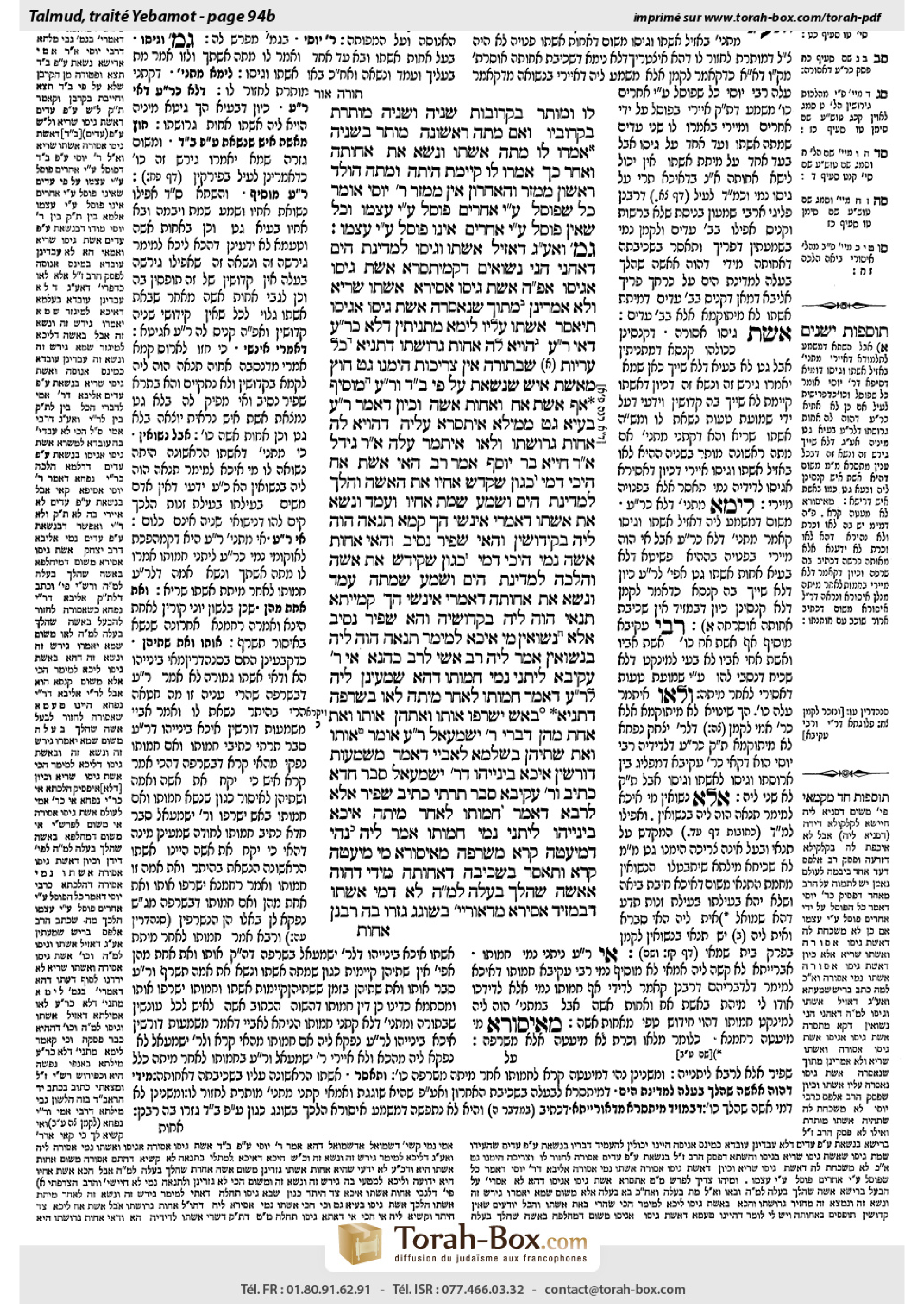
Yevamot 94b: Talmud study for Daf Yomi
Daf Yomi is the daily study of one Talmud folio. Explore 37 tractates with scans, Hebrew text, Sefaria English and AI-generated French translations where annotated.
Passage selection and English or AI-generated French translation are available where the scan has annotations. Daf Study is independent of Torah-Box and Sefaria.
Browse Yevamot · יבמות · All tractatesYevamot 94b text and translations
This page of Yevamot includes the Aramaic text, an English translation and an AI-generated French translation, alongside the scan above.
יבמות צ״ד ב · Aramaic and Hebrew text
לוֹ. וּמוּתָּר בִּקְרוֹבוֹת שְׁנִיָּה, וּשְׁנִיָּה מוּתֶּרֶת בִּקְרוֹבָיו. וְאִם מֵתָה רִאשׁוֹנָה — מוּתָּר בַּשְּׁנִיָּה.
אָמְרוּ לוֹ: מֵתָה אִשְׁתּוֹ, וְנָשָׂא אֶת אֲחוֹתָהּ. וְאַחַר כָּךְ אָמְרוּ לוֹ: קַיֶּימֶת הָיְתָה, וּמֵתָה. הַוָּלָד רִאשׁוֹן — מַמְזֵר, וְהָאַחֲרוֹן — אֵין מַמְזֵר. רַבִּי יוֹסֵי אוֹמֵר: כׇּל שֶׁפּוֹסֵל עַל יְדֵי אֲחֵרִים — פּוֹסֵל עַל יְדֵי עַצְמוֹ, וְכֹל שֶׁאֵין פּוֹסֵל עַל יְדֵי אֲחֵרִים — אֵינוֹ פּוֹסֵל עַל יְדֵי עַצְמוֹ.
גְּמָ׳ וְאַף עַל גַּב דַּאֲזוּל אִשְׁתּוֹ וְגִיסוֹ לִמְדִינַת הַיָּם, דְּאַהֲנִי הָנֵי נִשּׂוּאִים דְּקָמִיתַּסְרָא אֵשֶׁת גִּיסוֹ אַגִּיסוֹ, אֲפִילּוּ הָכִי: אֵשֶׁת גִּיסוֹ אֲסִירָא, אִשְׁתּוֹ שַׁרְיָא,
וְלָא אָמְרִינַן: מִתּוֹךְ שֶׁנֶּאֶסְרָה אֵשֶׁת גִּיסוֹ אַגִּיסוֹ, תֵּיאָסֵר אִשְׁתּוֹ עָלָיו. לֵימָא מַתְנִיתִין דְּלָא כְּרַבִּי עֲקִיבָא, דְּאִי רַבִּי עֲקִיבָא — הָוְיָא לַהּ אֲחוֹת גְּרוּשָׁתוֹ.
דְּתַנְיָא: כׇּל עֲרָיוֹת שֶׁבַּתּוֹרָה — אֵין צְרִיכוֹת הֵימֶנּוּ גֵּט, חוּץ מֵאֵשֶׁת אִישׁ שֶׁנִּשֵּׂאת עַל פִּי בֵּית דִּין, וְרַבִּי עֲקִיבָא מוֹסִיף אַף אֵשֶׁת אָח וַאֲחוֹת אִשָּׁה. וְכֵיוָן דְּאָמַר רַבִּי עֲקִיבָא בָּעֲיָא גֵּט, מִמֵּילָא אִיתַּסְרָא עֲלֵיהּ, דְּהָוְיָא לַהּ אֲחוֹת גְּרוּשָׁתוֹ.
וְלָאו אִיתְּמַר עֲלַהּ, אָמַר רַב גִּידֵּל אָמַר רַב חִיָּיא בַּר יוֹסֵף אָמַר רַב: הַאי אֵשֶׁת אָח הֵיכִי דָּמֵי — כְּגוֹן שֶׁקִּדֵּשׁ אָחִיו אֶת הָאִשָּׁה, וְהָלַךְ לִמְדִינַת הַיָּם, וְשָׁמַע שֶׁמֵּת אָחִיו, וְעָמַד וְנָשָׂא אֶת אִשְׁתּוֹ, דְּאָמְרִי אִינָשֵׁי: הָךְ קַמָּא, תְּנָאָה הֲוָה לֵיהּ בְּקִידּוּשִׁין, וְהַאי שַׁפִּיר נָסֵיב.
וְהַאי אֲחוֹת אִשָּׁה נָמֵי הֵיכִי דָּמֵי — כְּגוֹן שֶׁקִּידֵּשׁ אֶת אִשָּׁה, וְהָלְכָה לִמְדִינַת הַיָּם, וְשָׁמַע שֶׁמֵּתָה, עָמַד וְנָשָׂא אֶת אֲחוֹתָהּ. דְּאָמְרִי אִינָשֵׁי: הָךְ קַמַּיְיתָא, תְּנָאֵי הֲוָה לֵיהּ בְּקִדּוּשֶׁיהָ, וְהָא שַׁפִּיר נָסֵיב. אֶלָּא נִשּׂוּאִין, מִי אִיכָּא לְמֵימַר תְּנָאָה הֲוָה לֵיהּ בְּנִשּׂוּאִין?
אֲמַר לֵיהּ רַב אָשֵׁי לְרַב כָּהֲנָא: אִי רַבִּי עֲקִיבָא, לִיתְנֵי נָמֵי חֲמוֹתוֹ. דְּהָא שָׁמְעִינַן לֵיהּ לְרַבִּי עֲקִיבָא, דְּאָמַר: חֲמוֹתוֹ לְאַחַר מִיתָה — לָאו בִּשְׂרֵפָה.
דְּתַנְיָא: ״בָּאֵשׁ יִשְׂרְפוּ אוֹתוֹ וְאֶתְהֶן״ — אוֹתוֹ וְאֶת אַחַת מֵהֶן, דִּבְרֵי רַבִּי יִשְׁמָעֵאל. רַבִּי עֲקִיבָא אוֹמֵר: אוֹתוֹ וְאֶת שְׁתֵּיהֶן.
בִּשְׁלָמָא לְאַבָּיֵי דְּאָמַר מַשְׁמָעוּת דּוֹרְשִׁין אִיכָּא בֵּינַיְיהוּ, דְּרַבִּי יִשְׁמָעֵאל סָבַר: חֲדָא כְּתִיב, וְרַבִּי עֲקִיבָא סָבַר: תַּרְתֵּי כְּתִיב — שַׁפִּיר.
אֶלָּא לְרָבָא, דְּאָמַר: חֲמוֹתוֹ לְאַחַר מִיתָה אִיכָּא בֵּינַיְיהוּ — לִיתְנֵי נָמֵי חֲמוֹתוֹ!
אֲמַר לֵיהּ: נְהִי דְּמַיעֲטַהּ קְרָא מִשְּׂרֵפָה — מֵאִיסּוּרָא מִי מַיעֲטַהּ קְרָא?
וְתֵאָסֵר בִּשְׁכִיבָה דַּאֲחוֹתָהּ, מִידֵּי דְּהָוֵה אַאִשָּׁה שֶׁהָלַךְ בַּעְלָהּ לִמְדִינַת הַיָּם! לָא דָּמֵי: אִשְׁתּוֹ, דִּבְמֵזִיד אֲסִירָא מִדְּאוֹרָיְיתָא, בְּשׁוֹגֵג גְּזַרוּ בַּהּ רַבָּנַן,
Yevamot 94b · English translation
to him, as his erroneous marriage to her sister is considered licentious sexual relations, and one who has intercourse with his wife’s relatives has not rendered his first wife forbidden to himself. And he is permitted to the relatives of the second woman, e.g., her daughter, and this second woman is permitted to his relatives, e.g., his son, as the marriage was entirely invalid. And if the first woman died he is permitted to the second woman, despite the fact that he has already engaged in forbidden relations with her.
If they said to him that his wife is dead, and he married her sister, and afterward they said to him that she was alive when he married the sister and only later died, in this case the first child, born to the sister while his wife was still alive, is a mamzer, as he was born from the union of a man and his sister-in-law, and the last one is not a mamzer. Rabbi Yosei says: Whoever disqualifies others also disqualifies himself, and whoever does not disqualify others does not disqualify himself either. Rabbi Yosei’s obscure statement will be explained by the Gemara.
GEMARA: With regard to the case of a man who married his wife’s sister after he was informed that his wife was dead, the Gemara comments: And even if his wife and his brother-in-law both went overseas and he was told that they had died, the halakha is that this marriage he performed is effective only to the extent that his brother-in-law’s wife is forbidden to his brother-in-law. The reason for this prohibition is that he performed a marriage ceremony with a married woman by mistake, and one who erroneously weds a married woman has thereby rendered her forbidden to her husband. The Gemara adds: Even so, it is only his brother-in-law’s wife who is forbidden to her husband, whereas his own wife remains permitted to him.
It might have been thought that his own marriage, which caused this to be an act of forbidden sexual relations, would also be adversely affected. But the Gemara adds that we do not say: Since his brother-in-law’s wife is forbidden to his brother-in-law, his wife is likewise forbidden to him. The Gemara suggests: Let us say that the mishna is not in accordance with the opinion of Rabbi Akiva. The reason is that if the mishna follows the opinion of Rabbi Akiva, his wife is now considered, with regard to him, the sister of his divorcée.
As it is taught in a baraita: None of those with whom relations are forbidden by Torah law require a bill of divorce from him, even if he married them in a proper manner, apart from a married woman who married by mistake by permission of the court. And Rabbi Akiva adds: Also a brother’s wife and a wife’s sister. Since it is possible that these two women could become permitted to him, by levirate marriage in the case of a brother’s wife, or a wife’s sister after his wife’s death, they too require a bill of divorce. And with regard to the issue at hand, since Rabbi Akiva said that a wife’s sister requires a bill of divorce, this factor by itself indicates that his wife is forbidden to him, as his wife is considered the sister of his divorcée.
The Gemara refutes this claim: And wasn’t it stated with regard to this case that Rav Giddel said that Rav Ḥiyya bar Yosef said that Rav said: In the case of this brother’s wife, mentioned by Rabbi Akiva, what are the circumstances? For example, if his brother betrothed a woman and then went overseas, and the man who was here heard that his brother was dead, and he arose and married his brother’s wife as a yevama. The reason for Rabbi Akiva’s ruling is that uninformed people will say: This first one had a condition in the betrothal with his wife, and his betrothal was canceled because the condition was left unfulfilled, and this other one married well, in compliance with the halakha, as she was not his brother’s wife. It is for this reason that Rabbi Akiva requires him to give her a bill of divorce.
And in this case of a wife’s sister as well, what are the circumstances? For example, if he betrothed a woman and she went overseas, and he heard she died and arose and married her sister. As people will say: This first one, he had a condition in her betrothal, and as the condition was not fulfilled the betrothal is annulled, and this other one married well. However, with regard to the case of the mishna, which involves an actual previous marriage, can it be said that he had a condition in the marriage? There is a presumption that no man marries a woman conditionally. Once he marries her, it is assumed that he waived all prior conditions, and therefore even Rabbi Akiva agrees that a bill of divorce is not required in this case.
Rav Ashi said to Rav Kahana: If it is the opinion of Rabbi Akiva, let him also teach the case of his mother-in-law, as she is another forbidden woman who nevertheless requires a bill of divorce, as we have heard him, Rabbi Akiva, say: One who has relations with his mother-in-law after his wife’s death is not liable to being executed by burning, because the prohibition lapses upon his wife’s death.
As it is taught in a baraita: The Torah states, with regard to one who takes a woman and her daughter: “They shall be burned in fire, he and they [et’hen]” (Leviticus 20:14). Now this cannot literally mean that both women are burned, as the first woman he took did not sin at all. The Sages therefore explained that the word et’hen means he and one of them [mehen]. This is the statement of Rabbi Yishmael. Rabbi Akiva says: He and both of them. Since it is hard to understand how they could both deserve punishment, the amora’im suggested various interpretations of Rabbi Akiva’s opinion.
Granted, this makes sense according to the explanation of this dispute suggested by Abaye, who said that the interpretation of the meaning of the verse is the difference between them. In other words, Rabbi Yishmael and Rabbi Akiva did not argue over the halakha itself, but merely over the manner in which the halakha is derived from the Torah. That is, Rabbi Yishmael holds that it states: One woman, and the plain meaning of the verse is: He and one of them. And Rabbi Akiva holds that it states: Two, e.g., if he took two women who were both forbidden to him, such as his mother-in-law and her mother, they are both liable to be executed by burning. If this is the dispute between Rabbi Akiva and Rabbi Yishmael, it is fine, as there is no proof from here that the prohibition of a mother-in-law lapses upon his wife’s death.
However, there is a difficulty according to the explanation of Rava, who said that the practical difference between Rabbi Yishmael and Rabbi Akiva’s opinion concerns one’s mother-in-law after his wife’s death. Rabbi Yishmael maintains that even after the death of one’s wife he is liable for marrying his mother-in-law. Rabbi Akiva maintains that one is liable only if both women are alive, as the verse mentions two women, but if the first one has already died his relations with the second woman are no longer punishable by Torah law. If so, let the tanna of the mishna, according to Rabbi Akiva, also teach that one must give a bill of divorce to his mother-in-law whom he married by mistake, as she too will be permitted to him after his wife’s death.
Rav Kahana said to Rav Ashi: Granted that the verse excluded her from the punishment of burning, did the verse also exclude her from a prohibition? Even Rabbi Akiva agrees that the Torah prohibits a man from marrying his mother-in-law after his wife’s death. Consequently, he cannot marry her in a permitted manner, despite the fact that according to Rava’s explanation Rabbi Akiva maintains that they are not executed by burning.
§ The Gemara asks another question, from a different perspective: And let his wife be forbidden by his sexual relations with her sister, just as it is in the case of a woman whose husband went overseas, who is forbidden to her husband if she had relations with another man by mistake. The Gemara answers: This is not comparable. With regard to his wife, who is forbidden to him by Torah law if she committed adultery intentionally, the Sages decreed concerning her that she is forbidden to him even if she did so unwittingly.
Yevamot 94b · Traduction française (IA)
à son égard, car son mariage erroné avec sa sœur est considéré comme des relations sexuelles licencieuses, et celui qui a des relations avec les proches de sa femme n'a pas rendu sa première femme interdite à lui-même. Et il est autorisé auprès des proches de la seconde femme, par exemple sa fille, et cette seconde femme est autorisée auprès de ses proches, par exemple son fils, car le mariage était entièrement invalide. Et si la première femme est décédée, il est autorisé auprès de la seconde femme, malgré le fait qu'il ait déjà eu des relations interdites avec elle.
Si on lui a dit que sa femme est morte, et qu'il a épousé sa sœur, et qu'ensuite on lui a dit qu'elle était vivante au moment où il a épousé la sœur et qu'elle n'est décédée que plus tard, dans ce cas, le premier enfant, né de la sœur alors que sa femme était encore en vie, est un mamzer, car il est né de l'union d'un homme et de sa belle-sœur, et le dernier n'est pas un mamzer. Rabbi Yosse dit : Celui qui déclare inaptes les autres se déclare lui-même inapte, et celui qui ne déclare pas inaptes les autres ne se déclare pas non plus inapte. L'obscurité de la déclaration de Rabbi Yosse sera expliquée par la Guemara.
GUEMARA : S'agissant du cas d'un homme qui a épousé la sœur de sa femme après avoir été informé que sa femme était morte, la Guemara commente : Et même si sa femme et son beau-frère sont tous deux partis à l'étranger et qu'on lui a dit qu'ils étaient morts, la halakha est que ce mariage qu'il a contracté n'est efficace que dans la mesure où la femme de son beau-frère est interdite à son beau-frère. La raison de cette interdiction est qu'il a célébré un mariage avec une femme mariée par erreur, et celui qui épouse par erreur une femme mariée l'a rendue interdite à son mari. La Guemara ajoute : Même ainsi, c'est seulement la femme de son beau-frère qui est interdite à son mari, tandis que sa propre femme reste autorisée à lui.
On aurait pu penser que son propre mariage, qui a rendu cet acte une relation sexuelle interdite, serait lui aussi affecté négativement. Mais la Guemara précise que nous ne disons pas : Puisque la femme de son beau-frère est interdite à son beau-frère, sa femme est également interdite à lui. La Guemara propose : Disons que la Michna ne suit pas l'opinion de Rabbi Akiva. La raison en est que si la Michna suivait l'opinion de Rabbi Akiva, sa femme serait désormais considérée, à son égard, comme la sœur de sa divorcée.
Comme il est enseigné dans une baraïta : Aucune de celles avec qui les relations sont interdites par la Torah écrite ne nécessite de lui un acte de divorce, même s'il les a épousées de manière valide, à l'exception d'une femme mariée qui a contracté un mariage par erreur avec la permission du tribunal. Et Rabbi Akiva ajoute : De même pour la femme d'un frère et la sœur d'une femme. Puisqu'il est possible que ces deux femmes deviennent permises à lui, par mariage lévirat dans le cas de la femme d'un frère, ou la sœur d'une femme après la mort de sa femme, elles aussi nécessitent un acte de divorce. Et s'agissant de la question en cours, puisque Rabbi Akiva a dit que la sœur d'une femme nécessite un acte de divorce, ce facteur à lui seul indique que sa femme est interdite à lui, car sa femme est considérée comme la sœur de sa divorcée.
La Guemara réfute cette affirmation : N'a-t-il pas été dit à propos de ce cas que Rav Giddel a dit que Rav Ḥiyya bar Yosef a dit que Rav a dit : Dans le cas de la femme du frère mentionnée par Rabbi Akiva, quelles sont les circonstances ? Par exemple, si son frère a fiancé une femme puis est parti à l'étranger, et que l'homme qui était ici a appris la mort de son frère, et qu'il s'est levé et a épousé la femme de son frère en tant que yevama. La raison de la décision de Rabbi Akiva est que les gens peu instruits diront : Ce premier avait posé une condition lors des fiançailles avec sa femme, et ses fiançailles ont été annulées parce que la condition n'a pas été remplie, et cet autre a bien épousé, conformément à la halakha, car elle n'était pas la femme de son frère. C'est pour cette raison que Rabbi Akiva exige qu'il lui donne un acte de divorce.
Et dans le cas de la sœur de l'épouse également, quelles sont les circonstances ? Par exemple, s'il a fiancé une femme et qu'elle est partie à l'étranger, et qu'il a appris sa mort et s'est levé et a épousé sa sœur. Car les gens diront : Ce premier avait posé une condition lors de ses fiançailles, et comme la condition n'a pas été remplie, les fiançailles sont annulées, et cet autre a bien épousé. Cependant, s'agissant du cas de la Michna, qui implique un mariage précédent réel, peut-on dire qu'il avait posé une condition lors du mariage ? Il y a une présomption qu'aucun homme n'épouse une femme sous condition. Une fois qu'il l'a épousée, on suppose qu'il a renoncé à toutes les conditions antérieures, et par conséquent même Rabbi Akiva est d'accord pour dire qu'un acte de divorce n'est pas requis dans ce cas.
Rav Ashi a dit à Rav Kahana : Si c'est l'opinion de Rabbi Akiva, qu'il enseigne également le cas de sa belle-mère, car c'est une autre femme interdite qui nécessite néanmoins un acte de divorce, comme nous l'avons entendu, Rabbi Akiva, dire : Celui qui a des relations avec sa belle-mère après la mort de sa femme n'est pas passible de la peine de mort par le feu, car l'interdiction cesse à la mort de sa femme.
Comme il est enseigné dans une baraïta : La Torah déclare, à propos de celui qui prend une femme et sa fille : « Ils seront brûlés au feu, lui et elles [et’hen] » (Lévitique 20:14). Or cela ne peut pas littéralement signifier que les deux femmes sont brûlées, car la première femme qu’il a prise n’a pas péché du tout. Les Sages ont donc expliqué que le mot et’hen signifie « lui et l’une d’entre elles [mehen] ». C’est la déclaration de Rabbi Yishmael. Rabbi Akiva dit : « Lui et les deux. » Puisqu’il est difficile de comprendre comment elles pourraient toutes deux mériter le châtiment, les amoraïm ont proposé diverses interprétations de l’opinion de Rabbi Akiva.
Certes, cela se comprend selon l’explication de ce différend proposée par Abaye, qui a dit que l’interprétation du sens du verset est la différence entre eux. Autrement dit, Rabbi Yishmael et Rabbi Akiva ne se sont pas disputés sur la halakha elle-même, mais seulement sur la manière dont la halakha est dérivée de la Torah. C’est-à-dire que Rabbi Yishmael soutient que le verset énonce : « Une femme », et le sens littéral du verset est : « Lui et l’une d’entre elles ». Et Rabbi Akiva soutient que le verset énonce : « Deux », par exemple, s’il a pris deux femmes qui étaient toutes deux interdites à lui, telles que sa belle-mère et la mère de celle-ci, elles sont toutes deux passibles d’être exécutées par le feu. Si tel est le différend entre Rabbi Akiva et Rabbi Yishmael, cela est acceptable, car il n’y a pas de preuve ici que l’interdiction de la belle-mère cesse au décès de son épouse.
Cependant, il y a une difficulté selon l'explication de Rava, qui a dit que la différence pratique entre l'opinion de Rabbi Yishmael et celle de Rabbi Akiva concerne la belle-mère d'un homme après le décès de son épouse. Rabbi Yishmael soutient que même après le décès de son épouse, il est passible pour avoir épousé sa belle-mère. Rabbi Akiva soutient qu'on n'est passible que si les deux femmes sont vivantes, car le verset mentionne deux femmes, mais si la première est déjà décédée, ses relations avec la seconde femme ne sont plus punissables par la loi de la Torah. Si c'est le cas, que le tanna de la Michna, selon Rabbi Akiva, enseigne également qu'on doit donner un acte de divorce à sa belle-mère qu'il a épousée par erreur, car elle aussi lui sera permise après le décès de son épouse.
Rav Kahana a dit à Rav Ashi : Certes, le verset l'a exclue de la punition par le feu, mais le verset l'a-t-il également exclue d'une interdiction ? Même Rabbi Akiva convient que la Torah interdit à un homme d'épouser sa belle-mère après le décès de son épouse. Par conséquent, il ne peut pas l'épouser d'une manière permise, malgré le fait que selon l'explication de Rava, Rabbi Akiva soutient qu'elles ne sont pas exécutées par le feu.
§ La Guemara pose une autre question, d'une perspective différente : Et que son épouse soit interdite par ses relations sexuelles avec sa sœur, de même que dans le cas d'une femme dont le mari est allé à l'étranger, qui est interdite à son mari si elle a eu des relations avec un autre homme par erreur. La Guemara répond : Ce n'est pas comparable. S'agissant de son épouse, qui lui est interdite par la loi de la Torah si elle a commis l'adultère intentionnellement, les Sages ont décrété à son sujet qu'elle lui est interdite même si elle l'a fait sans intention.
Traduction française générée par IA à partir de l’édition anglaise de Sefaria. Vérifie toujours un passage avec le texte source.
Text from Sefaria: William Davidson Edition - Vocalized Aramaic (CC BY NC); William Davidson Edition - English (CC BY NC).