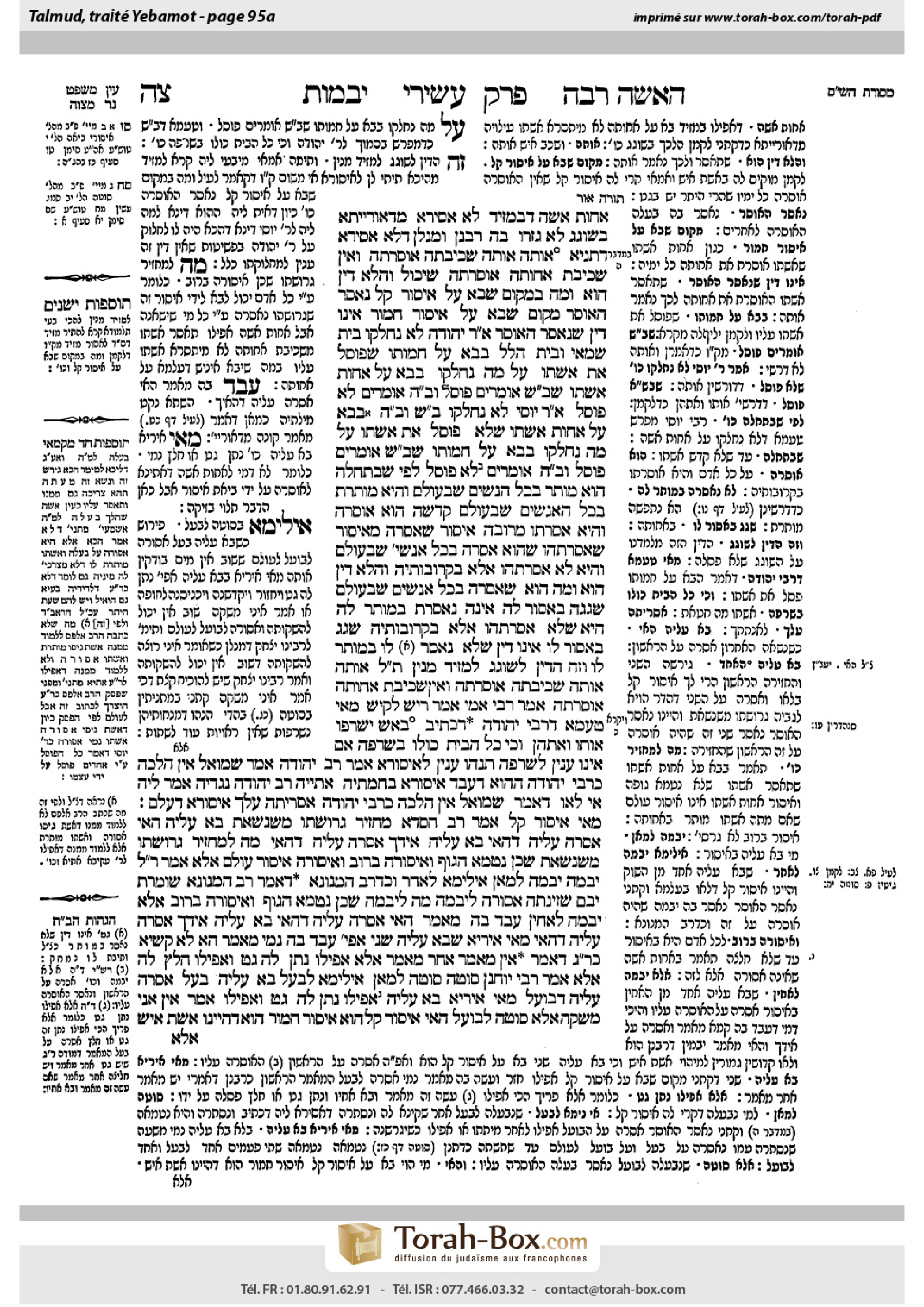
Yevamot 95a: Talmud study for Daf Yomi
Daf Yomi is the daily study of one Talmud folio. Explore 37 tractates with scans, Hebrew text, Sefaria English and AI-generated French translations where annotated.
Passage selection and English or AI-generated French translation are available where the scan has annotations. Daf Study is independent of Torah-Box and Sefaria.
Browse Yevamot · יבמות · All tractatesYevamot 95a text and translations
This page of Yevamot includes the Aramaic text, an English translation and an AI-generated French translation, alongside the scan above.
יבמות צ״ה א · Aramaic and Hebrew text
אֲחוֹת אִשָּׁה, דִּבְמֵזִיד לָא אֲסִירָא מִדְּאוֹרָיְיתָא, בְּשׁוֹגֵג לָא גְּזַרוּ בַּהּ רַבָּנַן. וּמְנָלַן דְּלָא אֲסִירָא, דְּתַנְיָא: ״אוֹתָהּ״, אוֹתָהּ — שְׁכִיבָתָהּ אוֹסַרְתָּהּ, וְאֵין שְׁכִיבַת אֲחוֹתָהּ אוֹסַרְתָּהּ.
שֶׁיָּכוֹל, וַהֲלֹא דִּין הוּא: וּמָה בִּמְקוֹם שֶׁבָּא עַל אִיסּוּר קַל — נֶאֱסָר הָאוֹסֵר, מְקוֹם שֶׁבָּא עַל אִיסּוּר חָמוּר — אֵינוֹ דִּין שֶׁנֶּאֱסָר הָאוֹסֵר.
אָמַר רַבִּי יְהוּדָה: לֹא נֶחְלְקוּ בֵּית שַׁמַּאי וּבֵית הִלֵּל בְּבָא עַל חֲמוֹתוֹ שֶׁפָּסַל אֶת אִשְׁתּוֹ, עַל מָה נֶחְלְקוּ — בְּבָא עַל אֲחוֹת אִשְׁתּוֹ, שֶׁבֵּית שַׁמַּאי אוֹמְרִים: פָּסַל, וּבֵית הִלֵּל אוֹמְרִים: לֹא פָּסַל. אָמַר רַבִּי יוֹסֵי: לֹא נֶחְלְקוּ בֵּית שַׁמַּאי וּבֵית הִלֵּל בְּבָא עַל אֲחוֹת אִשְׁתּוֹ שֶׁלֹּא פָּסַל אֶת אִשְׁתּוֹ, עַל מָה נֶחְלְקוּ — בְּבָא עַל חֲמוֹתוֹ, שֶׁבֵּית שַׁמַּאי אוֹמְרִים: פָּסַל, וּבֵית הִלֵּל אוֹמְרִים: לֹא פָּסַל.
לְפִי שֶׁבַּתְּחִלָּה, הוּא מוּתָּר בְּכׇל הַנָּשִׁים שֶׁבָּעוֹלָם, וְהִיא מוּתֶּרֶת בְּכׇל הָאֲנָשִׁים שֶׁבָּעוֹלָם. קִדְּשָׁהּ — הוּא אֲסָרָהּ, וְהִיא אֲסָרַתּוּ. מְרוּבֶּה אִיסּוּר שֶׁאֲסָרָהּ, מֵאִיסּוּר שֶׁאֲסָרַתְהוּ. שֶׁהוּא אֲסָרָהּ בְּכׇל אֲנָשִׁים שֶׁבָּעוֹלָם, וְהִיא לָא אֲסָרַתְהוּ אֶלָּא בִּקְרוֹבוֹתֶיהָ.
וַהֲלֹא דִּין הוּא: וּמָה הוּא, שֶׁאֲסָרָהּ בְּכׇל אֲנָשִׁים שֶׁבָּעוֹלָם, שָׁגְגָה בָּאָסוּר לָהּ — אֵינָהּ נֶאֱסֶרֶת בַּמּוּתָּר לָהּ, הִיא, שֶׁלֹּא אֲסָרַתְהוּ אֶלָּא בִּקְרוֹבוֹתֶיהָ, שָׁגַג בָּאָסוּר לוֹ — אֵינוֹ דִּין שֶׁלֹּא נֶאֱסַר (לוֹ) בַּמּוּתָּר לוֹ?!
וְזֶה הַדִּין לְשׁוֹגֵג. לְמֵזִיד מִנַּיִן? תַּלְמוּד לוֹמַר: ״אוֹתָהּ״, אוֹתָהּ — שְׁכִיבָתָהּ אוֹסַרְתָּהּ, וְאֵין שְׁכִיבַת אֲחוֹתָהּ אוֹסַרְתָּהּ.
אָמַר רַבִּי אַמֵּי אָמַר רֵישׁ לָקִישׁ: מַאי טַעְמָא דְּרַבִּי יְהוּדָה — דִּכְתִיב: ״בָּאֵשׁ יִשְׂרְפוּ אוֹתוֹ וְאֶתְהֶן״, וְכִי כׇּל הַבַּיִת כּוּלּוֹ בִּשְׂרֵפָה?! אִם אֵינוֹ עִנְיָן לִשְׂרֵפָה, תְּנֵהוּ עִנְיָן לְאִיסּוּרָא.
אָמַר רַב יְהוּדָה אָמַר שְׁמוּאֵל: אֵין הֲלָכָה כְּרַבִּי יְהוּדָה. הָהוּא דַּעֲבַד אִיסּוּרָא בַּחֲמָתֵיהּ. אַתְיֵיהּ רַב יְהוּדָה, נַגְּדֵיהּ. אֲמַר לֵיהּ: אִי לָאו דְּאָמַר שְׁמוּאֵל אֵין הֲלָכָה כְּרַבִּי יְהוּדָה — אַסְרִיתַהּ עֲלָךְ אִיסּוּרָא דְעָלַם.
מַאי ״אִיסּוּר קַל״? אָמַר רַב חִסְדָּא: מַחְזִיר גְּרוּשָׁתוֹ מִשֶּׁנִּשֵּׂאת.
בָּא עָלֶיהָ הַאי — אַסְרַהּ עֲלֵיהּ דְּהַאי. בָּא עָלֶיהָ אִידַּךְ — אַסְרַהּ עֲלֵיהּ דְּהַאי.
מָה לְמַחְזִיר גְּרוּשָׁתוֹ מִשֶּׁנִּשֵּׂאת, שֶׁכֵּן נִטְמָא הַגּוּף, וְאִיסּוּרָהּ בְּרוֹב, וְאִיסּוּרָהּ אִיסּוּר עוֹלָם.
אֶלָּא אָמַר רֵישׁ לָקִישׁ: יְבָמָה. יְבָמָה לְמַאן? אִילֵּימָא לְאַחֵר, וְכִדְרַב הַמְנוּנָא, דְּאָמַר רַב הַמְנוּנָא: שׁוֹמֶרֶת יָבָם שֶׁזִּינְּתָה אֲסוּרָה לִיבָמָהּ —
מָה לִיבָמָה שֶׁכֵּן נִטְמָא הַגּוּף, וְאִיסּוּרָהּ בְּרוֹב.
אֶלָּא יְבָמָה לָאַחִין. עֲבַד בַּהּ מַאֲמָר הַאי — אַסְרַהּ עֲלֵיהּ דְּהַאי. בָּא עָלֶיהָ אִידַּךְ — אַסְרַהּ עֲלֵיהּ דְּהַאי. מַאי אִירְיָא שֶׁבָּא עָלֶיהָ שֵׁנִי? אֲפִילּוּ עֲבַד בָּהּ נָמֵי מַאֲמָר!
הָא לָא קַשְׁיָא, כְּרַבָּן גַּמְלִיאֵל, דְּאָמַר: אֵין מַאֲמָר אַחַר מַאֲמָר. אֶלָּא, אֲפִילּוּ נָתַן לָהּ גֵּט, וַאֲפִילּוּ חָלַץ לָהּ!
אֶלָּא אָמַר רַבִּי יוֹחָנָן: סוֹטָה. סוֹטָה לְמַאן? אִילֵימָא לַבַּעַל: בָּא עָלֶיהָ בַּעַל — אַסְרַהּ עֲלֵיהּ דְּבוֹעֵל. מַאי אִירְיָא בָּא עָלֶיהָ? אֲפִילּוּ נָתַן לָהּ גֵּט — וַאֲפִילּוּ אָמַר ״אֵין אֲנִי מַשְׁקֶה״!
אֶלָּא סוֹטָה לַבּוֹעֵל. הַאי אִיסּוּר קַל הוּא? אִיסּוּר חָמוּר הוּא, דְּהַיְינוּ אֵשֶׁת אִישׁ!
Yevamot 95a · English translation
However, with regard to a wife’s sister, where even if the sister sins intentionally the wife is not forbidden to him by Torah law, if he did so unwittingly the Sages did not decree with regard to him. And from where do we derive that she is not forbidden? As it is taught in a baraita that in the verse: “A man, when his wife goes aside…and a man lies with her” (Numbers 5:12–13), the emphasis of “her” teaches: It is her intercourse with another man that renders her forbidden to her husband, but the intercourse of her sister does not render her forbidden.
As, were it not for this verse, one might have thought: Could this not be derived through an a fortiori inference: And if in a case where he has relations subject to a light prohibition, the one causing her to be rendered prohibited is forbidden, then in a situation where he has intercourse subject to a severe prohibition, is it not right that the one causing her to be rendered prohibited should be forbidden? This a fortiori inference will be explained later in the Gemara.
Rabbi Yehuda said: Beit Shammai and Beit Hillel did not disagree with regard to one who has relations with his mother-in-law, that he renders his wife disqualified from remaining married to him. With regard to what case did they disagree? With regard to one who has relations with his wife’s sister, as Beit Shammai say that he renders his wife disqualified, and Beit Hillel say he does not render her disqualified. Rabbi Yosei said: Not so, as Beit Shammai and Beit Hillel did not disagree with regard to one who has relations with his wife’s sister, that he does not render his wife disqualified from remaining married to him. With regard to what did they disagree? With regard to one who has relations with his mother-in-law, as Beit Shammai say he renders his wife disqualified and Beit Hillel say he does not render her disqualified.
Rabbi Yosei explains why Beit Shammai and Beit Hillel did not disagree with regard to the case of one who has relations with his wife’s sister. This is because at first, before the marriage, he is permitted to all the women in the world and she is permitted to all the men in the world. After he has betrothed her as his wife, he renders her forbidden to all men, and she renders him forbidden to her relatives. Consequently, the prohibition by which he renders her forbidden is greater than the prohibition by which she renders him forbidden, as he renders her forbidden to all the men in the world and she renders him forbidden by their betrothal only to her relatives.
Rabbi Yosei’s explanation continues. Could this halakha of a wife’s sister not be derived through an a fortiori inference: And if he prohibited her through their betrothal to all men in the world, and yet she was unwitting with one forbidden to her, i.e., she had relations with another man by mistake, she is not forbidden to he who is permitted to her, her husband; she, who prohibited him only to her relatives, if he was unwitting with one forbidden to him, her sister, is it not right that we should not render him forbidden to her, she who is permitted to him, namely his wife?
And this is the a fortiori inference and the reason for the halakha of an unwitting sinner, i.e., that if he had unwitting relations with one of his wife’s relations the wife is not thereby rendered forbidden to him. With regard to one whose act was intentional, from where is the halakha derived? The verse states: “Her,” meaning that it is her intercourse with another man that renders her forbidden to her husband, but the intercourse of her husband with her sister does not render her forbidden to him.
Rabbi Ami said that Reish Lakish said: What is the reason of Rabbi Yehuda, who maintains that one who has intercourse with his mother-in-law is forbidden to his wife? As it is written: “They shall be burned in fire, he and they” (Leviticus 20:14). This verse is puzzling: And shall the entire house be punished by burning? Why should both women be punished when only one of them transgressed? If it does not refer to the matter of burning, refer it to the matter of a prohibition, that they are both forbidden to him. This teaches that he is forbidden not only to the woman with whom he sinned, but also to his wife.
Rav Yehuda said that Shmuel said: The halakha is not in accordance with the opinion of Rabbi Yehuda. The Gemara relates: A certain individual performed a transgression by having relations with his mother-in-law. Rav Yehuda had him brought for judgment and ordered that he be flogged. He said to him: If it were not for the fact that Shmuel said the halakha is not in accordance with the opinion of Rabbi Yehuda, I would render your wife forbidden to you permanently.
§ At the start of the baraita the tanna stated an a fortiori inference that is not entirely clear: If in a place where he has relations subject to a light prohibition, the one causing her to be rendered prohibited is forbidden. The Gemara asks: What is this light prohibition? Rav Ḥisda said: It is referring to one who remarries his divorcée after she married another man.
The Gemara explains that according to this interpretation the a fortiori inference should be understood as follows: If this one, the second husband, has relations with her, he has rendered her forbidden to that one, the first husband. And if the second man divorced her and then the other one, the first husband, had relations with her, he has likewise rendered her forbidden to this one. This demonstrates that even with regard to a light prohibition the man who renders her forbidden is also forbidden by this intercourse.
The Gemara refutes this interpretation: What about the fact that one who remarries his divorcée after she married another man cannot be considered to have violated a light prohibition, as the prohibition is stringent in several regards: As the body is defiled by this intercourse, for the Torah states “after she has been defiled” (Deuteronomy 24:4); and her prohibition applies to the majority of the Jewish people, not to select groups; and her prohibition is an irrevocable prohibition, as she is no longer permitted to her first husband after having relations with her second husband. This last stringency is not true of his wife’s sister, who is permitted to him after the death of his wife.
Rather, the Gemara rejects this explanation in favor of the following one that Reish Lakish said: The baraita is referring to relations with a yevama, which is called a light prohibition, as the man who has relations with her is forbidden to her. The Gemara clarifies: With regard to this yevama, with whom did she engage in intercourse? If we say that she had relations with another man, not her yavam, this would mean that the ruling is in accordance with the opinion of Rav Hamnuna. As Rav Hamnuna said: A widow waiting for her yavam who engaged in licentious sexual relations with another man is forbidden to her yavam. The argument would be as follows: Although the yavam renders the yevama forbidden to every other man, if she has relations with another she becomes forbidden to him as well.
However, this argument can also be challenged: What about the fact that in the case of a yevama who engages in this forbidden relationship, the body is defiled and her prohibition applies equally to the majority of the people. Therefore, one cannot derive the prohibitions of one’s wife’s relatives from this halakha.
Rather, the baraita must be referring to a case of a yevama to the brothers, as follows: If this brother performed levirate betrothal [ma’amar] with her he has rendered her forbidden to that one, the other brothers, as she is effectively betrothed to him. If one of the other brothers, who had not performed levirate betrothal with her, subsequently has relations with her, he has rendered her forbidden to this one who had performed levirate betrothal with her. The Gemara asks: If that is the meaning of the baraita, why specifically state that the second had relations with her? Even if he performed levirate betrothal with her too, he thereby renders her forbidden to the first brother, which proves that it is not the act of intercourse itself that causes the prohibition.
The Gemara refutes this suggestion: This is not difficult, as it can be explained in accordance with the opinion of Rabban Gamliel, who said: There is no levirate betrothal after a levirate betrothal, i.e., if one brother performed levirate betrothal with the yevama, no other levirate betrothal is of any effect. However, this explanation can still be refuted, as her prohibition to the yavam is not due to the act of intercourse, as even if the other brother gave her a bill of divorce, or even if he performed ḥalitza with her, he has likewise rendered her forbidden to the first brother, who performed levirate betrothal.
Rather, Rabbi Yoḥanan said: The light prohibition is that of a sota. The Gemara asks: This sota, to whom is she forbidden? If we say that she is forbidden to the husband, the explanation would be as follows: If her husband has relations with her, despite the fact that she is forbidden to him after she disobeyed his warning not to seclude herself with a certain man, he has rendered her forbidden to the fornicator, as she is barred from marrying him even if her husband divorces her. However, why is this true specifically in a case in which he had relations with her? Even if her husband only gave her a bill of divorce and did not have relations with her after her seclusion, or even if he said: I will not force her to drink the waters of a sota, she is likewise forbidden to the other man.
Rather, the baraita is referring to a sota who had relations with the fornicator, thereby rendering herself permanently forbidden to her husband, as she was a married woman at the time. Yet this too is puzzling: Is this a light prohibition? It is a severe prohibition, as this is the prohibition proscribing a married woman, one of the most serious of all prohibitions.
Yevamot 95a · Traduction française (IA)
Cependant, dans le cas de la sœur de son épouse, même si celle-ci commet une faute intentionnellement, son épouse n’est pas interdite à son mari par la Torah. Si donc il a agi par inadvertance, les Sages n’ont pas décrété qu’elle lui soit interdite. D’où savons-nous qu’elle ne lui est pas interdite ? Il est enseigné dans une baraïta, au sujet du verset : « Un homme, lorsque son épouse s’écarte… et qu’un homme couche avec elle » (Nombres 5, 12-13), que l’accent mis sur « avec elle » enseigne que c’est la relation de l’épouse avec un autre homme qui la rend interdite à son mari, mais que la relation de sa sœur avec lui ne la rend pas interdite.
En effet, sans ce verset, on aurait pu penser qu’on pouvait le déduire par un raisonnement a fortiori : si, dans le cas où il a des relations avec une femme en transgressant une interdiction légère, l’homme qui rend son épouse interdite à lui-même est lui-même interdit à elle, alors, lorsqu’il a des relations en transgressant une interdiction grave, ne devrait-il pas, à plus forte raison, être interdit à elle ? Ce raisonnement a fortiori sera expliqué plus loin dans la Guemara.
Rabbi Yehuda a dit : Beit Shammaï et Beit Hillel ne sont pas en désaccord sur le fait que celui qui a des relations avec sa belle-mère rend son épouse inapte à rester mariée avec lui. Sur quel cas sont-ils en désaccord ? Sur celui de l’homme qui a des relations avec la sœur de son épouse : Beit Shammaï disent qu’il rend son épouse inapte, tandis que Beit Hillel disent qu’il ne la rend pas inapte. Rabbi Yosei a dit : Ce n’est pas ainsi. Beit Shammaï et Beit Hillel ne sont pas en désaccord sur le fait que celui qui a des relations avec la sœur de son épouse ne rend pas son épouse inapte à rester mariée avec lui. Sur quoi sont-ils en désaccord ? Sur celui qui a des relations avec sa belle-mère : Beit Shammaï disent qu’il rend son épouse inapte, tandis que Beit Hillel disent qu’il ne la rend pas inapte.
Rabbi Yosei explique pourquoi Beit Shammaï et Beit Hillel ne sont pas en désaccord dans le cas de celui qui a des relations avec la sœur de son épouse. En effet, au départ, avant le mariage, il est permis à toutes les femmes du monde, et elle est permise à tous les hommes du monde. Après l’avoir épousée, il la rend interdite à tous les hommes, et elle le rend interdit à ses parentes. Par conséquent, l’interdiction par laquelle il la rend interdite est plus étendue que celle par laquelle elle le rend interdit : il la rend interdite à tous les hommes du monde, tandis que, par leur mariage, elle ne le rend interdit qu’à ses parentes.
L’explication de Rabbi Yosei se poursuit. Ne peut-on pas déduire cette halakha concernant la sœur de l’épouse par un raisonnement a fortiori ? Il l’a rendue interdite à tous les hommes du monde par leur mariage ; pourtant, lorsqu’elle a eu par inadvertance des relations avec un homme qui lui était interdit, c’est-à-dire avec un autre homme, elle n’est pas interdite à celui qui lui est permis, son mari. Elle ne l’a rendu interdit qu’à ses parentes ; si lui a eu par inadvertance des relations avec une femme qui lui est interdite, sa sœur, ne devrait-il pas, à plus forte raison, ne pas être interdit à celle qui lui est permise, à savoir son épouse ?
Tel est le raisonnement a fortiori et la raison de la halakha concernant celui qui a péché par inadvertance : s’il a eu par inadvertance des relations avec l’une des parentes de son épouse, celle-ci n’est pas pour autant rendue interdite à son mari. Quant à celui dont l’acte était intentionnel, d’où tire-t-on cette halakha ? Le verset dit : « Avec elle », ce qui signifie que c’est la relation de l’épouse avec un autre homme qui la rend interdite à son mari, mais que la relation de son mari avec sa sœur ne rend pas son épouse interdite à lui.
Rabbi Ami a dit au nom de Reish Lakish : Quelle est la raison de Rabbi Yehuda, qui soutient que celui qui a des relations avec sa belle-mère est interdit à son épouse ? Il est écrit : « Ils seront brûlés par le feu, lui et elles » (Lévitique 20, 14). Ce verset pose question : toute la maisonnée sera-t-elle donc punie par le feu ? Pourquoi les deux femmes seraient-elles punies alors qu’une seule a transgressé ? Si le verset ne concerne pas la peine du feu, appliquons-le à la question de l’interdiction : elles lui sont toutes deux interdites. Cela enseigne qu’il est interdit non seulement à la femme avec laquelle il a péché, mais aussi à son épouse.
Rav Yehuda a dit au nom de Shmuel : La halakha ne suit pas l’opinion de Rabbi Yehuda. La Guemara rapporte qu’un homme commit une transgression en ayant des relations avec sa belle-mère. Rav Yehuda le fit comparaître en jugement et ordonna qu’il soit fouetté. Il lui dit : « Si ce n’était que Shmuel a dit que la halakha ne suit pas l’opinion de Rabbi Yehuda, je rendrais définitivement ton épouse interdite à toi. »
§ Au début de la baraïta, le tanna a formulé un raisonnement a fortiori qui n’est pas tout à fait clair : « Si, dans un cas où il a des relations en transgressant une interdiction légère, l’homme qui rend son épouse interdite à lui-même est lui-même interdit à elle. » La Guemara demande : quelle est cette interdiction légère ? Rav Ḥisda a dit : Il s’agit du cas de celui qui reprend son épouse divorcée après qu’elle a épousé un autre homme.
La Guemara explique que, selon cette interprétation, le raisonnement a fortiori doit être compris ainsi : si celui-ci, le second mari, a des relations avec elle, il l’a rendue interdite à celui-là, le premier mari. Et si le second homme l’a répudiée, puis que l’autre, le premier mari, a eu des relations avec elle, il l’a également rendue interdite à celui-ci. Cela démontre que même lorsqu’il s’agit d’une interdiction légère, l’homme qui la rend interdite devient lui aussi interdit à elle du fait de cette relation.
La Guemara réfute cette interprétation : celui qui reprend son épouse divorcée après qu’elle a épousé un autre homme ne peut pas être considéré comme ayant transgressé une interdiction légère, car cette interdiction est rigoureuse à plusieurs égards : son corps est profané par cette relation, puisque la Torah dit : « après qu’elle a été souillée » (Deutéronome 24, 4) ; l’interdiction s’applique à la majorité du peuple juif, et non à des groupes particuliers ; et c’est une interdiction irrévocable, puisqu’elle n’est plus permise à son premier mari après avoir eu des relations avec son second mari. Cette dernière rigueur ne s’applique pas à la sœur de son épouse, qui lui est permise après le décès de son épouse.
La Guemara rejette plutôt cette explication au profit de celle de Reish Lakish : la baraïta parle de relations avec une yevama, situation qualifiée d’interdiction légère, car l’homme qui a des relations avec elle lui est interdit. La Guemara précise : avec qui cette yevama a-t-elle eu des relations ? Si l’on dit qu’elle en a eu avec un autre homme, et non avec son yavam, cela signifierait que la décision suit l’opinion de Rav Hamnuna. Rav Hamnuna a en effet dit : une veuve en attente de son yavam qui a des relations illicites avec un autre homme est interdite à son yavam. Le raisonnement serait le suivant : bien que le yavam rende la yevama interdite à tous les autres hommes, si elle a des relations avec un autre homme, elle lui devient elle aussi interdite.
Cependant, cet argument peut lui aussi être contesté : dans le cas d’une yevama qui s’engage dans cette relation interdite, son corps est profané et l’interdiction qui la frappe s’applique également à la majorité des gens. On ne peut donc pas déduire de cette halakha les interdictions relatives aux parentes de son épouse.
La baraïta doit plutôt parler du cas d’une yevama par rapport aux frères, comme suit : si ce frère a accompli avec elle des fiançailles léviratiques [ma’amar], il l’a rendue interdite à celui-là, c’est-à-dire aux autres frères, puisqu’elle est de fait fiancée à lui. Si l’un des autres frères, qui n’avait pas accompli avec elle de fiançailles léviratiques, a ensuite des relations avec elle, il l’a rendue interdite à celui qui avait accompli ces fiançailles avec elle. La Guemara demande : si telle est la signification de la baraïta, pourquoi préciser que le second a eu des relations avec elle ? Même s’il avait lui aussi accompli avec elle des fiançailles léviratiques, il l’aurait ainsi rendue interdite au premier frère, ce qui prouve que ce n’est pas l’acte sexuel lui-même qui entraîne l’interdiction.
La Guemara réfute cette suggestion : cela ne pose pas de difficulté, car on peut l’expliquer conformément à l’opinion de Rabban Gamliel, qui a dit : « Il n’y a pas de fiançailles léviratiques après des fiançailles léviratiques », c’est-à-dire que si un frère a accompli des fiançailles léviratiques avec la yevama, aucune autre cérémonie de fiançailles léviratiques ne produit d’effet. Toutefois, cette explication peut encore être réfutée : l’interdiction qui frappe le yavam n’est pas due à l’acte sexuel, car même si l’autre frère lui avait remis un acte de divorce, ou même s’il avait accompli avec elle la ḥalitsa, il l’aurait également rendue interdite au premier frère, qui avait accompli des fiançailles léviratiques avec elle.
La Guemara propose plutôt l’explication de Rabbi Yoḥanan : l’interdiction légère est celle d’une sota. La Guemara demande : à qui cette sota est-elle interdite ? Si l’on dit qu’elle est interdite à son mari, l’explication serait la suivante : si son mari a des relations avec elle alors qu’elle lui est interdite après avoir désobéi à son avertissement de ne pas s’isoler avec un certain homme, il l’a rendue interdite au séducteur, puisqu’elle ne peut pas l’épouser même si son mari la répudie. Mais pourquoi cela ne vaut-il que dans le cas où il a eu des relations avec elle ? Même si son mari lui avait seulement remis un acte de divorce, sans avoir de relations avec elle après qu’elle s’est isolée, ou même s’il avait dit : « Je ne la contraindrai pas à boire les eaux d’une sota », elle serait également interdite à l’autre homme.
La baraïta parle plutôt d’une sota qui a eu des relations avec le séducteur, se rendant ainsi définitivement interdite à son mari, puisqu’elle était alors une femme mariée. Pourtant, cela aussi est troublant : s’agit-il d’une interdiction légère ? C’est une interdiction grave, car il s’agit de l’interdiction visant une femme mariée, l’une des plus sévères de toutes les interdictions.
Traduction française générée par IA à partir de l’édition anglaise de Sefaria. Vérifie toujours un passage avec le texte source.
Text from Sefaria: William Davidson Edition - Vocalized Aramaic (CC BY NC); William Davidson Edition - English (CC BY NC).